



Creativity + Innovation
Kevin Popović, B.A., M.S.
© Kevin Popović, SDSU Creativity + Innovation
CourseKey
© Kevin Popović, SDSU Creativity + Innovation
Please check-in: x22hau
Session 1.8
• Welcome
• Roll, Admin
• Game
• Mid-Term Exam
© Kevin Popović, SDSU Creativity + Innovation
• Discuss Chapter
• Assignment
Satellite Marketing™
Using Social Media To Create Engagement
© Kevin Popović, SDSU Creativity + Innovation
Satellite Marketing™
© Kevin Popović, SDSU Creativity + Innovation
Make A Better: Mid-Term
A Game of Collaboration and Evaluation
© Kevin Popović, SDSU Creativity + Innovation
Make A Better Mid-Term
© Kevin Popović, SDSU Creativity + Innovation
• Groups of 3 / 1 Group Leader
• 1 Hour to Create Exam
• Based on Slides, Book, Class
• Quality Counts / WWKPD?
• Groups will Exchange Exams
• Evaluation by Peers
The Problem Statement
• 10 True / False
• 15 Multiple Choice / 4 per
• Word doc w Questions / Names
• MGT353-03-Group1-Q.doc
• Word doc w Answers
• MGT353-03-Group1-A.doc
• Word doc with Peer Evaluation / Names
• MGT353-03-Group1-E.doc
• Submit Scranton Answer Key w Group #
© Kevin Popović, SDSU Creativity + Innovation
Mid-Term Exam
An Academic Evaluation of Understanding
© Kevin Popović, SDSU Creativity + Innovation
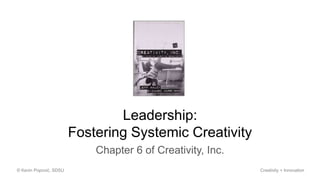
Leadership:
Fostering Systemic Creativity
Chapter 6 of Creativity, Inc.
Leadership: Fostering Systemic Creativity
• Class Discussion: What does systemic creativity
mean to you?
© Kevin Popović, SDSU Creativity + Innovation
Leadership: Fostering Systemic Creativity
• Guidant: Leaders want to maintain an
entrepreneurial character
• Company grows large enough that bureaucracy
threatens to dampen speed, risk taking,
atmosphere
© Kevin Popović, SDSU Creativity + Innovation
Leadership: Fostering Systemic Creativity
• “We could see some of the entrepreneurial
nature of our company fading, and we needed
to catch it in time.”
• “We could lose people as we scaled up.”
• “If we didn’t stay creative, we would not
survive.”
© Kevin Popović, SDSU Creativity + Innovation
Leadership: Fostering Systemic Creativity
• Less pressure, more holistic
• Assess current state of creativity
• Convened staff, focus groups
• Examined companies with reputations for ongoing
creativity
• Examined self vs. creative profiles
• Examined models of corporate structure
• Bottom up approach
© Kevin Popović, SDSU Creativity + Innovation
Leadership: Fostering Systemic Creativity
• “The idea is for everyone to learn to understand
that they are responsible people in a changing
world, to show how to take control of their lives
and their work, and how to speak what they
believe.”
© Kevin Popović, SDSU Creativity + Innovation
Leadership: Fostering Systemic Creativity
• Next round of training is planned to focus
directly on building skills for creativity and
innovation, skills that can be applied for
personal growth and the company’s benefit by
individuals and groups.
• Reward and recognize those who succeed.
(Good Management)
© Kevin Popović, SDSU Creativity + Innovation
Leadership: Fostering Systemic Creativity
• Systemic creativity is a never-ending quest –
why?
• What can you do?
• How can you foster change in your groups?
• How will you make creativity happen at your
company?
© Kevin Popović, SDSU Creativity + Innovation
Leadership: Fostering Systemic Creativity
• Initially, we present creative dynamics in a
sequence – why?
• The creative process is better understood as a
whole. (Read the entire book)
© Kevin Popović, SDSU Creativity + Innovation
Leadership: Fostering Systemic Creativity
• Best learned experientially, like riding a bike,
rather than reading about how to ride a bike.
• Every chance to learn the process from a
different angle makes for more comprehension.
© Kevin Popović, SDSU Creativity + Innovation
Leadership: Fostering Systemic Creativity
• Theory X = Employees need to be controlled to
produce good work.
• Employees respond to extrinsic motivation or
coercion, were not to be trusted or self-directed.
• Theory Y = Employees want and need to excel and
require the right organizational (global, local) climate
to do so.
© Kevin Popović, SDSU Creativity + Innovation
Leadership: Fostering Systemic Creativity
• Leaders need to confer responsibility and capability of
creative leadership on every employee.
• When each employee can engage with the (systemic)
creative process and feels like they are a part of change
THEN the company will reach systemic creativity.
• When this (systemic) process is in place and functioning it
can THEN work on refining the process.
© Kevin Popović, SDSU Creativity + Innovation
Leadership: Fostering Systemic Creativity
To foster creativity companies must:
• Reduce unnecessary controls
• Adopt creative-friendly reward systems
• Instill attitudes about efficiency and failure
• Communicate the value of creative change
• Provide tangible and intangible resources
• Lead as a guide, not manage as a manager
© Kevin Popović, SDSU Creativity + Innovation
Leadership: Fostering Systemic Creativity
1. Initiate Change
2. Build a Coalition
3. Plan and Experiment
• As the change to systemic creativity advances, effective
guiding, leadership will make a point to learn from every
step.
• Without a conscious effort to learn there will be no
creativity or innovation.
© Kevin Popović, SDSU Creativity + Innovation
Assignment
© Kevin Popović, SDSU Creativity + Innovation
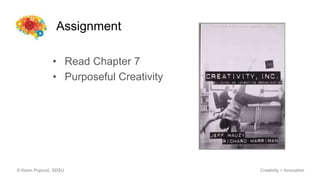
• Read Chapter 7
• Purposeful Creativity
Assignment
© Kevin Popović, SDSU Creativity + Innovation
• Read “The Innovation
Value Chain”
• Available in the reader
/ online
• Prepare for Quiz

Creativity & Innovation - Week 8

  • 1.
    Creativity + Innovation KevinPopović, B.A., M.S. © Kevin Popović, SDSU Creativity + Innovation
  • 2.
    CourseKey © Kevin Popović,SDSU Creativity + Innovation Please check-in: x22hau
  • 3.
    Session 1.8 • Welcome •Roll, Admin • Game • Mid-Term Exam © Kevin Popović, SDSU Creativity + Innovation • Discuss Chapter • Assignment
  • 4.
    Satellite Marketing™ Using SocialMedia To Create Engagement © Kevin Popović, SDSU Creativity + Innovation
  • 5.
    © Kevin Popović,SDSU Creativity + Innovation
  • 6.
    Satellite Marketing™ © KevinPopović, SDSU Creativity + Innovation
  • 7.
    Make A Better:Mid-Term A Game of Collaboration and Evaluation © Kevin Popović, SDSU Creativity + Innovation
  • 8.
    Make A BetterMid-Term © Kevin Popović, SDSU Creativity + Innovation • Groups of 3 / 1 Group Leader • 1 Hour to Create Exam • Based on Slides, Book, Class • Quality Counts / WWKPD? • Groups will Exchange Exams • Evaluation by Peers
  • 9.
    The Problem Statement •10 True / False • 15 Multiple Choice / 4 per • Word doc w Questions / Names • MGT353-03-Group1-Q.doc • Word doc w Answers • MGT353-03-Group1-A.doc • Word doc with Peer Evaluation / Names • MGT353-03-Group1-E.doc • Submit Scranton Answer Key w Group # © Kevin Popović, SDSU Creativity + Innovation
  • 10.
    Mid-Term Exam An AcademicEvaluation of Understanding © Kevin Popović, SDSU Creativity + Innovation
  • 11.
    © Kevin Popović,SDSU Creativity + Innovation Leadership: Fostering Systemic Creativity Chapter 6 of Creativity, Inc.
  • 12.
    Leadership: Fostering SystemicCreativity • Class Discussion: What does systemic creativity mean to you? © Kevin Popović, SDSU Creativity + Innovation
  • 13.
    © Kevin Popović,SDSU Creativity + Innovation
  • 14.
    Leadership: Fostering SystemicCreativity • Guidant: Leaders want to maintain an entrepreneurial character • Company grows large enough that bureaucracy threatens to dampen speed, risk taking, atmosphere © Kevin Popović, SDSU Creativity + Innovation
  • 15.
    Leadership: Fostering SystemicCreativity • “We could see some of the entrepreneurial nature of our company fading, and we needed to catch it in time.” • “We could lose people as we scaled up.” • “If we didn’t stay creative, we would not survive.” © Kevin Popović, SDSU Creativity + Innovation
  • 16.
    Leadership: Fostering SystemicCreativity • Less pressure, more holistic • Assess current state of creativity • Convened staff, focus groups • Examined companies with reputations for ongoing creativity • Examined self vs. creative profiles • Examined models of corporate structure • Bottom up approach © Kevin Popović, SDSU Creativity + Innovation
  • 17.
    Leadership: Fostering SystemicCreativity • “The idea is for everyone to learn to understand that they are responsible people in a changing world, to show how to take control of their lives and their work, and how to speak what they believe.” © Kevin Popović, SDSU Creativity + Innovation
  • 18.
    Leadership: Fostering SystemicCreativity • Next round of training is planned to focus directly on building skills for creativity and innovation, skills that can be applied for personal growth and the company’s benefit by individuals and groups. • Reward and recognize those who succeed. (Good Management) © Kevin Popović, SDSU Creativity + Innovation
  • 19.
    Leadership: Fostering SystemicCreativity • Systemic creativity is a never-ending quest – why? • What can you do? • How can you foster change in your groups? • How will you make creativity happen at your company? © Kevin Popović, SDSU Creativity + Innovation
  • 20.
    Leadership: Fostering SystemicCreativity • Initially, we present creative dynamics in a sequence – why? • The creative process is better understood as a whole. (Read the entire book) © Kevin Popović, SDSU Creativity + Innovation
  • 21.
    Leadership: Fostering SystemicCreativity • Best learned experientially, like riding a bike, rather than reading about how to ride a bike. • Every chance to learn the process from a different angle makes for more comprehension. © Kevin Popović, SDSU Creativity + Innovation
  • 22.
    Leadership: Fostering SystemicCreativity • Theory X = Employees need to be controlled to produce good work. • Employees respond to extrinsic motivation or coercion, were not to be trusted or self-directed. • Theory Y = Employees want and need to excel and require the right organizational (global, local) climate to do so. © Kevin Popović, SDSU Creativity + Innovation
  • 23.
    Leadership: Fostering SystemicCreativity • Leaders need to confer responsibility and capability of creative leadership on every employee. • When each employee can engage with the (systemic) creative process and feels like they are a part of change THEN the company will reach systemic creativity. • When this (systemic) process is in place and functioning it can THEN work on refining the process. © Kevin Popović, SDSU Creativity + Innovation
  • 24.
    Leadership: Fostering SystemicCreativity To foster creativity companies must: • Reduce unnecessary controls • Adopt creative-friendly reward systems • Instill attitudes about efficiency and failure • Communicate the value of creative change • Provide tangible and intangible resources • Lead as a guide, not manage as a manager © Kevin Popović, SDSU Creativity + Innovation
  • 25.
    Leadership: Fostering SystemicCreativity 1. Initiate Change 2. Build a Coalition 3. Plan and Experiment • As the change to systemic creativity advances, effective guiding, leadership will make a point to learn from every step. • Without a conscious effort to learn there will be no creativity or innovation. © Kevin Popović, SDSU Creativity + Innovation
  • 26.
    Assignment © Kevin Popović,SDSU Creativity + Innovation • Read Chapter 7 • Purposeful Creativity
  • 27.
    Assignment © Kevin Popović,SDSU Creativity + Innovation • Read “The Innovation Value Chain” • Available in the reader / online • Prepare for Quiz

Editor's Notes

  • #2 Creativity and innovation are integral to an organization’s ability to survive and thrive in today’s competitive marketplace. This course provides students with an understanding of how creativity and innovation can be facilitated and managed in a work setting. Students will learn about theoretical conceptualizations of creativity and innovation as well as practical applications involved in fostering creativity and innovation in the workplace. Students will be expected to play an active role in learning through class exercises, class discussions, and dialogue with guest speakers, and presentations about real (or planned) innovations in organizations.
  • #8 1 hour to develop a mid-term exam Reference slides, book and SLO’s Develop 25 Q&A’s, 25 points (10) True/False, (15) Multiple Choice manage the time for this project and your team Questions in electronic document (Word Only) Master / Answers on Scantron key Evaluate teams members 1-10 on their contribution to the project – you figure out how you will score. Submit as group project, names / participation scores on back of key.
  • #11 Exam: 25 points   You will take your own group exam. You will have 20-minutes to complete the exam using a Scranton card and pencil, marking your answers completely. Each correct answer is worth 1 point. If the Scantron does not read your answer it will not be graded.  
  • #12 Required Text: Creativity, Inc.: Building an Inventive Organization by Jeff Mauzy and Richard Harriman, ISBN: 1-57851-207-7, Harvard Business School Press. Chapter 6: Leadership: Fostering Systemic Creativity
  • #13 Class Discussion:TBD
  • #14 Class Discussion: Who saw Pooty Tang? The corporation runs our lives! https://youtu.be/yhBExhldRXQ
  • #15 Class Discussion: What did they do?
  • #16 Class Discussion: What did they do?
  • #17 Ongoing creativity: Disney, Apple, Sony, Motorola, 3M
  • #20 Class Discussion
  • #21 Class Discussion
  • #22 Class Discussion
  • #23  Management today: Where is management today? Hierarchical, paternalistic attitudes still permeate many businesses of every size Position equals knowledge, intelligence and power The higher the title the better the idea Only those with formal authority can responsible handle decisions
  • #28 Class Quiz: The Innovation Value Chain Discussion: The Innovation Value Chain, Harvard Business Review https://hbr.org/2007/06/the-innovation-value-chain