





Creativity + Innovation
Kevin Popović, B.A., M.S.
© Kevin Popović, SDSU Creativity + Innovation
CourseKey
© Kevin Popović, SDSU Creativity + Innovation
Please check-in: d5icrz
Session 1.7
• Welcome
• Roll, Admin
• Speaker
• Adventure
© Kevin Popović, SDSU Creativity + Innovation
• Game
• Discuss Chapter
• Quiz
• Mid-Term
Guest Speaker | Ali Horuz
Founder & CEO, VIP Pedicab Outdoor Media
© Kevin Popović, SDSU Creativity + Innovation
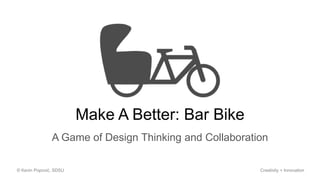
Make A Better: Bar Bike
A Game of Design Thinking and Collaboration
© Kevin Popović, SDSU Creativity + Innovation
Make A Better: Bar Bike
A Game of Design Thinking and Collaboration
© Kevin Popović, SDSU Creativity + Innovation
The Problem Statement
Design the next generation bar bike:
• Must convey 16 people
• Must include at least (1) beer tap
• Must include (1) LED screen per side
• Must include charging station for phones
• Maximum available space for advertising
© Kevin Popović, SDSU Creativity + Innovation
Pages 55-67, 75-83 of Creativity, Inc.
© Kevin Popović, SDSU Creativity + Innovation
Breaking and Making
Connections For Enterprise
Dynamics of Creativity
• The Dynamics of creativity apply to all companies as
well as individuals.
• The company is a metaphor for a person: variables
of complexity, scale, environment.
• In a company, motivation, curiosity and evaluation
are nurtured greatly by the corporate (global)
climate.
© Kevin Popović, SDSU Creativity + Innovation
Dynamics of Creativity
• Breaking and making connections = the pivotal
dynamic of the creative process.
• Create new ways to look at old things.
• Differentiate from the competition (standards
and norms).
• Example: Steelcase
• What did they see?
© Kevin Popović, SDSU Creativity + Innovation
Steelcase Products
• Design: Wheels on everything, change is inevitable
• Connections: Furniture must configure around
people in motion
• Anatomy: The body changes through the day over
time
• Ergonomics: Chairs maintain back support no
matter how you site in them
© Kevin Popović, SDSU Creativity + Innovation
Steelcase Thinking
• Pathways was a different way to look at an
office space.
• New thinking on old problem.
• Chasing a new concept of the workspace began
with the leaders – why?
• What room did they reference in new think –
and why?
© Kevin Popović, SDSU Creativity + Innovation
Steelcase Thinking
• Employees and clients had to be taught new
ways of thinking of furniture and space as
critical design elements
• Theories of learning-through-application to
address education through transition process
© Kevin Popović, SDSU Creativity + Innovation
Steelcase Thinking
• Brought groups of different people together for
creative connection making around the evolving
business model.
• Created environment for “displayed thinking”,
new work spaces, which institutionalized the
new approach
© Kevin Popović, SDSU Creativity + Innovation
Steelcase Reflections
• When a familiar map breaks down, or when a
map is discarded, there’s a terrific uncertainty
as old connections cease and new ones form.
• The more a company is dependent on an old
map the more disturbing a new connection can
be.
© Kevin Popović, SDSU Creativity + Innovation
Steelcase Reflections
• The success comes in encouraging (positive)
conflict and risk taking, in promoting diversity,
organizing groups of intrinsic motivation and
encouraging the flow of information.
© Kevin Popović, SDSU Creativity + Innovation
Encouraging Conflict
• Conflict between different ideas and points of view
can be instrumental in breaking down established
connections and generating new material for new
solutions.
• Conflict can raise levels of fear, lower motivation,
shut down connection making, distort evaluation and
damage client.
© Kevin Popović, SDSU Creativity + Innovation
Encouraging Conflict
• Everyone must believe that the intent is to
create a better idea – together.
© Kevin Popović, SDSU Creativity + Innovation
Encouraging Conflict
• Get past win-or-lose approach.
• “I like my idea, yours is wrong, I need to defend
my idea and my approach.”
• “If I am discounted as a person I will get
revenge, somehow, some time.”
© Kevin Popović, SDSU Creativity + Innovation
Encouraging Risk-Taking
• Companies that encourage risk-taking increase
the likelihood of breaking and making
connections.
• The short-term risk in challenging assumptions
and breaking connections reduces the longer-
term risk of relying on outdated assumptions.
© Kevin Popović, SDSU Creativity + Innovation
Encouraging Risk-Taking
• Challenging sacred assumptions takes the
blinders off the view of the world as you know it.
• If assumptions are flawed, employees can solve
the problems.
© Kevin Popović, SDSU Creativity + Innovation
Encouraging Risk-Taking
• Any action holds the risk of uncertain results.
• A plan is not a guarantee of results.
• Individual tolerances for risk-taking vary.
© Kevin Popović, SDSU Creativity + Innovation
Encouraging Risk-Taking
• Pressure of time and risk of wasting it triggers
anxiety, drives managers to shut down early to
avoid failure.
• Companies in favor of fast decisions and safe
answers rarely make new connections.
© Kevin Popović, SDSU Creativity + Innovation
Don’t pull out on the big ideas.
Assignment
© Kevin Popović, SDSU Creativity + Innovation
• Read “Managing
Creativity at Shanghai
Tang”
• Available in the reader
• Prepare for Quiz
Assignment
© Kevin Popović, SDSU Creativity + Innovation
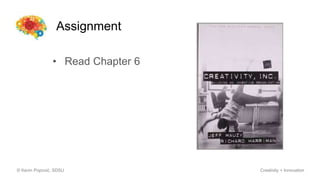
• Read Chapter 6
Mid-Term Exam
© Kevin Popović, SDSU Creativity + Innovation
• Based on what we have read, what
we have discussed, what we have
learned together.
• True/False
• Multiple Choice
• Review slides, our process, SLO’s
Student Learning Outcomes
© Kevin Popović, SDSU Creativity + Innovation
• Explain the influence of problem solving
techniques, team processes, and environmental
conditions on creativity in organizations.
Student Learning Outcomes
© Kevin Popović, SDSU Creativity + Innovation
• Describe the innovation process, including the
innovation value chain, the role of champions,
and commercializing an innovation.
Student Learning Outcomes
© Kevin Popović, SDSU Creativity + Innovation
• Explain the process involved in managing
creativity or innovation effectively and apply this
knowledge to your own creative idea or
innovation.
Student Learning Outcomes
© Kevin Popović, SDSU Creativity + Innovation
• Develop case study analysis skills (specifically,
identifying critical issues in case studies and
applying course material to case studies).

Creativity & Innovation - Week 7

  • 1.
    Creativity + Innovation KevinPopović, B.A., M.S. © Kevin Popović, SDSU Creativity + Innovation
  • 2.
    CourseKey © Kevin Popović,SDSU Creativity + Innovation Please check-in: d5icrz
  • 3.
    Session 1.7 • Welcome •Roll, Admin • Speaker • Adventure © Kevin Popović, SDSU Creativity + Innovation • Game • Discuss Chapter • Quiz • Mid-Term
  • 4.
    Guest Speaker |Ali Horuz Founder & CEO, VIP Pedicab Outdoor Media © Kevin Popović, SDSU Creativity + Innovation
  • 5.
    Make A Better:Bar Bike A Game of Design Thinking and Collaboration © Kevin Popović, SDSU Creativity + Innovation
  • 6.
    Make A Better:Bar Bike A Game of Design Thinking and Collaboration © Kevin Popović, SDSU Creativity + Innovation
  • 7.
    The Problem Statement Designthe next generation bar bike: • Must convey 16 people • Must include at least (1) beer tap • Must include (1) LED screen per side • Must include charging station for phones • Maximum available space for advertising © Kevin Popović, SDSU Creativity + Innovation
  • 8.
    Pages 55-67, 75-83of Creativity, Inc. © Kevin Popović, SDSU Creativity + Innovation Breaking and Making Connections For Enterprise
  • 9.
    Dynamics of Creativity •The Dynamics of creativity apply to all companies as well as individuals. • The company is a metaphor for a person: variables of complexity, scale, environment. • In a company, motivation, curiosity and evaluation are nurtured greatly by the corporate (global) climate. © Kevin Popović, SDSU Creativity + Innovation
  • 10.
    Dynamics of Creativity •Breaking and making connections = the pivotal dynamic of the creative process. • Create new ways to look at old things. • Differentiate from the competition (standards and norms). • Example: Steelcase • What did they see? © Kevin Popović, SDSU Creativity + Innovation
  • 11.
    Steelcase Products • Design:Wheels on everything, change is inevitable • Connections: Furniture must configure around people in motion • Anatomy: The body changes through the day over time • Ergonomics: Chairs maintain back support no matter how you site in them © Kevin Popović, SDSU Creativity + Innovation
  • 12.
    Steelcase Thinking • Pathwayswas a different way to look at an office space. • New thinking on old problem. • Chasing a new concept of the workspace began with the leaders – why? • What room did they reference in new think – and why? © Kevin Popović, SDSU Creativity + Innovation
  • 14.
    Steelcase Thinking • Employeesand clients had to be taught new ways of thinking of furniture and space as critical design elements • Theories of learning-through-application to address education through transition process © Kevin Popović, SDSU Creativity + Innovation
  • 15.
    Steelcase Thinking • Broughtgroups of different people together for creative connection making around the evolving business model. • Created environment for “displayed thinking”, new work spaces, which institutionalized the new approach © Kevin Popović, SDSU Creativity + Innovation
  • 16.
    Steelcase Reflections • Whena familiar map breaks down, or when a map is discarded, there’s a terrific uncertainty as old connections cease and new ones form. • The more a company is dependent on an old map the more disturbing a new connection can be. © Kevin Popović, SDSU Creativity + Innovation
  • 17.
    Steelcase Reflections • Thesuccess comes in encouraging (positive) conflict and risk taking, in promoting diversity, organizing groups of intrinsic motivation and encouraging the flow of information. © Kevin Popović, SDSU Creativity + Innovation
  • 18.
    Encouraging Conflict • Conflictbetween different ideas and points of view can be instrumental in breaking down established connections and generating new material for new solutions. • Conflict can raise levels of fear, lower motivation, shut down connection making, distort evaluation and damage client. © Kevin Popović, SDSU Creativity + Innovation
  • 19.
    Encouraging Conflict • Everyonemust believe that the intent is to create a better idea – together. © Kevin Popović, SDSU Creativity + Innovation
  • 20.
    Encouraging Conflict • Getpast win-or-lose approach. • “I like my idea, yours is wrong, I need to defend my idea and my approach.” • “If I am discounted as a person I will get revenge, somehow, some time.” © Kevin Popović, SDSU Creativity + Innovation
  • 21.
    Encouraging Risk-Taking • Companiesthat encourage risk-taking increase the likelihood of breaking and making connections. • The short-term risk in challenging assumptions and breaking connections reduces the longer- term risk of relying on outdated assumptions. © Kevin Popović, SDSU Creativity + Innovation
  • 22.
    Encouraging Risk-Taking • Challengingsacred assumptions takes the blinders off the view of the world as you know it. • If assumptions are flawed, employees can solve the problems. © Kevin Popović, SDSU Creativity + Innovation
  • 23.
    Encouraging Risk-Taking • Anyaction holds the risk of uncertain results. • A plan is not a guarantee of results. • Individual tolerances for risk-taking vary. © Kevin Popović, SDSU Creativity + Innovation
  • 24.
    Encouraging Risk-Taking • Pressureof time and risk of wasting it triggers anxiety, drives managers to shut down early to avoid failure. • Companies in favor of fast decisions and safe answers rarely make new connections. © Kevin Popović, SDSU Creativity + Innovation
  • 25.
    Don’t pull outon the big ideas.
  • 26.
    Assignment © Kevin Popović,SDSU Creativity + Innovation • Read “Managing Creativity at Shanghai Tang” • Available in the reader • Prepare for Quiz
  • 27.
    Assignment © Kevin Popović,SDSU Creativity + Innovation • Read Chapter 6
  • 28.
    Mid-Term Exam © KevinPopović, SDSU Creativity + Innovation • Based on what we have read, what we have discussed, what we have learned together. • True/False • Multiple Choice • Review slides, our process, SLO’s
  • 29.
    Student Learning Outcomes ©Kevin Popović, SDSU Creativity + Innovation • Explain the influence of problem solving techniques, team processes, and environmental conditions on creativity in organizations.
  • 30.
    Student Learning Outcomes ©Kevin Popović, SDSU Creativity + Innovation • Describe the innovation process, including the innovation value chain, the role of champions, and commercializing an innovation.
  • 31.
    Student Learning Outcomes ©Kevin Popović, SDSU Creativity + Innovation • Explain the process involved in managing creativity or innovation effectively and apply this knowledge to your own creative idea or innovation.
  • 32.
    Student Learning Outcomes ©Kevin Popović, SDSU Creativity + Innovation • Develop case study analysis skills (specifically, identifying critical issues in case studies and applying course material to case studies).

Editor's Notes

  • #2 Creativity and innovation are integral to an organization’s ability to survive and thrive in today’s competitive marketplace. This course provides students with an understanding of how creativity and innovation can be facilitated and managed in a work setting. Students will learn about theoretical conceptualizations of creativity and innovation as well as practical applications involved in fostering creativity and innovation in the workplace. Students will be expected to play an active role in learning through class exercises, class discussions, and dialogue with guest speakers, and presentations about real (or planned) innovations in organizations.
  • #6 Has to convey 16 people Has to include at least one beer tap Has to have at least (1) LED screens side Has to have charging stations for cell phones Has to include the maximum available space for advertising
  • #7 Has to convey 16 people Has to include at least one beer tap Has to have at least (1) LED screens side Has to have charging stations for cell phones Has to include the maximum available space for advertising
  • #8 Has to convey 16 people Has to include at least one beer tap Has to have at least (1) LED screens side Has to have charging stations for cell phones Has to include the maximum available space for advertising
  • #9 Creativity and innovation are integral to an organization’s ability to survive and thrive in today’s competitive marketplace. This course provides students with an understanding of how creativity and innovation can be facilitated and managed in a work setting. Students will learn about theoretical conceptualizations of creativity and innovation as well as practical applications involved in fostering creativity and innovation in the workplace. Students will be expected to play an active role in learning through class exercises, class discussions, and dialogue with guest speakers, and presentations about real (or planned) innovations in organizations.
  • #10 Class Discussion:TBD
  • #11 Class Discussion: Steelcase Markets was stale, same as it always was Had strength in customer relationships Used observational science to see how people used products (cameras) What did they see? People moved stuff to create barriers, but they never said that in focus groups Backs were never to doorways What they saw: people wanted to configure there space (not have it dictated) to improve their personal climate which impacted local climate
  • #12 This is the diversity needed to succeed in knowing what you need to know (breaking connections) and figuring out how to change (making connections)
  • #13 Reference Kitchens: The kitchen is one of the most functional areas in the house and most conducive to conversation. Ever have a party and everyone ends up in the kitchen?
  • #14 Reference Kitchens: The kitchen is one of the most functional areas in the house and most conducive to conversation. Ever have a party and everyone ends up in the kitchen? Tracked how peoples interaction and focus changed as they moved Different configurations encouraged formal or casual interactions Approached lead to new thinking
  • #20 Class Discussion: What would you do in your company to help people to believe?
  • #21 It may be unconscious. It is difficult to separate the personal from the professional. Discuss: Have you ever experienced this?
  • #27  https://hbr.org/product/paul-robertson-and-the-medici-string-quartet/an/607083-PDF-ENG Class Quiz: Team – Creative Collaborative in Teams