Creativity is a central tenant of advertising :MOTIVATION


   Many studies view creativity as a product or outcome
                                                         :SIGNIFICANCE
                    (advertisements, etc.) not a process


Viewing it as a process can lead to a better understanding
   of how to refine, encourage, manipulate and promote :CONTRIBUTIONS
                              that process in the real world

   What is the relationship, role, influence and impact of
                                                              :OVERALL GOAL
                                   creativity in advertising.


                                                   introduction
The dominant area of research in Creativity
views creativity in terms of output: Ads, art,
     music, written word, etc.(Sasser&Koslow, 2008)

   Creative Process research, though not as
     extensive, is still divided into two main
        streams or thoughts (Lubart, 2000).


                         literature review
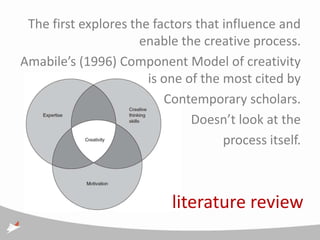
The first explores the factors that influence and
                      enable the creative process.
Amabile’s (1996) Component Model of creativity
                       is one of the most cited by
                          Contemporary scholars.
                               Doesn’t look at the
                                     process itself.


                            literature review
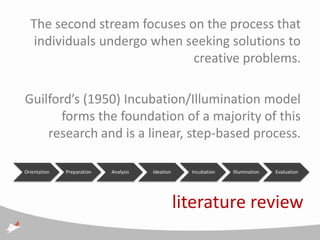
The second stream focuses on the process that
  individuals undergo when seeking solutions to
                             creative problems.

Guilford’s (1950) Incubation/Illumination model
      forms the foundation of a majority of this
    research and is a linear, step-based process.

Orientation   Preparation   Analysis   Ideation     Incubation   Illumination   Evaluation


                                                  literature review
In all streams, there seems to be little research
         which focuses on this process within the
                   specific context of advertising.

To address this weakness in the literature, I plan
  to use Norcutt and McCoy’s (2006) Interactive
      Qualitative Analysis method to identify an
   advertising-specific Creative Ideation Process.

                           literature review
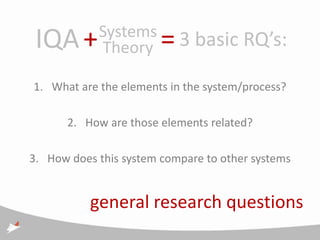
Systems
 IQA +      Theory      = 3 basic RQ’s:
1. What are the elements in the system/process?

      2. How are those elements related?

3. How does this system compare to other systems


           general research questions
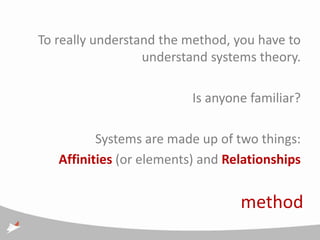
To really understand the method, you have to
                  understand systems theory.

                          Is anyone familiar?

          Systems are made up of two things:
   Affinities (or elements) and Relationships


                                  method
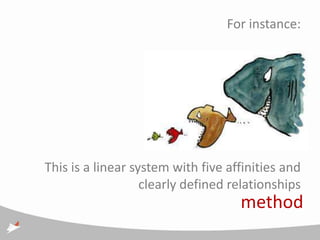
For instance:


This is a linear system with five affinities and
                   clearly defined relationships
                                    method
My goal is to examine the creative ideation process
  advertising students use when encountering a creative
             dilemma (i.e. getting a new client or planning a new campaign)

                       My specific research questions are:
      1. What affinities do they use (brainstorming, etc.)?

           2. How do those affinities relate to each other?

3. How does their process compare to traditional models
                               of the creative process?

                                                          method
A quick refresher
    Mini focus group with creative professors :1
  Two focus groups, one with P3, one with P4 :2
                           -Prompt, index card “brain dump”
Place all cards on wall, clarify any vague cards :3
         Silently organize cards into categories :4
                   Group names each category :5
  -these group names become the affinities used in the system


                                               method
14 students randomly selected for interviews :6
         -Each Interview consists of two parts:
1. Axial Interview: students are asked to explain each element.
This is an in-depth interview and provides rich, meaningful data
             that is used to “tell the story” of the creative process

  2. Theoretical Interview: Each student is asked to indicate the
      direction of the relationship between each of the affinities
                     (i.e.- brainstorming influences rough drafts)
This section provides the details about affinity relationships that
                       are used to map out the system or process.

                                                     method
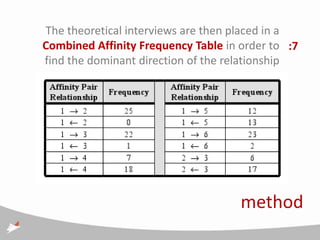
The theoretical interviews are then placed in a
Combined Affinity Frequency Table in order to :7
find the dominant direction of the relationship


                                     method
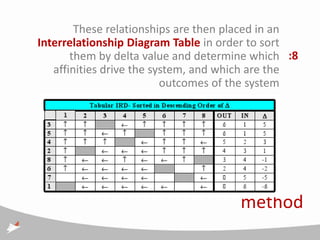
These relationships are then placed in an
Interrelationship Diagram Table in order to sort
       them by delta value and determine which :8
   affinities drive the system, and which are the
                          outcomes of the system


                                      method
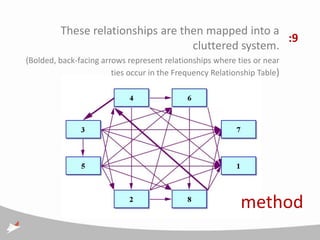
These relationships are then mapped into a
                                                     :9
                                   cluttered system.
(Bolded, back-facing arrows represent relationships where ties or near
                        ties occur in the Frequency Relationship Table)


                                                            method
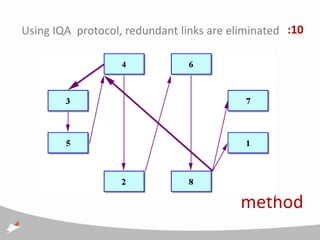
Using IQA protocol, redundant links are eliminated :10


                                         method
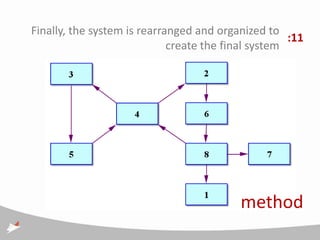
Finally, the system is rearranged and organized to
                                                     :11
                             create the final system


                                           method
Using the final system as a guide, and the quotes
  obtained from the axial portion of the interview, :12
   a discussion of each of their affinities and their
                             relationship is created.

Special attention is given to the timbre/tone within
                    each of the affinity descriptions.


                                        data analysis
IQA is essentially a modified, more rigorous form of
     grounded theory (with a heavy nod to systems
                                            theory).

As such, results are not predicted but are allowed to
               emerge naturally from the interviews.

     However, I anticipate that the creative ideation
     process used by students will be less linear and
         more complex than tradition models of the
                                    creative process.
                         anticipated results
If this study goes well, it will essentially become
       a pilot run for a more rigorous study using
          advertising creative professionals as the
                                  constituent group.

Further similar studies could also be conducted
  on those portions of the system/process that
                     differ from regular models.


                             future research
Amabile, T. M. (1996). The social psychology of creativity: A componential
  conceptualization. Journal Of Personality And Social Psychology, 45(2), 357-
  376.

Guilford, J. (1950). Creativity. American Psychologist, 5, 444-454.

Lubart, T. (2000). Models of the creative process: Past, Present and Future.
   Creativity Research Journal, 13(3), 295-308.

Norcutt, N., McCoy, D. (2006). IQA Method: Version Two [PDF Document].
   Retrieved from https://courses.utexas.edu/webapps/portal/frameset.jsp
   Sasser, S. L., &Koslow, S. (2008). Desperately seeking advertising creativity.
   Journal Of Advertising, 37(4), 5-19.


                                                          references
thank you

   ?

Creativity as Process

  • 2.
    Creativity is acentral tenant of advertising :MOTIVATION Many studies view creativity as a product or outcome :SIGNIFICANCE (advertisements, etc.) not a process Viewing it as a process can lead to a better understanding of how to refine, encourage, manipulate and promote :CONTRIBUTIONS that process in the real world What is the relationship, role, influence and impact of :OVERALL GOAL creativity in advertising. introduction
  • 3.
    The dominant areaof research in Creativity views creativity in terms of output: Ads, art, music, written word, etc.(Sasser&Koslow, 2008) Creative Process research, though not as extensive, is still divided into two main streams or thoughts (Lubart, 2000). literature review
  • 4.
    The first exploresthe factors that influence and enable the creative process. Amabile’s (1996) Component Model of creativity is one of the most cited by Contemporary scholars. Doesn’t look at the process itself. literature review
  • 5.
    The second streamfocuses on the process that individuals undergo when seeking solutions to creative problems. Guilford’s (1950) Incubation/Illumination model forms the foundation of a majority of this research and is a linear, step-based process. Orientation Preparation Analysis Ideation Incubation Illumination Evaluation literature review
  • 6.
    In all streams,there seems to be little research which focuses on this process within the specific context of advertising. To address this weakness in the literature, I plan to use Norcutt and McCoy’s (2006) Interactive Qualitative Analysis method to identify an advertising-specific Creative Ideation Process. literature review
  • 7.
    Systems IQA + Theory = 3 basic RQ’s: 1. What are the elements in the system/process? 2. How are those elements related? 3. How does this system compare to other systems general research questions
  • 8.
    To really understandthe method, you have to understand systems theory. Is anyone familiar? Systems are made up of two things: Affinities (or elements) and Relationships method
  • 9.
    For instance: This isa linear system with five affinities and clearly defined relationships method
  • 10.
    My goal isto examine the creative ideation process advertising students use when encountering a creative dilemma (i.e. getting a new client or planning a new campaign) My specific research questions are: 1. What affinities do they use (brainstorming, etc.)? 2. How do those affinities relate to each other? 3. How does their process compare to traditional models of the creative process? method
  • 11.
    A quick refresher Mini focus group with creative professors :1 Two focus groups, one with P3, one with P4 :2 -Prompt, index card “brain dump” Place all cards on wall, clarify any vague cards :3 Silently organize cards into categories :4 Group names each category :5 -these group names become the affinities used in the system method
  • 12.
    14 students randomlyselected for interviews :6 -Each Interview consists of two parts: 1. Axial Interview: students are asked to explain each element. This is an in-depth interview and provides rich, meaningful data that is used to “tell the story” of the creative process 2. Theoretical Interview: Each student is asked to indicate the direction of the relationship between each of the affinities (i.e.- brainstorming influences rough drafts) This section provides the details about affinity relationships that are used to map out the system or process. method
  • 13.
    The theoretical interviewsare then placed in a Combined Affinity Frequency Table in order to :7 find the dominant direction of the relationship method
  • 14.
    These relationships arethen placed in an Interrelationship Diagram Table in order to sort them by delta value and determine which :8 affinities drive the system, and which are the outcomes of the system method
  • 15.
    These relationships arethen mapped into a :9 cluttered system. (Bolded, back-facing arrows represent relationships where ties or near ties occur in the Frequency Relationship Table) method
  • 16.
    Using IQA protocol,redundant links are eliminated :10 method
  • 17.
    Finally, the systemis rearranged and organized to :11 create the final system method
  • 18.
    Using the finalsystem as a guide, and the quotes obtained from the axial portion of the interview, :12 a discussion of each of their affinities and their relationship is created. Special attention is given to the timbre/tone within each of the affinity descriptions. data analysis
  • 19.
    IQA is essentiallya modified, more rigorous form of grounded theory (with a heavy nod to systems theory). As such, results are not predicted but are allowed to emerge naturally from the interviews. However, I anticipate that the creative ideation process used by students will be less linear and more complex than tradition models of the creative process. anticipated results
  • 20.
    If this studygoes well, it will essentially become a pilot run for a more rigorous study using advertising creative professionals as the constituent group. Further similar studies could also be conducted on those portions of the system/process that differ from regular models. future research
  • 21.
    Amabile, T. M.(1996). The social psychology of creativity: A componential conceptualization. Journal Of Personality And Social Psychology, 45(2), 357- 376. Guilford, J. (1950). Creativity. American Psychologist, 5, 444-454. Lubart, T. (2000). Models of the creative process: Past, Present and Future. Creativity Research Journal, 13(3), 295-308. Norcutt, N., McCoy, D. (2006). IQA Method: Version Two [PDF Document]. Retrieved from https://courses.utexas.edu/webapps/portal/frameset.jsp Sasser, S. L., &Koslow, S. (2008). Desperately seeking advertising creativity. Journal Of Advertising, 37(4), 5-19. references
  • 22.