imagery
CREATIVE WRITING
What is imagery?
Imagery
 Imagery is language used by poets,
novelists and other writers to create
images in the mind of the reader.
Imagery includes figurative and
metaphorical language to improve the
reader’s experience through their
senses.
imagery
 As a literary device, imagery consists of descriptive language that
can function as a way for the reader to better imagine the world of
the piece of literature and also add symbolism to the work.
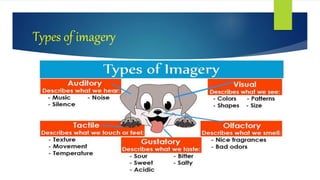
Imagery draws on the five senses, namely the details
of taste, touch, sight, smell, and sound. Imagery can also
pertain to details about movement or a sense of a body in motion
(kinesthetic imagery) or the emotions or sensations of a person,
such as fear or hunger (organic imagery or subjective imagery).
Using imagery helps the reader develop a more fully realized
understanding of the imaginary world that the author has created.
Examples of imagery:
 Imagery using visuals:
 The night was black as ever, but bright stars lit up the sky in beautiful and varied
constellations which were sprinkled across the astronomical landscape.
 In this example, the experience of the night sky is described in depth
with color (black as ever, bright), shape (varied constellations), and
pattern (sprinkled).
 Imagery using sounds:
 Silence was broken by the peal of piano keys as Shannon began practicing her
concerto.
 Here, auditory imagery breaks silence with the beautiful sound of
piano keys.
Example of imagery:
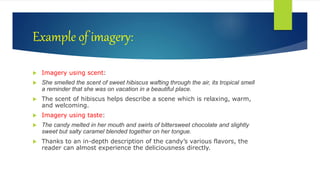
 Imagery using scent:
 She smelled the scent of sweet hibiscus wafting through the air, its tropical smell
a reminder that she was on vacation in a beautiful place.
 The scent of hibiscus helps describe a scene which is relaxing, warm,
and welcoming.
 Imagery using taste:
 The candy melted in her mouth and swirls of bittersweet chocolate and slightly
sweet but salty caramel blended together on her tongue.
 Thanks to an in-depth description of the candy’s various flavors, the
reader can almost experience the deliciousness directly.
Example of imagery:
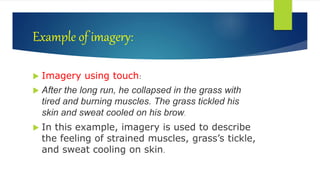
 Imagery using touch:
 After the long run, he collapsed in the grass with
tired and burning muscles. The grass tickled his
skin and sweat cooled on his brow.
 In this example, imagery is used to describe
the feeling of strained muscles, grass’s tickle,
and sweat cooling on skin.
Types of imagery
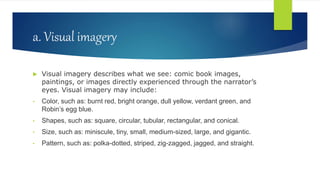
a. Visual imagery
 Visual imagery describes what we see: comic book images,
paintings, or images directly experienced through the narrator’s
eyes. Visual imagery may include:
• Color, such as: burnt red, bright orange, dull yellow, verdant green, and
Robin’s egg blue.
• Shapes, such as: square, circular, tubular, rectangular, and conical.
• Size, such as: miniscule, tiny, small, medium-sized, large, and gigantic.
• Pattern, such as: polka-dotted, striped, zig-zagged, jagged, and straight.
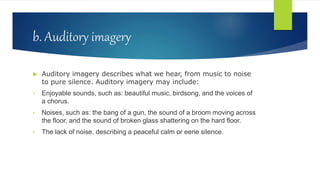
b. Auditory imagery
 Auditory imagery describes what we hear, from music to noise
to pure silence. Auditory imagery may include:
• Enjoyable sounds, such as: beautiful music, birdsong, and the voices of
a chorus.
• Noises, such as: the bang of a gun, the sound of a broom moving across
the floor, and the sound of broken glass shattering on the hard floor.
• The lack of noise, describing a peaceful calm or eerie silence.
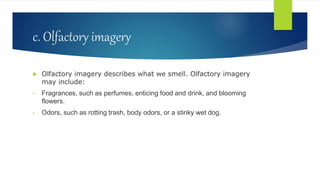
c. Olfactory imagery
 Olfactory imagery describes what we smell. Olfactory imagery
may include:
• Fragrances, such as perfumes, enticing food and drink, and blooming
flowers.
• Odors, such as rotting trash, body odors, or a stinky wet dog.
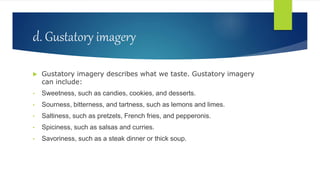
d. Gustatory imagery
 Gustatory imagery describes what we taste. Gustatory imagery
can include:
• Sweetness, such as candies, cookies, and desserts.
• Sourness, bitterness, and tartness, such as lemons and limes.
• Saltiness, such as pretzels, French fries, and pepperonis.
• Spiciness, such as salsas and curries.
• Savoriness, such as a steak dinner or thick soup.
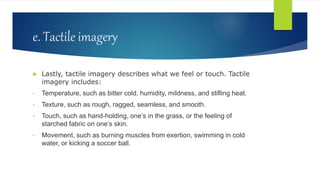
e. Tactile imagery
 Lastly, tactile imagery describes what we feel or touch. Tactile
imagery includes:
• Temperature, such as bitter cold, humidity, mildness, and stifling heat.
• Texture, such as rough, ragged, seamless, and smooth.
• Touch, such as hand-holding, one’s in the grass, or the feeling of
starched fabric on one’s skin.
• Movement, such as burning muscles from exertion, swimming in cold
water, or kicking a soccer ball.
The importance of using imagery
 Because we experience life through our senses, a strong
composition should appeal to them through the use of
imagery. Descriptive imagery launches the reader into the
experience of a warm spring day, scorching hot summer,
crisp fall, or harsh winter. It allows readers to directly
sympathize with characters and narrators as they imagine
having the same sense experiences. Imagery commonly
helps build compelling poetry, convincing narratives, vivid
plays, well-designed film sets, and descriptive songs.
Imagery in literature
Imagery is found throughout
literature in poems, plays,
stories, novels, and other
creative compositions
Example
 Excerpt describing a fish:
his brown skin hung in strips
like ancient wallpaper,
and its pattern of darker brown
was like wallpaper:
shapes like full-blown roses
stained and lost through age.
example
 This excerpt from Elizabeth Bishop’s poem “The Fish”
is brimming with visual imagery. It beautifies and
complicates the image of a fish that has just been
caught. You can imagine the fish with tattered, dark
brown skin “like ancient wallpaper” covered in
barnacles, lime deposits, and sea lice. In just a few
lines, Bishop mentions many colors including brown,
rose, white, and green.
Imagery in pop culture
Imagery can be found
throughout pop culture in
descriptive songs, colorful
plays, and in exciting movie
and television scenes.
example
Louis Armstrong’s “What a Wonderful World.”
I see trees of green, red roses too
I see them bloom for me and you
And I think to myself what a wonderful world.
I see skies of blue and clouds of white
The bright blessed day, the dark sacred night
And I think to myself what a wonderful world.
.
example
 The colors of the rainbow so pretty in the sky
Are also on the faces of people going by
I see friends shaking hands saying how do you do
But they're really saying I love you.
I hear baby's cry, and I watched them grow
They'll learn much more than I'll ever know
And I think to myself what a wonderful world.
Yes, I think to myself what a wonderful world.
example
 Armstrong’s classic song is an example
of simple yet beautiful imagery in song.
For instance, the colors are emphasized
in the green trees, red blooming roses,
blue skies, and white clouds from the
bright day to the dark night.
Related terms
Metaphor
Onomatopoeia
Personification
metaphor
 Metaphor is often used as a type of imagery.
Specifically, metaphor is the direct comparison of two
distinct things. Here are a few examples of metaphor
as imagery:
• Her smiling face is the sun.
• His temper was a hurricane whipping through the school,
scaring and amazing his classmates.
• We were penguins standing in our black and white coats in
the bitter cold.
onomatopoeia
 Onomatopoeia is also a common tool used for imagery.
Onomatopoeia is a form of auditory imagery in which
the word used sounds like the thing it describes. Here
are a few examples of onomatopoeia as imagery:
• The fire crackled and popped.
• She rudely slurped and gulped down her soup.
• The pigs happily oinked when the farmer gave them their
slop to eat.
personification
 Personification is another tool used for imagery.
Personification provides animals and objects with
human-like characteristics. Here are a few examples
of personification as imagery:
• The wind whistled and hissed through the stormy night.
• The tired tree’s branches moaned in the gusts of wind.
• The ocean waves slapped the shore and whispered in a fizz
as they withdrew again.

Creative_writing_imagery (1).pptx

  • 2.
  • 3.
  • 4.
    Imagery  Imagery islanguage used by poets, novelists and other writers to create images in the mind of the reader. Imagery includes figurative and metaphorical language to improve the reader’s experience through their senses.
  • 5.
    imagery  As aliterary device, imagery consists of descriptive language that can function as a way for the reader to better imagine the world of the piece of literature and also add symbolism to the work. Imagery draws on the five senses, namely the details of taste, touch, sight, smell, and sound. Imagery can also pertain to details about movement or a sense of a body in motion (kinesthetic imagery) or the emotions or sensations of a person, such as fear or hunger (organic imagery or subjective imagery). Using imagery helps the reader develop a more fully realized understanding of the imaginary world that the author has created.
  • 6.
    Examples of imagery: Imagery using visuals:  The night was black as ever, but bright stars lit up the sky in beautiful and varied constellations which were sprinkled across the astronomical landscape.  In this example, the experience of the night sky is described in depth with color (black as ever, bright), shape (varied constellations), and pattern (sprinkled).  Imagery using sounds:  Silence was broken by the peal of piano keys as Shannon began practicing her concerto.  Here, auditory imagery breaks silence with the beautiful sound of piano keys.
  • 7.
    Example of imagery: Imagery using scent:  She smelled the scent of sweet hibiscus wafting through the air, its tropical smell a reminder that she was on vacation in a beautiful place.  The scent of hibiscus helps describe a scene which is relaxing, warm, and welcoming.  Imagery using taste:  The candy melted in her mouth and swirls of bittersweet chocolate and slightly sweet but salty caramel blended together on her tongue.  Thanks to an in-depth description of the candy’s various flavors, the reader can almost experience the deliciousness directly.
  • 8.
    Example of imagery: Imagery using touch:  After the long run, he collapsed in the grass with tired and burning muscles. The grass tickled his skin and sweat cooled on his brow.  In this example, imagery is used to describe the feeling of strained muscles, grass’s tickle, and sweat cooling on skin.
  • 9.
  • 10.
    a. Visual imagery Visual imagery describes what we see: comic book images, paintings, or images directly experienced through the narrator’s eyes. Visual imagery may include: • Color, such as: burnt red, bright orange, dull yellow, verdant green, and Robin’s egg blue. • Shapes, such as: square, circular, tubular, rectangular, and conical. • Size, such as: miniscule, tiny, small, medium-sized, large, and gigantic. • Pattern, such as: polka-dotted, striped, zig-zagged, jagged, and straight.
  • 11.
    b. Auditory imagery Auditory imagery describes what we hear, from music to noise to pure silence. Auditory imagery may include: • Enjoyable sounds, such as: beautiful music, birdsong, and the voices of a chorus. • Noises, such as: the bang of a gun, the sound of a broom moving across the floor, and the sound of broken glass shattering on the hard floor. • The lack of noise, describing a peaceful calm or eerie silence.
  • 12.
    c. Olfactory imagery Olfactory imagery describes what we smell. Olfactory imagery may include: • Fragrances, such as perfumes, enticing food and drink, and blooming flowers. • Odors, such as rotting trash, body odors, or a stinky wet dog.
  • 13.
    d. Gustatory imagery Gustatory imagery describes what we taste. Gustatory imagery can include: • Sweetness, such as candies, cookies, and desserts. • Sourness, bitterness, and tartness, such as lemons and limes. • Saltiness, such as pretzels, French fries, and pepperonis. • Spiciness, such as salsas and curries. • Savoriness, such as a steak dinner or thick soup.
  • 14.
    e. Tactile imagery Lastly, tactile imagery describes what we feel or touch. Tactile imagery includes: • Temperature, such as bitter cold, humidity, mildness, and stifling heat. • Texture, such as rough, ragged, seamless, and smooth. • Touch, such as hand-holding, one’s in the grass, or the feeling of starched fabric on one’s skin. • Movement, such as burning muscles from exertion, swimming in cold water, or kicking a soccer ball.
  • 15.
    The importance ofusing imagery  Because we experience life through our senses, a strong composition should appeal to them through the use of imagery. Descriptive imagery launches the reader into the experience of a warm spring day, scorching hot summer, crisp fall, or harsh winter. It allows readers to directly sympathize with characters and narrators as they imagine having the same sense experiences. Imagery commonly helps build compelling poetry, convincing narratives, vivid plays, well-designed film sets, and descriptive songs.
  • 16.
    Imagery in literature Imageryis found throughout literature in poems, plays, stories, novels, and other creative compositions
  • 17.
    Example  Excerpt describinga fish: his brown skin hung in strips like ancient wallpaper, and its pattern of darker brown was like wallpaper: shapes like full-blown roses stained and lost through age.
  • 18.
    example  This excerptfrom Elizabeth Bishop’s poem “The Fish” is brimming with visual imagery. It beautifies and complicates the image of a fish that has just been caught. You can imagine the fish with tattered, dark brown skin “like ancient wallpaper” covered in barnacles, lime deposits, and sea lice. In just a few lines, Bishop mentions many colors including brown, rose, white, and green.
  • 19.
    Imagery in popculture Imagery can be found throughout pop culture in descriptive songs, colorful plays, and in exciting movie and television scenes.
  • 20.
    example Louis Armstrong’s “Whata Wonderful World.” I see trees of green, red roses too I see them bloom for me and you And I think to myself what a wonderful world. I see skies of blue and clouds of white The bright blessed day, the dark sacred night And I think to myself what a wonderful world. .
  • 21.
    example  The colorsof the rainbow so pretty in the sky Are also on the faces of people going by I see friends shaking hands saying how do you do But they're really saying I love you. I hear baby's cry, and I watched them grow They'll learn much more than I'll ever know And I think to myself what a wonderful world. Yes, I think to myself what a wonderful world.
  • 22.
    example  Armstrong’s classicsong is an example of simple yet beautiful imagery in song. For instance, the colors are emphasized in the green trees, red blooming roses, blue skies, and white clouds from the bright day to the dark night.
  • 23.
  • 24.
    metaphor  Metaphor isoften used as a type of imagery. Specifically, metaphor is the direct comparison of two distinct things. Here are a few examples of metaphor as imagery: • Her smiling face is the sun. • His temper was a hurricane whipping through the school, scaring and amazing his classmates. • We were penguins standing in our black and white coats in the bitter cold.
  • 25.
    onomatopoeia  Onomatopoeia isalso a common tool used for imagery. Onomatopoeia is a form of auditory imagery in which the word used sounds like the thing it describes. Here are a few examples of onomatopoeia as imagery: • The fire crackled and popped. • She rudely slurped and gulped down her soup. • The pigs happily oinked when the farmer gave them their slop to eat.
  • 26.
    personification  Personification isanother tool used for imagery. Personification provides animals and objects with human-like characteristics. Here are a few examples of personification as imagery: • The wind whistled and hissed through the stormy night. • The tired tree’s branches moaned in the gusts of wind. • The ocean waves slapped the shore and whispered in a fizz as they withdrew again.