ITS ALL IN THE MIND


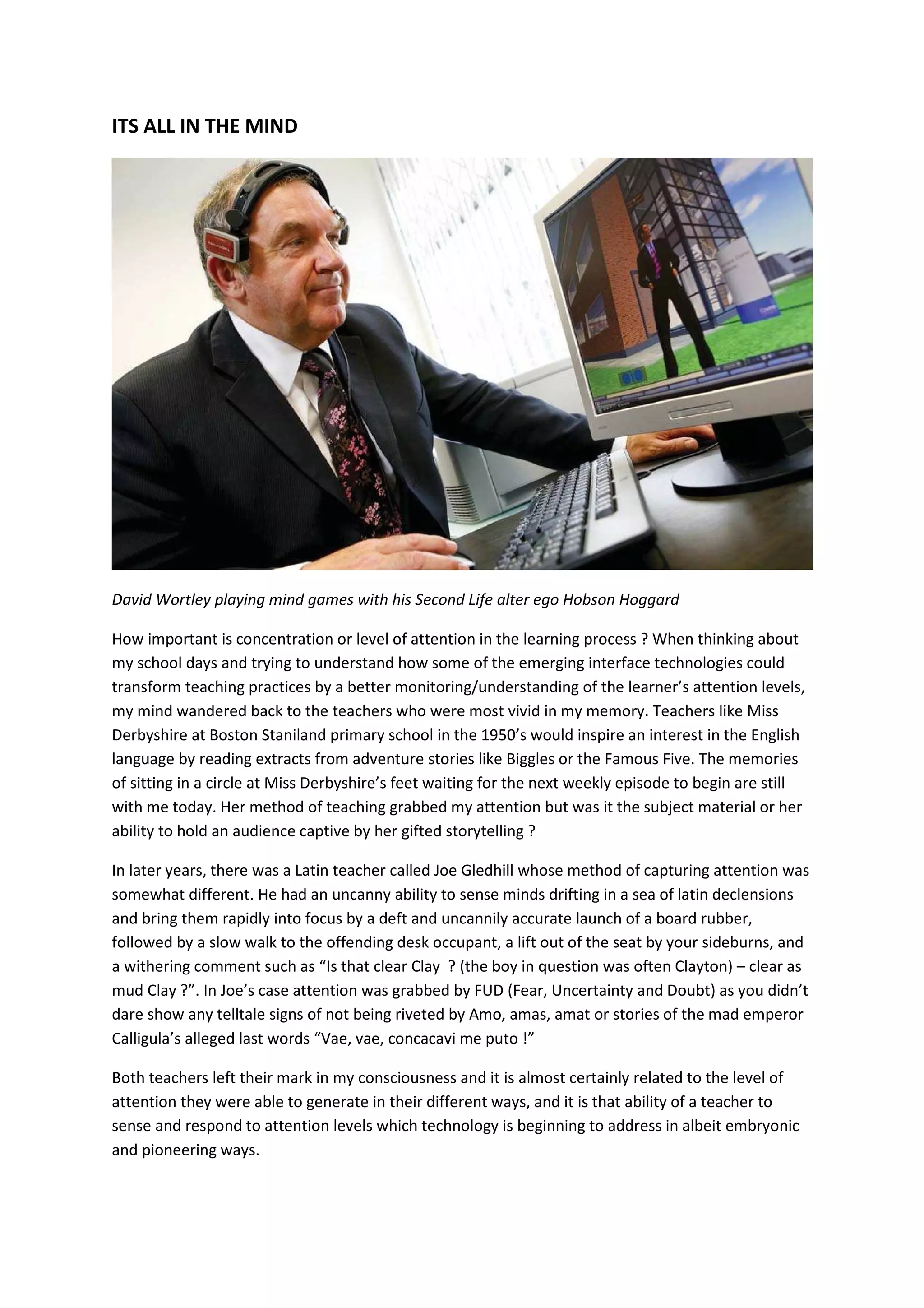
David Wortley playing mind games with his Second Life alter ego Hobson Hoggard

How important is concentration or level of attention in the learning process ? When thinking about
my school days and trying to understand how some of the emerging interface technologies could
transform teaching practices by a better monitoring/understanding of the learner’s attention levels,
my mind wandered back to the teachers who were most vivid in my memory. Teachers like Miss
Derbyshire at Boston Staniland primary school in the 1950’s would inspire an interest in the English
language by reading extracts from adventure stories like Biggles or the Famous Five. The memories
of sitting in a circle at Miss Derbyshire’s feet waiting for the next weekly episode to begin are still
with me today. Her method of teaching grabbed my attention but was it the subject material or her
ability to hold an audience captive by her gifted storytelling ?

In later years, there was a Latin teacher called Joe Gledhill whose method of capturing attention was
somewhat different. He had an uncanny ability to sense minds drifting in a sea of latin declensions
and bring them rapidly into focus by a deft and uncannily accurate launch of a board rubber,
followed by a slow walk to the offending desk occupant, a lift out of the seat by your sideburns, and
a withering comment such as “Is that clear Clay ? (the boy in question was often Clayton) – clear as
mud Clay ?”. In Joe’s case attention was grabbed by FUD (Fear, Uncertainty and Doubt) as you didn’t
dare show any telltale signs of not being riveted by Amo, amas, amat or stories of the mad emperor
Calligula’s alleged last words “Vae, vae, concacavi me puto !”

Both teachers left their mark in my consciousness and it is almost certainly related to the level of
attention they were able to generate in their different ways, and it is that ability of a teacher to
sense and respond to attention levels which technology is beginning to address in albeit embryonic
and pioneering ways.
The Serious Games Institute (SGI) is exploring the use of devices such as Neurosky which are able to
resolve and filter the brainwaves associated with our levels of attention/concentration and
meditation/relaxation. These types of devices, which are now almost at the level of consumer
pricing (likely to be about £40 per headset), use electrodes on the forehead and neck to capture the
electrical signals associated with these brain activities and use algorithms to translate these signal
strengths into the user’s level of attention and/or meditation.

To make these devices seriously practical in learning applications, they need to be able to
demonstrate :-

    •   Affordability (Under £50)
    •   Reliability and repeatability of results (To get consistent benefits)
    •   Auto-calibration (No need for different set-ups for individual users)
    •   Wearability (Don’t make you look like a geek)
    •   Useful applications (Demonstrable benefits in learning applications)

With Neurosky and other similar devices, we are getting very close to these technologies having a
major impact on learning environments and the functionality of technology enhanced learning
applications such as serious games.

Companies such as Games for Life (www.gamesforlife.co.uk) already have a commercial product for
use with pupils who have ADHD and the Serious Games Institute Applied Research team led by
Professor Sara de Freitas and Artificial Intelligence researcher Genaro Robolledo-Mendez is working
with Neurosky and companies like Rolling Sound (http://www.rollingsound.co.uk/) to develop games
based learning targeted at young people with anger management problems.


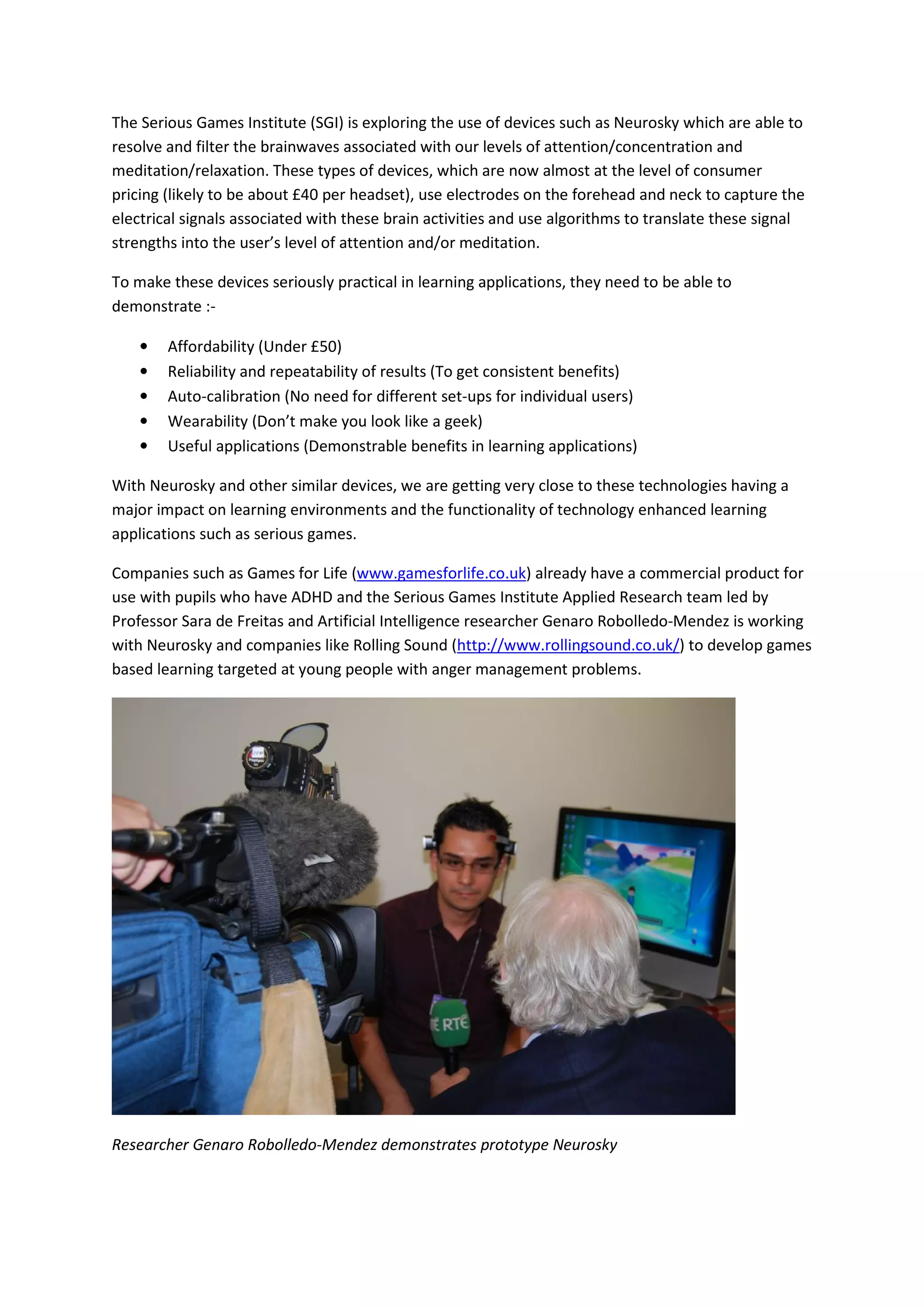
Researcher Genaro Robolledo-Mendez demonstrates prototype Neurosky
The work that has been done so far has focused on using levels of attention to control serious games
which reward the player for high levels of attention and/or relaxation. This technique could help
learners with ADHD to bring some control over their attention levels and people with high stress
levels to relax, but I believe that the really exciting future applications will come from the use of
these devices to create personalised self-directed learning applications in which the learning content
is dynamically selected according to the learner’s attention levels. For some time, the Holy Grail of
computer-assisted learning has been an environment which supports self-directed learning and
testing by recognising the ability and interest of the learner and controlling the pace and direction of
the learning experience to gain maximum interest and motivation.

In the meantime, interface technologies like Neurosky, Nintendo Wii, Guitar Hero and others are
providing much more engaging connections between learners and the technologies which support
learning professionals. Devices capable of measuring levels of attention through brainwaves will find
a place in the usability labs of Applied Research organisations such as the Serious Games Institute at
Coventry University, and all without the aid of a well-directed board rubber !!

09 03-29 its all in the mind

  • 1.
    ITS ALL INTHE MIND David Wortley playing mind games with his Second Life alter ego Hobson Hoggard How important is concentration or level of attention in the learning process ? When thinking about my school days and trying to understand how some of the emerging interface technologies could transform teaching practices by a better monitoring/understanding of the learner’s attention levels, my mind wandered back to the teachers who were most vivid in my memory. Teachers like Miss Derbyshire at Boston Staniland primary school in the 1950’s would inspire an interest in the English language by reading extracts from adventure stories like Biggles or the Famous Five. The memories of sitting in a circle at Miss Derbyshire’s feet waiting for the next weekly episode to begin are still with me today. Her method of teaching grabbed my attention but was it the subject material or her ability to hold an audience captive by her gifted storytelling ? In later years, there was a Latin teacher called Joe Gledhill whose method of capturing attention was somewhat different. He had an uncanny ability to sense minds drifting in a sea of latin declensions and bring them rapidly into focus by a deft and uncannily accurate launch of a board rubber, followed by a slow walk to the offending desk occupant, a lift out of the seat by your sideburns, and a withering comment such as “Is that clear Clay ? (the boy in question was often Clayton) – clear as mud Clay ?”. In Joe’s case attention was grabbed by FUD (Fear, Uncertainty and Doubt) as you didn’t dare show any telltale signs of not being riveted by Amo, amas, amat or stories of the mad emperor Calligula’s alleged last words “Vae, vae, concacavi me puto !” Both teachers left their mark in my consciousness and it is almost certainly related to the level of attention they were able to generate in their different ways, and it is that ability of a teacher to sense and respond to attention levels which technology is beginning to address in albeit embryonic and pioneering ways.
  • 2.
    The Serious GamesInstitute (SGI) is exploring the use of devices such as Neurosky which are able to resolve and filter the brainwaves associated with our levels of attention/concentration and meditation/relaxation. These types of devices, which are now almost at the level of consumer pricing (likely to be about £40 per headset), use electrodes on the forehead and neck to capture the electrical signals associated with these brain activities and use algorithms to translate these signal strengths into the user’s level of attention and/or meditation. To make these devices seriously practical in learning applications, they need to be able to demonstrate :- • Affordability (Under £50) • Reliability and repeatability of results (To get consistent benefits) • Auto-calibration (No need for different set-ups for individual users) • Wearability (Don’t make you look like a geek) • Useful applications (Demonstrable benefits in learning applications) With Neurosky and other similar devices, we are getting very close to these technologies having a major impact on learning environments and the functionality of technology enhanced learning applications such as serious games. Companies such as Games for Life (www.gamesforlife.co.uk) already have a commercial product for use with pupils who have ADHD and the Serious Games Institute Applied Research team led by Professor Sara de Freitas and Artificial Intelligence researcher Genaro Robolledo-Mendez is working with Neurosky and companies like Rolling Sound (http://www.rollingsound.co.uk/) to develop games based learning targeted at young people with anger management problems. Researcher Genaro Robolledo-Mendez demonstrates prototype Neurosky
  • 3.
    The work thathas been done so far has focused on using levels of attention to control serious games which reward the player for high levels of attention and/or relaxation. This technique could help learners with ADHD to bring some control over their attention levels and people with high stress levels to relax, but I believe that the really exciting future applications will come from the use of these devices to create personalised self-directed learning applications in which the learning content is dynamically selected according to the learner’s attention levels. For some time, the Holy Grail of computer-assisted learning has been an environment which supports self-directed learning and testing by recognising the ability and interest of the learner and controlling the pace and direction of the learning experience to gain maximum interest and motivation. In the meantime, interface technologies like Neurosky, Nintendo Wii, Guitar Hero and others are providing much more engaging connections between learners and the technologies which support learning professionals. Devices capable of measuring levels of attention through brainwaves will find a place in the usability labs of Applied Research organisations such as the Serious Games Institute at Coventry University, and all without the aid of a well-directed board rubber !!