CREATIVE outdoor
PHOTOGRAPHY
The “A to G” Method
1980
Simon Priest
simonpriest.com
Content Outline
Background Technology
Aperture & Shutter Speed
Lenses & Focal Lengths
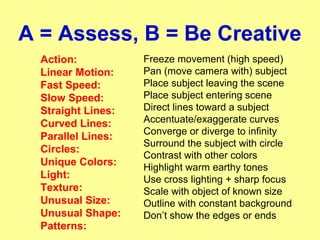
The “A to G” Method
A = Assess your reasons
B = Be creative
C = Composition
D = Depth of Field
E = Exposure
F = Focus
G = Go!
All photos taken prior to 1983 as slides
- scanned digitally in 2003 for this show
Apologies for the lack of clarity in some
Background Technology
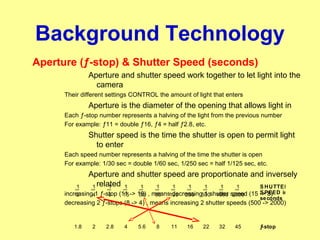
Aperture (ƒ-stop) & Shutter Speed (seconds)
Aperture and shutter speed work together to let light into the
camera
Their different settings CONTROL the amount of light that enters
Aperture is the diameter of the opening that allows light in
Each ƒ-stop number represents a halving of the light from the previous number
For example: ƒ11 = double ƒ16, ƒ4 = half ƒ2.8, etc.
Shutter speed is the time the shutter is open to permit light
to enter
Each speed number represents a halving of the time the shutter is open
For example: 1/30 sec = double 1/60 sec, 1/250 sec = half 1/125 sec, etc.
Aperture and shutter speed are proportionate and inversely
related
increasing 1 ƒ-stop (11 -> 16) , means decreasing 1 shutter speed (15 -> 8)
decreasing 2 ƒ-stops (8 -> 4) , means increasing 2 shutter speeds (500 -> 2000)
20001000500250125603015842
1 1 1 1 1 1 1 1 1 1 1
453222161185.642.821.8
S HUTTER
S PEED in
seconds
ƒ-stop
Background Technology
Lenses & Focal Lengths
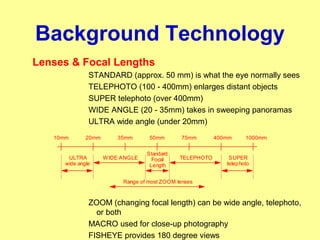
STANDARD (approx. 50 mm) is what the eye normally sees
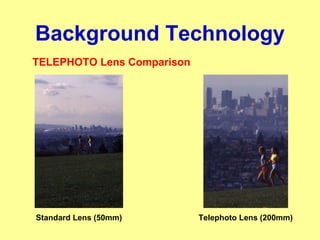
TELEPHOTO (100 - 400mm) enlarges distant objects
SUPER telephoto (over 400mm)
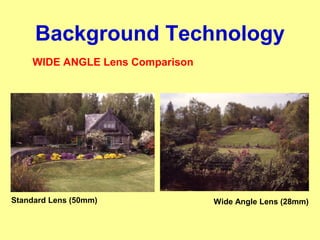
WIDE ANGLE (20 - 35mm) takes in sweeping panoramas
ULTRA wide angle (under 20mm)
ZOOM (changing focal length) can be wide angle, telephoto,
or both
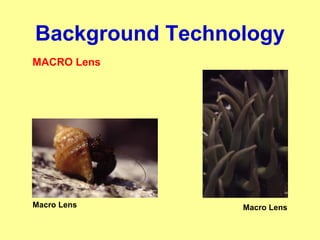
MACRO used for close-up photography
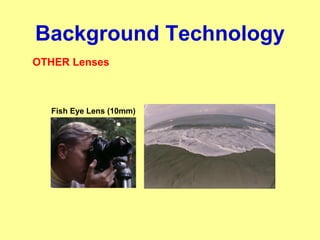
FISHEYE provides 180 degree views
Standard
Focal
Length
10mm 20mm 35mm 50mm 75mm 400mm 1000mm
SUPER
telephoto
TELEPHOTOULTRA
wide angle
WIDE ANGLE
Range of most ZOOM lenses
Background Technology
TELEPHOTO Lens Comparison
Standard Lens (50mm) Telephoto Lens (200mm)
Background Technology
WIDE ANGLE Lens Comparison
Standard Lens (50mm) Wide Angle Lens (28mm)
Background Technology
MACRO Lens
Macro LensMacro Lens
Background Technology
OTHER Lenses
Fish Eye Lens (10mm)
The “A to G” Method
A = Assess your reasons (for taking the photo)
What is it about the image/scene that attracts you to it?
B = Be creative (by making several adjustments)
Make these changes based on your reasons above!
C = Composition (format, viewpoint, framing, balance)
D = Depth of Field (how much is in focus from near to far)
E = Exposure (how much light is let into the camera)
F = Focus (how sharp and crisp the image can be made)
G = Go! (catch the decisive moment)
A = Assess, B = Be Creative
Action:
Linear Motion:
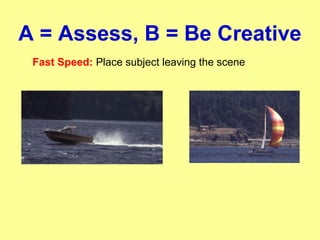
Fast Speed:
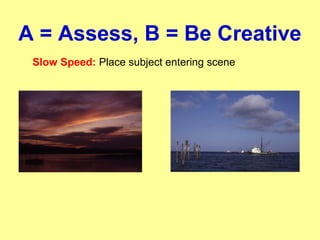
Slow Speed:
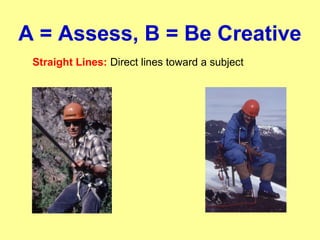
Straight Lines:
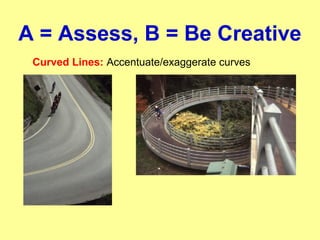
Curved Lines:
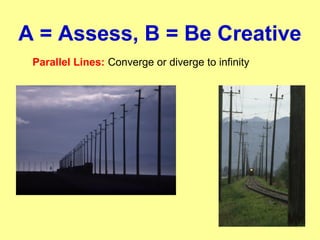
Parallel Lines:
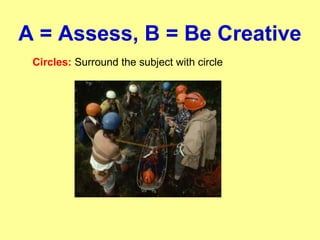
Circles:
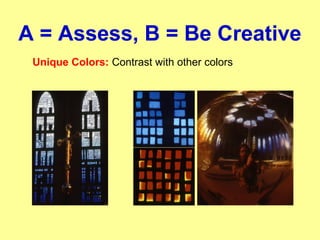
Unique Colors:
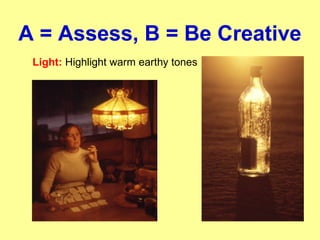
Light:
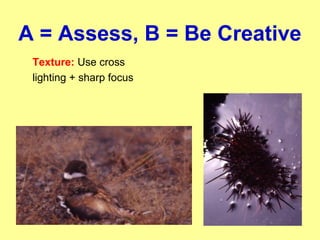
Texture:
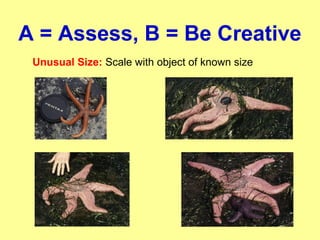
Unusual Size:
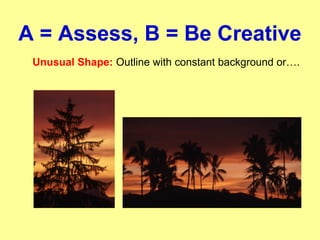
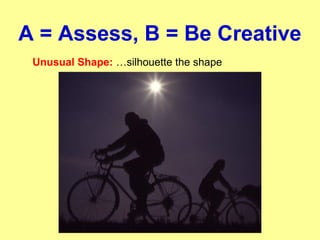
Unusual Shape:
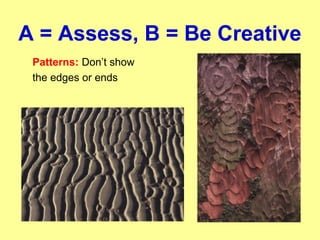
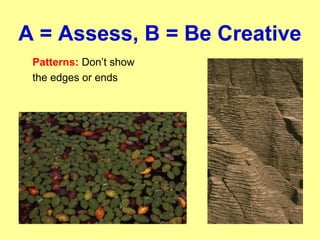
Patterns:
Freeze movement (high speed)
Pan (move camera with) subject
Place subject leaving the scene
Place subject entering scene
Direct lines toward a subject
Accentuate/exaggerate curves
Converge or diverge to infinity
Surround the subject with circle
Contrast with other colors
Highlight warm earthy tones
Use cross lighting + sharp focus
Scale with object of known size
Outline with constant background
Don’t show the edges or ends
A = Assess, B = Be Creative
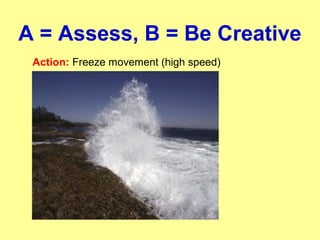
Action: Freeze movement (high speed)
A = Assess, B = Be Creative
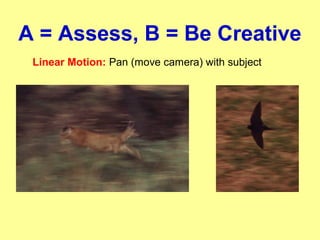
Linear Motion: Pan (move camera) with subject
A = Assess, B = Be Creative
Fast Speed: Place subject leaving the scene
A = Assess, B = Be Creative
Slow Speed: Place subject entering scene
A = Assess, B = Be Creative
Straight Lines: Direct lines toward a subject
A = Assess, B = Be Creative
Curved Lines: Accentuate/exaggerate curves
A = Assess, B = Be Creative
Parallel Lines: Converge or diverge to infinity
A = Assess, B = Be Creative
Circles: Surround the subject with circle
A = Assess, B = Be Creative
Unique Colors: Contrast with other colors
A = Assess, B = Be Creative
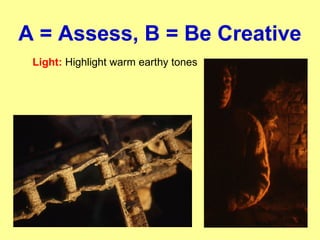
Light: Highlight warm earthy tones
A = Assess, B = Be Creative
Light: Highlight warm earthy tones
A = Assess, B = Be Creative
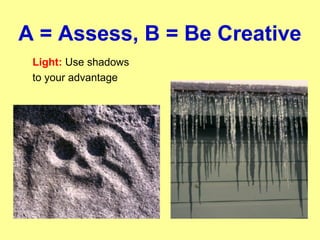
Light: Use shadows
to your advantage
A = Assess, B = Be Creative
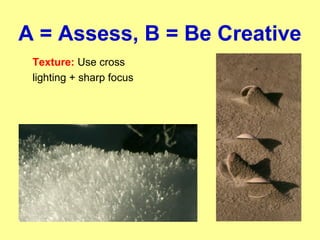
Texture: Use cross
lighting + sharp focus
A = Assess, B = Be Creative
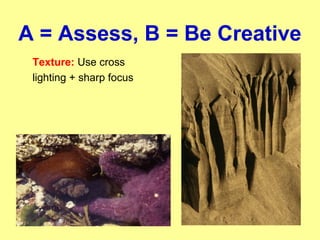
Texture: Use cross
lighting + sharp focus
A = Assess, B = Be Creative
Texture: Use cross
lighting + sharp focus
A = Assess, B = Be Creative
Unusual Size: Scale with object of known size
A = Assess, B = Be Creative
Unusual Shape: Outline with constant background or….
A = Assess, B = Be Creative
Unusual Shape: …silhouette the shape
A = Assess, B = Be Creative
Patterns: Don’t show
the edges or ends
A = Assess, B = Be Creative
Patterns: Don’t show
the edges or ends
C = Composition
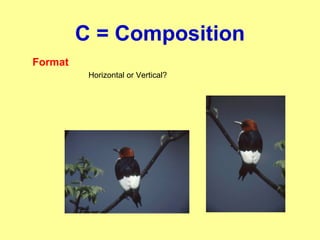
Format
Horizontal or Vertical?
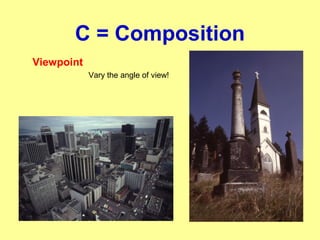
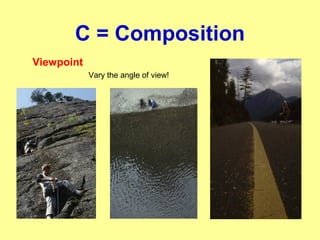
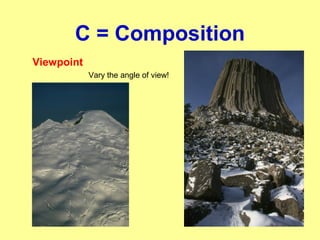
Viewpoint
Vary the angle of view!
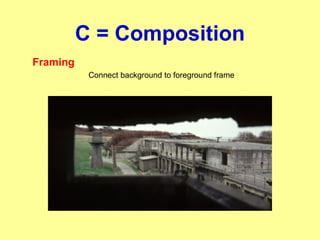
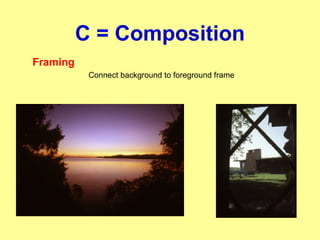
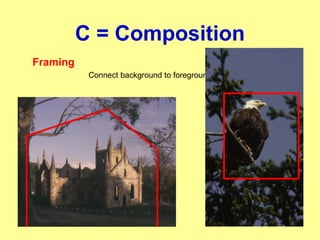
Framing
Connect background to foreground frame
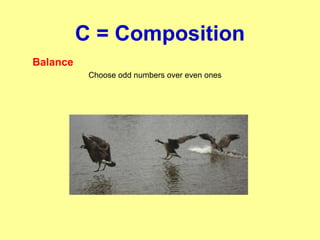
Balance
Choose odd numbers over even ones
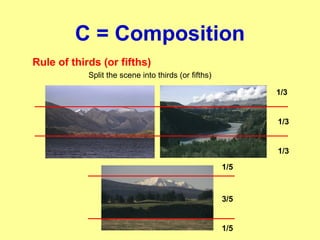
Rule of thirds (or fifths)
Split the scene into thirds (or fifths)
Golden Triangles
Place objects away from the center of the photograph
C = Composition
Format
Horizontal or Vertical?
C = Composition
Viewpoint
Vary the angle of view!
C = Composition
Viewpoint
Vary the angle of view!
C = Composition
Viewpoint
Vary the angle of view!
C = Composition
Framing
Connect background to foreground frame
C = Composition
Framing
Connect background to foreground frame
C = Composition
Framing
Connect background to foreground frame
C = Composition
Balance
Choose odd numbers over even ones
C = Composition
Rule of thirds (or fifths)
Split the scene into thirds (or fifths)
1/3
1/3
1/3
3/5
1/5
1/5
C = Composition
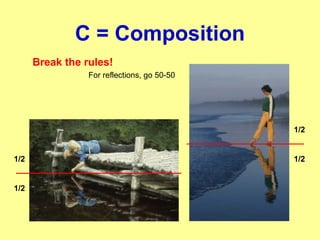
Break the rules!
For reflections, go 50-50
1/2
1/21/2
1/2
C = Composition
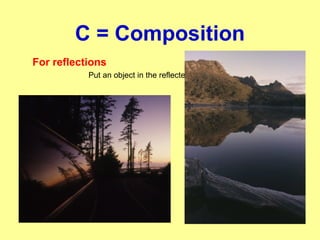
For reflections
Put an object in the reflected part
C = Composition
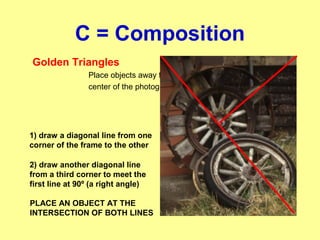
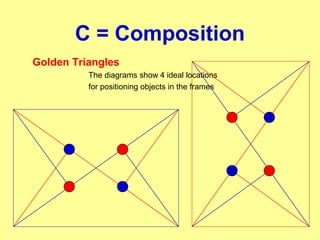
Golden Triangles
Place objects away from the
center of the photograph
1) draw a diagonal line from one
corner of the frame to the other
2) draw another diagonal line
from a third corner to meet the
first line at 90º (a right angle)
PLACE AN OBJECT AT THE
INTERSECTION OF BOTH LINES
C = Composition
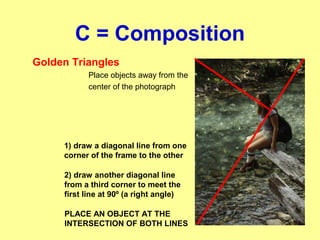
Golden Triangles
Place objects away from the
center of the photograph
1) draw a diagonal line from one
corner of the frame to the other
2) draw another diagonal line
from a third corner to meet the
first line at 90º (a right angle)
PLACE AN OBJECT AT THE
INTERSECTION OF BOTH LINES
C = Composition
Golden Triangles
The diagrams show 4 ideal locations
for positioning objects in the frames
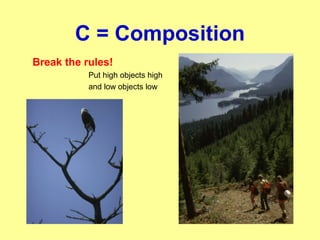
C = Composition
Break the rules!
Put high objects high
and low objects low
D = Depth of field
Depth of Field & Focus
The smaller the aperture (pinpoint) the more will be in focus
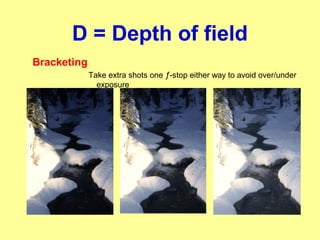
Bracketing
Take extra shots one ƒ-stop either way to avoid over/under
exposure
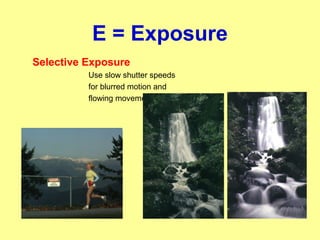
Selective Exposure
Use slow shutter speeds for blurred motion and flowing movement
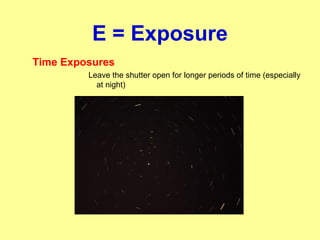
Time Exposures
Leave the shutter open for longer periods of time (especially at night)
E = Exposure
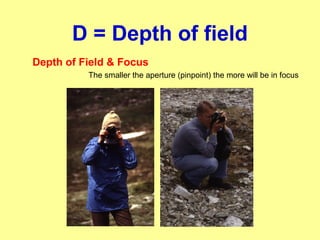
D = Depth of field
Depth of Field & Focus
The smaller the aperture (pinpoint) the more will be in focus
D = Depth of field
Bracketing
Take extra shots one ƒ-stop either way to avoid over/under
exposure
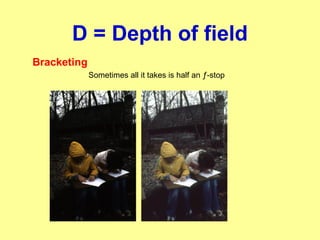
D = Depth of field
Bracketing
Sometimes all it takes is half an ƒ-stop
E = Exposure
Selective Exposure
Use slow shutter speeds
for blurred motion and
flowing movement
E = Exposure
Time Exposures
Leave the shutter open for longer periods of time (especially
at night)
F = Focus
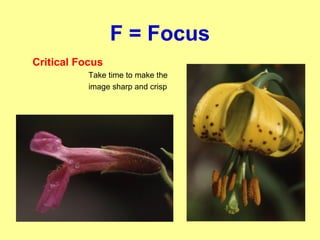
Critical Focus
Take time to make the image sharp and crisp
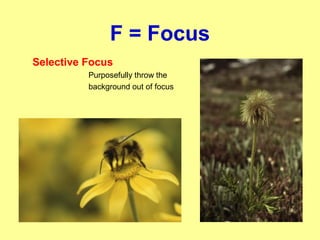
Selective Focus
Purposefully throw the background out of focus
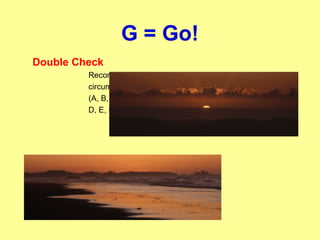
Double Check
Reconfirm circumstances (A, B, C, D, E, F)
Decisive moment
Catch the action!
G = Go!
F = Focus
Critical Focus
Take time to make the
image sharp and crisp
F = Focus
Selective Focus
Purposefully throw the
background out of focus
G = Go!
Double Check
Reconfirm
circumstances
(A, B, C,
D, E, F)
G = Go!
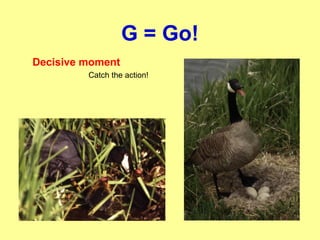
Decisive moment
Catch the action!
H = Homework
Rock Interesting color combination
Tree Interesting lighting
Person Interesting texture
Moving object Interesting pattern
Lots of lines Unusual sizes
Lots of shapes Unusual shapes
1. Take your digital camera, while working alone or
with a partner, and photograph the dozen above.
2. Critique the images by yourself or with your partner
(using the display/play function on your digital
camera) and decide how to improve each image.
3. Take the shot again (repeat, if necessary).

Creative Outdoor Photography: A2G

  • 1.
    CREATIVE outdoor PHOTOGRAPHY The “Ato G” Method 1980 Simon Priest simonpriest.com
  • 2.
    Content Outline Background Technology Aperture& Shutter Speed Lenses & Focal Lengths The “A to G” Method A = Assess your reasons B = Be creative C = Composition D = Depth of Field E = Exposure F = Focus G = Go! All photos taken prior to 1983 as slides - scanned digitally in 2003 for this show Apologies for the lack of clarity in some
  • 3.
    Background Technology Aperture (ƒ-stop)& Shutter Speed (seconds) Aperture and shutter speed work together to let light into the camera Their different settings CONTROL the amount of light that enters Aperture is the diameter of the opening that allows light in Each ƒ-stop number represents a halving of the light from the previous number For example: ƒ11 = double ƒ16, ƒ4 = half ƒ2.8, etc. Shutter speed is the time the shutter is open to permit light to enter Each speed number represents a halving of the time the shutter is open For example: 1/30 sec = double 1/60 sec, 1/250 sec = half 1/125 sec, etc. Aperture and shutter speed are proportionate and inversely related increasing 1 ƒ-stop (11 -> 16) , means decreasing 1 shutter speed (15 -> 8) decreasing 2 ƒ-stops (8 -> 4) , means increasing 2 shutter speeds (500 -> 2000) 20001000500250125603015842 1 1 1 1 1 1 1 1 1 1 1 453222161185.642.821.8 S HUTTER S PEED in seconds ƒ-stop
  • 4.
    Background Technology Lenses &Focal Lengths STANDARD (approx. 50 mm) is what the eye normally sees TELEPHOTO (100 - 400mm) enlarges distant objects SUPER telephoto (over 400mm) WIDE ANGLE (20 - 35mm) takes in sweeping panoramas ULTRA wide angle (under 20mm) ZOOM (changing focal length) can be wide angle, telephoto, or both MACRO used for close-up photography FISHEYE provides 180 degree views Standard Focal Length 10mm 20mm 35mm 50mm 75mm 400mm 1000mm SUPER telephoto TELEPHOTOULTRA wide angle WIDE ANGLE Range of most ZOOM lenses
  • 5.
    Background Technology TELEPHOTO LensComparison Standard Lens (50mm) Telephoto Lens (200mm)
  • 6.
    Background Technology WIDE ANGLELens Comparison Standard Lens (50mm) Wide Angle Lens (28mm)
  • 7.
  • 8.
  • 9.
    The “A toG” Method A = Assess your reasons (for taking the photo) What is it about the image/scene that attracts you to it? B = Be creative (by making several adjustments) Make these changes based on your reasons above! C = Composition (format, viewpoint, framing, balance) D = Depth of Field (how much is in focus from near to far) E = Exposure (how much light is let into the camera) F = Focus (how sharp and crisp the image can be made) G = Go! (catch the decisive moment)
  • 10.
    A = Assess,B = Be Creative Action: Linear Motion: Fast Speed: Slow Speed: Straight Lines: Curved Lines: Parallel Lines: Circles: Unique Colors: Light: Texture: Unusual Size: Unusual Shape: Patterns: Freeze movement (high speed) Pan (move camera with) subject Place subject leaving the scene Place subject entering scene Direct lines toward a subject Accentuate/exaggerate curves Converge or diverge to infinity Surround the subject with circle Contrast with other colors Highlight warm earthy tones Use cross lighting + sharp focus Scale with object of known size Outline with constant background Don’t show the edges or ends
  • 11.
    A = Assess,B = Be Creative Action: Freeze movement (high speed)
  • 12.
    A = Assess,B = Be Creative Linear Motion: Pan (move camera) with subject
  • 13.
    A = Assess,B = Be Creative Fast Speed: Place subject leaving the scene
  • 14.
    A = Assess,B = Be Creative Slow Speed: Place subject entering scene
  • 15.
    A = Assess,B = Be Creative Straight Lines: Direct lines toward a subject
  • 16.
    A = Assess,B = Be Creative Curved Lines: Accentuate/exaggerate curves
  • 17.
    A = Assess,B = Be Creative Parallel Lines: Converge or diverge to infinity
  • 18.
    A = Assess,B = Be Creative Circles: Surround the subject with circle
  • 19.
    A = Assess,B = Be Creative Unique Colors: Contrast with other colors
  • 20.
    A = Assess,B = Be Creative Light: Highlight warm earthy tones
  • 21.
    A = Assess,B = Be Creative Light: Highlight warm earthy tones
  • 22.
    A = Assess,B = Be Creative Light: Use shadows to your advantage
  • 23.
    A = Assess,B = Be Creative Texture: Use cross lighting + sharp focus
  • 24.
    A = Assess,B = Be Creative Texture: Use cross lighting + sharp focus
  • 25.
    A = Assess,B = Be Creative Texture: Use cross lighting + sharp focus
  • 26.
    A = Assess,B = Be Creative Unusual Size: Scale with object of known size
  • 27.
    A = Assess,B = Be Creative Unusual Shape: Outline with constant background or….
  • 28.
    A = Assess,B = Be Creative Unusual Shape: …silhouette the shape
  • 29.
    A = Assess,B = Be Creative Patterns: Don’t show the edges or ends
  • 30.
    A = Assess,B = Be Creative Patterns: Don’t show the edges or ends
  • 31.
    C = Composition Format Horizontalor Vertical? Viewpoint Vary the angle of view! Framing Connect background to foreground frame Balance Choose odd numbers over even ones Rule of thirds (or fifths) Split the scene into thirds (or fifths) Golden Triangles Place objects away from the center of the photograph
  • 32.
  • 33.
  • 34.
  • 35.
  • 36.
    C = Composition Framing Connectbackground to foreground frame
  • 37.
    C = Composition Framing Connectbackground to foreground frame
  • 38.
    C = Composition Framing Connectbackground to foreground frame
  • 39.
    C = Composition Balance Chooseodd numbers over even ones
  • 40.
    C = Composition Ruleof thirds (or fifths) Split the scene into thirds (or fifths) 1/3 1/3 1/3 3/5 1/5 1/5
  • 41.
    C = Composition Breakthe rules! For reflections, go 50-50 1/2 1/21/2 1/2
  • 42.
    C = Composition Forreflections Put an object in the reflected part
  • 43.
    C = Composition GoldenTriangles Place objects away from the center of the photograph 1) draw a diagonal line from one corner of the frame to the other 2) draw another diagonal line from a third corner to meet the first line at 90º (a right angle) PLACE AN OBJECT AT THE INTERSECTION OF BOTH LINES
  • 44.
    C = Composition GoldenTriangles Place objects away from the center of the photograph 1) draw a diagonal line from one corner of the frame to the other 2) draw another diagonal line from a third corner to meet the first line at 90º (a right angle) PLACE AN OBJECT AT THE INTERSECTION OF BOTH LINES
  • 45.
    C = Composition GoldenTriangles The diagrams show 4 ideal locations for positioning objects in the frames
  • 46.
    C = Composition Breakthe rules! Put high objects high and low objects low
  • 47.
    D = Depthof field Depth of Field & Focus The smaller the aperture (pinpoint) the more will be in focus Bracketing Take extra shots one ƒ-stop either way to avoid over/under exposure Selective Exposure Use slow shutter speeds for blurred motion and flowing movement Time Exposures Leave the shutter open for longer periods of time (especially at night) E = Exposure
  • 48.
    D = Depthof field Depth of Field & Focus The smaller the aperture (pinpoint) the more will be in focus
  • 49.
    D = Depthof field Bracketing Take extra shots one ƒ-stop either way to avoid over/under exposure
  • 50.
    D = Depthof field Bracketing Sometimes all it takes is half an ƒ-stop
  • 51.
    E = Exposure SelectiveExposure Use slow shutter speeds for blurred motion and flowing movement
  • 52.
    E = Exposure TimeExposures Leave the shutter open for longer periods of time (especially at night)
  • 53.
    F = Focus CriticalFocus Take time to make the image sharp and crisp Selective Focus Purposefully throw the background out of focus Double Check Reconfirm circumstances (A, B, C, D, E, F) Decisive moment Catch the action! G = Go!
  • 54.
    F = Focus CriticalFocus Take time to make the image sharp and crisp
  • 55.
    F = Focus SelectiveFocus Purposefully throw the background out of focus
  • 56.
    G = Go! DoubleCheck Reconfirm circumstances (A, B, C, D, E, F)
  • 57.
    G = Go! Decisivemoment Catch the action!
  • 58.
    H = Homework RockInteresting color combination Tree Interesting lighting Person Interesting texture Moving object Interesting pattern Lots of lines Unusual sizes Lots of shapes Unusual shapes 1. Take your digital camera, while working alone or with a partner, and photograph the dozen above. 2. Critique the images by yourself or with your partner (using the display/play function on your digital camera) and decide how to improve each image. 3. Take the shot again (repeat, if necessary).