VISUAL THINKING & IMAGINATION
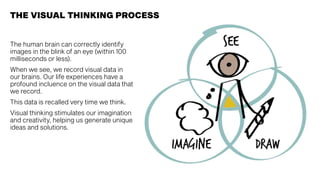
THE VISUAL THINKING PROCESS
The human brain can correctly identify
images in the blink of an eye (within 100
milliseconds or less).
When we see, we record visual data in
our brains. Our life experiences have a
profound incluence on the visual data that
we record.
This data is recalled very time we think.
Visual thinking stimulates our imagination
and creativity, helping us generate unique
ideas and solutions.
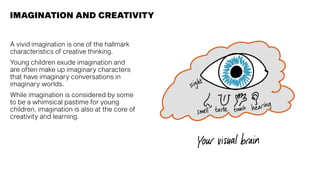
A vivid imagination is one of the hallmark
characteristics of creative thinking.
Young children exude imagination and
are often make up imaginary characters
that have imaginary conversations in
imaginary worlds.
While imagination is considered by some
to be a whimsical pastime for young
children, imagination is also at the core of
creativity and learning.
IMAGINATION AND CREATIVITY
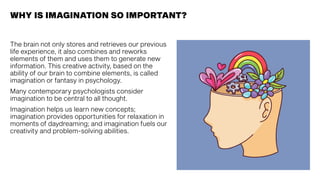
The brain not only stores and retrieves our previous
life experience, it also combines and reworks
elements of them and uses them to generate new
information. This creative activity, based on the
ability of our brain to combine elements, is called
imagination or fantasy in psychology.
Many contemporary psychologists consider
imagination to be central to all thought.
Imagination helps us learn new concepts;
imagination provides opportunities for relaxation in
moments of daydreaming; and imagination fuels our
creativity and problem-solving abilities.
WHY IS IMAGINATION SO IMPORTANT?
IMAGINING: SEEING WITH YOUR MIND’S EYE
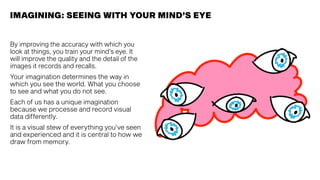
By improving the accuracy with which you
look at things, you train your mind’s eye. It
will improve the quality and the detail of the
images it records and recalls.
Your imagination determines the way in
which you see the world. What you choose
to see and what you do not see.
Each of us has a unique imagination
because we processe and record visual
data differently.
It is a visual stew of everything you’ve seen
and experienced and it is central to how we
draw from memory.
WHAT HAPPENS TO IMAGINATION?
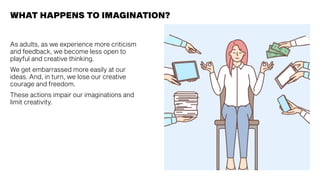
As adults, as we experience more criticism
and feedback, we become less open to
playful and creative thinking.
We get embarrassed more easily at our
ideas. And, in turn, we lose our creative
courage and freedom.
These actions impair our imaginations and
limit creativity.
WHAT HAPPENS TO IMAGINATION?
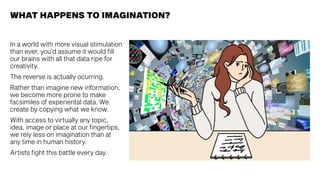
In a world with more visual stimulation
than ever, you’d assume it would fill
our brains with all that data ripe for
creativity.
The reverse is actually ocurring.
Rather than imagine new information,
we become more prone to make
facsimiles of experiental data. We
create by copying what we know.
With access to virtually any topic,
idea, image or place at our fingertips,
we rely less on imagination than at
any time in human history.
Artists fight this battle every day.
TEND TO YOUR IMAGINATION!
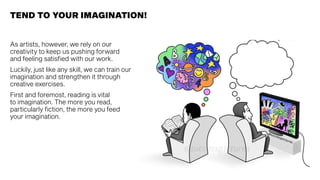
As artists, however, we rely on our
creativity to keep us pushing forward
and feeling satisfied with our work.
Luckily, just like any skill, we can train our
imagination and strengthen it through
creative exercises.
First and foremost, reading is vital
to imagination. The more you read,
particularly fiction, the more you feed
your imagination.
EXERCISE YOUR IMAGINATION
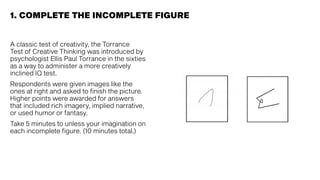
A classic test of creativity, the Torrance
Test of Creative Thinking was introduced by
psychologist Ellis Paul Torrance in the sixties
as a way to administer a more creatively
inclined IQ test.
Respondents were given images like the
ones at right and asked to finish the picture.
Higher points were awarded for answers
that included rich imagery, implied narrative,
or used humor or fantasy.
Take 5 minutes to unless your imagination on
each incomplete figure. (10 minutes total.)
1. COMPLETE THE INCOMPLETE FIGURE
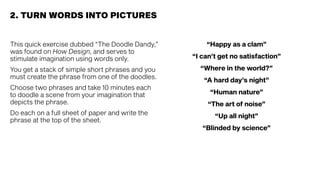
This quick exercise dubbed “The Doodle Dandy,”
was found on How Design, and serves to
stimulate imagination using words only.
You get a stack of simple short phrases and you
must create the phrase from one of the doodles.
Choose two phrases and take 10 minutes each
to doodle a scene from your imagination that
depicts the phrase.
Do each on a full sheet of paper and write the
phrase at the top of the sheet.
2. TURN WORDS INTO PICTURES
“Happy as a clam”
“I can’t get no satisfaction”
“Where in the world?”
“A hard day’s night”
“Human nature”
“The art of noise”
“Up all night”
“Blinded by science”
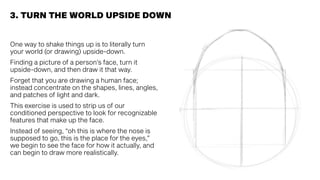
One way to shake things up is to literally turn
your world (or drawing) upside-down.
Finding a picture of a person’s face, turn it
upside-down, and then draw it that way.
Forget that you are drawing a human face;
instead concentrate on the shapes, lines, angles,
and patches of light and dark.
This exercise is used to strip us of our
conditioned perspective to look for recognizable
features that make up the face.
Instead of seeing, “oh this is where the nose is
supposed to go, this is the place for the eyes,”
we begin to see the face for how it actually, and
can begin to draw more realistically.
3. TURN THE WORLD UPSIDE DOWN
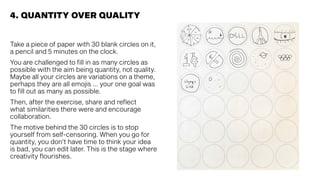
Take a piece of paper with 30 blank circles on it,
a pencil and 5 minutes on the clock.
You are challenged to fill in as many circles as
possible with the aim being quantity, not quality.
Maybe all your circles are variations on a theme,
perhaps they are all emojis … your one goal was
to fill out as many as possible.
Then, after the exercise, share and reflect
what similarities there were and encourage
collaboration.
The motive behind the 30 circles is to stop
yourself from self-censoring. When you go for
quantity, you don’t have time to think your idea
is bad, you can edit later. This is the stage where
creativity flourishes.
4. QUANTITY OVER QUALITY
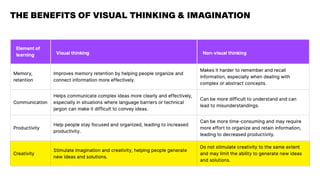
THE BENEFITS OF VISUAL THINKING & IMAGINATION

Using Imagination in Art and Visual Thinking

  • 1.
    VISUAL THINKING &IMAGINATION
  • 2.
    THE VISUAL THINKINGPROCESS The human brain can correctly identify images in the blink of an eye (within 100 milliseconds or less). When we see, we record visual data in our brains. Our life experiences have a profound incluence on the visual data that we record. This data is recalled very time we think. Visual thinking stimulates our imagination and creativity, helping us generate unique ideas and solutions.
  • 3.
    A vivid imaginationis one of the hallmark characteristics of creative thinking. Young children exude imagination and are often make up imaginary characters that have imaginary conversations in imaginary worlds. While imagination is considered by some to be a whimsical pastime for young children, imagination is also at the core of creativity and learning. IMAGINATION AND CREATIVITY
  • 4.
    The brain notonly stores and retrieves our previous life experience, it also combines and reworks elements of them and uses them to generate new information. This creative activity, based on the ability of our brain to combine elements, is called imagination or fantasy in psychology. Many contemporary psychologists consider imagination to be central to all thought. Imagination helps us learn new concepts; imagination provides opportunities for relaxation in moments of daydreaming; and imagination fuels our creativity and problem-solving abilities. WHY IS IMAGINATION SO IMPORTANT?
  • 5.
    IMAGINING: SEEING WITHYOUR MIND’S EYE By improving the accuracy with which you look at things, you train your mind’s eye. It will improve the quality and the detail of the images it records and recalls. Your imagination determines the way in which you see the world. What you choose to see and what you do not see. Each of us has a unique imagination because we processe and record visual data differently. It is a visual stew of everything you’ve seen and experienced and it is central to how we draw from memory.
  • 6.
    WHAT HAPPENS TOIMAGINATION? As adults, as we experience more criticism and feedback, we become less open to playful and creative thinking. We get embarrassed more easily at our ideas. And, in turn, we lose our creative courage and freedom. These actions impair our imaginations and limit creativity.
  • 7.
    WHAT HAPPENS TOIMAGINATION? In a world with more visual stimulation than ever, you’d assume it would fill our brains with all that data ripe for creativity. The reverse is actually ocurring. Rather than imagine new information, we become more prone to make facsimiles of experiental data. We create by copying what we know. With access to virtually any topic, idea, image or place at our fingertips, we rely less on imagination than at any time in human history. Artists fight this battle every day.
  • 8.
    TEND TO YOURIMAGINATION! As artists, however, we rely on our creativity to keep us pushing forward and feeling satisfied with our work. Luckily, just like any skill, we can train our imagination and strengthen it through creative exercises. First and foremost, reading is vital to imagination. The more you read, particularly fiction, the more you feed your imagination.
  • 9.
  • 10.
    A classic testof creativity, the Torrance Test of Creative Thinking was introduced by psychologist Ellis Paul Torrance in the sixties as a way to administer a more creatively inclined IQ test. Respondents were given images like the ones at right and asked to finish the picture. Higher points were awarded for answers that included rich imagery, implied narrative, or used humor or fantasy. Take 5 minutes to unless your imagination on each incomplete figure. (10 minutes total.) 1. COMPLETE THE INCOMPLETE FIGURE
  • 12.
    This quick exercisedubbed “The Doodle Dandy,” was found on How Design, and serves to stimulate imagination using words only. You get a stack of simple short phrases and you must create the phrase from one of the doodles. Choose two phrases and take 10 minutes each to doodle a scene from your imagination that depicts the phrase. Do each on a full sheet of paper and write the phrase at the top of the sheet. 2. TURN WORDS INTO PICTURES “Happy as a clam” “I can’t get no satisfaction” “Where in the world?” “A hard day’s night” “Human nature” “The art of noise” “Up all night” “Blinded by science”
  • 14.
    One way toshake things up is to literally turn your world (or drawing) upside-down. Finding a picture of a person’s face, turn it upside-down, and then draw it that way. Forget that you are drawing a human face; instead concentrate on the shapes, lines, angles, and patches of light and dark. This exercise is used to strip us of our conditioned perspective to look for recognizable features that make up the face. Instead of seeing, “oh this is where the nose is supposed to go, this is the place for the eyes,” we begin to see the face for how it actually, and can begin to draw more realistically. 3. TURN THE WORLD UPSIDE DOWN
  • 16.
    Take a pieceof paper with 30 blank circles on it, a pencil and 5 minutes on the clock. You are challenged to fill in as many circles as possible with the aim being quantity, not quality. Maybe all your circles are variations on a theme, perhaps they are all emojis … your one goal was to fill out as many as possible. Then, after the exercise, share and reflect what similarities there were and encourage collaboration. The motive behind the 30 circles is to stop yourself from self-censoring. When you go for quantity, you don’t have time to think your idea is bad, you can edit later. This is the stage where creativity flourishes. 4. QUANTITY OVER QUALITY
  • 18.
    THE BENEFITS OFVISUAL THINKING & IMAGINATION