Graffiti.
Where did the word
     GRAFFITI come from?
  Graffiti and graffito are from the Italian word
graffiato ("scratched"). "Graffiti" is applied in art
history to works of art produced by scratching a
design into a surface. A related term is
"sgraffito",[4] which involves scratching through
one layer of pigment to reveal another beneath
it. This technique was primarily used by potters
who would glaze their wares and then scratch a
design into it. In ancient times graffiti was carved
on walls with a sharp object, although sometimes
chalk or coal were used. The word originates
from Greek γράφειν — graphein — meaning "to
write."
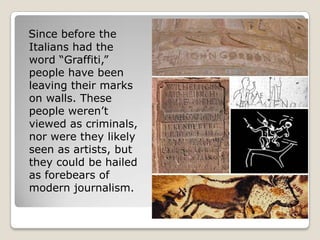
Since before the
Italians had the
word ―Graffiti,‖
people have been
leaving their marks
on walls. These
people weren’t
viewed as criminals,
nor were they likely
seen as artists, but
they could be hailed
as forebears of
modern journalism.
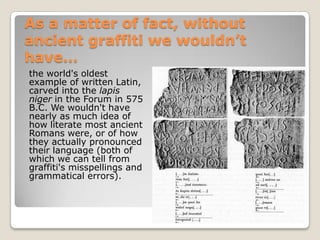
As a matter of fact, without
ancient graffiti we wouldn’t
have…
the world's oldest
example of written Latin,
carved into the lapis
niger in the Forum in 575
B.C. We wouldn't have
nearly as much idea of
how literate most ancient
Romans were, or of how
they actually pronounced
their language (both of
which we can tell from
graffiti's misspellings and
grammatical errors).
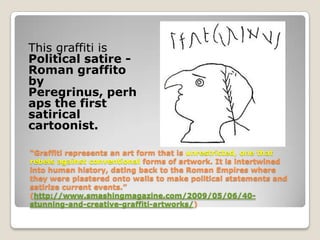
This graffiti is
Political satire -
Roman graffito
by
Peregrinus, perh
aps the first
satirical
cartoonist.

“Graffiti represents an art form that is unrestricted, one that
rebels against conventional forms of artwork. It is intertwined
into human history, dating back to the Roman Empires where
they were plastered onto walls to make political statements and
satirize current events.”
(http://www.smashingmagazine.com/2009/05/06/40-
stunning-and-creative-graffiti-artworks/)
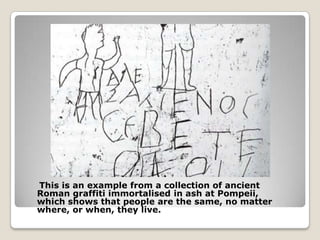
This is an example from a collection of ancient
Roman graffiti immortalised in ash at Pompeii,
which shows that people are the same, no matter
where, or when, they live.
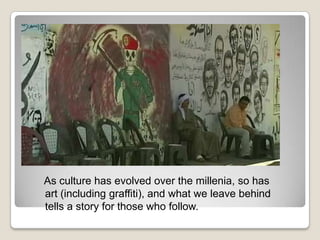
As culture has evolved over the millenia, so has
art (including graffiti), and what we leave behind
tells a story for those who follow.
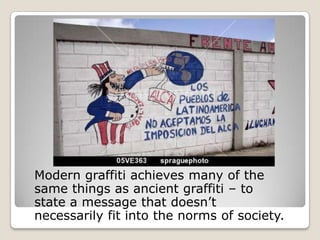
Modern graffiti achieves many of the
same things as ancient graffiti – to
state a message that doesn’t
necessarily fit into the norms of society.
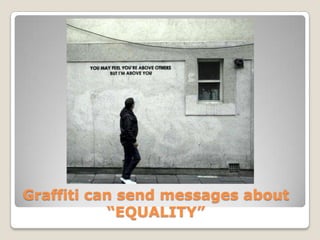
Graffiti can send messages about
           “EQUALITY”
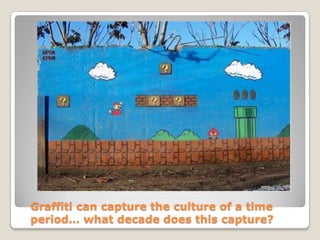
Graffiti can capture the culture of a time
period… what decade does this capture?
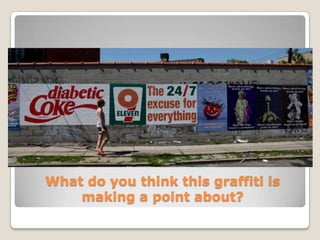
What do you think this graffiti is
    making a point about?
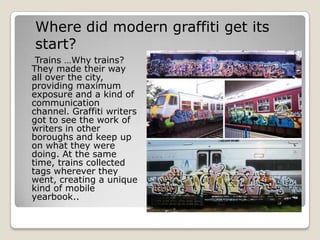
Where did modern graffiti get its
start?
 Trains …Why trains?
They made their way
all over the city,
providing maximum
exposure and a kind of
communication
channel. Graffiti writers
got to see the work of
writers in other
boroughs and keep up
on what they were
doing. At the same
time, trains collected
tags wherever they
went, creating a unique
kind of mobile
yearbook..
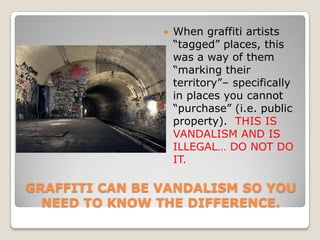
   When graffiti artists
                    ―tagged‖ places, this
                    was a way of them
                    ―marking their
                    territory‖– specifically
                    in places you cannot
                    ―purchase‖ (i.e. public
                    property). THIS IS
                    VANDALISM AND IS
                    ILLEGAL… DO NOT DO
                    IT.

GRAFFITI CAN BE VANDALISM SO YOU
  NEED TO KNOW THE DIFFERENCE.
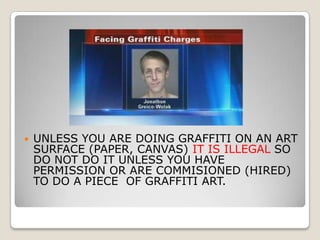
   UNLESS YOU ARE DOING GRAFFITI ON AN ART
    SURFACE (PAPER, CANVAS) IT IS ILLEGAL SO
    DO NOT DO IT UNLESS YOU HAVE
    PERMISSION OR ARE COMMISIONED (HIRED)
    TO DO A PIECE OF GRAFFITI ART.
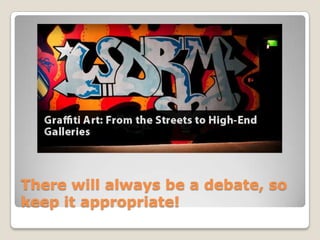
There will always be a debate, so
keep it appropriate!
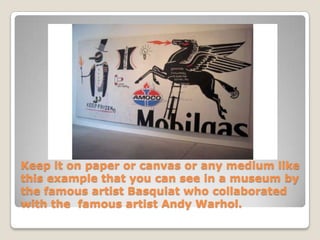
Keep it on paper or canvas or any medium like
this example that you can see in a museum by
the famous artist Basquiat who collaborated
with the famous artist Andy Warhol.
   Again, WE ARE LEARNING ABOUT IT
    BECAUSE IT IS STILL A HISTORICAL ART
    FORM THAT HAS EVOLVED OVER TIME.
    Suppose that Leonardo, Monet, Picasso, or any of the
    recognized artisans of Western European culture were alive in
    the present day. Then, suppose that one of these famous artists
    decided to paint a masterpiece on the side of your house or on
    your front door or on a wall in your neighborhood. Would
    Picasso or Monet's markings be graffiti or art or vandalism or
    graffiti art? The answer may vary across people. Their markings
    would qualify as vandalism only if they appeared on private or
    public property without permission. The same answer holds for
    the present day, genre of graffiti known as graffiti art.
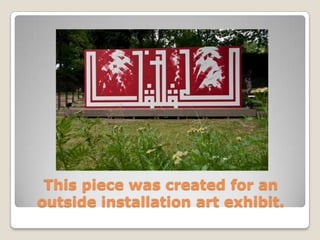
This piece was created for an
outside installation art exhibit.
So how do you do
 this on paper?
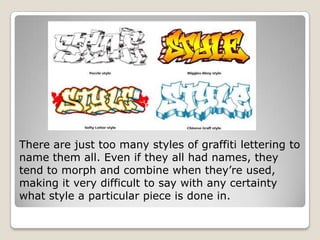
There are just too many styles of graffiti lettering to
name them all. Even if they all had names, they
tend to morph and combine when they’re used,
making it very difficult to say with any certainty
what style a particular piece is done in.
Let’s look at one
    example:
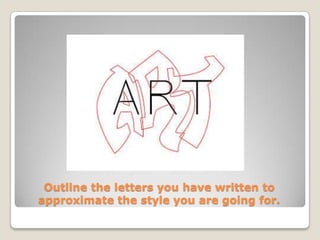
Outline the letters you have written to
approximate the style you are going for.
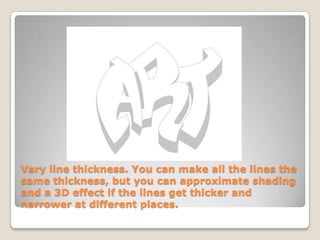
Vary line thickness. You can make all the lines the
same thickness, but you can approximate shading
and a 3D effect if the lines get thicker and
narrower at different places.
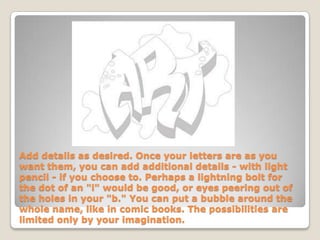
Add details as desired. Once your letters are as you
want them, you can add additional details - with light
pencil - if you choose to. Perhaps a lightning bolt for
the dot of an "i" would be good, or eyes peering out of
the holes in your "b." You can put a bubble around the
whole name, like in comic books. The possibilities are
limited only by your imagination.
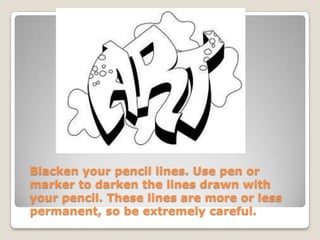
Blacken your pencil lines. Use pen or
marker to darken the lines drawn with
your pencil. These lines are more or less
permanent, so be extremely careful.
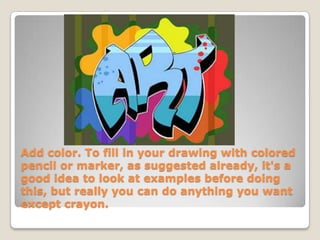
Add color. To fill in your drawing with colored
pencil or marker, as suggested already, it's a
good idea to look at examples before doing
this, but really you can do anything you want
except crayon.
Let’s also talk about ways to lay out
your paper so you don’t run out of
room for your lettering… I will show
you on the board and pass out some
sample fonts. Additionally we will
look at a website to get some
brainstorming… Let’s get started!

Graffiti art

  • 1.
  • 2.
    Where did theword GRAFFITI come from? Graffiti and graffito are from the Italian word graffiato ("scratched"). "Graffiti" is applied in art history to works of art produced by scratching a design into a surface. A related term is "sgraffito",[4] which involves scratching through one layer of pigment to reveal another beneath it. This technique was primarily used by potters who would glaze their wares and then scratch a design into it. In ancient times graffiti was carved on walls with a sharp object, although sometimes chalk or coal were used. The word originates from Greek γράφειν — graphein — meaning "to write."
  • 3.
    Since before the Italianshad the word ―Graffiti,‖ people have been leaving their marks on walls. These people weren’t viewed as criminals, nor were they likely seen as artists, but they could be hailed as forebears of modern journalism.
  • 4.
    As a matterof fact, without ancient graffiti we wouldn’t have… the world's oldest example of written Latin, carved into the lapis niger in the Forum in 575 B.C. We wouldn't have nearly as much idea of how literate most ancient Romans were, or of how they actually pronounced their language (both of which we can tell from graffiti's misspellings and grammatical errors).
  • 5.
    This graffiti is Politicalsatire - Roman graffito by Peregrinus, perh aps the first satirical cartoonist. “Graffiti represents an art form that is unrestricted, one that rebels against conventional forms of artwork. It is intertwined into human history, dating back to the Roman Empires where they were plastered onto walls to make political statements and satirize current events.” (http://www.smashingmagazine.com/2009/05/06/40- stunning-and-creative-graffiti-artworks/)
  • 6.
    This is anexample from a collection of ancient Roman graffiti immortalised in ash at Pompeii, which shows that people are the same, no matter where, or when, they live.
  • 7.
    As culture hasevolved over the millenia, so has art (including graffiti), and what we leave behind tells a story for those who follow.
  • 8.
    Modern graffiti achievesmany of the same things as ancient graffiti – to state a message that doesn’t necessarily fit into the norms of society.
  • 9.
    Graffiti can sendmessages about “EQUALITY”
  • 10.
    Graffiti can capturethe culture of a time period… what decade does this capture?
  • 11.
    What do youthink this graffiti is making a point about?
  • 12.
    Where did moderngraffiti get its start? Trains …Why trains? They made their way all over the city, providing maximum exposure and a kind of communication channel. Graffiti writers got to see the work of writers in other boroughs and keep up on what they were doing. At the same time, trains collected tags wherever they went, creating a unique kind of mobile yearbook..
  • 13.
    When graffiti artists ―tagged‖ places, this was a way of them ―marking their territory‖– specifically in places you cannot ―purchase‖ (i.e. public property). THIS IS VANDALISM AND IS ILLEGAL… DO NOT DO IT. GRAFFITI CAN BE VANDALISM SO YOU NEED TO KNOW THE DIFFERENCE.
  • 14.
    UNLESS YOU ARE DOING GRAFFITI ON AN ART SURFACE (PAPER, CANVAS) IT IS ILLEGAL SO DO NOT DO IT UNLESS YOU HAVE PERMISSION OR ARE COMMISIONED (HIRED) TO DO A PIECE OF GRAFFITI ART.
  • 15.
    There will alwaysbe a debate, so keep it appropriate!
  • 16.
    Keep it onpaper or canvas or any medium like this example that you can see in a museum by the famous artist Basquiat who collaborated with the famous artist Andy Warhol.
  • 17.
    Again, WE ARE LEARNING ABOUT IT BECAUSE IT IS STILL A HISTORICAL ART FORM THAT HAS EVOLVED OVER TIME. Suppose that Leonardo, Monet, Picasso, or any of the recognized artisans of Western European culture were alive in the present day. Then, suppose that one of these famous artists decided to paint a masterpiece on the side of your house or on your front door or on a wall in your neighborhood. Would Picasso or Monet's markings be graffiti or art or vandalism or graffiti art? The answer may vary across people. Their markings would qualify as vandalism only if they appeared on private or public property without permission. The same answer holds for the present day, genre of graffiti known as graffiti art.
  • 18.
    This piece wascreated for an outside installation art exhibit.
  • 19.
    So how doyou do this on paper?
  • 20.
    There are justtoo many styles of graffiti lettering to name them all. Even if they all had names, they tend to morph and combine when they’re used, making it very difficult to say with any certainty what style a particular piece is done in.
  • 21.
    Let’s look atone example:
  • 22.
    Outline the lettersyou have written to approximate the style you are going for.
  • 23.
    Vary line thickness.You can make all the lines the same thickness, but you can approximate shading and a 3D effect if the lines get thicker and narrower at different places.
  • 24.
    Add details asdesired. Once your letters are as you want them, you can add additional details - with light pencil - if you choose to. Perhaps a lightning bolt for the dot of an "i" would be good, or eyes peering out of the holes in your "b." You can put a bubble around the whole name, like in comic books. The possibilities are limited only by your imagination.
  • 25.
    Blacken your pencillines. Use pen or marker to darken the lines drawn with your pencil. These lines are more or less permanent, so be extremely careful.
  • 26.
    Add color. Tofill in your drawing with colored pencil or marker, as suggested already, it's a good idea to look at examples before doing this, but really you can do anything you want except crayon.
  • 27.
    Let’s also talkabout ways to lay out your paper so you don’t run out of room for your lettering… I will show you on the board and pass out some sample fonts. Additionally we will look at a website to get some brainstorming… Let’s get started!