Creation and Evolution  #5 What do Science and the Bible say about Human Origins?
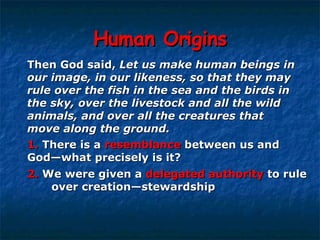
Human Origins Then God said,  Let us make human beings in  our image, in our likeness, so that they may  rule over the fish in the sea and the birds in  the sky, over the livestock and all the wild  animals, and over all the creatures that  move along the ground. 1.   There is a  resemblance  between us and  God—what precisely is it? 2.   We were given a  delegated authority  to rule  over creation—stewardship
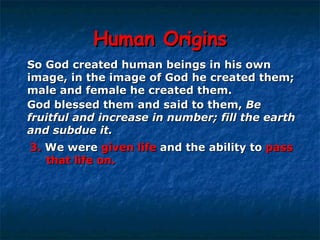
Human Origins So God created human beings in his own  image, in the image of God he created them;  male and female he created them. God blessed them and said to them,  Be  fruitful and increase in number; fill the earth  and subdue it.   3.   We were  given   life  and the ability to  pass   that life on.
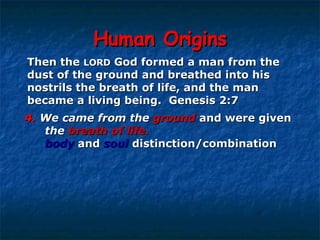
Human Origins Then the  LORD  God formed a man from the  dust of the ground and breathed into his  nostrils the breath of life, and the man  became a living being.  Genesis 2:7  4.   We came from the   ground  and were given  the   breath of life.   body   and   soul   distinction/combination
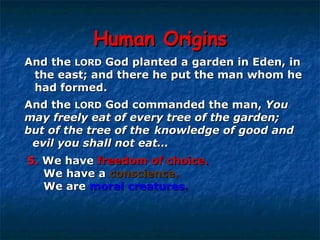
Human Origins And the  LORD  God commanded the man,  You  may freely eat of every tree of the garden;  but of the tree of the  knowledge of good and  evil   you shall not eat… And the  LORD  God planted a garden in Eden, in  the east; and there he put the man whom he  had formed.  5.  We have  freedom of choice.   We have a  conscience.   We are  moral creatures .
Human Origins The  LORD  God said,  It is not good that the man  should be alone; I will make a helper as his  partner.   So out of the ground the  LORD  God formed  every animal of the field and every bird of the  air, and brought them to the man… but for the man there was not found a helper  as his partner.
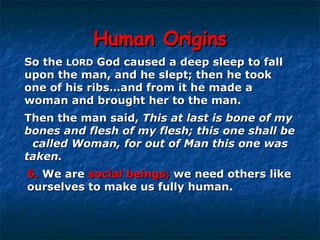
Human Origins So the  LORD  God caused a deep sleep to fall  upon the man, and he slept; then he took  one of his ribs…and from it he made a  woman and brought her to the man.  Then the man said,  This at last is bone of my  bones and flesh of my flesh; this one shall be  called Woman, for out of Man this one was  taken. 6.  We are  social beings;  we need others like  ourselves to make us fully human.
Human Origins 1.   There is a  resemblance  between us and God  —what precisely is it? 2.   We were given a  delegated authority  to rule  over creation—stewardship   3.   We were  given life  and the ability to  pass that  life on.
Human Origins 4.   We came from the   ground  and were given the   breath of life.   body   and   soul   distinction/combination 5.  We have  freedom of choice.   We have a  conscience .   We are  moral creatures . 6.  We are  social beings;  we need others like  ourselves to make us fully human.
Questions evolution raises: 1.   What  makes  us human beings unique? 2.   How did we  become  unique? 4.  When did  death  become a reality? 5.  Was there a  Fall —or  was there a  goal  not  reached? What does the evidence of so much early death say about the character of God? 3.   What about  miracles ?  How does (can?)  God intervene in an evolutionary process?
What makes us unique? A.   We are   image bearers of God .    What does that mean? 1.  We have greater  mental  and  social  abilities  than other creatures. 2.  We alone have a  personal relationship  with  God. 3.  We have been  commissioned  by God to be  the stewards of his creation.
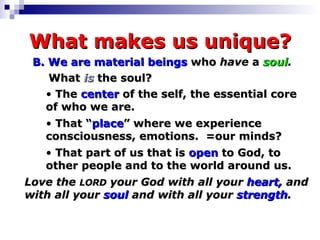
What makes us unique? B. We   are   material beings  who  have  a  soul . What  is  the soul? The  center  of the self, the essential core  of who we are. That “ place ” where we experience  consciousness, emotions.  =our minds?  That part of us that is  open  to God, to  other people and to the world around us. Love the  LORD  your God with all your  heart,  and with all your  soul  and with all your  strength .
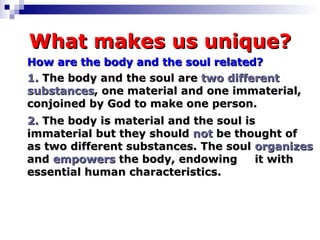
What makes us unique? How are the body and the soul related? 1.  The body and the soul are  two different  substances , one material and one immaterial,  conjoined by God to make one person. 2.  The body is material and the soul is  immaterial but they should  not  be thought of  as two different substances. The soul  organizes  and  empowers  the body, endowing  it with essential human characteristics.
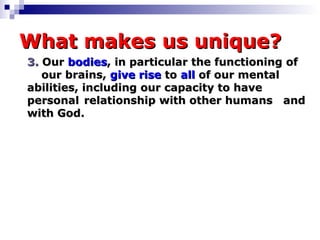
What makes us unique? 3.   Our  bodies , in particular the functioning of  our brains,  give rise   to   all  of our mental  abilities, including our capacity to have  personal  relationship with other humans  and with God.
How did we become unique? 1.  Souls are  added  to our bodies at ________. Souls are  pre-existent  [Origen, Mormons (?)] Souls are  individually created  for each  person. Souls are  sexually passed .
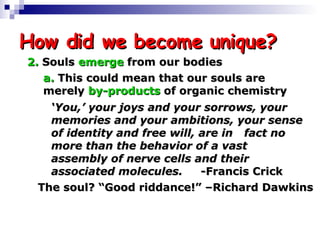
How did we become unique? 2.  Souls  emerge  from our bodies a.   This could mean that our souls are  merely  by-products  of organic chemistry ‘ You,’ your joys and your sorrows, your  memories and your ambitions, your  sense of identity and free will, are in  fact no more than the behavior of a vast  assembly of nerve cells and their  associated molecules.   -Francis Crick The soul? “Good riddance!” –Richard Dawkins
How did we become unique? 2.  Souls  emerge  from our bodies b.  This could mean that a  new entity  called  soul  comes into being.
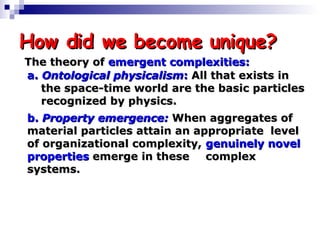
How did we become unique? b.  Property emergence:  When aggregates of  material particles attain an appropriate  level of organizational complexity,  genuinely novel properties  emerge in these  complex systems. a.  Ontological physicalism :  All that exists in  the space-time world are the basic particles  recognized by physics. The theory of  emergent complexities:
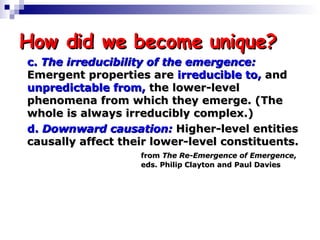
How did we become unique? c.  The irreducibility of the emergence:   Emergent properties are  irreducible to,  and  unpredictable from,  the lower-level  phenomena from which they emerge. (The  whole is always irreducibly complex.) d.  Downward causation:  Higher-level entities  causally affect their lower-level constituents.  from  The Re-Emergence of Emergence ,  eds. Philip Clayton and Paul Davies
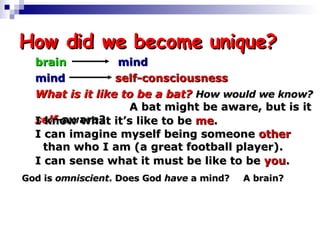
How did we become unique? What is it like to be a bat?   How would we know?   A bat might be aware, but is it  self - aware? I know what it’s like to be  me .  I can sense what it must be like to be  you . I can imagine myself being someone  other   than who I am (a great football player). God is  omniscient . Does God  have  a mind?  A brain? brain mind mind self-consciousness
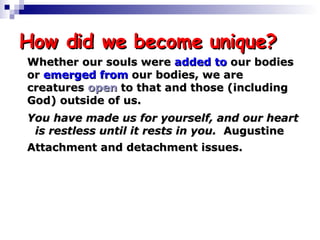
How did we become unique? Whether our souls were  added   to  our bodies  or  emerged   from  our bodies, we are  creatures  open  to that and those (including  God) outside of us. You have made us for yourself, and our heart  is restless until it rests in you.  Augustine Attachment and detachment issues.
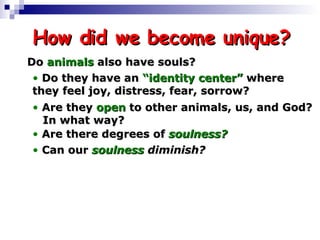
How did we become unique? Do  animals  also have souls? Do they have an  “identity center”  where  they feel joy, distress, fear, sorrow?  Are they  open  to other animals, us, and God?  In what way? Are there degrees of  soulness? Can our  soulness  diminish?
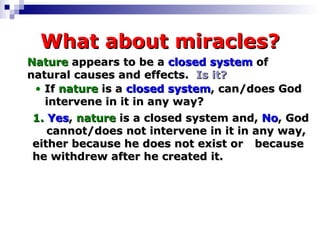
What about miracles? Nature  appears to be a  closed system  of  natural causes and effects.  Is it? If  nature  is a  closed system , can/does God   intervene in it in any way? 1.   Yes ,  nature  is a closed system and,  No , God  cannot/does not intervene in it in any way,  either because he does not exist or  because he withdrew after he created it.
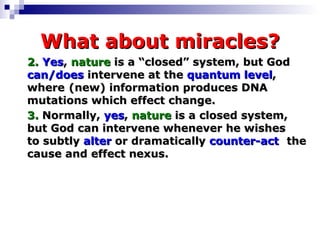
What about miracles? 2.   Yes ,  nature  is a “closed” system, but God  can/does  intervene at the  quantum level ,  where  (new) information produces DNA  mutations which effect change.  3.  Normally,  yes ,  nature  is a closed system,  but God can intervene whenever he wishes  to subtly  alter  or dramatically  counter-act   the cause and effect nexus.
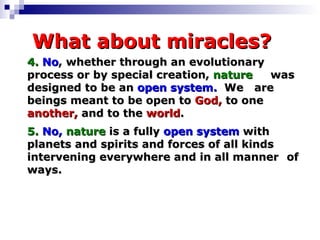
What about miracles? 4.   No , whether through an evolutionary  process or by special creation,  nature   was designed to be an  open   system.   We  are beings meant to be open to  God,  to one  another,  and to the  world .   5.   No,   nature  is a fully  open system  with  planets and spirits and forces of all kinds  intervening everywhere and in all manner  of ways.
When did death become a reality? According to evolutionary theory,  animals   have died,  species  have become extinct, long  before  homo sapiens  appeared on the earth.  If Adam and Eve lived 10,000 years ago, earlier  forms of the  human species  also died.  We Christians have always assumed that  death is a  consequence  of Adam & Eve’s  sin .
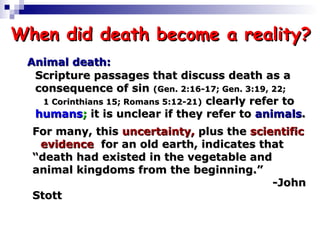
When did death become a reality? Animal death:   Scripture passages that discuss death as a  consequence of sin  (Gen. 2:16-17; Gen. 3:19, 22;    1 Corinthians 15; Romans 5:12-21)  clearly refer to  humans ;  it is unclear if they refer to  animals . For many, this  uncertainty,  plus the  scientific  evidence   for an old earth, indicates that  “death had existed in the vegetable and  animal kingdoms from the beginning.”  -John Stott
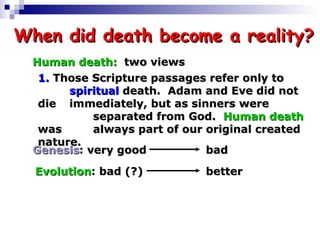
When did death become a reality? Human death:   two views 1.  Those Scripture passages refer only to  spiritual  death.  Adam and Eve did not die  immediately, but as sinners were  separated from God.  Human death  was  always part of our original created nature. Genesis :  very good bad Evolution :  bad (?) better
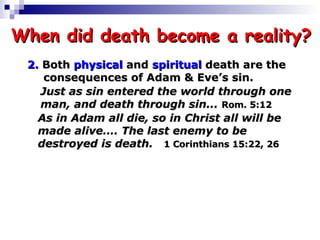
When did death become a reality? 2.  Both  physical  and  spiritual  death are the  consequences of Adam & Eve’s sin. Just as sin entered the world through one  man, and death through sin...  Rom. 5:12   As in Adam all die, so in Christ all will be  made alive…. The last enemy to be  destroyed is death.   1 Corinthians 15:22, 26
When did death become a reality? a.  Were Adam and Eve created  immortal?  If so, they would have had bodies that did   not age, resisted diseases, repaired     themselves when injured, etc.  The  perishable  must clothe itself with the    imperishable , the  mortal  with  immortality .  Did the opposite occur at the beginning?
When did death become a reality? b.  Were Adam and Eve created  mortal  but  with the potential to become  immortal ? They would then have had bodies similar   to ours that, if they had obeyed God,     would have become  immortal . The presence of the  tree of life  makes sense   if Adam and Eve were mortal and needed       something to make them immortal. (Did     they regularly eat of that tree, or were they   going to be given an opportunity to eat of it   once—to determine the length of their     lives?
What makes us unique? So, was there a  Fall  —or  was there a  goal  not reached?

Creation And Evolution Session 5

  • 1.
    Creation and Evolution #5 What do Science and the Bible say about Human Origins?
  • 2.
    Human Origins ThenGod said, Let us make human beings in our image, in our likeness, so that they may rule over the fish in the sea and the birds in the sky, over the livestock and all the wild animals, and over all the creatures that move along the ground. 1. There is a resemblance between us and God—what precisely is it? 2. We were given a delegated authority to rule over creation—stewardship
  • 3.
    Human Origins SoGod created human beings in his own image, in the image of God he created them; male and female he created them. God blessed them and said to them, Be fruitful and increase in number; fill the earth and subdue it. 3. We were given life and the ability to pass that life on.
  • 4.
    Human Origins Thenthe LORD God formed a man from the dust of the ground and breathed into his nostrils the breath of life, and the man became a living being. Genesis 2:7 4. We came from the ground and were given the breath of life. body and soul distinction/combination
  • 5.
    Human Origins Andthe LORD God commanded the man, You may freely eat of every tree of the garden; but of the tree of the knowledge of good and evil you shall not eat… And the LORD God planted a garden in Eden, in the east; and there he put the man whom he had formed. 5. We have freedom of choice. We have a conscience. We are moral creatures .
  • 6.
    Human Origins The LORD God said, It is not good that the man should be alone; I will make a helper as his partner. So out of the ground the LORD God formed every animal of the field and every bird of the air, and brought them to the man… but for the man there was not found a helper as his partner.
  • 7.
    Human Origins Sothe LORD God caused a deep sleep to fall upon the man, and he slept; then he took one of his ribs…and from it he made a woman and brought her to the man. Then the man said, This at last is bone of my bones and flesh of my flesh; this one shall be called Woman, for out of Man this one was taken. 6. We are social beings; we need others like ourselves to make us fully human.
  • 8.
    Human Origins 1. There is a resemblance between us and God —what precisely is it? 2. We were given a delegated authority to rule over creation—stewardship 3. We were given life and the ability to pass that life on.
  • 9.
    Human Origins 4. We came from the ground and were given the breath of life. body and soul distinction/combination 5. We have freedom of choice. We have a conscience . We are moral creatures . 6. We are social beings; we need others like ourselves to make us fully human.
  • 10.
    Questions evolution raises:1. What makes us human beings unique? 2. How did we become unique? 4. When did death become a reality? 5. Was there a Fall —or was there a goal not reached? What does the evidence of so much early death say about the character of God? 3. What about miracles ? How does (can?) God intervene in an evolutionary process?
  • 11.
    What makes usunique? A. We are image bearers of God . What does that mean? 1. We have greater mental and social abilities than other creatures. 2. We alone have a personal relationship with God. 3. We have been commissioned by God to be the stewards of his creation.
  • 12.
    What makes usunique? B. We are material beings who have a soul . What is the soul? The center of the self, the essential core of who we are. That “ place ” where we experience consciousness, emotions. =our minds? That part of us that is open to God, to other people and to the world around us. Love the LORD your God with all your heart, and with all your soul and with all your strength .
  • 13.
    What makes usunique? How are the body and the soul related? 1. The body and the soul are two different substances , one material and one immaterial, conjoined by God to make one person. 2. The body is material and the soul is immaterial but they should not be thought of as two different substances. The soul organizes and empowers the body, endowing it with essential human characteristics.
  • 14.
    What makes usunique? 3. Our bodies , in particular the functioning of our brains, give rise to all of our mental abilities, including our capacity to have personal relationship with other humans and with God.
  • 15.
    How did webecome unique? 1. Souls are added to our bodies at ________. Souls are pre-existent [Origen, Mormons (?)] Souls are individually created for each person. Souls are sexually passed .
  • 16.
    How did webecome unique? 2. Souls emerge from our bodies a. This could mean that our souls are merely by-products of organic chemistry ‘ You,’ your joys and your sorrows, your memories and your ambitions, your sense of identity and free will, are in fact no more than the behavior of a vast assembly of nerve cells and their associated molecules. -Francis Crick The soul? “Good riddance!” –Richard Dawkins
  • 17.
    How did webecome unique? 2. Souls emerge from our bodies b. This could mean that a new entity called soul comes into being.
  • 18.
    How did webecome unique? b. Property emergence: When aggregates of material particles attain an appropriate level of organizational complexity, genuinely novel properties emerge in these complex systems. a. Ontological physicalism : All that exists in the space-time world are the basic particles recognized by physics. The theory of emergent complexities:
  • 19.
    How did webecome unique? c. The irreducibility of the emergence: Emergent properties are irreducible to, and unpredictable from, the lower-level phenomena from which they emerge. (The whole is always irreducibly complex.) d. Downward causation: Higher-level entities causally affect their lower-level constituents. from The Re-Emergence of Emergence , eds. Philip Clayton and Paul Davies
  • 20.
    How did webecome unique? What is it like to be a bat? How would we know? A bat might be aware, but is it self - aware? I know what it’s like to be me . I can sense what it must be like to be you . I can imagine myself being someone other than who I am (a great football player). God is omniscient . Does God have a mind? A brain? brain mind mind self-consciousness
  • 21.
    How did webecome unique? Whether our souls were added to our bodies or emerged from our bodies, we are creatures open to that and those (including God) outside of us. You have made us for yourself, and our heart is restless until it rests in you. Augustine Attachment and detachment issues.
  • 22.
    How did webecome unique? Do animals also have souls? Do they have an “identity center” where they feel joy, distress, fear, sorrow? Are they open to other animals, us, and God? In what way? Are there degrees of soulness? Can our soulness diminish?
  • 23.
    What about miracles?Nature appears to be a closed system of natural causes and effects. Is it? If nature is a closed system , can/does God intervene in it in any way? 1. Yes , nature is a closed system and, No , God cannot/does not intervene in it in any way, either because he does not exist or because he withdrew after he created it.
  • 24.
    What about miracles?2. Yes , nature is a “closed” system, but God can/does intervene at the quantum level , where (new) information produces DNA mutations which effect change. 3. Normally, yes , nature is a closed system, but God can intervene whenever he wishes to subtly alter or dramatically counter-act the cause and effect nexus.
  • 25.
    What about miracles?4. No , whether through an evolutionary process or by special creation, nature was designed to be an open system. We are beings meant to be open to God, to one another, and to the world . 5. No, nature is a fully open system with planets and spirits and forces of all kinds intervening everywhere and in all manner of ways.
  • 26.
    When did deathbecome a reality? According to evolutionary theory, animals have died, species have become extinct, long before homo sapiens appeared on the earth. If Adam and Eve lived 10,000 years ago, earlier forms of the human species also died. We Christians have always assumed that death is a consequence of Adam & Eve’s sin .
  • 27.
    When did deathbecome a reality? Animal death: Scripture passages that discuss death as a consequence of sin (Gen. 2:16-17; Gen. 3:19, 22; 1 Corinthians 15; Romans 5:12-21) clearly refer to humans ; it is unclear if they refer to animals . For many, this uncertainty, plus the scientific evidence for an old earth, indicates that “death had existed in the vegetable and animal kingdoms from the beginning.” -John Stott
  • 28.
    When did deathbecome a reality? Human death: two views 1. Those Scripture passages refer only to spiritual death. Adam and Eve did not die immediately, but as sinners were separated from God. Human death was always part of our original created nature. Genesis : very good bad Evolution : bad (?) better
  • 29.
    When did deathbecome a reality? 2. Both physical and spiritual death are the consequences of Adam & Eve’s sin. Just as sin entered the world through one man, and death through sin... Rom. 5:12 As in Adam all die, so in Christ all will be made alive…. The last enemy to be destroyed is death. 1 Corinthians 15:22, 26
  • 30.
    When did deathbecome a reality? a. Were Adam and Eve created immortal? If so, they would have had bodies that did not age, resisted diseases, repaired themselves when injured, etc. The perishable must clothe itself with the imperishable , the mortal with immortality . Did the opposite occur at the beginning?
  • 31.
    When did deathbecome a reality? b. Were Adam and Eve created mortal but with the potential to become immortal ? They would then have had bodies similar to ours that, if they had obeyed God, would have become immortal . The presence of the tree of life makes sense if Adam and Eve were mortal and needed something to make them immortal. (Did they regularly eat of that tree, or were they going to be given an opportunity to eat of it once—to determine the length of their lives?
  • 32.
    What makes usunique? So, was there a Fall —or was there a goal not reached?