The Land before Time; How Old is our Earth,  How to Explain the Scientific Findings regarding the Age of Dinosaurs’ Fossils from Biblical Point of View   Background In the summer of 2009, Belle (my wife), Jonathan (my 12 years old son) and I took a trip to a famous Christian museum for our summer vacation. During our visit in this museum,  one thing caught my and Jonathan’s eyes at the same time; a model of Noah’s Ark stands  on the ground with dinosaurs beside it. Both of us looked at each other without saying a word.  Continuing our journey, more display regarding the young earth theory appeared.  It was a wonderful feeling to observe such a great presentation regarding Genesis.  The tour came to an end. At the book store, an author was there signing his autograph  regarding his new book for his readers. At his free time, Jonathan went to him asking him a question with good manner.  “How did dinosaurs extinguish after they came out of Ark?” asked Jonathan.  “ With nature cause.” replied the author. Then Jonathan thanked him politely and left with an unsatisfied look  on his face, I observed.  During the trip back home, Jonathan asked me one question that I could not answer with biblical confidence.  He stated “How old is our earth?”  Immediately I realized where the problem was. At school, science t aught  him that our earth is billion or  trillion years old based on the scientific findings. However, during the trip, he was told that earth is only  several thousand years old. This conflict between science and biblical teachings puzzled him at that moment.  And he is not alone. Today, thousands of our teen Christians face the same challenge in their daily life  and this unresolved challenge may cause the final loss of our next generation being away from Christ if we can not offer a “satisfied” answer to them.  Therefore, my research journey starts with Jonathan’s question; “ How old is our earth?”
Introduction Dr. Hugh Ross, a respectable Christian apologetics, stated the following in his lecture  Creation as Science in 2007 :  “ Over the past 20 years, creation evolution debate has become increasingly more hostile, and society is becoming  more and more polarized as the results of these debates .” Indeed. In today’s scientific and biblical fields, both sides positioned themselves at extremely aggressive offensive  mood, like tit for tat. The most visible example is at Genesis 1, the creation of the world. At present, the major  interpreters of the Genesis Account in Bible are : The Young Earth Creationism ,  The Progressive Creationism  and  The Gap  or Restoration Theory This article will briefly cover the approaches of these three creation theories and their drawbacks respectively. The author will then present his finding by revisiting Genesis 1:1-1 0  and suggest how to accommodate  the scientific findings biblically, i.e. the age of the Earth.
The following information was quoted from  “ Kregel Dictionary of the Bible and the Theology”, Henry W. Holloman (2005) The Young Earth (or Recent) Creationism “ young earth” creationism, on the other hand, incorporates flood geology. This theory looks at earth’s topography  and geologic column to see if it can better be explained by the action of Genesis flood. Young earth creationists  disagree  o ver the age of the earth, but all hold that the lengths of time should be measured in thousands, rather than millions or  b illions of years … Young earth creationism posits a literal, grammatical-historical reading of  Genesis one, with creation occurring over six successive, literal solar days of creative activity. (pp.89) (2) The Progressive Creationism They believe that everything ultimately originated from God’s creative acts, which probably occurred with long  intervening interval and included only broad categories of life forms. All other life forms have diversified from these  original forms through macroevolution as naturalistic evolutionists and theistic evolutionists teach.  To accommodate this view, “day” in Genesis one usually is understood as a vast, indefinite period of time (as in  day-age theory)… Thus, the days of Genesis are not literal solar days of God’s creative activity as in recent  creationism. (pp.92) Exegetical evidence favors the view that the days are successive twenty-four hour span of time… the six days of  creation are all described as being composed of light and dark portions (e.g., Gen 1:5), indicating a solar cycle.(pp.90) The two poles of evangelical viewpoint, recent creationism and progressive creationism, both cite abundant  evidence from Scripture and science to support their respective theories. Both are quick to point out the weakness  in the opposing extremes, and in the views of those who take a middle ground.  Recent creationists seems to have a  stronger case from biblical exegesis but a weaker case from scientific evidence. Progressive creationists tend to  follow what they see as strong arguments in science, but their view gives ground in biblical exegesis.(pp.92)
(3) The Gap or Restoration Theory Advocates of the gap view generally believe that the creation narrative describes restoration of the earth following a divine judgment that occurred because of the fall of Satan and the other angles who collaborated with him …  There are two versions of this theory, depend on how Genesis 1:1-2 is translated and where the gap is placed in the  relation to the passage.  [Gap A] First, if the fall of Satan and the resultant divine judgment upon him and the earth took place between  Genesis 1:1 and 1:2, then v.1 presents the original, perfect creation and v.2a reveals the imperfect and chaotic  condition after divine judgment. Thus, v.2a should be translated: “ The earth  became  formless and Void.”   The Proposed gap between v.1 and v.2a could have been a vast period,  allowing for the geologic age…  [Gap B] Second, if the original creation and the fall of Satan took place before Genesis 1:1, then, according to  this theory, “In the beginning” (v.1a) refers to a relative beginning of God’s creative activity, rather than to an  original creation of Heavens and earth. Thus, vv. 1-2 should be translated: “ When  God began to create the heavens and the earth, the earth was without form and void; and darkness was  upon the face of the deep.”… Under this view, passages such as John 1:3, Colossians 1:16, and Hebrew 1:2 would refer to original creation, but  Not Genesis one. The translation of Genesis 1:1 in this view and the translation of Genesis 1:2 in the previous view are grammatically  possible,  but they are highly improbable, especially when examined in the clear sense of other Scripture passages. No ancient or serious modern versions have ever rendered Genesis in either of these ways.  (pp.89). [End of Quoting]
More finding on Gap Theory [A and B] From “Unger, Merrill F., Unger’s Bible Handbook. Chicago: Moody Press, 1966.”  “ Genesis 1:2 and the Gap Theory. This verse has been sometimes held to portray a chaotic visitation of divine  judgment upon the original earth and made a slot to pigeonhole scientific difficulties.  To place this gap in 1:2  is untenable as is proved by the Hebrew text,  which shows that all three clauses of 1:2 are circumstantial either t o the main clause in 1:1 or that in 1:3. Presumably 1:2 is circumstantial to 1:1,  putting the gap not in 1:2 [GAP A] but before 1:1 [GAP B]. This is a possible interpretation that must be reckoned with in an era of alleged conflict  between  t he Genesis account of creation and modern science”  (pp.37-38) Now let’s revisit Genesis 1:1-10 focusing on three key words/phrase:  earth ,  create  and  in the beginning
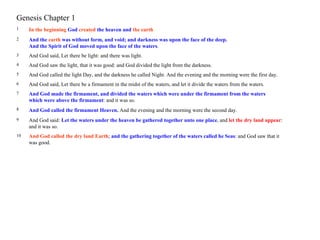
Genesis Chapter 1 And God called the dry land Earth ;  and the gathering together of the waters called he Seas : and God saw that it  was good.  10 And God said:  Let the waters under the heaven be gathered together unto one place , and  let the dry land appear :  and it was so.  9 And God called the firmament Heaven.  And the evening and the morning were the second day.  8 And God made the firmament, and divided the waters which were under the firmament from the waters  which were above the firmament : and it was so.  7 And God said, Let there be a firmament in the midst of the waters, and let it divide the waters from the waters.  6 And God called the light Day, and the darkness he called Night. And the evening and the morning were the first day.  5 And God saw the light, that it was good: and God divided the light from the darkness.  4 And God said, Let there be light: and there was light.  3 And the  earth  was without form, and void;   and darkness was upon the face of the deep.  And the Spirit of God moved upon the face of the waters .   2 In the beginning  God  created  the heaven and  the earth .  1
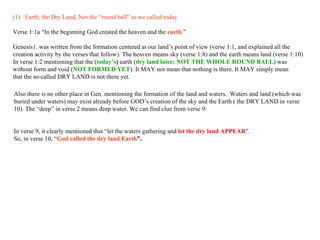
Earth; the Dry Land, Not the “round ball” as we called today Verse 1:1a “ In the beginning   God   created   the heaven and   the   earth .” Genesis1. was written from the formation centered at our land’s point of view (verse 1:1, and explained all the  creation activity by the verses that follow). The heaven means sky (verse 1:8) and the earth means land (verse 1:10) In verse 1:2 mentioning that the ( today’s )  earth ( dry   land later; NOT THE WHOLE ROUND BALL ) was  without form and void ( NOT FORMED YET ). It MAY not mean that nothing is there. It MAY simply mean  that the so-called DRY LAND is not there yet.  Also there is no other place in Gen. mentioning the formation of the land and waters.  Waters and land (which was buried under waters) may exist already before GOD’s creation of the sky and the Earth ( the DRY LAND in verse 10). The “deep” in verse 2 means deep water. We can find clue from verse 9: In verse 9, it clearly mentioned that “let the waters gathering and  let the dry land   APPEAR ”.  So, in verse 10, “ God called the dry land Earth ”.
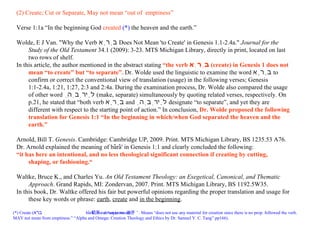
(*) Create ( בּרא , bârâ‘, cut down (a wood)  切开  or “separate  分开 ” . Means “does not use any material for creation since there is no prop. followed the verb.  MAY not mean from emptiness.” “Alpha and Omega: Creation Theology and Ethics by Dr. Samuel Y. C. Tang” pp166 ).  (2) Create; Cut or Separate, May not mean “out of  emptiness” Verse 1:1a “ In the beginning   God   created  (*)   the heaven and   the earth .” Wolde, E J Van. "Why the Verb  בָּרָא   Does Not Mean 'to Create' in Genesis 1.1-2.4a."  Journal for the Study of the Old Testament  34.1 (2009): 3-23.  MTS Michigan Library, directly in print, located on last two rows of shelf. In this article, the author mentioned in the abstract stating  “the verb  בָּרָא   (create) in Genesis 1 does not mean “to create” but “to separate”.  Dr. Wolde used the linguistic to examine the word  בָּרָא   to confirm or correct the conventional view of translation (usage) in the following verses; Genesis 1:1-2.4a, 1:21, 1:27, 2:3 and 2:4a. During the examination process, Dr. Wolde also compared the usage of other word  לָירְבְהַ   (make, separate) simultaneously by quoting related verses, respectively. On p.21, he stated that “both verb  בָּרָא   and  לָירְבְהַ   designate “to separate”, and yet they are different with respect to the starting point of action.” In conclusion,  Dr. Wolde proposed the following translation for Genesis 1:1 “In the beginning in which/when God separated the heaven and the earth.” Arnold, Bill T.  Genesis . Cambridge: Cambridge UP, 2009. Print.  MTS Michigan Library, BS 1235.53 A76.  Dr. Arnold explained the meaning of bârâ' in Genesis 1:1 and clearly concluded the following: “ it has here an intentional, and no less theological significant connection if creating by cutting, shaping, or fashioning.“ Waltke, Bruce K., and Charles Yu.  An Old Testament Theology: an Exegetical, Canonical, and Thematic Approach . Grand Rapids, MI: Zondervan, 2007. Print.  MTS Michigan Library, BS 1192.5W35.  In this book, Dr. Waltke offered his fair but powerful opinions regarding the proper translation and usage for these key words or phrase:  earth ,  create  and  in the beginning .
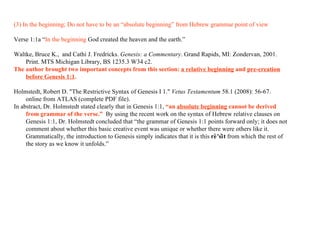
(3) In the beginning; Do not have to be an “absolute beginning” from Hebrew grammar point of view Verse 1:1a “ In the beginning   God   created   the heaven and   the earth .” Waltke, Bruce K.,  and Cathi J. Fredricks.  Genesis: a Commentary . Grand Rapids, MI: Zondervan, 2001. Print.  MTS Michigan Library, BS 1235.3 W34 c2.  The author brought two important concepts from this section:  a relative beginning  and  pre-creation before Genesis 1:1 .   Holmstedt, Robert D. "The Restrictive Syntax of Genesis I 1."  Vetus Testamentum  58.1 (2008): 56-67.  online from ATLAS (complete PDF file). In abstract, Dr. Holmstedt stated clearly that in Genesis 1:1,  “an  absolute beginning  cannot be derived from grammar of the verse.”   By using the recent work on the syntax of Hebrew relative clauses on Genesis 1:1, Dr. Holmstedt concluded that “the grammar of Genesis 1:1 points forward only; it does not comment about whether this basic creative event was unique or whether there were others like it. Grammatically, the introduction to Genesis simply indicates that it is this  rê'sît  from which the rest of the story as we know it unfolds.”
If the “beginning” in Verse 1:1a can be explained as a relative beginning, then the ages of the earth and all the dinosaurs’ fossils (the confliction between biblical and scientific fields) can be resolved and an new era  of Christian Scholars working with scientists will begin.

Explaining The age of Dinosaur fossils from Biblical point of view

  • 1.
    The Land beforeTime; How Old is our Earth, How to Explain the Scientific Findings regarding the Age of Dinosaurs’ Fossils from Biblical Point of View Background In the summer of 2009, Belle (my wife), Jonathan (my 12 years old son) and I took a trip to a famous Christian museum for our summer vacation. During our visit in this museum, one thing caught my and Jonathan’s eyes at the same time; a model of Noah’s Ark stands on the ground with dinosaurs beside it. Both of us looked at each other without saying a word. Continuing our journey, more display regarding the young earth theory appeared. It was a wonderful feeling to observe such a great presentation regarding Genesis. The tour came to an end. At the book store, an author was there signing his autograph regarding his new book for his readers. At his free time, Jonathan went to him asking him a question with good manner. “How did dinosaurs extinguish after they came out of Ark?” asked Jonathan. “ With nature cause.” replied the author. Then Jonathan thanked him politely and left with an unsatisfied look on his face, I observed. During the trip back home, Jonathan asked me one question that I could not answer with biblical confidence. He stated “How old is our earth?” Immediately I realized where the problem was. At school, science t aught him that our earth is billion or trillion years old based on the scientific findings. However, during the trip, he was told that earth is only several thousand years old. This conflict between science and biblical teachings puzzled him at that moment. And he is not alone. Today, thousands of our teen Christians face the same challenge in their daily life and this unresolved challenge may cause the final loss of our next generation being away from Christ if we can not offer a “satisfied” answer to them. Therefore, my research journey starts with Jonathan’s question; “ How old is our earth?”
  • 2.
    Introduction Dr. HughRoss, a respectable Christian apologetics, stated the following in his lecture Creation as Science in 2007 : “ Over the past 20 years, creation evolution debate has become increasingly more hostile, and society is becoming more and more polarized as the results of these debates .” Indeed. In today’s scientific and biblical fields, both sides positioned themselves at extremely aggressive offensive mood, like tit for tat. The most visible example is at Genesis 1, the creation of the world. At present, the major interpreters of the Genesis Account in Bible are : The Young Earth Creationism , The Progressive Creationism and The Gap or Restoration Theory This article will briefly cover the approaches of these three creation theories and their drawbacks respectively. The author will then present his finding by revisiting Genesis 1:1-1 0 and suggest how to accommodate the scientific findings biblically, i.e. the age of the Earth.
  • 3.
    The following informationwas quoted from “ Kregel Dictionary of the Bible and the Theology”, Henry W. Holloman (2005) The Young Earth (or Recent) Creationism “ young earth” creationism, on the other hand, incorporates flood geology. This theory looks at earth’s topography and geologic column to see if it can better be explained by the action of Genesis flood. Young earth creationists disagree o ver the age of the earth, but all hold that the lengths of time should be measured in thousands, rather than millions or b illions of years … Young earth creationism posits a literal, grammatical-historical reading of Genesis one, with creation occurring over six successive, literal solar days of creative activity. (pp.89) (2) The Progressive Creationism They believe that everything ultimately originated from God’s creative acts, which probably occurred with long intervening interval and included only broad categories of life forms. All other life forms have diversified from these original forms through macroevolution as naturalistic evolutionists and theistic evolutionists teach. To accommodate this view, “day” in Genesis one usually is understood as a vast, indefinite period of time (as in day-age theory)… Thus, the days of Genesis are not literal solar days of God’s creative activity as in recent creationism. (pp.92) Exegetical evidence favors the view that the days are successive twenty-four hour span of time… the six days of creation are all described as being composed of light and dark portions (e.g., Gen 1:5), indicating a solar cycle.(pp.90) The two poles of evangelical viewpoint, recent creationism and progressive creationism, both cite abundant evidence from Scripture and science to support their respective theories. Both are quick to point out the weakness in the opposing extremes, and in the views of those who take a middle ground. Recent creationists seems to have a stronger case from biblical exegesis but a weaker case from scientific evidence. Progressive creationists tend to follow what they see as strong arguments in science, but their view gives ground in biblical exegesis.(pp.92)
  • 4.
    (3) The Gapor Restoration Theory Advocates of the gap view generally believe that the creation narrative describes restoration of the earth following a divine judgment that occurred because of the fall of Satan and the other angles who collaborated with him … There are two versions of this theory, depend on how Genesis 1:1-2 is translated and where the gap is placed in the relation to the passage. [Gap A] First, if the fall of Satan and the resultant divine judgment upon him and the earth took place between Genesis 1:1 and 1:2, then v.1 presents the original, perfect creation and v.2a reveals the imperfect and chaotic condition after divine judgment. Thus, v.2a should be translated: “ The earth became formless and Void.” The Proposed gap between v.1 and v.2a could have been a vast period, allowing for the geologic age… [Gap B] Second, if the original creation and the fall of Satan took place before Genesis 1:1, then, according to this theory, “In the beginning” (v.1a) refers to a relative beginning of God’s creative activity, rather than to an original creation of Heavens and earth. Thus, vv. 1-2 should be translated: “ When God began to create the heavens and the earth, the earth was without form and void; and darkness was upon the face of the deep.”… Under this view, passages such as John 1:3, Colossians 1:16, and Hebrew 1:2 would refer to original creation, but Not Genesis one. The translation of Genesis 1:1 in this view and the translation of Genesis 1:2 in the previous view are grammatically possible, but they are highly improbable, especially when examined in the clear sense of other Scripture passages. No ancient or serious modern versions have ever rendered Genesis in either of these ways. (pp.89). [End of Quoting]
  • 5.
    More finding onGap Theory [A and B] From “Unger, Merrill F., Unger’s Bible Handbook. Chicago: Moody Press, 1966.” “ Genesis 1:2 and the Gap Theory. This verse has been sometimes held to portray a chaotic visitation of divine judgment upon the original earth and made a slot to pigeonhole scientific difficulties. To place this gap in 1:2 is untenable as is proved by the Hebrew text, which shows that all three clauses of 1:2 are circumstantial either t o the main clause in 1:1 or that in 1:3. Presumably 1:2 is circumstantial to 1:1, putting the gap not in 1:2 [GAP A] but before 1:1 [GAP B]. This is a possible interpretation that must be reckoned with in an era of alleged conflict between t he Genesis account of creation and modern science” (pp.37-38) Now let’s revisit Genesis 1:1-10 focusing on three key words/phrase: earth , create and in the beginning
  • 6.
    Genesis Chapter 1And God called the dry land Earth ; and the gathering together of the waters called he Seas : and God saw that it was good. 10 And God said: Let the waters under the heaven be gathered together unto one place , and let the dry land appear : and it was so. 9 And God called the firmament Heaven. And the evening and the morning were the second day. 8 And God made the firmament, and divided the waters which were under the firmament from the waters which were above the firmament : and it was so. 7 And God said, Let there be a firmament in the midst of the waters, and let it divide the waters from the waters. 6 And God called the light Day, and the darkness he called Night. And the evening and the morning were the first day. 5 And God saw the light, that it was good: and God divided the light from the darkness. 4 And God said, Let there be light: and there was light. 3 And the earth was without form, and void; and darkness was upon the face of the deep. And the Spirit of God moved upon the face of the waters . 2 In the beginning God created the heaven and the earth . 1
  • 7.
    Earth; the DryLand, Not the “round ball” as we called today Verse 1:1a “ In the beginning God created the heaven and the earth .” Genesis1. was written from the formation centered at our land’s point of view (verse 1:1, and explained all the creation activity by the verses that follow). The heaven means sky (verse 1:8) and the earth means land (verse 1:10) In verse 1:2 mentioning that the ( today’s ) earth ( dry land later; NOT THE WHOLE ROUND BALL ) was without form and void ( NOT FORMED YET ). It MAY not mean that nothing is there. It MAY simply mean that the so-called DRY LAND is not there yet. Also there is no other place in Gen. mentioning the formation of the land and waters. Waters and land (which was buried under waters) may exist already before GOD’s creation of the sky and the Earth ( the DRY LAND in verse 10). The “deep” in verse 2 means deep water. We can find clue from verse 9: In verse 9, it clearly mentioned that “let the waters gathering and let the dry land APPEAR ”. So, in verse 10, “ God called the dry land Earth ”.
  • 8.
    (*) Create (בּרא , bârâ‘, cut down (a wood) 切开 or “separate 分开 ” . Means “does not use any material for creation since there is no prop. followed the verb. MAY not mean from emptiness.” “Alpha and Omega: Creation Theology and Ethics by Dr. Samuel Y. C. Tang” pp166 ). (2) Create; Cut or Separate, May not mean “out of emptiness” Verse 1:1a “ In the beginning God created (*) the heaven and the earth .” Wolde, E J Van. "Why the Verb בָּרָא Does Not Mean 'to Create' in Genesis 1.1-2.4a." Journal for the Study of the Old Testament 34.1 (2009): 3-23. MTS Michigan Library, directly in print, located on last two rows of shelf. In this article, the author mentioned in the abstract stating “the verb בָּרָא (create) in Genesis 1 does not mean “to create” but “to separate”. Dr. Wolde used the linguistic to examine the word בָּרָא to confirm or correct the conventional view of translation (usage) in the following verses; Genesis 1:1-2.4a, 1:21, 1:27, 2:3 and 2:4a. During the examination process, Dr. Wolde also compared the usage of other word לָירְבְהַ (make, separate) simultaneously by quoting related verses, respectively. On p.21, he stated that “both verb בָּרָא and לָירְבְהַ designate “to separate”, and yet they are different with respect to the starting point of action.” In conclusion, Dr. Wolde proposed the following translation for Genesis 1:1 “In the beginning in which/when God separated the heaven and the earth.” Arnold, Bill T. Genesis . Cambridge: Cambridge UP, 2009. Print. MTS Michigan Library, BS 1235.53 A76. Dr. Arnold explained the meaning of bârâ' in Genesis 1:1 and clearly concluded the following: “ it has here an intentional, and no less theological significant connection if creating by cutting, shaping, or fashioning.“ Waltke, Bruce K., and Charles Yu. An Old Testament Theology: an Exegetical, Canonical, and Thematic Approach . Grand Rapids, MI: Zondervan, 2007. Print. MTS Michigan Library, BS 1192.5W35. In this book, Dr. Waltke offered his fair but powerful opinions regarding the proper translation and usage for these key words or phrase: earth , create and in the beginning .
  • 9.
    (3) In thebeginning; Do not have to be an “absolute beginning” from Hebrew grammar point of view Verse 1:1a “ In the beginning God created the heaven and the earth .” Waltke, Bruce K., and Cathi J. Fredricks. Genesis: a Commentary . Grand Rapids, MI: Zondervan, 2001. Print. MTS Michigan Library, BS 1235.3 W34 c2. The author brought two important concepts from this section: a relative beginning and pre-creation before Genesis 1:1 . Holmstedt, Robert D. "The Restrictive Syntax of Genesis I 1." Vetus Testamentum 58.1 (2008): 56-67. online from ATLAS (complete PDF file). In abstract, Dr. Holmstedt stated clearly that in Genesis 1:1, “an absolute beginning cannot be derived from grammar of the verse.” By using the recent work on the syntax of Hebrew relative clauses on Genesis 1:1, Dr. Holmstedt concluded that “the grammar of Genesis 1:1 points forward only; it does not comment about whether this basic creative event was unique or whether there were others like it. Grammatically, the introduction to Genesis simply indicates that it is this rê'sît from which the rest of the story as we know it unfolds.”
  • 10.
    If the “beginning”in Verse 1:1a can be explained as a relative beginning, then the ages of the earth and all the dinosaurs’ fossils (the confliction between biblical and scientific fields) can be resolved and an new era of Christian Scholars working with scientists will begin.