In the beginning
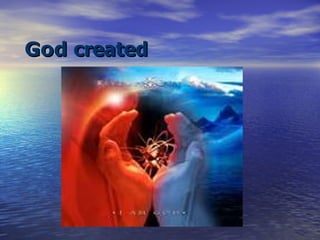
God   created
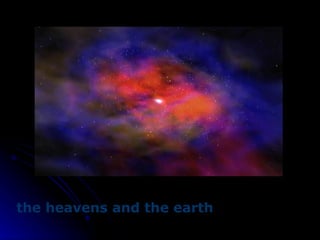
the heavens and the earth
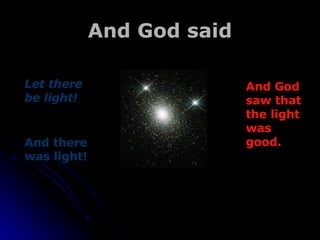
And God said And there was light!   And God saw that the light was good. Let there be light!
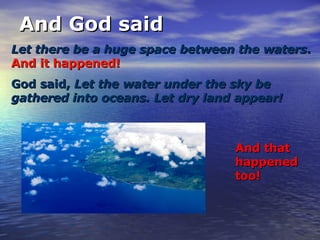
And God said Let there be a huge space between the waters .   And it happened! And that happened too! God said,  Let the water under the sky be gathered into oceans. Let dry land appear!
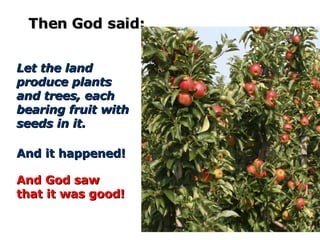
Then God said: And it happened! Let the land produce plants and trees, each bearing fruit with seeds in it. And God saw that it was good!
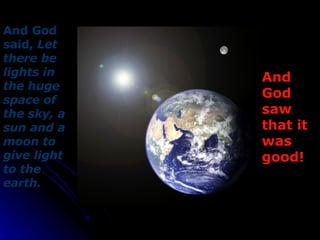
And God saw that it was good! And God said,  Let there be lights in the huge space of the sky, a sun and a moon to give light to the earth.
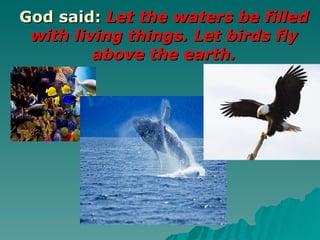
God said:  Let the waters be filled with living things. Let birds fly above the earth.
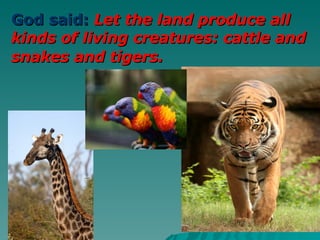
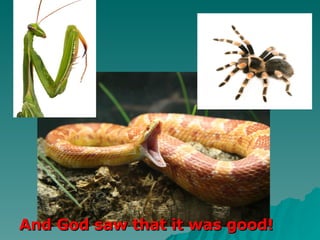
God said:   Let the land produce all kinds of living creatures: cattle and snakes and tigers.
And God saw that it was good!
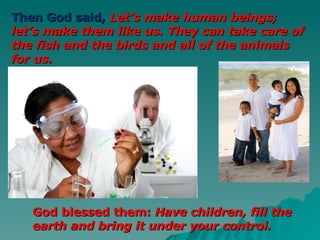
Then God said,   Let’s make human beings; let’s make them like us. They can take care of the fish and the birds and all of the animals for us. God blessed them:  Have children, fill the earth and bring it under your control.
God saw everything that he made.  Then God rested… And it was very good! It was the seventh day.
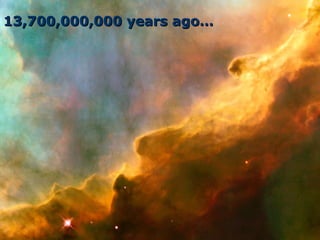
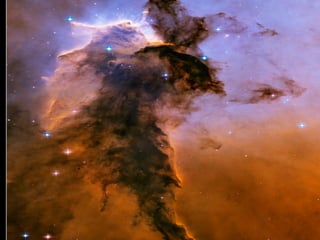
13,700,000,000 years ago…


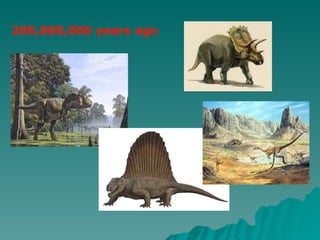
200,000,000 years ago
 
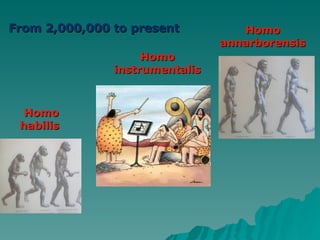
From 2,000,000 to present Homo annarborensis Homo habilis   Homo instrumentalis
 
Creation  and/or  Evolution How should we read Genesis 1 & 2 in light of current scientific theory?
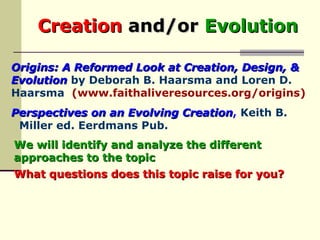
Creation   and/or   Evolution Origins: A Reformed Look at Creation, Design, &  Evolution  by Deborah B. Haarsma and Loren D.  Haarsma  (www.faithaliveresources.org/origins) What questions does this topic raise for you? We will identify and analyze the different  approaches to the topic Perspectives on an Evolving Creation ,  Keith B.  Miller ed. Eerdmans Pub.
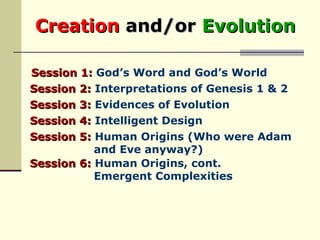
Creation   and/or   Evolution   Session 1:  God’s Word and God’s World Session 2:  Interpretations of Genesis 1 & 2 Session 3:  Evidences of Evolution Session 4:  Intelligent Design Session 5:  Human Origins (Who were Adam  and Eve anyway?) Session 6:  Human Origins, cont.  Emergent Complexities
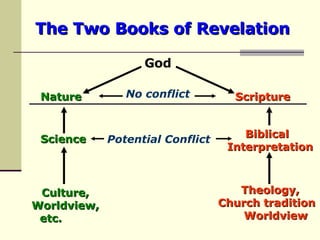
The Two Books of   Revelation God Nature Scripture Science Culture, Worldview, etc.   Theology, Church tradition  Worldview Biblical Interpretation Potential Conflict No conflict
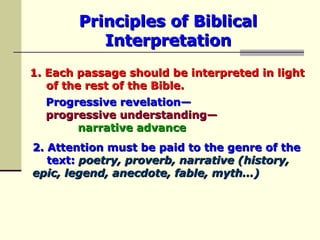
Principles of Biblical Interpretation 1. Each passage should be interpreted in light  of the rest of the Bible.   Progressive revelation—   progressive understanding— narrative advance 2. Attention must be paid to the genre   of the  text:   poetry, proverb, narrative (history,  epic, legend, anecdote, fable, myth…)
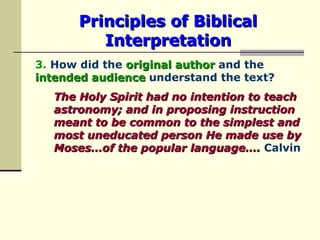
Principles of Biblical Interpretation 3.  How did the  original author  and the  intended audience  understand the text? The Holy Spirit had no intention to teach astronomy; and in proposing instruction meant to be common to the simplest and most uneducated person He made use by Moses…of the popular language….  Calvin
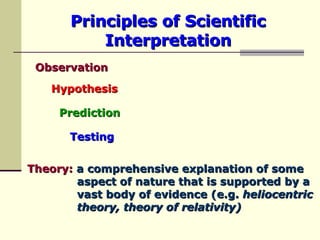
Principles of Scientific Interpretation Observation Hypothesis Prediction Testing Theory:  a comprehensive explanation of some  aspect of nature that is supported by a  vast body of evidence (e.g.  heliocentric  theory, theory of relativity)
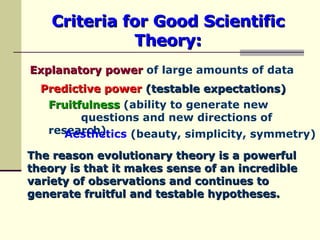
Criteria for Good Scientific Theory: Explanatory power  of large amounts of data Predictive power  (testable expectations) Fruitfulness  (ability to generate new  questions and new directions of research) Aesthetics  (beauty, simplicity, symmetry) The reason evolutionary theory is a powerful  theory is that it makes sense of an incredible  variety of observations and continues to  generate fruitful and testable hypotheses.
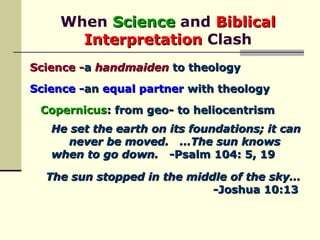
When  Science  and  Biblical Interpretation  Clash Science - a   handmaiden  to theology Science - an  equal   partner  with theology Copernicus : from geo- to heliocentrism He set the earth on its foundations; it can  never be moved.  …The sun knows  when to go down.   -Psalm 104: 5, 19 The sun stopped in the middle of the sky…     -Joshua 10:13
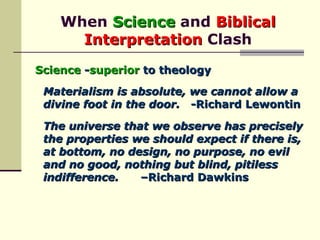
When  Science  and  Biblical Interpretation  Clash Science  - superior  to theology Materialism is absolute, we cannot allow a divine foot in the door.   -Richard Lewontin The universe that we observe has precisely the properties we should expect if there is, at bottom, no design, no purpose, no evil and no good, nothing but blind, pitiless indifference.   –Richard Dawkins
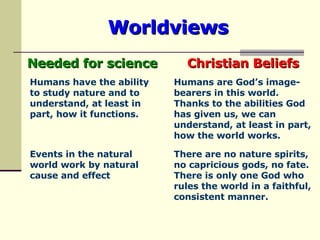
Worldviews Needed for science Christian Beliefs Humans have the ability to study nature and to understand, at least in part, how it functions. Events in the natural world work by natural cause and effect   Humans are God’s image-bearers in this world. Thanks to the abilities God has given us, we can understand, at least in part, how the world works. There are no nature spirits, no capricious gods, no fate. There is only one God who rules the world in a faithful, consistent manner.
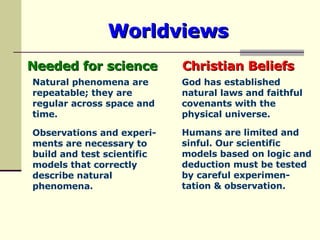
Worldviews Needed for science  Christian Beliefs Natural phenomena are repeatable; they are regular across space and time. Observations and experi-ments are necessary to build and test scientific models that correctly describe natural phenomena. God has established natural laws and faithful covenants with the physical universe. Humans are limited and sinful. Our scientific models based on logic and deduction must be tested by careful experimen-tation & observation.
Worldviews Needed for science   Christian Beliefs Science is a worthwhile use of human time and resources. Studying nature is worth doing because we are studying the very handiwork of God.
Christians  Agree  and  Disagree Christians in agreement: God created, sustains, and governs this  universe. The God who created this world also  reveals himself to humanity.  The God who created this world is also  our Redeemer.
Christians  Agree  and  Disagree Christians in agreement: The Bible is authoritative and sufficient  for salvation. God is sovereign over all realms of human  endeavor and God has given human beings  special abilities and responsibilities.
Christians  Agree  and  Disagree Christians in disagreement: As we study God’s  word , what is the best  way to understand passages that talk  about God’s acts   of creation? As we study God’s  world , what can we  reliably conclude that it tells us about its  history?
Christians  Agree  and  Disagree Christians today are young earth creationists old earth creationists evolutionary creationists progressive creationists
Christians  Agree  and  Disagree The (CRCNA) wishes to honor its commitment to the freedom of exegesis by not imposing upon its members an authorized interpretation of specific passages in Scripture, insisting only that such exegetical freedom be carried on within the limits of the analogy of Scripture and the confessional guidelines of the creeds .
Christians  Agree  and  Disagree The (CRCNA) wishes also to respect the freedom of science by not canonizing certain hypotheses, models, or paradigms proposed by the sciences while rejecting others, insisting only that all such theorizing be subject to the teaching of Scripture and the confessions.     - Acts of Synod , CRCNA, 1991
Christians  Agree  and  Disagree If the Lord has willed that we (Christians) be helped in physics, dialectic, mathematics, and other like disciplines, by the work and ministry of the ungodly, let us use this assistance. For if we neglect God’s gift freely offered in these arts, we ought to suffer just punishment for our sloth.  -John Calvin,  Institutes .. 2.2.16

Creation and Evolution Session 1

  • 1.
  • 2.
    God created
  • 3.
    the heavens andthe earth
  • 4.
    And God saidAnd there was light! And God saw that the light was good. Let there be light!
  • 5.
    And God saidLet there be a huge space between the waters . And it happened! And that happened too! God said, Let the water under the sky be gathered into oceans. Let dry land appear!
  • 6.
    Then God said:And it happened! Let the land produce plants and trees, each bearing fruit with seeds in it. And God saw that it was good!
  • 7.
    And God sawthat it was good! And God said, Let there be lights in the huge space of the sky, a sun and a moon to give light to the earth.
  • 8.
    God said: Let the waters be filled with living things. Let birds fly above the earth.
  • 9.
    God said: Let the land produce all kinds of living creatures: cattle and snakes and tigers.
  • 10.
    And God sawthat it was good!
  • 11.
    Then God said, Let’s make human beings; let’s make them like us. They can take care of the fish and the birds and all of the animals for us. God blessed them: Have children, fill the earth and bring it under your control.
  • 12.
    God saw everythingthat he made. Then God rested… And it was very good! It was the seventh day.
  • 13.
  • 14.
  • 15.
  • 16.
  • 17.
  • 18.
  • 19.
    From 2,000,000 topresent Homo annarborensis Homo habilis Homo instrumentalis
  • 20.
  • 21.
    Creation and/or Evolution How should we read Genesis 1 & 2 in light of current scientific theory?
  • 22.
    Creation and/or Evolution Origins: A Reformed Look at Creation, Design, & Evolution by Deborah B. Haarsma and Loren D. Haarsma (www.faithaliveresources.org/origins) What questions does this topic raise for you? We will identify and analyze the different approaches to the topic Perspectives on an Evolving Creation , Keith B. Miller ed. Eerdmans Pub.
  • 23.
    Creation and/or Evolution Session 1: God’s Word and God’s World Session 2: Interpretations of Genesis 1 & 2 Session 3: Evidences of Evolution Session 4: Intelligent Design Session 5: Human Origins (Who were Adam and Eve anyway?) Session 6: Human Origins, cont. Emergent Complexities
  • 24.
    The Two Booksof Revelation God Nature Scripture Science Culture, Worldview, etc. Theology, Church tradition Worldview Biblical Interpretation Potential Conflict No conflict
  • 25.
    Principles of BiblicalInterpretation 1. Each passage should be interpreted in light of the rest of the Bible. Progressive revelation— progressive understanding— narrative advance 2. Attention must be paid to the genre of the text: poetry, proverb, narrative (history, epic, legend, anecdote, fable, myth…)
  • 26.
    Principles of BiblicalInterpretation 3. How did the original author and the intended audience understand the text? The Holy Spirit had no intention to teach astronomy; and in proposing instruction meant to be common to the simplest and most uneducated person He made use by Moses…of the popular language…. Calvin
  • 27.
    Principles of ScientificInterpretation Observation Hypothesis Prediction Testing Theory: a comprehensive explanation of some aspect of nature that is supported by a vast body of evidence (e.g. heliocentric theory, theory of relativity)
  • 28.
    Criteria for GoodScientific Theory: Explanatory power of large amounts of data Predictive power (testable expectations) Fruitfulness (ability to generate new questions and new directions of research) Aesthetics (beauty, simplicity, symmetry) The reason evolutionary theory is a powerful theory is that it makes sense of an incredible variety of observations and continues to generate fruitful and testable hypotheses.
  • 29.
    When Science and Biblical Interpretation Clash Science - a handmaiden to theology Science - an equal partner with theology Copernicus : from geo- to heliocentrism He set the earth on its foundations; it can never be moved. …The sun knows when to go down. -Psalm 104: 5, 19 The sun stopped in the middle of the sky… -Joshua 10:13
  • 30.
    When Science and Biblical Interpretation Clash Science - superior to theology Materialism is absolute, we cannot allow a divine foot in the door. -Richard Lewontin The universe that we observe has precisely the properties we should expect if there is, at bottom, no design, no purpose, no evil and no good, nothing but blind, pitiless indifference. –Richard Dawkins
  • 31.
    Worldviews Needed forscience Christian Beliefs Humans have the ability to study nature and to understand, at least in part, how it functions. Events in the natural world work by natural cause and effect Humans are God’s image-bearers in this world. Thanks to the abilities God has given us, we can understand, at least in part, how the world works. There are no nature spirits, no capricious gods, no fate. There is only one God who rules the world in a faithful, consistent manner.
  • 32.
    Worldviews Needed forscience Christian Beliefs Natural phenomena are repeatable; they are regular across space and time. Observations and experi-ments are necessary to build and test scientific models that correctly describe natural phenomena. God has established natural laws and faithful covenants with the physical universe. Humans are limited and sinful. Our scientific models based on logic and deduction must be tested by careful experimen-tation & observation.
  • 33.
    Worldviews Needed forscience Christian Beliefs Science is a worthwhile use of human time and resources. Studying nature is worth doing because we are studying the very handiwork of God.
  • 34.
    Christians Agree and Disagree Christians in agreement: God created, sustains, and governs this universe. The God who created this world also reveals himself to humanity. The God who created this world is also our Redeemer.
  • 35.
    Christians Agree and Disagree Christians in agreement: The Bible is authoritative and sufficient for salvation. God is sovereign over all realms of human endeavor and God has given human beings special abilities and responsibilities.
  • 36.
    Christians Agree and Disagree Christians in disagreement: As we study God’s word , what is the best way to understand passages that talk about God’s acts of creation? As we study God’s world , what can we reliably conclude that it tells us about its history?
  • 37.
    Christians Agree and Disagree Christians today are young earth creationists old earth creationists evolutionary creationists progressive creationists
  • 38.
    Christians Agree and Disagree The (CRCNA) wishes to honor its commitment to the freedom of exegesis by not imposing upon its members an authorized interpretation of specific passages in Scripture, insisting only that such exegetical freedom be carried on within the limits of the analogy of Scripture and the confessional guidelines of the creeds .
  • 39.
    Christians Agree and Disagree The (CRCNA) wishes also to respect the freedom of science by not canonizing certain hypotheses, models, or paradigms proposed by the sciences while rejecting others, insisting only that all such theorizing be subject to the teaching of Scripture and the confessions. - Acts of Synod , CRCNA, 1991
  • 40.
    Christians Agree and Disagree If the Lord has willed that we (Christians) be helped in physics, dialectic, mathematics, and other like disciplines, by the work and ministry of the ungodly, let us use this assistance. For if we neglect God’s gift freely offered in these arts, we ought to suffer just punishment for our sloth. -John Calvin, Institutes .. 2.2.16