Democracy is a design problem
Effective voting materials
and websites
Whitney Quesenbery
Center for Civic Design
@civicdesign | @whitneyq
Utah Association of Counties
April 29, 2015
What makes election
materials so hard for
voters to read & use?
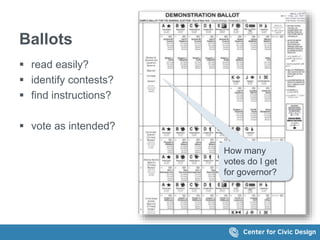
Ballots
 read easily?
 identify contests?
 find instructions?
 vote as intended?
How many
votes do I get
for governor?
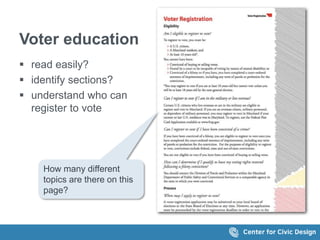
Voter education
 read easily?
 identify sections?
 understand who can
register to vote
How many different
topics are there on this
page?
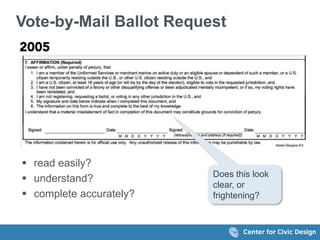
Vote-by-Mail Ballot Request
 read easily?
 understand?
 complete accurately?
Does this look
clear, or
frightening?
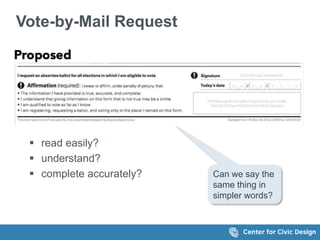
Vote-by-Mail Request
 read easily?
 understand?
 complete accurately? Can we say the
same thing in
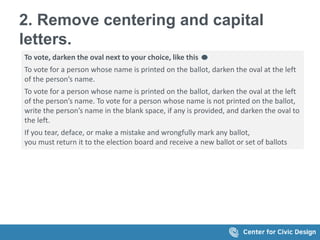
simpler words?
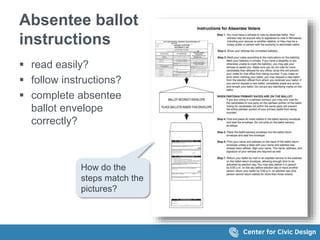
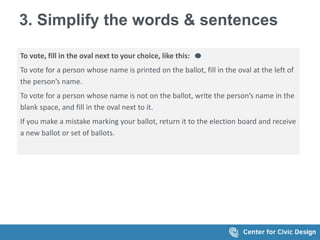
Absentee ballot
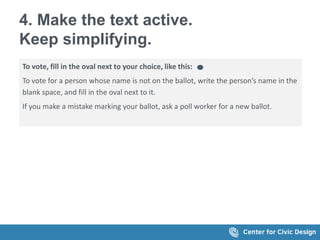
instructions
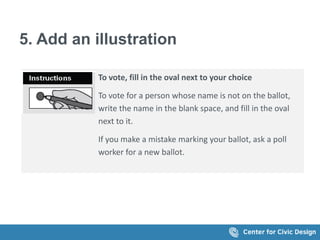
 read easily?
 follow instructions?
 complete absentee
ballot envelope
correctly?
How do the
steps match the
pictures?
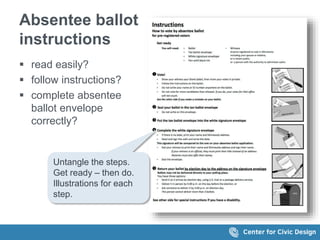
Absentee ballot
instructions
 read easily?
 follow instructions?
 complete absentee
ballot envelope
correctly?
Untangle the steps.
Get ready – then do.
Illustrations for each
step.
When voters can't
understand the ballot,
forms, and voter guides
they think that elections
are difficult, confusing,
and complicated
(And they don't vote.)
There's a lot of forces behind
difficult-to-read information
 We've always done it like that!
 The curse of completeness.
 It's legal. It's supposed to sound like that.
 We don't have the resources.
 Voters can't tell the difference.
Plain information is important
because people...
 have different degrees of literacy
 do not always read carefully.
 may have a cognitive disability
 or a visual disability that can affect
reading.
 may not know (or read) the language well
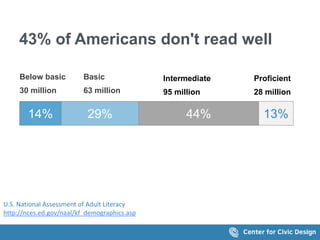
43% of Americans don't read well
Below basic
30 million
14%
Basic
63 million
29%
Intermediate
95 million
44%
Proficient
28 million
13%
U.S. National Assessment of Adult Literacy
http://nces.ed.gov/naal/kf_demographics.asp
Even skilled readers may be
 rushed
 distracted
 tired
 stressed
 inexperienced
 confused
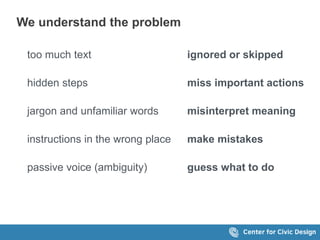
We understand the problem
too much text ignored or skipped
hidden steps miss important actions
jargon and unfamiliar words misinterpret meaning
instructions in the wrong place make mistakes
passive voice (ambiguity) guess what to do
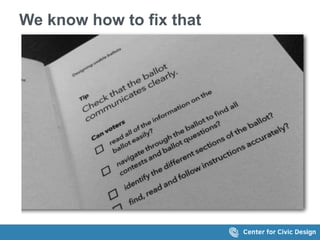
We know how to fix that
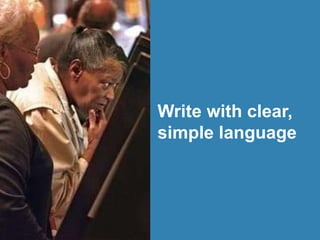
Write with clear,
simple language
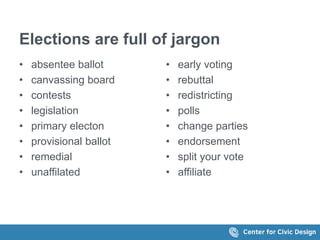
Elections are full of jargon
• absentee ballot
• canvassing board
• contests
• legislation
• primary electon
• provisional ballot
• remedial
• unaffilated
• early voting
• rebuttal
• redistricting
• polls
• change parties
• endorsement
• split your vote
• affiliate
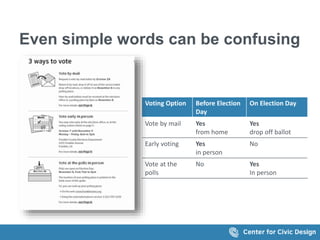
Even simple words can be confusing
Voting Option Before Election
Day
On Election Day
Vote by mail Yes
from home
Yes
drop off ballot
Early voting Yes
in person
No
Vote at the
polls
No Yes
In person
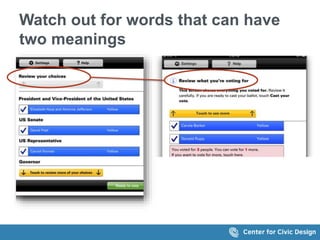
Watch out for words that can have
two meanings
Write for action
Answer questions
Voters ask questions their own way
 Who do I support or vote for?
 Who is running?
 Who will I be voting for?
 Who are the candidates?
 Who supports the candidates?
 What are the candidates’ positions on [specific issue]?
 What are the ballot measures?
 What are the pros and cons for the measures?
 Does this measure mean a tax increases?
 How does the official guide compare to the TV ads?
 Who is in office right now?
What’s on the ballot
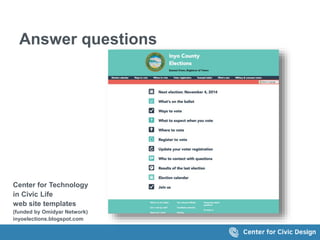
Answer questions
Center for Technology
in Civic Life
web site templates
(funded by Omidyar Network)
inyoelections.blogspot.com
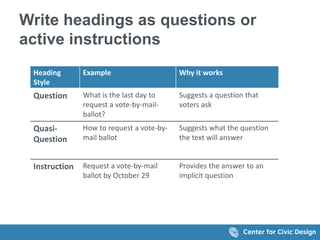
Write headings as questions or
active instructions
Heading
Style
Example Why it works
Question What is the last day to
request a vote-by-mail-
ballot?
Suggests a question that
voters ask
Quasi-
Question
How to request a vote-by-
mail ballot
Suggests what the question
the text will answer
Instruction Request a vote-by-mail
ballot by October 29
Provides the answer to an
implicit question
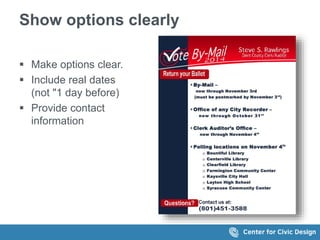
Show options clearly
 Make options clear.
 Include real dates
(not "1 day before)
 Provide contact
information
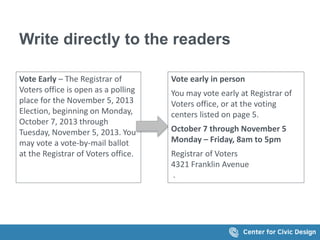
Write directly to the readers
Vote Early – The Registrar of
Voters office is open as a polling
place for the November 5, 2013
Election, beginning on Monday,
October 7, 2013 through
Tuesday, November 5, 2013. You
may vote a vote-by-mail ballot
at the Registrar of Voters office.
Vote early in person
You may vote early at Registrar of
Voters office, or at the voting
centers listed on page 5.
October 7 through November 5
Monday – Friday, 8am to 5pm
Registrar of Voters
4321 Franklin Avenue
.
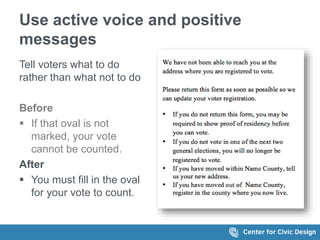
Use active voice and positive
messages
Tell voters what to do
rather than what not to do
Before
 If that oval is not
marked, your vote
cannot be counted.
After
 You must fill in the oval
for your vote to count.
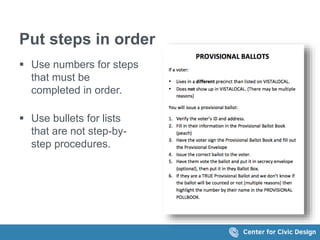
Put steps in order
 Use numbers for steps
that must be
completed in order.
 Use bullets for lists
that are not step-by-
step procedures.
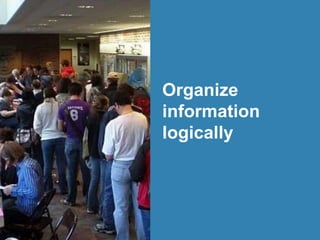
Organize
information
logically
Voters don't think like an election
official
• They don't see elections as a process
• They’re unaware that their ballot could be
unique
• They don’t think to look in the polling place
lookup widget for ballots
• They don’t expect to have to give personal
information to see a sample ballot
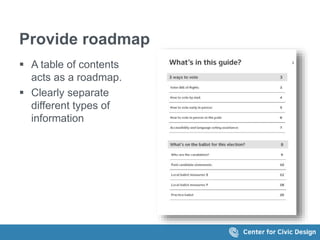
Provide roadmap
 A table of contents
acts as a roadmap.
 Clearly separate
different types of
information
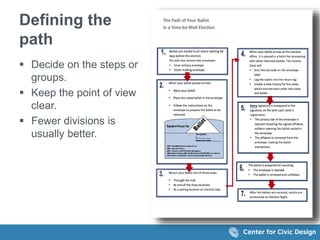
Defining the
path
 Decide on the steps or
groups.
 Keep the point of view
clear.
 Fewer divisions is
usually better.
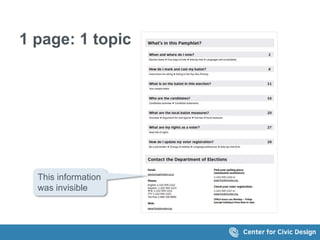
1 page: 1 topic
This information
was invisible
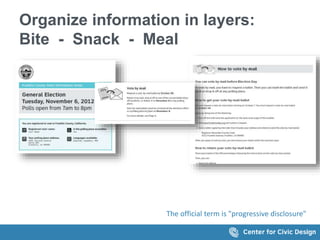
Organize information in layers:
Bite - Snack - Meal
The official term is "progressive disclosure"
Plain language is a
process
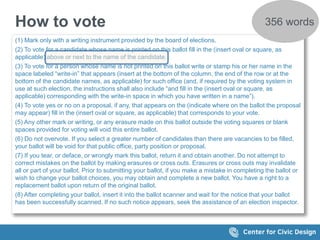
How to vote
(1) Mark only with a writing instrument provided by the board of elections.
(2) To vote for a candidate whose name is printed on this ballot fill in the (insert oval or square, as
applicable) above or next to the name of the candidate.
(3) To vote for a person whose name is not printed on this ballot write or stamp his or her name in the
space labeled “write-in” that appears (insert at the bottom of the column, the end of the row or at the
bottom of the candidate names, as applicable) for such office (and, if required by the voting system in
use at such election, the instructions shall also include “and fill in the (insert oval or square, as
applicable) corresponding with the write-in space in which you have written in a name”).
(4) To vote yes or no on a proposal, if any, that appears on the (indicate where on the ballot the proposal
may appear) fill in the (insert oval or square, as applicable) that corresponds to your vote.
(5) Any other mark or writing, or any erasure made on this ballot outside the voting squares or blank
spaces provided for voting will void this entire ballot.
(6) Do not overvote. If you select a greater number of candidates than there are vacancies to be filled,
your ballot will be void for that public office, party position or proposal.
(7) If you tear, or deface, or wrongly mark this ballot, return it and obtain another. Do not attempt to
correct mistakes on the ballot by making erasures or cross outs. Erasures or cross outs may invalidate
all or part of your ballot. Prior to submitting your ballot, if you make a mistake in completing the ballot or
wish to change your ballot choices, you may obtain and complete a new ballot. You have a right to a
replacement ballot upon return of the original ballot.
(8) After completing your ballot, insert it into the ballot scanner and wait for the notice that your ballot
has been successfully scanned. If no such notice appears, seek the assistance of an election inspector.
356 words
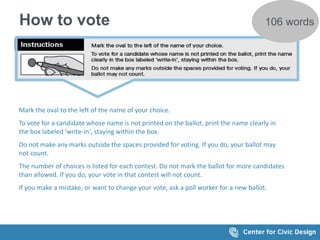
How to vote
Mark the oval to the left of the name of your choice.
To vote for a candidate whose name is not printed on the ballot, print the name clearly in
the box labeled 'write-in', staying within the box.
Do not make any marks outside the spaces provided for voting. If you do, your ballot may
not count.
The number of choices is listed for each contest. Do not mark the ballot for more candidates
than allowed. If you do, your vote in that contest will not count.
If you make a mistake, or want to change your vote, ask a poll worker for a new ballot.
106 words
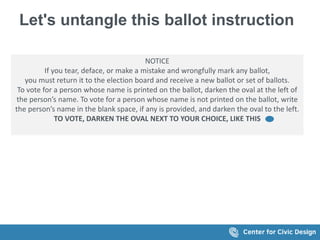
Let's untangle this ballot instruction
NOTICE
If you tear, deface, or make a mistake and wrongfully mark any ballot,
you must return it to the election board and receive a new ballot or set of ballots.
To vote for a person whose name is printed on the ballot, darken the oval at the left of
the person’s name. To vote for a person whose name is not printed on the ballot, write
the person’s name in the blank space, if any is provided, and darken the oval to the left.
TO VOTE, DARKEN THE OVAL NEXT TO YOUR CHOICE, LIKE THIS
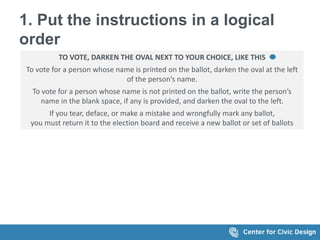
1. Put the instructions in a logical
order
TO VOTE, DARKEN THE OVAL NEXT TO YOUR CHOICE, LIKE THIS
To vote for a person whose name is printed on the ballot, darken the oval at the left
of the person’s name.
To vote for a person whose name is not printed on the ballot, write the person’s
name in the blank space, if any is provided, and darken the oval to the left.
If you tear, deface, or make a mistake and wrongfully mark any ballot,
you must return it to the election board and receive a new ballot or set of ballots
2. Remove centering and capital
letters.
To vote, darken the oval next to your choice, like this
To vote for a person whose name is printed on the ballot, darken the oval at the left
of the person’s name.
To vote for a person whose name is printed on the ballot, darken the oval at the left
of the person’s name. To vote for a person whose name is not printed on the ballot,
write the person’s name in the blank space, if any is provided, and darken the oval to
the left.
If you tear, deface, or make a mistake and wrongfully mark any ballot,
you must return it to the election board and receive a new ballot or set of ballots
3. Simplify the words & sentences
To vote, fill in the oval next to your choice, like this:
To vote for a person whose name is printed on the ballot, fill in the oval at the left of
the person’s name.
To vote for a person whose name is not on the ballot, write the person’s name in the
blank space, and fill in the oval next to it.
If you make a mistake marking your ballot, return it to the election board and receive
a new ballot or set of ballots.
4. Make the text active.
Keep simplifying.
To vote, fill in the oval next to your choice, like this:
To vote for a person whose name is not on the ballot, write the person’s name in the
blank space, and fill in the oval next to it.
If you make a mistake marking your ballot, ask a poll worker for a new ballot.
5. Add an illustration
To vote, fill in the oval next to your choice
To vote for a person whose name is not on the ballot,
write the name in the blank space, and fill in the oval
next to it.
If you make a mistake marking your ballot, ask a poll
worker for a new ballot.
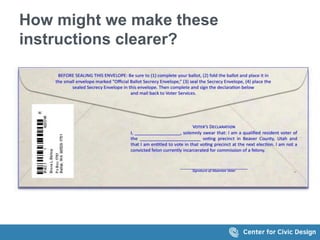
How might we make these
instructions clearer?
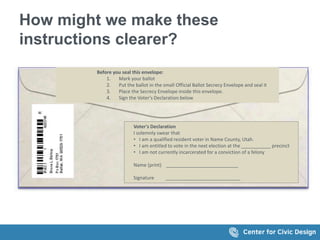
How might we make these
instructions clearer?
Before you seal this envelope:
1. Mark your ballot
2. Put the ballot in the small Official Ballot Secrecy Envelope and seal it
3. Place the Secrecy Envelope inside this envelope.
4. Sign the Voter's Declaration below
Voter's Declaration
I solemnly swear that
• I am a qualified resident voter in Name County, Utah.
• I am entitled to vote in the next election at the ___________ precinct
• I am not currently incarcerated for a conviction of a felony
Name (print) ___________________________
Signature ____________________________
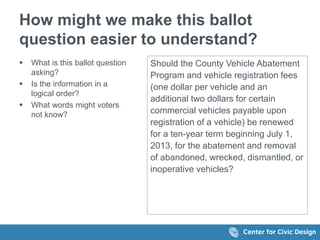
How might we make this ballot
question easier to understand?
 What is this ballot question
asking?
 Is the information in a
logical order?
 What words might voters
not know?
Should the County Vehicle Abatement
Program and vehicle registration fees
(one dollar per vehicle and an
additional two dollars for certain
commercial vehicles payable upon
registration of a vehicle) be renewed
for a ten-year term beginning July 1,
2013, for the abatement and removal
of abandoned, wrecked, dismantled, or
inoperative vehicles?
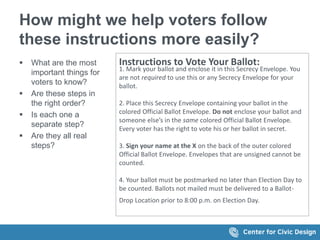
How might we help voters follow
these instructions more easily?
 What are the most
important things for
voters to know?
 Are these steps in
the right order?
 Is each one a
separate step?
 Are they all real
steps?
Instructions to Vote Your Ballot:
1. Mark your ballot and enclose it in this Secrecy Envelope. You
are not required to use this or any Secrecy Envelope for your
ballot.
2. Place this Secrecy Envelope containing your ballot in the
colored Official Ballot Envelope. Do not enclose your ballot and
someone else’s in the same colored Official Ballot Envelope.
Every voter has the right to vote his or her ballot in secret.
3. Sign your name at the X on the back of the outer colored
Official Ballot Envelope. Envelopes that are unsigned cannot be
counted.
4. Your ballot must be postmarked no later than Election Day to
be counted. Ballots not mailed must be delivered to a Ballot-
Drop Location prior to 8:00 p.m. on Election Day.
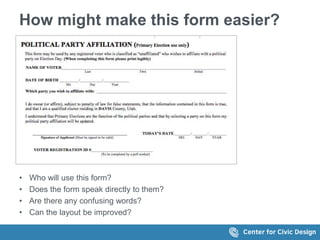
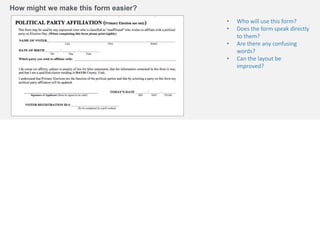
How might make this form easier?
• Who will use this form?
• Does the form speak directly to them?
• Are there any confusing words?
• Can the layout be improved?
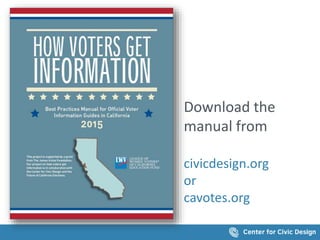
Download the
manual from
civicdesign.org
or
cavotes.org
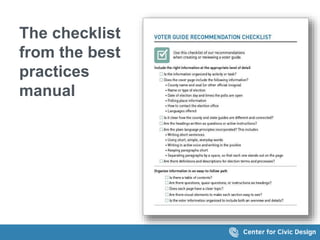
The checklist
from the best
practices
manual
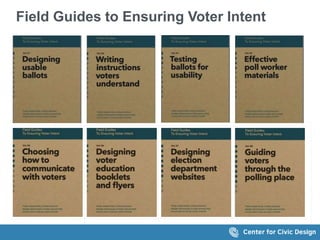
Field Guides to Ensuring Voter Intent
Get in touch!
Whitney Quesenbery
whitneyq@civicdesign.org
@whitneyq
civicdesign.org
@civicdesign
Think about how
voters will read the
form, instructions, or
text
Can voters...
 read all of the information easily?
 navigate through the form to find
everything they need?
 identify the different sections of the ballot,
booklet, or form?
 find, read, and follow instructions
accurately?
Designing usable ballots
 Use lowercase letters
 Avoid centered type
 Use big enough type
 Pick one sans serif font
 Support process and
navigation
 Use clear, simple
language
 Use accurate instructional
illustrations
 Use informational icons
(only)
 Use contrast and color to
support meaning
 Show what’s most
important
Can voters...
 understand what each instruction means?
 follow instructions easily?
 complete the ballot without making
mistakes?
 respond appropriately to error messages?
Writing instructions voters
understand
 Put instructions where
voters need them
 Include information that
will prevent voters from
making errors
 Write in active voice, with
the person doing comes
before the verb
 Be positive – tell people
what to do, not what not
to do
 When giving instructions
that are more than one
step, use a numbered list
 Write short sentences
 Use short, simple,
everyday words
 Keep paragraphs short
 Separate paragraphs by
a space
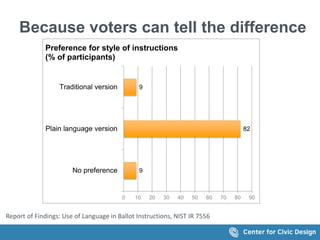
Because voters can tell the difference
Report of Findings: Use of Language in Ballot Instructions, NIST IR 7556
9
82
9
0 10 20 30 40 50 60 70 80 90
No preference
Plain language version
Traditional version
Preference for style of instructions
(% of participants)
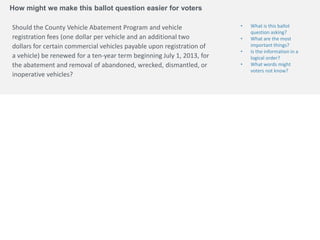
How might we make this ballot question easier for voters
• What is this ballot
question asking?
• What are the most
important things?
• Is the information in a
logical order?
• What words might
voters not know?
Should the County Vehicle Abatement Program and vehicle
registration fees (one dollar per vehicle and an additional two
dollars for certain commercial vehicles payable upon registration of
a vehicle) be renewed for a ten-year term beginning July 1, 2013, for
the abatement and removal of abandoned, wrecked, dismantled, or
inoperative vehicles?
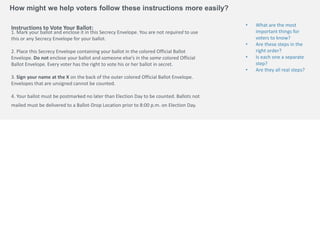
How might we help voters follow these instructions more easily?
• What are the most
important things for
voters to know?
• Are these steps in the
right order?
• Is each one a separate
step?
• Are they all real steps?
Instructions to Vote Your Ballot:
1. Mark your ballot and enclose it in this Secrecy Envelope. You are not required to use
this or any Secrecy Envelope for your ballot.
2. Place this Secrecy Envelope containing your ballot in the colored Official Ballot
Envelope. Do not enclose your ballot and someone else’s in the same colored Official
Ballot Envelope. Every voter has the right to vote his or her ballot in secret.
3. Sign your name at the X on the back of the outer colored Official Ballot Envelope.
Envelopes that are unsigned cannot be counted.
4. Your ballot must be postmarked no later than Election Day to be counted. Ballots not
mailed must be delivered to a Ballot-Drop Location prior to 8:00 p.m. on Election Day.
How might we make this form easier?
• Who will use this form?
• Does the form speak directly
to them?
• Are there any confusing
words?
• Can the layout be
improved?
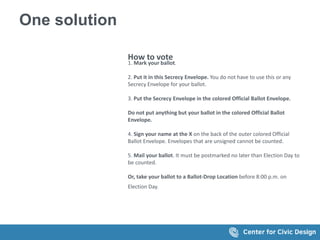
One solution
How to vote
1. Mark your ballot.
2. Put it in this Secrecy Envelope. You do not have to use this or any
Secrecy Envelope for your ballot.
3. Put the Secrecy Envelope in the colored Official Ballot Envelope.
Do not put anything but your ballot in the colored Official Ballot
Envelope.
4. Sign your name at the X on the back of the outer colored Official
Ballot Envelope. Envelopes that are unsigned cannot be counted.
5. Mail your ballot. It must be postmarked no later than Election Day to
be counted.
Or, take your ballot to a Ballot-Drop Location before 8:00 p.m. on
Election Day.

Creating effective election materials and websites

  • 1.
    Democracy is adesign problem Effective voting materials and websites Whitney Quesenbery Center for Civic Design @civicdesign | @whitneyq Utah Association of Counties April 29, 2015
  • 2.
    What makes election materialsso hard for voters to read & use?
  • 3.
    Ballots  read easily? identify contests?  find instructions?  vote as intended? How many votes do I get for governor?
  • 4.
    Voter education  readeasily?  identify sections?  understand who can register to vote How many different topics are there on this page?
  • 5.
    Vote-by-Mail Ballot Request read easily?  understand?  complete accurately? Does this look clear, or frightening?
  • 6.
    Vote-by-Mail Request  readeasily?  understand?  complete accurately? Can we say the same thing in simpler words?
  • 7.
    Absentee ballot instructions  readeasily?  follow instructions?  complete absentee ballot envelope correctly? How do the steps match the pictures?
  • 8.
    Absentee ballot instructions  readeasily?  follow instructions?  complete absentee ballot envelope correctly? Untangle the steps. Get ready – then do. Illustrations for each step.
  • 9.
    When voters can't understandthe ballot, forms, and voter guides they think that elections are difficult, confusing, and complicated (And they don't vote.)
  • 10.
    There's a lotof forces behind difficult-to-read information  We've always done it like that!  The curse of completeness.  It's legal. It's supposed to sound like that.  We don't have the resources.  Voters can't tell the difference.
  • 11.
    Plain information isimportant because people...  have different degrees of literacy  do not always read carefully.  may have a cognitive disability  or a visual disability that can affect reading.  may not know (or read) the language well
  • 12.
    43% of Americansdon't read well Below basic 30 million 14% Basic 63 million 29% Intermediate 95 million 44% Proficient 28 million 13% U.S. National Assessment of Adult Literacy http://nces.ed.gov/naal/kf_demographics.asp
  • 13.
    Even skilled readersmay be  rushed  distracted  tired  stressed  inexperienced  confused
  • 14.
    We understand theproblem too much text ignored or skipped hidden steps miss important actions jargon and unfamiliar words misinterpret meaning instructions in the wrong place make mistakes passive voice (ambiguity) guess what to do
  • 15.
    We know howto fix that
  • 16.
  • 17.
    Elections are fullof jargon • absentee ballot • canvassing board • contests • legislation • primary electon • provisional ballot • remedial • unaffilated • early voting • rebuttal • redistricting • polls • change parties • endorsement • split your vote • affiliate
  • 18.
    Even simple wordscan be confusing Voting Option Before Election Day On Election Day Vote by mail Yes from home Yes drop off ballot Early voting Yes in person No Vote at the polls No Yes In person
  • 19.
    Watch out forwords that can have two meanings
  • 20.
  • 21.
    Voters ask questionstheir own way  Who do I support or vote for?  Who is running?  Who will I be voting for?  Who are the candidates?  Who supports the candidates?  What are the candidates’ positions on [specific issue]?  What are the ballot measures?  What are the pros and cons for the measures?  Does this measure mean a tax increases?  How does the official guide compare to the TV ads?  Who is in office right now? What’s on the ballot
  • 22.
    Answer questions Center forTechnology in Civic Life web site templates (funded by Omidyar Network) inyoelections.blogspot.com
  • 23.
    Write headings asquestions or active instructions Heading Style Example Why it works Question What is the last day to request a vote-by-mail- ballot? Suggests a question that voters ask Quasi- Question How to request a vote-by- mail ballot Suggests what the question the text will answer Instruction Request a vote-by-mail ballot by October 29 Provides the answer to an implicit question
  • 24.
    Show options clearly Make options clear.  Include real dates (not "1 day before)  Provide contact information
  • 25.
    Write directly tothe readers Vote Early – The Registrar of Voters office is open as a polling place for the November 5, 2013 Election, beginning on Monday, October 7, 2013 through Tuesday, November 5, 2013. You may vote a vote-by-mail ballot at the Registrar of Voters office. Vote early in person You may vote early at Registrar of Voters office, or at the voting centers listed on page 5. October 7 through November 5 Monday – Friday, 8am to 5pm Registrar of Voters 4321 Franklin Avenue .
  • 26.
    Use active voiceand positive messages Tell voters what to do rather than what not to do Before  If that oval is not marked, your vote cannot be counted. After  You must fill in the oval for your vote to count.
  • 27.
    Put steps inorder  Use numbers for steps that must be completed in order.  Use bullets for lists that are not step-by- step procedures.
  • 28.
  • 29.
    Voters don't thinklike an election official • They don't see elections as a process • They’re unaware that their ballot could be unique • They don’t think to look in the polling place lookup widget for ballots • They don’t expect to have to give personal information to see a sample ballot
  • 30.
    Provide roadmap  Atable of contents acts as a roadmap.  Clearly separate different types of information
  • 31.
    Defining the path  Decideon the steps or groups.  Keep the point of view clear.  Fewer divisions is usually better.
  • 32.
    1 page: 1topic This information was invisible
  • 33.
    Organize information inlayers: Bite - Snack - Meal The official term is "progressive disclosure"
  • 34.
  • 35.
    How to vote (1)Mark only with a writing instrument provided by the board of elections. (2) To vote for a candidate whose name is printed on this ballot fill in the (insert oval or square, as applicable) above or next to the name of the candidate. (3) To vote for a person whose name is not printed on this ballot write or stamp his or her name in the space labeled “write-in” that appears (insert at the bottom of the column, the end of the row or at the bottom of the candidate names, as applicable) for such office (and, if required by the voting system in use at such election, the instructions shall also include “and fill in the (insert oval or square, as applicable) corresponding with the write-in space in which you have written in a name”). (4) To vote yes or no on a proposal, if any, that appears on the (indicate where on the ballot the proposal may appear) fill in the (insert oval or square, as applicable) that corresponds to your vote. (5) Any other mark or writing, or any erasure made on this ballot outside the voting squares or blank spaces provided for voting will void this entire ballot. (6) Do not overvote. If you select a greater number of candidates than there are vacancies to be filled, your ballot will be void for that public office, party position or proposal. (7) If you tear, or deface, or wrongly mark this ballot, return it and obtain another. Do not attempt to correct mistakes on the ballot by making erasures or cross outs. Erasures or cross outs may invalidate all or part of your ballot. Prior to submitting your ballot, if you make a mistake in completing the ballot or wish to change your ballot choices, you may obtain and complete a new ballot. You have a right to a replacement ballot upon return of the original ballot. (8) After completing your ballot, insert it into the ballot scanner and wait for the notice that your ballot has been successfully scanned. If no such notice appears, seek the assistance of an election inspector. 356 words
  • 36.
    How to vote Markthe oval to the left of the name of your choice. To vote for a candidate whose name is not printed on the ballot, print the name clearly in the box labeled 'write-in', staying within the box. Do not make any marks outside the spaces provided for voting. If you do, your ballot may not count. The number of choices is listed for each contest. Do not mark the ballot for more candidates than allowed. If you do, your vote in that contest will not count. If you make a mistake, or want to change your vote, ask a poll worker for a new ballot. 106 words
  • 37.
    Let's untangle thisballot instruction NOTICE If you tear, deface, or make a mistake and wrongfully mark any ballot, you must return it to the election board and receive a new ballot or set of ballots. To vote for a person whose name is printed on the ballot, darken the oval at the left of the person’s name. To vote for a person whose name is not printed on the ballot, write the person’s name in the blank space, if any is provided, and darken the oval to the left. TO VOTE, DARKEN THE OVAL NEXT TO YOUR CHOICE, LIKE THIS
  • 38.
    1. Put theinstructions in a logical order TO VOTE, DARKEN THE OVAL NEXT TO YOUR CHOICE, LIKE THIS To vote for a person whose name is printed on the ballot, darken the oval at the left of the person’s name. To vote for a person whose name is not printed on the ballot, write the person’s name in the blank space, if any is provided, and darken the oval to the left. If you tear, deface, or make a mistake and wrongfully mark any ballot, you must return it to the election board and receive a new ballot or set of ballots
  • 39.
    2. Remove centeringand capital letters. To vote, darken the oval next to your choice, like this To vote for a person whose name is printed on the ballot, darken the oval at the left of the person’s name. To vote for a person whose name is printed on the ballot, darken the oval at the left of the person’s name. To vote for a person whose name is not printed on the ballot, write the person’s name in the blank space, if any is provided, and darken the oval to the left. If you tear, deface, or make a mistake and wrongfully mark any ballot, you must return it to the election board and receive a new ballot or set of ballots
  • 40.
    3. Simplify thewords & sentences To vote, fill in the oval next to your choice, like this: To vote for a person whose name is printed on the ballot, fill in the oval at the left of the person’s name. To vote for a person whose name is not on the ballot, write the person’s name in the blank space, and fill in the oval next to it. If you make a mistake marking your ballot, return it to the election board and receive a new ballot or set of ballots.
  • 41.
    4. Make thetext active. Keep simplifying. To vote, fill in the oval next to your choice, like this: To vote for a person whose name is not on the ballot, write the person’s name in the blank space, and fill in the oval next to it. If you make a mistake marking your ballot, ask a poll worker for a new ballot.
  • 42.
    5. Add anillustration To vote, fill in the oval next to your choice To vote for a person whose name is not on the ballot, write the name in the blank space, and fill in the oval next to it. If you make a mistake marking your ballot, ask a poll worker for a new ballot.
  • 43.
    How might wemake these instructions clearer?
  • 44.
    How might wemake these instructions clearer? Before you seal this envelope: 1. Mark your ballot 2. Put the ballot in the small Official Ballot Secrecy Envelope and seal it 3. Place the Secrecy Envelope inside this envelope. 4. Sign the Voter's Declaration below Voter's Declaration I solemnly swear that • I am a qualified resident voter in Name County, Utah. • I am entitled to vote in the next election at the ___________ precinct • I am not currently incarcerated for a conviction of a felony Name (print) ___________________________ Signature ____________________________
  • 45.
    How might wemake this ballot question easier to understand?  What is this ballot question asking?  Is the information in a logical order?  What words might voters not know? Should the County Vehicle Abatement Program and vehicle registration fees (one dollar per vehicle and an additional two dollars for certain commercial vehicles payable upon registration of a vehicle) be renewed for a ten-year term beginning July 1, 2013, for the abatement and removal of abandoned, wrecked, dismantled, or inoperative vehicles?
  • 46.
    How might wehelp voters follow these instructions more easily?  What are the most important things for voters to know?  Are these steps in the right order?  Is each one a separate step?  Are they all real steps? Instructions to Vote Your Ballot: 1. Mark your ballot and enclose it in this Secrecy Envelope. You are not required to use this or any Secrecy Envelope for your ballot. 2. Place this Secrecy Envelope containing your ballot in the colored Official Ballot Envelope. Do not enclose your ballot and someone else’s in the same colored Official Ballot Envelope. Every voter has the right to vote his or her ballot in secret. 3. Sign your name at the X on the back of the outer colored Official Ballot Envelope. Envelopes that are unsigned cannot be counted. 4. Your ballot must be postmarked no later than Election Day to be counted. Ballots not mailed must be delivered to a Ballot- Drop Location prior to 8:00 p.m. on Election Day.
  • 47.
    How might makethis form easier? • Who will use this form? • Does the form speak directly to them? • Are there any confusing words? • Can the layout be improved?
  • 48.
  • 49.
    The checklist from thebest practices manual
  • 50.
    Field Guides toEnsuring Voter Intent
  • 51.
    Get in touch! WhitneyQuesenbery whitneyq@civicdesign.org @whitneyq civicdesign.org @civicdesign
  • 53.
    Think about how voterswill read the form, instructions, or text
  • 54.
    Can voters...  readall of the information easily?  navigate through the form to find everything they need?  identify the different sections of the ballot, booklet, or form?  find, read, and follow instructions accurately?
  • 55.
    Designing usable ballots Use lowercase letters  Avoid centered type  Use big enough type  Pick one sans serif font  Support process and navigation  Use clear, simple language  Use accurate instructional illustrations  Use informational icons (only)  Use contrast and color to support meaning  Show what’s most important
  • 56.
    Can voters...  understandwhat each instruction means?  follow instructions easily?  complete the ballot without making mistakes?  respond appropriately to error messages?
  • 57.
    Writing instructions voters understand Put instructions where voters need them  Include information that will prevent voters from making errors  Write in active voice, with the person doing comes before the verb  Be positive – tell people what to do, not what not to do  When giving instructions that are more than one step, use a numbered list  Write short sentences  Use short, simple, everyday words  Keep paragraphs short  Separate paragraphs by a space
  • 58.
    Because voters cantell the difference Report of Findings: Use of Language in Ballot Instructions, NIST IR 7556 9 82 9 0 10 20 30 40 50 60 70 80 90 No preference Plain language version Traditional version Preference for style of instructions (% of participants)
  • 59.
    How might wemake this ballot question easier for voters • What is this ballot question asking? • What are the most important things? • Is the information in a logical order? • What words might voters not know? Should the County Vehicle Abatement Program and vehicle registration fees (one dollar per vehicle and an additional two dollars for certain commercial vehicles payable upon registration of a vehicle) be renewed for a ten-year term beginning July 1, 2013, for the abatement and removal of abandoned, wrecked, dismantled, or inoperative vehicles?
  • 60.
    How might wehelp voters follow these instructions more easily? • What are the most important things for voters to know? • Are these steps in the right order? • Is each one a separate step? • Are they all real steps? Instructions to Vote Your Ballot: 1. Mark your ballot and enclose it in this Secrecy Envelope. You are not required to use this or any Secrecy Envelope for your ballot. 2. Place this Secrecy Envelope containing your ballot in the colored Official Ballot Envelope. Do not enclose your ballot and someone else’s in the same colored Official Ballot Envelope. Every voter has the right to vote his or her ballot in secret. 3. Sign your name at the X on the back of the outer colored Official Ballot Envelope. Envelopes that are unsigned cannot be counted. 4. Your ballot must be postmarked no later than Election Day to be counted. Ballots not mailed must be delivered to a Ballot-Drop Location prior to 8:00 p.m. on Election Day.
  • 61.
    How might wemake this form easier? • Who will use this form? • Does the form speak directly to them? • Are there any confusing words? • Can the layout be improved?
  • 62.
    One solution How tovote 1. Mark your ballot. 2. Put it in this Secrecy Envelope. You do not have to use this or any Secrecy Envelope for your ballot. 3. Put the Secrecy Envelope in the colored Official Ballot Envelope. Do not put anything but your ballot in the colored Official Ballot Envelope. 4. Sign your name at the X on the back of the outer colored Official Ballot Envelope. Envelopes that are unsigned cannot be counted. 5. Mail your ballot. It must be postmarked no later than Election Day to be counted. Or, take your ballot to a Ballot-Drop Location before 8:00 p.m. on Election Day.

Editor's Notes

  • #13 Below basic – only the most simple and concrete reading skills: Labels, simple signs, Basic – able to manage everyday tasks: basic instructions Intermediate – moderately challenging activities like consulting reference material: newspapers, Proficient – interpreting text, comparing viewpoints: arguments National assessment Adults 16+ 19K participants 2003
  • #20 DC Literal was good. But it took observing people using it to get there. When we did, it was like opening a door to a secret garden.
  • #21 We’ve come to learn that voter’s questions are not what we expected. When we looked at county election websites a couple of years ago, we compared the topics on the websites to questions voters had about elections. There was a gap. Voters were ballot-driven. The first thing they wanted to know was why they were voting. What was going to be on the ballot.
  • #22 But that question has lots of variations. Again, we learned this through watching people interact with voter information and listening to the questions they asked. These are just some of the ways we heard people wonder aloud what choices they would make when they got to the polling place.
  • #27 One way to answer voters’ questions – anticipate their questions – is to use active voice. First, it’s positive. It tells people what to do. The message of the first one is “don’t leave the oval blank if you want to vote for something.” But that takes most English speakers a while to process as they take it apart to interpret what they should do. Instead, just tell people what to do. It’s simple and straightforward. It answers a question.
  • #29 WQ
  • #33 WQ
  • #36 How do we get from this wordy "wall of words" to something voters can read and use? Like many voting instructions, it is written into statute, so it's hard to change One of the things about these instructions is that they were written for a different voting system than the one currently in use. Notice where is says the marking target is "above or next to" the name? Well, in the new system, it's BELOW the name.
  • #37 Here's our final version. We did this exercise in a workshop election officials and their versions were not that different from ours.
  • #39 Same words, just re-arranged. Move from most common instruction to the exceptions
  • #40 Stop shouting. Get the words lined up so you can read them.
  • #41 Simplify. Have we noticed the duplicate instruction. Legalism. Get rid of it. Darken Don't have to name the mistakes, just if you do
  • #43 No shouting. Active text If before then 96 words down to 54 words – think about your translation budget NOTICE If you tear, deface, or make a mistake and wrongfully mark any ballot, you must return it to the election bard and receive a new ballot or set of ballots. To vote for a person whose name is printed on the ballot, darken the oval at the left of the person’s name. To vote for a person whose name is not printed on the ballot, write the person’s name in the blank space, if any is provided, and darken the oval to the left. TO VOTE, DARKEN THE OVAL NEXT TO YOUR CHOICE, LIKE THIS
  • #47 WQ
  • #51 Each guide covers a different topic. If you would like more sets, let us know. We’ll send them to you for free, thanks to the generous support of the MacArthur Foundation. Or, you can download PDFs from civicdesigning.org/fieldguides
  • #54 WQ
  • #55 WQ
  • #56 WQ
  • #57 WQ
  • #58 WQ
  • #59 Participants in a study of instruction styles overwhelmingly preferred the plain language version When even standad document like privacy notices and mortgage disclosure forms have good design, we don’t want election material to look like voters have not been considered. It’s not just performance. Preference affects performance – if it looks scary, people are less likely to vote accurately.
  • #63 WQ