Creating Competitive Advantage
Strategy
Based on the works of Michael E. Porter
By Ian Simpson
The Situation
 Schools trying to be all things to all customers
 Little or no competitive advantage

Perform tasks better and faster

Fewer required inputs

Minimizing defects

Absolutely necessary for strategy

Examples
Operational Effectiveness
Operational Effectiveness 2
NOT strategy
Easy to imitate
Competitive Convergence
Definition
Strategy is the creation of a unique and valuable position, involving a
different set of activities.
Strategy
Strategy
Strategic Position
 Serving few needs of many customers
 Serving broad needs of a few customers
 Serving broad needs of many customers in a narrow market

Trade-offs

Essence of Strategy

Choosing what not to do!
Strategy
Activities
Definition
Basic units of Competitive Advantage
Examples
New Products

FIT is the way a companies activities interact and reinforce each other

Strategy requires FIT among a companies activities

Very hard for competitors to copy a good FIT
FIT
FIT – The Queens School Model:
1.Strategic Position –
Serving the broad needs of few customers
2.Target Customers
Busy High-End Professionals (Medical Bias)
3.Activities
 Private Classroom lessons
 Private Online video lessons
 Online Learning Platform
 Central 'HUB' Administration Software System
4. Queens School operates 3 schools
1 X 1
Online Video
Lesson
1 X 1
Corporate
Courses
1 X 1
Classroom
Lesson
Happy
Hour
The Edge
[Engine Room]
Video Sharing
And
Admin
SIMSTAT
Teaching
System
Medical
Bias
Target
High-End
Profession
als
First Expansion:
Deepen Strategic Position
Uniqueness of your Business
Second Expansion:
Separate “stand-alone” unit
Examples
FIT – The Queens School Model:
Waseda/Queens Kids School
Original
Name
Logo
Homepage
Image
Strategic -
Position
Doesn't blur
the original
Queens
Strategic
Position
Curriculum
Staff
Marketing
Buildings
Kid's school
Administration
Link to
Queens
Engine
Room
Queens
English
School
School 1
School 2
( in city A )
( in city B )
Japanese
Teacher
Native
Teacher
Japanese
Teacher
Native
Teacher
Native
Teacher
Native
Teacher
Japanese
Teacher
Japanese
Teacher
Week 1 Week 3Week 2 Week 4
Waseda
Juku
"FIT" Drives both Competitive Advantage and Sustainability
"SHARE"
Workload
& Costs
Conclusion
Do you have a Strategy?
1. Which of our products are the most distinctive?
2. Which are the most profitable?
3. Which of our students/clients are most satisfied?
4. Which of the products in our value chain are the most different and
effective?
5. What is our Core Competence?
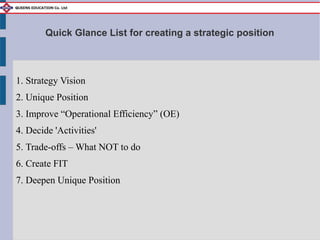
1. Strategy Vision
2. Unique Position
3. Improve “Operational Efficiency” (OE)
4. Decide 'Activities'
5. Trade-offs – What NOT to do
6. Create FIT
7. Deepen Unique Position
Quick Glance List for creating a strategic position
Quote – Michael E. Porter
A companies choice of a new position must be driven by the ability to
find new trade-offs and leverage a new system of complimentary
activities into sustainable advantage.

Creating Competitive Advantage

  • 1.
    Creating Competitive Advantage Strategy Basedon the works of Michael E. Porter By Ian Simpson
  • 2.
    The Situation  Schoolstrying to be all things to all customers  Little or no competitive advantage
  • 3.
     Perform tasks betterand faster  Fewer required inputs  Minimizing defects  Absolutely necessary for strategy  Examples Operational Effectiveness
  • 4.
    Operational Effectiveness 2 NOTstrategy Easy to imitate Competitive Convergence
  • 5.
    Definition Strategy is thecreation of a unique and valuable position, involving a different set of activities. Strategy
  • 6.
    Strategy Strategic Position  Servingfew needs of many customers  Serving broad needs of a few customers  Serving broad needs of many customers in a narrow market
  • 7.
  • 8.
    Activities Definition Basic units ofCompetitive Advantage Examples New Products
  • 9.
     FIT is theway a companies activities interact and reinforce each other  Strategy requires FIT among a companies activities  Very hard for competitors to copy a good FIT FIT
  • 10.
    FIT – TheQueens School Model: 1.Strategic Position – Serving the broad needs of few customers 2.Target Customers Busy High-End Professionals (Medical Bias) 3.Activities  Private Classroom lessons  Private Online video lessons  Online Learning Platform  Central 'HUB' Administration Software System 4. Queens School operates 3 schools
  • 11.
    1 X 1 OnlineVideo Lesson 1 X 1 Corporate Courses 1 X 1 Classroom Lesson Happy Hour The Edge [Engine Room] Video Sharing And Admin SIMSTAT Teaching System Medical Bias Target High-End Profession als
  • 12.
    First Expansion: Deepen StrategicPosition Uniqueness of your Business Second Expansion: Separate “stand-alone” unit Examples FIT – The Queens School Model:
  • 13.
    Waseda/Queens Kids School Original Name Logo Homepage Image Strategic- Position Doesn't blur the original Queens Strategic Position Curriculum Staff Marketing Buildings Kid's school Administration Link to Queens Engine Room Queens English School School 1 School 2 ( in city A ) ( in city B ) Japanese Teacher Native Teacher Japanese Teacher Native Teacher Native Teacher Native Teacher Japanese Teacher Japanese Teacher Week 1 Week 3Week 2 Week 4 Waseda Juku "FIT" Drives both Competitive Advantage and Sustainability "SHARE" Workload & Costs
  • 14.
    Conclusion Do you havea Strategy? 1. Which of our products are the most distinctive? 2. Which are the most profitable? 3. Which of our students/clients are most satisfied? 4. Which of the products in our value chain are the most different and effective? 5. What is our Core Competence?
  • 15.
    1. Strategy Vision 2.Unique Position 3. Improve “Operational Efficiency” (OE) 4. Decide 'Activities' 5. Trade-offs – What NOT to do 6. Create FIT 7. Deepen Unique Position Quick Glance List for creating a strategic position
  • 16.
    Quote – MichaelE. Porter A companies choice of a new position must be driven by the ability to find new trade-offs and leverage a new system of complimentary activities into sustainable advantage.

Editor's Notes

  • #3 Do you have unique position within the market ? – Do you have a Strategy ?????? Many business don’t have a strategy , they rely on Operational Effectiveness to try and stay ahead of rivals !
  • #4 Examples of OE - -- Good quality, easy to navigate HP , including online functions like booking a trial lesson, receiving info. -- Schools communication system between staff and students – in-house email –Viber-Line etc …. -- teacher recruitment and training/ assessment – smooth -- system for ordering stock – bulk buying – discounts -- efffective timetableing -- office filing system -- monthly financial calculations – salaries -- new student - ease of induction and placement -- student surveys and continual improvement and “best practice”
  • #5 Stay ahead of imitation by running faster and faster !!!! Easy to imitate / Competitive Convergence -- - Japanese companies of the 70` & 80`s – leading the world in OE -- - lead to CV and low profits. -- The only person who gains is the client/student, because of increased customer service and low prices !! -- Nowadays companies are having to think more about strategy - Toa & Arai – Forging –competing with China- Taiwan- Malaysia – by making unique machine-less products ..etc.
  • #6 That is doing different activities or doing similar activities in a different way, from your rivals.
  • #7 These 3 positions are not mutually exclusive , but sometimes overlap 1- Variety based position - eg - an Exam school, pronunciation school, Kumon ? 2- Needs based position – eg - serving a particular segment of client ( medical – Doctors jokes !!) or kind of service ( study abroad ). 3 – Access based – eg – the countyside school – adv.- lower costs because of locality, rents, advertising, less competition, Deciding on which ? - Incumbunts- cost of rebranding, / adv. To new Entrants –seeing a seded or new position. -- its diffucult to provide a better and greater value service than a specialist. – because of over stretching your resources.
  • #8 -Trade Offs are essential for a successful strategy - it basically means more of one thing neccesitates a need for less of another. You cant hope to do everything without high costs and overheads. Some activities are not mutually compatitble. Eg - Trying to do an IELTS-TOIEC course on the same T/T as a coffee & chat lesson and a pronunciation division may blur your strategic position in the eye of the customer,, activities NOT compatable ! & problem with the need for specialist teachers. -- lack of trade offs / danger of Straddling /
  • #9 -- Creating unique and compatible activities are the basic units of CA. -- EXAMPLES of activities could include – type of lesson focus, original curriculum, course structure, pricing structure( low cost or differentiator), packages etc. New products - music, videos , ( combined with original texts) / online courses / The Edge – MY new product. – combining these activities to make unique courses and programs add to CA.
  • #10 Its hard to copy one part of a system, but very almost impossible to copy a complete interlocking system. So this can be a great “barrier to entry” , because of cost and complexity.
  • #12 1- This diagram aims to show how the strategic Activities selected by Queens Education are mutually compatable and therefore create a strategic advantage over rivals. 2 – 3 main lesson types + 1 expansion ( later )! 3 – And , 3 other compatable activities that strengthen the FIT and make it harder for rivals to copy. 4- Lets talk about the FIT from the inside out. 5 – To give you an example of how it might work in reality. A students signing up for the PRIVATE LESSON will get a package that includes ……………
  • #13 The first expansion was the HH lesson, introduced to serve the needs of the local community. ( providing a benefit to the community – social responsibility – but possible to do because of the existing infrastructure and FIT) -- see previous slide – HH -- see next slide to see the second and different kind of expansion.
  • #14 -- The activities are the :- course structure, unique curriculum, link to JHS 1- balance of communication to grammar, shuttle bus service, combination packages with Juku subjects. -- This is a tight FIT !!
  • #15 -- ASK YOURSELF ? -- if you’re an existing school - ask yourself. Are we still on track, focused. What was the vision of the founder ?