What Is Strategy ?
HBR Nov.-Dec. 1996 Michel E. Porter
Is it means Positioning ?
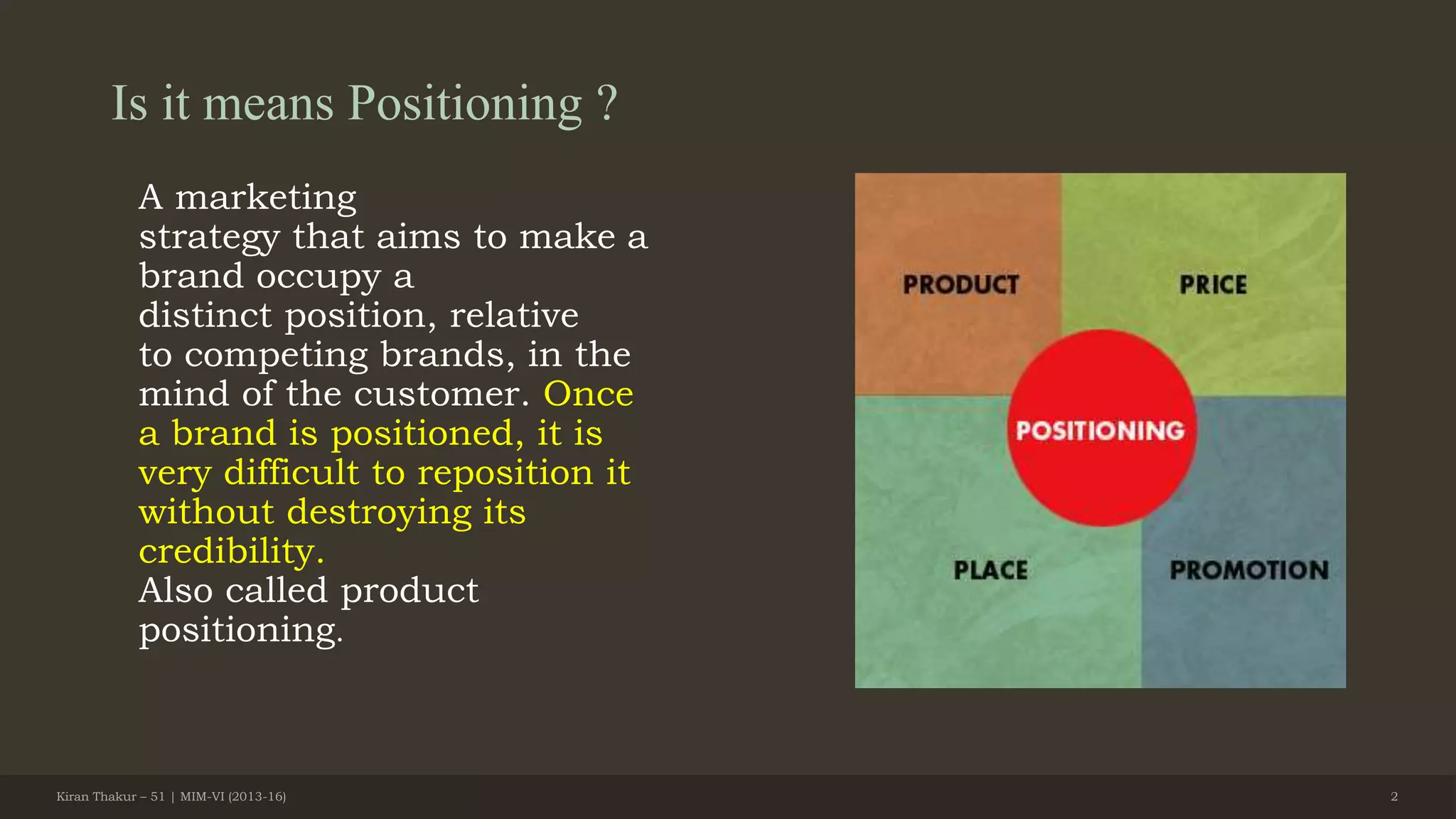
A marketing
strategy that aims to make a
brand occupy a
distinct position, relative
to competing brands, in the
mind of the customer. Once
a brand is positioned, it is
very difficult to reposition it
without destroying its
credibility.
Also called product
positioning.
Kiran Thakur – 51 | MIM-VI (2013-16) 2
Is it about Operational Effectiveness ?
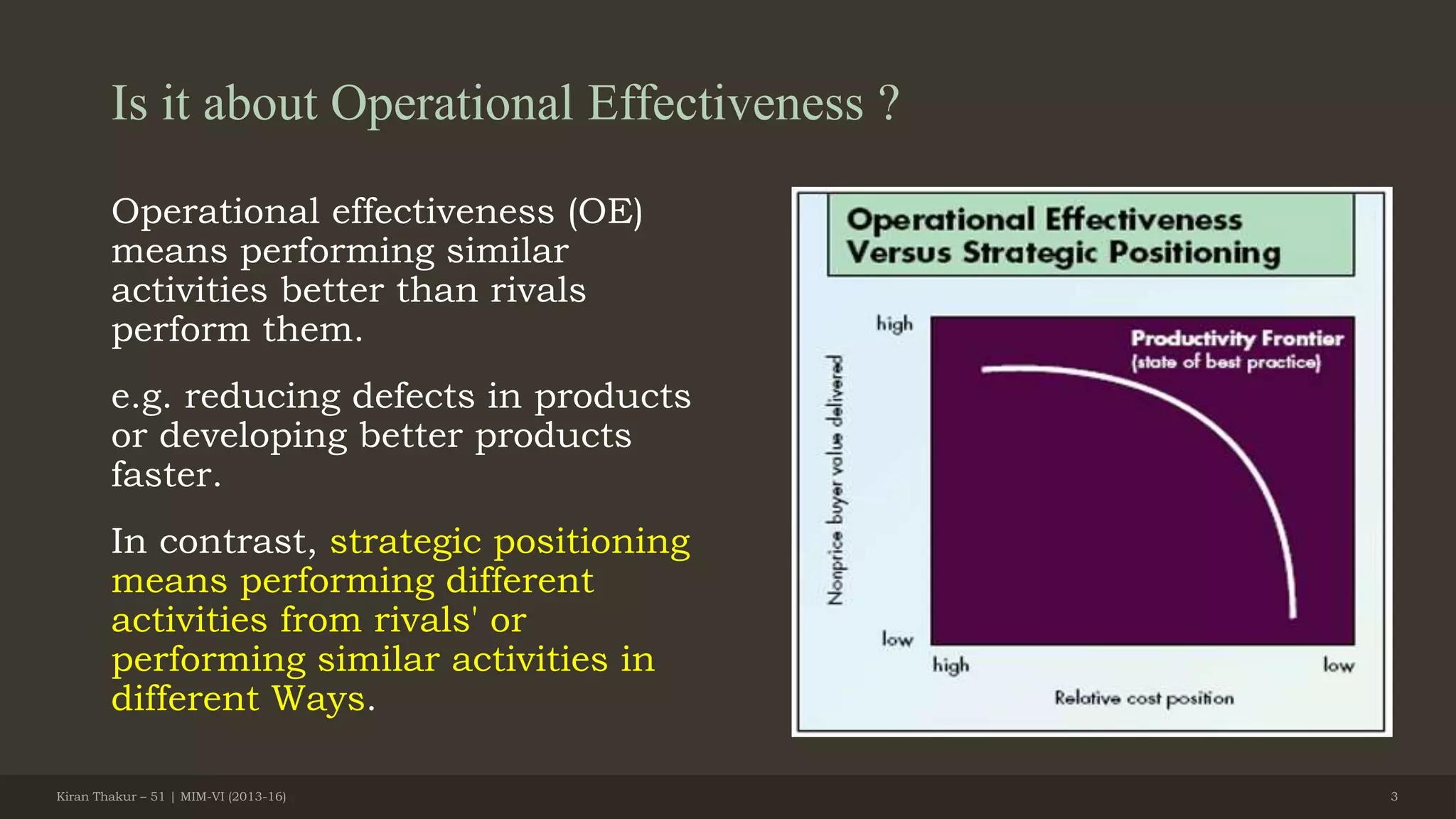
Operational effectiveness (OE)
means performing similar
activities better than rivals
perform them.
e.g. reducing defects in products
or developing better products
faster.
In contrast, strategic positioning
means performing different
activities from rivals' or
performing similar activities in
different Ways.
Kiran Thakur – 51 | MIM-VI (2013-16) 3
Continuous improvement has been etched on managers'
brains. But its tools unwittingly draw companies toward
imitation and homogeneity. Gradually, managers have let
operational effectiveness supplant strategy. The result is
zero sum competition, static or declining prices, and
pressures on costs that compromise companies‘ ability to
invest in the business for the long term. ………….. Pg No.64
Kiran Thakur – 51 | MIM-VI (2013-16) 4
Strategic Positioning
Strategic positioning is
the positioning of an
organization (unit) in the
future, while taking into
account the changing
environment, plus the
systematic realization of
that positioning.
Variety-based
positioning
Access-
based
positioning
Needs-
based
positioning
Sagar Soparkar - 49 | MIM-VI (2013-16) 5
Strategic Positioning …(contd)
• Variety Based Positioning – It is
based on the choice of product or
service varieties rather than
customer segment.
• Needs-Based Positioning – Do
everything, but only for a
particular group of customers
• Access-Based Positioning – Go
where your customers are.
Function of customer geography or
customer scale to reach customers
in best way.
Sagar Soparkar - 49 | MIM-VI (2013-16) 6
Strategy is the creation of a unique and valuable position,
involving a different set of activities. If there were only one
ideal position, there would be no need for strategy. The
essence of strategic positioning is to choose activities that
are different from rivals'. If the same set of activities were
best to produce all varieties, meet all needs, and access all
customers, companies could easily shift among them and
operational effectiveness would determine performance.
…………….Pg No.68
Sagar Soparkar - 49 | MIM-VI (2013-16) 7
Sustainable Strategic Position
• A valuable position will attract imitation by incumbents, who are
likely to copy it in one of two ways
• Superior performer
• Straddling - The straddle seeks to match the benefits of a successful position
while maintaining its existing position.
But a strategic position is not sustainable unless
there are trade-offs with other positions. ………Pg.No. 68
Jidnesh Bhogare - 05 | MIM-VI (2013-16) 8
Trade-Offs
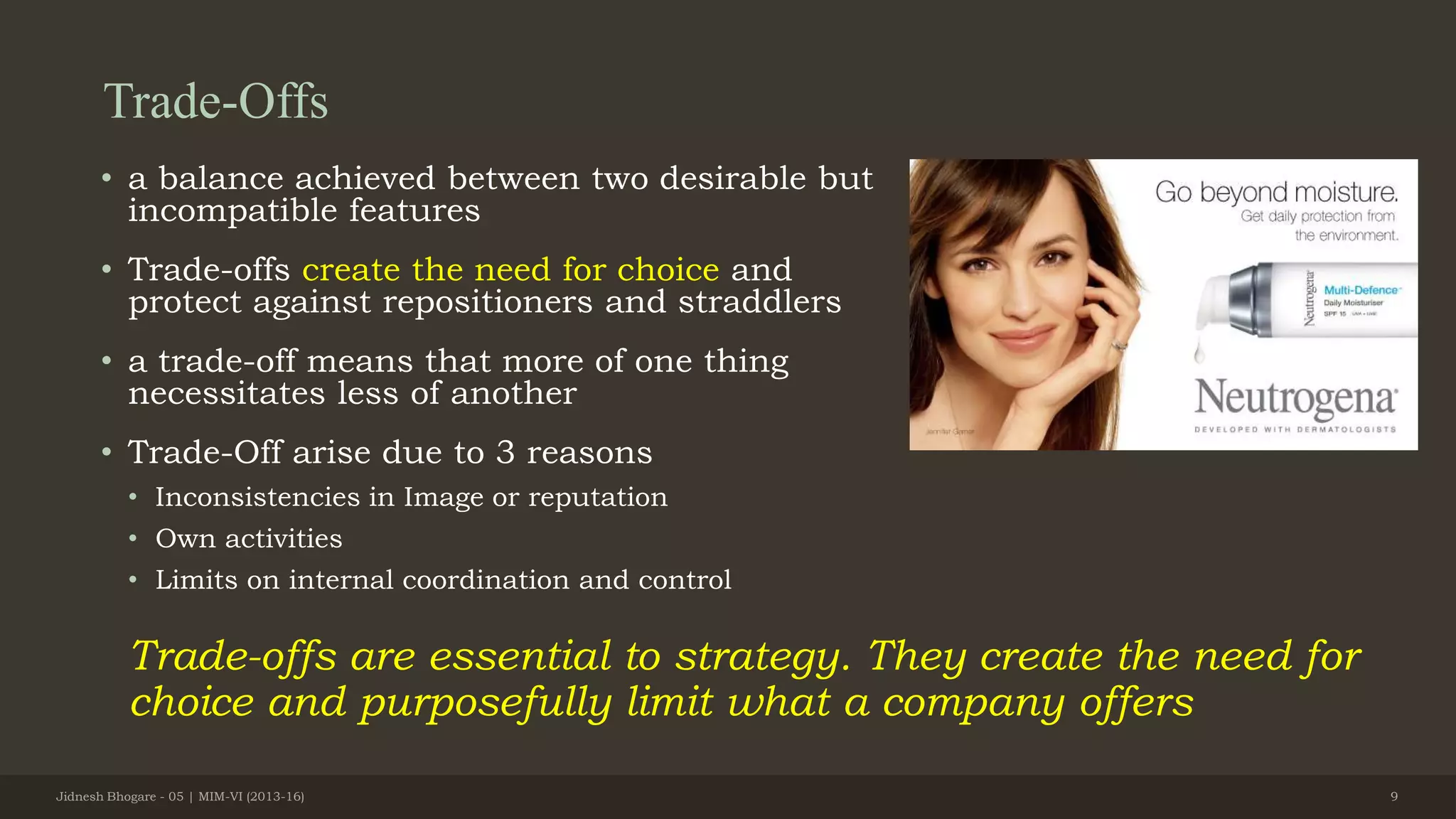
• a balance achieved between two desirable but
incompatible features
• Trade-offs create the need for choice and
protect against repositioners and straddlers
• a trade-off means that more of one thing
necessitates less of another
• Trade-Off arise due to 3 reasons
• Inconsistencies in Image or reputation
• Own activities
• Limits on internal coordination and control
Trade-offs are essential to strategy. They create the need for
choice and purposefully limit what a company offers
Jidnesh Bhogare - 05 | MIM-VI (2013-16) 9
Fit : A Competitive Advantage and Sustainability
• …strategy is about combining activities.
• Fit locks out imitators by creating a
chain that is as strong as its strongest
link.
• A strategic fit creates competitive
advantage and superior profitability
• Fit is important because discrete
activities often affect one another.
• The most valuable fit is strategy-specific
as it enhances a position’s uniqueness
and amplifies trade-off
Jidnesh Bhogare - 05 | MIM-VI (2013-16) 10
Types of Fit
• First-order fit
• consistency between each activity (function) and the overall strategy.
• consistency makes it easier to communicate the strategy to customers,
employees, and shareholders, and improves implementation through single-
mindedness in the corporation.
• Second-order fit
• Occurs when activities are reinforcing.
• Third-order fit
• as optimization of effort.
• Coordination and information exchange across activities to eliminate
redundancy and minimize wasted effort are the most basic types of effort
optimization.
Manoj Dube - 10 | MIM-VI (2013-16) 11
Manoj Dube - 10 | MIM-VI (2013-16) 12
Fit and Sustainability
• Positions built on systems of activities are far more sustainable than
those built on individual activities.
• It is harder for a rival to match an array of interlocked activities than
it is merely to imitate a particular sales-force approach
• fit among a company's activities creates pressures and incentives to
improve operational effectiveness, which makes imitation even harder
• Achieving fit is difficult because it requires the integration of decisions
and actions across many independent subunits
• Strategic positioning sets the trade-off rules that define how individual
activities will be configured and integrated
• strategic positions should have a horizon of a decade or more, not of a
single planning cycle
Manoj Dube - 10 | MIM-VI (2013-16) 13
Fit and Sustainability …(contd)
• Strategy is creating fit among a company's activities
The success of a strategy depends on doing many things
well-not just a few and integrating among them. If there is
no fit among activities, there is no distinctive strategy and
little sustainability. …..PgNo.75
Manoj Dube - 10 | MIM-VI (2013-16) 14
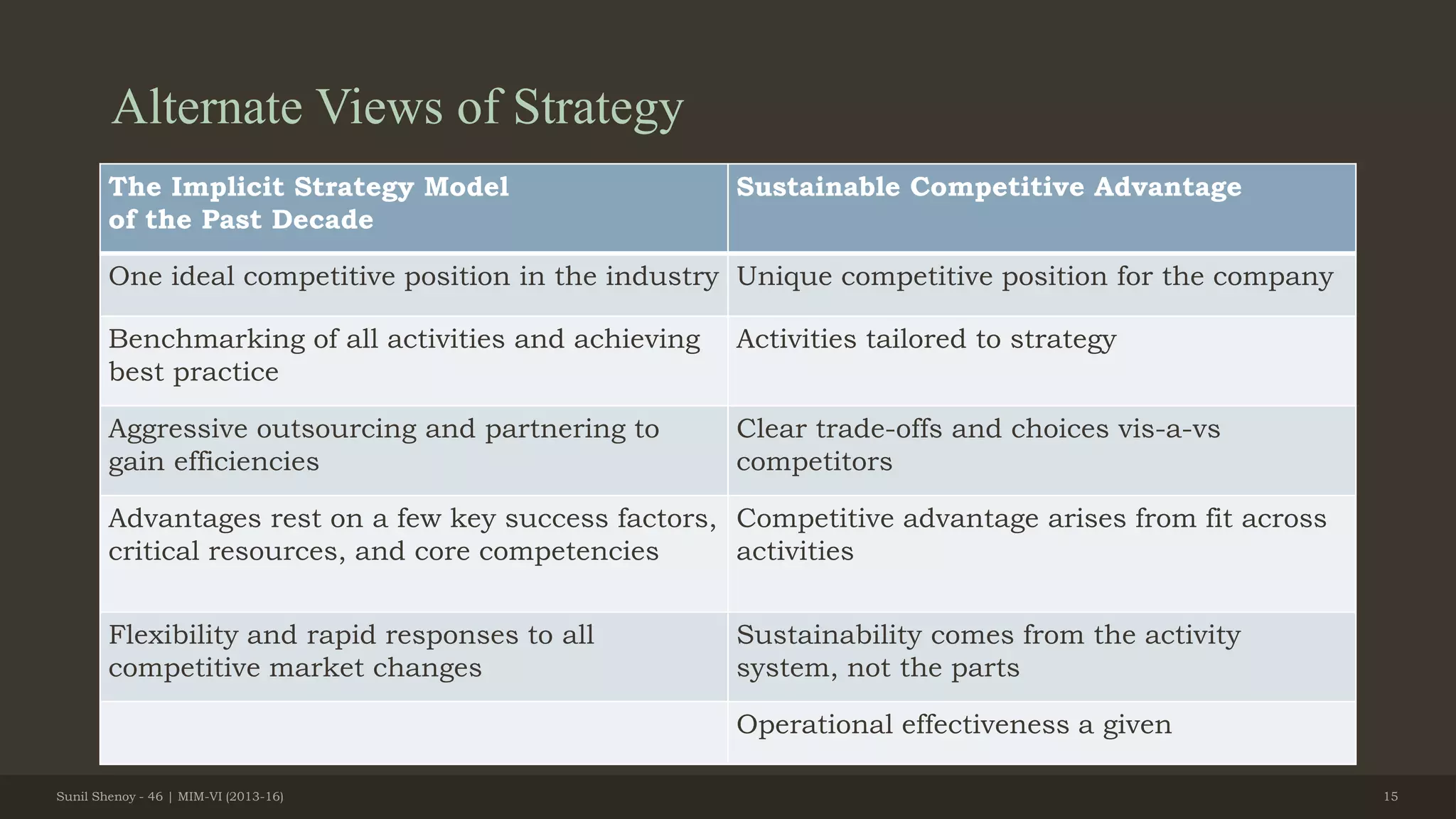
Alternate Views of Strategy
The Implicit Strategy Model
of the Past Decade
Sustainable Competitive Advantage
One ideal competitive position in the industry Unique competitive position for the company
Benchmarking of all activities and achieving
best practice
Activities tailored to strategy
Aggressive outsourcing and partnering to
gain efficiencies
Clear trade-offs and choices vis-a-vs
competitors
Advantages rest on a few key success factors,
critical resources, and core competencies
Competitive advantage arises from fit across
activities
Flexibility and rapid responses to all
competitive market changes
Sustainability comes from the activity
system, not the parts
Operational effectiveness a given
Sunil Shenoy - 46 | MIM-VI (2013-16) 15
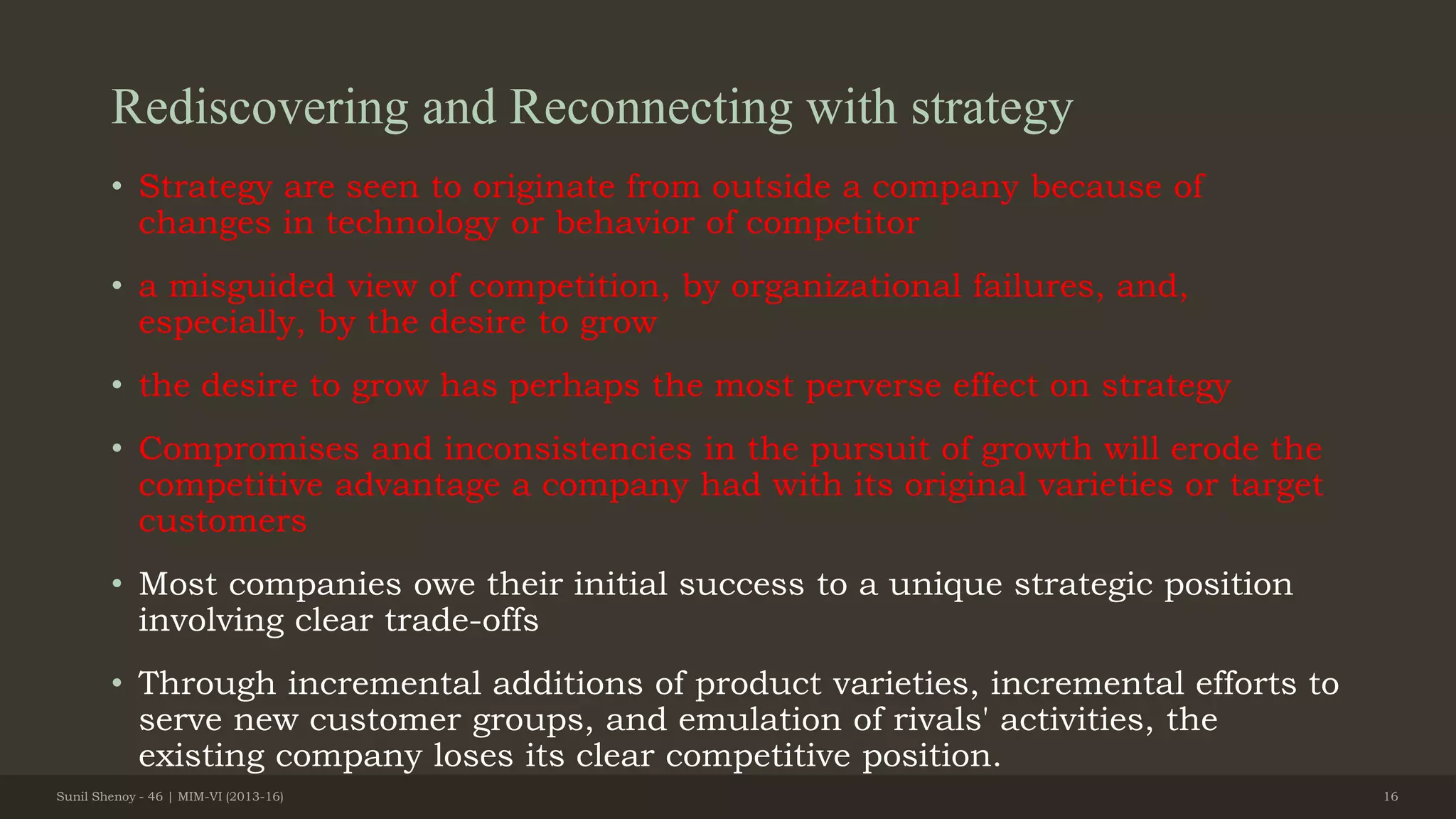
Rediscovering and Reconnecting with strategy
• Strategy are seen to originate from outside a company because of
changes in technology or behavior of competitor
• a misguided view of competition, by organizational failures, and,
especially, by the desire to grow
• the desire to grow has perhaps the most perverse effect on strategy
• Compromises and inconsistencies in the pursuit of growth will erode the
competitive advantage a company had with its original varieties or target
customers
• Most companies owe their initial success to a unique strategic position
involving clear trade-offs
• Through incremental additions of product varieties, incremental efforts to
serve new customer groups, and emulation of rivals' activities, the
existing company loses its clear competitive position.
Sunil Shenoy - 46 | MIM-VI (2013-16) 16
Rediscovering and Reconnecting with strategy …(contd)
• How to reconnect with strategy ?
• Which of our product or service varieties are the most distinctive ?
• Which of our product or service varieties are the most profitable?
• Which of our customers are the most satisfied?
• which customers, channels, or purchase occasions are the most profitable?
• Which of the activities in our value chain are the most different and effective?
A company can often grow faster-and far more profitably - by
better penetrating needs and varieties where it is distinctive
than by slugging it out in potentially higher growth arenas in
which the company lacks uniqueness ….PgNo.77
Sunil Shenoy - 46 | MIM-VI (2013-16) 17
HBR Executive Summary
• Porter argues that operational effectiveness, although necessary to
superior performance, is not sufficient, because its techniques are easy to
imitate. In contrast, the essence of strategy is choosing a unique and
valuable position rooted in systems of activities that are much more
difficult to match. Porter thus traces the economic basis of competitive
advantage down to the level of the specific activities a company performs.
Using cases such as Ikea and Vanguard, he shows how making trade-offs
among activities is critical to the sustainability of a strategy. Whereas
managers often focus on individual components of success such as core
competencies or critical resources, Porter shows how managing fit across
all of a company’s activities enhances both competitive advantage and
sustainability. While stressing the role of leadership in making and
enforcing clear strategic choices, Porter also offers advice on how
companies can reconnect with strategies that have become blurred over
time.
Sunil Shenoy - 46 | MIM-VI (2013-16) 18
Conclusion
• A company must continually improve its operational effectiveness
and actively try to shift the productivity frontier;
• at the same time, there needs to be ongoing effort to extend its
uniqueness while strengthening the fit among its activities
• a company may have to change its strategic position due to a major
structural change in the industry.
• a company should choose its new position depending on its ability
to find new trade-offs and leverage a new system of complementary
activities into a sustainable advantage.
Sunil Shenoy - 46 | MIM-VI (2013-16) 19
Thank You ! 
MIM-VI (2013-16) 20

What Is Strategy

  • 1.
    What Is Strategy? HBR Nov.-Dec. 1996 Michel E. Porter
  • 2.
    Is it meansPositioning ? A marketing strategy that aims to make a brand occupy a distinct position, relative to competing brands, in the mind of the customer. Once a brand is positioned, it is very difficult to reposition it without destroying its credibility. Also called product positioning. Kiran Thakur – 51 | MIM-VI (2013-16) 2
  • 3.
    Is it aboutOperational Effectiveness ? Operational effectiveness (OE) means performing similar activities better than rivals perform them. e.g. reducing defects in products or developing better products faster. In contrast, strategic positioning means performing different activities from rivals' or performing similar activities in different Ways. Kiran Thakur – 51 | MIM-VI (2013-16) 3
  • 4.
    Continuous improvement hasbeen etched on managers' brains. But its tools unwittingly draw companies toward imitation and homogeneity. Gradually, managers have let operational effectiveness supplant strategy. The result is zero sum competition, static or declining prices, and pressures on costs that compromise companies‘ ability to invest in the business for the long term. ………….. Pg No.64 Kiran Thakur – 51 | MIM-VI (2013-16) 4
  • 5.
    Strategic Positioning Strategic positioningis the positioning of an organization (unit) in the future, while taking into account the changing environment, plus the systematic realization of that positioning. Variety-based positioning Access- based positioning Needs- based positioning Sagar Soparkar - 49 | MIM-VI (2013-16) 5
  • 6.
    Strategic Positioning …(contd) •Variety Based Positioning – It is based on the choice of product or service varieties rather than customer segment. • Needs-Based Positioning – Do everything, but only for a particular group of customers • Access-Based Positioning – Go where your customers are. Function of customer geography or customer scale to reach customers in best way. Sagar Soparkar - 49 | MIM-VI (2013-16) 6
  • 7.
    Strategy is thecreation of a unique and valuable position, involving a different set of activities. If there were only one ideal position, there would be no need for strategy. The essence of strategic positioning is to choose activities that are different from rivals'. If the same set of activities were best to produce all varieties, meet all needs, and access all customers, companies could easily shift among them and operational effectiveness would determine performance. …………….Pg No.68 Sagar Soparkar - 49 | MIM-VI (2013-16) 7
  • 8.
    Sustainable Strategic Position •A valuable position will attract imitation by incumbents, who are likely to copy it in one of two ways • Superior performer • Straddling - The straddle seeks to match the benefits of a successful position while maintaining its existing position. But a strategic position is not sustainable unless there are trade-offs with other positions. ………Pg.No. 68 Jidnesh Bhogare - 05 | MIM-VI (2013-16) 8
  • 9.
    Trade-Offs • a balanceachieved between two desirable but incompatible features • Trade-offs create the need for choice and protect against repositioners and straddlers • a trade-off means that more of one thing necessitates less of another • Trade-Off arise due to 3 reasons • Inconsistencies in Image or reputation • Own activities • Limits on internal coordination and control Trade-offs are essential to strategy. They create the need for choice and purposefully limit what a company offers Jidnesh Bhogare - 05 | MIM-VI (2013-16) 9
  • 10.
    Fit : ACompetitive Advantage and Sustainability • …strategy is about combining activities. • Fit locks out imitators by creating a chain that is as strong as its strongest link. • A strategic fit creates competitive advantage and superior profitability • Fit is important because discrete activities often affect one another. • The most valuable fit is strategy-specific as it enhances a position’s uniqueness and amplifies trade-off Jidnesh Bhogare - 05 | MIM-VI (2013-16) 10
  • 11.
    Types of Fit •First-order fit • consistency between each activity (function) and the overall strategy. • consistency makes it easier to communicate the strategy to customers, employees, and shareholders, and improves implementation through single- mindedness in the corporation. • Second-order fit • Occurs when activities are reinforcing. • Third-order fit • as optimization of effort. • Coordination and information exchange across activities to eliminate redundancy and minimize wasted effort are the most basic types of effort optimization. Manoj Dube - 10 | MIM-VI (2013-16) 11
  • 12.
    Manoj Dube -10 | MIM-VI (2013-16) 12
  • 13.
    Fit and Sustainability •Positions built on systems of activities are far more sustainable than those built on individual activities. • It is harder for a rival to match an array of interlocked activities than it is merely to imitate a particular sales-force approach • fit among a company's activities creates pressures and incentives to improve operational effectiveness, which makes imitation even harder • Achieving fit is difficult because it requires the integration of decisions and actions across many independent subunits • Strategic positioning sets the trade-off rules that define how individual activities will be configured and integrated • strategic positions should have a horizon of a decade or more, not of a single planning cycle Manoj Dube - 10 | MIM-VI (2013-16) 13
  • 14.
    Fit and Sustainability…(contd) • Strategy is creating fit among a company's activities The success of a strategy depends on doing many things well-not just a few and integrating among them. If there is no fit among activities, there is no distinctive strategy and little sustainability. …..PgNo.75 Manoj Dube - 10 | MIM-VI (2013-16) 14
  • 15.
    Alternate Views ofStrategy The Implicit Strategy Model of the Past Decade Sustainable Competitive Advantage One ideal competitive position in the industry Unique competitive position for the company Benchmarking of all activities and achieving best practice Activities tailored to strategy Aggressive outsourcing and partnering to gain efficiencies Clear trade-offs and choices vis-a-vs competitors Advantages rest on a few key success factors, critical resources, and core competencies Competitive advantage arises from fit across activities Flexibility and rapid responses to all competitive market changes Sustainability comes from the activity system, not the parts Operational effectiveness a given Sunil Shenoy - 46 | MIM-VI (2013-16) 15
  • 16.
    Rediscovering and Reconnectingwith strategy • Strategy are seen to originate from outside a company because of changes in technology or behavior of competitor • a misguided view of competition, by organizational failures, and, especially, by the desire to grow • the desire to grow has perhaps the most perverse effect on strategy • Compromises and inconsistencies in the pursuit of growth will erode the competitive advantage a company had with its original varieties or target customers • Most companies owe their initial success to a unique strategic position involving clear trade-offs • Through incremental additions of product varieties, incremental efforts to serve new customer groups, and emulation of rivals' activities, the existing company loses its clear competitive position. Sunil Shenoy - 46 | MIM-VI (2013-16) 16
  • 17.
    Rediscovering and Reconnectingwith strategy …(contd) • How to reconnect with strategy ? • Which of our product or service varieties are the most distinctive ? • Which of our product or service varieties are the most profitable? • Which of our customers are the most satisfied? • which customers, channels, or purchase occasions are the most profitable? • Which of the activities in our value chain are the most different and effective? A company can often grow faster-and far more profitably - by better penetrating needs and varieties where it is distinctive than by slugging it out in potentially higher growth arenas in which the company lacks uniqueness ….PgNo.77 Sunil Shenoy - 46 | MIM-VI (2013-16) 17
  • 18.
    HBR Executive Summary •Porter argues that operational effectiveness, although necessary to superior performance, is not sufficient, because its techniques are easy to imitate. In contrast, the essence of strategy is choosing a unique and valuable position rooted in systems of activities that are much more difficult to match. Porter thus traces the economic basis of competitive advantage down to the level of the specific activities a company performs. Using cases such as Ikea and Vanguard, he shows how making trade-offs among activities is critical to the sustainability of a strategy. Whereas managers often focus on individual components of success such as core competencies or critical resources, Porter shows how managing fit across all of a company’s activities enhances both competitive advantage and sustainability. While stressing the role of leadership in making and enforcing clear strategic choices, Porter also offers advice on how companies can reconnect with strategies that have become blurred over time. Sunil Shenoy - 46 | MIM-VI (2013-16) 18
  • 19.
    Conclusion • A companymust continually improve its operational effectiveness and actively try to shift the productivity frontier; • at the same time, there needs to be ongoing effort to extend its uniqueness while strengthening the fit among its activities • a company may have to change its strategic position due to a major structural change in the industry. • a company should choose its new position depending on its ability to find new trade-offs and leverage a new system of complementary activities into a sustainable advantage. Sunil Shenoy - 46 | MIM-VI (2013-16) 19
  • 20.
    Thank You ! MIM-VI (2013-16) 20

Editor's Notes

  • #4 Operational effectiveness includes but is not limited to efficiency. It refers to any number of practices that allow a company to better utilize its inputs by,
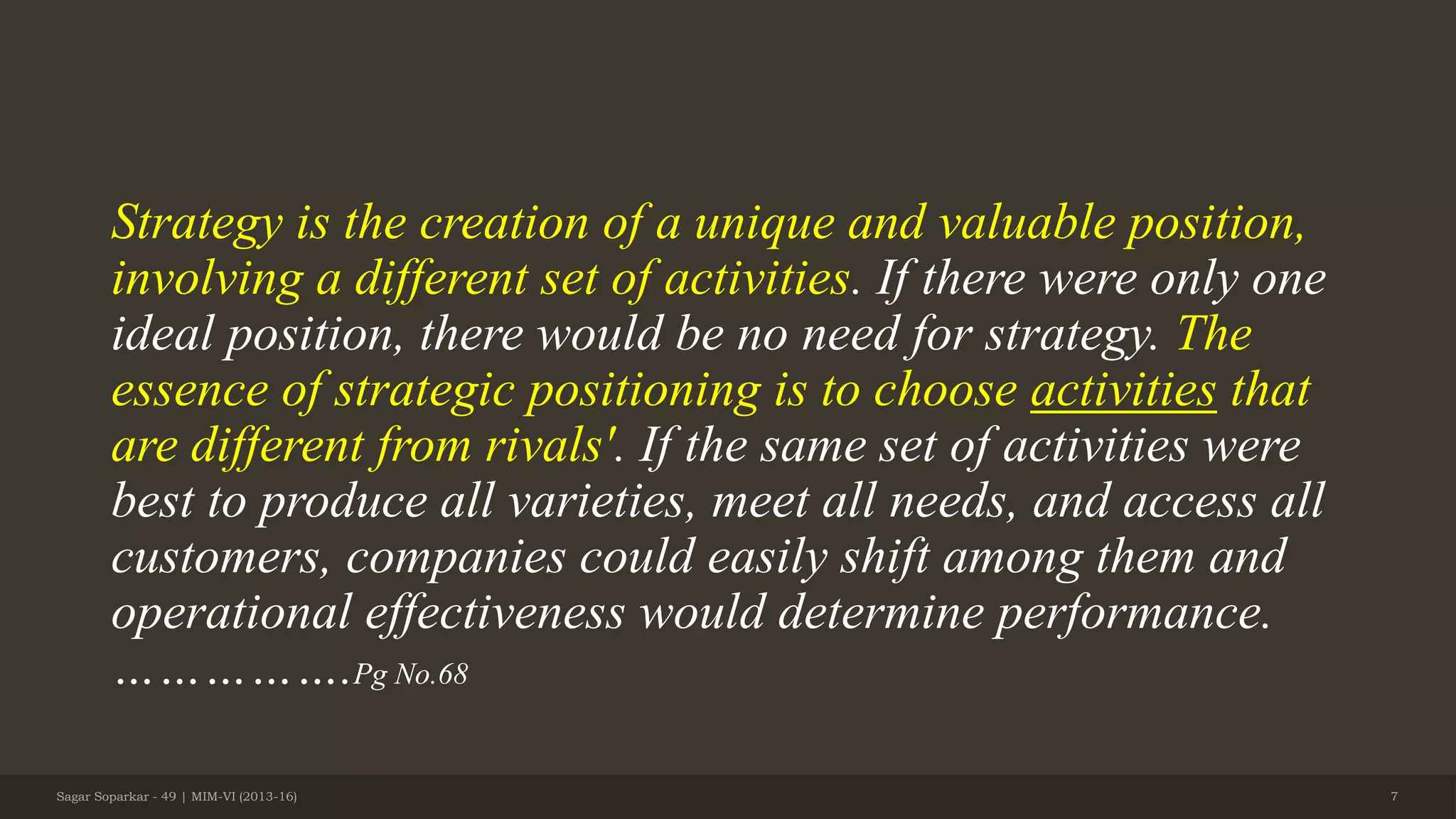
  • #7 At Staples for example, you can find everything you could ever need in the office. It doesn’t matter if you are a freelancer, a secretary or the boss of a company. Staples is about office equipment, not about household articles and not about car parts. Not to overlook is, that what you are doing also has to differ. It doesn’t help to only focus on what you do best, but that you gain a differentiation advantage through it. IKEA is still the perfect example for Need Based positioning. The furnishing company serves all needs, not just a few, of it’s target group of customers which are primarily young furniture buyers who want style at low cost.  Carmike’s Small-town customers can be served through standardized, low-cost theater, less sophisticated projection technology than big-city theaters. Proprietary information system and management process eliment the need of local staff beyond a single theater manger. Ref : http://www.mindt-kries.com/being-the-best-is-not-strategy-strategic-positioning/
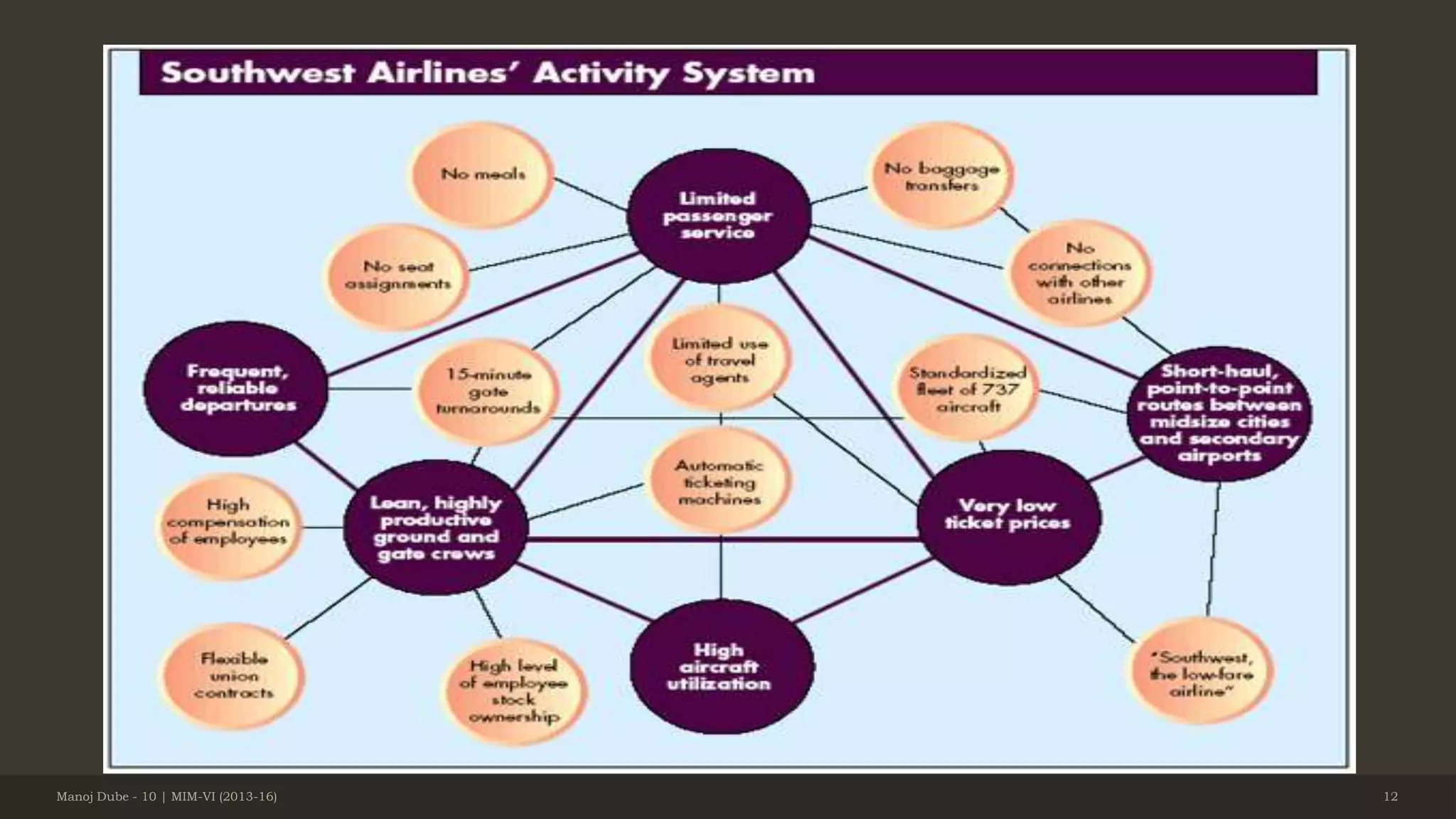
  • #11 Positioning choices determine not only which activities a company will perform and how it will configure individual activities but also how activities relate to one another. While operational effectiveness is ahout achieving excellence in individual activities, or functions, strategy is about combining activities. Southwest's rapid gate turnaround, which allows frequent departures and greater use of aircraft, is essential to its high-convenience, low-cost positioning. But how does Southwest achieve it? Part of the answer lies in the company's well-paid gate and ground crews, whose productivity in turnarounds is enhanced by flexible union rules. But the bigger part of the answer lies in how Southwest performs other activities. With no meals, no seat assignment, and no interline baggage transfers. Southwest avoids having to perform activities that slow down other airlines. It selects airports and routes to avoid congestion that introduces delays. Southwest's strict hmits on the type and length of routes make standardized aircraft possible; every aircraft Southwest turns is a Boeing 737. Southwest's activities complement one another in ways that create real economic value. One activity's cost, for example, is lowered because of the way other activities are performed. Similarly, one activity's value to customers can be enhanced by a company's other activities.