WHAT IS STRATEGY? BY Michael  E.   Porter Presented by: IDREES WARIS  3095
Operational Effectiveness It is the process of producing faster or with fewer inputs and defects than rivals. How  is achieved ? Eliminate wasted efforts. Employ advanced technology. Motivated employees better. Greater insight into managing particular set of activities. Operational effectiveness is necessary to compete but not sufficient to win.
Strategic positioning Strategic positioning means doing things different from competitors. Strategic position are often not obvious and finding them requires creativity and insight.
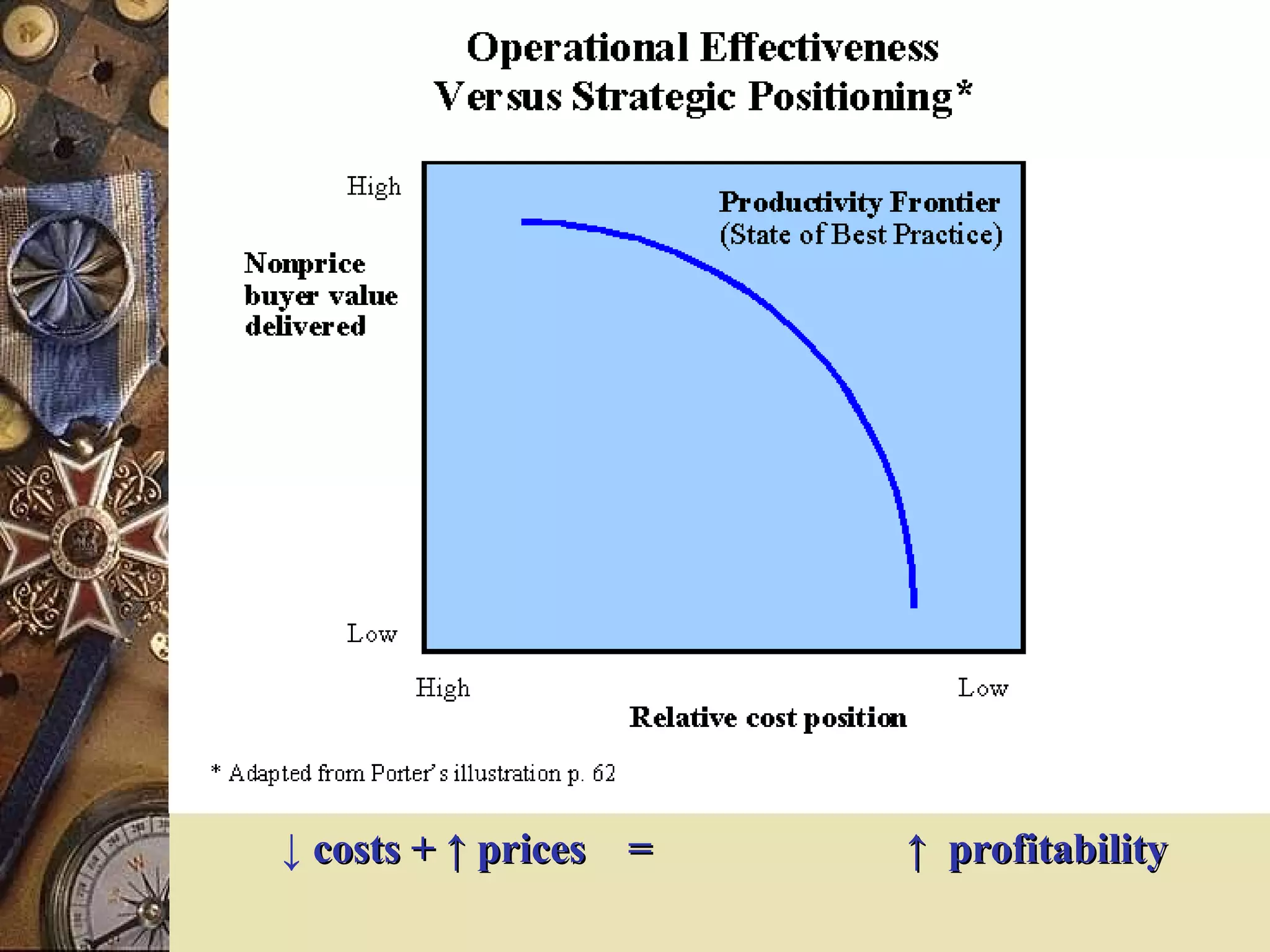
↓   costs +  ↑  prices  =  ↑  profitability
OE is necessary but not sufficient:  Weaknesses Competitors can quickly imitate management techniques, technologies, input improvements and superior ways to meet customer’s needs. Eg: Japanese companies (1970-1980) enjoy substantial cost & quality advantages (productivity frontier). Now they need to learn strategy.
Strategy Rests On Unique Activities
STRATEGY “ Competitive strategy is about being different” Doing thinks differently than rivals do. So, strategy is not serving customers but serving them better than others do by deliberately choosing a set of activities to deliver a  unique mix of value . Example: southwest airline.
Competitive  Advantage  Examples  Strive to be the industry’s low-cost provider Southwest Airlines Wal-Mart Outcompete rivals on a key differentiating feature Johnson & Johnson   – Reliability in baby products Rolex  – Top-of-the-line prestige Mercedes-Benz  – Engineering design and performance
Competitive  Advantage  Examples (cont)  Develop expertise, resource strengths, and capabilities not easily imitated by rivals FedEx  – Next-day delivery of small packages Walt Disney  – Theme park management and family entertainment Toyota  – Sophisticated production system
The Origins of Strategic Positions Strategic positions can be based on: 1)  Variety based positioning  (product/services) 2)  Need based positioning  ( Customers’ needs) Way of accessing customers  ( serving the broader needs of customer in a narrow market)
Variety based positioning Based on the choice of product or service varieties rather than customer segments. feasible only when a company can best produce particular products or services using distinctive sets of activities. Example: jiffy lube international, specializes in automotive lubricants and does not provide other maintenance services.
Need based positioning (serving board needs of few customers) Serving the most or all the needs of a particular group of customers. It is based on targeting a segment of customers Example: IKEA seeks to meet all the home furnishing needs of its target customers, not just a subset of them.
Access based positioning Segmenting customers who are accessible in different ways. Access can be a function of customer geography or customer scale or of anything that requires a different set of activities to reach customers in the best way. Example: Carmike cinemas
A Sustainable Strategic Position Requires Trade-offs
Unique position is not enough  to guarantee a sustainable  advantage. A competitor can choose to reposition itself to match the superior performer. A competitor can seek to match the benefits of a successful position while maintaining its existing position (known as straddling). Example: continental airlines decided to straddle.
Trade off  Trade off occur when the activities are incompatible.(mismatch) Trade off create the need for choice and protect against repositioners and straddlers. Example: Neutrogena's marketing strategy looks more like a drug company’s than a soap maker’s.
Trade off arises for 3 reasons Inconsistencies in image or reputation Example: ivory soap, inexpensive soap. Trade offs arise from activities themselves Example: IKEA activities lowering the cost  by having its customer do assembly and delivery less satisfied the customers. Trade offs arise from limits on internal coordination and control.
Trade offs Trade-offs create the need for choice and protect against re-positioners and straddlers.  So strategy is defined as making trade-offs in competing.  The essence of strategy is choosing what  not  to do.
Fit drives both sustainability and competitive advantage
Operational effectiveness Operational effectiveness is about achieving excellence in individual activities. Strategy Strategy is about combining activities.
Sustainable Competitive Advantage Unique competitive position for a company. Activities tailored to strategy. Clear trade-offs and choices vis-à-vis competitors. Competitive advantage arises from fit across activities. And sustainable barriers to entry Sustainability comes from the activity system, not the parts. Example:   one activity’s cost is lowered because of way others are performed and vice versa.
Three TYPES OF FIT Simple consistency Activities are reinforcing Optimization of effort.
Simple consistency Consistency between each activity and the overall strategy. Example: vanguard align all with its activities with its low cost strategy.
Activities are reinforcing Fit occur when the activities are reinforcing. Example: Neutrogena, markets to upscale hotels eager to offer their guest a soap recommended by dermatologists.
Optimization of effort Coordination and information exchange across activities to eliminate redundancy and minimize wasted efforts. Example: product design choices can eliminate the need for after sale service.
Fit  and sustainability Strategic fit among activities is fundamental not only to competitive advantages but also to the sustainability of that advantage.  Example: continental lite’s disastrous attempt to imitate southwest.
Rediscovering strategy Failure to Choose: External changes can pose a threat to a company’s strategy A greater threat to strategy often comes from within the company Do not understand the need to have a strategy Conventional wisdom Risking blame for a bad choice
The Growth Trap Companies often grow by : Extending their product lines ( e.g.: Neutrogena extended product line, in which it was not unique) Adding new features Imitating competitors’ popular services Matching processes and  Making acquisitions Compromises and inconsistencies in the chase of growth eventually erode the competitive advantage of a company and their uniqueness with their rivals
Profitable Growth Deepening a strategic position by: Distinctive activities Strengthen fit Communicating strategy in a better way Globalization often allows growth that is consistent with a company’s strategy
What should companies and leaders do ? They should reevaluate their strategies and challenge themselves to start over. They should refocus on the unique core and realign the companies activities with it. Evaluate the vision of the founder and reexamine the original strategy. Leaders should be in charge of defining and communicating the company’s unique position, making trade-offs and forging it among activities.

Strategy by idrees waris IUGC

  • 1.
    WHAT IS STRATEGY?BY Michael E. Porter Presented by: IDREES WARIS 3095
  • 2.
    Operational Effectiveness Itis the process of producing faster or with fewer inputs and defects than rivals. How is achieved ? Eliminate wasted efforts. Employ advanced technology. Motivated employees better. Greater insight into managing particular set of activities. Operational effectiveness is necessary to compete but not sufficient to win.
  • 3.
    Strategic positioning Strategicpositioning means doing things different from competitors. Strategic position are often not obvious and finding them requires creativity and insight.
  • 4.
    costs + ↑ prices = ↑ profitability
  • 5.
    OE is necessarybut not sufficient: Weaknesses Competitors can quickly imitate management techniques, technologies, input improvements and superior ways to meet customer’s needs. Eg: Japanese companies (1970-1980) enjoy substantial cost & quality advantages (productivity frontier). Now they need to learn strategy.
  • 6.
    Strategy Rests OnUnique Activities
  • 7.
    STRATEGY “ Competitivestrategy is about being different” Doing thinks differently than rivals do. So, strategy is not serving customers but serving them better than others do by deliberately choosing a set of activities to deliver a unique mix of value . Example: southwest airline.
  • 8.
    Competitive Advantage Examples Strive to be the industry’s low-cost provider Southwest Airlines Wal-Mart Outcompete rivals on a key differentiating feature Johnson & Johnson – Reliability in baby products Rolex – Top-of-the-line prestige Mercedes-Benz – Engineering design and performance
  • 9.
    Competitive Advantage Examples (cont) Develop expertise, resource strengths, and capabilities not easily imitated by rivals FedEx – Next-day delivery of small packages Walt Disney – Theme park management and family entertainment Toyota – Sophisticated production system
  • 10.
    The Origins ofStrategic Positions Strategic positions can be based on: 1) Variety based positioning (product/services) 2) Need based positioning ( Customers’ needs) Way of accessing customers ( serving the broader needs of customer in a narrow market)
  • 11.
    Variety based positioningBased on the choice of product or service varieties rather than customer segments. feasible only when a company can best produce particular products or services using distinctive sets of activities. Example: jiffy lube international, specializes in automotive lubricants and does not provide other maintenance services.
  • 12.
    Need based positioning(serving board needs of few customers) Serving the most or all the needs of a particular group of customers. It is based on targeting a segment of customers Example: IKEA seeks to meet all the home furnishing needs of its target customers, not just a subset of them.
  • 13.
    Access based positioningSegmenting customers who are accessible in different ways. Access can be a function of customer geography or customer scale or of anything that requires a different set of activities to reach customers in the best way. Example: Carmike cinemas
  • 14.
    A Sustainable StrategicPosition Requires Trade-offs
  • 15.
    Unique position isnot enough to guarantee a sustainable advantage. A competitor can choose to reposition itself to match the superior performer. A competitor can seek to match the benefits of a successful position while maintaining its existing position (known as straddling). Example: continental airlines decided to straddle.
  • 16.
    Trade off Trade off occur when the activities are incompatible.(mismatch) Trade off create the need for choice and protect against repositioners and straddlers. Example: Neutrogena's marketing strategy looks more like a drug company’s than a soap maker’s.
  • 17.
    Trade off arisesfor 3 reasons Inconsistencies in image or reputation Example: ivory soap, inexpensive soap. Trade offs arise from activities themselves Example: IKEA activities lowering the cost by having its customer do assembly and delivery less satisfied the customers. Trade offs arise from limits on internal coordination and control.
  • 18.
    Trade offs Trade-offscreate the need for choice and protect against re-positioners and straddlers. So strategy is defined as making trade-offs in competing. The essence of strategy is choosing what not to do.
  • 19.
    Fit drives bothsustainability and competitive advantage
  • 20.
    Operational effectiveness Operationaleffectiveness is about achieving excellence in individual activities. Strategy Strategy is about combining activities.
  • 21.
    Sustainable Competitive AdvantageUnique competitive position for a company. Activities tailored to strategy. Clear trade-offs and choices vis-à-vis competitors. Competitive advantage arises from fit across activities. And sustainable barriers to entry Sustainability comes from the activity system, not the parts. Example: one activity’s cost is lowered because of way others are performed and vice versa.
  • 22.
    Three TYPES OFFIT Simple consistency Activities are reinforcing Optimization of effort.
  • 23.
    Simple consistency Consistencybetween each activity and the overall strategy. Example: vanguard align all with its activities with its low cost strategy.
  • 24.
    Activities are reinforcingFit occur when the activities are reinforcing. Example: Neutrogena, markets to upscale hotels eager to offer their guest a soap recommended by dermatologists.
  • 25.
    Optimization of effortCoordination and information exchange across activities to eliminate redundancy and minimize wasted efforts. Example: product design choices can eliminate the need for after sale service.
  • 26.
    Fit andsustainability Strategic fit among activities is fundamental not only to competitive advantages but also to the sustainability of that advantage. Example: continental lite’s disastrous attempt to imitate southwest.
  • 27.
    Rediscovering strategy Failureto Choose: External changes can pose a threat to a company’s strategy A greater threat to strategy often comes from within the company Do not understand the need to have a strategy Conventional wisdom Risking blame for a bad choice
  • 28.
    The Growth TrapCompanies often grow by : Extending their product lines ( e.g.: Neutrogena extended product line, in which it was not unique) Adding new features Imitating competitors’ popular services Matching processes and Making acquisitions Compromises and inconsistencies in the chase of growth eventually erode the competitive advantage of a company and their uniqueness with their rivals
  • 29.
    Profitable Growth Deepeninga strategic position by: Distinctive activities Strengthen fit Communicating strategy in a better way Globalization often allows growth that is consistent with a company’s strategy
  • 30.
    What should companiesand leaders do ? They should reevaluate their strategies and challenge themselves to start over. They should refocus on the unique core and realign the companies activities with it. Evaluate the vision of the founder and reexamine the original strategy. Leaders should be in charge of defining and communicating the company’s unique position, making trade-offs and forging it among activities.

Editor's Notes

  • #2 Welcome and Introduce self here