It Gives You Wiings
Contents
 Origin
 Growth Story
 Ingredients and Productlines.
 Competitive Analysis
 Different stratagies employed.
 Managing Integrated Marketing
Communications.
 The Mini Case Solution-kotler keller
Origin
 Red Bull is an energy drink sold
by Austrian company Red Bull GmbH,
created in 1987.
 Austrian entrepreneur Dietrich
Mateschitz along with  Chaleo Yoovidhya
founded Red Bull GmbH in 1987 in
Chakkapong.
 Entered Hungary, its foreign market in 1992.
Growth story
 It entered the United States via California in 1997and
the Middle East in 2000.
 In the U.S., Red Bull enjoys a 47% share of the energy
drink market, and now has a 50% share of the German
energy drink market.
 Its market has extended to more than 160 countries as
of now.
 Now, Red Bull is the highest-selling energy drink in the
world, with 5.73 billion cans sold in 2013.
Ingredients and product lines
 Mainly contains amino acid taurine, B-complex
Vitamins,caffiene and Carbohydrates.
 Highly regarded as ‘Liquid cocaine’ and ‘speed
ina can’ by core customers.
 Offered only a single product, RedBull energy
drink in a size of 250 ml since inception.
 Recently introduced three more products:Red Bull
sugar free, Red Bull Energy shots and Red Bull
Cola.
Product lines
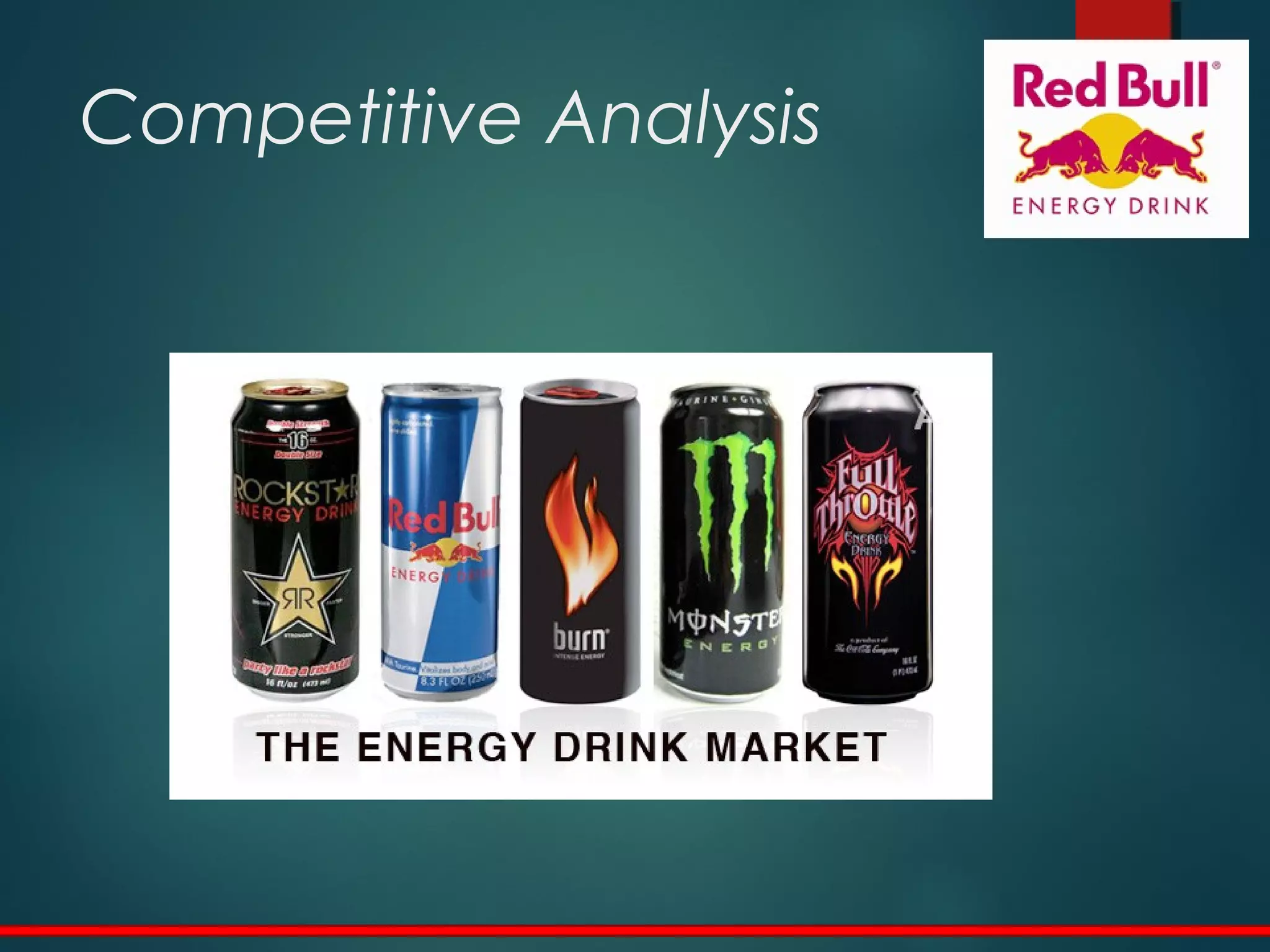
Competitive Analysis
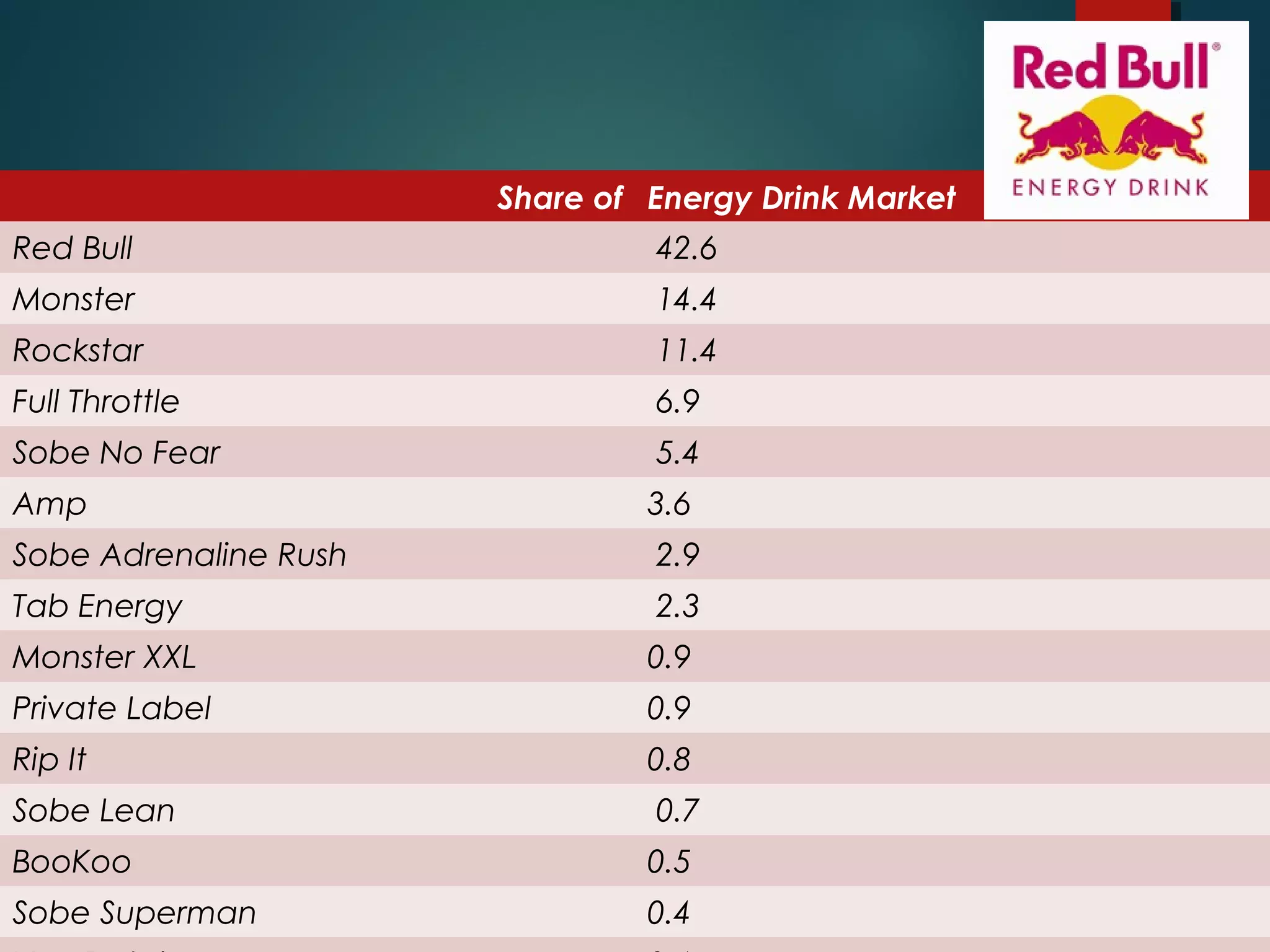
Share of Energy Drink Market
Red Bull 42.6
Monster 14.4
Rockstar 11.4
Full Throttle 6.9
Sobe No Fear 5.4
Amp 3.6
Sobe Adrenaline Rush 2.9
Tab Energy 2.3
Monster XXL 0.9
Private Label 0.9
Rip It 0.8
Sobe Lean 0.7
BooKoo 0.5
Sobe Superman 0.4
Real Competition
 Redbull’s real competitors are the market
leaders of cola companies such as : Pepsi
& Coca Cola, who have created their
brand leadership since several years in
the International market.
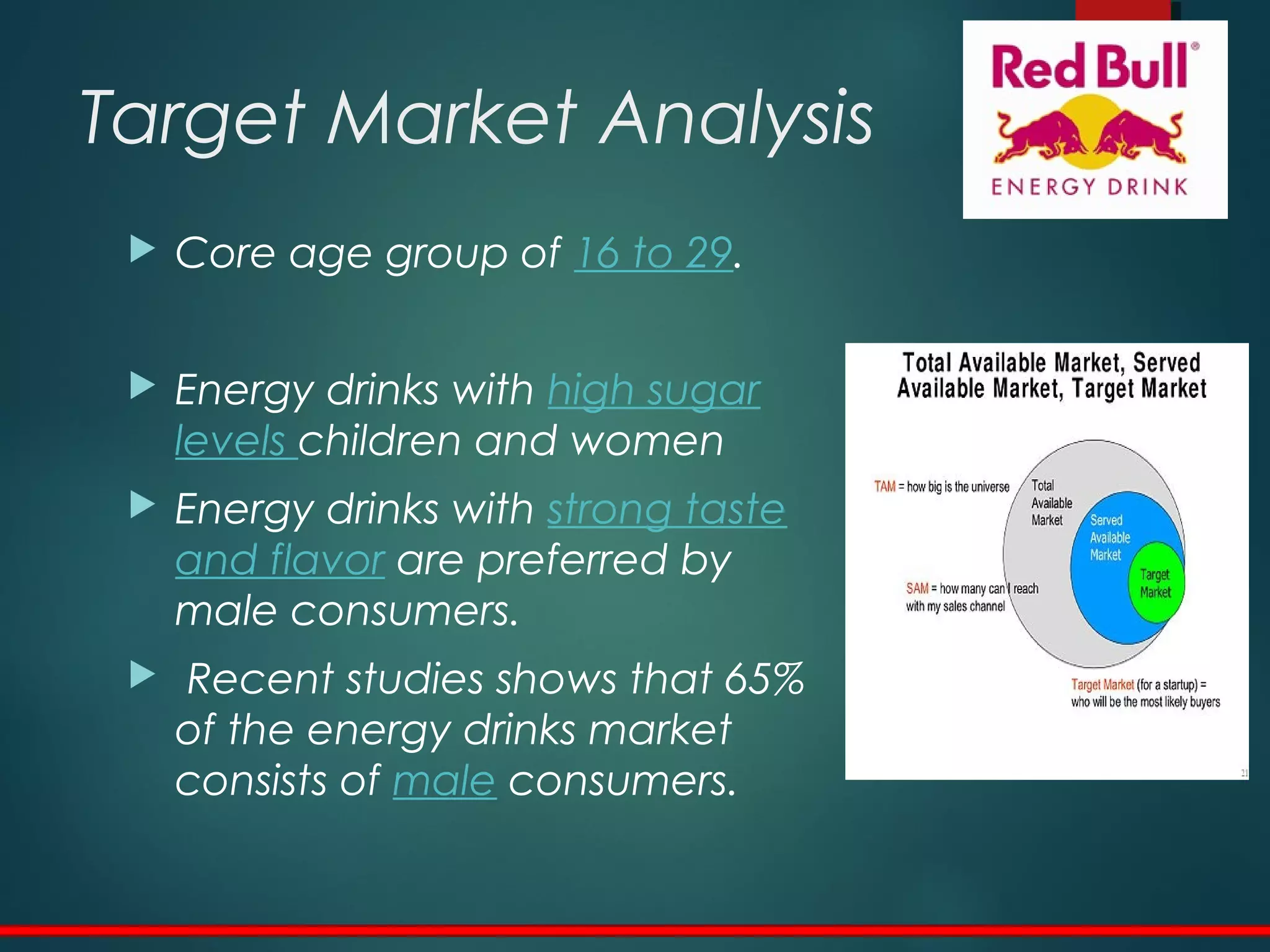
Target Market Analysis
 Core age group of 16 to 29.
 Energy drinks with high sugar
levels children and women
 Energy drinks with strong taste
and flavor are preferred by
male consumers.
 Recent studies shows that 65%
of the energy drinks market
consists of male consumers.
Customer Analysis
 Young people are especially open to determined
exhaustion and insufficient energy.
 More specifically male teenagers & people in their
20s, are also most likely to believe in the authenticity
of the energy drinks’.
 Appeal to very specialized groups, such as gamers,
extreme sports enthusiasts, and the hip-hop crowd.
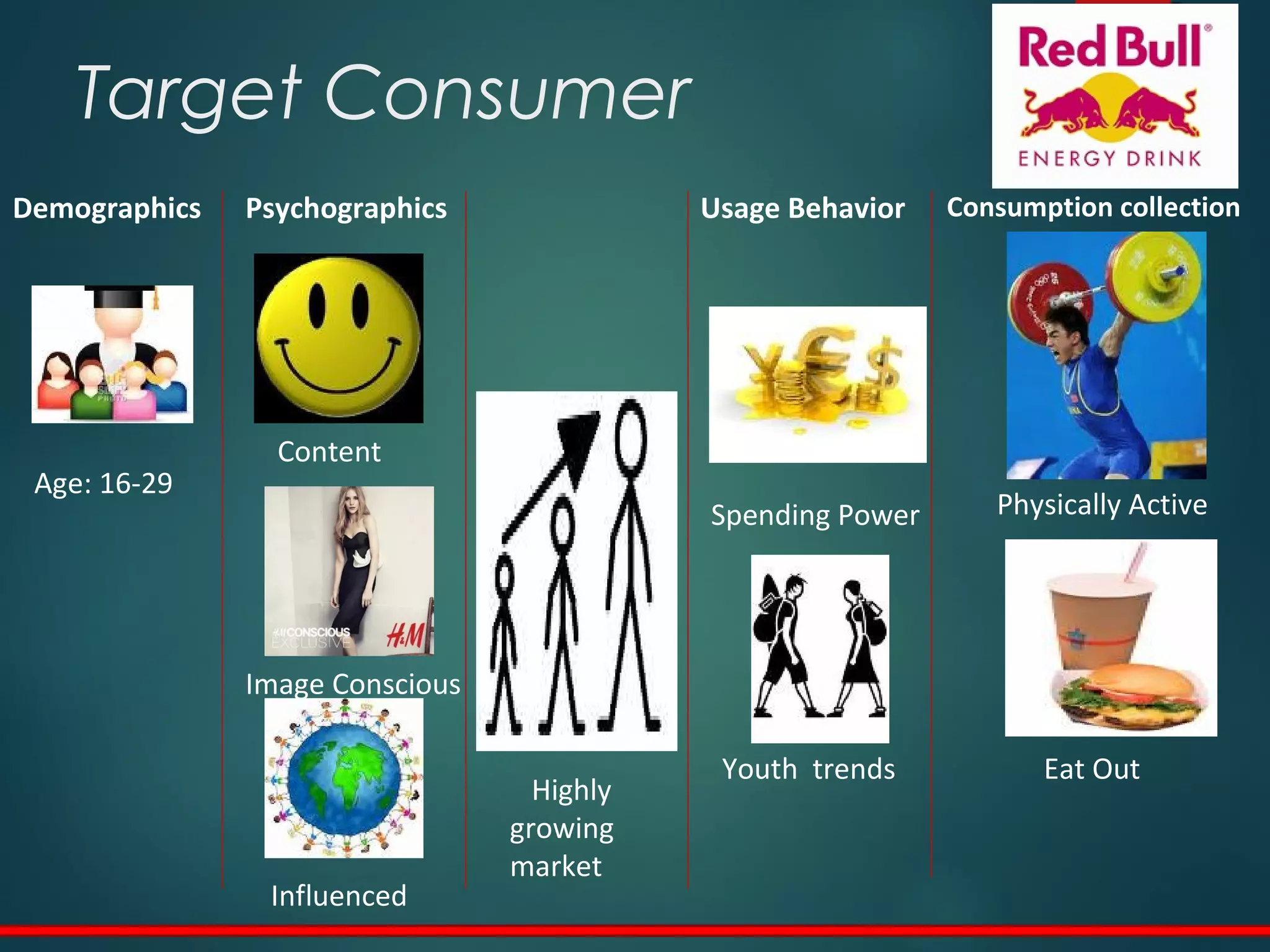
Target Consumer
Demographics Psychographics Usage Behavior Consumption collection
Age: 16-29
Content
Image Conscious
Influenced
Spending Power
Youth trends
Physically Active
Eat Out
Highly
growing
market
Different strategies
employed
Market Segmentation
Strategy
 Avoided usual methods of
marketing, relying more on‘Viral
marketing' and word-of-mouth.
 Red Bull advertised directly to
Generation Y: people born after
1981.
 ‘Student brand managers‘ are
encouraged to throw parties at
which free cases of Red Bull would
be distributed at Universities.
Corporate Strategies
Mission Statement
To be the premier marketer and supplier of
RedBull in Asia, Europe and other parts of the globe.
Achieve by building long-term relationships with the
people who can make it become a reality.
Vision Statement:
 People: Be a great place to work & Keep people
inspired.
 Portfolio: Portfolio of quality beverage that satisfy
people's needs.
 Partners: winning network of customers and supplier
to create mutual & enduring value.
 Profit: Maximize long-term return keeping overall
responsibilities In mind.
 Productivity: Highly effective, lean and fast-moving
organization.
Brand Positioning Strategy
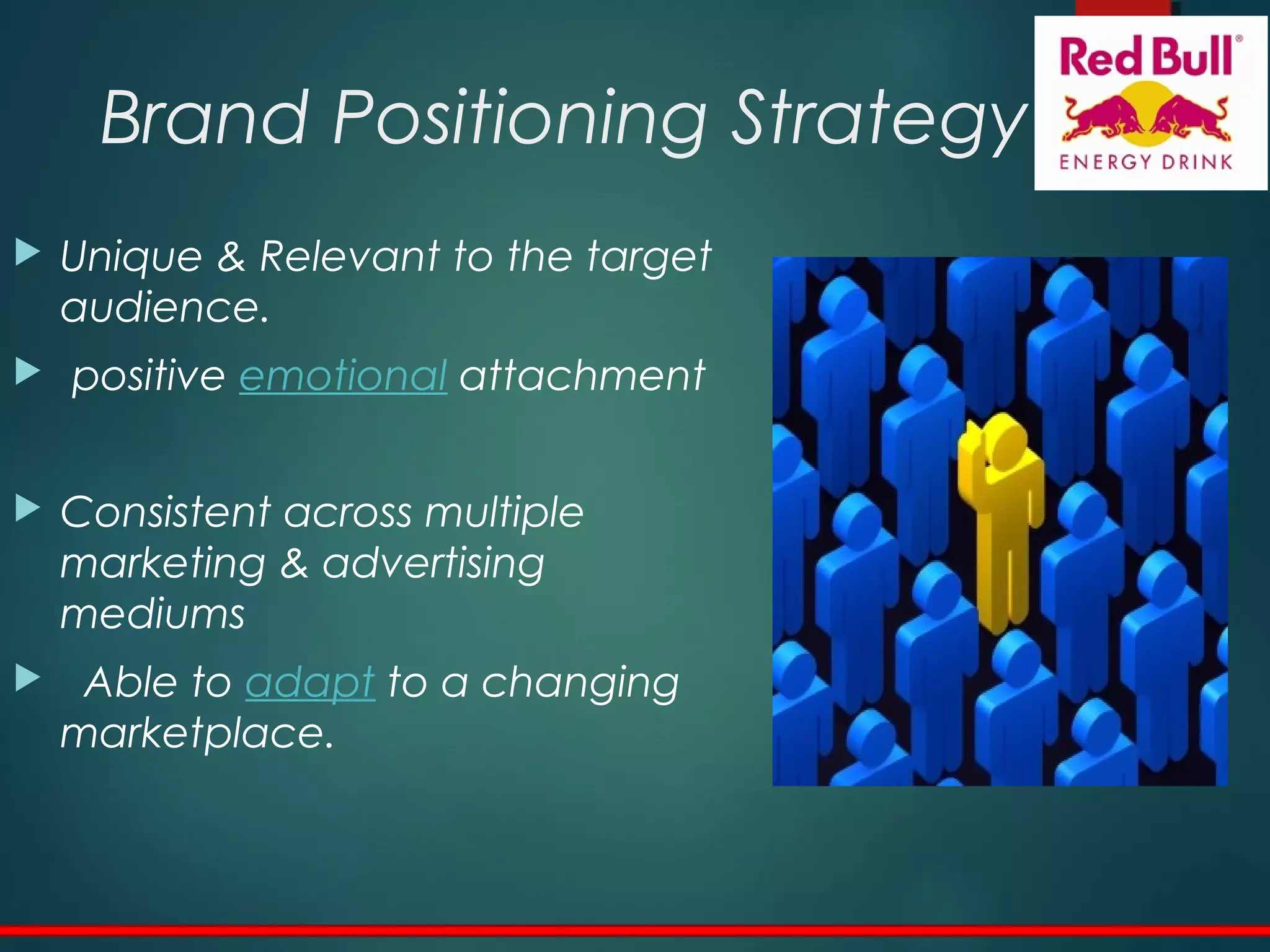
 Unique & Relevant to the target
audience. 
 positive emotional attachment
 Consistent across multiple
marketing & advertising
mediums
   Able to adapt to a changing
marketplace.
Distribution Strategy
Intensive distribution aims to
provide saturation coverage of the
market by using all available outlets
such as:
Bars and clubs.
Gyms and Trendy shops,
Coffee & Pizza Houses.
Restaurants & super Markets.
Managing Integrated
Marketing
Communications
Integrated Marketing
Communication
Methodologies
How do we communicate?How do we communicate?
How do customers process information?How do customers process information?
Thorough understanding of the audience's needs, emotions &Thorough understanding of the audience's needs, emotions &
activities is essential to ensureactivities is essential to ensure accuracy & relevanceaccuracy & relevance of theof the
message.message.
IMC Objectives
RedBull’s IMC objective Are : Sales Promotions.
Create new target markets.
Large display in the Departmental stores.
Bull Hoof stickers on the floors of departmental stores
promoting RB.
Integrated Marketing
Communications
Management
Sales Promotion:
 Must encourage the 1st
purchase of
the product in a store.
 Make them aware of the product &
its advantages by offering free
samples.
Word of Mouth Marketing
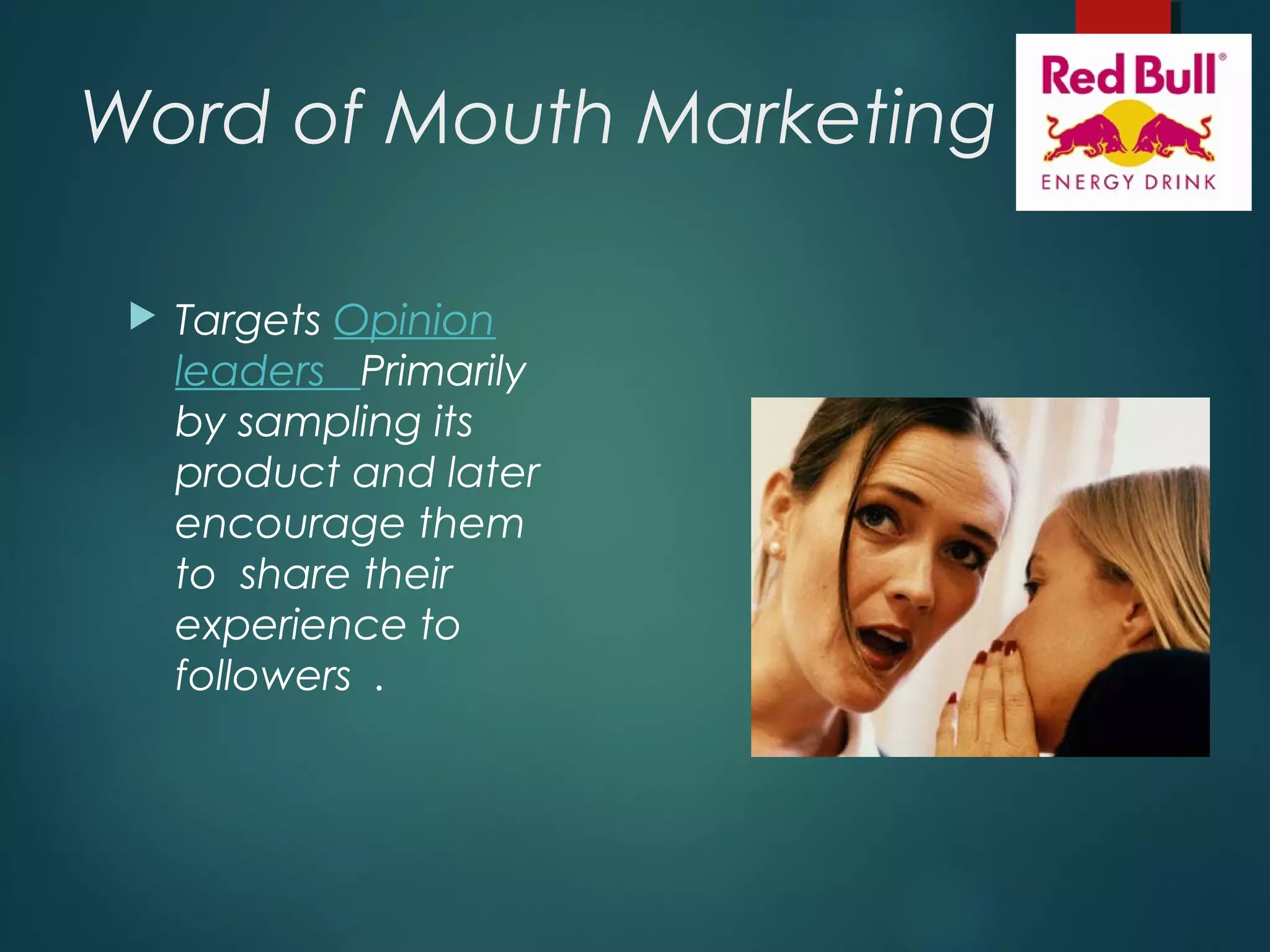
 Targets Opinion
leaders Primarily
by sampling its
product and later
encourage them
to share their
experience to
followers .
Events and Experiences
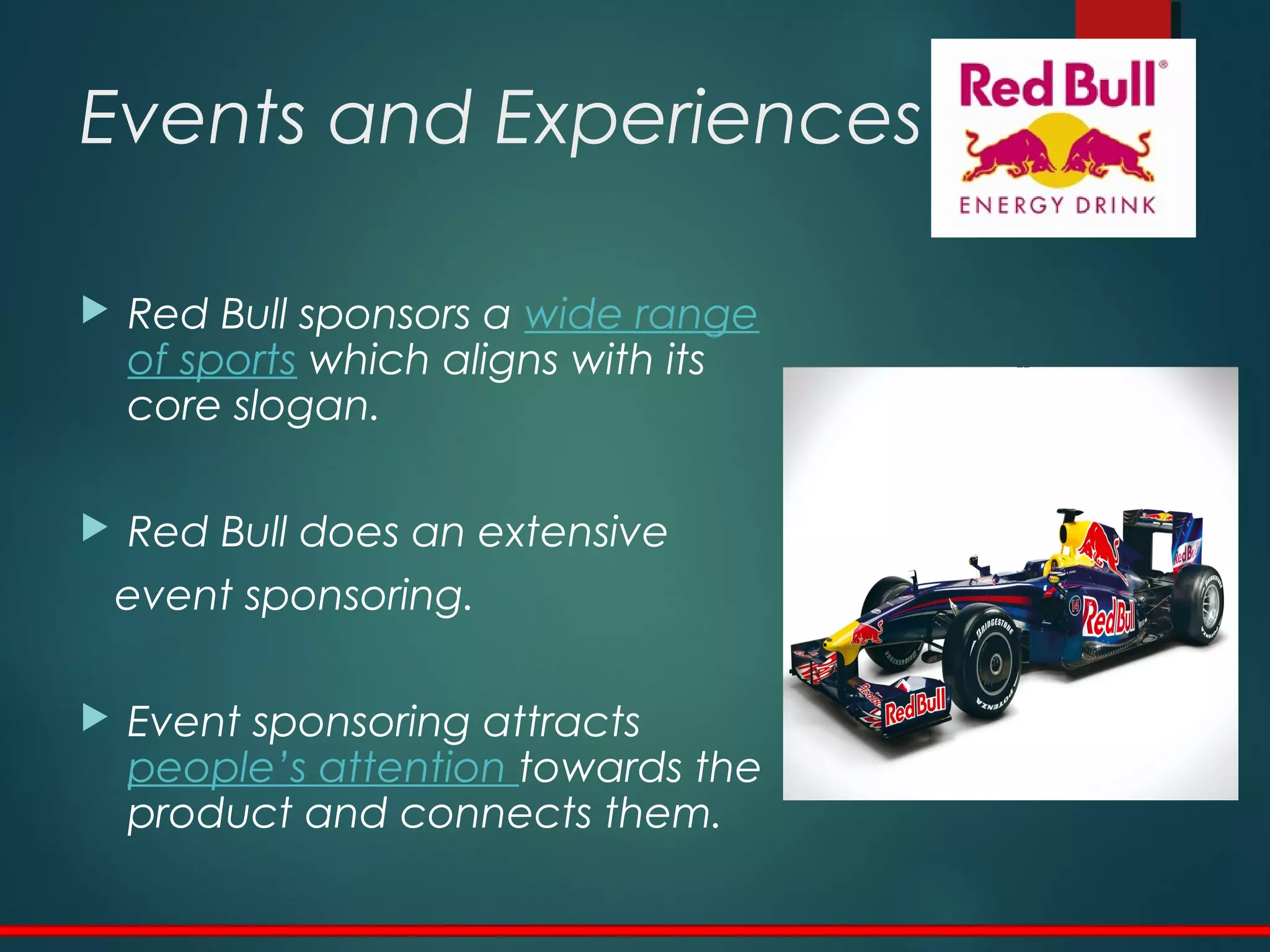
 Red Bull sponsors a wide range
of sports which aligns with its
core slogan.
 Red Bull does an extensive
event sponsoring.
 Event sponsoring attracts
people’s attention towards the
product and connects them.
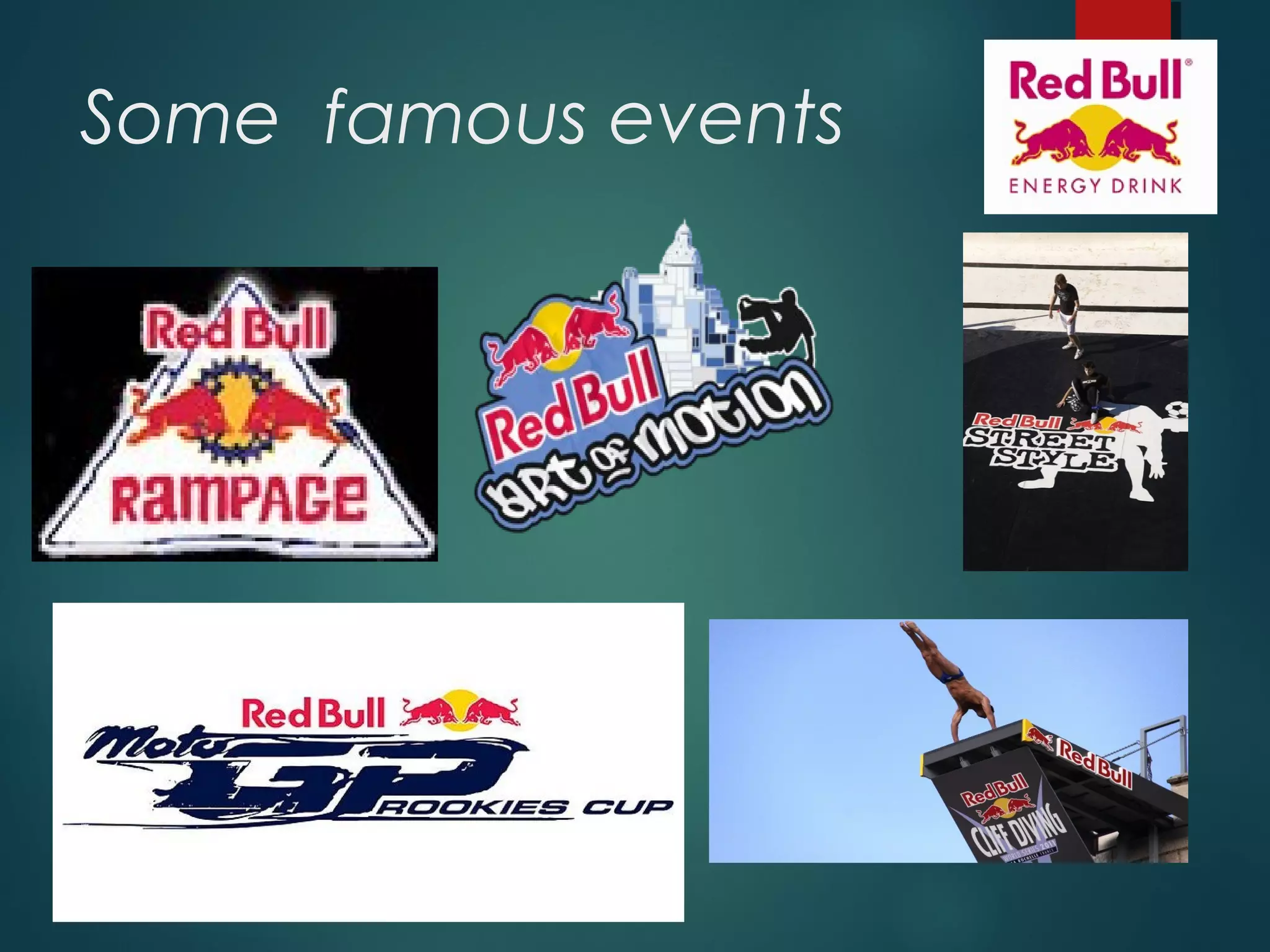
Some famous events
 High credibility than Ads
 Reach hard to find buyers
 Create Public Awareness
 Challenge consumer
misconceptions.
 Media Relaitons.
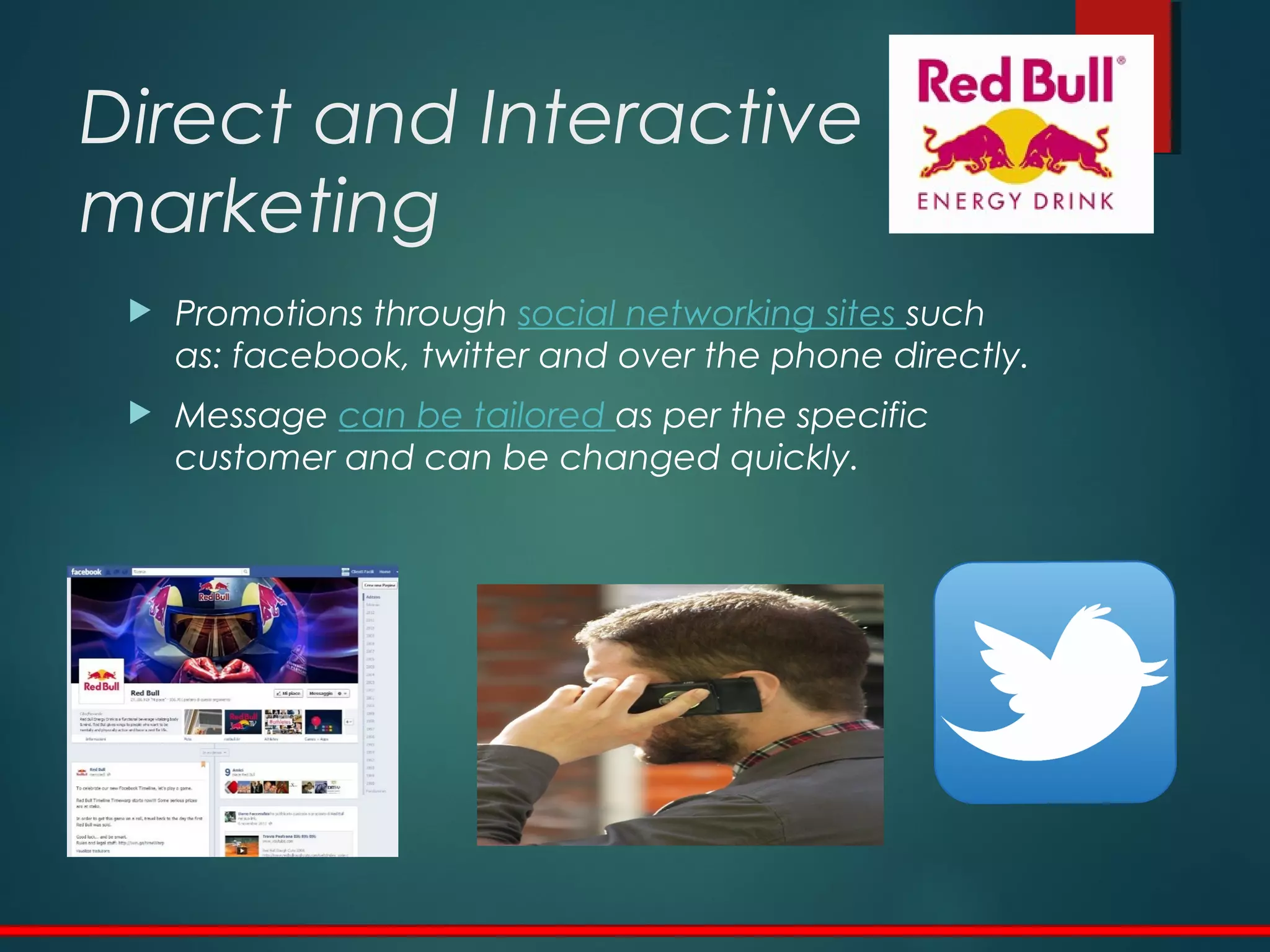
 Promotions through social networking sites such
as: facebook, twitter and over the phone directly.
 Message can be tailored as per the specific
customer and can be changed quickly.
Direct and Interactive
marketing
Advertising
 Red Bull has an aggressive marketing campaign.
 Red Bull moves to the traditional advertising only
after the market turns mature.
 “Media is not a tool that we use to establish in the
market, its just later in the development” as said by a
senior executive of Red Bull.
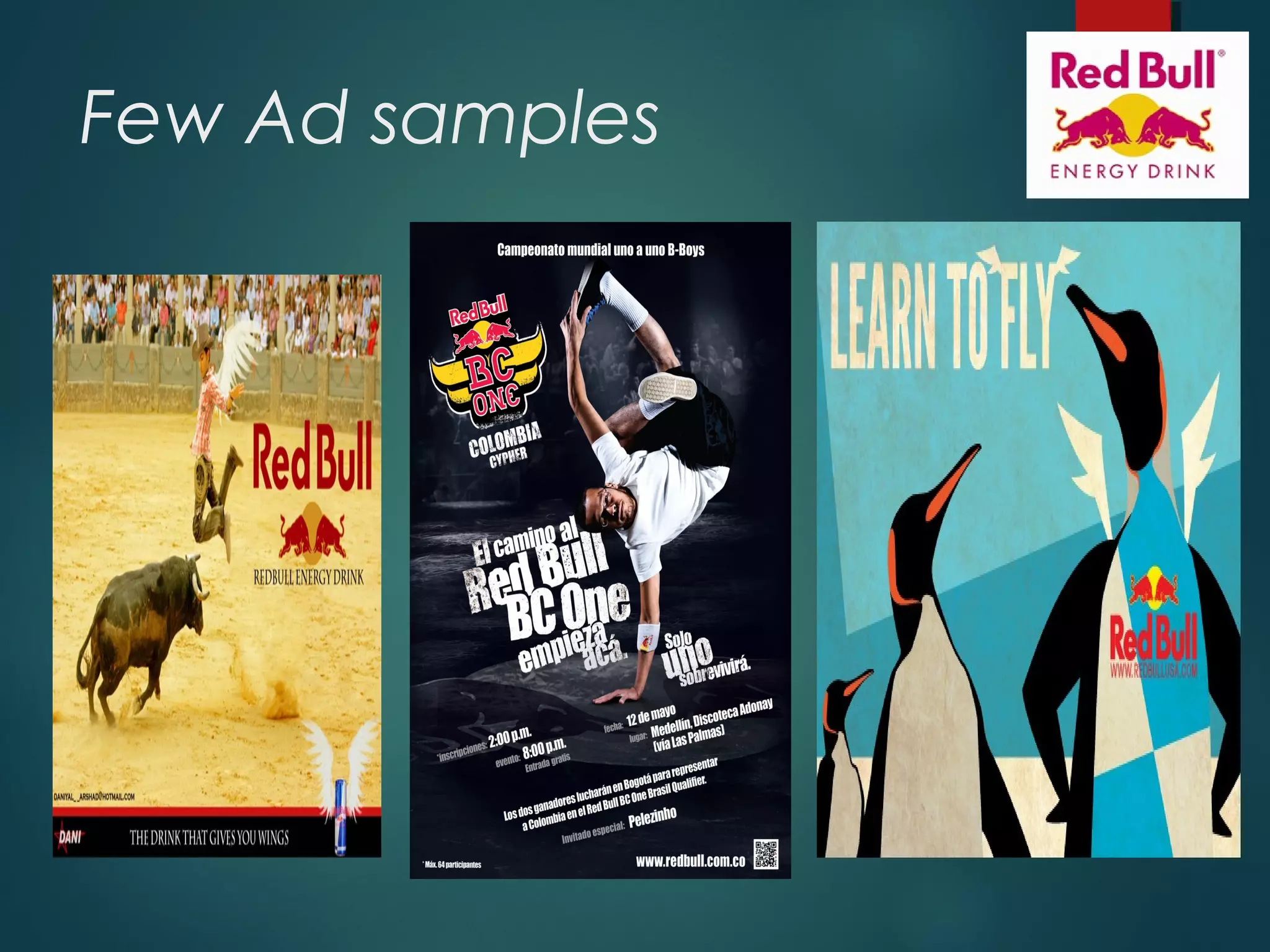
 Red Bull achieves this by a humorous and witty
cartoon campaign, transferring the message that
this energy drink helps you to escape by `giving you
wings ´.
Few Ad samples
Media Plan
TV:
 Still a staple medium of advertising.
 Allows to demonstrate the advantages of
RB.
 Good Reach.
Magazines:
 Economical.
 Provides higher brand awareness.
Evaluation & Control
Metrics
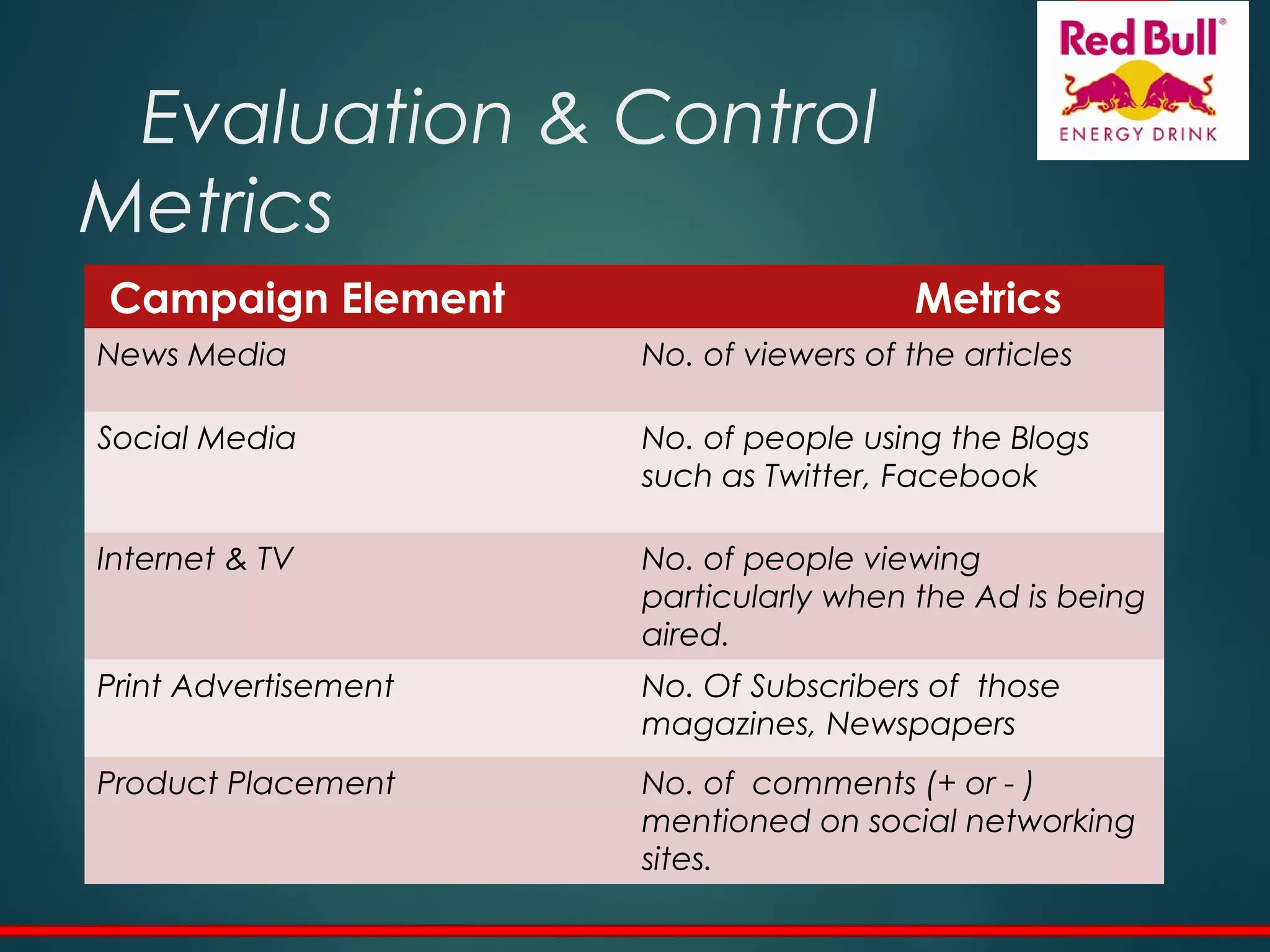
Campaign Element Metrics
News Media No. of viewers of the articles
Social Media No. of people using the Blogs
such as Twitter, Facebook
Internet & TV No. of people viewing
particularly when the Ad is being
aired.
Print Advertisement No. Of Subscribers of those
magazines, Newspapers
Product Placement No. of comments (+ or - )
mentioned on social networking
sites.
Personal Selling
 Sampling is important part of the
three pillar marketing system.
 As the major purpose of Red Bull is
to energize the company samples
at the right place at the right time,
where it finds its exact target
market.
 Examples of usage are driving,
studying, working night shifts and
sports.
The Mini Case solution
Kotler keller 14th edition
1.What are RedBulls great
strengths and weaknesses as more
companies enter the energy drink
category and gain market share?
Overview
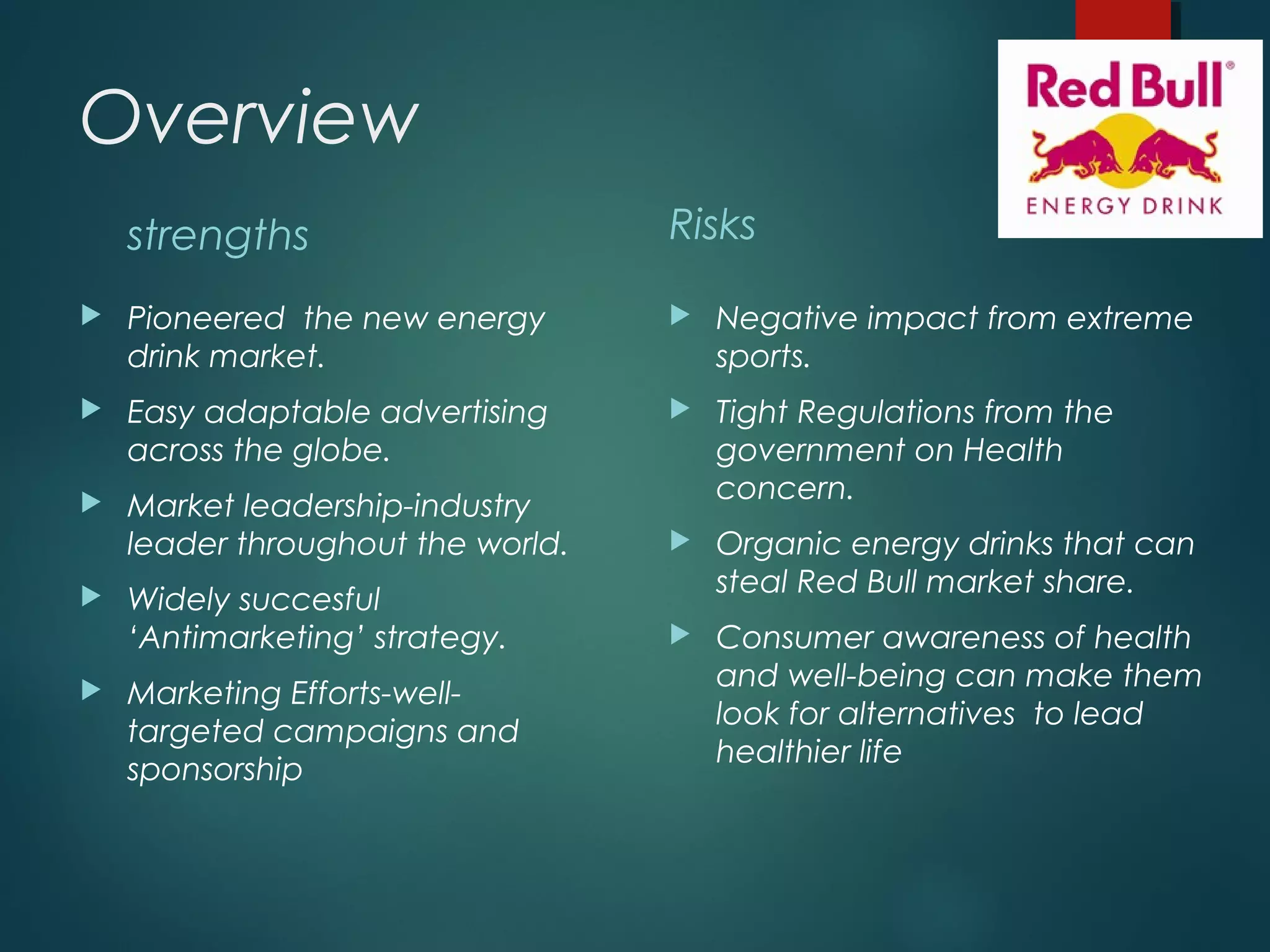
strengths
 Pioneered the new energy
drink market.
 Easy adaptable advertising
across the globe.
 Market leadership-industry
leader throughout the world.
 Widely succesful
‘Antimarketing’ strategy.
 Marketing Efforts-well-
targeted campaigns and
sponsorship
Risks
 Negative impact from extreme
sports.
 Tight Regulations from the
government on Health
concern.
 Organic energy drinks that can
steal Red Bull market share.
 Consumer awareness of health
and well-being can make them
look for alternatives to lead
healthier life
2.Should redbull do more
traditional advertising?why or why
not?
Traditional advertising
Decision
 Target Market – Young people who aggressively use
Technological and social Media platforms, Youtube etc.
 The slogan ‘Red Bull gives you wiings’ align with the extreme
sports and event sponsorships will have a huge influence on
Target Market.
 Use of seeding programs and sampling to opinion leaders
help to acquire potential customers who would have never
tried otherwise with costs much lesser than traditional
advertising.
 So, it should continue with its current strategy of using
traditional advertising only when market is mature.
3)Discuss the effectiveness of Red
Bull’s sponsorships, for example,
Bull stratos. Is this a good use of
marketing budget? Where should
the company draw the line?
Bull Stratos
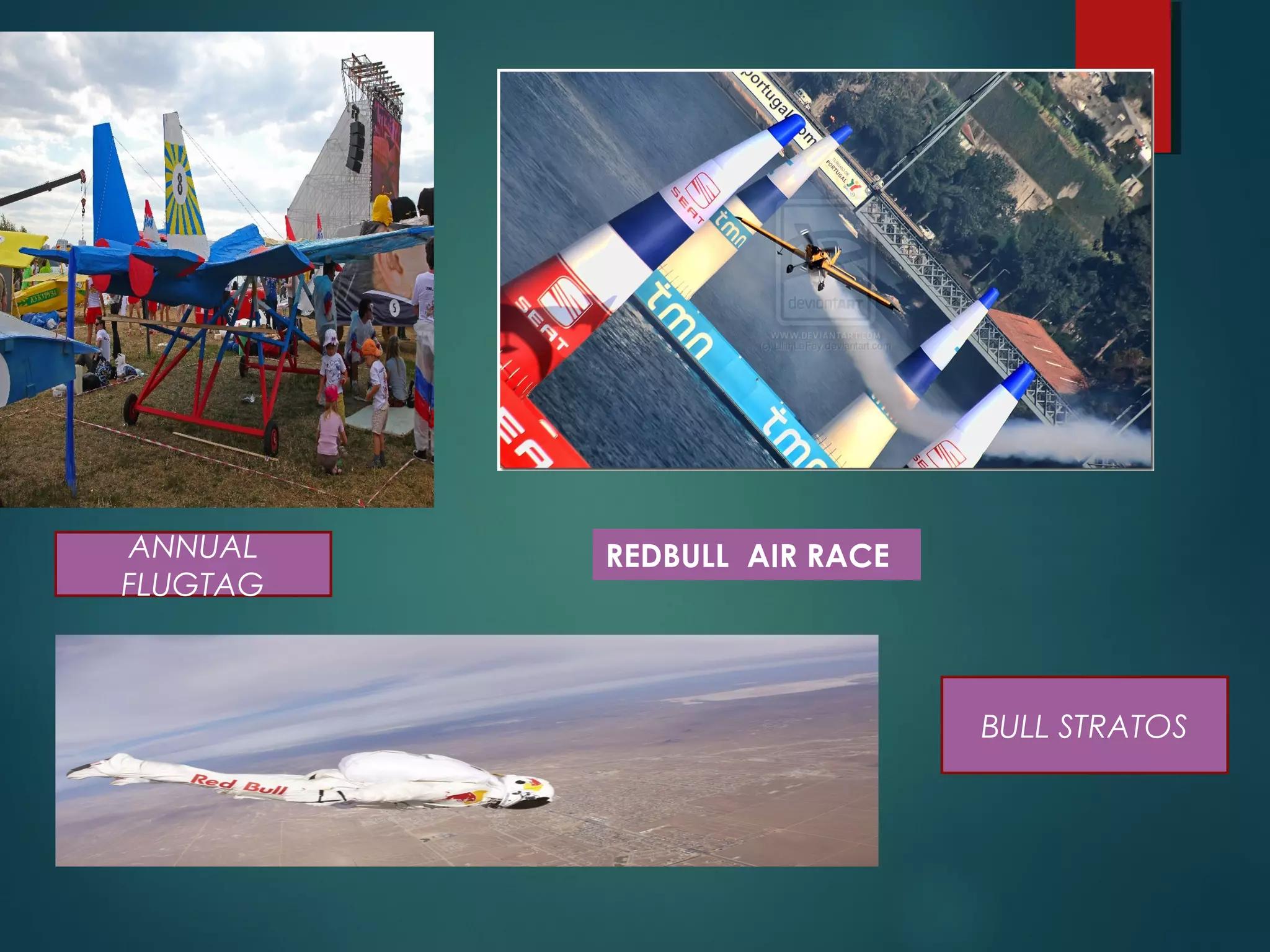
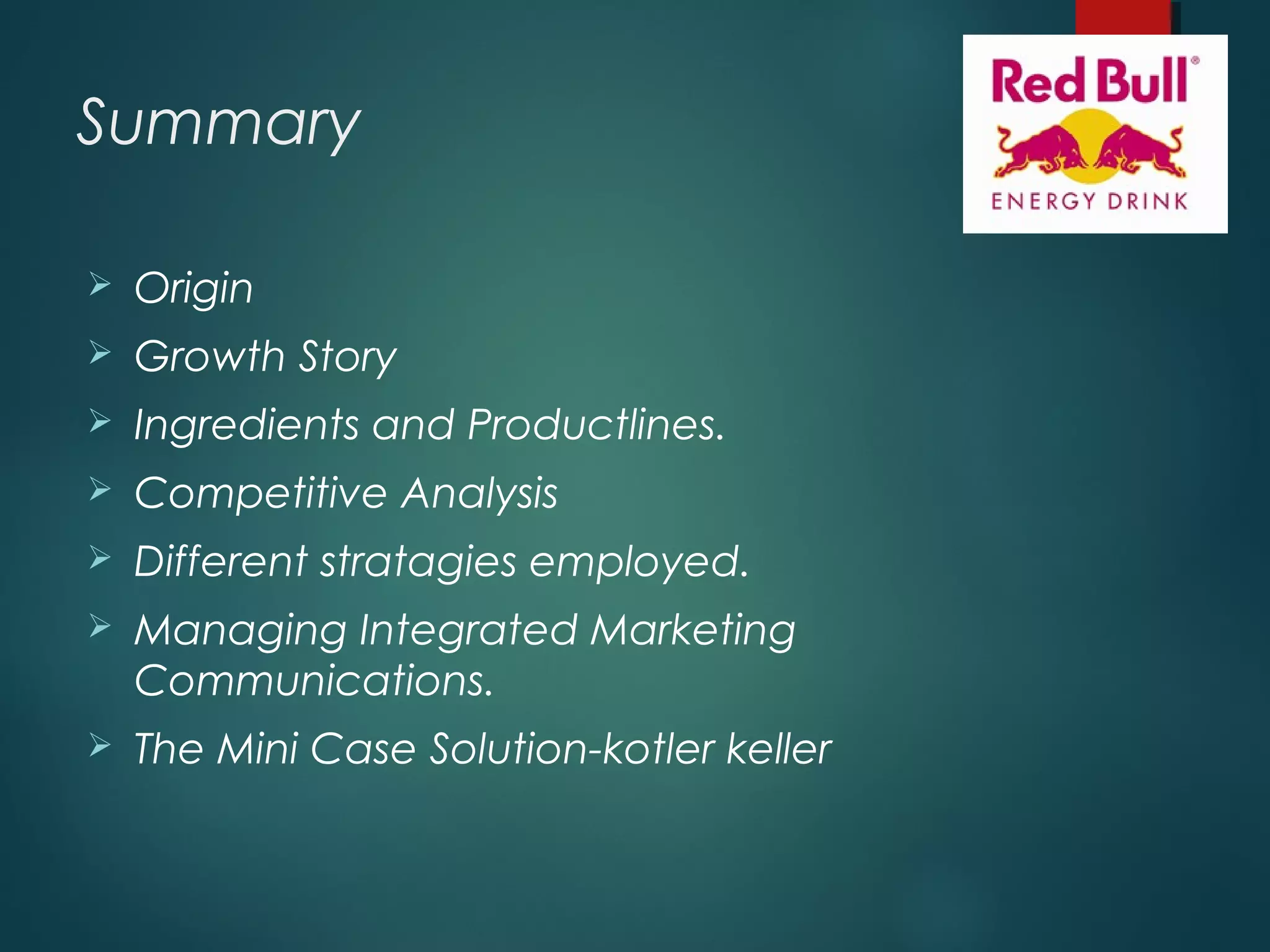
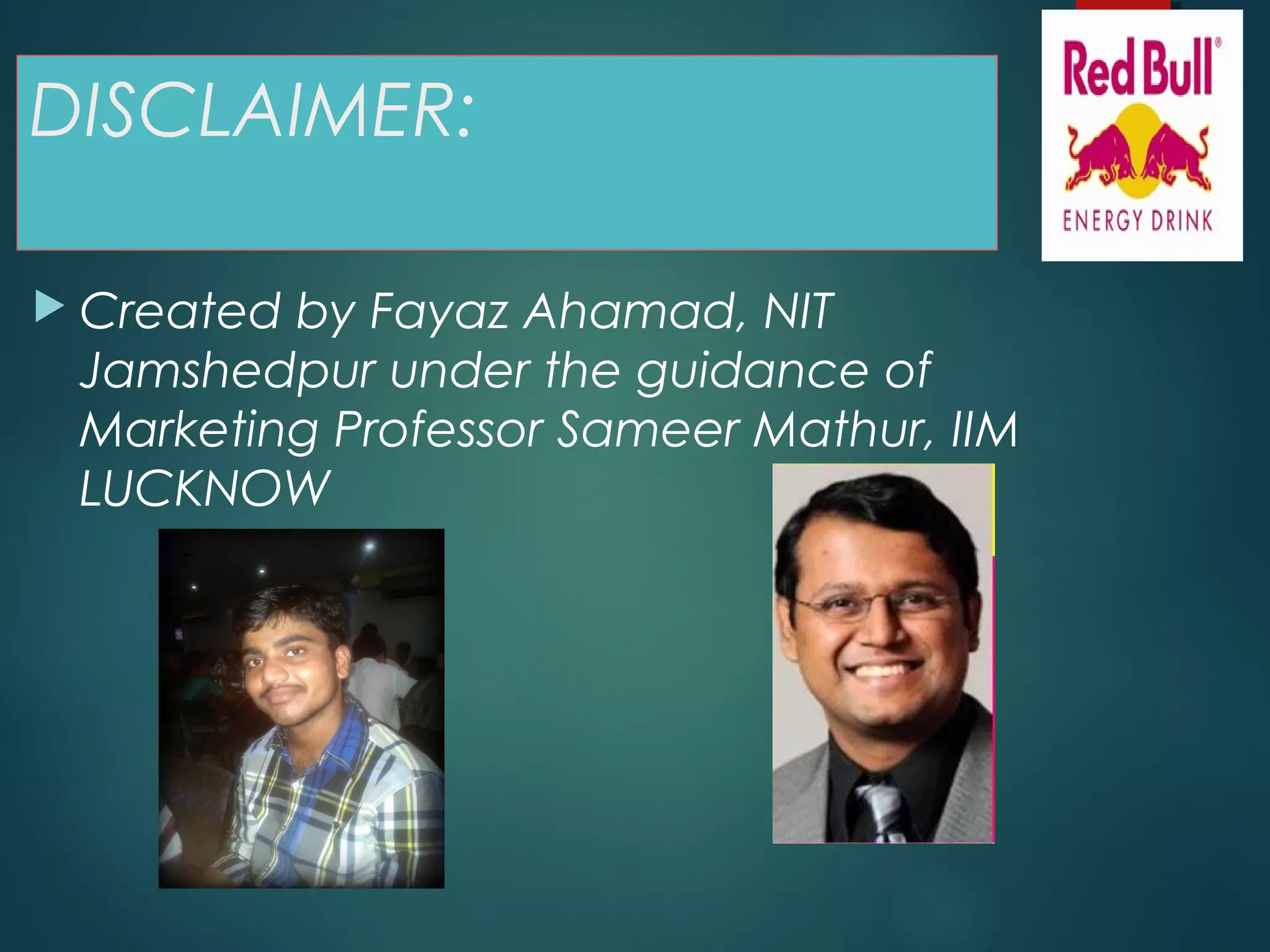
 Red Bull sponsorships such as Bull stratos , annual Flugtag are
highly effective as they align with its tag line ‘Red Bull gives you
wiings’.
 Stratos featured the first man to break the sound barrier with a
free fall on 14th
october 2012 and Flugtag encourages to build a
pilot controlled under 450 pound aeroplane race.
 The sponsorships of events like this will invoke a high energy and
power feeling to the consumer and can be spread to the world
using lowcost through Youtube and RedBull.tv
 Redbull should draw the line if the costs of the sponsorship are
too high and they do not foresee themselves being able to
make up the costs in the near future
REDBULL AIR RACEANNUAL
FLUGTAG
BULL STRATOS
Sources
 Images from Creative Commons
 http://www.rediff.com/money/2006/may
/24drink.htm
 http://www.thestudentroom.co.uk/showt
hread.php?t=986602
 http://www.trcb.com/business/marketing
/redbull-marketing-strategy-7375.htm
 http://www.drawert.com/red_bull_2.php
 http://energydrinks.factexpert.com/882-
energy-drink-industry.php
Summary
 Origin
 Growth Story
 Ingredients and Productlines.
 Competitive Analysis
 Different stratagies employed.
 Managing Integrated Marketing
Communications.
 The Mini Case Solution-kotler keller
DISCLAIMER:
 Created by Fayaz Ahamad, NIT
Jamshedpur under the guidance of
Marketing Professor Sameer Mathur, IIM
LUCKNOW

Redbull company overview and mini case solution of kotler keller

  • 1.
  • 2.
    Contents  Origin  GrowthStory  Ingredients and Productlines.  Competitive Analysis  Different stratagies employed.  Managing Integrated Marketing Communications.  The Mini Case Solution-kotler keller
  • 3.
    Origin  Red Bull isan energy drink sold by Austrian company Red Bull GmbH, created in 1987.  Austrian entrepreneur Dietrich Mateschitz along with  Chaleo Yoovidhya founded Red Bull GmbH in 1987 in Chakkapong.  Entered Hungary, its foreign market in 1992.
  • 4.
    Growth story  Itentered the United States via California in 1997and the Middle East in 2000.  In the U.S., Red Bull enjoys a 47% share of the energy drink market, and now has a 50% share of the German energy drink market.  Its market has extended to more than 160 countries as of now.  Now, Red Bull is the highest-selling energy drink in the world, with 5.73 billion cans sold in 2013.
  • 5.
    Ingredients and productlines  Mainly contains amino acid taurine, B-complex Vitamins,caffiene and Carbohydrates.  Highly regarded as ‘Liquid cocaine’ and ‘speed ina can’ by core customers.  Offered only a single product, RedBull energy drink in a size of 250 ml since inception.  Recently introduced three more products:Red Bull sugar free, Red Bull Energy shots and Red Bull Cola.
  • 6.
  • 7.
  • 8.
    Share of EnergyDrink Market Red Bull 42.6 Monster 14.4 Rockstar 11.4 Full Throttle 6.9 Sobe No Fear 5.4 Amp 3.6 Sobe Adrenaline Rush 2.9 Tab Energy 2.3 Monster XXL 0.9 Private Label 0.9 Rip It 0.8 Sobe Lean 0.7 BooKoo 0.5 Sobe Superman 0.4
  • 9.
    Real Competition  Redbull’sreal competitors are the market leaders of cola companies such as : Pepsi & Coca Cola, who have created their brand leadership since several years in the International market.
  • 10.
    Target Market Analysis Core age group of 16 to 29.  Energy drinks with high sugar levels children and women  Energy drinks with strong taste and flavor are preferred by male consumers.  Recent studies shows that 65% of the energy drinks market consists of male consumers.
  • 11.
    Customer Analysis  Youngpeople are especially open to determined exhaustion and insufficient energy.  More specifically male teenagers & people in their 20s, are also most likely to believe in the authenticity of the energy drinks’.  Appeal to very specialized groups, such as gamers, extreme sports enthusiasts, and the hip-hop crowd.
  • 12.
    Target Consumer Demographics PsychographicsUsage Behavior Consumption collection Age: 16-29 Content Image Conscious Influenced Spending Power Youth trends Physically Active Eat Out Highly growing market
  • 13.
  • 14.
    Market Segmentation Strategy  Avoidedusual methods of marketing, relying more on‘Viral marketing' and word-of-mouth.  Red Bull advertised directly to Generation Y: people born after 1981.  ‘Student brand managers‘ are encouraged to throw parties at which free cases of Red Bull would be distributed at Universities.
  • 15.
    Corporate Strategies Mission Statement Tobe the premier marketer and supplier of RedBull in Asia, Europe and other parts of the globe. Achieve by building long-term relationships with the people who can make it become a reality.
  • 16.
    Vision Statement:  People:Be a great place to work & Keep people inspired.  Portfolio: Portfolio of quality beverage that satisfy people's needs.  Partners: winning network of customers and supplier to create mutual & enduring value.  Profit: Maximize long-term return keeping overall responsibilities In mind.  Productivity: Highly effective, lean and fast-moving organization.
  • 17.
    Brand Positioning Strategy Unique & Relevant to the target audience.   positive emotional attachment  Consistent across multiple marketing & advertising mediums    Able to adapt to a changing marketplace.
  • 18.
    Distribution Strategy Intensive distributionaims to provide saturation coverage of the market by using all available outlets such as: Bars and clubs. Gyms and Trendy shops, Coffee & Pizza Houses. Restaurants & super Markets.
  • 19.
  • 20.
    Integrated Marketing Communication Methodologies How dowe communicate?How do we communicate? How do customers process information?How do customers process information? Thorough understanding of the audience's needs, emotions &Thorough understanding of the audience's needs, emotions & activities is essential to ensureactivities is essential to ensure accuracy & relevanceaccuracy & relevance of theof the message.message.
  • 21.
    IMC Objectives RedBull’s IMCobjective Are : Sales Promotions. Create new target markets. Large display in the Departmental stores. Bull Hoof stickers on the floors of departmental stores promoting RB.
  • 22.
    Integrated Marketing Communications Management Sales Promotion: Must encourage the 1st purchase of the product in a store.  Make them aware of the product & its advantages by offering free samples.
  • 23.
    Word of MouthMarketing  Targets Opinion leaders Primarily by sampling its product and later encourage them to share their experience to followers .
  • 24.
    Events and Experiences Red Bull sponsors a wide range of sports which aligns with its core slogan.  Red Bull does an extensive event sponsoring.  Event sponsoring attracts people’s attention towards the product and connects them.
  • 25.
  • 26.
     High credibilitythan Ads  Reach hard to find buyers  Create Public Awareness  Challenge consumer misconceptions.  Media Relaitons.
  • 27.
     Promotions throughsocial networking sites such as: facebook, twitter and over the phone directly.  Message can be tailored as per the specific customer and can be changed quickly. Direct and Interactive marketing
  • 28.
    Advertising  Red Bullhas an aggressive marketing campaign.  Red Bull moves to the traditional advertising only after the market turns mature.  “Media is not a tool that we use to establish in the market, its just later in the development” as said by a senior executive of Red Bull.  Red Bull achieves this by a humorous and witty cartoon campaign, transferring the message that this energy drink helps you to escape by `giving you wings ´.
  • 29.
  • 30.
    Media Plan TV:  Stilla staple medium of advertising.  Allows to demonstrate the advantages of RB.  Good Reach. Magazines:  Economical.  Provides higher brand awareness.
  • 31.
    Evaluation & Control Metrics CampaignElement Metrics News Media No. of viewers of the articles Social Media No. of people using the Blogs such as Twitter, Facebook Internet & TV No. of people viewing particularly when the Ad is being aired. Print Advertisement No. Of Subscribers of those magazines, Newspapers Product Placement No. of comments (+ or - ) mentioned on social networking sites.
  • 32.
    Personal Selling  Samplingis important part of the three pillar marketing system.  As the major purpose of Red Bull is to energize the company samples at the right place at the right time, where it finds its exact target market.  Examples of usage are driving, studying, working night shifts and sports.
  • 33.
    The Mini Casesolution Kotler keller 14th edition
  • 34.
    1.What are RedBullsgreat strengths and weaknesses as more companies enter the energy drink category and gain market share?
  • 35.
    Overview strengths  Pioneered thenew energy drink market.  Easy adaptable advertising across the globe.  Market leadership-industry leader throughout the world.  Widely succesful ‘Antimarketing’ strategy.  Marketing Efforts-well- targeted campaigns and sponsorship Risks  Negative impact from extreme sports.  Tight Regulations from the government on Health concern.  Organic energy drinks that can steal Red Bull market share.  Consumer awareness of health and well-being can make them look for alternatives to lead healthier life
  • 36.
    2.Should redbull domore traditional advertising?why or why not?
  • 37.
    Traditional advertising Decision  TargetMarket – Young people who aggressively use Technological and social Media platforms, Youtube etc.  The slogan ‘Red Bull gives you wiings’ align with the extreme sports and event sponsorships will have a huge influence on Target Market.  Use of seeding programs and sampling to opinion leaders help to acquire potential customers who would have never tried otherwise with costs much lesser than traditional advertising.  So, it should continue with its current strategy of using traditional advertising only when market is mature.
  • 38.
    3)Discuss the effectivenessof Red Bull’s sponsorships, for example, Bull stratos. Is this a good use of marketing budget? Where should the company draw the line?
  • 39.
    Bull Stratos  RedBull sponsorships such as Bull stratos , annual Flugtag are highly effective as they align with its tag line ‘Red Bull gives you wiings’.  Stratos featured the first man to break the sound barrier with a free fall on 14th october 2012 and Flugtag encourages to build a pilot controlled under 450 pound aeroplane race.  The sponsorships of events like this will invoke a high energy and power feeling to the consumer and can be spread to the world using lowcost through Youtube and RedBull.tv  Redbull should draw the line if the costs of the sponsorship are too high and they do not foresee themselves being able to make up the costs in the near future
  • 40.
  • 41.
    Sources  Images fromCreative Commons  http://www.rediff.com/money/2006/may /24drink.htm  http://www.thestudentroom.co.uk/showt hread.php?t=986602  http://www.trcb.com/business/marketing /redbull-marketing-strategy-7375.htm  http://www.drawert.com/red_bull_2.php  http://energydrinks.factexpert.com/882- energy-drink-industry.php
  • 42.
    Summary  Origin  GrowthStory  Ingredients and Productlines.  Competitive Analysis  Different stratagies employed.  Managing Integrated Marketing Communications.  The Mini Case Solution-kotler keller
  • 43.
    DISCLAIMER:  Created byFayaz Ahamad, NIT Jamshedpur under the guidance of Marketing Professor Sameer Mathur, IIM LUCKNOW

Editor's Notes

  • #16 3.1Corporate Image Strategy 3.2Brand Development Strategy 3.3Brand Positioning Strategy 3.4Distribution Strategy 3.5Business-to-Business Strategy 3.6Public Relations Strategy 3.7Evaluation
  • #18 brand proposition should convey a message
  • #23 4.1IMC Objectives 4.2IMC Budget 4.3Agency Selection 4.4Internet Web site
  • #25 5.2.2.1Budget Allocation 5.2.2.2Consumer Promotion Selection
  • #27 One of the age-old prerequisites for good PR is making sure the media picks up the campaign. Social media giants like Facebook, Digg and Youtube are now being heavily used by PR agencies for their clients. Viral marketing and video campaigns are just two of the ways that businesses are reaching a wider audience.
  • #29 5.2.1.1Advertising Goals and Budget