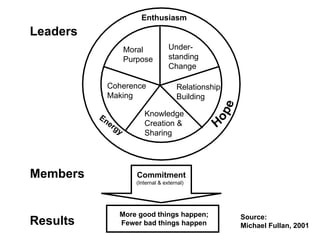
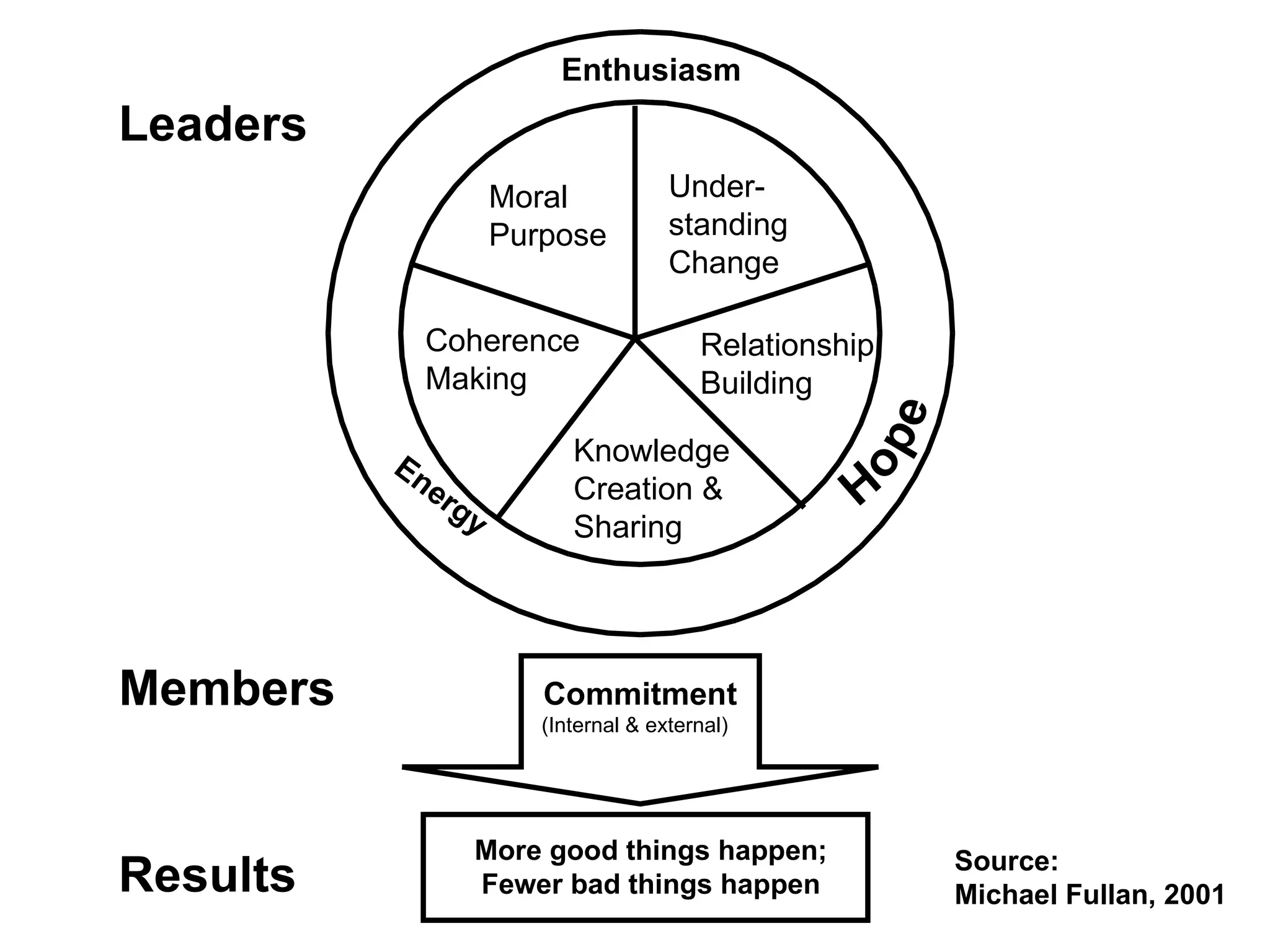
Commitment (Internal & external) More good things happen; Fewer bad things happen Hope Moral Purpose Under-standing Change Coherence Making Knowledge Creation & Sharing Relationship Building Leaders Members Results Source: Michael Fullan, 2001 Energy Enthusiasm
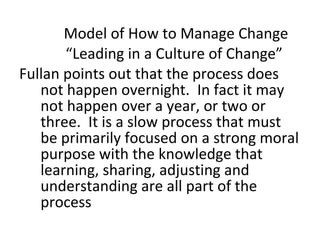
Model of How to Manage Change “ Leading in a Culture of Change”  Fullan points out that the process does not happen overnight.  In fact it may not happen over a year, or two or three.  It is a slow process that must be primarily focused on a strong moral purpose with the knowledge that learning, sharing, adjusting and understanding are all part of the process
How do you do it?
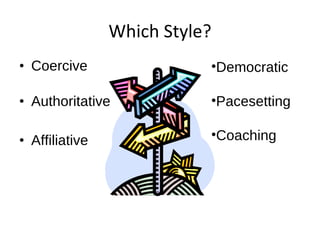
Which Style? Coercive Authoritative Affiliative Democratic Pacesetting Coaching
Golman’s Leadership Styles Coercive Authoritative Affiliative Democratic Pacesetting Coaching “ Do what I tell you.” “ Come with me.” “ People come first.” “ What do you think?”. “ Do as I do, now.” “ Try this.”
Understanding Change Leading in a culture of change means creating a  culture (not just a structure) of change . It does not mean adopting innovation, one after another; it does mean producing the capacity to seek, critically assess, and selectively incorporation new ideas and practices – all the time, inside the organization as well as outside it.  pg. 44
The  structure and culture  of the school gain expression through systems of norms .  Both structure and culture determine the capacity of the school to accept and incorporate new technologies.  (The  structure  of the school refers to existing systems of rules, roles, and relationships. The  culture  refers to the values, commitments, tradition, lore, and shared meanings of the school.)


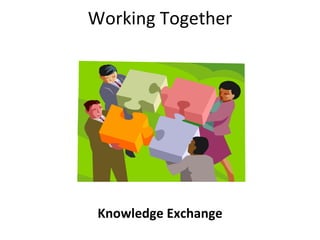
Working Together Knowledge Exchange
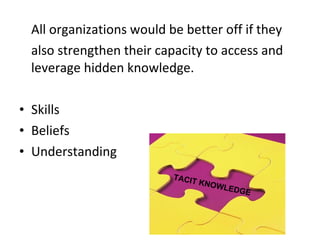
All organizations would be better off if they  also strengthen their capacity to access and leverage hidden knowledge.  Skills Beliefs Understanding TACIT KNOWLEDGE
Knowledge Creation and Sharing Dixon (2000) – “It is a kind of chicken-or-egg issue: which comes first, the learning culture or the exchange of knowledge?  Given the many organization’s rather abysmal success rate at changing their culture, I would put my money on having exchange (of knowledge) impact the culture rather than waiting for the culture to change [pg.5-6]
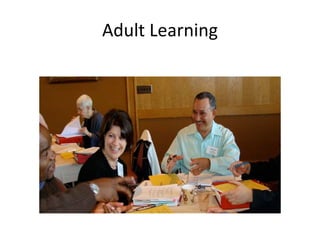
Adult Learning
Knowledge Sharing Business and Education Models Peer Assist After Action Learning Fishbowl Best Practices Lessons Learned Learning Fair Inter-visitation
Principles of Adult Learning Adults learn best when… They’re  motivated .  Motivation comes from the  context, relevance & involvement  level of the work. Learning is conducted as a  partnership . Learning involves the learner’s  primary learning mode & is interactive & experiential . © 2005 MSU PROM/SE  Promoting Rigorous Outcomes in Mathematics and Science  Education,  Supported by NSF Cooperative Agreement EHR-0314866
Principles of Adult Learning Adults learn best when…(cont.) There is an understandable  structure & reinforcement . People’s  attention & energy stay engaged & focused . © 2005 MSU PROM/SE  Promoting Rigorous Outcomes in Mathematics and Science  Education,  Supported by NSF Cooperative Agreement EHR-0314866
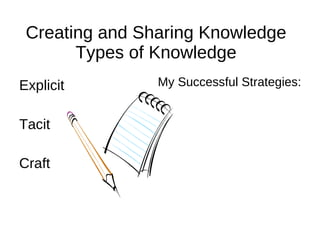
Creating and Sharing Knowledge Types of Knowledge Explicit Tacit Craft My Successful Strategies:
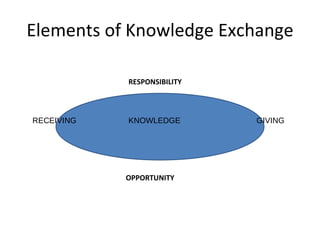
Elements of Knowledge Exchange RESPONSIBILITY OPPORTUNITY RECEIVING  KNOWLEDGE  GIVING
Creating & Sharing  Knowledge: Generate & increase  knowledge both inside &  outside your school Create a collaborative culture that encourages knowledge  sharing
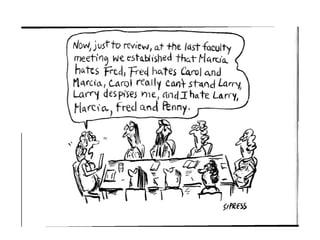
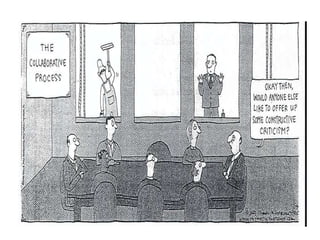
Collaborative Cultures Collaborative cultures, which by definition have close relationships, are indeed powerful, but unless they are focusing on the right things, they end up being powerfully wrong.
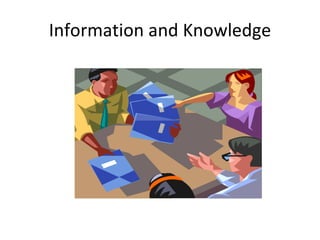
Information and Knowledge
Sharing Knowledge Access to individuals’ knowledge and skills Share beliefs Develop professional development opportunities Share up and down as well laterally

Creating and Sharing Knowledge

  • 1.
    Commitment (Internal &external) More good things happen; Fewer bad things happen Hope Moral Purpose Under-standing Change Coherence Making Knowledge Creation & Sharing Relationship Building Leaders Members Results Source: Michael Fullan, 2001 Energy Enthusiasm
  • 2.
    Model of Howto Manage Change “ Leading in a Culture of Change” Fullan points out that the process does not happen overnight. In fact it may not happen over a year, or two or three. It is a slow process that must be primarily focused on a strong moral purpose with the knowledge that learning, sharing, adjusting and understanding are all part of the process
  • 3.
    How do youdo it?
  • 4.
    Which Style? CoerciveAuthoritative Affiliative Democratic Pacesetting Coaching
  • 5.
    Golman’s Leadership StylesCoercive Authoritative Affiliative Democratic Pacesetting Coaching “ Do what I tell you.” “ Come with me.” “ People come first.” “ What do you think?”. “ Do as I do, now.” “ Try this.”
  • 6.
    Understanding Change Leadingin a culture of change means creating a culture (not just a structure) of change . It does not mean adopting innovation, one after another; it does mean producing the capacity to seek, critically assess, and selectively incorporation new ideas and practices – all the time, inside the organization as well as outside it. pg. 44
  • 7.
    The structureand culture of the school gain expression through systems of norms . Both structure and culture determine the capacity of the school to accept and incorporate new technologies. (The structure of the school refers to existing systems of rules, roles, and relationships. The culture refers to the values, commitments, tradition, lore, and shared meanings of the school.)
  • 8.
  • 9.
  • 10.
  • 11.
  • 12.
  • 13.
  • 14.
    All organizations wouldbe better off if they also strengthen their capacity to access and leverage hidden knowledge. Skills Beliefs Understanding TACIT KNOWLEDGE
  • 15.
    Knowledge Creation andSharing Dixon (2000) – “It is a kind of chicken-or-egg issue: which comes first, the learning culture or the exchange of knowledge? Given the many organization’s rather abysmal success rate at changing their culture, I would put my money on having exchange (of knowledge) impact the culture rather than waiting for the culture to change [pg.5-6]
  • 16.
  • 17.
    Knowledge Sharing Businessand Education Models Peer Assist After Action Learning Fishbowl Best Practices Lessons Learned Learning Fair Inter-visitation
  • 18.
    Principles of AdultLearning Adults learn best when… They’re motivated . Motivation comes from the context, relevance & involvement level of the work. Learning is conducted as a partnership . Learning involves the learner’s primary learning mode & is interactive & experiential . © 2005 MSU PROM/SE Promoting Rigorous Outcomes in Mathematics and Science Education, Supported by NSF Cooperative Agreement EHR-0314866
  • 19.
    Principles of AdultLearning Adults learn best when…(cont.) There is an understandable structure & reinforcement . People’s attention & energy stay engaged & focused . © 2005 MSU PROM/SE Promoting Rigorous Outcomes in Mathematics and Science Education, Supported by NSF Cooperative Agreement EHR-0314866
  • 20.
    Creating and SharingKnowledge Types of Knowledge Explicit Tacit Craft My Successful Strategies:
  • 21.
    Elements of KnowledgeExchange RESPONSIBILITY OPPORTUNITY RECEIVING KNOWLEDGE GIVING
  • 22.
    Creating & Sharing Knowledge: Generate & increase knowledge both inside & outside your school Create a collaborative culture that encourages knowledge sharing
  • 23.
    Collaborative Cultures Collaborativecultures, which by definition have close relationships, are indeed powerful, but unless they are focusing on the right things, they end up being powerfully wrong.
  • 24.
  • 25.
    Sharing Knowledge Accessto individuals’ knowledge and skills Share beliefs Develop professional development opportunities Share up and down as well laterally

Editor's Notes

  • #4 Waking the Sleeping Giant: Empowering Change in your Organization 2005 TACRAO Annual Conference Logan Faris