By: Ms. Uditi Handa (Asst. Prof.)
M.Pharmacy (Ph.D)
GGSCOP, Yamunanagar
Chapter – Cosmetics
Topic: Creams
Subject: Formulative
Pharmacy
BP-502 T
Cold cream is an emulsion of water and certain fats, usually including beeswax and
various scent agents, designed to smooth skin and remove makeup. Cold cream is
an emulsion of water in a larger amount of oil, unlike the oil in water emulsion of
vanishing cream, so-called because it seems to disappear when applied on skin.
The name "cold cream" derives from the cooling feeling that the cream leaves on
the skin. Variations of the product have been used for nearly 2000 years.
Cold cream is mainly used for skin treatment (such as a facial mask or lip balm), due
to its moisturizing properties. It can also be used to remove makeup.
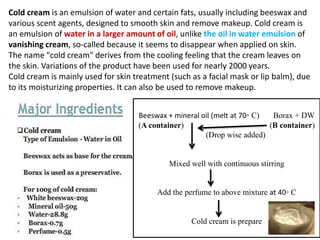
Beeswax + mineral oil (melt at 70⸰ C) Borax + DW
(A container) (B container)
(Drop wise added)
Mixed well with continuous stirring
Add the perfume to above mixture at 40⸰ C
Cold cream is prepare
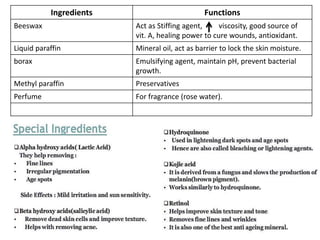
Ingredients Functions
Beeswax Act as Stiffing agent, viscosity, good source of
vit. A, healing power to cure wounds, antioxidant.
Liquid paraffin Mineral oil, act as barrier to lock the skin moisture.
borax Emulsifying agent, maintain pH, prevent bacterial
growth.
Methyl paraffin Preservatives
Perfume For fragrance (rose water).
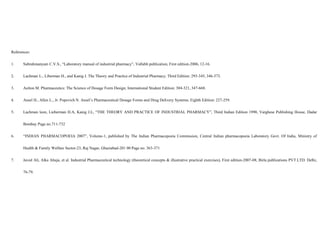
References:
1. Subrahmanyam C.V.S., “Laboratory manual of industrial pharmacy”, Vallabh publication, First edition-2006, 12-16.
2. Lachman L., Liberman H., and Kanig J. The Theory and Practice of Industrial Pharmacy; Third Edition: 293-345, 346-373.
3. Aulton M. Pharmaceutics: The Science of Dosage Form Design; International Student Edition: 304-321, 347-668.
4. Ansel H., Allen L., Jr. Popovich N. Ansel’s Pharmaceutical Dosage Forms and Drug Delivery Systems; Eighth Edition: 227-259.
5. Lachman leon, Lieberman H.A, Kanig J.L, “THE THEORY AND PRACTICE OF INDUSTRIAL PHARMACY”, Third Indian Edition 1990, Varghese Publishing House, Dadar
Bombay Page no.711-732
6. “INDIAN PHARMACOPOEIA 2007”, Volume-1, published by The Indian Pharmacopoeia Commission, Central Indian pharmacopoeia Laboratory Govt. Of India, Ministry of
Health & Family Welfare Sector-23, Raj Nagar, Ghaziabad-201 00 Page no. 363-371
7. Javed Ali, Alka Ahuja, et al. Industrial Pharmaceutical technology (theoretical concepts & illustrative practical exercises), First edition-2007-08, Birla publications PVT.LTD. Delhi,
76-79.

creams formualtion and evaluation test (cosmetics)

  • 1.
    By: Ms. UditiHanda (Asst. Prof.) M.Pharmacy (Ph.D) GGSCOP, Yamunanagar Chapter – Cosmetics Topic: Creams Subject: Formulative Pharmacy BP-502 T
  • 4.
    Cold cream isan emulsion of water and certain fats, usually including beeswax and various scent agents, designed to smooth skin and remove makeup. Cold cream is an emulsion of water in a larger amount of oil, unlike the oil in water emulsion of vanishing cream, so-called because it seems to disappear when applied on skin. The name "cold cream" derives from the cooling feeling that the cream leaves on the skin. Variations of the product have been used for nearly 2000 years. Cold cream is mainly used for skin treatment (such as a facial mask or lip balm), due to its moisturizing properties. It can also be used to remove makeup. Beeswax + mineral oil (melt at 70⸰ C) Borax + DW (A container) (B container) (Drop wise added) Mixed well with continuous stirring Add the perfume to above mixture at 40⸰ C Cold cream is prepare
  • 5.
    Ingredients Functions Beeswax Actas Stiffing agent, viscosity, good source of vit. A, healing power to cure wounds, antioxidant. Liquid paraffin Mineral oil, act as barrier to lock the skin moisture. borax Emulsifying agent, maintain pH, prevent bacterial growth. Methyl paraffin Preservatives Perfume For fragrance (rose water).
  • 13.
    References: 1. Subrahmanyam C.V.S.,“Laboratory manual of industrial pharmacy”, Vallabh publication, First edition-2006, 12-16. 2. Lachman L., Liberman H., and Kanig J. The Theory and Practice of Industrial Pharmacy; Third Edition: 293-345, 346-373. 3. Aulton M. Pharmaceutics: The Science of Dosage Form Design; International Student Edition: 304-321, 347-668. 4. Ansel H., Allen L., Jr. Popovich N. Ansel’s Pharmaceutical Dosage Forms and Drug Delivery Systems; Eighth Edition: 227-259. 5. Lachman leon, Lieberman H.A, Kanig J.L, “THE THEORY AND PRACTICE OF INDUSTRIAL PHARMACY”, Third Indian Edition 1990, Varghese Publishing House, Dadar Bombay Page no.711-732 6. “INDIAN PHARMACOPOEIA 2007”, Volume-1, published by The Indian Pharmacopoeia Commission, Central Indian pharmacopoeia Laboratory Govt. Of India, Ministry of Health & Family Welfare Sector-23, Raj Nagar, Ghaziabad-201 00 Page no. 363-371 7. Javed Ali, Alka Ahuja, et al. Industrial Pharmaceutical technology (theoretical concepts & illustrative practical exercises), First edition-2007-08, Birla publications PVT.LTD. Delhi, 76-79.