A Block Based Adaptive Video Data Hiding
Method Using Forbidden Zone Data Hiding
B. Raj Kumar#1
, S. Tharun Reddy*2
and Dr. G. Narasimha^3
#1
Associate Professor Dept. of Computer Science and Engineering, SR Engineering College , AnanthaSagar, Warangal-
506371, Andhra Pradesh, India
1
naaniraj@gmail.com
*2
M. Tech Dept. of Computer Science and Engineering, SR Engineering College, AnanthaSagar,
Warangal-506371, Andhra Pradesh, India
2
tharunreddy5826@gmail.com
3
Associate Professor, Dept. of Computer Science and Engineering, JNTUH, Hyderabad, Andhra Pradesh, India
3
narasimha06@gmail.com
Abstract---Data hiding is a process of embedding information
into some sort of host media. Especially video data hiding has
become an important research topic as it is complex when
compared data hiding process in other media. This paper
proposes a new method based on erasure correction capability
of RA codes using forbidden zone data hiding. This method
finds suitable host signals that are useful for data hiding. The
proposed method also overcomes the problems of frame drop
and inserts attacks. The simulation results reveal that this
video data hiding framework can be used in data hiding
applications of the real world.
Key Words – RA codes, selective embedding, watermarking,
forbidden zone data hiding, simulation, selective embedding,
erasure handling, block partitioning
I. INTRODUCTION
As ITC (Information Technology and
Communication) grows rapidly, multimedia is used widely
in order to have flexibility in expression and also
communication. This led to security problems over
Internet. This facilitated the need for new data hiding
technologies for having secret communication.
Cryptography is one such technique that scrambles
messages or converts message into un-understable format
while another technology by name steganography hides
data in such a way that it can’t be viewed by adversaries.
Intellectual property such as digital media like video,
audio, images are distributed, manipulated and reproduced
over IT systems. Copyright protection in this scenario is a
challenging issue. Towards this end watermarking
technology came into existence. This technology is meant
for identifying the owner of the media. This is achieved by
encoding some sort of hidden information for copyright
protection. It is in contrast with encryption as it can be part
of media permanently and protects copyrights while
encryption merely restricts data access illegally. As an
alternative to encryption, data hiding within cover media
came into existence. The cover media includes video,
image and audio. This kind of data hiding can also be
called as steganography where data is hidden in unused and
undetectable bytes of the select host media. It gives
superior security when compared with cryptography. The
process of data hiding in various cover media has
significant similarities. However, the data hiding process in
video demands more complex designs [1], [2].
There are two main ways in which data hiding in video
takes place. They are data-level and bit stream-level. The
bit stream – level data hiding exploits redundancy in
compression standards. Its encoders have freedom to
choose various options for the purpose of data hiding based
on the structure of the bit stream. This makes the technique
fragile and it can’t withstand any kind of format conversion
though perceptual quality can be preserved. Therefore it is
not suitable to all applications except some fragile
applications like authentication. On the other hand, data-
level approach to data hiding is more robust to security
attacks. This makes it suitable for wide range of
applications. In spite of their fragility, the bit stream-level
data hiding techniques are still attractive solutions for data
hiding as described in [3], [4], and [5]. In [3] redundancy in
block size selection is used while in [5] DCT coefficients
are modified in the bit-stream level. In [4] QIM
(Quantization Index Modulation) technique is used to low
frequency DCT coefficients based on the parameters of
videos of type MPEG-2. They changed embed rate based
on the type of video frame resulting in de-synchronization
of erasures and insertions that take place at the decoder.
They processed each frame separately since the parameters
are used based on the type of frame.
Usage of RA codes can be viewed in [6] so as to handle
erasures. On the other hand, convolutional codes are used
in [7] to handle erasures and insertions. Though
convolutional codes are used at decoder, the embedding
process gets overloaded and there was evidence of de-
synchronization. To overcome this problem they used
multiple parallel Viterbi decoders. The approach in [7] is
successful only if less number of host signals is selected for
embedding. For hiding data 3-D DWT domain was
explored in [8] by using LL substandard coefficients. No
adaptive selection and error correction codes are used here.
In order to overcome the local burst of errors, the authors
performed 3-D interleaving. They devised attack
prevention technique known as temporal synchronization
to withstand temporal attacks such as repeat, insert and
frame drop which are known kinds of attacks in the
literature.
This paper proposes a new block-based data hiding
technique using FZDB (Forbidden Zone Data Hiding) as
described in [9] and RA codes are used as per the temporal
synchronization approach. When compared to QIM [9]
FZDH is more robust to attacks. As described in [4] and [6]
RA codes are robust to erasures. This helps in handling
problems in enbedder and also decoder. The proposed
approach used divides blocks into two groups to
incorporate the frame synchronization markers. The first
group is used in embedding process for frame marker while
the second one is used for message bits that improves
robustness in repeat, drop and insert attacks. First of all
frame selection is done and some known, low frequency
DCT coefficients are used to hide data. The energy of each
block is ensured that is greater than a threshold value. This
is finally compared with that of another block. The blocks
which are not selected are known as erasures and they are
not involved in processing. Various coefficients exists for
only selected blocks for embedding single message bit
using multidimensional form of FZDH which contains
lattice as its base quantizer.
II. FORBIDDEN ZONE DATA HIDING
It is a process of hiding data in a forbidden zone
which is nothing but the zone where no changes are
allowed during data hiding process. It was first introduced
in [9]. Deciding the zones and partitions is an important
aspect in FZDH. There are many ways and means to
achieve this. However, quantizes can be used to have a
practical design in which mapping function is defined as
follows:
Mm(s) = { s+em(1- r/||em||)
As used in the above equation, there is an additional term
that indicates the scaled version of quantization difference.
Using a control parameter and difference vector the values
for FZm and AZm are found as follows:
FZm = {s| ||em|| ≤ r}, AZm = {s| ||em|| > r}.
Fig.1: Sample embedding function of FZDH
As can be viewed in fig.1, the reconstruction point of
quantize is visualized. The next section is going to
elaborate the proposed video data hiding framework.
III. PROPOSED VIDEO DATA HIDING
FRAMEWORK
A new technique is proposed here for data hiding
which is based on the adaptive video data hiding method
that makes use of FZDH. It is superior to both QIM and
also DC-QIM [10] and RA codes. Selective embedding as
described in [6] is used in this work. However, unlike [6] It
uses block selection and coefficient selection processes
together, It uses RA codes as described in [4] and [6] for
handling de-synchronization which is due to block
selection and it also uses multi-dimensional form of FZDH
to handle de-synchronization due to coefficient selection. It
uses 3-D interleaving as described in [8] for handling local
bursts of errors which depend on LL subband of DCT. As
shown in [8] It uses frame synchronization markers that are
robust to attacks such as repeat, insert and drop. Thus this
paper contributes in developing a complete and
comprehensive data hiding mechanism.
A) Architectural Framework
Embedder and decoder flowcharts are as given in fig. 2
and 3. For a single frame the flow is given in these figures.
For data embedding Y channel is used. For each block a
single bit is hidden.
Fig. 2: Embedding process
As shown in fig. 2, the embedding process takes host video
as input. Frame selection, DCT, energy check, data
embedding, IDCT are phases involved in the process of
embedding and the result of the process is the marked
video.
Fig. 3: Decoder flowchart
The decoder process takes received video as input and
decode, DCT, energy check and data extraction phases are
part of the process. The process is presented for a single
frame. It does mean that that gets repeated for each frame.
B) Selective Embedding
Adaptive host signal sampling is used in the proposed
framework. There are four stages in the selection process.
They are selection of frame, determination of frequency
band, selection of block and selection of coefficient. In the
first stage, the selected number of blocks is counted and it
is determined based on the threshold value. In the second
stage, the usage of coefficiency is used as given in [4]. In
the third stage, it computes the energy of the coefficients in
the mask while the last stage focuses on the selection of
coefficient based on the energy of other blocks and by
comparing thresholds.
C) Block Partitioning
Embedding involves two different data sets. They are
frame synchronization markers (m2) and message bits
(m1). Random key is used to determine m2 and the rest are
automatically reserved from m1.
D) Erasure Handling
As block selection is adaptive in nature, between the
embedder and decoder, de-synchronization has to be
performed. As a result, the decoder may not be able to
determine the selected blocks at the embedder. This
problem can be overcome by sing RA codes as given in [6]
for video data hiding.
E) Frame Synchronization Markers
In the given video frames are indexed for
identification. The index starts from 0 and ends with T-1.
In each frame synchronization markers are used. These
markers are then used to determine the attacks such as
frame drops, inserts and repeats.
IV. EXPERIMENTS
Experiments are performed in three stages. In the
first stage QIM and FZDH are compared. In the second
stage observes video processing attacks and the system’s
stability in handling them. The third stage is to compare the
framework with watermarking and the video data hiding
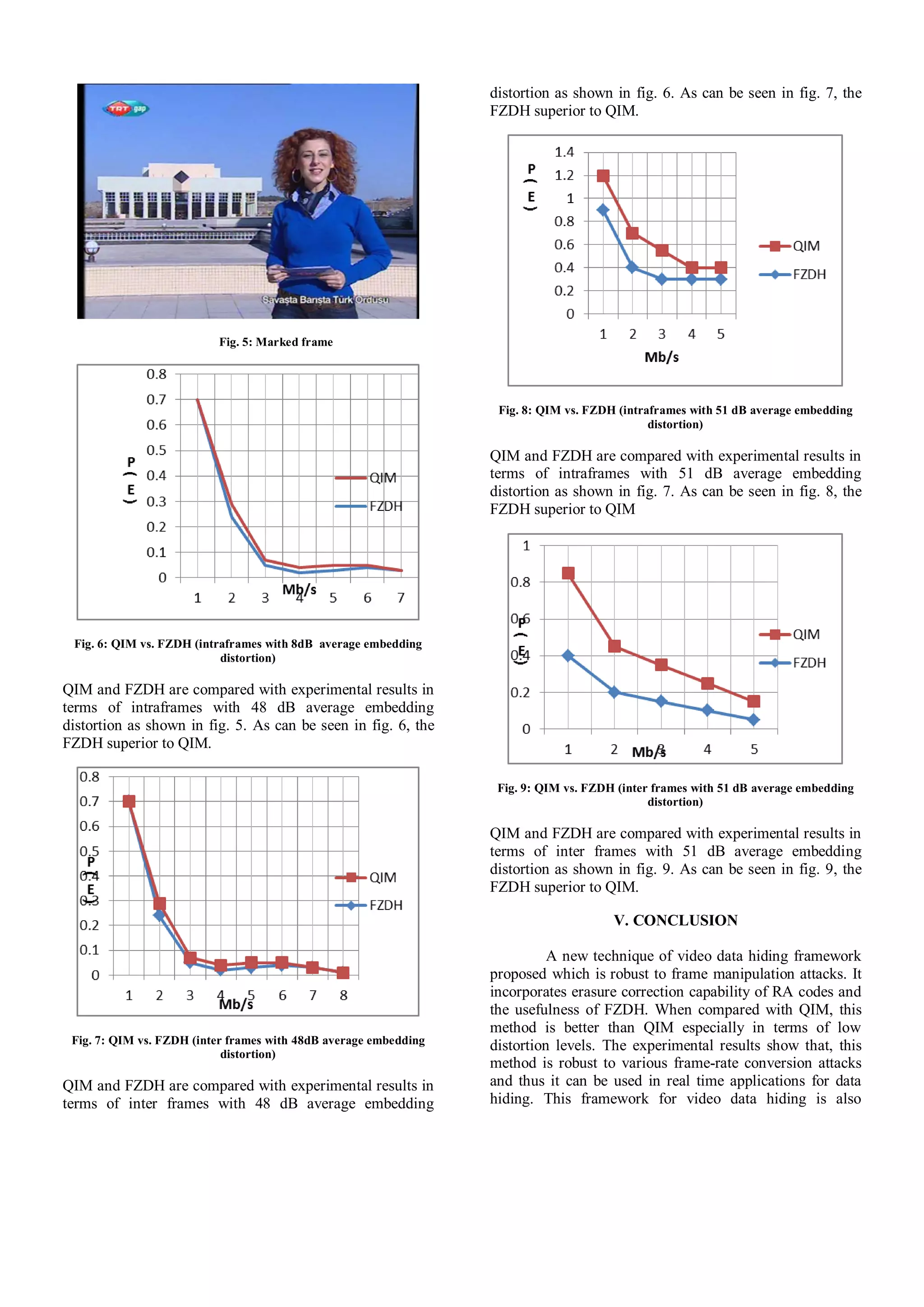
method in [4]. The figures 3 and 4 show the host frame and
marked frame respectively.
Fig. 4: Host frame
Fig. 5: Marked frame
Fig. 6: QIM vs. FZDH (intraframes with 8dB average embedding
distortion)
QIM and FZDH are compared with experimental results in
terms of intraframes with 48 dB average embedding
distortion as shown in fig. 5. As can be seen in fig. 6, the
FZDH superior to QIM.
Fig. 7: QIM vs. FZDH (inter frames with 48dB average embedding
distortion)
QIM and FZDH are compared with experimental results in
terms of inter frames with 48 dB average embedding
distortion as shown in fig. 6. As can be seen in fig. 7, the
FZDH superior to QIM.
Fig. 8: QIM vs. FZDH (intraframes with 51 dB average embedding
distortion)
QIM and FZDH are compared with experimental results in
terms of intraframes with 51 dB average embedding
distortion as shown in fig. 7. As can be seen in fig. 8, the
FZDH superior to QIM
Fig. 9: QIM vs. FZDH (inter frames with 51 dB average embedding
distortion)
QIM and FZDH are compared with experimental results in
terms of inter frames with 51 dB average embedding
distortion as shown in fig. 9. As can be seen in fig. 9, the
FZDH superior to QIM.
V. CONCLUSION
A new technique of video data hiding framework
proposed which is robust to frame manipulation attacks. It
incorporates erasure correction capability of RA codes and
the usefulness of FZDH. When compared with QIM, this
method is better than QIM especially in terms of low
distortion levels. The experimental results show that, this
method is robust to various frame-rate conversion attacks
and thus it can be used in real time applications for data
hiding. This framework for video data hiding is also
superior to water marking method [4] in terms of
performance.
REFERENCES
[1] M. Wu, H. Yu, and B. Liu, “Data hiding in image and video: I.
Fundamental issues and solutions,” IEEE Trans. Image Process., vol. 12,
no. 6, pp. 685–695, Jun. 2003.
[2] M. Wu, H. Yu, and B. Liu, “Data hiding in image and video: II.
Designs and applications,” IEEE Trans. Image Process., vol. 12, no. 6, pp.
696–705, Jun. 2003.
[3] S. K. Kapotas, E. E. Varsaki, and A. N. Skodras, “Data hiding in H-
264 encoded video sequences,” in Proc. IEEE 9th Workshop Multimedia
Signal Process., pp. 373–376,Oct. 2007,.
[4] A. Sarkar, U. Madhow, S. Chandrasekaran, and B. S.
Manjunath,“Adaptive MPEG-2 video data hiding scheme,” in Proc. 9th
SPIE Security Steganography Watermarking Multimedia Contents,
pp.373–376. 2007,
[5] K. Wong, K. Tanaka, K. Takagi, and Y. Nakajima, “Complete video
quality-preserving data hiding,” IEEE
[6] K. Solanki, N. Jacobsen, U. Madhow, B. S. Manjunath, and S.
Chandrasekaran, “Robust image-adaptive data hiding using erasure and
error correction,” IEEE Trans. Image Process., vol. 13, no. 12, pp. 1627–
1639,Dec. 2004.
[7] M. Schlauweg, D. Profrock, and E. Muller, “Correction of insertions
and deletions in selective watermarking,” in Proc. IEEE Int. Conf. SITIS,
pp. 277–284. Nov.–Dec. 2008,
[8] H. Liu, J. Huang, and Y. Q. Shi, “DWT-based video data hiding robust
to MPEG compression and frame loss,” Int. J. Image Graph., vol. 5, no. 1,
pp. 111–134, Jan. 2005.
[9] E. Esen and A. A. Alatan, “Forbidden zone data hiding,” in Proc.
IEEE Int. Conf. Image Process., pp. 1393–1396. Oct. 2006,
[10] B. Chen and G. W. Wornell, “Quantization index modulation: A
class of provably good methods for digital watermarking and information
embedding,” IEEE Trans. Inform. Theory, vol. 47, no. 4, pp. 1423–1443,
May 2001. Trans. Circuits Syst. Video Technol., vol. 19, no. 10, pp. 1499–
1512, Oct. 2009.

CR_CSI_119

  • 1.
    A Block BasedAdaptive Video Data Hiding Method Using Forbidden Zone Data Hiding B. Raj Kumar#1 , S. Tharun Reddy*2 and Dr. G. Narasimha^3 #1 Associate Professor Dept. of Computer Science and Engineering, SR Engineering College , AnanthaSagar, Warangal- 506371, Andhra Pradesh, India 1 naaniraj@gmail.com *2 M. Tech Dept. of Computer Science and Engineering, SR Engineering College, AnanthaSagar, Warangal-506371, Andhra Pradesh, India 2 tharunreddy5826@gmail.com 3 Associate Professor, Dept. of Computer Science and Engineering, JNTUH, Hyderabad, Andhra Pradesh, India 3 narasimha06@gmail.com Abstract---Data hiding is a process of embedding information into some sort of host media. Especially video data hiding has become an important research topic as it is complex when compared data hiding process in other media. This paper proposes a new method based on erasure correction capability of RA codes using forbidden zone data hiding. This method finds suitable host signals that are useful for data hiding. The proposed method also overcomes the problems of frame drop and inserts attacks. The simulation results reveal that this video data hiding framework can be used in data hiding applications of the real world. Key Words – RA codes, selective embedding, watermarking, forbidden zone data hiding, simulation, selective embedding, erasure handling, block partitioning I. INTRODUCTION As ITC (Information Technology and Communication) grows rapidly, multimedia is used widely in order to have flexibility in expression and also communication. This led to security problems over Internet. This facilitated the need for new data hiding technologies for having secret communication. Cryptography is one such technique that scrambles messages or converts message into un-understable format while another technology by name steganography hides data in such a way that it can’t be viewed by adversaries. Intellectual property such as digital media like video, audio, images are distributed, manipulated and reproduced over IT systems. Copyright protection in this scenario is a challenging issue. Towards this end watermarking technology came into existence. This technology is meant for identifying the owner of the media. This is achieved by encoding some sort of hidden information for copyright protection. It is in contrast with encryption as it can be part of media permanently and protects copyrights while encryption merely restricts data access illegally. As an alternative to encryption, data hiding within cover media came into existence. The cover media includes video, image and audio. This kind of data hiding can also be called as steganography where data is hidden in unused and undetectable bytes of the select host media. It gives superior security when compared with cryptography. The process of data hiding in various cover media has significant similarities. However, the data hiding process in video demands more complex designs [1], [2]. There are two main ways in which data hiding in video takes place. They are data-level and bit stream-level. The bit stream – level data hiding exploits redundancy in compression standards. Its encoders have freedom to choose various options for the purpose of data hiding based on the structure of the bit stream. This makes the technique fragile and it can’t withstand any kind of format conversion though perceptual quality can be preserved. Therefore it is not suitable to all applications except some fragile applications like authentication. On the other hand, data- level approach to data hiding is more robust to security attacks. This makes it suitable for wide range of applications. In spite of their fragility, the bit stream-level data hiding techniques are still attractive solutions for data hiding as described in [3], [4], and [5]. In [3] redundancy in block size selection is used while in [5] DCT coefficients are modified in the bit-stream level. In [4] QIM (Quantization Index Modulation) technique is used to low frequency DCT coefficients based on the parameters of videos of type MPEG-2. They changed embed rate based on the type of video frame resulting in de-synchronization of erasures and insertions that take place at the decoder. They processed each frame separately since the parameters are used based on the type of frame. Usage of RA codes can be viewed in [6] so as to handle erasures. On the other hand, convolutional codes are used in [7] to handle erasures and insertions. Though convolutional codes are used at decoder, the embedding process gets overloaded and there was evidence of de- synchronization. To overcome this problem they used multiple parallel Viterbi decoders. The approach in [7] is
  • 2.
    successful only ifless number of host signals is selected for embedding. For hiding data 3-D DWT domain was explored in [8] by using LL substandard coefficients. No adaptive selection and error correction codes are used here. In order to overcome the local burst of errors, the authors performed 3-D interleaving. They devised attack prevention technique known as temporal synchronization to withstand temporal attacks such as repeat, insert and frame drop which are known kinds of attacks in the literature. This paper proposes a new block-based data hiding technique using FZDB (Forbidden Zone Data Hiding) as described in [9] and RA codes are used as per the temporal synchronization approach. When compared to QIM [9] FZDH is more robust to attacks. As described in [4] and [6] RA codes are robust to erasures. This helps in handling problems in enbedder and also decoder. The proposed approach used divides blocks into two groups to incorporate the frame synchronization markers. The first group is used in embedding process for frame marker while the second one is used for message bits that improves robustness in repeat, drop and insert attacks. First of all frame selection is done and some known, low frequency DCT coefficients are used to hide data. The energy of each block is ensured that is greater than a threshold value. This is finally compared with that of another block. The blocks which are not selected are known as erasures and they are not involved in processing. Various coefficients exists for only selected blocks for embedding single message bit using multidimensional form of FZDH which contains lattice as its base quantizer. II. FORBIDDEN ZONE DATA HIDING It is a process of hiding data in a forbidden zone which is nothing but the zone where no changes are allowed during data hiding process. It was first introduced in [9]. Deciding the zones and partitions is an important aspect in FZDH. There are many ways and means to achieve this. However, quantizes can be used to have a practical design in which mapping function is defined as follows: Mm(s) = { s+em(1- r/||em||) As used in the above equation, there is an additional term that indicates the scaled version of quantization difference. Using a control parameter and difference vector the values for FZm and AZm are found as follows: FZm = {s| ||em|| ≤ r}, AZm = {s| ||em|| > r}. Fig.1: Sample embedding function of FZDH As can be viewed in fig.1, the reconstruction point of quantize is visualized. The next section is going to elaborate the proposed video data hiding framework. III. PROPOSED VIDEO DATA HIDING FRAMEWORK A new technique is proposed here for data hiding which is based on the adaptive video data hiding method that makes use of FZDH. It is superior to both QIM and also DC-QIM [10] and RA codes. Selective embedding as described in [6] is used in this work. However, unlike [6] It uses block selection and coefficient selection processes together, It uses RA codes as described in [4] and [6] for handling de-synchronization which is due to block selection and it also uses multi-dimensional form of FZDH to handle de-synchronization due to coefficient selection. It uses 3-D interleaving as described in [8] for handling local bursts of errors which depend on LL subband of DCT. As shown in [8] It uses frame synchronization markers that are robust to attacks such as repeat, insert and drop. Thus this paper contributes in developing a complete and comprehensive data hiding mechanism. A) Architectural Framework Embedder and decoder flowcharts are as given in fig. 2 and 3. For a single frame the flow is given in these figures. For data embedding Y channel is used. For each block a single bit is hidden.
  • 3.
    Fig. 2: Embeddingprocess As shown in fig. 2, the embedding process takes host video as input. Frame selection, DCT, energy check, data embedding, IDCT are phases involved in the process of embedding and the result of the process is the marked video. Fig. 3: Decoder flowchart The decoder process takes received video as input and decode, DCT, energy check and data extraction phases are part of the process. The process is presented for a single frame. It does mean that that gets repeated for each frame. B) Selective Embedding Adaptive host signal sampling is used in the proposed framework. There are four stages in the selection process. They are selection of frame, determination of frequency band, selection of block and selection of coefficient. In the first stage, the selected number of blocks is counted and it is determined based on the threshold value. In the second stage, the usage of coefficiency is used as given in [4]. In the third stage, it computes the energy of the coefficients in the mask while the last stage focuses on the selection of coefficient based on the energy of other blocks and by comparing thresholds. C) Block Partitioning Embedding involves two different data sets. They are frame synchronization markers (m2) and message bits (m1). Random key is used to determine m2 and the rest are automatically reserved from m1. D) Erasure Handling As block selection is adaptive in nature, between the embedder and decoder, de-synchronization has to be performed. As a result, the decoder may not be able to determine the selected blocks at the embedder. This problem can be overcome by sing RA codes as given in [6] for video data hiding. E) Frame Synchronization Markers In the given video frames are indexed for identification. The index starts from 0 and ends with T-1. In each frame synchronization markers are used. These markers are then used to determine the attacks such as frame drops, inserts and repeats. IV. EXPERIMENTS Experiments are performed in three stages. In the first stage QIM and FZDH are compared. In the second stage observes video processing attacks and the system’s stability in handling them. The third stage is to compare the framework with watermarking and the video data hiding method in [4]. The figures 3 and 4 show the host frame and marked frame respectively. Fig. 4: Host frame
  • 4.
    Fig. 5: Markedframe Fig. 6: QIM vs. FZDH (intraframes with 8dB average embedding distortion) QIM and FZDH are compared with experimental results in terms of intraframes with 48 dB average embedding distortion as shown in fig. 5. As can be seen in fig. 6, the FZDH superior to QIM. Fig. 7: QIM vs. FZDH (inter frames with 48dB average embedding distortion) QIM and FZDH are compared with experimental results in terms of inter frames with 48 dB average embedding distortion as shown in fig. 6. As can be seen in fig. 7, the FZDH superior to QIM. Fig. 8: QIM vs. FZDH (intraframes with 51 dB average embedding distortion) QIM and FZDH are compared with experimental results in terms of intraframes with 51 dB average embedding distortion as shown in fig. 7. As can be seen in fig. 8, the FZDH superior to QIM Fig. 9: QIM vs. FZDH (inter frames with 51 dB average embedding distortion) QIM and FZDH are compared with experimental results in terms of inter frames with 51 dB average embedding distortion as shown in fig. 9. As can be seen in fig. 9, the FZDH superior to QIM. V. CONCLUSION A new technique of video data hiding framework proposed which is robust to frame manipulation attacks. It incorporates erasure correction capability of RA codes and the usefulness of FZDH. When compared with QIM, this method is better than QIM especially in terms of low distortion levels. The experimental results show that, this method is robust to various frame-rate conversion attacks and thus it can be used in real time applications for data hiding. This framework for video data hiding is also
  • 5.
    superior to watermarking method [4] in terms of performance. REFERENCES [1] M. Wu, H. Yu, and B. Liu, “Data hiding in image and video: I. Fundamental issues and solutions,” IEEE Trans. Image Process., vol. 12, no. 6, pp. 685–695, Jun. 2003. [2] M. Wu, H. Yu, and B. Liu, “Data hiding in image and video: II. Designs and applications,” IEEE Trans. Image Process., vol. 12, no. 6, pp. 696–705, Jun. 2003. [3] S. K. Kapotas, E. E. Varsaki, and A. N. Skodras, “Data hiding in H- 264 encoded video sequences,” in Proc. IEEE 9th Workshop Multimedia Signal Process., pp. 373–376,Oct. 2007,. [4] A. Sarkar, U. Madhow, S. Chandrasekaran, and B. S. Manjunath,“Adaptive MPEG-2 video data hiding scheme,” in Proc. 9th SPIE Security Steganography Watermarking Multimedia Contents, pp.373–376. 2007, [5] K. Wong, K. Tanaka, K. Takagi, and Y. Nakajima, “Complete video quality-preserving data hiding,” IEEE [6] K. Solanki, N. Jacobsen, U. Madhow, B. S. Manjunath, and S. Chandrasekaran, “Robust image-adaptive data hiding using erasure and error correction,” IEEE Trans. Image Process., vol. 13, no. 12, pp. 1627– 1639,Dec. 2004. [7] M. Schlauweg, D. Profrock, and E. Muller, “Correction of insertions and deletions in selective watermarking,” in Proc. IEEE Int. Conf. SITIS, pp. 277–284. Nov.–Dec. 2008, [8] H. Liu, J. Huang, and Y. Q. Shi, “DWT-based video data hiding robust to MPEG compression and frame loss,” Int. J. Image Graph., vol. 5, no. 1, pp. 111–134, Jan. 2005. [9] E. Esen and A. A. Alatan, “Forbidden zone data hiding,” in Proc. IEEE Int. Conf. Image Process., pp. 1393–1396. Oct. 2006, [10] B. Chen and G. W. Wornell, “Quantization index modulation: A class of provably good methods for digital watermarking and information embedding,” IEEE Trans. Inform. Theory, vol. 47, no. 4, pp. 1423–1443, May 2001. Trans. Circuits Syst. Video Technol., vol. 19, no. 10, pp. 1499– 1512, Oct. 2009.