Title Page -Page 1
• Theme- Smart Automation(IoT)
• PS Category – Hardware
• Team Name - Crazy Engineers
• Team Leader Name – Divyanshu Kumar
2.
Automatic RailwayBarricade Lifting System
Problem Occur In Railway Barricade System:
• Accident Case
• Traffic at the Train Barrier ( Waiting Time Is More )
• Unwanted action performed by the Person
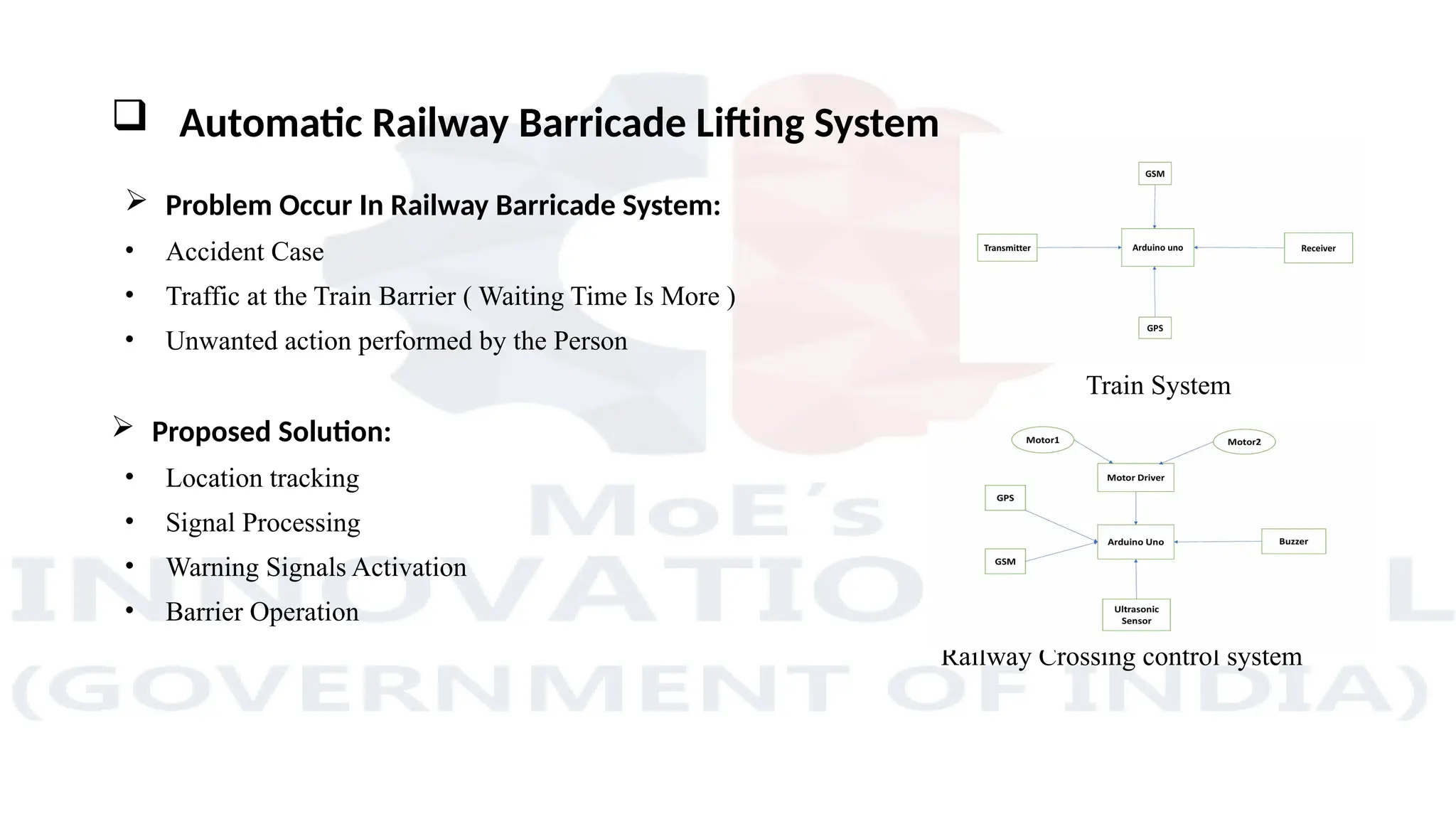
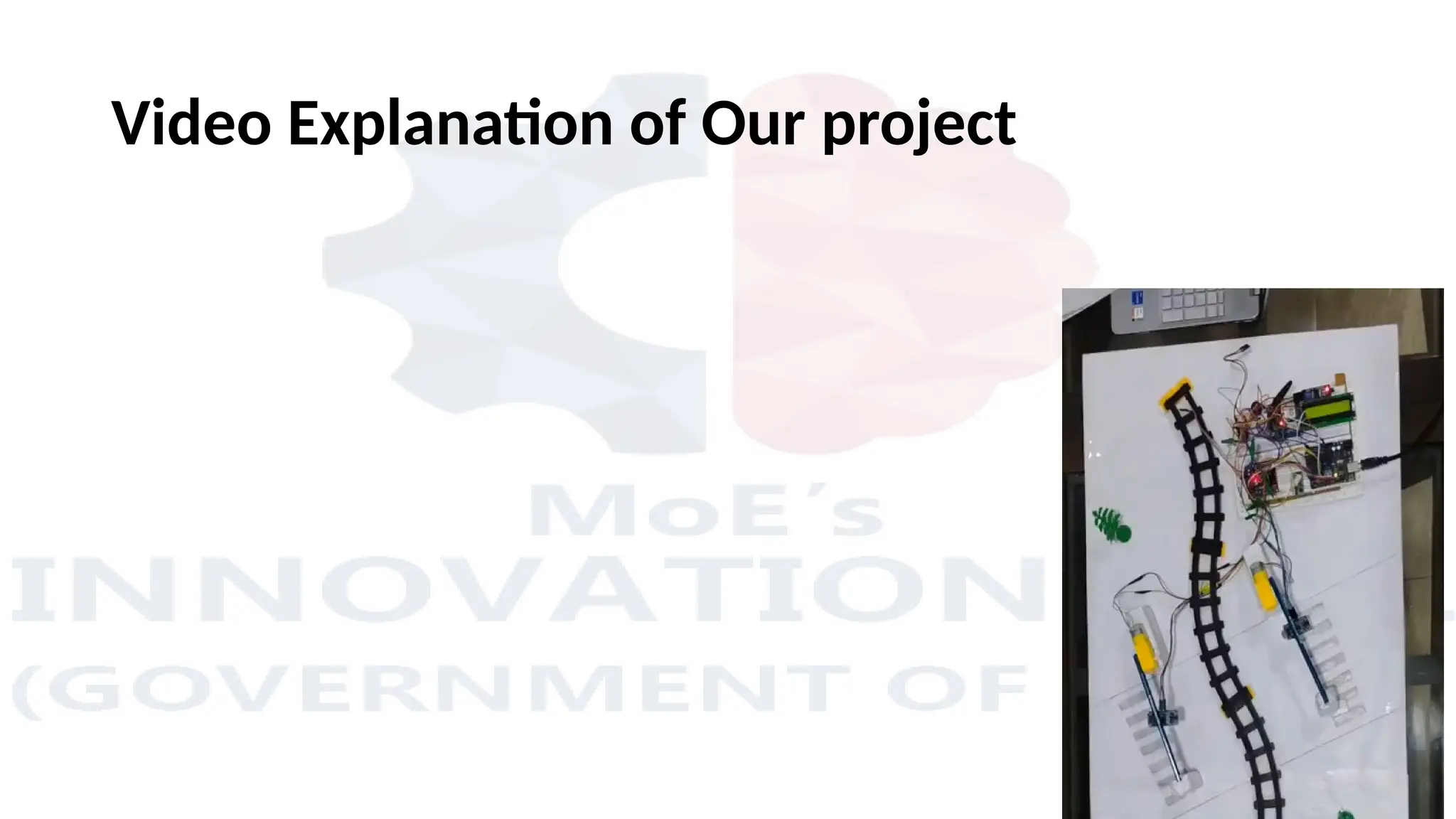
Train System
Proposed Solution:
• Location tracking
• Signal Processing
• Warning Signals Activation
• Barrier Operation
Railway Crossing control system
Technical Approach
Programming Language
• Embedded C++
Hardware
• Arduino uno • GSM Module
• GPS Module • Ultrasonic Sensor
• Motor Driver • RF Transmitter and RF Receiver
• Gear Motor
5.
Feasibility and Viability
•The technology required for automation is readily available and proven to work reliably.
• System is customizable and safety concerns are improved.
• Long term advantages and worthwhile investment for railway authorities.
Potential challenges and risks.
• GPS/GSM Communication.
• Data Transmission Protocol.
Strategies for overcoming these challenges.
• By using RF Transmitter and RF Receiver.
6.
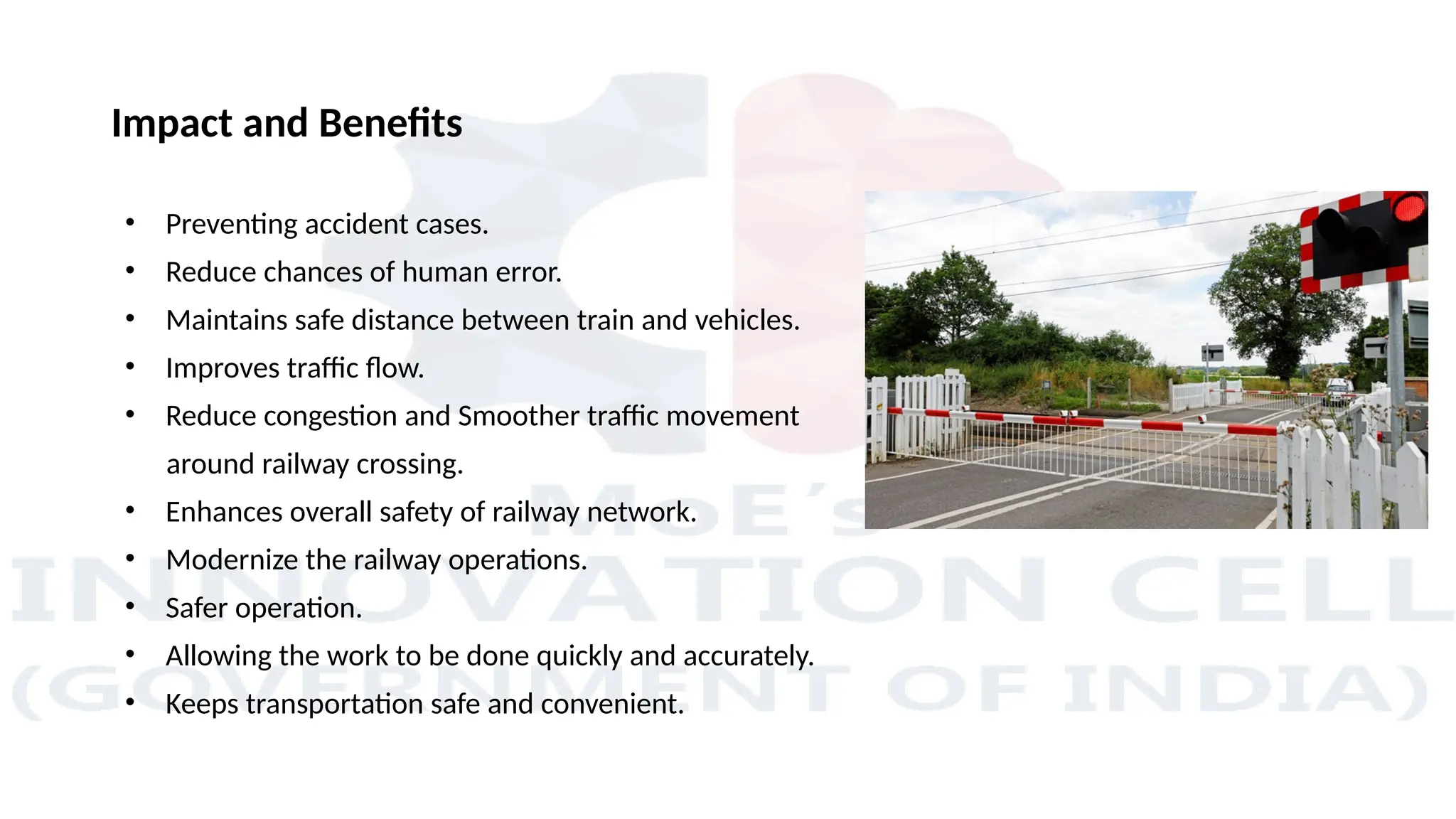
Impact and Benefits
•Preventing accident cases.
• Reduce chances of human error.
• Maintains safe distance between train and vehicles.
• Improves traffic flow.
• Reduce congestion and Smoother traffic movement
around railway crossing.
• Enhances overall safety of railway network.
• Modernize the railway operations.
• Safer operation.
• Allowing the work to be done quickly and accurately.
• Keeps transportation safe and convenient.
7.
References and Research
References
• Ajay.V.Deshmukh, Microcontrollers (Theory and Application), TataMcGraw-Hill Publication, 2005.
• Sandhya Gautam , Sandip remade, Teena Sukla. Simulation of an anti-collision system on same
track for railways. International Journal of Engineering and Technology, vol.2 (9), page 4832-
4837, 2010.
• Abidkhan , Ravi Mishra,” GPS – GSM Based Tracking System”, International Journal of Engineering
Trends and Technology , Vol 3,No 2,2012
Research Areas
• Sensor Technologies
• Communication Systems
• Human Factors and Usability



![automaticrailwaygatecontrolusingarduinouno-200115134737[1].pptx](https://cdn.slidesharecdn.com/ss_thumbnails/automaticrailwaygatecontrolusingarduinouno-2001151347371-250826175600-5d686697-thumbnail.jpg?width=640&height=640&fit=bounds)


![1. SIH2025-IDEA-Presentation-Format[1].pptx](https://cdn.slidesharecdn.com/ss_thumbnails/1-251204091914-b1bb69d5-thumbnail.jpg?width=640&height=640&fit=bounds)


