CQE EXAM
PREPARATION COURSE
Part 1
Management and Leadership
By :
Eng : Hosam Abd El-Galeil
Chapter 1 A. Quality Philosophies and Foundations
Chapter 2 B. The Quality Management System
Chapter 3 C. ASQ Code of Ethics for Professional Conduct
Chapter 4 D. Leadership Principles and Techniques
Chapter 5 E. Facilitation Principles and Techniques
Chapter 6 F. Communication Skills
Chapter 7 G. Customer Relations
Chapter 8 H. Supplier Management
Chapter 9 I. Overcoming Barriers to Quality Improvement
Content
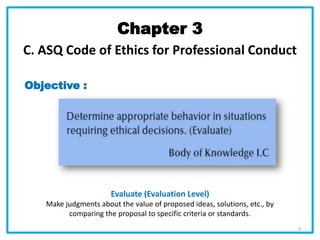
Objective :
Chapter 3
C. ASQ Code of Ethics for Professional Conduct
Evaluate (Evaluation Level)
Make judgments about the value of proposed ideas, solutions, etc., by
comparing the proposal to specific criteria or standards.
3
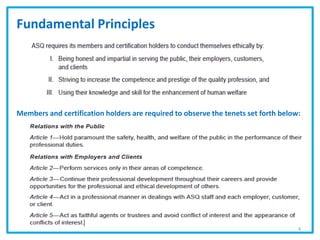
Fundamental Principles
Members and certification holders are required to observe the tenets set forth below:
4
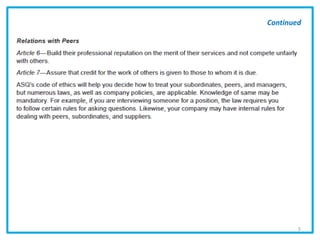
Continued
5
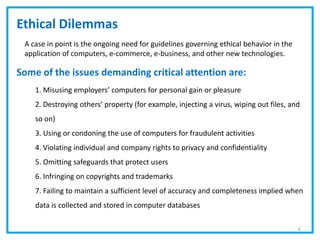
Ethical Dilemmas
A case in point is the ongoing need for guidelines governing ethical behavior in the
application of computers, e-commerce, e-business, and other new technologies.
Some of the issues demanding critical attention are:
1. Misusing employers’ computers for personal gain or pleasure
2. Destroying others’ property (for example, injecting a virus, wiping out files, and
so on)
3. Using or condoning the use of computers for fraudulent activities
4. Violating individual and company rights to privacy and confidentiality
5. Omitting safeguards that protect users
6. Infringing on copyrights and trademarks
7. Failing to maintain a sufficient level of accuracy and completeness implied when
data is collected and stored in computer databases
6
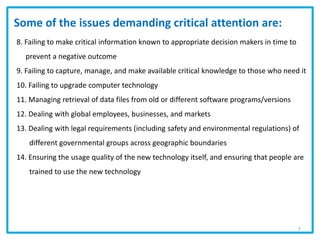
8. Failing to make critical information known to appropriate decision makers in time to
prevent a negative outcome
9. Failing to capture, manage, and make available critical knowledge to those who need it
10. Failing to upgrade computer technology
11. Managing retrieval of data files from old or different software programs/versions
12. Dealing with global employees, businesses, and markets
13. Dealing with legal requirements (including safety and environmental regulations) of
different governmental groups across geographic boundaries
14. Ensuring the usage quality of the new technology itself, and ensuring that people are
trained to use the new technology
Some of the issues demanding critical attention are:
7
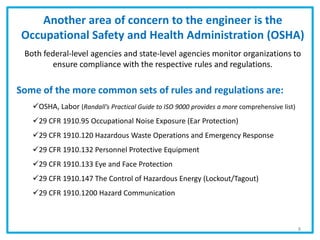
Some of the more common sets of rules and regulations are:
OSHA, Labor (Randall’s Practical Guide to ISO 9000 provides a more comprehensive list)
29 CFR 1910.95 Occupational Noise Exposure (Ear Protection)
29 CFR 1910.120 Hazardous Waste Operations and Emergency Response
29 CFR 1910.132 Personnel Protective Equipment
29 CFR 1910.133 Eye and Face Protection
29 CFR 1910.147 The Control of Hazardous Energy (Lockout/Tagout)
29 CFR 1910.1200 Hazard Communication
Another area of concern to the engineer is the
Occupational Safety and Health Administration (OSHA)
Both federal-level agencies and state-level agencies monitor organizations to
ensure compliance with the respective rules and regulations.
8
Engineers also are finding themselves involved with issues
usually handled by management, such as interviewing
potential new employees for the organization.
Some items that the interviewers must be aware of include:
Ask only job-related questions
Do not ask about age, race, national origin, marital status, or religion
Focus on the competencies and skills for the job in question
Avoid any small talk that is not related to the job
Without the proper training, engineers could be
putting themselves and their employers at great risk
for lawsuits by asking inappropriate questions.
9
C Q E Exam Prep. Course
STUDY GROUP
www.facebook.com/groups/1458356601047218/
www.facebook.com/ASQCQE
www.youtube.com/QualityInitiative
CQE Preparation | asq code of ethics

CQE Preparation | asq code of ethics

  • 1.
    CQE EXAM PREPARATION COURSE Part1 Management and Leadership By : Eng : Hosam Abd El-Galeil
  • 2.
    Chapter 1 A.Quality Philosophies and Foundations Chapter 2 B. The Quality Management System Chapter 3 C. ASQ Code of Ethics for Professional Conduct Chapter 4 D. Leadership Principles and Techniques Chapter 5 E. Facilitation Principles and Techniques Chapter 6 F. Communication Skills Chapter 7 G. Customer Relations Chapter 8 H. Supplier Management Chapter 9 I. Overcoming Barriers to Quality Improvement Content
  • 3.
    Objective : Chapter 3 C.ASQ Code of Ethics for Professional Conduct Evaluate (Evaluation Level) Make judgments about the value of proposed ideas, solutions, etc., by comparing the proposal to specific criteria or standards. 3
  • 4.
    Fundamental Principles Members andcertification holders are required to observe the tenets set forth below: 4
  • 5.
  • 6.
    Ethical Dilemmas A casein point is the ongoing need for guidelines governing ethical behavior in the application of computers, e-commerce, e-business, and other new technologies. Some of the issues demanding critical attention are: 1. Misusing employers’ computers for personal gain or pleasure 2. Destroying others’ property (for example, injecting a virus, wiping out files, and so on) 3. Using or condoning the use of computers for fraudulent activities 4. Violating individual and company rights to privacy and confidentiality 5. Omitting safeguards that protect users 6. Infringing on copyrights and trademarks 7. Failing to maintain a sufficient level of accuracy and completeness implied when data is collected and stored in computer databases 6
  • 7.
    8. Failing tomake critical information known to appropriate decision makers in time to prevent a negative outcome 9. Failing to capture, manage, and make available critical knowledge to those who need it 10. Failing to upgrade computer technology 11. Managing retrieval of data files from old or different software programs/versions 12. Dealing with global employees, businesses, and markets 13. Dealing with legal requirements (including safety and environmental regulations) of different governmental groups across geographic boundaries 14. Ensuring the usage quality of the new technology itself, and ensuring that people are trained to use the new technology Some of the issues demanding critical attention are: 7
  • 8.
    Some of themore common sets of rules and regulations are: OSHA, Labor (Randall’s Practical Guide to ISO 9000 provides a more comprehensive list) 29 CFR 1910.95 Occupational Noise Exposure (Ear Protection) 29 CFR 1910.120 Hazardous Waste Operations and Emergency Response 29 CFR 1910.132 Personnel Protective Equipment 29 CFR 1910.133 Eye and Face Protection 29 CFR 1910.147 The Control of Hazardous Energy (Lockout/Tagout) 29 CFR 1910.1200 Hazard Communication Another area of concern to the engineer is the Occupational Safety and Health Administration (OSHA) Both federal-level agencies and state-level agencies monitor organizations to ensure compliance with the respective rules and regulations. 8
  • 9.
    Engineers also arefinding themselves involved with issues usually handled by management, such as interviewing potential new employees for the organization. Some items that the interviewers must be aware of include: Ask only job-related questions Do not ask about age, race, national origin, marital status, or religion Focus on the competencies and skills for the job in question Avoid any small talk that is not related to the job Without the proper training, engineers could be putting themselves and their employers at great risk for lawsuits by asking inappropriate questions. 9
  • 10.
    C Q EExam Prep. Course STUDY GROUP www.facebook.com/groups/1458356601047218/
  • 11.