One  or  two  CPWF  case  studies  
What  are  outcomes?  


and  final  users  that  results  in  adopter  level  changes  which  are  
                                                                          
  
In  other  words,                                        
  
(My  own  interpretation)     self-­‐sustaining  changes  in  behavior  
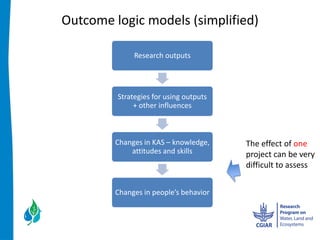
Outcome  logic  models  (simplified)  

                Research  outputs  


          Strategies  for  using  outputs  
               +  other  influences    


          Changes  in  KAS     knowledge,          The  effect  of  one  
              attitudes  and  skills               project  can  be  very  
                                                   difficult  to  assess  


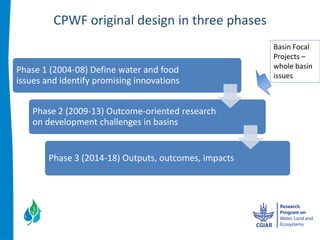
CPWF  original  design  in  three  phases  
                                                                         Basin  Focal  
                                                                         Projects     
                                                                         whole  basin  
Phase  1  (2004-­‐08)  Define  water  and  food  
                                                                         issues    
issues  and  identify  promising  innovations    


    Phase  2  (2009-­‐13)  Outcome-­‐oriented  research    
    on  development  challenges  in  basins  


         Phase  3  (2014-­‐18)  Outputs,  outcomes,  impacts          
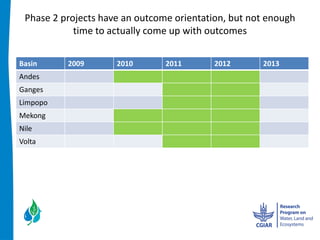
Phase  2  projects  have  an  outcome  orientation,  but  not  enough  
               time  to  actually  come  up  with  outcomes    


Basin        2009        2010         2011         2012         2013  
Andes  
Ganges  
Limpopo  
Mekong  
Nile  
Volta  
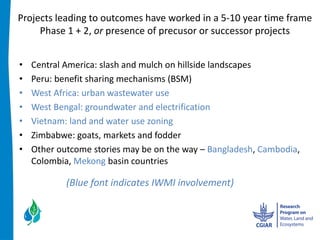
Projects  leading  to  outcomes  have  worked  in  a  5-­‐10  year  time  frame  
     Phase  1  +  2,  or  presence  of  precusor  or  successor  projects  


   Central  America:  slash  and  mulch  on  hillside  landscapes  
   Peru:  benefit  sharing  mechanisms  (BSM)  
   West  Africa:  urban  wastewater  use    
   West  Bengal:  groundwater  and  electrification  
   Vietnam:  land  and  water  use  zoning  
   Zimbabwe:  goats,  markets  and  fodder  
   Other  outcome  stories  may  be  on  the  way     Bangladesh,  Cambodia,  
   Colombia,  Mekong  basin  countries  
     
             (Blue  font  indicates  IWMI  involvement)  


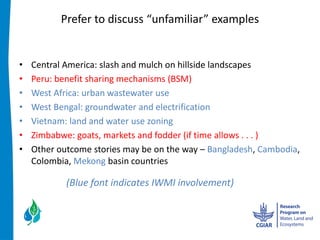
Central  America:  slash  and  mulch  on  hillside  landscapes  
Peru:  benefit  sharing  mechanisms  (BSM)      
West  Africa:  urban  wastewater  use    
West  Bengal:  groundwater  and  electrification  
Vietnam:  land  and  water  use  zoning  
Zimbabwe:  goats,  markets  and  fodder  (if  time  allows  .  .  .  )  
Other  outcome  stories  may  be  on  the  way     Bangladesh,  Cambodia,  
Colombia,  Mekong  basin  countries  
  
         (Blue  font  indicates  IWMI  involvement)  
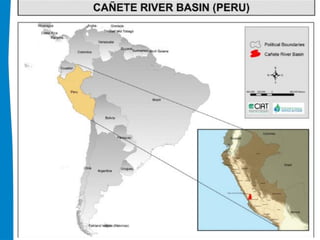
Peru:  benefit  sharing  mechanisms  (BSM)    
         (CPWF  Phases  1  and  2)      


                Marcela  Quintero  
             Ruben  Dario  Estrada  
             .  .  .  and  many  others  
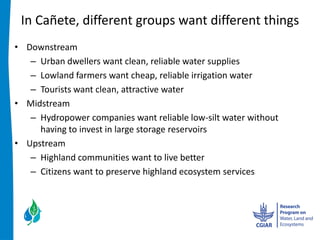
In  Cañete,  different  groups  want  different  things  
 Downstream  
    Urban  dwellers  want  clean,  reliable  water  supplies  
    Lowland  farmers  want  cheap,  reliable  irrigation  water  
    Tourists  want  clean,  attractive  water  
 Midstream  
    Hydropower  companies  want  reliable  low-­‐silt  water  without  
    having  to  invest  in  large  storage  reservoirs  
 Upstream  
    Highland  communities  want  to  live  better  
    Citizens  want  to  preserve  highland  ecosystem  services    
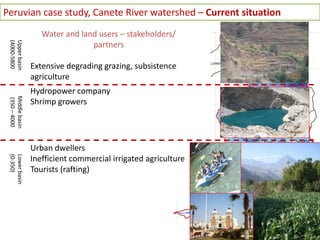
Peruvian  case  study,  Canete  River  watershed     Current  situation  
                         Water  and  land  users     stakeholders/  
                             Ecosystem  service  provision    
                                 River  flow  use  (m3/s)  
 (4000-­‐5800  
 (4000-­‐5800  
 Upper  basin  
 Upper  basin  
 (4000-­‐5800  


                                    (Water  yield  (mm))  
                                          partners  
                                                
                                                   
                                             0    
                      Extensive  degrading  grazing,  subsistence  
                                       1111-­‐1507  
                                 (mostly  from  springs)  
                      agriculture  
                      Hydropower  company  
                                        51-­‐256  
                                               
   (350     4000  
   (350     4000  
 Middle  basin  
 Middle  basin  
    (350     4000  


                      Shrimp  growers          
                                               
                                        250,  64  

                      Urban  dwellers   0-­‐50    
 (0-­‐350)  
 (0-­‐350)  
 Lower  basin    
 Lower  basin    
 (0-­‐350)  


                      Inefficient  commercial  irrigated  agriculture  
                      Tourists  (rafting)  
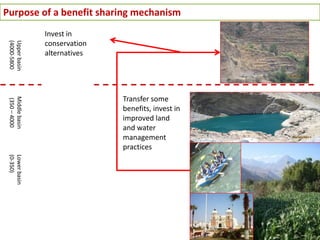
Purpose  of  a  benefit  sharing  mechanism  
                     Invest  in  
                     conservation  
 (4000-­‐5800  
 Upper  basin  


                     alternatives  


                                      Transfer  some  
   (350     4000  
 Middle  basin  


                                      benefits,  invest  in  
                                      improved  land  
                                      and  water  
                                      management  
                                      practices  
 (0-­‐350)  
 Lower  basin    
 
2005    
   CPWF-­‐CIAT-­‐GTZ  Phase  1  project  in  Moyobamba,  BSM  methods  
   developed     high  profile  because  of  GTZ  link    
   Example  of  downstream  $$  used  for  upstream  investments  
2008  
   Ministry  of  Environment  (MinAm)  created  
2009  
   MinAm  asked  CIAT  to  participate  in  BSM  design  for  Cañete,    
   designated  as  official  MinAm  pilot  site  for  national  BSM  program  
2010  
   Cañete  study  enters  CPWF  Phase  2  as  Andes  AN2  project  
     
Time  line  
2010-­‐2011  
   AN2  research  on  economic  valuation  and  hydrological  priority  areas  
   Legal  feasibility  found  to  be  an  obstacle  to  BSM  
   Conservation  International  joins  to  work  on  BSM  legal  issues  
2011-­‐2012  
   AN2  identifies  intensification  practices  for  highlands  
   Drawing  on  Cañete  experience,  AN2  works  with  MinAm  in  drafting  
   national  Ecosystem  Services  Law     national  application  of  BSM  
     
     
News    


be  sent  to  the  Congress  for  approval  this  week.  They  asked  us  for  
support  in  case  there  are  questions  from  the  Congress  regarding  
                        
  
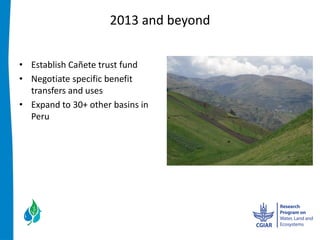
2013  and  beyond  


Establish  Cañete  trust  fund  
Negotiate  specific  benefit  
transfers  and  uses  
Expand  to  30+  other  basins  in  
Peru    
  
  
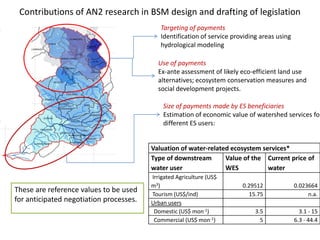
Contributions  of  AN2  research  in  BSM  design  and  drafting  of  legislation  
                                                      Targeting  of  payments    
                                                      Identification  of  service  providing  areas  using  
                                                      hydrological  modeling    

                                                     Use  of  payments    
                                                     Ex-­‐ante  assessment  of  likely  eco-­‐efficient  land  use  
                                                     alternatives;  ecosystem  conservation  measures  and  
                                                     social  development  projects.  

                                                       Size  of  payments  made  by  ES  beneficiaries  
                                                       Estimation  of  economic  value  of  watershed  services  for
                                                       different  ES  users:  


                                                  Valuation  of  water-­‐related  ecosystem  services*  
                                                  Type  of  downstream         Value  of  the   Current  price  of  
                                                  water  user                  WES              water  
                                                    Irrigated  Agriculture  (US$  
                                                  m3)                                   0.29512                0.023664  
These  are  reference  values  to  be  used    
                                                    Tourism  (US$/ind)                    15.75                     n.a.  
for  anticipated  negotiation  processes.         Urban  users  
                                                      Domestic  (US$  mon-­‐1)               3.5                 3.1  -­‐  15  
                                                      Commercial  (US$  mon-­‐1)               5               6.3  -­‐  44.4  
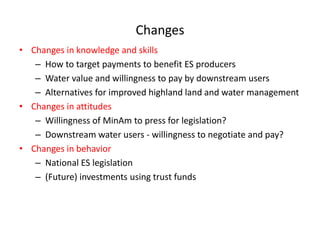
Changes  
Changes  in  knowledge  and  skills    
   How  to  target  payments  to  benefit  ES  producers    
   Water  value  and  willingness  to  pay  by  downstream  users  
   Alternatives  for  improved  highland  land  and  water  management    
Changes  in  attitudes  
   Willingness  of  MinAm  to  press  for  legislation?  
   Downstream  water  users  -­‐  willingness  to  negotiate  and  pay?  
Changes  in  behavior  
   National  ES  legislation  
   (Future)  investments  using  trust  funds  
     
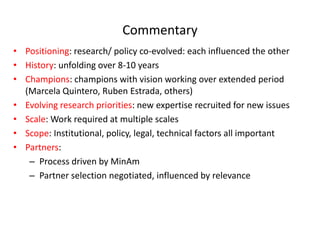
Commentary  
Positioning:  research/  policy  co-­‐evolved:  each  influenced  the  other  
History:  unfolding  over  8-­‐10  years  
Champions:  champions  with  vision  working  over  extended  period  
(Marcela  Quintero,  Ruben  Estrada,  others)  
Evolving  research  priorities:  new  expertise  recruited  for  new  issues    
Scale:  Work  required  at  multiple  scales  
Scope:  Institutional,  policy,  legal,  technical  factors  all  important  
Partners:    
    Process  driven  by  MinAm  
    Partner  selection  negotiated,  influenced  by  relevance  
  
Case  study:  goats,  markets  and  fodder  in  
                     Zimbabwe  
(an  example  of  precusor  development  projects  that  led  
               up  to  CPWF  Phase  2  work)  
                                
                      Andre  van  Rooyen  
                         Sabine  Homann  
                Patricia  Masikati  Hlanguyo  
                   .  .  .  and  many  others  
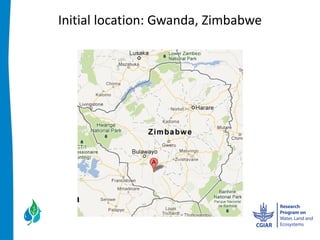
Initial  location:  Gwanda,  Zimbabwe  
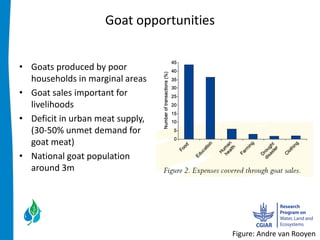
Goat  opportunities    


Goats  produced  by  poor  
households  in  marginal  areas  
Goat  sales  important  for  
livelihoods  
Deficit  in  urban  meat  supply,  
(30-­‐50%  unmet  demand  for  
goat  meat)  
National  goat  population  
around  3m  


                                               Figure:  Andre  van  Rooyen  
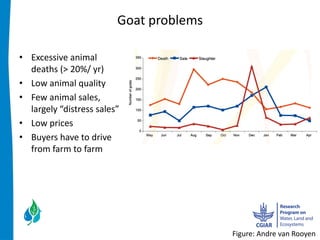
Goat  problems  

Excessive  animal  
deaths  (>  20%/  yr)  
Low  animal  quality  
Few  animal  sales,  
                              
Low  prices  
Buyers  have  to  drive  
from  farm  to  farm  


                                               Figure:  Andre  van  Rooyen  
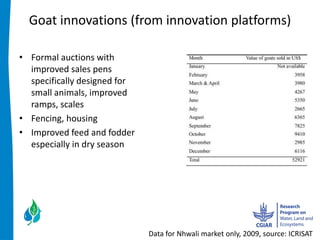
Goat  innovations  (from  innovation  platforms)    
                          
Formal  auctions  with  
improved  sales  pens  
specifically  designed  for  
small  animals,  improved  
ramps,  scales  
Fencing,  housing  
Improved  feed  and  fodder  
especially  in  dry  season  


                                Data  for  Nhwali  market  only,  2009,  source:  ICRISAT  
Auction  pens  foster  intensification  
Buyers'  transaction  costs  reduced  
Prices  higher  because  buyers  compete  
Better  quality  animals  command  higher  prices  (500-­‐600%  increase)    
Farmers  motivated  to  invest  to  raise  quality,  reduce  mortality    
    Housing  and  fencing  
    Commercial  stock  feed,  dry  season  fodder  
Fewer  distress  sales,  now  most  sales  through  auctions    
New  private  sector  investment  in  goat  production  and  marketing    

   Note  consequences  for  water  productivity  in  rainfed  systems!  
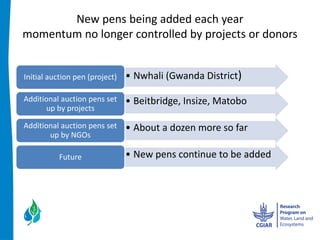
New  pens  being  added  each  year  
momentum  no  longer  controlled  by  projects  or  donors    
                            

Initial  auction  pen  (project)     Nwhali  (Gwanda  District)  

Additional  auction  pens  set       Beitbridge,  Insize,  Matobo  
      up  by  projects  

Additional  auction  pens  set       About  a  dozen  more  so  far  
       up  by  NGOs      

            Future                   New  pens  continue  to  be  added    
Changes  
Changes  in  knowledge  and  skills    
   How  to  build  and  manage  auction  pens  
                                       
   How  to  raise  better  goats    
Changes  in  attitudes  
   Buyers  willing  to  attend  auctions  and  compete    
                                                                
Changes  in  behavior  
   Farm  households  now  invest  own  resources  in  goat  housing,  
   commercial  feed,  dry  season  fodder  
   Autonomous  dissemination  of  auction  pens  and  increase  in  
   market  volume    (now  about  20  pens  x  500-­‐600  animals/yr/pen)  
Notes  
Priorities  for  CPWF  research       Commentary  
   The  auction  pen  story             Same  few  champions  working  on  
   precedes  CPWF  involvement          goat  marketing  since  early  2000s  
   CPWF  work  was  based  on              Andre  van  Rooyen    
   existing  platforms,  existing       Time  frame  about  10  years    
   development  processes               Technical  and  institutional    
   CPWF  project  L2  focuses  on       change  both  needed      
   dry  season  fodder                  Research  priorities  evolved     dry  
                                        season  fodder  became  an  issue  
                                        only  after  goat  value  increased  
                                          

Planning and Facilitating Project Outcomes: CPWF Case Studies

  • 1.
      One  or  two CPWF  case  studies  
  • 2.
    What  are  outcomes?  and  final  users  that  results  in  adopter  level  changes  which  are       In  other  words,       (My  own  interpretation)    self-­‐sustaining  changes  in  behavior  
  • 3.
    Outcome  logic  models (simplified)   Research  outputs   Strategies  for  using  outputs   +  other  influences     Changes  in  KAS    knowledge,   The  effect  of  one   attitudes  and  skills   project  can  be  very   difficult  to  assess    
  • 4.
    CPWF  original  design in  three  phases   Basin  Focal   Projects     whole  basin   Phase  1  (2004-­‐08)  Define  water  and  food   issues     issues  and  identify  promising  innovations     Phase  2  (2009-­‐13)  Outcome-­‐oriented  research     on  development  challenges  in  basins   Phase  3  (2014-­‐18)  Outputs,  outcomes,  impacts          
  • 5.
    Phase  2  projects have  an  outcome  orientation,  but  not  enough   time  to  actually  come  up  with  outcomes     Basin   2009   2010   2011   2012   2013   Andes   Ganges   Limpopo   Mekong   Nile   Volta  
  • 6.
    Projects  leading  to outcomes  have  worked  in  a  5-­‐10  year  time  frame   Phase  1  +  2,  or  presence  of  precusor  or  successor  projects   Central  America:  slash  and  mulch  on  hillside  landscapes   Peru:  benefit  sharing  mechanisms  (BSM)   West  Africa:  urban  wastewater  use     West  Bengal:  groundwater  and  electrification   Vietnam:  land  and  water  use  zoning   Zimbabwe:  goats,  markets  and  fodder   Other  outcome  stories  may  be  on  the  way    Bangladesh,  Cambodia,   Colombia,  Mekong  basin  countries     (Blue  font  indicates  IWMI  involvement)  
  • 7.
      Central  America:  slash and  mulch  on  hillside  landscapes   Peru:  benefit  sharing  mechanisms  (BSM)       West  Africa:  urban  wastewater  use     West  Bengal:  groundwater  and  electrification   Vietnam:  land  and  water  use  zoning   Zimbabwe:  goats,  markets  and  fodder  (if  time  allows  .  .  .  )   Other  outcome  stories  may  be  on  the  way    Bangladesh,  Cambodia,   Colombia,  Mekong  basin  countries     (Blue  font  indicates  IWMI  involvement)  
  • 8.
    Peru:  benefit  sharing mechanisms  (BSM)     (CPWF  Phases  1  and  2)       Marcela  Quintero   Ruben  Dario  Estrada   .  .  .  and  many  others  
  • 10.
    In  Cañete,  different groups  want  different  things   Downstream   Urban  dwellers  want  clean,  reliable  water  supplies   Lowland  farmers  want  cheap,  reliable  irrigation  water   Tourists  want  clean,  attractive  water   Midstream   Hydropower  companies  want  reliable  low-­‐silt  water  without   having  to  invest  in  large  storage  reservoirs   Upstream   Highland  communities  want  to  live  better   Citizens  want  to  preserve  highland  ecosystem  services    
  • 11.
    Peruvian  case  study, Canete  River  watershed    Current  situation   Water  and  land  users    stakeholders/   Ecosystem  service  provision     River  flow  use  (m3/s)   (4000-­‐5800   (4000-­‐5800   Upper  basin   Upper  basin   (4000-­‐5800    (Water  yield  (mm))   partners         0     Extensive  degrading  grazing,  subsistence   1111-­‐1507   (mostly  from  springs)   agriculture   Hydropower  company   51-­‐256      (350    4000    (350    4000   Middle  basin   Middle  basin    (350    4000   Shrimp  growers       250,  64   Urban  dwellers   0-­‐50     (0-­‐350)   (0-­‐350)   Lower  basin     Lower  basin     (0-­‐350)   Inefficient  commercial  irrigated  agriculture   Tourists  (rafting)  
  • 12.
    Purpose  of  a benefit  sharing  mechanism   Invest  in   conservation   (4000-­‐5800   Upper  basin   alternatives           Transfer  some    (350    4000   Middle  basin   benefits,  invest  in   improved  land   and  water   management   practices   (0-­‐350)   Lower  basin    
  • 13.
      2005     CPWF-­‐CIAT-­‐GTZ  Phase  1  project  in  Moyobamba,  BSM  methods   developed    high  profile  because  of  GTZ  link     Example  of  downstream  $$  used  for  upstream  investments   2008   Ministry  of  Environment  (MinAm)  created   2009   MinAm  asked  CIAT  to  participate  in  BSM  design  for  Cañete,     designated  as  official  MinAm  pilot  site  for  national  BSM  program   2010   Cañete  study  enters  CPWF  Phase  2  as  Andes  AN2  project    
  • 14.
    Time  line   2010-­‐2011  AN2  research  on  economic  valuation  and  hydrological  priority  areas   Legal  feasibility  found  to  be  an  obstacle  to  BSM   Conservation  International  joins  to  work  on  BSM  legal  issues   2011-­‐2012   AN2  identifies  intensification  practices  for  highlands   Drawing  on  Cañete  experience,  AN2  works  with  MinAm  in  drafting   national  Ecosystem  Services  Law    national  application  of  BSM      
  • 15.
    News         be  sent  to  the  Congress  for  approval  this  week.  They  asked  us  for   support  in  case  there  are  questions  from  the  Congress  regarding      
  • 16.
    2013  and  beyond  Establish  Cañete  trust  fund   Negotiate  specific  benefit   transfers  and  uses   Expand  to  30+  other  basins  in   Peru        
  • 17.
    Contributions  of  AN2 research  in  BSM  design  and  drafting  of  legislation   Targeting  of  payments     Identification  of  service  providing  areas  using   hydrological  modeling     Use  of  payments     Ex-­‐ante  assessment  of  likely  eco-­‐efficient  land  use   alternatives;  ecosystem  conservation  measures  and   social  development  projects.   Size  of  payments  made  by  ES  beneficiaries   Estimation  of  economic  value  of  watershed  services  for different  ES  users:   Valuation  of  water-­‐related  ecosystem  services*   Type  of  downstream   Value  of  the   Current  price  of   water  user   WES   water    Irrigated  Agriculture  (US$   m3)   0.29512   0.023664   These  are  reference  values  to  be  used      Tourism  (US$/ind)   15.75   n.a.   for  anticipated  negotiation  processes.   Urban  users      Domestic  (US$  mon-­‐1)   3.5   3.1  -­‐  15      Commercial  (US$  mon-­‐1)   5   6.3  -­‐  44.4  
  • 18.
    Changes   Changes  in knowledge  and  skills     How  to  target  payments  to  benefit  ES  producers     Water  value  and  willingness  to  pay  by  downstream  users   Alternatives  for  improved  highland  land  and  water  management     Changes  in  attitudes   Willingness  of  MinAm  to  press  for  legislation?   Downstream  water  users  -­‐  willingness  to  negotiate  and  pay?   Changes  in  behavior   National  ES  legislation   (Future)  investments  using  trust  funds    
  • 19.
    Commentary   Positioning:  research/ policy  co-­‐evolved:  each  influenced  the  other   History:  unfolding  over  8-­‐10  years   Champions:  champions  with  vision  working  over  extended  period   (Marcela  Quintero,  Ruben  Estrada,  others)   Evolving  research  priorities:  new  expertise  recruited  for  new  issues     Scale:  Work  required  at  multiple  scales   Scope:  Institutional,  policy,  legal,  technical  factors  all  important   Partners:     Process  driven  by  MinAm   Partner  selection  negotiated,  influenced  by  relevance    
  • 20.
    Case  study:  goats, markets  and  fodder  in   Zimbabwe   (an  example  of  precusor  development  projects  that  led   up  to  CPWF  Phase  2  work)     Andre  van  Rooyen   Sabine  Homann   Patricia  Masikati  Hlanguyo   .  .  .  and  many  others  
  • 21.
  • 22.
    Goat  opportunities    Goats  produced  by  poor   households  in  marginal  areas   Goat  sales  important  for   livelihoods   Deficit  in  urban  meat  supply,   (30-­‐50%  unmet  demand  for   goat  meat)   National  goat  population   around  3m     Figure:  Andre  van  Rooyen  
  • 23.
    Goat  problems   Excessive animal   deaths  (>  20%/  yr)   Low  animal  quality   Few  animal  sales,     Low  prices   Buyers  have  to  drive   from  farm  to  farm     Figure:  Andre  van  Rooyen  
  • 24.
    Goat  innovations  (from innovation  platforms)       Formal  auctions  with   improved  sales  pens   specifically  designed  for   small  animals,  improved   ramps,  scales   Fencing,  housing   Improved  feed  and  fodder   especially  in  dry  season       Data  for  Nhwali  market  only,  2009,  source:  ICRISAT  
  • 25.
    Auction  pens  foster intensification   Buyers'  transaction  costs  reduced   Prices  higher  because  buyers  compete   Better  quality  animals  command  higher  prices  (500-­‐600%  increase)     Farmers  motivated  to  invest  to  raise  quality,  reduce  mortality     Housing  and  fencing   Commercial  stock  feed,  dry  season  fodder   Fewer  distress  sales,  now  most  sales  through  auctions     New  private  sector  investment  in  goat  production  and  marketing     Note  consequences  for  water  productivity  in  rainfed  systems!  
  • 26.
    New  pens  being added  each  year   momentum  no  longer  controlled  by  projects  or  donors       Initial  auction  pen  (project)   Nwhali  (Gwanda  District)   Additional  auction  pens  set   Beitbridge,  Insize,  Matobo   up  by  projects   Additional  auction  pens  set   About  a  dozen  more  so  far   up  by  NGOs       Future   New  pens  continue  to  be  added    
  • 27.
    Changes   Changes  in knowledge  and  skills     How  to  build  and  manage  auction  pens     How  to  raise  better  goats     Changes  in  attitudes   Buyers  willing  to  attend  auctions  and  compete       Changes  in  behavior   Farm  households  now  invest  own  resources  in  goat  housing,   commercial  feed,  dry  season  fodder   Autonomous  dissemination  of  auction  pens  and  increase  in   market  volume    (now  about  20  pens  x  500-­‐600  animals/yr/pen)  
  • 28.
    Notes   Priorities  for CPWF  research     Commentary   The  auction  pen  story   Same  few  champions  working  on   precedes  CPWF  involvement   goat  marketing  since  early  2000s   CPWF  work  was  based  on      Andre  van  Rooyen     existing  platforms,  existing   Time  frame  about  10  years     development  processes     Technical  and  institutional     CPWF  project  L2  focuses  on   change  both  needed       dry  season  fodder   Research  priorities  evolved    dry     season  fodder  became  an  issue   only  after  goat  value  increased