ENERGY USE AND THE WATER INDUSTRY CARBON FOOTPRINT
                                  Y
  Mike Barker Associate ARUP, MIEEM CEnv


ENERGY USE AND THE WATER INDUSTRY CARBON FOOTPRINT
PRESENTATION OUTLINE

 •     Energy and carbon in the water sector
 •     Links to the energy sector
 •     Frameworks: Carbon hierarchy and water hierar  rchy
 •     Carbon and water footprinting: An introduction
 •     Balancing carbon and water: Behaviour or techn nology
 •     Conclusions
       C    l i


ENERGY USE AND THE WATER INDUSTRY CARBON FOOTPRINT
TOTAL WATER WITHDRAWALS


                 Private                                                  Mining
                                                                          M
               water supply                                                1%
             Other                                                                          Domestic
                   0%
              0%         Other                                                  Public        1%
Fish, farming,         industry                                                 Supply
cress growing
           i             12%                                                     11%                          Public Water
 and amenity                                                                                                    Supply
    ponds                                                                                                        21%
     10%
                                     Public water                                                                                    Energy Cooling
                                       supply
                                          pp y           Thermoelectric                  Irrigation                                       43%
                                        49%                  power                          31%
                                                              49%                                         Irrigation
               Electricity                                                                                   24%
                 28%

 Agriculture other                                                                                                          Industry
   than spray                                                                                                                 12%
                                                                                       Livestock
                                                                                   Aquaculture
     irrigation                   Spray irrigation                 Indus
                                                                       strial
         0%                            1%                             4%
                                                                       %              2% 1%


  ENGLAND AND WALES                                     UNITEDSurvey 2005 data
                                                                        ST
                                                                         TATES                         EUROPEAN UNION
                                                                                                       European Environment Agency data, 1997-2002
  Ofwat 2007 data                                       U.S. Geological   y


   ENERGY USE AND THE WATER INDUSTRY CARBON FOOTPRINT
UK WATER-RELATED GREENHOUSE GAS EMISSIONS,
2005/06


 ENERGY USE AND THE WATER INDUSTRY CARBON FOOTPRINT
BREAKDOWN OF CARBON EMISSIONS FOR DOMESTIC USE WATER
                                R


ENERGY USE AND THE WATER INDUSTRY CARBON FOOTPRINT
ENERGY INDUSTRY ISSUES MAP 2007/8 – 2008/9


ENERGY USE AND THE WATER INDUSTRY CARBON FOOTPRINT
THE NEED FOR A FRAMEWORK
     • Climate change is the defining issue of this century
     • Carbon is everyone’s concern
     • Water in the UK is highly regulated
     • Pressure to “do our bit” is increasing –
                     do      bit
       but what is “our bit” for the water industry?

© phil landowski


ENERGY USE AND THE WATER INDUSTRY CARBON FOOTPRINT
WHAT FRAMEWORK?
  CARBON AND WATER SYSTEM


                            CARBON                   WATER


ENERGY USE AND THE WATER INDUSTRY CARBON FOOTPRINT
CARBON HIERARCHY


ENERGY USE AND THE WATER INDUSTRY CARBON FOOTPRINT
DYNAMIC SYSTEMS
 WATER CYCLE

 • How to work with feedback loops
 • Describing positive and negative feedback
 • Combining carbon cycle and water cycle,
   with many variables
 • A systems approach helps us identify
   industry-wide opportunities


ENERGY USE AND THE WATER INDUSTRY CARBON FOOTPRINT
DEVELOPING THE SYSTEM


ENERGY USE AND THE WATER INDUSTRY CARBON FOOTPRINT
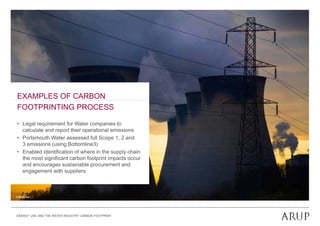
EXAMPLES OF CARBON
FOOTPRINTING PROCESS

• Legal requirement for Water companies to
     g    q                         p
  calculate and report their operational emissions
• Portsmouth Water assessed full Scope 1, 2 and
  3 emissions (using Bottomline3)
• E bl d id tifi ti of where i th supply chain
  Enabled identification f h      in the     l h i
  the most significant carbon footprint impacts occur
  and encourages sustainable procurement and
  engagement with suppliers


© Attilio Ivan


ENERGY USE AND THE WATER INDUSTRY CARBON FOOTPRINT
WATER HIERARCHY


ENERGY USE AND THE WATER INDUSTRY CARBON FOOTPRINT
WATER FOOTPRINTING: AN
INTRODUCTION

the volume of fresh water used to produce the product,
summed over the various steps of the production chain.
Water footprint includes a temporal and spatial
dimension.
type of water use:
Green water footprint volume of rainwater evaporated.
                p                            p
Blue water footprint volume of surface or groundwater
evaporated.
Grey water footprint volume of polluted water.
(the theoretical amount of water needed to dilute
contaminants.)


 ENERGY USE AND THE WATER INDUSTRY CARBON FOOTPRINT
WHY IS THIS IMPORTANT?
DOMESTIC WATER USE EXAMPLE


ENERGY USE AND THE WATER INDUSTRY CARBON FOOTPRINT
WHY IS THIS IMPORTANT?
DOMESTIC WATER USE EXAMPLE


                                        EU per capita water consumption (l/p/d)


Source: based on Waterwise data, 2006


ENERGY USE AND THE WATER INDUSTRY CARBON FOOTPRINT
UK REGULATORY
FRAMEWORK

•How can the reg lator s stem
 Ho            regulatory system
 incentives reductions in water use?
•In the US, some energy utilities sell
 "Negawatts" (a Megawatt avoided)
  Negawatts
•How would we create, measure and
 sell "Negalitres"?
•Why would the consumer trust a water
 Why
 company to sell them Negalitres?


ENERGY USE AND THE WATER INDUSTRY CARBON FOOTPRINT
DOMESTIC DESIGN
GREY WATER AND RAINWATER HARVESTING


ENERGY USE AND THE WATER INDUSTRY CARBON FOOTPRINT
POSSIBLE BALANCED SOLUTIONS

                                                     Carbon                                      Other Stakeholder  Power Sector 
                                  Delivery Cost      Benefits   Water Be
                                                                       enefits Water Co Priority      Priority        Priority
   Incentivising Negalitres                                                           N                  N               N
   Small hydro                                                                        N                 N                      ?
   Anaerobic digestion                                                                Y                  Y                     ?
   Catchment management                                                               ?                  Y                     N
   Process efficiency                                                                 N                 N                      Y
   Rainwater harvesting                                                               N                 N                      N
   Greywater recycling                                                                N                 N                      N
   Desalination                                                                       N                 N                      N
   Non‐potable water                                                                  N                 N                      ?
   Reduce leakage                                                                     ?                  Y                     N
   Metering
   M t i                                                                              ?                  Y                     N
   Dry cooling                                                                        N                  ?                     ?
   Renewables                                                                         ?                  Y                     Y
   Biofuels                                                                           N                  Y                     ?
                                                                                                              Source: Arup internal workshop


ENERGY USE AND THE WATER INDUSTRY CARBON FOOTPRINT
PIECE BY PIECE - ENERGY
•        Reduce consumer demand for energy
•        Increase renewables
•        So e carbon-saving technologies a e dde
         Some ca bo sa g tec o og es have hidden
         water implications (CCS)
•        Biofuels are not all as beneficial as they seem


    ENERGY USE AND THE WATER INDUSTRY CARBON FOOTPRINT
PIECE BY PIECE - WATER

•    Reduce consumer demand and water heating,
•    Look at total system carbon including treatment
•    Biogas p
        g production and use
•    Increase climate resilience
•    Gravity feed standards
•    Leakage reductions
•    Heat recovery


ENERGY USE AND THE WATER INDUSTRY CARBON FOOTPRINT
REMAKING THE SYSTEM                                                               Increase climate
                                                                                  resilience


                                                                                                             Gravity feed
                                                                                                             standards


    Reduce consumer
    demand and water
    heating                                                                                                   Leakage reductions


                                       Look at total system
                                                              Biogas production              Heat recovery
                                       carbon including
                                                              and use
                                       treatment


ENERGY USE AND THE WATER INDUSTRY CARBON FOOTPRINT
CONCLUSIONS


ENERGY USE AND THE WATER INDUSTRY CARBON FOOTPRINT
CONC
                                                        CLUSIONS
                                                     •   Water a carbon – the big issues of our age
                                                               and
                                                     •   Engine
                                                              eering problems but not only engineering problems
                                                     •   System thinking is imperative
                                                              ms
                                                     •   Change is possible, and offers potential to be beneficial and inclusive
                                                               e


ENERGY USE AND THE WATER INDUSTRY CARBON FOOTPRINT
THANK YOU
  ANY QUESTIONS?


ENERGY USE AND THE WATER INDUSTRY CARBON FOOTPRINT

Mike Barker, Arup

  • 1.
    ENERGY USE ANDTHE WATER INDUSTRY CARBON FOOTPRINT Y Mike Barker Associate ARUP, MIEEM CEnv ENERGY USE AND THE WATER INDUSTRY CARBON FOOTPRINT
  • 2.
    PRESENTATION OUTLINE • Energy and carbon in the water sector • Links to the energy sector • Frameworks: Carbon hierarchy and water hierar rchy • Carbon and water footprinting: An introduction • Balancing carbon and water: Behaviour or techn nology • Conclusions C l i ENERGY USE AND THE WATER INDUSTRY CARBON FOOTPRINT
  • 3.
    TOTAL WATER WITHDRAWALS Private Mining M water supply 1% Other Domestic 0% 0% Other Public 1% Fish, farming, industry Supply cress growing i 12% 11% Public Water and amenity Supply ponds 21% 10% Public water Energy Cooling supply pp y Thermoelectric Irrigation 43% 49% power 31% 49% Irrigation Electricity 24% 28% Agriculture other Industry than spray 12% Livestock Aquaculture irrigation Spray irrigation Indus strial 0% 1% 4% % 2% 1% ENGLAND AND WALES UNITEDSurvey 2005 data ST TATES EUROPEAN UNION European Environment Agency data, 1997-2002 Ofwat 2007 data U.S. Geological y ENERGY USE AND THE WATER INDUSTRY CARBON FOOTPRINT
  • 4.
    UK WATER-RELATED GREENHOUSEGAS EMISSIONS, 2005/06 ENERGY USE AND THE WATER INDUSTRY CARBON FOOTPRINT
  • 5.
    BREAKDOWN OF CARBONEMISSIONS FOR DOMESTIC USE WATER R ENERGY USE AND THE WATER INDUSTRY CARBON FOOTPRINT
  • 6.
    ENERGY USE ANDTHE WATER INDUSTRY CARBON FOOTPRINT
  • 7.
    ENERGY INDUSTRY ISSUESMAP 2007/8 – 2008/9 ENERGY USE AND THE WATER INDUSTRY CARBON FOOTPRINT
  • 8.
    THE NEED FORA FRAMEWORK • Climate change is the defining issue of this century • Carbon is everyone’s concern • Water in the UK is highly regulated • Pressure to “do our bit” is increasing – do bit but what is “our bit” for the water industry? © phil landowski ENERGY USE AND THE WATER INDUSTRY CARBON FOOTPRINT
  • 9.
    WHAT FRAMEWORK? CARBON AND WATER SYSTEM CARBON WATER ENERGY USE AND THE WATER INDUSTRY CARBON FOOTPRINT
  • 10.
    CARBON HIERARCHY ENERGY USEAND THE WATER INDUSTRY CARBON FOOTPRINT
  • 11.
    DYNAMIC SYSTEMS WATERCYCLE • How to work with feedback loops • Describing positive and negative feedback • Combining carbon cycle and water cycle, with many variables • A systems approach helps us identify industry-wide opportunities ENERGY USE AND THE WATER INDUSTRY CARBON FOOTPRINT
  • 12.
    DEVELOPING THE SYSTEM ENERGYUSE AND THE WATER INDUSTRY CARBON FOOTPRINT
  • 13.
    EXAMPLES OF CARBON FOOTPRINTINGPROCESS • Legal requirement for Water companies to g q p calculate and report their operational emissions • Portsmouth Water assessed full Scope 1, 2 and 3 emissions (using Bottomline3) • E bl d id tifi ti of where i th supply chain Enabled identification f h in the l h i the most significant carbon footprint impacts occur and encourages sustainable procurement and engagement with suppliers © Attilio Ivan ENERGY USE AND THE WATER INDUSTRY CARBON FOOTPRINT
  • 14.
    WATER HIERARCHY ENERGY USEAND THE WATER INDUSTRY CARBON FOOTPRINT
  • 15.
    WATER FOOTPRINTING: AN INTRODUCTION thevolume of fresh water used to produce the product, summed over the various steps of the production chain. Water footprint includes a temporal and spatial dimension. type of water use: Green water footprint volume of rainwater evaporated. p p Blue water footprint volume of surface or groundwater evaporated. Grey water footprint volume of polluted water. (the theoretical amount of water needed to dilute contaminants.) ENERGY USE AND THE WATER INDUSTRY CARBON FOOTPRINT
  • 16.
    WHY IS THISIMPORTANT? DOMESTIC WATER USE EXAMPLE ENERGY USE AND THE WATER INDUSTRY CARBON FOOTPRINT
  • 17.
    WHY IS THISIMPORTANT? DOMESTIC WATER USE EXAMPLE EU per capita water consumption (l/p/d) Source: based on Waterwise data, 2006 ENERGY USE AND THE WATER INDUSTRY CARBON FOOTPRINT
  • 18.
    UK REGULATORY FRAMEWORK •How canthe reg lator s stem Ho regulatory system incentives reductions in water use? •In the US, some energy utilities sell "Negawatts" (a Megawatt avoided) Negawatts •How would we create, measure and sell "Negalitres"? •Why would the consumer trust a water Why company to sell them Negalitres? ENERGY USE AND THE WATER INDUSTRY CARBON FOOTPRINT
  • 19.
    DOMESTIC DESIGN GREY WATERAND RAINWATER HARVESTING ENERGY USE AND THE WATER INDUSTRY CARBON FOOTPRINT
  • 20.
    POSSIBLE BALANCED SOLUTIONS Carbon  Other Stakeholder  Power Sector  Delivery Cost Benefits Water Be enefits Water Co Priority Priority Priority Incentivising Negalitres N N N Small hydro N N ? Anaerobic digestion Y Y ? Catchment management ? Y N Process efficiency N N Y Rainwater harvesting N N N Greywater recycling N N N Desalination N N N Non‐potable water N N ? Reduce leakage ? Y N Metering M t i ? Y N Dry cooling N ? ? Renewables ? Y Y Biofuels N Y ? Source: Arup internal workshop ENERGY USE AND THE WATER INDUSTRY CARBON FOOTPRINT
  • 21.
    PIECE BY PIECE- ENERGY • Reduce consumer demand for energy • Increase renewables • So e carbon-saving technologies a e dde Some ca bo sa g tec o og es have hidden water implications (CCS) • Biofuels are not all as beneficial as they seem ENERGY USE AND THE WATER INDUSTRY CARBON FOOTPRINT
  • 22.
    PIECE BY PIECE- WATER • Reduce consumer demand and water heating, • Look at total system carbon including treatment • Biogas p g production and use • Increase climate resilience • Gravity feed standards • Leakage reductions • Heat recovery ENERGY USE AND THE WATER INDUSTRY CARBON FOOTPRINT
  • 23.
    REMAKING THE SYSTEM Increase climate resilience Gravity feed standards Reduce consumer demand and water heating Leakage reductions Look at total system Biogas production Heat recovery carbon including and use treatment ENERGY USE AND THE WATER INDUSTRY CARBON FOOTPRINT
  • 24.
    CONCLUSIONS ENERGY USE ANDTHE WATER INDUSTRY CARBON FOOTPRINT
  • 25.
    CONC CLUSIONS • Water a carbon – the big issues of our age and • Engine eering problems but not only engineering problems • System thinking is imperative ms • Change is possible, and offers potential to be beneficial and inclusive e ENERGY USE AND THE WATER INDUSTRY CARBON FOOTPRINT
  • 26.
    THANK YOU ANY QUESTIONS? ENERGY USE AND THE WATER INDUSTRY CARBON FOOTPRINT