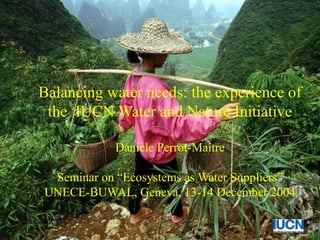
Balancing water needs: the experience of
the IUCN Water and Nature Initiative
Danièle Perrot-Maître
Seminar on “Ecosystems as Water Suppliers”
UNECE-BUWAL, Geneva, 13-14 December 2004
The Water and Nature Initiative:
A Learning Initiative
GOAL :To improve watershed ecosystems health and livelihoods
PURPOSE: To learn and demonstrate how to apply the ecosystem
approach into river basin planning and management
HOW TO ACHIEVE THIS?
 Governance and Law
 Participation and Empowerment
 Economics and Finance
 Information and Knowledge
 Learning and Communication
The Water and Nature Initiative in
Figures
– 5-year (2001 - 2006)
– US$ 80 million budget
– 80 partner organisations
– 30 projects
– 30 countries
– 10 river basins
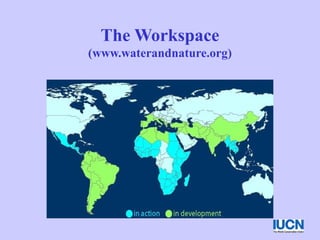
The Workspace
(www.waterandnature.org)
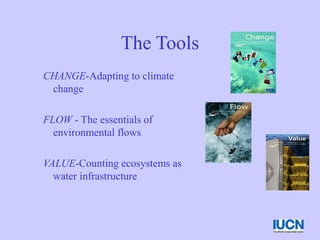
The Tools
CHANGE-Adapting to climate
change
FLOW - The essentials of
environmental flows
VALUE-Counting ecosystems as
water infrastructure
What is an environmental flow?
Environmental flow is the water regime provided within a
river, wetland or coastal zone to maintain ecosystems and
their benefits where there are competing water uses and
where flows are regulated.
The outcome is an improved management regime that
guarantees the longevity of the system and finds the
optimal balance between the various uses.
Source: FLOW, The Essentials of Environmental Flows,
IUCN-WANI, 2003
How to establish environmental flows ?
• Define water requirements (defining objective,
selecting trade offs scenarios and EF method)
• Modify water infrastructure
• Finance
• Create a policy and legal framework
• Generate political momentum
• Build capacity for design and implementation
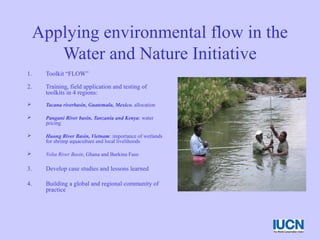
Applying environmental flow in the
Water and Nature Initiative
1. Toolkit “FLOW”
2. Training, field application and testing of
toolkits in 4 regions:
 Tacana riverbasin, Guatemala, Mexico. allocation
 Pangani River basin, Tanzania and Kenya: water
pricing
 Huong River Basin, Vietnam: importance of wetlands
for shrimp aquaculture and local livelihoods
 Volta River Basin, Ghana and Burkina Faso
3. Develop case studies and lessons learned
4. Building a global and regional community of
practice
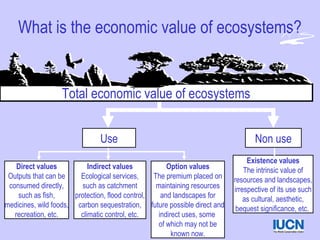
What is the economic value of ecosystems?
Direct values
Outputs that can be
consumed directly,
such as fish,
medicines, wild foods,
recreation, etc.
Indirect values
Ecological services,
such as catchment
protection, flood control,
carbon sequestration,
climatic control, etc.
Option values
The premium placed on
maintaining resources
and landscapes for
future possible direct and
indirect uses, some
of which may not be
known now.
Existence values
The intrinsic value of
resources and landscapes,
irrespective of its use such
as cultural, aesthetic,
bequest significance, etc.
Non useUse
Total economic value of ecosystems
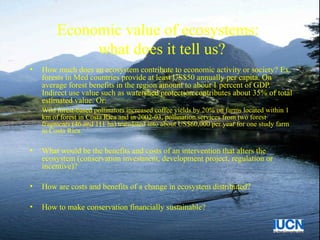
Economic value of ecosystems:
what does it tell us?
• How much does an ecosystem contribute to economic activity or society? Ex.
forests in Med countries provide at least US$50 annually per capita. On
average forest benefits in the region amount to about 1 percent of GDP.
Indirect use value such as watershed protection contributes about 35% of total
estimated value. Or:
Wild forest-based pollinators increased coffee yields by 20% on farms located within 1
km of forest in Costa Rica and in 2002-03, pollination services from two forest
fragments (46 and 111 ha) translated into about US$60,000 per year for one study farm
in Costa Rica.
• What would be the benefits and costs of an intervention that alters the
ecosystem (conservation investment, development project, regulation or
incentive)?
• How are costs and benefits of a change in ecosystem distributed?
• How to make conservation financially sustainable?
Ecosystem valuation results can provide valuable input
into many types of water management decisions
• Investing in infrastructure development (design, management,
investment appraisal) taking into account the cost of ecosystem
maintenance
• Allocating water to various economic users including the
ecosystem
• Land use planning: investing in ecosystems for water supply
and quality
• Accounting for cost of ecosystems protection in water prices
and price of water-based products
• Designing incentives mechanisms such as payments for
ecosystem services (and removing inadequate incentives)
• Designing new financing mechanisms
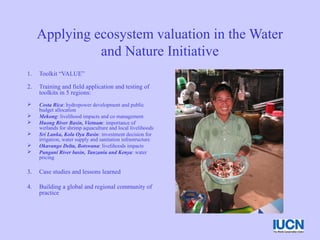
Applying ecosystem valuation in the Water
and Nature Initiative
1. Toolkit “VALUE”
2. Training and field application and testing of
toolkits in 5 regions:
 Costa Rica: hydropower development and public
budget allocation
 Mekong: livelihood impacts and co management
 Huong River Basin, Vietnam: importance of
wetlands for shrimp aquaculture and local livelihoods
 Sri Lanka, Kola Oya Basin: investment decision for
irrigation, water supply and sanitation infrastructure
 Okavango Delta, Botswana: livelihoods impacts
 Pangani River basin, Tanzania and Kenya: water
pricing
3. Case studies and lessons learned
4. Building a global and regional community of
practice
Lessons and challenges of ecosystem
valuation
• Most published studies focus on the direct use values of marketed products
• Non-use values (existence values) are even harder to capture, due to high uncertainty
• Economic valuation handles very large scale and long term problems rather poorly
(analysis less robust as scale increases and role of discounting increasingly determinant)
• Valuation runs into trouble when environmental change is irreversible or when resources
have no acceptable substitutes
• Economic valuation not always useful for managers and policy makers
because
 Conducted as snap-shot rather than with comprehensive time series
 Total valuation studies say nothing about values of marginal changes
linked to realistic alternatives
 Ecosystem services are rarely valued or unreliably valued, due to poor data on
biophysical relationships
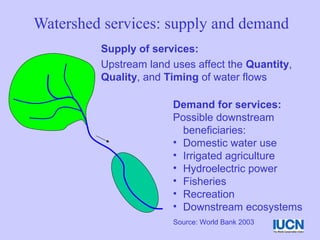
Watershed services: supply and demand
Supply of services:
Upstream land uses affect the Quantity,
Quality, and Timing of water flows
Demand for services:
Possible downstream
beneficiaries:
• Domestic water use
• Irrigated agriculture
• Hydroelectric power
• Fisheries
• Recreation
• Downstream ecosystems
Source: World Bank 2003
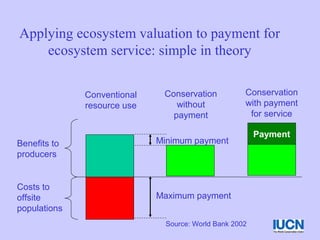
Applying ecosystem valuation to payment for
ecosystem service: simple in theory
Benefits to
producers
Costs to
offsite
populations
Conventional
resource use
Conservation
with payment
for service
Payment
Conservation
without
payment
Minimum payment
Maximum payment
Source: World Bank 2002
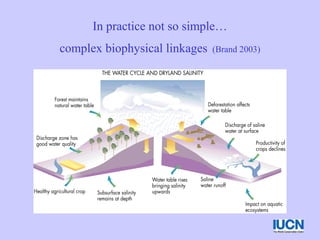
In practice not so simple…
complex biophysical linkages (Brand 2003)
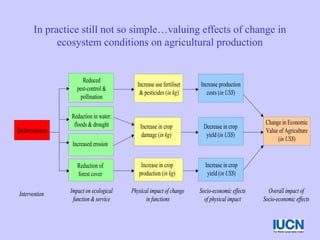
In practice still not so simple…valuing effects of change in
ecosystem conditions on agricultural production
Impact on ecological
function & service
Physical impact of change
in functions
Socio-economic effects
of physical impact
Overall impact of
Socio-economic effects
Intervention
Reduction in water:
floods & drought
Increased erosion
Increase in crop
damage (in kg)
Decrease in crop
yield (in US$)
Increase use fertiliser
& pesticides (in kg)
Increase production
costs (in US$)
Increase in crop
production (in kg)
Increase in crop
yield (in US$)
Reduction of
forest cover
Reduced
pest-control &
pollination
Deforestation
Change in Economic
Value of Agriculture
(in US$)
Impact on ecological
function & service
Physical impact of change
in functions
Socio-economic effects
of physical impact
Overall impact of
Socio-economic effects
Intervention
Reduction in water:
floods & drought
Increased erosion
Increase in crop
damage (in kg)
Decrease in crop
yield (in US$)
Increase use fertiliser
& pesticides (in kg)
Increase production
costs (in US$)
Increase in crop
production (in kg)
Increase in crop
yield (in US$)
Reduction of
forest cover
Reduced
pest-control &
pollination
Deforestation
Change in Economic
Value of Agriculture
(in US$)
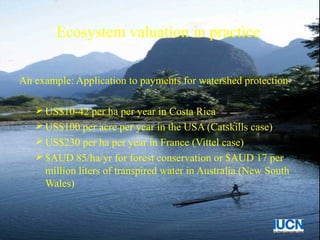
Ecosystem valuation in practice
An example: Application to payments for watershed protection
US$10-42 per ha per year in Costa Rica
US$100 per acre per year in the USA (Catskills case)
US$230 per ha per year in France (Vittel case)
$AUD 85/ha/yr for forest conservation or $AUD 17 per
million liters of transpired water in Australia (New South
Wales)
Putting IWRM in practice: a
balancing act….

Balancing water needs

  • 1.
    Balancing water needs:the experience of the IUCN Water and Nature Initiative Danièle Perrot-Maître Seminar on “Ecosystems as Water Suppliers” UNECE-BUWAL, Geneva, 13-14 December 2004
  • 2.
    The Water andNature Initiative: A Learning Initiative GOAL :To improve watershed ecosystems health and livelihoods PURPOSE: To learn and demonstrate how to apply the ecosystem approach into river basin planning and management HOW TO ACHIEVE THIS?  Governance and Law  Participation and Empowerment  Economics and Finance  Information and Knowledge  Learning and Communication
  • 3.
    The Water andNature Initiative in Figures – 5-year (2001 - 2006) – US$ 80 million budget – 80 partner organisations – 30 projects – 30 countries – 10 river basins
  • 4.
  • 5.
    The Tools CHANGE-Adapting toclimate change FLOW - The essentials of environmental flows VALUE-Counting ecosystems as water infrastructure
  • 6.
    What is anenvironmental flow? Environmental flow is the water regime provided within a river, wetland or coastal zone to maintain ecosystems and their benefits where there are competing water uses and where flows are regulated. The outcome is an improved management regime that guarantees the longevity of the system and finds the optimal balance between the various uses. Source: FLOW, The Essentials of Environmental Flows, IUCN-WANI, 2003
  • 7.
    How to establishenvironmental flows ? • Define water requirements (defining objective, selecting trade offs scenarios and EF method) • Modify water infrastructure • Finance • Create a policy and legal framework • Generate political momentum • Build capacity for design and implementation
  • 8.
    Applying environmental flowin the Water and Nature Initiative 1. Toolkit “FLOW” 2. Training, field application and testing of toolkits in 4 regions:  Tacana riverbasin, Guatemala, Mexico. allocation  Pangani River basin, Tanzania and Kenya: water pricing  Huong River Basin, Vietnam: importance of wetlands for shrimp aquaculture and local livelihoods  Volta River Basin, Ghana and Burkina Faso 3. Develop case studies and lessons learned 4. Building a global and regional community of practice
  • 9.
    What is theeconomic value of ecosystems? Direct values Outputs that can be consumed directly, such as fish, medicines, wild foods, recreation, etc. Indirect values Ecological services, such as catchment protection, flood control, carbon sequestration, climatic control, etc. Option values The premium placed on maintaining resources and landscapes for future possible direct and indirect uses, some of which may not be known now. Existence values The intrinsic value of resources and landscapes, irrespective of its use such as cultural, aesthetic, bequest significance, etc. Non useUse Total economic value of ecosystems
  • 10.
    Economic value ofecosystems: what does it tell us? • How much does an ecosystem contribute to economic activity or society? Ex. forests in Med countries provide at least US$50 annually per capita. On average forest benefits in the region amount to about 1 percent of GDP. Indirect use value such as watershed protection contributes about 35% of total estimated value. Or: Wild forest-based pollinators increased coffee yields by 20% on farms located within 1 km of forest in Costa Rica and in 2002-03, pollination services from two forest fragments (46 and 111 ha) translated into about US$60,000 per year for one study farm in Costa Rica. • What would be the benefits and costs of an intervention that alters the ecosystem (conservation investment, development project, regulation or incentive)? • How are costs and benefits of a change in ecosystem distributed? • How to make conservation financially sustainable?
  • 11.
    Ecosystem valuation resultscan provide valuable input into many types of water management decisions • Investing in infrastructure development (design, management, investment appraisal) taking into account the cost of ecosystem maintenance • Allocating water to various economic users including the ecosystem • Land use planning: investing in ecosystems for water supply and quality • Accounting for cost of ecosystems protection in water prices and price of water-based products • Designing incentives mechanisms such as payments for ecosystem services (and removing inadequate incentives) • Designing new financing mechanisms
  • 12.
    Applying ecosystem valuationin the Water and Nature Initiative 1. Toolkit “VALUE” 2. Training and field application and testing of toolkits in 5 regions:  Costa Rica: hydropower development and public budget allocation  Mekong: livelihood impacts and co management  Huong River Basin, Vietnam: importance of wetlands for shrimp aquaculture and local livelihoods  Sri Lanka, Kola Oya Basin: investment decision for irrigation, water supply and sanitation infrastructure  Okavango Delta, Botswana: livelihoods impacts  Pangani River basin, Tanzania and Kenya: water pricing 3. Case studies and lessons learned 4. Building a global and regional community of practice
  • 13.
    Lessons and challengesof ecosystem valuation • Most published studies focus on the direct use values of marketed products • Non-use values (existence values) are even harder to capture, due to high uncertainty • Economic valuation handles very large scale and long term problems rather poorly (analysis less robust as scale increases and role of discounting increasingly determinant) • Valuation runs into trouble when environmental change is irreversible or when resources have no acceptable substitutes • Economic valuation not always useful for managers and policy makers because  Conducted as snap-shot rather than with comprehensive time series  Total valuation studies say nothing about values of marginal changes linked to realistic alternatives  Ecosystem services are rarely valued or unreliably valued, due to poor data on biophysical relationships
  • 14.
    Watershed services: supplyand demand Supply of services: Upstream land uses affect the Quantity, Quality, and Timing of water flows Demand for services: Possible downstream beneficiaries: • Domestic water use • Irrigated agriculture • Hydroelectric power • Fisheries • Recreation • Downstream ecosystems Source: World Bank 2003
  • 15.
    Applying ecosystem valuationto payment for ecosystem service: simple in theory Benefits to producers Costs to offsite populations Conventional resource use Conservation with payment for service Payment Conservation without payment Minimum payment Maximum payment Source: World Bank 2002
  • 16.
    In practice notso simple… complex biophysical linkages (Brand 2003)
  • 17.
    In practice stillnot so simple…valuing effects of change in ecosystem conditions on agricultural production Impact on ecological function & service Physical impact of change in functions Socio-economic effects of physical impact Overall impact of Socio-economic effects Intervention Reduction in water: floods & drought Increased erosion Increase in crop damage (in kg) Decrease in crop yield (in US$) Increase use fertiliser & pesticides (in kg) Increase production costs (in US$) Increase in crop production (in kg) Increase in crop yield (in US$) Reduction of forest cover Reduced pest-control & pollination Deforestation Change in Economic Value of Agriculture (in US$) Impact on ecological function & service Physical impact of change in functions Socio-economic effects of physical impact Overall impact of Socio-economic effects Intervention Reduction in water: floods & drought Increased erosion Increase in crop damage (in kg) Decrease in crop yield (in US$) Increase use fertiliser & pesticides (in kg) Increase production costs (in US$) Increase in crop production (in kg) Increase in crop yield (in US$) Reduction of forest cover Reduced pest-control & pollination Deforestation Change in Economic Value of Agriculture (in US$)
  • 18.
    Ecosystem valuation inpractice An example: Application to payments for watershed protection US$10-42 per ha per year in Costa Rica US$100 per acre per year in the USA (Catskills case) US$230 per ha per year in France (Vittel case) $AUD 85/ha/yr for forest conservation or $AUD 17 per million liters of transpired water in Australia (New South Wales)
  • 19.
    Putting IWRM inpractice: a balancing act….

Editor's Notes

  • #2 Life is about making decisions and evaluating trade offs. This is done through understanding what we gain what we give up with each choice, that is the benefits and the costs associated with each possible choice.
  • #10 Economic valuation undertaken so that value is expressed in monetary units which can then be compared to other options
  • #11 VALUE IS ABOUT BENEFITS AND COSTS Does not mean only goods and services that directly generate monetary benefits are taken into account. Quite the contrary. Much of the work in envtal eco focuses on goods and services that do not enter markets In first case, raising awareness and guide overall investment strategy but needs more detailed analysis to assess specific interventions. Need to be careful interpreting the information (scale issue and observed prices no longer hold at large scales, underestimation of non use values, estimates will change as ecosystem management changes over time). Ideally need multi year estimates of ecosystem services values 2. Need to estimate the change in physical flow of benefits as a result of intervention often more difficult than estimating total flows. Need to compare a site with and withoug intervention at same point in time, not a before and after study of the same site as many other variables may have changed. 3. Important because can affect how ecosystem is managed, enforcement and sustainability and socially acceptability of intervention, and compensaiton mechanisms, target poverty reduction interventions. For ex protected area in Madagascar provides high benefits to national and internaitonal community and local tourism industry but the cost is borne by poor groups near the park who are barred from using the protected area for agriculture, collection of NFTP. 4. Valuation can show that it is worth allocating more budget to ecosystem protection/management. Can also help quantifying benefits, identifying beneficiaries and develop innovative financing mechanisms based on this info (entrance fees, user fees, PES for water,, biodiv Can these values actually make a difference to land use decisions, water allocation and pricing, river-basin planning, infrastructure development, investment appraisals and financial flows, and so on 3rd and 4th points important because set the basis to develop payments/compensation scheme (who bears the cost) and financing mechanisms (who should pay). Questions look at same set of data but from a different perspective (different sub set, changes over time vs change at one point in time).
  • #12 Basically the environment should be factored out in CBA
  • #14 Non eco approaches such as setting Safe Minimum Standard may be more adapted to situations where changes are irreversible or when it is difficult to conduct eco valuation (non use)
  • #16 Incentive because payment compensate opportunity cost of conservation for private land owner. Resource users are paid to « grow » water by altering their land use or behaviour. Beneficiaries from ecosystem services compensate resource users for the adoption of production practices compatible with specific ecosystem services Steps in market creation Define what to purchase or sell Identify potential buyers Identify potential sellers Payment mechanism (price, contract, intermediaries) Enabling institutions (property rights, monitoring and enforcement) Resource users are paid to « grow » water by altering their land use or behaviour. Beneficiaries from ecosystem services compensate resource users for the adoption of production practices compatible with specific ecosystem services Steps in market creation Define what to purchase or sell Identify potential buyers Identify potential sellers Payment mechanism (price, contract, intermediaries) Enabling institutions (property rights, monitoring and enforcement) Need to know precisely what is the service being purchased Introduce WTP and WTA concepts
  • #19 Vittel program is developed under the assumption that an improvement in farming activities will be sufficient to restore water quality to desired levels . Based on the assumption that one hectare of well managed pasture produces an estimated 3,000 m3 of drinkable water per year, the study concluded that the program was economically justifiable Co-benefits can be important also: (plus discussion of different ways to use eco valuation results to calculate compensation) Land tenure security Social development Biodiversity and other environmental benefits