OVERVIEW: UPSTREAM PRODUCTION 
FACILITIES 
(FSF/FPF/CPF) 
DATE: /2012 
INFRASTRUCTURE DEVELOPMENT ENGINEER 
OIL AND GAS (INTRUMENTATION AND CONTROL)
CONTENT 
 Introduction 
 Field Surface Facilities 
•Wellhead 
•Pumps 
•Oil Gathering Manifold (OGM) 
Field Production Facilities (FPF) 
•Desanders 
•Separators 
•Compressors 
• Heat Exchangers 
•Booster Pumps 
•Water Treatment 
Central Processing Facilities (CPF) 
•Compressors 
• Separators 
•Heat Exchangers 
•Dehydrators/Desalters 
Control System (Instrumentation) 
Power Generation and Distribution
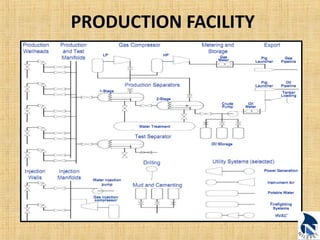
PRODUCTION FACILITY
INTRODUCTION 
 Separate the well stream into three components, called 
“phases” (oil, gas, and water) 
 Process these phases into some marketable products 
 Dispose of them in an environmentally acceptable 
 Accommodation of accurate measuring and sampling of 
the crude oil.
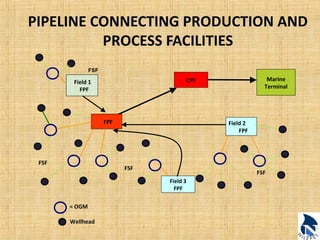
PIPELINE CONNECTING PRODUCTION AND 
PROCESS FACILITIES 
CPF 
FPF Field 2 
FPF 
Field 1 
FPF 
Field 3 
FPF 
FSF 
FSF 
FSF 
FSF 
Marine 
Terminal 
= OGM 
Wellhead
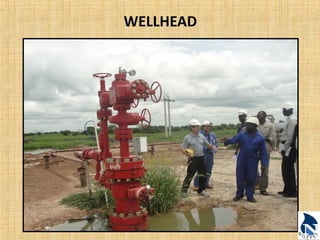
WELLHEAD 
 Maintains surface control using choke 
 Prevent well fluids from leaking or blowing at the surface 
 Design to withstand pressures of up to 140 MPa(1400 
 Consist of three components; 
I.Casing head 
II.Tubing head 
III.Christmas Tree 
 Consist of two types of Pumps 
1.Electric Submersible Pumps (ESP) 
2.Progressive Cavity Pumps (PCP)
WELLHEAD
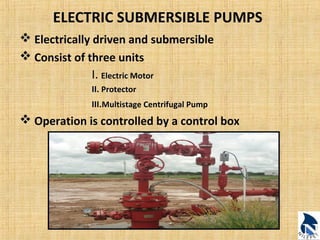
ELECTRIC SUBMERSIBLE PUMPS 
 Electrically driven and submersible 
 Consist of three units 
I. Electric Motor 
II. Protector 
III.Multistage Centrifugal Pump 
 Operation is controlled by a control box
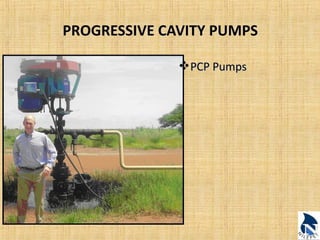
PROGRESSIVE CAVITY PUMPS 
PPCCPP PPuummppss
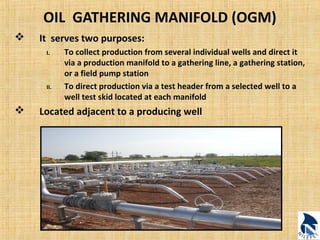
OIL GATHERING MANIFOLD (OGM) 
 It serves two purposes: 
I. To collect production from several individual wells and direct it 
via a production manifold to a gathering line, a gathering station, 
or a field pump station 
II. To direct production via a test header from a selected well to a 
well test skid located at each manifold 
 Located adjacent to a producing well
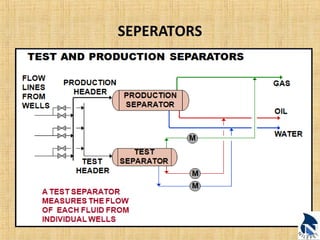
SEPERATORS 
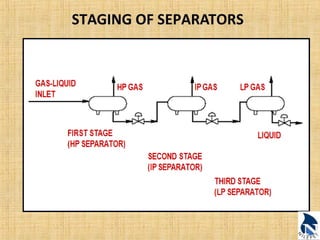
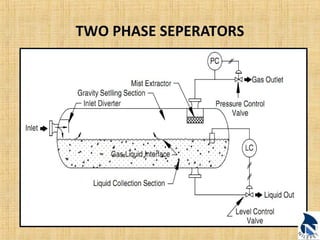
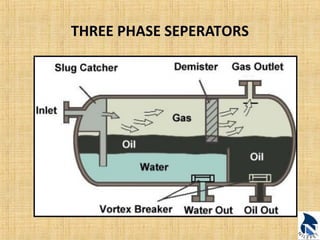
Mechanical devices where gas is flashed from the liquids and 
“free water” is separated from the oil 
Can be either horizontal, vertical and spherical in configuration 
Two types Production separator and Test separator 
Production separator can be either two phase and three phase 
Most oil contracts specify a maximum percent of basic 
sediment and water (BS&W) that can be in the crude 
Typically vary from 0.5% to 3% depending on location 
Water from the separators must be treated to remove small 
quantities of produced oil
SEPERATORS
STAGING OF SEPARATORS
TWO PHASE SEPERATORS
THREE PHASE SEPERATORS
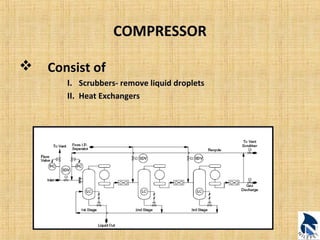
COMPRESSOR 
 Consist of 
I. Scrubbers- remove liquid droplets 
II. Heat Exchangers
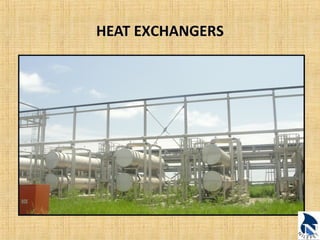
HEAT EXCHANGERS 
 Use to cool the gas
HEAT EXCHANGERS
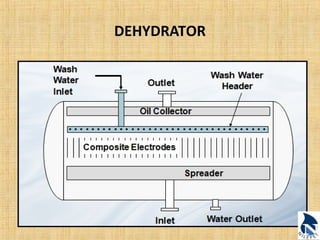
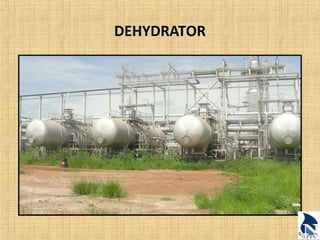
DEHYDRATOR/DESALTER 
 Dehydration 
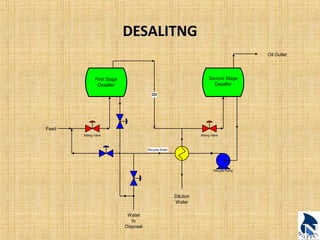
 Desalting 
 Consists of three primary steps 
I. Injection of wash water 
II. Contact between the wash water and the 
soluble salts, and 
III. Separation of the aqueous phase – most of the 
installed hardware is involved in the phase 
separation step
DEHYDRATOR
DESALITNG 
Oil 
Mixing Valve Mixing Valve 
Recycle Pump 
Dilution 
Water 
Feed 
Oil Outlet 
Water 
to 
Disposal 
Recycle Water 
Second Stage 
Desalter 
First Stage 
Desalter
DEHYDRATOR
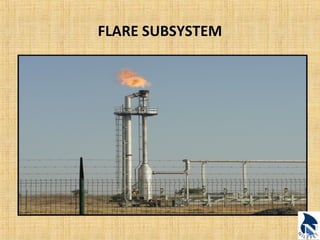
FLARE SUBSYSTEM 
 Include Flare, atmospheric ventilation and blow down 
 Provide safe discharge and disposal of gases and liquids 
resulting from: 
I. Spill-off flaring from the product stabilization system 
(Oil, Condensate etc.) 
I. Production testing 
II. Relief of excess pressure caused by process upset 
conditions and thermal expansion 
I. Depressurization either in response to an emergency 
situation or as part of a normal procedure 
I. Planned depressurization of subsea production 
flowlines and export pipelines.
FLARE SUBSYSTEM
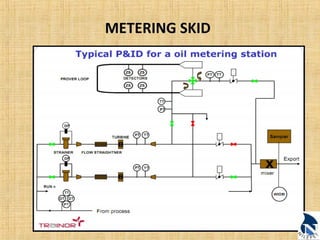
METERING SKID
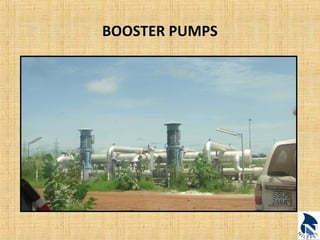
BOOSTER PUMPS
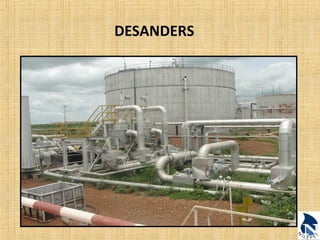
DESANDERS
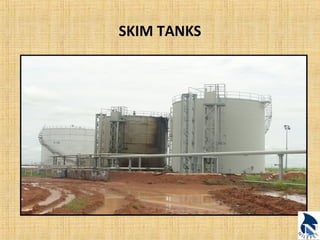
SKIM TANKS
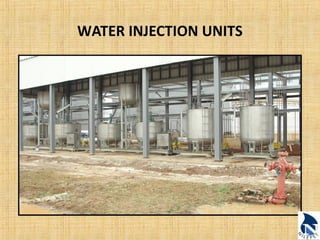
WATER INJECTION UNITS
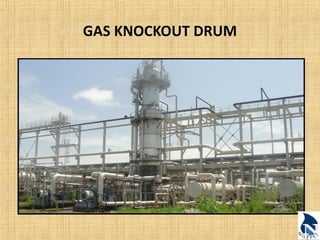
GAS KNOCKOUT DRUM
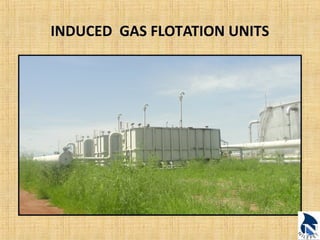
INDUCED GAS FLOTATION UNITS
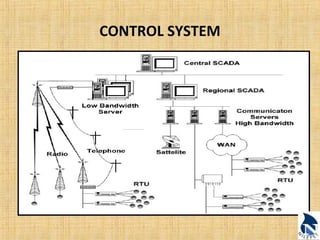
CONTROL SYSTEM 
Programmable Logic Design (PLCs) and Distributed 
Control System (DCS) 
Provide automatic day-to –day control of oil field 
production system
CONTROL SYSTEM
POWER GENERATION AND DISTRIBUTION 
Provided from main power or from local diesel 
generator sets 
Large facilities have great power demands, from 30 
MW and upwards to several hundred MW. 
Voltage levels for High, Medium and Low 
voltage distribution boards are 13- 130kV, 2-8 kV 
and 300-600 V respectively 
Power is generated and exchanged with mains or 
other facilities on the HV distribution board 
Relays for protection functions
PPOOWWEERR GGEENNEERRAATTIIOONN AANNDD 
DDIISSTTRRIIBBUUTTIIOONN
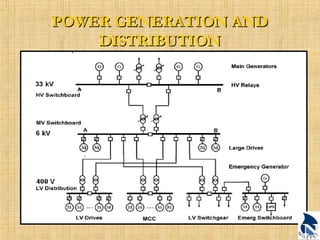
POWER GENERATION AND DISTRIBUTION 
 Power management system is used for control of electrical 
switchgear and equipment 
 Includes HV, MV and LV low voltage switchgear 
 Motor Control Centers (MCC) and emergency generator sets 
Thank you 
Jacob Kuorwel N.

Cpf nilepet

  • 1.
    OVERVIEW: UPSTREAM PRODUCTION FACILITIES (FSF/FPF/CPF) DATE: /2012 INFRASTRUCTURE DEVELOPMENT ENGINEER OIL AND GAS (INTRUMENTATION AND CONTROL)
  • 2.
    CONTENT  Introduction  Field Surface Facilities •Wellhead •Pumps •Oil Gathering Manifold (OGM) Field Production Facilities (FPF) •Desanders •Separators •Compressors • Heat Exchangers •Booster Pumps •Water Treatment Central Processing Facilities (CPF) •Compressors • Separators •Heat Exchangers •Dehydrators/Desalters Control System (Instrumentation) Power Generation and Distribution
  • 3.
  • 4.
    INTRODUCTION  Separatethe well stream into three components, called “phases” (oil, gas, and water)  Process these phases into some marketable products  Dispose of them in an environmentally acceptable  Accommodation of accurate measuring and sampling of the crude oil.
  • 5.
    PIPELINE CONNECTING PRODUCTIONAND PROCESS FACILITIES CPF FPF Field 2 FPF Field 1 FPF Field 3 FPF FSF FSF FSF FSF Marine Terminal = OGM Wellhead
  • 6.
    WELLHEAD  Maintainssurface control using choke  Prevent well fluids from leaking or blowing at the surface  Design to withstand pressures of up to 140 MPa(1400  Consist of three components; I.Casing head II.Tubing head III.Christmas Tree  Consist of two types of Pumps 1.Electric Submersible Pumps (ESP) 2.Progressive Cavity Pumps (PCP)
  • 7.
  • 8.
    ELECTRIC SUBMERSIBLE PUMPS  Electrically driven and submersible  Consist of three units I. Electric Motor II. Protector III.Multistage Centrifugal Pump  Operation is controlled by a control box
  • 9.
    PROGRESSIVE CAVITY PUMPS PPCCPP PPuummppss
  • 10.
    OIL GATHERING MANIFOLD(OGM)  It serves two purposes: I. To collect production from several individual wells and direct it via a production manifold to a gathering line, a gathering station, or a field pump station II. To direct production via a test header from a selected well to a well test skid located at each manifold  Located adjacent to a producing well
  • 11.
    SEPERATORS Mechanical deviceswhere gas is flashed from the liquids and “free water” is separated from the oil Can be either horizontal, vertical and spherical in configuration Two types Production separator and Test separator Production separator can be either two phase and three phase Most oil contracts specify a maximum percent of basic sediment and water (BS&W) that can be in the crude Typically vary from 0.5% to 3% depending on location Water from the separators must be treated to remove small quantities of produced oil
  • 12.
  • 13.
  • 14.
  • 15.
  • 16.
    COMPRESSOR  Consistof I. Scrubbers- remove liquid droplets II. Heat Exchangers
  • 17.
    HEAT EXCHANGERS Use to cool the gas
  • 18.
  • 19.
    DEHYDRATOR/DESALTER  Dehydration  Desalting  Consists of three primary steps I. Injection of wash water II. Contact between the wash water and the soluble salts, and III. Separation of the aqueous phase – most of the installed hardware is involved in the phase separation step
  • 20.
  • 21.
    DESALITNG Oil MixingValve Mixing Valve Recycle Pump Dilution Water Feed Oil Outlet Water to Disposal Recycle Water Second Stage Desalter First Stage Desalter
  • 22.
  • 23.
    FLARE SUBSYSTEM Include Flare, atmospheric ventilation and blow down  Provide safe discharge and disposal of gases and liquids resulting from: I. Spill-off flaring from the product stabilization system (Oil, Condensate etc.) I. Production testing II. Relief of excess pressure caused by process upset conditions and thermal expansion I. Depressurization either in response to an emergency situation or as part of a normal procedure I. Planned depressurization of subsea production flowlines and export pipelines.
  • 24.
  • 25.
  • 26.
  • 27.
  • 28.
  • 29.
  • 30.
  • 31.
  • 32.
    CONTROL SYSTEM ProgrammableLogic Design (PLCs) and Distributed Control System (DCS) Provide automatic day-to –day control of oil field production system
  • 33.
  • 34.
    POWER GENERATION ANDDISTRIBUTION Provided from main power or from local diesel generator sets Large facilities have great power demands, from 30 MW and upwards to several hundred MW. Voltage levels for High, Medium and Low voltage distribution boards are 13- 130kV, 2-8 kV and 300-600 V respectively Power is generated and exchanged with mains or other facilities on the HV distribution board Relays for protection functions
  • 35.
    PPOOWWEERR GGEENNEERRAATTIIOONN AANNDD DDIISSTTRRIIBBUUTTIIOONN
  • 36.
    POWER GENERATION ANDDISTRIBUTION  Power management system is used for control of electrical switchgear and equipment  Includes HV, MV and LV low voltage switchgear  Motor Control Centers (MCC) and emergency generator sets Thank you Jacob Kuorwel N.