CPET .…..
The Gold
Standrad
AHMED KADRY,MD
LECTURER OF CARDIOLOGY
AIN SHAMS UNIVERSITY
we use Echocardiography to assess functional
capacity in heart failure patients???
we use Echocardiography to assess functional
capacity in heart failure patients???
Echocardiography is “the single most
useful test in the diagnosis &
classification of patients with HF, yet it
gives little information about functional
capacity”
Functional capacity is best assessed with
Cardiopulmonary exercise (CPET) testing
“Gold standard”
OUTLINE
• CPET and its terminology
• Exercise physiology
• Interpretation of CPET results
• Indications in clinical practice
OUTLINE
•CPET and its terminology
• Exercise physiology
• Interpretation of CPET results
• Indications in clinical practice
CPET
Symptom-limited provocative test
Combines
1.ECG stress testing
2.Indices of gas exchange and spirometry
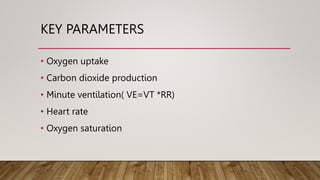
KEY PARAMETERS
• Oxygen uptake
• Carbon dioxide production
• Minute ventilation( VE=VT *RR)
• Heart rate
• Oxygen saturation
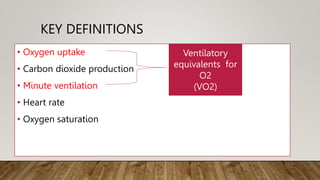
KEY DEFINITIONS
• Oxygen uptake
• Carbon dioxide production
• Minute ventilation
• Heart rate
• Oxygen saturation
Ventilatory
equivalents for
O2
(VO2)
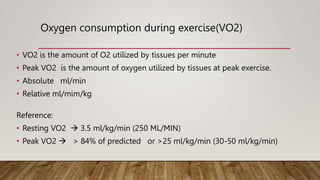
Oxygen consumption during exercise(VO2)
• VO2 is the amount of O2 utilized by tissues per minute
• Peak VO2 is the amount of oxygen utilized by tissues at peak exercise.
• Absolute ml/min
• Relative ml/mim/kg
Reference:
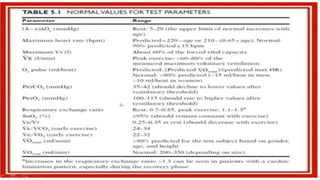
• Resting VO2  3.5 ml/kg/min (250 ML/MIN)
• Peak VO2  > 84% of predicted or >25 ml/kg/min (30-50 ml/kg/min)
KEY DEFINITIONS
• Oxygen uptake
• Carbon dioxide production
• Minute ventilation
• Heart rate
• Oxygen saturation
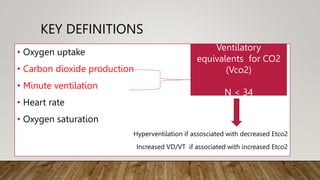
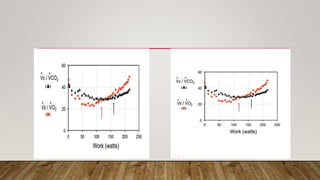
Hyperventilation if assosciated with decreased Etco2
Increased VD/VT if associated with increased Etco2
Ventilatory
equivalents for CO2
(Vco2)
N < 34
KEY DEFINITIONS
• Oxygen uptake
• Carbon dioxide production
• Minute ventilation
• Heart rate
• Oxygen saturation
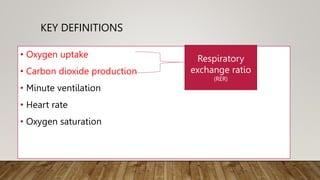
Respiratory
exchange ratio
(RER)
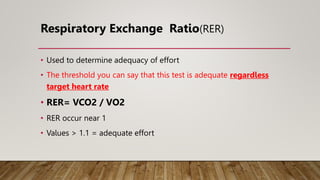
Respiratory Exchange Ratio(RER)
• Used to determine adequacy of effort
• The threshold you can say that this test is adequate regardless
target heart rate
• RER= VCO2 / VO2
• RER occur near 1
• Values > 1.1 = adequate effort
KEY DEFINITIONS
• Oxygen uptake
• Carbon dioxide production
• Minute ventilation
• Heart rate
• Oxygen saturation
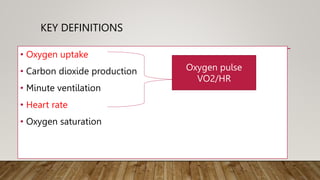
Oxygen pulse
VO2/HR
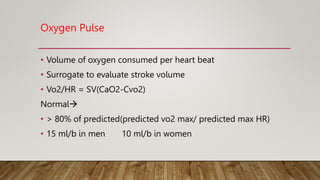
Oxygen Pulse
• Volume of oxygen consumed per heart beat
• Surrogate to evaluate stroke volume
• Vo2/HR = SV(CaO2-Cvo2)
Normal
• > 80% of predicted(predicted vo2 max/ predicted max HR)
• 15 ml/b in men 10 ml/b in women
OUTLINE
• CPET and its terminology
•Exercise physiology
• Interpretation of CPET results
• Indications in clinical practice
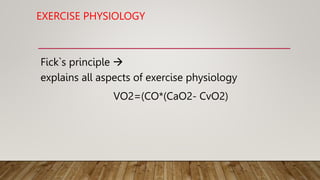
EXERCISE PHYSIOLOGY
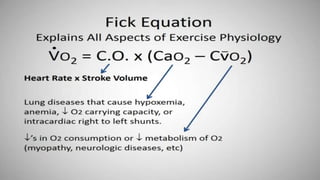
Fick`s principle 
explains all aspects of exercise physiology
VO2=(CO*(CaO2- CvO2)
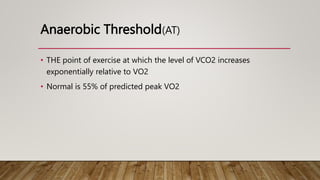
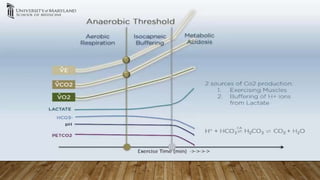
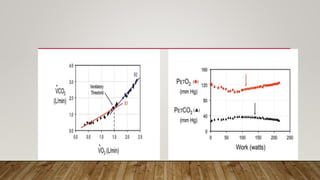
Anaerobic Threshold(AT)
• THE point of exercise at which the level of VCO2 increases
exponentially relative to VO2
• Normal is 55% of predicted peak VO2
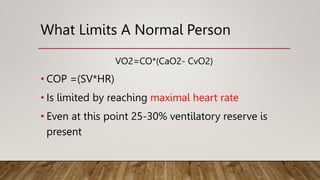
What Limits A Normal Person
VO2=CO*(CaO2- CvO2)
• COP =(SV*HR)
• Is limited by reaching maximal heart rate
• Even at this point 25-30% ventilatory reserve is
present
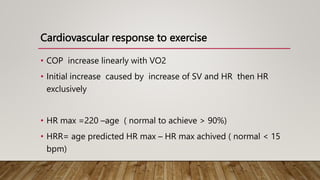
Cardiovascular response to exercise
• COP increase linearly with VO2
• Initial increase caused by increase of SV and HR then HR
exclusively
• HR max =220 –age ( normal to achieve > 90%)
• HRR= age predicted HR max – HR max achived ( normal < 15
bpm)
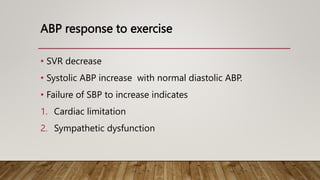
ABP response to exercise
• SVR decrease
• Systolic ABP increase with normal diastolic ABP.
• Failure of SBP to increase indicates
1. Cardiac limitation
2. Sympathetic dysfunction
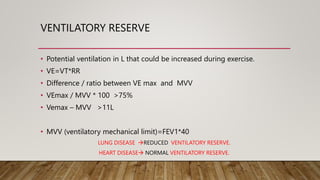
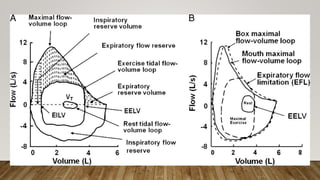
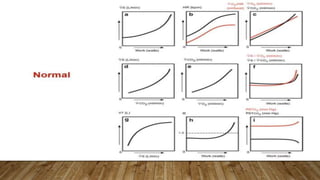
VENTILATORY RESERVE
• Potential ventilation in L that could be increased during exercise.
• VE=VT*RR
• Difference / ratio between VE max and MVV
• VEmax / MVV * 100 >75%
• Vemax – MVV >11L
• MVV (ventilatory mechanical limit)=FEV1*40
LUNG DISEASE REDUCED VENTILATORY RESERVE.
HEART DISEASE NORMAL VENTILATORY RESERVE.
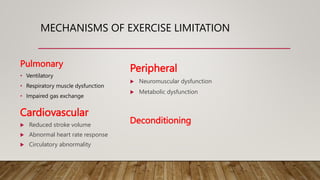
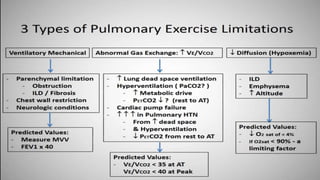
MECHANISMS OF EXERCISE LIMITATION
Pulmonary
• Ventilatory
• Respiratory muscle dysfunction
• Impaired gas exchange
Deconditioning
Peripheral
 Neuromuscular dysfunction
 Metabolic dysfunction
Cardiovascular
 Reduced stroke volume
 Abnormal heart rate response
 Circulatory abnormality
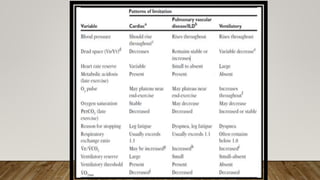
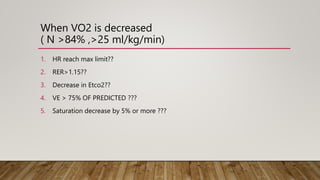
When VO2 is decreased
( N >84% ,>25 ml/kg/min)
1. HR reach max limit??
2. RER>1.15??
3. Decrease in Etco2??
4. VE > 75% OF PREDICTED ???
5. Saturation decrease by 5% or more ???
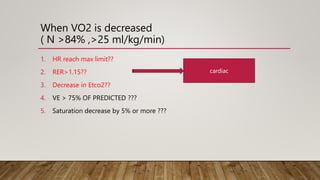
When VO2 is decreased
( N >84% ,>25 ml/kg/min)
1. HR reach max limit??
2. RER>1.15??
3. Decrease in Etco2??
4. VE > 75% OF PREDICTED ???
5. Saturation decrease by 5% or more ???
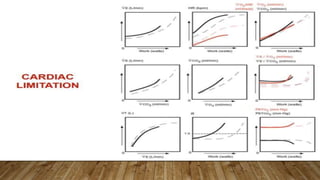
cardiac
When VO2 is decreased
( N >84% ,>25 ml/kg/min)
1. HR reach max limit??
2. RER>1.15??
3. Decrease in Etco2??
4. VE > 75% OF PREDICTED ???
5. Saturation decrease by 5% or more ???
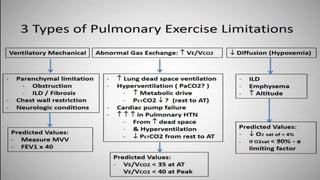
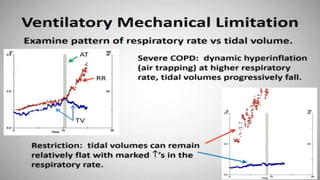
ventilatory
When VO2 is decreased
( N >84% ,>25 ml/kg/min)
1. HR reach max limit??
2. RER>1.15??
3. Decrease in Etco2??
4. VE > 75% OF PREDICTED ???
5. Saturation decrease by 5% or more ???
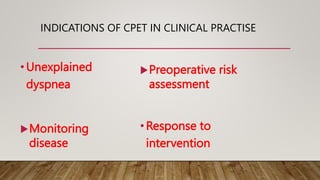
INDICATIONS OF CPET IN CLINICAL PRACTISE
•Unexplained
dyspnea
•Response to
intervention
Monitoring
disease
Preoperative risk
assessment
CPET dr ahmed kadry.pptx

CPET dr ahmed kadry.pptx

  • 1.
    CPET .….. The Gold Standrad AHMEDKADRY,MD LECTURER OF CARDIOLOGY AIN SHAMS UNIVERSITY
  • 2.
    we use Echocardiographyto assess functional capacity in heart failure patients???
  • 3.
    we use Echocardiographyto assess functional capacity in heart failure patients???
  • 4.
    Echocardiography is “thesingle most useful test in the diagnosis & classification of patients with HF, yet it gives little information about functional capacity”
  • 5.
    Functional capacity isbest assessed with Cardiopulmonary exercise (CPET) testing “Gold standard”
  • 6.
    OUTLINE • CPET andits terminology • Exercise physiology • Interpretation of CPET results • Indications in clinical practice
  • 7.
    OUTLINE •CPET and itsterminology • Exercise physiology • Interpretation of CPET results • Indications in clinical practice
  • 8.
    CPET Symptom-limited provocative test Combines 1.ECGstress testing 2.Indices of gas exchange and spirometry
  • 9.
    KEY PARAMETERS • Oxygenuptake • Carbon dioxide production • Minute ventilation( VE=VT *RR) • Heart rate • Oxygen saturation
  • 10.
    KEY DEFINITIONS • Oxygenuptake • Carbon dioxide production • Minute ventilation • Heart rate • Oxygen saturation Ventilatory equivalents for O2 (VO2)
  • 11.
    Oxygen consumption duringexercise(VO2) • VO2 is the amount of O2 utilized by tissues per minute • Peak VO2 is the amount of oxygen utilized by tissues at peak exercise. • Absolute ml/min • Relative ml/mim/kg Reference: • Resting VO2  3.5 ml/kg/min (250 ML/MIN) • Peak VO2  > 84% of predicted or >25 ml/kg/min (30-50 ml/kg/min)
  • 12.
    KEY DEFINITIONS • Oxygenuptake • Carbon dioxide production • Minute ventilation • Heart rate • Oxygen saturation Hyperventilation if assosciated with decreased Etco2 Increased VD/VT if associated with increased Etco2 Ventilatory equivalents for CO2 (Vco2) N < 34
  • 13.
    KEY DEFINITIONS • Oxygenuptake • Carbon dioxide production • Minute ventilation • Heart rate • Oxygen saturation Respiratory exchange ratio (RER)
  • 14.
    Respiratory Exchange Ratio(RER) •Used to determine adequacy of effort • The threshold you can say that this test is adequate regardless target heart rate • RER= VCO2 / VO2 • RER occur near 1 • Values > 1.1 = adequate effort
  • 15.
    KEY DEFINITIONS • Oxygenuptake • Carbon dioxide production • Minute ventilation • Heart rate • Oxygen saturation Oxygen pulse VO2/HR
  • 16.
    Oxygen Pulse • Volumeof oxygen consumed per heart beat • Surrogate to evaluate stroke volume • Vo2/HR = SV(CaO2-Cvo2) Normal • > 80% of predicted(predicted vo2 max/ predicted max HR) • 15 ml/b in men 10 ml/b in women
  • 17.
    OUTLINE • CPET andits terminology •Exercise physiology • Interpretation of CPET results • Indications in clinical practice
  • 18.
    EXERCISE PHYSIOLOGY Fick`s principle explains all aspects of exercise physiology VO2=(CO*(CaO2- CvO2)
  • 20.
    Anaerobic Threshold(AT) • THEpoint of exercise at which the level of VCO2 increases exponentially relative to VO2 • Normal is 55% of predicted peak VO2
  • 22.
    What Limits ANormal Person VO2=CO*(CaO2- CvO2) • COP =(SV*HR) • Is limited by reaching maximal heart rate • Even at this point 25-30% ventilatory reserve is present
  • 23.
    Cardiovascular response toexercise • COP increase linearly with VO2 • Initial increase caused by increase of SV and HR then HR exclusively • HR max =220 –age ( normal to achieve > 90%) • HRR= age predicted HR max – HR max achived ( normal < 15 bpm)
  • 24.
    ABP response toexercise • SVR decrease • Systolic ABP increase with normal diastolic ABP. • Failure of SBP to increase indicates 1. Cardiac limitation 2. Sympathetic dysfunction
  • 25.
    VENTILATORY RESERVE • Potentialventilation in L that could be increased during exercise. • VE=VT*RR • Difference / ratio between VE max and MVV • VEmax / MVV * 100 >75% • Vemax – MVV >11L • MVV (ventilatory mechanical limit)=FEV1*40 LUNG DISEASE REDUCED VENTILATORY RESERVE. HEART DISEASE NORMAL VENTILATORY RESERVE.
  • 29.
    MECHANISMS OF EXERCISELIMITATION Pulmonary • Ventilatory • Respiratory muscle dysfunction • Impaired gas exchange Deconditioning Peripheral  Neuromuscular dysfunction  Metabolic dysfunction Cardiovascular  Reduced stroke volume  Abnormal heart rate response  Circulatory abnormality
  • 36.
    When VO2 isdecreased ( N >84% ,>25 ml/kg/min) 1. HR reach max limit?? 2. RER>1.15?? 3. Decrease in Etco2?? 4. VE > 75% OF PREDICTED ??? 5. Saturation decrease by 5% or more ???
  • 37.
    When VO2 isdecreased ( N >84% ,>25 ml/kg/min) 1. HR reach max limit?? 2. RER>1.15?? 3. Decrease in Etco2?? 4. VE > 75% OF PREDICTED ??? 5. Saturation decrease by 5% or more ??? cardiac
  • 38.
    When VO2 isdecreased ( N >84% ,>25 ml/kg/min) 1. HR reach max limit?? 2. RER>1.15?? 3. Decrease in Etco2?? 4. VE > 75% OF PREDICTED ??? 5. Saturation decrease by 5% or more ??? ventilatory
  • 39.
    When VO2 isdecreased ( N >84% ,>25 ml/kg/min) 1. HR reach max limit?? 2. RER>1.15?? 3. Decrease in Etco2?? 4. VE > 75% OF PREDICTED ??? 5. Saturation decrease by 5% or more ???
  • 40.
    INDICATIONS OF CPETIN CLINICAL PRACTISE •Unexplained dyspnea •Response to intervention Monitoring disease Preoperative risk assessment