Cardiopulmonary
Exercise Testing in Mitral
Regurgitation
Dr Koh Choong Hou
Mar 2019
Scope
• CPET parameters
• Mitral Regurgitation
★ Combination and correlation with echo in FMR
★ Functional capacity assessment
★ Pre and Post mitral repair
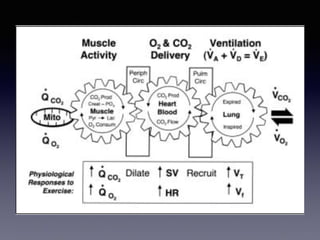
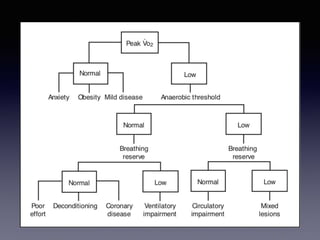
CPET Parameters
CPET Parameters
• VO2 Max
‣ Maximal oxygen extraction as a function of cardiorespiratory performance
‣ (HRmax x SVmax) x (CaO2max - CvO2min)
• O2 Pulse
‣ Amount of oxygen consumed (“O2”) from the volume of blood delivered to
the tissue per heartbeat (“pulse”); alternatively defined as the volume of O2
ejected from the LV in each beat
‣ Since oxygen extraction is maximal and constant at peak exercise, O2 pulse
= surrogate of SV
‣ Diminished in severe LV dysfunction or VHD
CPET Parameters
• VE/VCO2
‣ “Ventilatory equivalent for CO2”
‣ Reflection of ventilatory efficiency (“what controls respiration”): chemoreceptor sensitivity,
acid-base balance, ventilatory efficiency at alveolar-alveolar-capillary interface
‣ Increased in pulmonary disease or HF
๏ Exercise starts: VE/VCO2 drops (improved V/Q matching)
๏ Mid exercise: VE/VCO2 constant
๏ Exercise peaks: VE/VCO2 small increases (lactic acidosis stimulates VE)
CPET Parameters
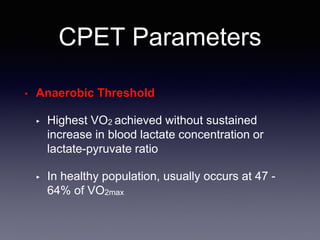
• Anaerobic Threshold
‣ Highest VO2 achieved without sustained
increase in blood lactate concentration or
lactate-pyruvate ratio
‣ In healthy population, usually occurs at 47 -
64% of VO2max
CPET Parameters
• Respiratory Exchange Ratio (RER)
‣ VCO2/VO2
‣ Represents metabolic exchange of gases at tissue level and
dependent on predominant fuel (cbh vs fat) used for metabolism
‣ Objective means of quantifying effort
✓ 1 to 1.1 = fair effort
✓ 1.1 to 1.2 = good effort
✓ >1.2 = excellent effort
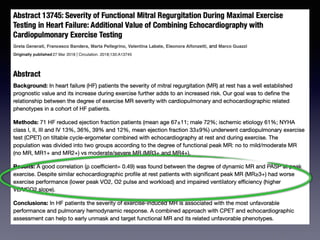
Mitral Regurgitation
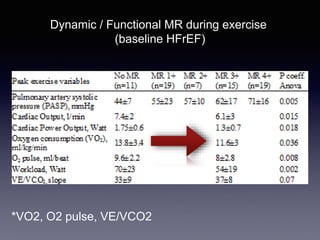
Dynamic / Functional MR during exercise
(baseline HFrEF)
*VO2, O2 pulse, VE/VCO2
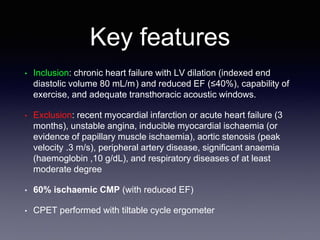
Key features
• Inclusion: chronic heart failure with LV dilation (indexed end
diastolic volume 80 mL/m2
) and reduced EF (≤40%), capability of
exercise, and adequate transthoracic acoustic windows.
• Exclusion: recent myocardial infarction or acute heart failure (3
months), unstable angina, inducible myocardial ischaemia (or
evidence of papillary muscle ischaemia), aortic stenosis (peak
velocity .3 m/s), peripheral artery disease, significant anaemia
(haemoglobin ,10 g/dL), and respiratory diseases of at least
moderate degree
• 60% ischaemic CMP (with reduced EF)
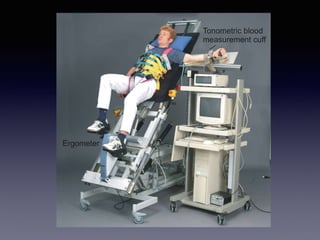
• CPET performed with tiltable cycle ergometer
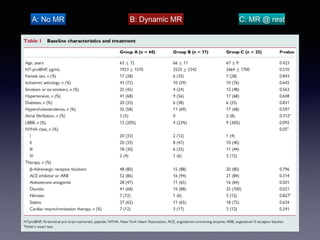
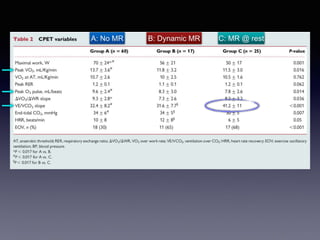
B: Dynamic MR
A: No MR C: MR @ rest
Group B Group C
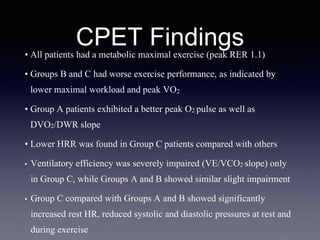
CPET Findings
• All patients had a metabolic maximal exercise (peak RER 1.1)
• Groups B and C had worse exercise performance, as indicated by
lower maximal workload and peak VO2
• Group A patients exhibited a better peak O2 pulse as well as
DVO2/DWR slope
• Lower HRR was found in Group C patients compared with others
• Ventilatory efficiency was severely impaired (VE/VCO2 slope) only
in Group C, while Groups A and B showed similar slight impairment
• Group C compared with Groups A and B showed significantly
increased rest HR, reduced systolic and diastolic pressures at rest and
during exercise
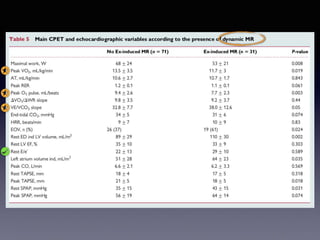
B: Dynamic MR
A: No MR C: MR @ rest
Correlation of
VE/VCO2 and MR
ERO
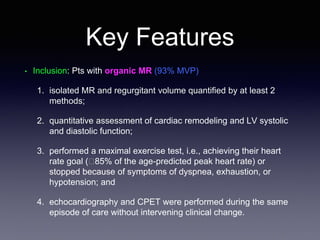
Key Features
• Inclusion: Pts with organic MR (93% MVP)
1. isolated MR and regurgitant volume quantified by at least 2
methods;
2. quantitative assessment of cardiac remodeling and LV systolic
and diastolic function;
3. performed a maximal exercise test, i.e., achieving their heart
rate goal (􏰆85% of the age-predicted peak heart rate) or
stopped because of symptoms of dyspnea, exhaustion, or
hypotension; and
4. echocardiography and CPET were performed during the same
episode of care without intervening clinical change.
Key Features
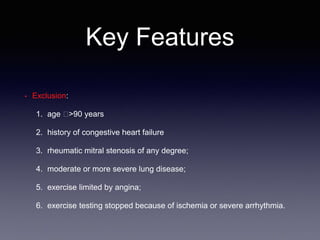
• Exclusion:
1. age 􏰆>90 years
2. history of congestive heart failure
3. rheumatic mitral stenosis of any degree;
4. moderate or more severe lung disease;
5. exercise limited by angina;
6. exercise testing stopped because of ischemia or severe arrhythmia.
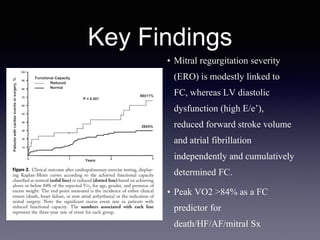
Key Findings
• Mitral regurgitation severity
(ERO) is modestly linked to
FC, whereas LV diastolic
dysfunction (high E/e’),
reduced forward stroke volume
and atrial fibrillation
independently and cumulatively
determined FC.
• Peak VO2 >84% as a FC
predictor for
death/HF/AF/mitral Sx
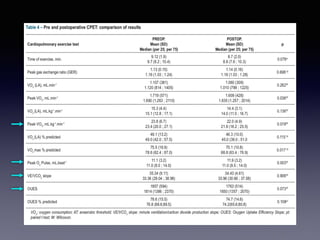
Oxygen Uptake
Efficiency Slope
(OUES)
= VE/VO2
Key Lesson
• Rehab, rehab, rehab!!
The End

Cardiopulmonary exercise testing made easy

  • 1.
    Cardiopulmonary Exercise Testing inMitral Regurgitation Dr Koh Choong Hou Mar 2019
  • 2.
    Scope • CPET parameters •Mitral Regurgitation ★ Combination and correlation with echo in FMR ★ Functional capacity assessment ★ Pre and Post mitral repair
  • 3.
  • 5.
    CPET Parameters • VO2Max ‣ Maximal oxygen extraction as a function of cardiorespiratory performance ‣ (HRmax x SVmax) x (CaO2max - CvO2min) • O2 Pulse ‣ Amount of oxygen consumed (“O2”) from the volume of blood delivered to the tissue per heartbeat (“pulse”); alternatively defined as the volume of O2 ejected from the LV in each beat ‣ Since oxygen extraction is maximal and constant at peak exercise, O2 pulse = surrogate of SV ‣ Diminished in severe LV dysfunction or VHD
  • 6.
    CPET Parameters • VE/VCO2 ‣“Ventilatory equivalent for CO2” ‣ Reflection of ventilatory efficiency (“what controls respiration”): chemoreceptor sensitivity, acid-base balance, ventilatory efficiency at alveolar-alveolar-capillary interface ‣ Increased in pulmonary disease or HF ๏ Exercise starts: VE/VCO2 drops (improved V/Q matching) ๏ Mid exercise: VE/VCO2 constant ๏ Exercise peaks: VE/VCO2 small increases (lactic acidosis stimulates VE)
  • 7.
    CPET Parameters • AnaerobicThreshold ‣ Highest VO2 achieved without sustained increase in blood lactate concentration or lactate-pyruvate ratio ‣ In healthy population, usually occurs at 47 - 64% of VO2max
  • 8.
    CPET Parameters • RespiratoryExchange Ratio (RER) ‣ VCO2/VO2 ‣ Represents metabolic exchange of gases at tissue level and dependent on predominant fuel (cbh vs fat) used for metabolism ‣ Objective means of quantifying effort ✓ 1 to 1.1 = fair effort ✓ 1.1 to 1.2 = good effort ✓ >1.2 = excellent effort
  • 10.
  • 12.
    Dynamic / FunctionalMR during exercise (baseline HFrEF) *VO2, O2 pulse, VE/VCO2
  • 14.
    Key features • Inclusion:chronic heart failure with LV dilation (indexed end diastolic volume 80 mL/m2 ) and reduced EF (≤40%), capability of exercise, and adequate transthoracic acoustic windows. • Exclusion: recent myocardial infarction or acute heart failure (3 months), unstable angina, inducible myocardial ischaemia (or evidence of papillary muscle ischaemia), aortic stenosis (peak velocity .3 m/s), peripheral artery disease, significant anaemia (haemoglobin ,10 g/dL), and respiratory diseases of at least moderate degree • 60% ischaemic CMP (with reduced EF) • CPET performed with tiltable cycle ergometer
  • 16.
    B: Dynamic MR A:No MR C: MR @ rest
  • 17.
  • 18.
    CPET Findings • Allpatients had a metabolic maximal exercise (peak RER 1.1) • Groups B and C had worse exercise performance, as indicated by lower maximal workload and peak VO2 • Group A patients exhibited a better peak O2 pulse as well as DVO2/DWR slope • Lower HRR was found in Group C patients compared with others • Ventilatory efficiency was severely impaired (VE/VCO2 slope) only in Group C, while Groups A and B showed similar slight impairment • Group C compared with Groups A and B showed significantly increased rest HR, reduced systolic and diastolic pressures at rest and during exercise
  • 19.
    B: Dynamic MR A:No MR C: MR @ rest
  • 21.
  • 23.
    Key Features • Inclusion:Pts with organic MR (93% MVP) 1. isolated MR and regurgitant volume quantified by at least 2 methods; 2. quantitative assessment of cardiac remodeling and LV systolic and diastolic function; 3. performed a maximal exercise test, i.e., achieving their heart rate goal (􏰆85% of the age-predicted peak heart rate) or stopped because of symptoms of dyspnea, exhaustion, or hypotension; and 4. echocardiography and CPET were performed during the same episode of care without intervening clinical change.
  • 24.
    Key Features • Exclusion: 1.age 􏰆>90 years 2. history of congestive heart failure 3. rheumatic mitral stenosis of any degree; 4. moderate or more severe lung disease; 5. exercise limited by angina; 6. exercise testing stopped because of ischemia or severe arrhythmia.
  • 26.
    Key Findings • Mitralregurgitation severity (ERO) is modestly linked to FC, whereas LV diastolic dysfunction (high E/e’), reduced forward stroke volume and atrial fibrillation independently and cumulatively determined FC. • Peak VO2 >84% as a FC predictor for death/HF/AF/mitral Sx
  • 28.
  • 30.
    Key Lesson • Rehab,rehab, rehab!!
  • 33.