
Synopsis Writing: How
to Research and
Summarize Effectively
Writing a synopsis can be a challenging task, but with the right approach,
it can become a rewarding experience. In this presentation, we'll guide
you through the steps to write a perfect synopsis that captures your
reader's attention and provides a clear overview of your research.
by DR. ANSHU RAJ PUROHIT
What is a Synopsis?
A Snapshot of Your
Research
A synopsis is a brief summary
of your research that highlights
its main points and aims to
entice readers to want to know
more.
Makes Your Research
Accessible
A well-crafted synopsis can be
an effective tool to
communicate your research to
a wider audience with varying
levels of knowledge or
expertise on the subject.
An Opportunity to
Showcase Your
Research Skills
Writing a succinct summary
requires you to critically
evaluate your research and
think strategically about its
impact and relevance to the
field.
Step 1: Determine the Purpose and
Audience
1 Define Your Objective
Identify the purpose of your synopsis and the key messages you want to convey to
your reader. Clarify your goals and output expectations.
2 Know Your Audience
Understand your target readership, their interests, and existing knowledge. Adapt
your writing style and content accordingly.
3 Plan Your Scope
Decide what to include and exclude in your synopsis based on your objective and
audience. Consider the length and format required.
Step 2: Identify the Key Points
Highlight the Main Ideas
Identify the most important concepts,
findings, and arguments presented in
your research. Filter out the less
relevant details.
Emphasize the Unique Features
Pinpoint the aspects of your research
that differentiate it from others in the
field. Highlight your contributions and
innovation.
Provide Context
Situate your research within the broader field and explain its relevance to the current
debates or practices. Help readers understand the implications of your findings.
Step 3: Organize the Information
Logically
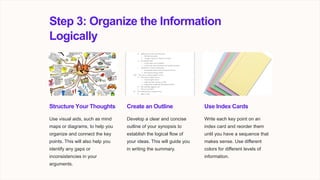
Structure Your Thoughts
Use visual aids, such as mind
maps or diagrams, to help you
organize and connect the key
points. This will also help you
identify any gaps or
inconsistencies in your
arguments.
Create an Outline
Develop a clear and concise
outline of your synopsis to
establish the logical flow of
your ideas. This will guide you
in writing the summary.
Use Index Cards
Write each key point on an
index card and reorder them
until you have a sequence that
makes sense. Use different
colors for different levels of
information.
Step 4: Write a Clear and Concise
Summary
1 Stick to the Word Count
Ensure that your synopsis stays within the required word count, without sacrificing
coherence or meaning. Use words economically.
2 Follow the Outline
Write each section of your synopsis according to the outline you have created. Use
clear and concise language, avoid jargon.
3 Edit for Clarity and Accuracy
Review your synopsis for typos, grammatical errors, and inaccuracies. Ask
someone else to read it to ensure that the meaning is clear.
Step 5: Revise and Edit for Clarity and
Accuracy
Take a Break
After finishing your first draft,
take a break to clear your
mind. Come back later with a
fresh perspective and revise
your synopsis objectively.
Check for Pitfalls
Check your synopsis for
common mistakes such as
repetition, ambiguity, or
unsupported assumptions.
Verify your sources and ensure
that your facts are correct.
Use Writing Tips
Use writing tips such as using
active voice, varying sentence
structure, and avoiding cliches.
This will improve the readability
and impact of your synopsis.
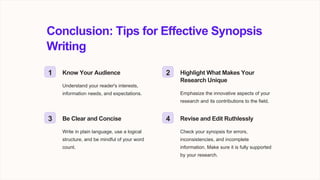
Conclusion: Tips for Effective Synopsis
Writing
1 Know Your Audience
Understand your reader's interests,
information needs, and expectations.
2 Highlight What Makes Your
Research Unique
Emphasize the innovative aspects of your
research and its contributions to the field.
3 Be Clear and Concise
Write in plain language, use a logical
structure, and be mindful of your word
count.
4 Revise and Edit Ruthlessly
Check your synopsis for errors,
inconsistencies, and incomplete
information. Make sure it is fully supported
by your research.

Synopsis Writing.pptx

  • 1.
    Synopsis Writing: How toResearch and Summarize Effectively Writing a synopsis can be a challenging task, but with the right approach, it can become a rewarding experience. In this presentation, we'll guide you through the steps to write a perfect synopsis that captures your reader's attention and provides a clear overview of your research. by DR. ANSHU RAJ PUROHIT
  • 2.
    What is aSynopsis? A Snapshot of Your Research A synopsis is a brief summary of your research that highlights its main points and aims to entice readers to want to know more. Makes Your Research Accessible A well-crafted synopsis can be an effective tool to communicate your research to a wider audience with varying levels of knowledge or expertise on the subject. An Opportunity to Showcase Your Research Skills Writing a succinct summary requires you to critically evaluate your research and think strategically about its impact and relevance to the field.
  • 3.
    Step 1: Determinethe Purpose and Audience 1 Define Your Objective Identify the purpose of your synopsis and the key messages you want to convey to your reader. Clarify your goals and output expectations. 2 Know Your Audience Understand your target readership, their interests, and existing knowledge. Adapt your writing style and content accordingly. 3 Plan Your Scope Decide what to include and exclude in your synopsis based on your objective and audience. Consider the length and format required.
  • 4.
    Step 2: Identifythe Key Points Highlight the Main Ideas Identify the most important concepts, findings, and arguments presented in your research. Filter out the less relevant details. Emphasize the Unique Features Pinpoint the aspects of your research that differentiate it from others in the field. Highlight your contributions and innovation. Provide Context Situate your research within the broader field and explain its relevance to the current debates or practices. Help readers understand the implications of your findings.
  • 5.
    Step 3: Organizethe Information Logically Structure Your Thoughts Use visual aids, such as mind maps or diagrams, to help you organize and connect the key points. This will also help you identify any gaps or inconsistencies in your arguments. Create an Outline Develop a clear and concise outline of your synopsis to establish the logical flow of your ideas. This will guide you in writing the summary. Use Index Cards Write each key point on an index card and reorder them until you have a sequence that makes sense. Use different colors for different levels of information.
  • 6.
    Step 4: Writea Clear and Concise Summary 1 Stick to the Word Count Ensure that your synopsis stays within the required word count, without sacrificing coherence or meaning. Use words economically. 2 Follow the Outline Write each section of your synopsis according to the outline you have created. Use clear and concise language, avoid jargon. 3 Edit for Clarity and Accuracy Review your synopsis for typos, grammatical errors, and inaccuracies. Ask someone else to read it to ensure that the meaning is clear.
  • 7.
    Step 5: Reviseand Edit for Clarity and Accuracy Take a Break After finishing your first draft, take a break to clear your mind. Come back later with a fresh perspective and revise your synopsis objectively. Check for Pitfalls Check your synopsis for common mistakes such as repetition, ambiguity, or unsupported assumptions. Verify your sources and ensure that your facts are correct. Use Writing Tips Use writing tips such as using active voice, varying sentence structure, and avoiding cliches. This will improve the readability and impact of your synopsis.
  • 8.
    Conclusion: Tips forEffective Synopsis Writing 1 Know Your Audience Understand your reader's interests, information needs, and expectations. 2 Highlight What Makes Your Research Unique Emphasize the innovative aspects of your research and its contributions to the field. 3 Be Clear and Concise Write in plain language, use a logical structure, and be mindful of your word count. 4 Revise and Edit Ruthlessly Check your synopsis for errors, inconsistencies, and incomplete information. Make sure it is fully supported by your research.