Format No. QSP/7.1/01.F01 (B)
Issue No.04 Rev. No 4 Dated: June 7, 2014
_____________________________________________________________________________________________
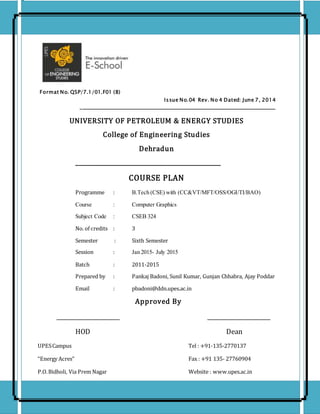
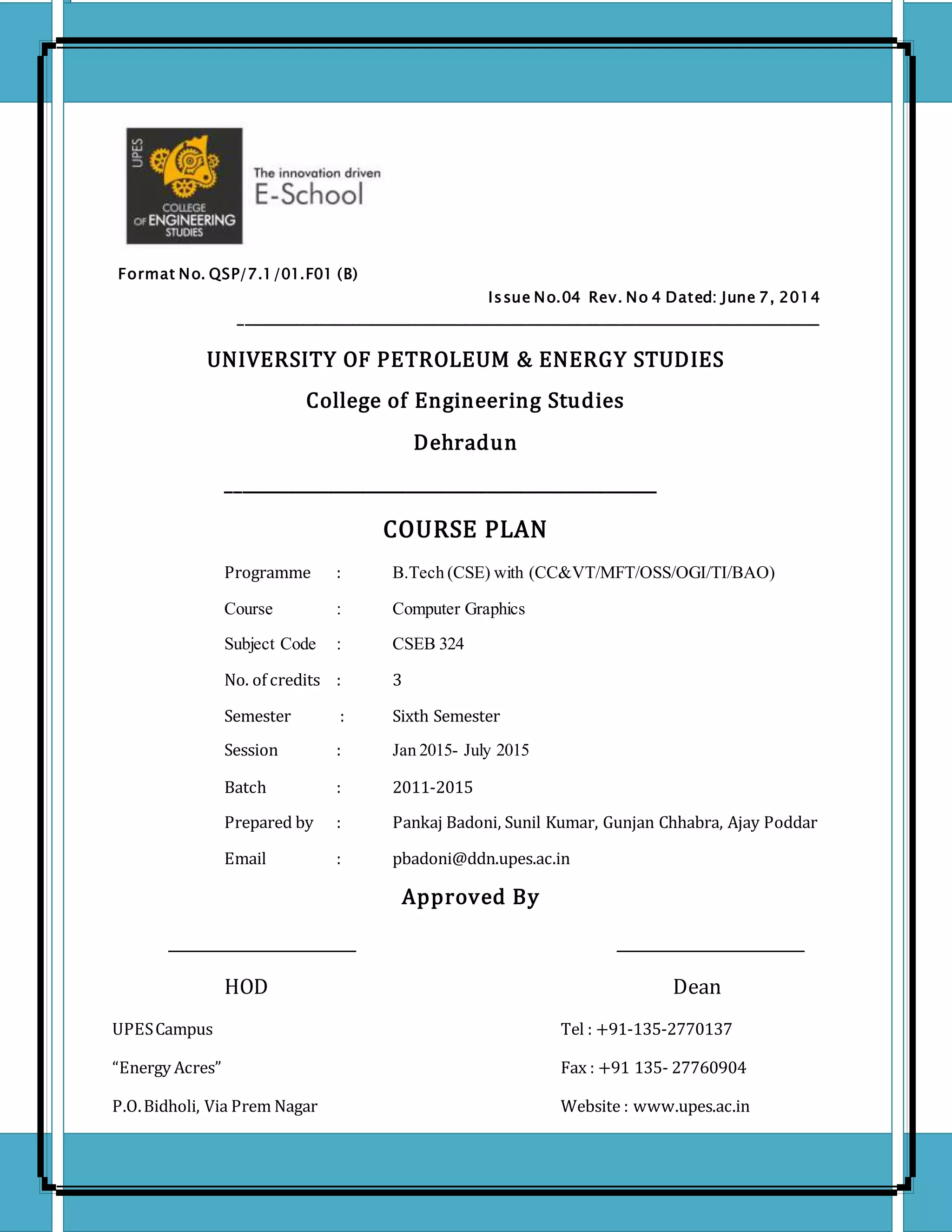
UNIVERSITY OF PETROLEUM & ENERGY STUDIES
College of Engineering Studies
Dehradun
______________________________________________________
COURSE PLAN
Programme : B.Tech (CSE) with (CC&VT/MFT/OSS/OGI/TI/BAO)
Course : Computer Graphics
Subject Code : CSEB 324
No. of credits : 3
Semester : Sixth Semester
Session : Jan 2015- July 2015
Batch : 2011-2015
Prepared by : Pankaj Badoni, Sunil Kumar, Gunjan Chhabra, Ajay Poddar
Email : pbadoni@ddn.upes.ac.in
Approved By
_______________________ _______________________
HOD Dean
UPESCampus Tel : +91-135-2770137
“Energy Acres” Fax : +91 135- 27760904
P.O.Bidholi, Via Prem Nagar Website : www.upes.ac.in
COURSE PLAN
Subject: Computer Graphics Course: B.Tech (CSE) with
(CC&VT/MFT/OSS/OGI/TI/BAO)
Duration: Jan 2015- July 2015 Subject code: CSEB 324
One Session: 60 Minutes
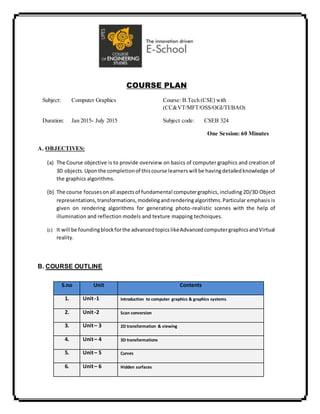
A. OBJECTIVES:
(a) The Course objective is to provide overview on basics of computer graphics and creation of
3D objects.Uponthe completionof thiscourse learnerswill be havingdetailedknowledge of
the graphics algorithms.
(b) The course focusesonall aspectsof fundamental computergraphics,including 2D/3D Object
representations,transformations,modelingandrenderingalgorithms.Particular emphasis is
given on rendering algorithms for generating photo-realistic scenes with the help of
illumination and reflection models and texture mapping techniques.
(c) It will be foundingblockforthe advancedtopicslikeAdvancedcomputergraphicsandVirtual
reality.
B. COURSE OUTLINE
S.no Unit Contents
1. Unit-1 Introduction to computer graphics & graphics systems
2. Unit-2 Scan conversion
3. Unit– 3 2D transformation & viewing
4. Unit– 4 3D transformations
5. Unit– 5 Curves
6. Unit– 6 Hidden surfaces
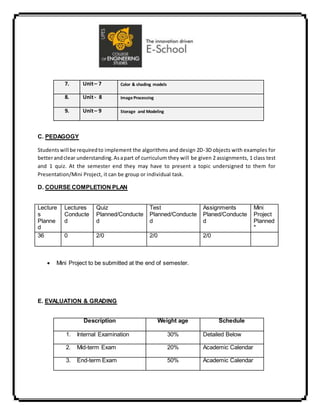
7. Unit– 7 Color & shading models
8. Unit- 8 Image Processing
9. Unit– 9 Storage and Modeling
C. PEDAGOGY
Studentswill be requiredto implement the algorithms and design 2D-3D objects with examples for
betterandclear understanding.Asapart of curriculum they will be given 2 assignments, 1 class test
and 1 quiz. At the semester end they may have to present a topic undersigned to them for
Presentation/Mini Project, it can be group or individual task.
D. COURSE COMPLETION PLAN
Lecture
s
Planne
d
Lectures
Conducte
d
Quiz
Planned/Conducte
d
Test
Planned/Conducte
d
Assignments
Planed/Conducte
d
Mini
Project
Planned
*
36 0 2/0 2/0 2/0
 Mini Project to be submitted at the end of semester.
E. EVALUATION & GRADING
Description Weight age Schedule
1. Internal Examination 30% Detailed Below
2. Mid-term Exam 20% Academic Calendar
3. End-term Exam 50% Academic Calendar
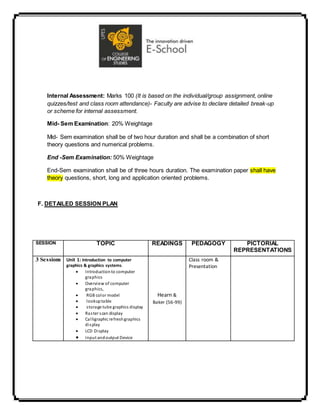
Internal Assessment: Marks 100 (It is based on the individual/group assignment, online
quizzes/test and class room attendance)- Faculty are advise to declare detailed break-up
or scheme for internal assessment.
Mid- Sem Examination: 20% Weightage
Mid- Sem examination shall be of two hour duration and shall be a combination of short
theory questions and numerical problems.
End -Sem Examination: 50% Weightage
End-Sem examination shall be of three hours duration. The examination paper shall have
theory questions, short, long and application oriented problems.
F. DETAILED SESSION PLAN
SESSION TOPIC READINGS PEDAGOGY PICTORIAL
REPRESENTATIONS
3 Sessions Unit 1: Introduction to computer
graphics & graphics systems.
 Introductionto computer
graphics
 Overview of computer
graphics,
 RGB color model
 lookuptable
 storage tube graphics display
 Raster scan display
 Calligraphic refreshgraphics
display
 LCD Display
 Input andoutput Device
Hearn &
Baker (56-99)
Class room &
Presentation
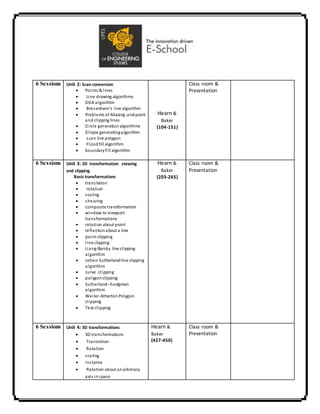
6 Sessions Unit 2: Scan conversion
 Points & lines
 Line drawing algorithms
 DDA algorithm
 Bresenham’s line algorithm
 Problems of Aliasing ,endpoint
and clipping lines
 Circle generationalgorithms
 Ellipse generatingalgorithm
 scan line polygon
 Floodfill algorithm
 boundaryfill algorithm
Hearn &
Baker
(104-151)
Class room &
Presentation
6 Sessions Unit 3: 2D transformation viewing
and clipping
Basic transformations
 translation
 rotation
 scaling
 shearing
 composite transformation
 window to viewport
transformations
 rotation about point
 reflectionabout a line
 point clipping
 line clipping
 Liang-Barsky line clipping
algorithm
 cohen Sutherlandline clipping
algorithm
 curve clipping
 polygonclipping
 Sutherland –hodgman
algorithm
 Weiler-AthertonPolygon
clipping
 Text clipping
Hearn &
Baker
(203-265)
Class room &
Presentation
6 Sessions Unit 4: 3D transformations
 3D transformations
 Translation
 Rotation
 scaling
 Instance
 Rotation about anarbitrary
axis inspace
Hearn &
Baker
(427-450)
Class room &
Presentation
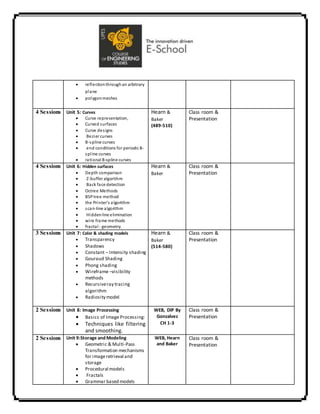
 reflectionthroughan arbitrary
plane
 polygonmeshes
4 Sessions Unit 5: Curves
 Curve representation,
 Curved surfaces
 Curve designs
 Bezier curves
 B-spline curves
 end conditions for periodic B-
spline curves
 rational B-spline curves
Hearn &
Baker
(489-510)
Class room &
Presentation
4 Sessions Unit 6: Hidden surfaces
 Depth comparison
 Z-buffer algorithm
 Back face detection
 Octree Methods
 BSPtree method
 the Printer’s algorithm
 scan-line algorithm
 Hiddenline elimination
 wire frame methods
 fractal - geometry.
Hearn &
Baker
Class room &
Presentation
3 Sessions Unit 7: Color & shading models
 Transparency
 Shadows
 Constant – Intensity shading
 Gouraud Shading
 Phong shading
 Wireframe –visibility
methods
 Recursiveray tracing
algorithm
 Radiosity model
Hearn &
Baker
(514-580)
Class room &
Presentation
2 Sessions Unit 8: Image Processing
 Basics of Image Processing:
 Techniques like filtering
and smoothing.
WEB, DIP By
Gonzalvez
CH 1-3
Class room &
Presentation
2 Sessions Unit 9:Storage and Modeling
 Geometric & Multi-Pass
Transformation mechanisms
for imageretrieval and
storage
 Procedural models
 Fractals
 Grammar based models
WEB, Hearn
and Baker
Class room &
Presentation
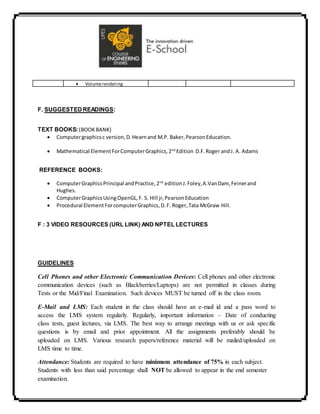
 Volumerendering
F. SUGGESTEDREADINGS:
TEXT BOOKS:(BOOK BANK)
 Computergraphicsc version,D.Hearnand M.P. Baker,PearsonEducation.
 Mathematical ElementForComputerGraphics,2nd
Edition D.F.Roger andJ. A. Adams
REFERENCE BOOKS:
 ComputerGraphicsPrincipal andPractice,2nd
editionJ.Foley,A.VanDam, Feinerand
Hughes.
 ComputerGraphicsUsingOpenGL,F. S. Hill jr,PearsonEducation
 Procedural ElementForcomputerGraphics,D.F. Roger,Tata McGraw Hill.
F : 3 VIDEO RESOURCES (URL LINK) AND NPTEL LECTURES
GUIDELINES
Cell Phones and other Electronic Communication Devices: Cell phones and other electronic
communication devices (such as Blackberries/Laptops) are not permitted in classes during
Tests or the Mid/Final Examination. Such devices MUST be turned off in the class room.
E-Mail and LMS: Each student in the class should have an e-mail id and a pass word to
access the LMS system regularly. Regularly, important information – Date of conducting
class tests, guest lectures, via LMS. The best way to arrange meetings with us or ask specific
questions is by email and prior appointment. All the assignments preferably should be
uploaded on LMS. Various research papers/reference material will be mailed/uploaded on
LMS time to time.
Attendance: Students are required to have minimum attendance of 75% in each subject.
Students with less than said percentage shall NOT be allowed to appear in the end semester
examination.
Passing criterion: Student has to secure minimum 30%/40% marks of the “highest marks in
the class scored by a student in that subject (in that class/group class)” individually in both the
‘End-Semester examination’ and ‘Total Marks’ in order to pass in that paper.
 Passing Criterion for B. Tech: minimum 30% of the highest marks in the class
 Passing Criterion for M. Tech: minimum 40% of the highest marks in the class

Course plan computer graphics

  • 1.
    Format No. QSP/7.1/01.F01(B) Issue No.04 Rev. No 4 Dated: June 7, 2014 _____________________________________________________________________________________________ UNIVERSITY OF PETROLEUM & ENERGY STUDIES College of Engineering Studies Dehradun ______________________________________________________ COURSE PLAN Programme : B.Tech (CSE) with (CC&VT/MFT/OSS/OGI/TI/BAO) Course : Computer Graphics Subject Code : CSEB 324 No. of credits : 3 Semester : Sixth Semester Session : Jan 2015- July 2015 Batch : 2011-2015 Prepared by : Pankaj Badoni, Sunil Kumar, Gunjan Chhabra, Ajay Poddar Email : pbadoni@ddn.upes.ac.in Approved By _______________________ _______________________ HOD Dean UPESCampus Tel : +91-135-2770137 “Energy Acres” Fax : +91 135- 27760904 P.O.Bidholi, Via Prem Nagar Website : www.upes.ac.in
  • 2.
    COURSE PLAN Subject: ComputerGraphics Course: B.Tech (CSE) with (CC&VT/MFT/OSS/OGI/TI/BAO) Duration: Jan 2015- July 2015 Subject code: CSEB 324 One Session: 60 Minutes A. OBJECTIVES: (a) The Course objective is to provide overview on basics of computer graphics and creation of 3D objects.Uponthe completionof thiscourse learnerswill be havingdetailedknowledge of the graphics algorithms. (b) The course focusesonall aspectsof fundamental computergraphics,including 2D/3D Object representations,transformations,modelingandrenderingalgorithms.Particular emphasis is given on rendering algorithms for generating photo-realistic scenes with the help of illumination and reflection models and texture mapping techniques. (c) It will be foundingblockforthe advancedtopicslikeAdvancedcomputergraphicsandVirtual reality. B. COURSE OUTLINE S.no Unit Contents 1. Unit-1 Introduction to computer graphics & graphics systems 2. Unit-2 Scan conversion 3. Unit– 3 2D transformation & viewing 4. Unit– 4 3D transformations 5. Unit– 5 Curves 6. Unit– 6 Hidden surfaces
  • 3.
    7. Unit– 7Color & shading models 8. Unit- 8 Image Processing 9. Unit– 9 Storage and Modeling C. PEDAGOGY Studentswill be requiredto implement the algorithms and design 2D-3D objects with examples for betterandclear understanding.Asapart of curriculum they will be given 2 assignments, 1 class test and 1 quiz. At the semester end they may have to present a topic undersigned to them for Presentation/Mini Project, it can be group or individual task. D. COURSE COMPLETION PLAN Lecture s Planne d Lectures Conducte d Quiz Planned/Conducte d Test Planned/Conducte d Assignments Planed/Conducte d Mini Project Planned * 36 0 2/0 2/0 2/0  Mini Project to be submitted at the end of semester. E. EVALUATION & GRADING Description Weight age Schedule 1. Internal Examination 30% Detailed Below 2. Mid-term Exam 20% Academic Calendar 3. End-term Exam 50% Academic Calendar
  • 4.
    Internal Assessment: Marks100 (It is based on the individual/group assignment, online quizzes/test and class room attendance)- Faculty are advise to declare detailed break-up or scheme for internal assessment. Mid- Sem Examination: 20% Weightage Mid- Sem examination shall be of two hour duration and shall be a combination of short theory questions and numerical problems. End -Sem Examination: 50% Weightage End-Sem examination shall be of three hours duration. The examination paper shall have theory questions, short, long and application oriented problems. F. DETAILED SESSION PLAN SESSION TOPIC READINGS PEDAGOGY PICTORIAL REPRESENTATIONS 3 Sessions Unit 1: Introduction to computer graphics & graphics systems.  Introductionto computer graphics  Overview of computer graphics,  RGB color model  lookuptable  storage tube graphics display  Raster scan display  Calligraphic refreshgraphics display  LCD Display  Input andoutput Device Hearn & Baker (56-99) Class room & Presentation
  • 5.
    6 Sessions Unit2: Scan conversion  Points & lines  Line drawing algorithms  DDA algorithm  Bresenham’s line algorithm  Problems of Aliasing ,endpoint and clipping lines  Circle generationalgorithms  Ellipse generatingalgorithm  scan line polygon  Floodfill algorithm  boundaryfill algorithm Hearn & Baker (104-151) Class room & Presentation 6 Sessions Unit 3: 2D transformation viewing and clipping Basic transformations  translation  rotation  scaling  shearing  composite transformation  window to viewport transformations  rotation about point  reflectionabout a line  point clipping  line clipping  Liang-Barsky line clipping algorithm  cohen Sutherlandline clipping algorithm  curve clipping  polygonclipping  Sutherland –hodgman algorithm  Weiler-AthertonPolygon clipping  Text clipping Hearn & Baker (203-265) Class room & Presentation 6 Sessions Unit 4: 3D transformations  3D transformations  Translation  Rotation  scaling  Instance  Rotation about anarbitrary axis inspace Hearn & Baker (427-450) Class room & Presentation
  • 6.
     reflectionthroughan arbitrary plane polygonmeshes 4 Sessions Unit 5: Curves  Curve representation,  Curved surfaces  Curve designs  Bezier curves  B-spline curves  end conditions for periodic B- spline curves  rational B-spline curves Hearn & Baker (489-510) Class room & Presentation 4 Sessions Unit 6: Hidden surfaces  Depth comparison  Z-buffer algorithm  Back face detection  Octree Methods  BSPtree method  the Printer’s algorithm  scan-line algorithm  Hiddenline elimination  wire frame methods  fractal - geometry. Hearn & Baker Class room & Presentation 3 Sessions Unit 7: Color & shading models  Transparency  Shadows  Constant – Intensity shading  Gouraud Shading  Phong shading  Wireframe –visibility methods  Recursiveray tracing algorithm  Radiosity model Hearn & Baker (514-580) Class room & Presentation 2 Sessions Unit 8: Image Processing  Basics of Image Processing:  Techniques like filtering and smoothing. WEB, DIP By Gonzalvez CH 1-3 Class room & Presentation 2 Sessions Unit 9:Storage and Modeling  Geometric & Multi-Pass Transformation mechanisms for imageretrieval and storage  Procedural models  Fractals  Grammar based models WEB, Hearn and Baker Class room & Presentation
  • 7.
     Volumerendering F. SUGGESTEDREADINGS: TEXTBOOKS:(BOOK BANK)  Computergraphicsc version,D.Hearnand M.P. Baker,PearsonEducation.  Mathematical ElementForComputerGraphics,2nd Edition D.F.Roger andJ. A. Adams REFERENCE BOOKS:  ComputerGraphicsPrincipal andPractice,2nd editionJ.Foley,A.VanDam, Feinerand Hughes.  ComputerGraphicsUsingOpenGL,F. S. Hill jr,PearsonEducation  Procedural ElementForcomputerGraphics,D.F. Roger,Tata McGraw Hill. F : 3 VIDEO RESOURCES (URL LINK) AND NPTEL LECTURES GUIDELINES Cell Phones and other Electronic Communication Devices: Cell phones and other electronic communication devices (such as Blackberries/Laptops) are not permitted in classes during Tests or the Mid/Final Examination. Such devices MUST be turned off in the class room. E-Mail and LMS: Each student in the class should have an e-mail id and a pass word to access the LMS system regularly. Regularly, important information – Date of conducting class tests, guest lectures, via LMS. The best way to arrange meetings with us or ask specific questions is by email and prior appointment. All the assignments preferably should be uploaded on LMS. Various research papers/reference material will be mailed/uploaded on LMS time to time. Attendance: Students are required to have minimum attendance of 75% in each subject. Students with less than said percentage shall NOT be allowed to appear in the end semester examination.
  • 8.
    Passing criterion: Studenthas to secure minimum 30%/40% marks of the “highest marks in the class scored by a student in that subject (in that class/group class)” individually in both the ‘End-Semester examination’ and ‘Total Marks’ in order to pass in that paper.  Passing Criterion for B. Tech: minimum 30% of the highest marks in the class  Passing Criterion for M. Tech: minimum 40% of the highest marks in the class