INTRODUCTION


   Cute,     handsome,   intelligent,  interesting,
   beautiful, bad, nice, cheap, heavy, easy or
   difficult are some of the words teenagers use
   to describe a situation, event, task or person.
   Teenagers usually talk about different topics.
   They tend to compare each music genre, TV
   program, singer or actor. They also like to
   share information about authors of songs,
   bands, books of their interest. Besides, some
   of them learn adjectives to talk with their
   classmates to give either negative or positive
   attributes to them.
OBJECTIVES

 To help students to get more information about the
  usage of adjectives, let them know about its
  features, usual order, and rules to make
  comparisons, include the exception of the
  adjectives,
 To clarify how to choose the correct adjective
  according to the context, and how to identify it
  among pronouns and nouns in sentences.
ADJECTIVES

The word adjective brings to mind the following
  characteristics:
 Adjectives modify nouns and pronouns by telling
  which, what kind of, whose or how many.
 An adjective can be a word a phrase or a clause.

 Verbs have an adjective form called a participle.

 All possessive words are adjectives.
   One or more adjectives can modify a noun.
    Usually, no more than three or four adjectives are
    used to describe the same noun:

Order of the adjectives:
Number, Characteristic, Size, Shape, Age, Color,
 Origin, Noun

Ex.     A beautiful new green Italian suit
        Three big long red pencils
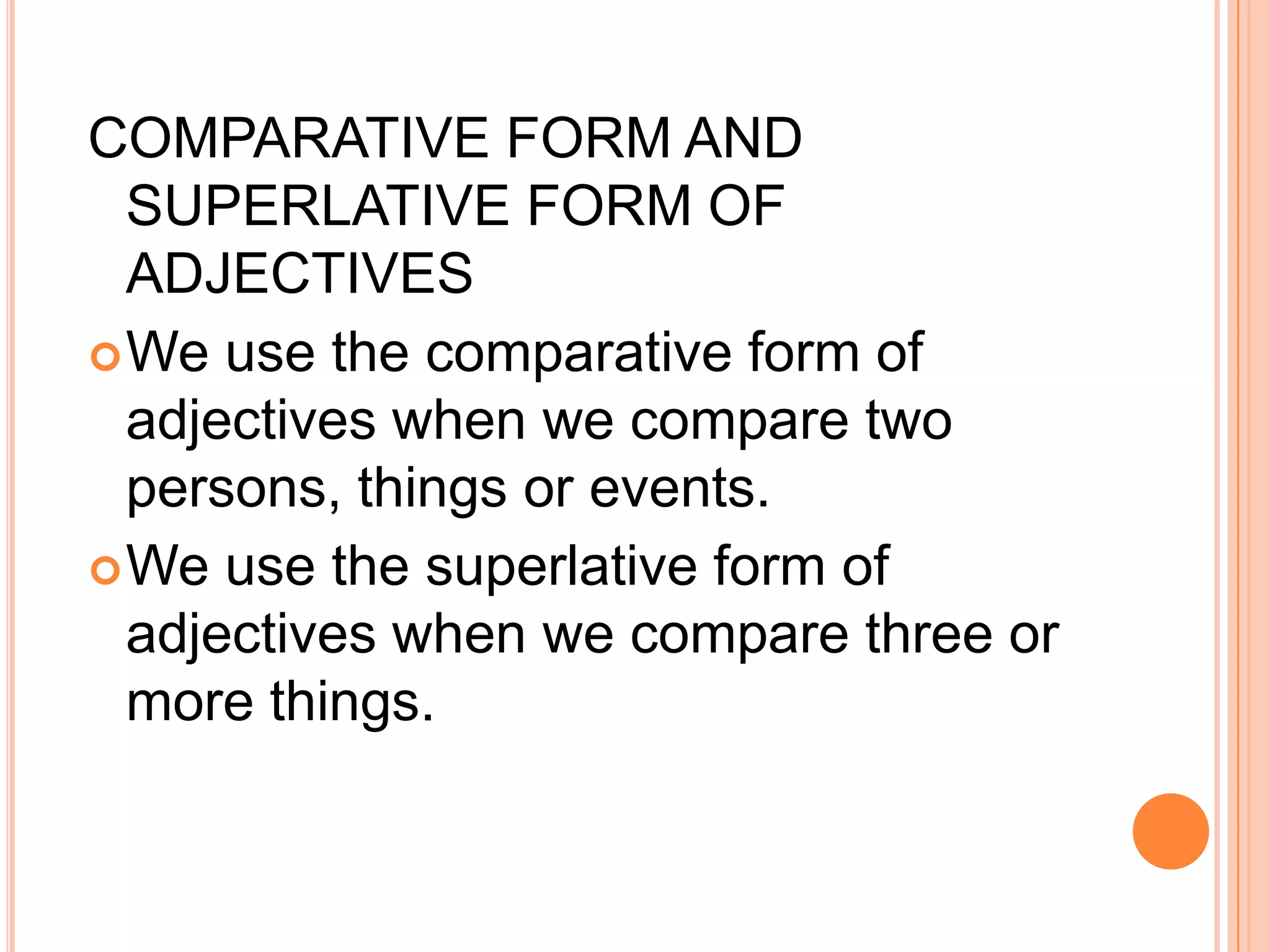
COMPARATIVE FORM AND
  SUPERLATIVE FORM OF
  ADJECTIVES
 We use the comparative form of
  adjectives when we compare two
  persons, things or events.
 We use the superlative form of
  adjectives when we compare three or
  more things.
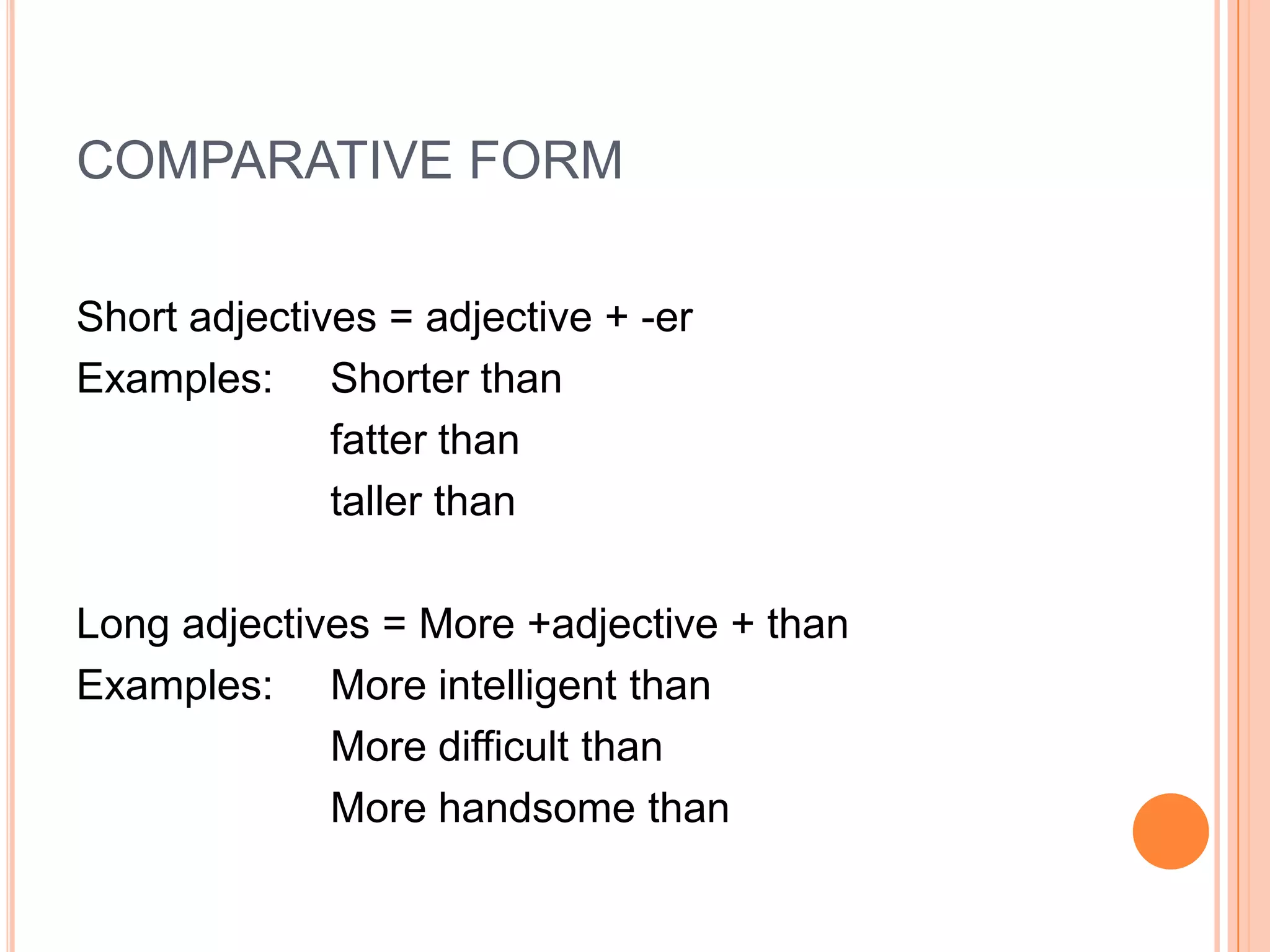
COMPARATIVE FORM

Short adjectives = adjective + -er
Examples: Shorter than
              fatter than
              taller than

Long adjectives = More +adjective + than
Examples: More intelligent than
             More difficult than
             More handsome than
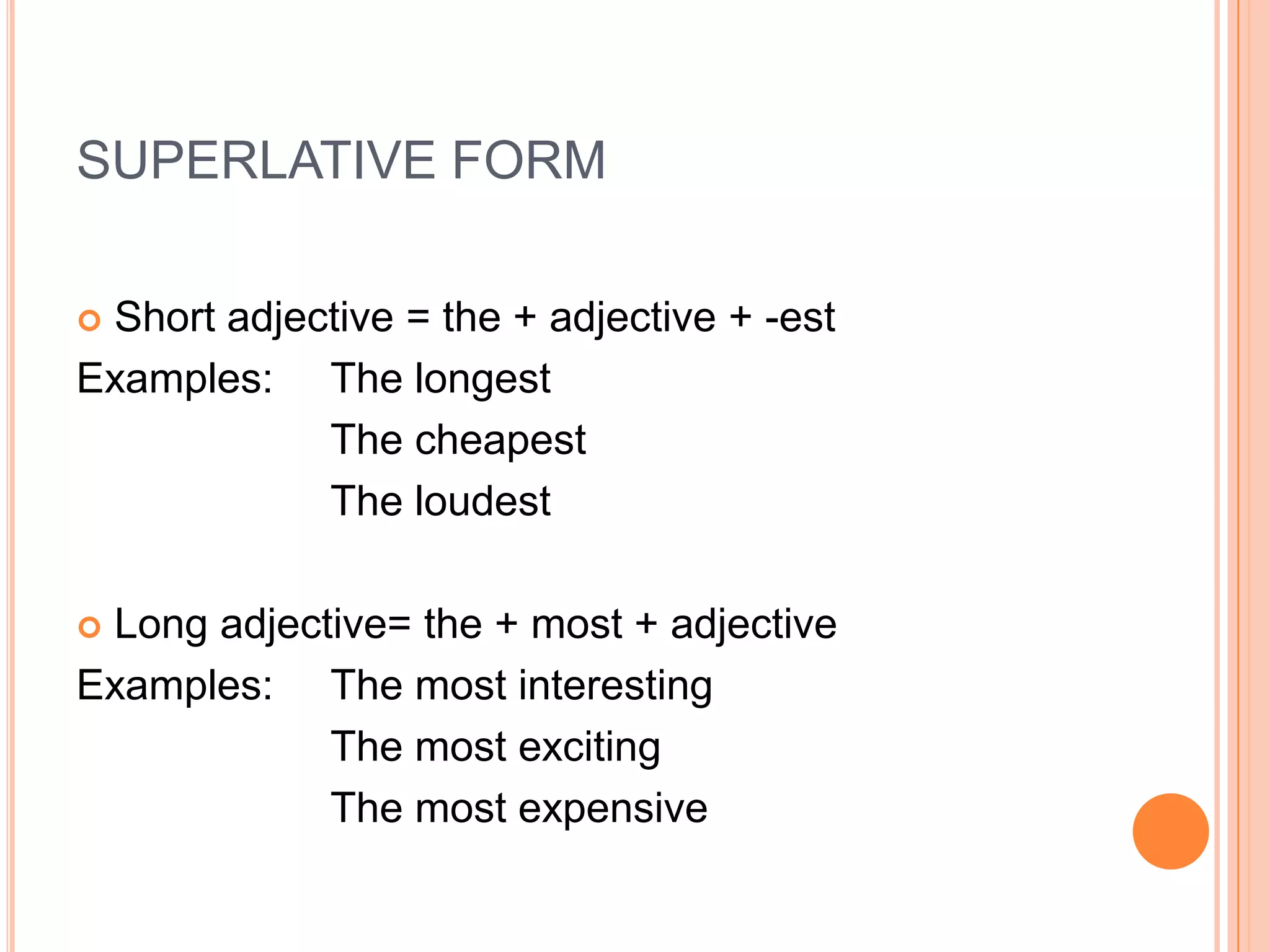
SUPERLATIVE FORM

Short adjective = the + adjective + -est
Examples: The longest
            The cheapest
            The loudest

Long adjective= the + most + adjective
Examples: The most interesting
            The most exciting
            The most expensive
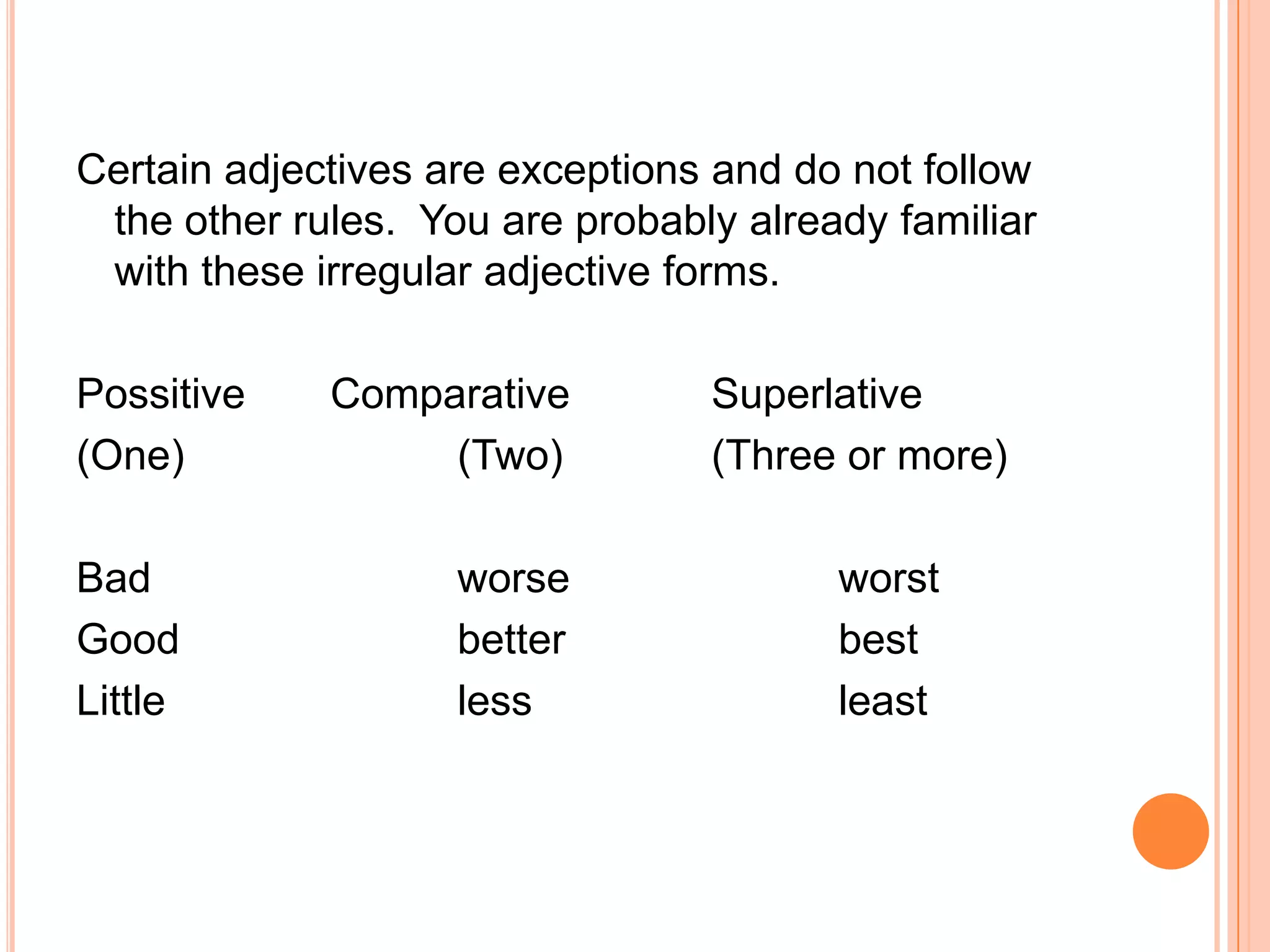
Certain adjectives are exceptions and do not follow
 the other rules. You are probably already familiar
 with these irregular adjective forms.

Possitive    Comparative         Superlative
(One)             (Two)          (Three or more)

Bad                 worse               worst
Good                better              best
Little              less                least
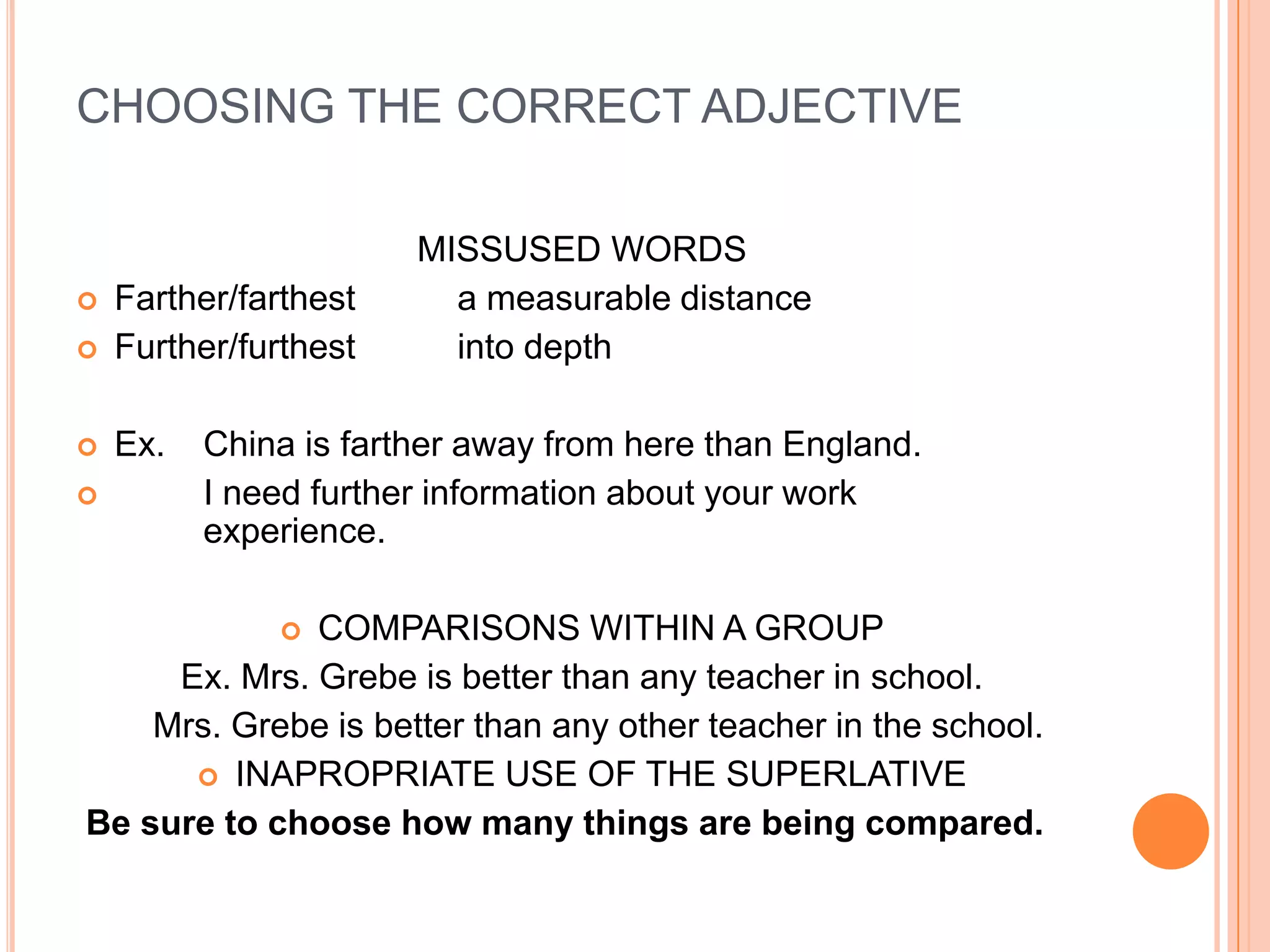
CHOOSING THE CORRECT ADJECTIVE

                       MISSUSED WORDS
   Farther/farthest     a measurable distance
   Further/furthest     into depth

   Ex.   China is farther away from here than England.
         I need further information about your work
          experience.

              COMPARISONS WITHIN A GROUP
              
     Ex. Mrs. Grebe is better than any teacher in school.
    Mrs. Grebe is better than any other teacher in the school.
       INAPROPRIATE USE OF THE SUPERLATIVE
Be sure to choose how many things are being compared.
DISTINGUISHING ADJECTIVES FROM NOUNS
  AND PRONOUNS

Many times the same word can be used as different
    parts of speech. You cannot tell what part of
  speech a word is until you determine its use in a
                     sentence.
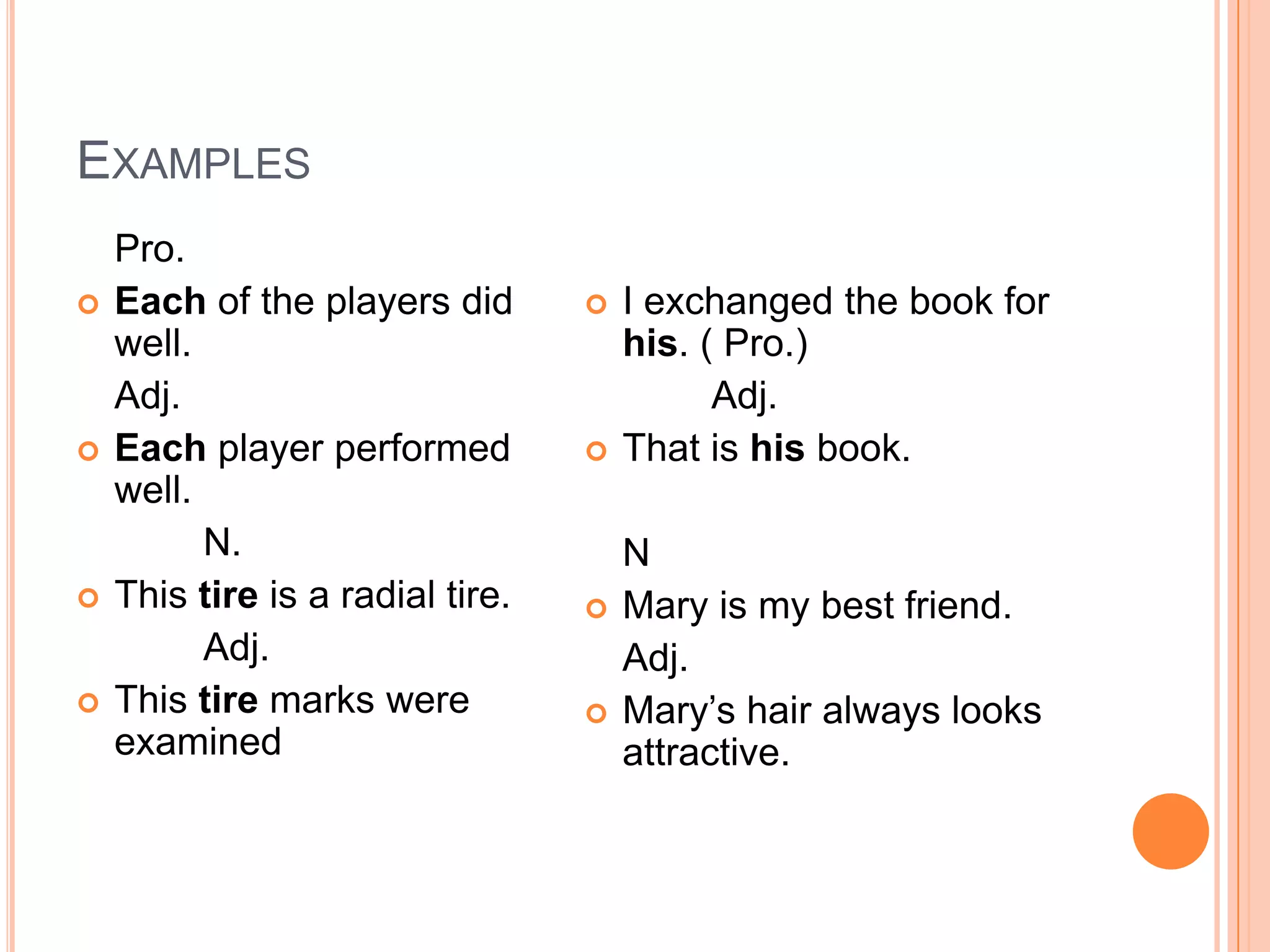
EXAMPLES
    Pro.
   Each of the players did          I exchanged the book for
    well.                             his. ( Pro.)
    Adj.                                    Adj.
   Each player performed            That is his book.
    well.
          N.                          N
   This tire is a radial tire.      Mary is my best friend.
          Adj.                        Adj.
   This tire marks were             Mary’s hair always looks
    examined                          attractive.
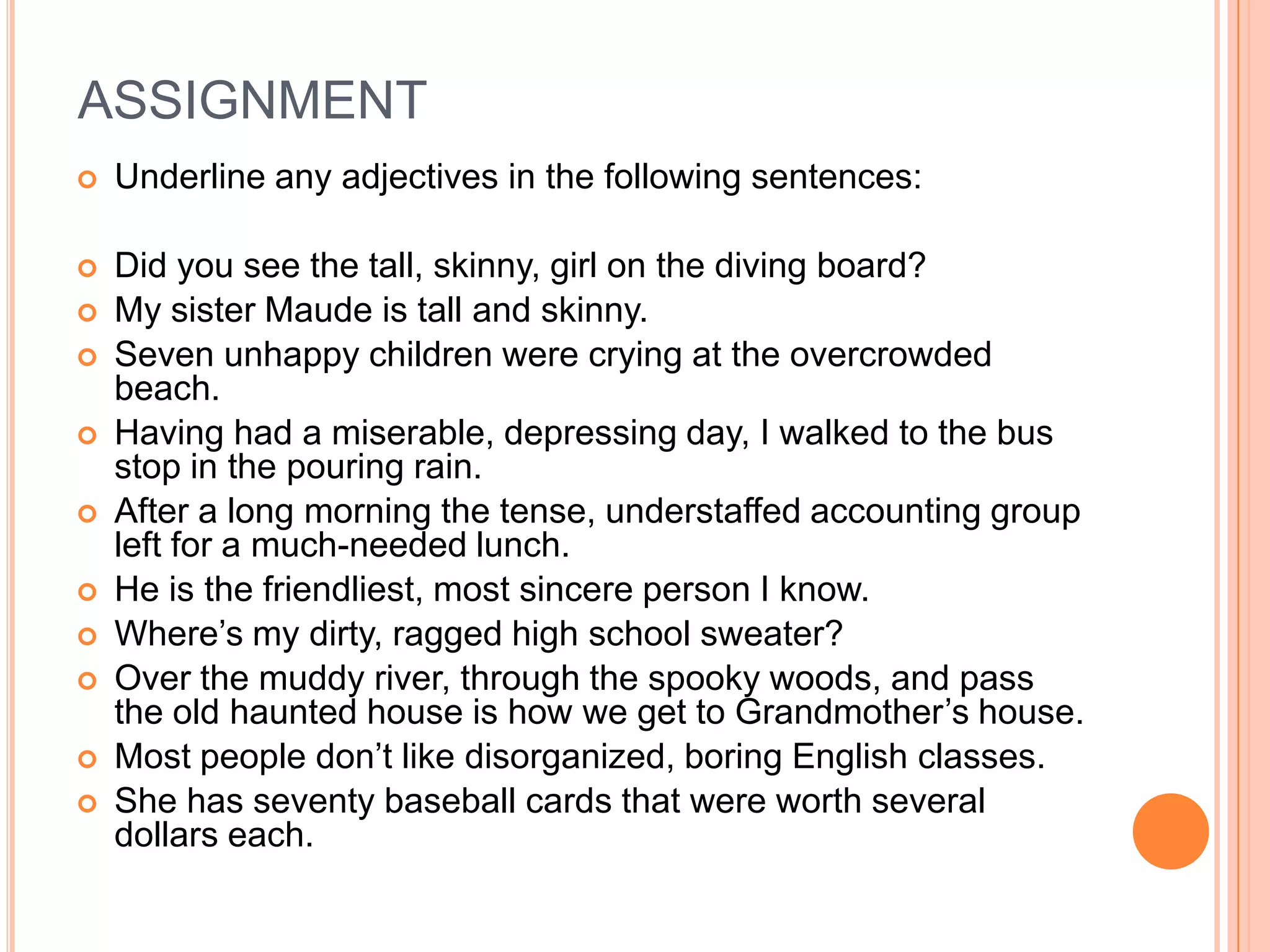
ASSIGNMENT
   Underline any adjectives in the following sentences:

   Did you see the tall, skinny, girl on the diving board?
   My sister Maude is tall and skinny.
   Seven unhappy children were crying at the overcrowded
    beach.
   Having had a miserable, depressing day, I walked to the bus
    stop in the pouring rain.
   After a long morning the tense, understaffed accounting group
    left for a much-needed lunch.
   He is the friendliest, most sincere person I know.
   Where’s my dirty, ragged high school sweater?
   Over the muddy river, through the spooky woods, and pass
    the old haunted house is how we get to Grandmother’s house.
   Most people don’t like disorganized, boring English classes.
   She has seventy baseball cards that were worth several
    dollars each.
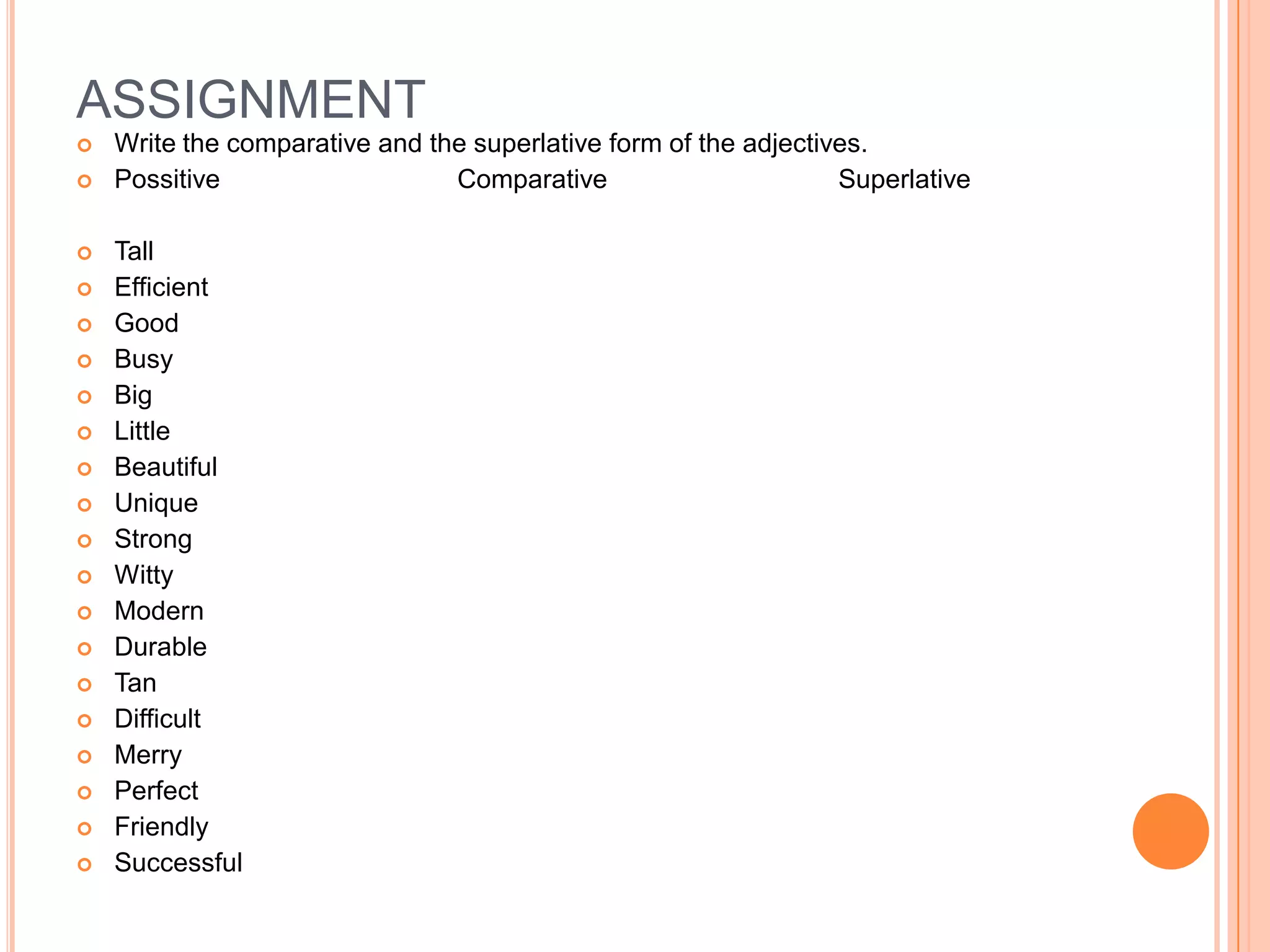
ASSIGNMENT
   Write the comparative and the superlative form of the adjectives.
   Possitive                   Comparative                       Superlative

   Tall
   Efficient
   Good
   Busy
   Big
   Little
   Beautiful
   Unique
   Strong
   Witty
   Modern
   Durable
   Tan
   Difficult
   Merry
   Perfect
   Friendly
   Successful

Course content adjectives

  • 1.
    INTRODUCTION Cute, handsome, intelligent, interesting, beautiful, bad, nice, cheap, heavy, easy or difficult are some of the words teenagers use to describe a situation, event, task or person. Teenagers usually talk about different topics. They tend to compare each music genre, TV program, singer or actor. They also like to share information about authors of songs, bands, books of their interest. Besides, some of them learn adjectives to talk with their classmates to give either negative or positive attributes to them.
  • 2.
    OBJECTIVES  To helpstudents to get more information about the usage of adjectives, let them know about its features, usual order, and rules to make comparisons, include the exception of the adjectives,  To clarify how to choose the correct adjective according to the context, and how to identify it among pronouns and nouns in sentences.
  • 3.
    ADJECTIVES The word adjectivebrings to mind the following characteristics:  Adjectives modify nouns and pronouns by telling which, what kind of, whose or how many.  An adjective can be a word a phrase or a clause.  Verbs have an adjective form called a participle.  All possessive words are adjectives.
  • 4.
    One or more adjectives can modify a noun. Usually, no more than three or four adjectives are used to describe the same noun: Order of the adjectives: Number, Characteristic, Size, Shape, Age, Color, Origin, Noun Ex. A beautiful new green Italian suit Three big long red pencils
  • 5.
    COMPARATIVE FORM AND SUPERLATIVE FORM OF ADJECTIVES  We use the comparative form of adjectives when we compare two persons, things or events.  We use the superlative form of adjectives when we compare three or more things.
  • 6.
    COMPARATIVE FORM Short adjectives= adjective + -er Examples: Shorter than fatter than taller than Long adjectives = More +adjective + than Examples: More intelligent than More difficult than More handsome than
  • 7.
    SUPERLATIVE FORM Short adjective= the + adjective + -est Examples: The longest The cheapest The loudest Long adjective= the + most + adjective Examples: The most interesting The most exciting The most expensive
  • 8.
    Certain adjectives areexceptions and do not follow the other rules. You are probably already familiar with these irregular adjective forms. Possitive Comparative Superlative (One) (Two) (Three or more) Bad worse worst Good better best Little less least
  • 9.
    CHOOSING THE CORRECTADJECTIVE MISSUSED WORDS  Farther/farthest a measurable distance  Further/furthest into depth  Ex. China is farther away from here than England.  I need further information about your work experience. COMPARISONS WITHIN A GROUP  Ex. Mrs. Grebe is better than any teacher in school. Mrs. Grebe is better than any other teacher in the school.  INAPROPRIATE USE OF THE SUPERLATIVE Be sure to choose how many things are being compared.
  • 10.
    DISTINGUISHING ADJECTIVES FROMNOUNS AND PRONOUNS Many times the same word can be used as different parts of speech. You cannot tell what part of speech a word is until you determine its use in a sentence.
  • 11.
    EXAMPLES Pro.  Each of the players did  I exchanged the book for well. his. ( Pro.) Adj. Adj.  Each player performed  That is his book. well. N. N  This tire is a radial tire.  Mary is my best friend. Adj. Adj.  This tire marks were  Mary’s hair always looks examined attractive.
  • 12.
    ASSIGNMENT  Underline any adjectives in the following sentences:  Did you see the tall, skinny, girl on the diving board?  My sister Maude is tall and skinny.  Seven unhappy children were crying at the overcrowded beach.  Having had a miserable, depressing day, I walked to the bus stop in the pouring rain.  After a long morning the tense, understaffed accounting group left for a much-needed lunch.  He is the friendliest, most sincere person I know.  Where’s my dirty, ragged high school sweater?  Over the muddy river, through the spooky woods, and pass the old haunted house is how we get to Grandmother’s house.  Most people don’t like disorganized, boring English classes.  She has seventy baseball cards that were worth several dollars each.
  • 13.
    ASSIGNMENT  Write the comparative and the superlative form of the adjectives.  Possitive Comparative Superlative  Tall  Efficient  Good  Busy  Big  Little  Beautiful  Unique  Strong  Witty  Modern  Durable  Tan  Difficult  Merry  Perfect  Friendly  Successful