Adjectives 
Prepared by: 
Chen Eu Keok 
Kee Guek Fen 
Low Zi Xin
Adjectives are words that describe nouns. 
Adjectives answer such questions as: 
What kind? Which one? How many?
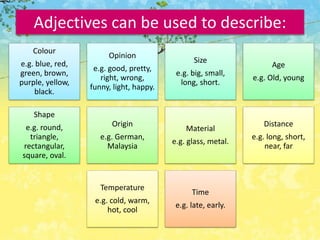
Adjectives can be used to describe: 
Colour 
e.g. blue, red, 
green, brown, 
purple, yellow, 
black. 
Opinion 
e.g. good, pretty, 
right, wrong, 
funny, light, happy. 
Size 
e.g. big, small, 
long, short. 
Age 
e.g. Old, young 
Shape 
e.g. round, 
triangle, 
rectangular, 
square, oval. 
Origin 
e.g. German, 
Malaysia 
Material 
e.g. glass, metal. 
Distance 
e.g. long, short, 
near, far 
Temperature 
e.g. cold, warm, 
hot, cool 
Time 
e.g. late, early.
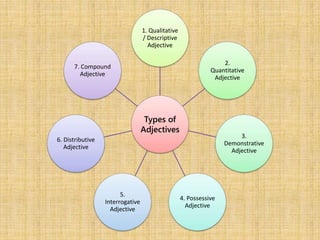
1. Qualitative 
/ Descriptive 
Adjective 
Types of 
Adjectives 
2. 
Quantitative 
Adjective 
3. 
Demonstrative 
Adjective 
4. Possessive 
Adjective 
5. 
7. Compound 
Adjective 
Interrogative 
Adjective 
6. Distributive 
Adjective
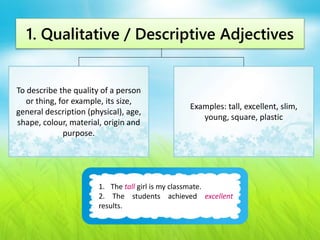
1. Qualitative / Descriptive Adjectives 
To describe the quality of a person 
or thing, for example, its size, 
general description (physical), age, 
shape, colour, material, origin and 
1. The tall girl is my classmate. 
2. The students achieved excellent 
results. 
purpose. 
Examples: tall, excellent, slim, 
young, square, plastic
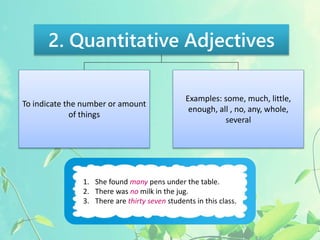
2. Quantitative Adjectives 
To indicate the number or amount 
of things 
Examples: some, much, little, 
enough, all , no, any, whole, 
several 
1. She found many pens under the table. 
2. There was no milk in the jug. 
3. There are thirty seven students in this class.
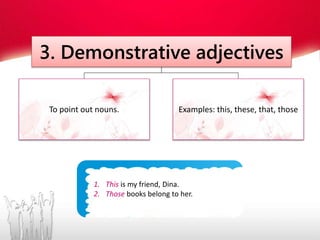
3. Demonstrative adjectives 
To point out nouns. Examples: this, these, that, those 
1. This is my friend, Dina. 
2. Those books belong to her.
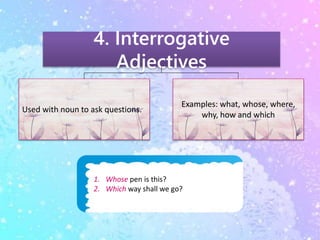
4. Interrogative 
Adjectives 
Used with noun to ask questions. 
Examples: what, whose, where, 
1. Whose pen is this? 
2. Which way shall we go? 
why, how and which
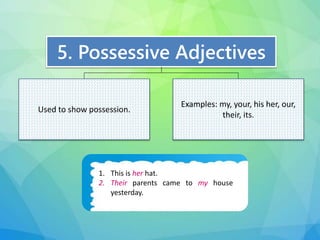
5. Possessive Adjectives 
Used to show possession. 
1. This is her hat. 
2. Their parents came to my house 
yesterday. 
Examples: my, your, his her, our, 
their, its.
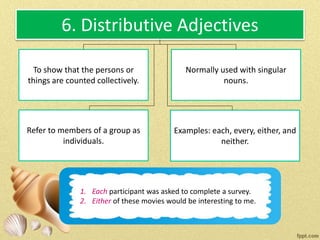
6. Distributive Adjectives 
To show that the persons or 
things are counted collectively. 
Normally used with singular 
nouns. 
Refer to members of a group as 
individuals. 
Examples: each, every, either, and 
neither. 
1. Each participant was asked to complete a survey. 
2. Either of these movies would be interesting to me.
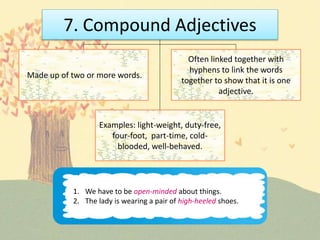
7. Compound Adjectives 
Made up of two or more words. 
Often linked together with 
hyphens to link the words 
together to show that it is one 
adjective. 
Examples: light-weight, duty-free, 
four-foot, part-time, cold-blooded, 
well-behaved. 
1. We have to be open-minded about things. 
2. The lady is wearing a pair of high-heeled shoes.
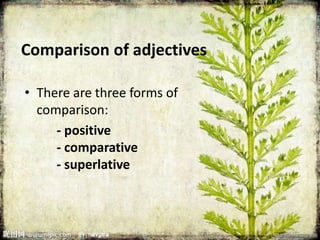
Comparison of adjectives 
• There are three forms of 
comparison: 
- positive 
- comparative 
- superlative
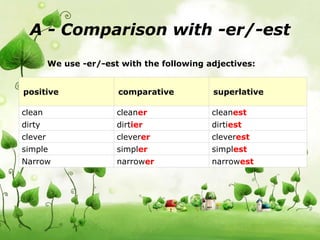
A - Comparison with -er/-est 
We use -er/-est with the following adjectives: 
positive comparative superlative 
clean cleaner cleanest 
dirty dirtier dirtiest 
clever cleverer cleverest 
simple simpler simplest 
Narrow narrower narrowest
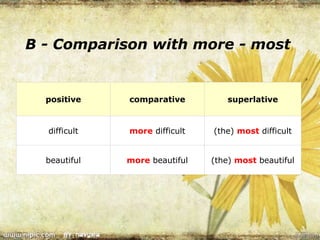
B - Comparison with more - most 
positive comparative superlative 
difficult more difficult (the) most difficult 
beautiful more beautiful (the) most beautiful
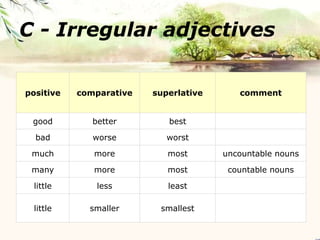
C - Irregular adjectives 
positive comparative superlative comment 
good better best 
bad worse worst 
much more most uncountable nouns 
many more most countable nouns 
little less least 
little smaller smallest
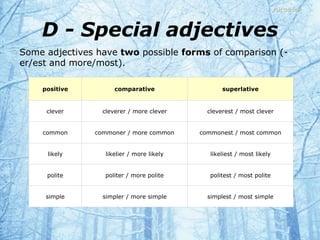
D - Special adjectives 
Some adjectives have two possible forms of comparison (- 
er/est and more/most). 
positive comparative superlative 
clever cleverer / more clever cleverest / most clever 
common commoner / more common commonest / most common 
likely likelier / more likely likeliest / most likely 
polite politer / more polite politest / most polite 
simple simpler / more simple simplest / most simple
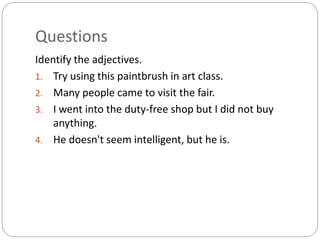
Questions 
Identify the adjectives. 
1. Try using this paintbrush in art class. 
2. Many people came to visit the fair. 
3. I went into the duty-free shop but I did not buy 
anything. 
4. He doesn't seem intelligent, but he is.
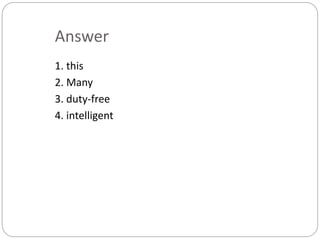
Answer 
1. this 
2. Many 
3. duty-free 
4. intelligent
References 
 http://www.playlearnschool.com/English/1/Adjecti 
ves/Adjectives.aspx 
 http://www.everythingenglishblog.com/?tag=distri 
butive-adjectives 
 http://www.english-for-students.com/Quantitative- 
Adjective.html

Adjective presentation

  • 1.
    Adjectives Prepared by: Chen Eu Keok Kee Guek Fen Low Zi Xin
  • 2.
    Adjectives are wordsthat describe nouns. Adjectives answer such questions as: What kind? Which one? How many?
  • 3.
    Adjectives can beused to describe: Colour e.g. blue, red, green, brown, purple, yellow, black. Opinion e.g. good, pretty, right, wrong, funny, light, happy. Size e.g. big, small, long, short. Age e.g. Old, young Shape e.g. round, triangle, rectangular, square, oval. Origin e.g. German, Malaysia Material e.g. glass, metal. Distance e.g. long, short, near, far Temperature e.g. cold, warm, hot, cool Time e.g. late, early.
  • 4.
    1. Qualitative /Descriptive Adjective Types of Adjectives 2. Quantitative Adjective 3. Demonstrative Adjective 4. Possessive Adjective 5. 7. Compound Adjective Interrogative Adjective 6. Distributive Adjective
  • 5.
    1. Qualitative /Descriptive Adjectives To describe the quality of a person or thing, for example, its size, general description (physical), age, shape, colour, material, origin and 1. The tall girl is my classmate. 2. The students achieved excellent results. purpose. Examples: tall, excellent, slim, young, square, plastic
  • 6.
    2. Quantitative Adjectives To indicate the number or amount of things Examples: some, much, little, enough, all , no, any, whole, several 1. She found many pens under the table. 2. There was no milk in the jug. 3. There are thirty seven students in this class.
  • 7.
    3. Demonstrative adjectives To point out nouns. Examples: this, these, that, those 1. This is my friend, Dina. 2. Those books belong to her.
  • 8.
    4. Interrogative Adjectives Used with noun to ask questions. Examples: what, whose, where, 1. Whose pen is this? 2. Which way shall we go? why, how and which
  • 9.
    5. Possessive Adjectives Used to show possession. 1. This is her hat. 2. Their parents came to my house yesterday. Examples: my, your, his her, our, their, its.
  • 10.
    6. Distributive Adjectives To show that the persons or things are counted collectively. Normally used with singular nouns. Refer to members of a group as individuals. Examples: each, every, either, and neither. 1. Each participant was asked to complete a survey. 2. Either of these movies would be interesting to me.
  • 11.
    7. Compound Adjectives Made up of two or more words. Often linked together with hyphens to link the words together to show that it is one adjective. Examples: light-weight, duty-free, four-foot, part-time, cold-blooded, well-behaved. 1. We have to be open-minded about things. 2. The lady is wearing a pair of high-heeled shoes.
  • 12.
    Comparison of adjectives • There are three forms of comparison: - positive - comparative - superlative
  • 13.
    A - Comparisonwith -er/-est We use -er/-est with the following adjectives: positive comparative superlative clean cleaner cleanest dirty dirtier dirtiest clever cleverer cleverest simple simpler simplest Narrow narrower narrowest
  • 14.
    B - Comparisonwith more - most positive comparative superlative difficult more difficult (the) most difficult beautiful more beautiful (the) most beautiful
  • 15.
    C - Irregularadjectives positive comparative superlative comment good better best bad worse worst much more most uncountable nouns many more most countable nouns little less least little smaller smallest
  • 16.
    D - Specialadjectives Some adjectives have two possible forms of comparison (- er/est and more/most). positive comparative superlative clever cleverer / more clever cleverest / most clever common commoner / more common commonest / most common likely likelier / more likely likeliest / most likely polite politer / more polite politest / most polite simple simpler / more simple simplest / most simple
  • 17.
    Questions Identify theadjectives. 1. Try using this paintbrush in art class. 2. Many people came to visit the fair. 3. I went into the duty-free shop but I did not buy anything. 4. He doesn't seem intelligent, but he is.
  • 18.
    Answer 1. this 2. Many 3. duty-free 4. intelligent
  • 19.
    References  http://www.playlearnschool.com/English/1/Adjecti ves/Adjectives.aspx  http://www.everythingenglishblog.com/?tag=distri butive-adjectives  http://www.english-for-students.com/Quantitative- Adjective.html