
Data ~ Data ~ Data ~ Oh My…. 
Review of a Collection of Articles and Book Excerpts 
By Lori Cottle 
EdPsych 510 
You can have data without information, but you cannot have information without data. 
Daniel Keys Moran
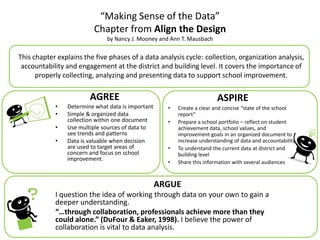
“Making Sense of the Data” 
Chapter from Align the Design 
by Nancy J. Mooney and Ann T. Mausbach 
This chapter explains the five phases of a data analysis cycle: collection, organization analysis, 
accountability and engagement at the district and building level. It covers the importance of 
properly collecting, analyzing and presenting data to support school improvement. 
AGREE 
• Determine what data is important 
• Simple & organized data 
collection within one document 
• Use multiple sources of data to 
see trends and patterns 
• Data is valuable when decision 
are used to target areas of 
concern and focus on school 
improvement. 
ASPIRE 
• Create a clear and concise “state of the school 
report” 
• Prepare a school portfolio – reflect on student 
achievement data, school values, and 
improvement goals in an organized document to 
increase understanding of data and accountability 
• To understand the current data at district and 
building level 
• Share this information with several audiences 
ARGUE 
I question the idea of working through data on your own to gain a 
deeper understanding. 
“…through collaboration, professionals achieve more than they 
could alone.” (DuFour & Eaker, 1998). I believe the power of 
collaboration is vital to data analysis.
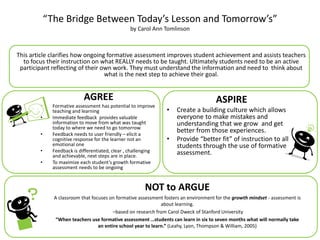
“The Bridge Between Today’s Lesson and Tomorrow’s” 
by Carol Ann Tomlinson 
This article clarifies how ongoing formative assessment improves student achievement and assists teachers 
to focus their instruction on what REALLY needs to be taught. Ultimately students need to be an active 
participant reflecting of their own work. They must understand the information and need to think about 
what is the next step to achieve their goal. 
AGREE 
• Formative assessment has potential to improve 
teaching and learning 
• Immediate feedback provides valuable 
information to move from what was taught 
today to where we need to go tomorrow 
• Feedback needs to user friendly – elicit a 
cognitive response for the learner not an 
emotional one 
• Feedback is differentiated, clear , challenging 
and achievable, next steps are in place. 
• To maximize each student’s growth formative 
assessment needs to be ongoing 
ASPIRE 
• Create a building culture which allows 
everyone to make mistakes and 
understanding that we grow and get 
better from those experiences. 
• Provide “better fit” of instruction to all 
students through the use of formative 
assessment. 
NOT to ARGUE 
A classroom that focuses on formative assessment fosters an environment for the growth mindset - assessment is 
about learning. 
–based on research from Carol Dweck of Stanford University 
“When teachers use formative assessment …students can learn in six to seven months what will normally take 
an entire school year to learn.” (Leahy, Lyon, Thompson & William, 2005)
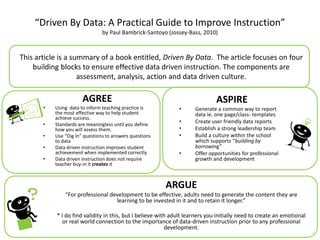
“Driven By Data: A Practical Guide to Improve Instruction” 
by Paul Bambrick-Santoyo (Jossey-Bass, 2010) 
This article is a summary of a book entitled, Driven By Data. The article focuses on four 
building blocks to ensure effective data driven instruction. The components are 
assessment, analysis, action and data driven culture. 
ARGUE 
“For professional development to be effective, adults need to generate the content they are 
learning to be invested in it and to retain it longer.” 
* I do find validity in this, but I believe with adult learners you initially need to create an emotional 
or real world connection to the importance of data-driven instruction prior to any professional 
development. 
ASPIRE 
• Generate a common way to report 
data ie. one page/class- templates 
• Create user friendly data reports 
• Establish a strong leadership team 
• Build a culture within the school 
which supports “building by 
borrowing” 
• Offer opportunities for professional 
growth and development 
AGREE 
• Using data to inform teaching practice is 
the most effective way to help student 
achieve success. 
• Standards are meaningless until you define 
how you will assess them. 
• Use “Dig In” questions to answers questions 
to data 
• Data driven instruction improves student 
achievement when implemented correctly 
• Data driven instruction does not require 
teacher buy-in it creates it
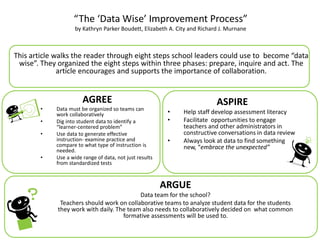
“The ‘Data Wise’ Improvement Process” 
by Kathryn Parker Boudett, Elizabeth A. City and Richard J. Murnane 
This article walks the reader through eight steps school leaders could use to become “data 
wise”. They organized the eight steps within three phases: prepare, inquire and act. The 
article encourages and supports the importance of collaboration. 
AGREE 
• Data must be organized so teams can 
work collaboratively 
• Dig into student data to identify a 
“learner-centered problem” 
• Use data to generate effective 
instruction- examine practice and 
compare to what type of instruction is 
needed. 
• Use a wide range of data, not just results 
from standardized tests 
ASPIRE 
• Help staff develop assessment literacy 
• Facilitate opportunities to engage 
teachers and other administrators in 
constructive conversations in data review 
• Always look at data to find something 
new, “embrace the unexpected” 
ARGUE 
Data team for the school? 
Teachers should work on collaborative teams to analyze student data for the students 
they work with daily. The team also needs to collaboratively decided on what common 
formative assessments will be used to.
“Sustaining School Improvement-Data Driven Decision Making” 
McREL Web site 
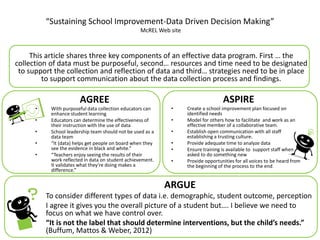
This article shares three key components of an effective data program. First … the 
collection of data must be purposeful, second… resources and time need to be designated 
to support the collection and reflection of data and third… strategies need to be in place 
to support communication about the data collection process and findings. 
AGREE 
• With purposeful data collection educators can 
enhance student learning 
• Educators can determine the effectiveness of 
their instruction with the use of data 
• School leadership team should not be used as a 
data team 
• “It (data) helps get people on board when they 
see the evidence in black and white.” 
• “Teachers enjoy seeing the results of their 
work reflected in data on student achievement. 
It validates what they’re doing makes a 
difference.” 
ASPIRE 
• Create a school improvement plan focused on 
identified needs 
• Model for others how to facilitate and work as an 
effective member of a collaborative team. 
• Establish open communication with all staff 
establishing a trusting culture. 
• Provide adequate time to analyze data 
• Ensure training is available to support staff when 
asked to do something new 
• Provide opportunities for all voices to be heard from 
the beginning of the process to the end. 
ARGUE 
To consider different types of data i.e. demographic, student outcome, perception 
I agree it gives you the overall picture of a student but…. I believe we need to 
focus on what we have control over. 
“It is not the label that should determine interventions, but the child’s needs.” 
(Buffum, Mattos & Weber, 2012)
“Building a High-Performing Data Culture” 
by Nancy Love 
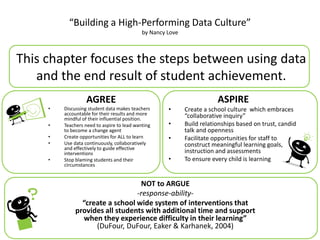
This chapter focuses the steps between using data 
and the end result of student achievement. 
AGREE 
• Discussing student data makes teachers 
accountable for their results and more 
mindful of their influential position. 
• Teachers need to aspire to lead wanting 
to become a change agent 
• Create opportunities for ALL to learn 
• Use data continuously, collaboratively 
and effectively to guide effective 
interventions 
• Stop blaming students and their 
circumstances 
ASPIRE 
• Create a school culture which embraces 
“collaborative inquiry” 
• Build relationships based on trust, candid 
talk and openness 
• Facilitate opportunities for staff to 
construct meaningful learning goals, 
instruction and assessments 
• To ensure every child is learning 
NOT to ARGUE 
-response-ability- 
“create a school wide system of interventions that 
provides all students with additional time and support 
when they experience difficulty in their learning” 
(DuFour, DuFour, Eaker & Karhanek, 2004)

Cottle ppt edpsych510

  • 1.
    Data ~ Data~ Data ~ Oh My…. Review of a Collection of Articles and Book Excerpts By Lori Cottle EdPsych 510 You can have data without information, but you cannot have information without data. Daniel Keys Moran
  • 2.
    “Making Sense ofthe Data” Chapter from Align the Design by Nancy J. Mooney and Ann T. Mausbach This chapter explains the five phases of a data analysis cycle: collection, organization analysis, accountability and engagement at the district and building level. It covers the importance of properly collecting, analyzing and presenting data to support school improvement. AGREE • Determine what data is important • Simple & organized data collection within one document • Use multiple sources of data to see trends and patterns • Data is valuable when decision are used to target areas of concern and focus on school improvement. ASPIRE • Create a clear and concise “state of the school report” • Prepare a school portfolio – reflect on student achievement data, school values, and improvement goals in an organized document to increase understanding of data and accountability • To understand the current data at district and building level • Share this information with several audiences ARGUE I question the idea of working through data on your own to gain a deeper understanding. “…through collaboration, professionals achieve more than they could alone.” (DuFour & Eaker, 1998). I believe the power of collaboration is vital to data analysis.
  • 3.
    “The Bridge BetweenToday’s Lesson and Tomorrow’s” by Carol Ann Tomlinson This article clarifies how ongoing formative assessment improves student achievement and assists teachers to focus their instruction on what REALLY needs to be taught. Ultimately students need to be an active participant reflecting of their own work. They must understand the information and need to think about what is the next step to achieve their goal. AGREE • Formative assessment has potential to improve teaching and learning • Immediate feedback provides valuable information to move from what was taught today to where we need to go tomorrow • Feedback needs to user friendly – elicit a cognitive response for the learner not an emotional one • Feedback is differentiated, clear , challenging and achievable, next steps are in place. • To maximize each student’s growth formative assessment needs to be ongoing ASPIRE • Create a building culture which allows everyone to make mistakes and understanding that we grow and get better from those experiences. • Provide “better fit” of instruction to all students through the use of formative assessment. NOT to ARGUE A classroom that focuses on formative assessment fosters an environment for the growth mindset - assessment is about learning. –based on research from Carol Dweck of Stanford University “When teachers use formative assessment …students can learn in six to seven months what will normally take an entire school year to learn.” (Leahy, Lyon, Thompson & William, 2005)
  • 4.
    “Driven By Data:A Practical Guide to Improve Instruction” by Paul Bambrick-Santoyo (Jossey-Bass, 2010) This article is a summary of a book entitled, Driven By Data. The article focuses on four building blocks to ensure effective data driven instruction. The components are assessment, analysis, action and data driven culture. ARGUE “For professional development to be effective, adults need to generate the content they are learning to be invested in it and to retain it longer.” * I do find validity in this, but I believe with adult learners you initially need to create an emotional or real world connection to the importance of data-driven instruction prior to any professional development. ASPIRE • Generate a common way to report data ie. one page/class- templates • Create user friendly data reports • Establish a strong leadership team • Build a culture within the school which supports “building by borrowing” • Offer opportunities for professional growth and development AGREE • Using data to inform teaching practice is the most effective way to help student achieve success. • Standards are meaningless until you define how you will assess them. • Use “Dig In” questions to answers questions to data • Data driven instruction improves student achievement when implemented correctly • Data driven instruction does not require teacher buy-in it creates it
  • 5.
    “The ‘Data Wise’Improvement Process” by Kathryn Parker Boudett, Elizabeth A. City and Richard J. Murnane This article walks the reader through eight steps school leaders could use to become “data wise”. They organized the eight steps within three phases: prepare, inquire and act. The article encourages and supports the importance of collaboration. AGREE • Data must be organized so teams can work collaboratively • Dig into student data to identify a “learner-centered problem” • Use data to generate effective instruction- examine practice and compare to what type of instruction is needed. • Use a wide range of data, not just results from standardized tests ASPIRE • Help staff develop assessment literacy • Facilitate opportunities to engage teachers and other administrators in constructive conversations in data review • Always look at data to find something new, “embrace the unexpected” ARGUE Data team for the school? Teachers should work on collaborative teams to analyze student data for the students they work with daily. The team also needs to collaboratively decided on what common formative assessments will be used to.
  • 6.
    “Sustaining School Improvement-DataDriven Decision Making” McREL Web site This article shares three key components of an effective data program. First … the collection of data must be purposeful, second… resources and time need to be designated to support the collection and reflection of data and third… strategies need to be in place to support communication about the data collection process and findings. AGREE • With purposeful data collection educators can enhance student learning • Educators can determine the effectiveness of their instruction with the use of data • School leadership team should not be used as a data team • “It (data) helps get people on board when they see the evidence in black and white.” • “Teachers enjoy seeing the results of their work reflected in data on student achievement. It validates what they’re doing makes a difference.” ASPIRE • Create a school improvement plan focused on identified needs • Model for others how to facilitate and work as an effective member of a collaborative team. • Establish open communication with all staff establishing a trusting culture. • Provide adequate time to analyze data • Ensure training is available to support staff when asked to do something new • Provide opportunities for all voices to be heard from the beginning of the process to the end. ARGUE To consider different types of data i.e. demographic, student outcome, perception I agree it gives you the overall picture of a student but…. I believe we need to focus on what we have control over. “It is not the label that should determine interventions, but the child’s needs.” (Buffum, Mattos & Weber, 2012)
  • 7.
    “Building a High-PerformingData Culture” by Nancy Love This chapter focuses the steps between using data and the end result of student achievement. AGREE • Discussing student data makes teachers accountable for their results and more mindful of their influential position. • Teachers need to aspire to lead wanting to become a change agent • Create opportunities for ALL to learn • Use data continuously, collaboratively and effectively to guide effective interventions • Stop blaming students and their circumstances ASPIRE • Create a school culture which embraces “collaborative inquiry” • Build relationships based on trust, candid talk and openness • Facilitate opportunities for staff to construct meaningful learning goals, instruction and assessments • To ensure every child is learning NOT to ARGUE -response-ability- “create a school wide system of interventions that provides all students with additional time and support when they experience difficulty in their learning” (DuFour, DuFour, Eaker & Karhanek, 2004)