Co-Teaching Models
What do they look like?
By Beth Edwards
What is Co-Teaching?

Two teachers sharing classroom responsibilities

Used for inclusion classrooms

5 different co-teaching models
Model 1: Parallel Teaching

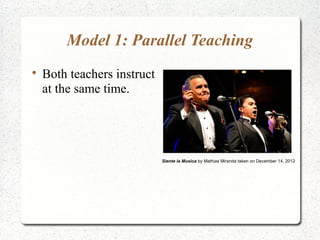
Both teachers instruct
at the same time.
Siente la Musica by Mathias Miranda taken on December 14, 2012
Model 2: Team Teaching

Both teachers take
turns leading the
instruction.
Passing the Baton by Calum Graham taken on August 29, 2011
Model 3: One teach/ One drift

One teacher leads the
whole group
instruction while the
other drifts around
the class.
Visually Stimulating Kindergarten Classroom by Kay taken on May 4, 2010
Model 4: Station/Center Teaching

The class is broken
into stations while
both teachers lead
one station.
Elementary by Kingswood Academy taken on October 18, 2010
Model 5: Alternative Teaching

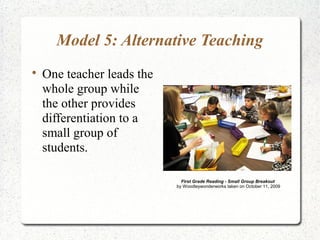
One teacher leads the
whole group while
the other provides
differentiation to a
small group of
students.
First Grade Reading - Small Group Breakout
by Woodleywonderworks taken on October 11, 2009
Reference
Goldwriter (2012) Co-teaching and Different Styles of Co-teaching. Retrieved from
http://www.brighthubeducation.com/special-ed-inclusion-strategies/4096-co-teaching-and-di

Co-Teaching Models

  • 1.
    Co-Teaching Models What dothey look like? By Beth Edwards
  • 2.
    What is Co-Teaching?  Twoteachers sharing classroom responsibilities  Used for inclusion classrooms  5 different co-teaching models
  • 3.
    Model 1: ParallelTeaching  Both teachers instruct at the same time. Siente la Musica by Mathias Miranda taken on December 14, 2012
  • 4.
    Model 2: TeamTeaching  Both teachers take turns leading the instruction. Passing the Baton by Calum Graham taken on August 29, 2011
  • 5.
    Model 3: Oneteach/ One drift  One teacher leads the whole group instruction while the other drifts around the class. Visually Stimulating Kindergarten Classroom by Kay taken on May 4, 2010
  • 6.
    Model 4: Station/CenterTeaching  The class is broken into stations while both teachers lead one station. Elementary by Kingswood Academy taken on October 18, 2010
  • 7.
    Model 5: AlternativeTeaching  One teacher leads the whole group while the other provides differentiation to a small group of students. First Grade Reading - Small Group Breakout by Woodleywonderworks taken on October 11, 2009
  • 8.
    Reference Goldwriter (2012) Co-teachingand Different Styles of Co-teaching. Retrieved from http://www.brighthubeducation.com/special-ed-inclusion-strategies/4096-co-teaching-and-di

Editor's Notes

  • #3 Co-teaching is used in classrooms that have inclusion students, consisting of a regular education teacher and a special education teacher. This is becoming a widely used and popular structure in our modern educational community. Co-teaching can look like 5 different models. Most successful co-teaching settings utilize all five models throughout the school year.
  • #4 This model of co-teaching is ideal for larger classes. Teachers will split the class in half and teach the same lesson at the same time. In larger classroom settings, students can easily get lost in a lesson, but by breaking the class into a smaller group makes it harder for this to happen causing larger chances for success for the students. In my own experience, this was a very good model when teaching inclusion math. We were able to teach at a rate that was appropriate for our individual groups and give more individualized attention to students who needed it.
  • #5 Also known as tag team teaching, this is a highly favored style of teaching amongst co-teachers. Both teachers take turns leading the instruction during the lesson. This is one of the more commonly used models in a co-teaching setting. This style also allows students to experience a healthy collaboration relationship if the model is done correctly in the classroom setting.
  • #6 This is a co-teaching model that can be used, but should not be utilized on a regular basis. If co-teachers use this model on a daily basis, it will make one teacher dominant in the classroom and not create a healthy inclusion environment for the students. This model should be used for assessment purposes. The teacher who drifts can observe the students as a whole and individually to help guide future lessons in the classroom.
  • #7 In most classrooms that utilize station or centers, the class is broken into four small groups. Each co-teacher takes one of the stations and is responsible for leading that group. These are usually activities that require some guidance, like small group reading groups. The other groups are activities that the students would be able to complete independently. Stations takes a lot of planning and preparation on the teachers' parts, but is a highly enjoyed model especially on the elementary level.
  • #8 Alternative teaching is the last co-teaching model. This is when one of the co-teachers leads the whole class in a lesson. While that teacher is teaching, the other has pulled a small group of students to work with. This can be a way to help struggling students with a concept, or could also be utilized for students who need enrichment on the lesson that is currently being taught.