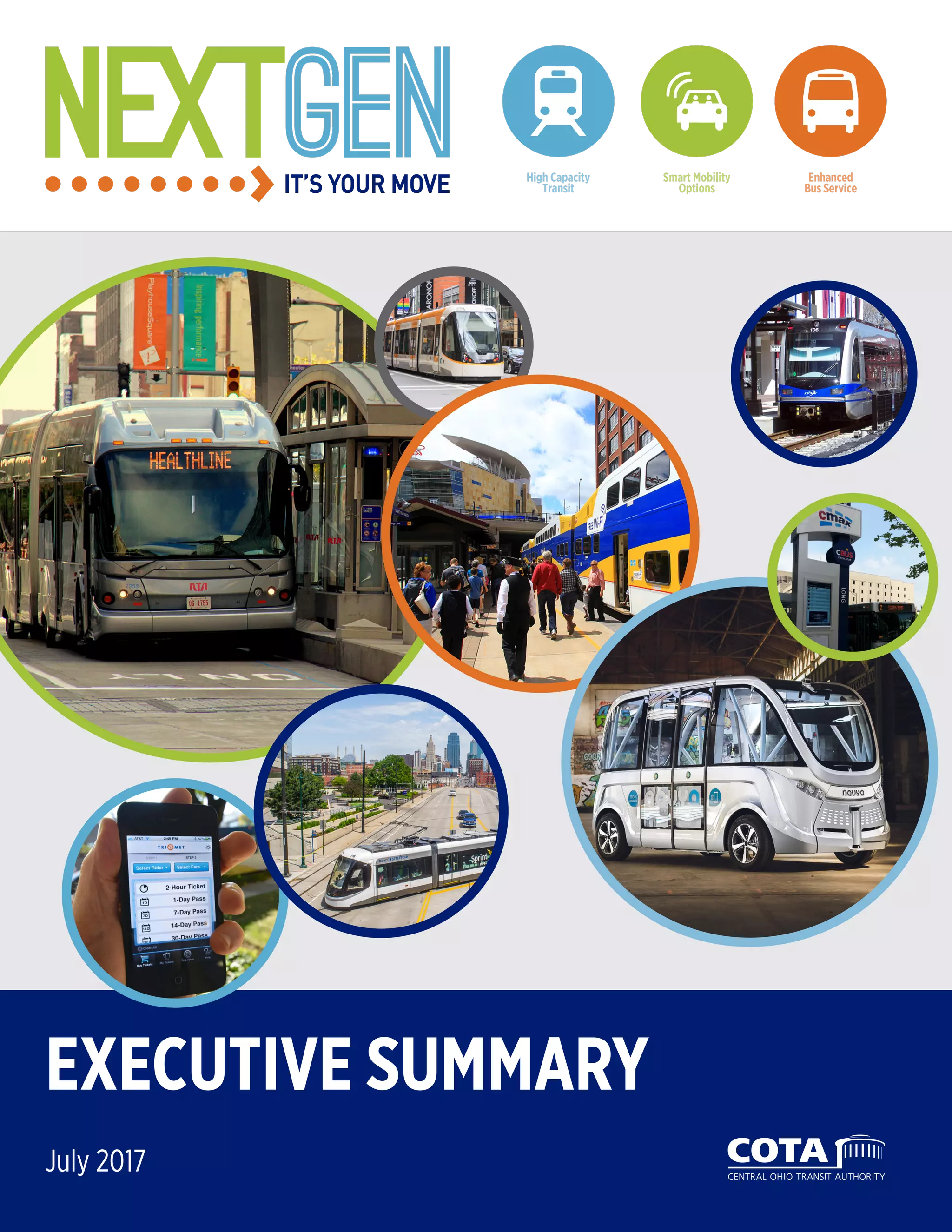
High Capacity
Transit
Smart Mobility
Options
Enhanced
Bus Service
FINAL REPORT
July 2017
EXECUTIVE SUMMARY
July 2017
Cover page photo credits (clockwise from left):
Flickr, wyliepoon
Flickr, Angelskiss31
Michael Hicks
Flickr, James Willamor
NelsonNygaard
AutonomousBus-Source-Navya
Flickr, Jason Doss
TriMet
EXECUTIVE
SUMMARY
Executive Summary
1 2 3 4
The Community’s Vision
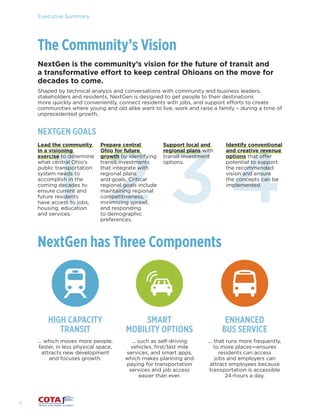
NextGen has Three Components
NEXTGEN GOALS
NextGen is the community’s vision for the future of transit and
a transformative effort to keep central Ohioans on the move for
decades to come.
Shaped by technical analysis and conversations with community and business leaders,
stakeholders and residents, NextGen is designed to get people to their destinations
more quickly and conveniently, connect residents with jobs, and support efforts to create
communities where young and old alike want to live, work and raise a family – during a time of
unprecedented growth.
Lead the community
in a visioning
exercise to determine
what central Ohio’s
public transportation
system needs to
accomplish in the
coming decades to
ensure current and
future residents
have access to jobs,
housing, education
and services.
... which moves more people,
faster, in less physical space,
attracts new development
and focuses growth.
... such as self-driving
vehicles, first/last mile
services, and smart apps,
which makes planning and
paying for transportation
services and job access
easier than ever.
... that runs more frequently,
to more places—ensures
residents can access
jobs and employers can
attract employees because
transportation is accessible
24-hours a day.
Prepare central
Ohio for future
growth by identifying
transit investments
that integrate with
regional plans
and goals. Critical
regional goals include
maintaining regional
competitiveness,
minimizing sprawl,
and responding
to demographic
preferences.
Support local and
regional plans with
transit investment
options.
Identify conventional
and creative revenue
options that offer
potential to support
the recommended
vision and ensure
the concepts can be
implemented.
HIGH CAPACITY
TRANSIT
SMART
MOBILITY OPTIONS
ENHANCED
BUS SERVICE
4
Executive Summary
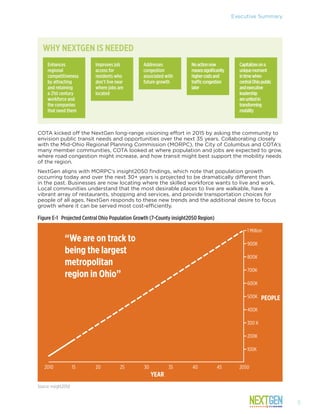
COTA kicked off the NextGen long-range visioning effort in 2015 by asking the community to
envision public transit needs and opportunities over the next 35 years. Collaborating closely
with the Mid-Ohio Regional Planning Commission (MORPC), the City of Columbus and COTA’s
many member communities, COTA looked at where population and jobs are expected to grow,
where road congestion might increase, and how transit might best support the mobility needs
of the region.
NextGen aligns with MORPC’s insight2050 findings, which note that population growth
occurring today and over the next 30+ years is projected to be dramatically different than
in the past. Businesses are now locating where the skilled workforce wants to live and work.
Local communities understand that the most desirable places to live are walkable, have a
vibrant array of restaurants, shopping and services, and provide transportation choices for
people of all ages. NextGen responds to these new trends and the additional desire to focus
growth where it can be served most cost-efficiently.
1 Million
900K
800K
700K
600K
500K
400K
300 K
200K
100K
2010 15 20 25 30 35 40 45 2050
“We are on track to
being the largest
metropolitan
region in Ohio”
PEOPLE
YEAR
Figure E-1	 Projected Central Ohio Population Growth (7-County insight2050 Region)
Source: insight2050
WHY NEXTGEN IS NEEDED
Enhances
regional
competitiveness
by attracting
and retaining
a 21st century
workforce and
the companies
that need them
Improves job
access for
residents who
don’t live near
where jobs are
located
Addresses
congestion
associated with
future growth
Noactionnow
meanssignificantly
highercostsand
trafficcongestion
later
Capitalizesona
uniquemoment
intimewhen
centralOhiopublic
andexecutive
leadership
areunitedin
transforming
mobility
5
Executive Summary
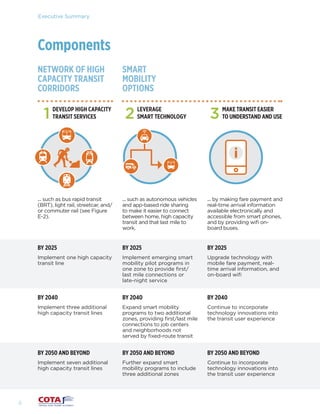
Components
NETWORK OF HIGH
CAPACITY TRANSIT
CORRIDORS
SMART
MOBILITY
OPTIONS
i
DEVELOP HIGH CAPACITY
TRANSIT SERVICES
LEVERAGE
SMART TECHNOLOGY
MAKE TRANSIT EASIER
TO UNDERSTAND AND USE
... such as bus rapid transit
(BRT), light rail, streetcar, and/
or commuter rail (see Figure
E-2).
... such as autonomous vehicles
and app-based ride sharing
to make it easier to connect
between home, high capacity
transit and that last mile to
work.
... by making fare payment and
real-time arrival information
available electronically and
accessible from smart phones,
and by providing wifi on-
board buses.
Implement seven additional
high capacity transit lines
Further expand smart
mobility programs to include
three additional zones
Continue to incorporate
technology innovations into
the transit user experience
BY 2050 AND BEYOND BY 2050 AND BEYOND BY 2050 AND BEYOND
Implement three additional
high capacity transit lines
Expand smart mobility
programs to two additional
zones, providing first/last mile
connections to job centers
and neighborhoods not
served by fixed-route transit
Continue to incorporate
technology innovations into
the transit user experience
BY 2040 BY 2040 BY 2040
Implement one high capacity
transit line
Implement emerging smart
mobility pilot programs in
one zone to provide first/
last mile connections or
late-night service
Upgrade technology with
mobile fare payment, real-
time arrival information, and
on-board wifi
BY 2025 BY 2025 BY 2025
1 2 3
6
Executive Summary
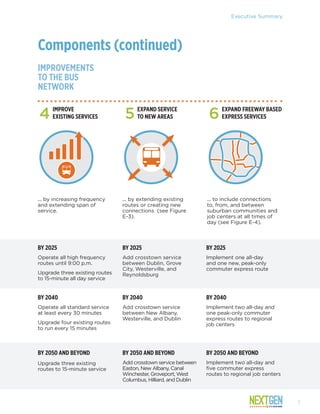
Components (continued)
IMPROVEMENTS
TO THE BUS
NETWORK
... by increasing frequency
and extending span of
service.
Upgrade three existing
routes to 15-minute service
BY 2050 AND BEYOND
Operate all standard service
at least every 30 minutes
Upgrade four existing routes
to run every 15 minutes
BY 2040
Operate all high frequency
routes until 9:00 p.m.
Upgrade three existing routes
to 15-minute all day service
BY 2025
IMPROVE
EXISTING SERVICES4
... by extending existing
routes or creating new
connections (see Figure
E-3).
Add crosstown service between
Easton, New Albany, Canal
Winchester, Groveport, West
Columbus, Hilliard, and Dublin
BY 2050 AND BEYOND
Add crosstown service
between New Albany,
Westerville, and Dublin
BY 2040
Add crosstown service
between Dublin, Grove
City, Westerville, and
Reynoldsburg
BY 2025
EXPAND SERVICE
TO NEW AREAS5
... to include connections
to, from, and between
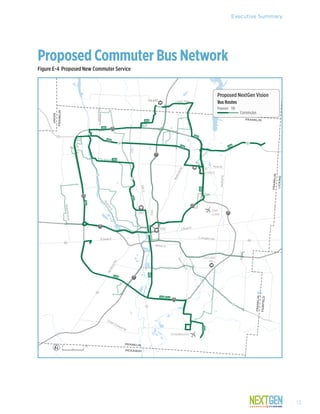
suburban communities and
job centers at all times of
day (see Figure E-4).
Implement two all-day and
five commuter express
routes to regional job centers
BY 2050 AND BEYOND
Implement two all-day and
one peak-only commuter
express routes to regional
job centers
BY 2040
Implement one all-day
and one new, peak-only
commuter express route
BY 2025
EXPAND FREEWAY BASED
EXPRESS SERVICES6
7
Executive Summary
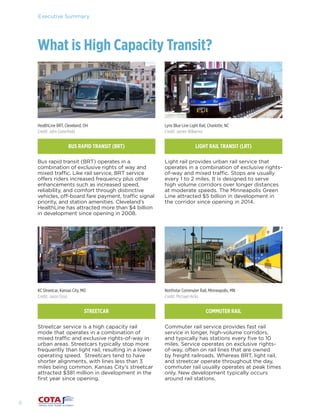
What is High Capacity Transit?
Bus rapid transit (BRT) operates in a
combination of exclusive rights of way and
mixed traffic. Like rail service, BRT service
offers riders increased frequency plus other
enhancements such as increased speed,
reliability, and comfort through distinctive
vehicles, off-board fare payment, traffic signal
priority, and station amenities. Cleveland’s
HealthLine has attracted more than $4 billion
in development since opening in 2008.
HealthLine BRT, Cleveland, OH
Credit: John Greenfield
KC Streetcar, Kansas City, MO
Credit: Jason Doss
Lynx Blue Line Light Rail, Charlotte, NC
Credit: James Willamor
Northstar Commuter Rail, Minneapolis, MN
Credit: Michael Hicks
STREETCAR
BUS RAPID TRANSIT (BRT)
COMMUTER RAIL
LIGHT RAIL TRANSIT (LRT)
Streetcar service is a high capacity rail
mode that operates in a combination of
mixed traffic and exclusive rights-of-way in
urban areas. Streetcars typically stop more
frequently than light rail, resulting in a lower
operating speed. Streetcars tend to have
shorter alignments, with lines less than 3
miles being common. Kansas City’s streetcar
attracted $381 million in development in the
first year since opening.
Light rail provides urban rail service that
operates in a combination of exclusive rights-
of-way and mixed traffic. Stops are usually
every 1 to 2 miles. It is designed to serve
high volume corridors over longer distances
at moderate speeds. The Minneapolis Green
Line attracted $5 billion in development in
the corridor since opening in 2014.
Commuter rail service provides fast rail
service in longer, high-volume corridors,
and typically has stations every five to 10
miles. Service operates on exclusive rights-
of-way, often on rail lines that are owned
by freight railroads. Whereas BRT, light rail,
and streetcar operate throughout the day,
commuter rail usually operates at peak times
only. New development typically occurs
around rail stations.
8
Why Invest in High Capacity Transit?
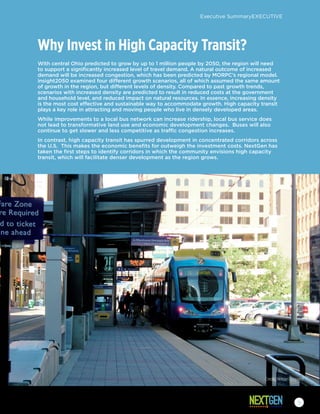
With central Ohio predicted to grow by up to 1 million people by 2050, the region will need
to support a significantly increased level of travel demand. A natural outcome of increased
demand will be increased congestion, which has been predicted by MORPC’s regional model.
insight2050 examined four different growth scenarios, all of which assumed the same amount
of growth in the region, but different levels of density. Compared to past growth trends,
scenarios with increased density are predicted to result in reduced costs at the government
and household level, and reduced impact on natural resources. In essence, increasing density
is the most cost effective and sustainable way to accommodate growth. High capacity transit
plays a key role in attracting and moving people who live in densely developed areas.
While improvements to a local bus network can increase ridership, local bus service does
not lead to transformative land use and economic development changes. Buses will also
continue to get slower and less competitive as traffic congestion increases.
In contrast, high capacity transit has spurred development in concentrated corridors across
the U.S. This makes the economic benefits for outweigh the investment costs. NextGen has
taken the first steps to identify corridors in which the community envisions high capacity
transit, which will facilitate denser development as the region grows.
Credit: NelsonNygaard
Executive SummaryEXECUTIVE
9
Executive Summary
Proposed High Capacity Transit Network
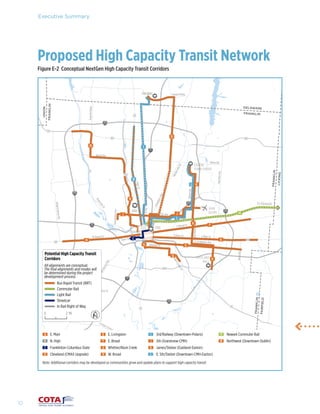
Figure E-2	 Conceptual NextGen High Capacity Transit Corridors
PICKAWAY
FRANKLIN
DELAWARE
FRANKLIN
FRANKLIN
UNION
FRANKLIN
FAIRFIELD
FRANKLIN
LICKING
POLARIS
OSU
CSCC
EASTON
TOWN CENTER
EASTLAND
MALL
JOHN
GLENN
RICKENBACKER
To Newark
40
33
40
33
23
62
23
33
104
161
315
161
270
670
71
71
70
270
270
270
E Broad St
E Main StE Main St
Whittier St
E Livingston Ave
BriceRd
W Broad St
HarrisburgPike
RiversideDr
3rdSt
ClevelandAve
JamesRd
StelzerRd
Morse Rd
HighSt
5th Ave
GrandviewAve
Bethel Rd
London Groveport Rd
Polaris Pkwy
AlumCreekDr
SawmillRoad
Hilliard-RomeRd
Columbus St
WestervilleRd
HamiltonRd
Town St
MJ J
L
K
K
K
L
N
N
F
H
G
G E
D
I
B
AC
%
%
%
%
Bus Rapid Transit (BRT)
Commuter Rail
Light Rail
Streetcar
In Rail Right of Way
0 2 Mi
Potential High Capacity Transit
Corridors
All alignments are conceptual.
The final alignments and modes will
be determined during the project
development process.
M
K
J
L
N
E
D
F
E. Livingston
E. Broad
Whittier/Alum Creek
W. BroadH
G
I 3rd/Railway (Downtown-Polaris)
5th (Grandview-CMH)
James/Stelzer (Eastland-Easton)
E. 5th/Stelzer (Downtown-CMH-Easton)
Newark Commuter Rail
Northwest (Downtown-Dublin)B
A
C
E. Main
N. High
Franklinton-Columbus State
Cleveland (CMAX Upgrade)
Note: Additional corridors may be developed as communities grow and update plans to support high capacity transit.
10
Executive Summary
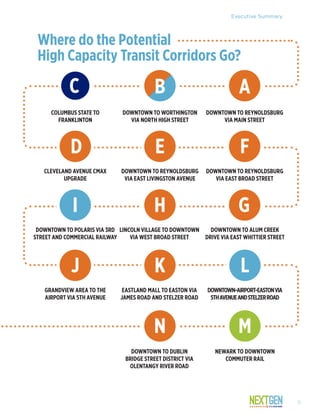
Where do the Potential
High Capacity Transit Corridors Go?
DOWNTOWN TO REYNOLDSBURG
VIA MAIN STREET
DOWNTOWN TO WORTHINGTON
VIA NORTH HIGH STREET
COLUMBUS STATE TO
FRANKLINTON
CLEVELAND AVENUE CMAX
UPGRADE
DOWNTOWN TO REYNOLDSBURG
VIA EAST LIVINGSTON AVENUE
DOWNTOWN TO ALUM CREEK
DRIVE VIA EAST WHITTIER STREET
GRANDVIEW AREA TO THE
AIRPORT VIA 5TH AVENUE
NEWARK TO DOWNTOWN
COMMUTER RAIL
LINCOLN VILLAGE TO DOWNTOWN
VIA WEST BROAD STREET
EASTLAND MALL TO EASTON VIA
JAMES ROAD AND STELZER ROAD
DOWNTOWN TO DUBLIN
BRIDGE STREET DISTRICT VIA
OLENTANGY RIVER ROAD
DOWNTOWN TO POLARIS VIA 3RD
STREET AND COMMERCIAL RAILWAY
DOWNTOWN-AIRPORT-EASTONVIA
5THAVENUEANDSTELZERROAD
A
D
G
J
M
B
E
H
K
N
C
I
L
DOWNTOWN TO REYNOLDSBURG
VIA EAST BROAD STREET
F
11
Executive Summary
Proposed Local Bus Network
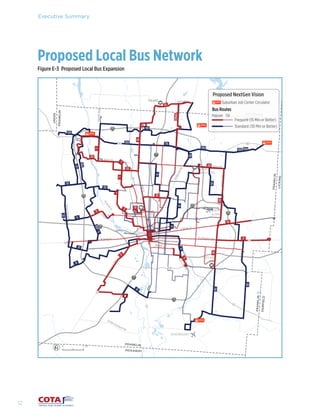
Figure E-3	 Proposed Local Bus Expansion
2
5
10
24
24
24
CMAX
2L
2L
33
33
1
1
1
3
3
31
31
5
101
101
102
102
32
32
21
21
21
9
9
103
103 104
103
25
25
24
35
35
5
5
11
11
11
8
LOCAL
LOCAL
LOCAL
LOCAL
PICKAWAY
FRANKLIN
PICKAWAY
FAIRFIELD
DELAWARE
FRANKLIN
FRANKLIN
UNION
FRANKLIN
FAIRFIELD
FRANKLIN
LICKING
POLARIS
OSU
CSCC
EASTON
TOWN CENTER
EASTLAND
MALL
JOHN
GLENN
RICKENBACKER
40
33
40
33
23
62
33
104
161
315
161
270
670
71
71
70
270
270
270
E Broad St
Whittier St
E Livingston Ave
BriceRd
W Broad St
HarrisburgPike
RiversideDr
3rdSt
Morse Rd
HighSt
Bethel Rd
London Groveport Rd
Polaris Pkwy
AlumCreekDr
SawmillRoad
Hilliard-RomeRd
WestervilleRd
HamiltonRd
%
%
Proposed NextGen Vision
Frequent (15 Min or Better)
Standard (30 Min or Better)
Suburban Job Center CirculatorLOCAL
Bus Routes
TSRProposed
0 2 Mi
12
Executive Summary
Proposed Commuter Bus Network
Figure E-4	Proposed New Commuter Service
209
204
209
209
203
206
206
204
207
208
202
202
201
205
205
PICKAWAY
FRANKLIN
PICKAWAY
FAIRFIELD
DELAWARE
FRANKLIN
FRANKLIN
UNION
FRANKLIN
FAIRFIELD
FRANKLIN
LICKING
POLARIS
OSU
CSCC
EASTON
TOWN CENTER
EASTLAND
MALL
JOHN
GLENN
RICKENBACKER
40
33
40
33
23
62
33
104
161
315
161
270
670
71
71
70
270
270
270
E Broad St
Whittier St
E Livingston Ave
BriceRd
W Broad St
HarrisburgPike
RiversideDr
3rdSt
Morse Rd
HighSt
Bethel Rd
London Groveport Rd
Polaris Pkwy
AlumCreekDr
SawmillRoad
Hilliard-RomeRd
WestervilleRd
HamiltonRd
%
%
Proposed NextGen Vision
Commuter
TSRProposed
Bus Routes
0 2 Mi
13
Executive Summary
APPLICATIONS FOR SMART MOBILITY OPTIONS INCLUDE:
NextGen is Smart
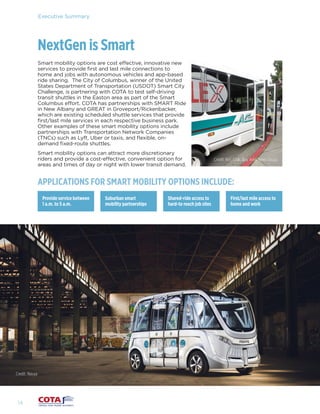
Smart mobility options are cost effective, innovative new
services to provide first and last mile connections to
home and jobs with autonomous vehicles and app-based
ride sharing. The City of Columbus, winner of the United
States Department of Transportation (USDOT) Smart City
Challenge, is partnering with COTA to test self-driving
transit shuttles in the Easton area as part of the Smart
Columbus effort. COTA has partnerships with SMART Ride
in New Albany and GREAT in Groveport/Rickenbacker,
which are existing scheduled shuttle services that provide
first/last mile services in each respective business park.
Other examples of these smart mobility options include
partnerships with Transportation Network Companies
(TNCs) such as Lyft, Uber or taxis, and flexible, on-
demand fixed-route shuttles.
Smart mobility options can attract more discretionary
riders and provide a cost-effective, convenient option for
areas and times of day or night with lower transit demand.
Provide service between
1 a.m. to 5 a.m.
Suburban smart
mobility partnerships
Shared-ride access to
hard-to reach job sites
First/last mile access to
home and work
Credit: Aric Crab, Bay Area News Group
Credit: Navya
14
Executive Summary
Collaborative Efforts
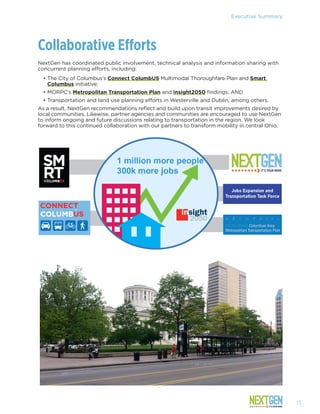
NextGen has coordinated public involvement, technical analysis and information sharing with
concurrent planning efforts, including:
•	The City of Columbus’s Connect ColumbUS Multimodal Thoroughfare Plan and Smart
Columbus initiative;
•	MORPC’s Metropolitan Transportation Plan and insight2050 findings; AND
•	Transportation and land use planning efforts in Westerville and Dublin, among others.
As a result, NextGen recommendations reflect and build upon transit improvements desired by
local communities. Likewise, partner agencies and communities are encouraged to use NextGen
to inform ongoing and future discussions relating to transportation in the region. We look
forward to this continued collaboration with our partners to transform mobility in central Ohio.
15
Executive Summary
NextGen was developed without defined funding sources or budget constraints in order to
create a vision that is tailored to the aspirations and needs of the region. It will, however,
require building new infrastructure, acquiring more vehicles and expanding budgets to
operate and maintain new and enhanced transit services.
It is estimated that between $4.9- and $5.4-billion in capital funds will be necessary to build
out NextGen over the next 35 years.1
In addition, transit operating budgets will need to
increase by $113- and $127-million annually between now and 2050. Though central Ohioans
contribute to transit service today through a 0.5 percent local sales tax, additional sources of
local, state and/or federal funding will be needed to make the vision outlined in NextGen a
reality.
NextGen is one piece of a broader investment in the robust transportation network needed
to accommodate regional growth in the coming years. Other examples include the Columbus
Crossroads interstate 70/71 reconstruction through downtown Columbus ($1.1 billion), and the
widening of I-270 in North Columbus ($390 million).
1	 All capital and operating costs are in 2016 dollars.
Funding the Vision
The Community’s Voice Was Heard
The NextGen Vision was shaped by extensive public and stakeholder engagement. Public
input helped define community values and identified needs and opportunities. It also shaped
in initial improvement options and the subsequent alternative refinement process. These
five community values emerged from public input and served as the guiding principles in the
development of the NextGen Vision.
MAKE BETTER
CONNECTIONS
Extend transit’s
reach further.
INVEST IN
UNDERSERVED
COMMUNITIES
Direct transit
investment
to specific
corridors and
neighborhoods.
COORDINATE
WITH GROWTH
Encourage
focused growth
in existing
neighborhoods
and fast-
growing areas.
BUILD
ON SUCCESS
Improve
existing service.
SUSTAINABILITY
Protect the
environment
and reduce
greenhouse gas
emissions.
Benefits of Transit Investment
•	 87% of public transit trips impact the
economy.
•	 Every $1 invested in public
transportation generates
approximately $4 in economic returns.
•	 Every $1 billion invested in public
transportation supports and creates
more than 50,000 jobs.
•	 Every $10 million in capital investment
in public transportation yields $32
million in increased business sales.
•	 Residential property values performed
42% better on average if they were
located near public transportation
with high-frequency service.
Source: American Public Transportation Association 2016 Public Transportation Fact Book – www.apta.com
16
Executive Summary
How NextGen Could Change
Transportation in Central Ohio
NextGen calls for improving and expanding existing transit service, implementing new types
of mobility services, and developing high capacity transit such as bus rapid transit (BRT),
light rail, streetcar and/or commuter rail. COTA’s new network, implemented by COTA in May
2017 took crucial first steps in transforming the bus network into a more effective system
with resources that exist today.
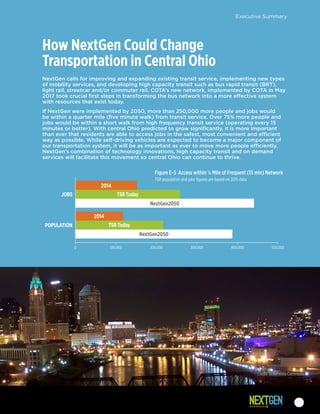
If NextGen were implemented by 2050, more than 250,000 more people and jobs would
be within a quarter mile (five minute walk) from transit service. Over 75% more people and
jobs would be within a short walk from high frequency transit service (operating every 15
minutes or better). With central Ohio predicted to grow significantly, it is more important
than ever that residents are able to access jobs in the safest, most convenient and efficient
way as possible. While self-driving vehicles are expected to become a major component of
our transportation system, it will be as important as ever to move more people efficiently.
NextGen’s combination of technology innovations, high capacity transit and on demand
services will facilitate this movement so central Ohio can continue to thrive.
POPULATION
JOBS
2014
TSR Today
NextGen2050
2014
TSR Today
NextGen2050
0 100,000 200,000 300,000 400,000 500,000
Figure E-5	 Access within ¼ Mile of Frequent (15 min) Network
TSR population and jobs figures are based on 2015 data
Executive Summary
Credit: Wikimedia Commons
17
Executive Summary
What is Included in this Vision?
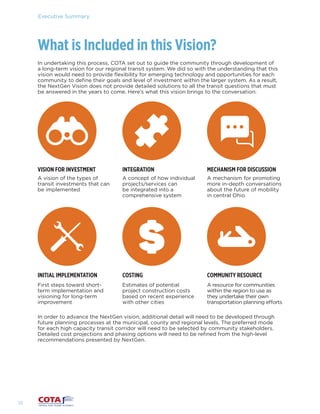
In undertaking this process, COTA set out to guide the community through development of
a long-term vision for our regional transit system. We did so with the understanding that this
vision would need to provide flexibility for emerging technology and opportunities for each
community to define their goals and level of investment within the larger system. As a result,
the NextGen Vision does not provide detailed solutions to all the transit questions that must
be answered in the years to come. Here’s what this vision brings to the conversation:
In order to advance the NextGen vision, additional detail will need to be developed through
future planning processes at the municipal, county and regional levels. The preferred mode
for each high capacity transit corridor will need to be selected by community stakeholders.
Detailed cost projections and phasing options will need to be refined from the high-level
recommendations presented by NextGen.
VISION FOR INVESTMENT
INITIAL IMPLEMENTATION
A vision of the types of
transit investments that can
be implemented
First steps toward short-
term implementation and
visioning for long-term
improvement
INTEGRATION
COSTING
A concept of how individual
projects/services can
be integrated into a
comprehensive system
Estimates of potential
project construction costs
based on recent experience
with other cities
MECHANISM FOR DISCUSSION
COMMUNITY RESOURCE
A mechanism for promoting
more in-depth conversations
about the future of mobility
in central Ohio
A resource for communities
within the region to use as
they undertake their own
transportation planning efforts
18
Executive Summary
Next Steps
NextGen reflects the desires of the very broad base of stakeholders and public who were
consulted as part of this effort, but it will require substantial investment to implement and
be challenging to fund. The community must now begin working together to develop new
funding options.
In the near term, COTA, its partner agencies and local municipalities can move forward
with components of NextGen that have a direct path to implementation. This includes
leveraging Smart Columbus to integrate more technology into transit, building on the recently
implemented bus network with further frequency enhancements, and expanding the reach
of the bus network to job sites through partnerships with municipalities and freeway-based
commuter services.
Developing a network of high capacity transit service will require additional planning and
consensus building to determine the order in which to implement corridors and how they will
be funded. Corridors selected for implementation in the next ten years must move beyond
conceptual visioning into project development. COTA will create a community-based steering
committee to prioritize components of the NextGen Vision. The steering committee will
consist of COTA Board of Trustee members, the business community, public officials, major
stakeholders, and the general public to set the direction for prioritizing NextGen projects and
develop funding alternatives.
Credit: NelsonNygaard
19
COTA NextGen-Executive Summary

COTA NextGen-Executive Summary

  • 1.
    High Capacity Transit Smart Mobility Options Enhanced BusService FINAL REPORT July 2017 EXECUTIVE SUMMARY July 2017
  • 2.
    Cover page photocredits (clockwise from left): Flickr, wyliepoon Flickr, Angelskiss31 Michael Hicks Flickr, James Willamor NelsonNygaard AutonomousBus-Source-Navya Flickr, Jason Doss TriMet
  • 3.
  • 4.
    Executive Summary 1 23 4 The Community’s Vision NextGen has Three Components NEXTGEN GOALS NextGen is the community’s vision for the future of transit and a transformative effort to keep central Ohioans on the move for decades to come. Shaped by technical analysis and conversations with community and business leaders, stakeholders and residents, NextGen is designed to get people to their destinations more quickly and conveniently, connect residents with jobs, and support efforts to create communities where young and old alike want to live, work and raise a family – during a time of unprecedented growth. Lead the community in a visioning exercise to determine what central Ohio’s public transportation system needs to accomplish in the coming decades to ensure current and future residents have access to jobs, housing, education and services. ... which moves more people, faster, in less physical space, attracts new development and focuses growth. ... such as self-driving vehicles, first/last mile services, and smart apps, which makes planning and paying for transportation services and job access easier than ever. ... that runs more frequently, to more places—ensures residents can access jobs and employers can attract employees because transportation is accessible 24-hours a day. Prepare central Ohio for future growth by identifying transit investments that integrate with regional plans and goals. Critical regional goals include maintaining regional competitiveness, minimizing sprawl, and responding to demographic preferences. Support local and regional plans with transit investment options. Identify conventional and creative revenue options that offer potential to support the recommended vision and ensure the concepts can be implemented. HIGH CAPACITY TRANSIT SMART MOBILITY OPTIONS ENHANCED BUS SERVICE 4
  • 5.
    Executive Summary COTA kickedoff the NextGen long-range visioning effort in 2015 by asking the community to envision public transit needs and opportunities over the next 35 years. Collaborating closely with the Mid-Ohio Regional Planning Commission (MORPC), the City of Columbus and COTA’s many member communities, COTA looked at where population and jobs are expected to grow, where road congestion might increase, and how transit might best support the mobility needs of the region. NextGen aligns with MORPC’s insight2050 findings, which note that population growth occurring today and over the next 30+ years is projected to be dramatically different than in the past. Businesses are now locating where the skilled workforce wants to live and work. Local communities understand that the most desirable places to live are walkable, have a vibrant array of restaurants, shopping and services, and provide transportation choices for people of all ages. NextGen responds to these new trends and the additional desire to focus growth where it can be served most cost-efficiently. 1 Million 900K 800K 700K 600K 500K 400K 300 K 200K 100K 2010 15 20 25 30 35 40 45 2050 “We are on track to being the largest metropolitan region in Ohio” PEOPLE YEAR Figure E-1 Projected Central Ohio Population Growth (7-County insight2050 Region) Source: insight2050 WHY NEXTGEN IS NEEDED Enhances regional competitiveness by attracting and retaining a 21st century workforce and the companies that need them Improves job access for residents who don’t live near where jobs are located Addresses congestion associated with future growth Noactionnow meanssignificantly highercostsand trafficcongestion later Capitalizesona uniquemoment intimewhen centralOhiopublic andexecutive leadership areunitedin transforming mobility 5
  • 6.
    Executive Summary Components NETWORK OFHIGH CAPACITY TRANSIT CORRIDORS SMART MOBILITY OPTIONS i DEVELOP HIGH CAPACITY TRANSIT SERVICES LEVERAGE SMART TECHNOLOGY MAKE TRANSIT EASIER TO UNDERSTAND AND USE ... such as bus rapid transit (BRT), light rail, streetcar, and/ or commuter rail (see Figure E-2). ... such as autonomous vehicles and app-based ride sharing to make it easier to connect between home, high capacity transit and that last mile to work. ... by making fare payment and real-time arrival information available electronically and accessible from smart phones, and by providing wifi on- board buses. Implement seven additional high capacity transit lines Further expand smart mobility programs to include three additional zones Continue to incorporate technology innovations into the transit user experience BY 2050 AND BEYOND BY 2050 AND BEYOND BY 2050 AND BEYOND Implement three additional high capacity transit lines Expand smart mobility programs to two additional zones, providing first/last mile connections to job centers and neighborhoods not served by fixed-route transit Continue to incorporate technology innovations into the transit user experience BY 2040 BY 2040 BY 2040 Implement one high capacity transit line Implement emerging smart mobility pilot programs in one zone to provide first/ last mile connections or late-night service Upgrade technology with mobile fare payment, real- time arrival information, and on-board wifi BY 2025 BY 2025 BY 2025 1 2 3 6
  • 7.
    Executive Summary Components (continued) IMPROVEMENTS TOTHE BUS NETWORK ... by increasing frequency and extending span of service. Upgrade three existing routes to 15-minute service BY 2050 AND BEYOND Operate all standard service at least every 30 minutes Upgrade four existing routes to run every 15 minutes BY 2040 Operate all high frequency routes until 9:00 p.m. Upgrade three existing routes to 15-minute all day service BY 2025 IMPROVE EXISTING SERVICES4 ... by extending existing routes or creating new connections (see Figure E-3). Add crosstown service between Easton, New Albany, Canal Winchester, Groveport, West Columbus, Hilliard, and Dublin BY 2050 AND BEYOND Add crosstown service between New Albany, Westerville, and Dublin BY 2040 Add crosstown service between Dublin, Grove City, Westerville, and Reynoldsburg BY 2025 EXPAND SERVICE TO NEW AREAS5 ... to include connections to, from, and between suburban communities and job centers at all times of day (see Figure E-4). Implement two all-day and five commuter express routes to regional job centers BY 2050 AND BEYOND Implement two all-day and one peak-only commuter express routes to regional job centers BY 2040 Implement one all-day and one new, peak-only commuter express route BY 2025 EXPAND FREEWAY BASED EXPRESS SERVICES6 7
  • 8.
    Executive Summary What isHigh Capacity Transit? Bus rapid transit (BRT) operates in a combination of exclusive rights of way and mixed traffic. Like rail service, BRT service offers riders increased frequency plus other enhancements such as increased speed, reliability, and comfort through distinctive vehicles, off-board fare payment, traffic signal priority, and station amenities. Cleveland’s HealthLine has attracted more than $4 billion in development since opening in 2008. HealthLine BRT, Cleveland, OH Credit: John Greenfield KC Streetcar, Kansas City, MO Credit: Jason Doss Lynx Blue Line Light Rail, Charlotte, NC Credit: James Willamor Northstar Commuter Rail, Minneapolis, MN Credit: Michael Hicks STREETCAR BUS RAPID TRANSIT (BRT) COMMUTER RAIL LIGHT RAIL TRANSIT (LRT) Streetcar service is a high capacity rail mode that operates in a combination of mixed traffic and exclusive rights-of-way in urban areas. Streetcars typically stop more frequently than light rail, resulting in a lower operating speed. Streetcars tend to have shorter alignments, with lines less than 3 miles being common. Kansas City’s streetcar attracted $381 million in development in the first year since opening. Light rail provides urban rail service that operates in a combination of exclusive rights- of-way and mixed traffic. Stops are usually every 1 to 2 miles. It is designed to serve high volume corridors over longer distances at moderate speeds. The Minneapolis Green Line attracted $5 billion in development in the corridor since opening in 2014. Commuter rail service provides fast rail service in longer, high-volume corridors, and typically has stations every five to 10 miles. Service operates on exclusive rights- of-way, often on rail lines that are owned by freight railroads. Whereas BRT, light rail, and streetcar operate throughout the day, commuter rail usually operates at peak times only. New development typically occurs around rail stations. 8
  • 9.
    Why Invest inHigh Capacity Transit? With central Ohio predicted to grow by up to 1 million people by 2050, the region will need to support a significantly increased level of travel demand. A natural outcome of increased demand will be increased congestion, which has been predicted by MORPC’s regional model. insight2050 examined four different growth scenarios, all of which assumed the same amount of growth in the region, but different levels of density. Compared to past growth trends, scenarios with increased density are predicted to result in reduced costs at the government and household level, and reduced impact on natural resources. In essence, increasing density is the most cost effective and sustainable way to accommodate growth. High capacity transit plays a key role in attracting and moving people who live in densely developed areas. While improvements to a local bus network can increase ridership, local bus service does not lead to transformative land use and economic development changes. Buses will also continue to get slower and less competitive as traffic congestion increases. In contrast, high capacity transit has spurred development in concentrated corridors across the U.S. This makes the economic benefits for outweigh the investment costs. NextGen has taken the first steps to identify corridors in which the community envisions high capacity transit, which will facilitate denser development as the region grows. Credit: NelsonNygaard Executive SummaryEXECUTIVE 9
  • 10.
    Executive Summary Proposed High Capacity Transit Network FigureE-2 Conceptual NextGen High Capacity Transit Corridors PICKAWAY FRANKLIN DELAWARE FRANKLIN FRANKLIN UNION FRANKLIN FAIRFIELD FRANKLIN LICKING POLARIS OSU CSCC EASTON TOWN CENTER EASTLAND MALL JOHN GLENN RICKENBACKER To Newark 40 33 40 33 23 62 23 33 104 161 315 161 270 670 71 71 70 270 270 270 E Broad St E Main StE Main St Whittier St E Livingston Ave BriceRd W Broad St HarrisburgPike RiversideDr 3rdSt ClevelandAve JamesRd StelzerRd Morse Rd HighSt 5th Ave GrandviewAve Bethel Rd London Groveport Rd Polaris Pkwy AlumCreekDr SawmillRoad Hilliard-RomeRd Columbus St WestervilleRd HamiltonRd Town St MJ J L K K K L N N F H G G E D I B AC % % % % Bus Rapid Transit (BRT) Commuter Rail Light Rail Streetcar In Rail Right of Way 0 2 Mi Potential High Capacity Transit Corridors All alignments are conceptual. The final alignments and modes will be determined during the project development process. M K J L N E D F E. Livingston E. Broad Whittier/Alum Creek W. BroadH G I 3rd/Railway (Downtown-Polaris) 5th (Grandview-CMH) James/Stelzer (Eastland-Easton) E. 5th/Stelzer (Downtown-CMH-Easton) Newark Commuter Rail Northwest (Downtown-Dublin)B A C E. Main N. High Franklinton-Columbus State Cleveland (CMAX Upgrade) Note: Additional corridors may be developed as communities grow and update plans to support high capacity transit. 10
  • 11.
    Executive Summary Where dothe Potential High Capacity Transit Corridors Go? DOWNTOWN TO REYNOLDSBURG VIA MAIN STREET DOWNTOWN TO WORTHINGTON VIA NORTH HIGH STREET COLUMBUS STATE TO FRANKLINTON CLEVELAND AVENUE CMAX UPGRADE DOWNTOWN TO REYNOLDSBURG VIA EAST LIVINGSTON AVENUE DOWNTOWN TO ALUM CREEK DRIVE VIA EAST WHITTIER STREET GRANDVIEW AREA TO THE AIRPORT VIA 5TH AVENUE NEWARK TO DOWNTOWN COMMUTER RAIL LINCOLN VILLAGE TO DOWNTOWN VIA WEST BROAD STREET EASTLAND MALL TO EASTON VIA JAMES ROAD AND STELZER ROAD DOWNTOWN TO DUBLIN BRIDGE STREET DISTRICT VIA OLENTANGY RIVER ROAD DOWNTOWN TO POLARIS VIA 3RD STREET AND COMMERCIAL RAILWAY DOWNTOWN-AIRPORT-EASTONVIA 5THAVENUEANDSTELZERROAD A D G J M B E H K N C I L DOWNTOWN TO REYNOLDSBURG VIA EAST BROAD STREET F 11
  • 12.
    Executive Summary Proposed Local Bus Network FigureE-3 Proposed Local Bus Expansion 2 5 10 24 24 24 CMAX 2L 2L 33 33 1 1 1 3 3 31 31 5 101 101 102 102 32 32 21 21 21 9 9 103 103 104 103 25 25 24 35 35 5 5 11 11 11 8 LOCAL LOCAL LOCAL LOCAL PICKAWAY FRANKLIN PICKAWAY FAIRFIELD DELAWARE FRANKLIN FRANKLIN UNION FRANKLIN FAIRFIELD FRANKLIN LICKING POLARIS OSU CSCC EASTON TOWN CENTER EASTLAND MALL JOHN GLENN RICKENBACKER 40 33 40 33 23 62 33 104 161 315 161 270 670 71 71 70 270 270 270 E Broad St Whittier St E Livingston Ave BriceRd W Broad St HarrisburgPike RiversideDr 3rdSt Morse Rd HighSt Bethel Rd London Groveport Rd Polaris Pkwy AlumCreekDr SawmillRoad Hilliard-RomeRd WestervilleRd HamiltonRd % % Proposed NextGen Vision Frequent (15 Min or Better) Standard (30 Min or Better) Suburban Job Center CirculatorLOCAL Bus Routes TSRProposed 0 2 Mi 12
  • 13.
    Executive Summary Proposed CommuterBus Network Figure E-4 Proposed New Commuter Service 209 204 209 209 203 206 206 204 207 208 202 202 201 205 205 PICKAWAY FRANKLIN PICKAWAY FAIRFIELD DELAWARE FRANKLIN FRANKLIN UNION FRANKLIN FAIRFIELD FRANKLIN LICKING POLARIS OSU CSCC EASTON TOWN CENTER EASTLAND MALL JOHN GLENN RICKENBACKER 40 33 40 33 23 62 33 104 161 315 161 270 670 71 71 70 270 270 270 E Broad St Whittier St E Livingston Ave BriceRd W Broad St HarrisburgPike RiversideDr 3rdSt Morse Rd HighSt Bethel Rd London Groveport Rd Polaris Pkwy AlumCreekDr SawmillRoad Hilliard-RomeRd WestervilleRd HamiltonRd % % Proposed NextGen Vision Commuter TSRProposed Bus Routes 0 2 Mi 13
  • 14.
    Executive Summary APPLICATIONS FORSMART MOBILITY OPTIONS INCLUDE: NextGen is Smart Smart mobility options are cost effective, innovative new services to provide first and last mile connections to home and jobs with autonomous vehicles and app-based ride sharing. The City of Columbus, winner of the United States Department of Transportation (USDOT) Smart City Challenge, is partnering with COTA to test self-driving transit shuttles in the Easton area as part of the Smart Columbus effort. COTA has partnerships with SMART Ride in New Albany and GREAT in Groveport/Rickenbacker, which are existing scheduled shuttle services that provide first/last mile services in each respective business park. Other examples of these smart mobility options include partnerships with Transportation Network Companies (TNCs) such as Lyft, Uber or taxis, and flexible, on- demand fixed-route shuttles. Smart mobility options can attract more discretionary riders and provide a cost-effective, convenient option for areas and times of day or night with lower transit demand. Provide service between 1 a.m. to 5 a.m. Suburban smart mobility partnerships Shared-ride access to hard-to reach job sites First/last mile access to home and work Credit: Aric Crab, Bay Area News Group Credit: Navya 14
  • 15.
    Executive Summary Collaborative Efforts NextGenhas coordinated public involvement, technical analysis and information sharing with concurrent planning efforts, including: • The City of Columbus’s Connect ColumbUS Multimodal Thoroughfare Plan and Smart Columbus initiative; • MORPC’s Metropolitan Transportation Plan and insight2050 findings; AND • Transportation and land use planning efforts in Westerville and Dublin, among others. As a result, NextGen recommendations reflect and build upon transit improvements desired by local communities. Likewise, partner agencies and communities are encouraged to use NextGen to inform ongoing and future discussions relating to transportation in the region. We look forward to this continued collaboration with our partners to transform mobility in central Ohio. 15
  • 16.
    Executive Summary NextGen wasdeveloped without defined funding sources or budget constraints in order to create a vision that is tailored to the aspirations and needs of the region. It will, however, require building new infrastructure, acquiring more vehicles and expanding budgets to operate and maintain new and enhanced transit services. It is estimated that between $4.9- and $5.4-billion in capital funds will be necessary to build out NextGen over the next 35 years.1 In addition, transit operating budgets will need to increase by $113- and $127-million annually between now and 2050. Though central Ohioans contribute to transit service today through a 0.5 percent local sales tax, additional sources of local, state and/or federal funding will be needed to make the vision outlined in NextGen a reality. NextGen is one piece of a broader investment in the robust transportation network needed to accommodate regional growth in the coming years. Other examples include the Columbus Crossroads interstate 70/71 reconstruction through downtown Columbus ($1.1 billion), and the widening of I-270 in North Columbus ($390 million). 1 All capital and operating costs are in 2016 dollars. Funding the Vision The Community’s Voice Was Heard The NextGen Vision was shaped by extensive public and stakeholder engagement. Public input helped define community values and identified needs and opportunities. It also shaped in initial improvement options and the subsequent alternative refinement process. These five community values emerged from public input and served as the guiding principles in the development of the NextGen Vision. MAKE BETTER CONNECTIONS Extend transit’s reach further. INVEST IN UNDERSERVED COMMUNITIES Direct transit investment to specific corridors and neighborhoods. COORDINATE WITH GROWTH Encourage focused growth in existing neighborhoods and fast- growing areas. BUILD ON SUCCESS Improve existing service. SUSTAINABILITY Protect the environment and reduce greenhouse gas emissions. Benefits of Transit Investment • 87% of public transit trips impact the economy. • Every $1 invested in public transportation generates approximately $4 in economic returns. • Every $1 billion invested in public transportation supports and creates more than 50,000 jobs. • Every $10 million in capital investment in public transportation yields $32 million in increased business sales. • Residential property values performed 42% better on average if they were located near public transportation with high-frequency service. Source: American Public Transportation Association 2016 Public Transportation Fact Book – www.apta.com 16
  • 17.
    Executive Summary How NextGenCould Change Transportation in Central Ohio NextGen calls for improving and expanding existing transit service, implementing new types of mobility services, and developing high capacity transit such as bus rapid transit (BRT), light rail, streetcar and/or commuter rail. COTA’s new network, implemented by COTA in May 2017 took crucial first steps in transforming the bus network into a more effective system with resources that exist today. If NextGen were implemented by 2050, more than 250,000 more people and jobs would be within a quarter mile (five minute walk) from transit service. Over 75% more people and jobs would be within a short walk from high frequency transit service (operating every 15 minutes or better). With central Ohio predicted to grow significantly, it is more important than ever that residents are able to access jobs in the safest, most convenient and efficient way as possible. While self-driving vehicles are expected to become a major component of our transportation system, it will be as important as ever to move more people efficiently. NextGen’s combination of technology innovations, high capacity transit and on demand services will facilitate this movement so central Ohio can continue to thrive. POPULATION JOBS 2014 TSR Today NextGen2050 2014 TSR Today NextGen2050 0 100,000 200,000 300,000 400,000 500,000 Figure E-5 Access within ¼ Mile of Frequent (15 min) Network TSR population and jobs figures are based on 2015 data Executive Summary Credit: Wikimedia Commons 17
  • 18.
    Executive Summary What isIncluded in this Vision? In undertaking this process, COTA set out to guide the community through development of a long-term vision for our regional transit system. We did so with the understanding that this vision would need to provide flexibility for emerging technology and opportunities for each community to define their goals and level of investment within the larger system. As a result, the NextGen Vision does not provide detailed solutions to all the transit questions that must be answered in the years to come. Here’s what this vision brings to the conversation: In order to advance the NextGen vision, additional detail will need to be developed through future planning processes at the municipal, county and regional levels. The preferred mode for each high capacity transit corridor will need to be selected by community stakeholders. Detailed cost projections and phasing options will need to be refined from the high-level recommendations presented by NextGen. VISION FOR INVESTMENT INITIAL IMPLEMENTATION A vision of the types of transit investments that can be implemented First steps toward short- term implementation and visioning for long-term improvement INTEGRATION COSTING A concept of how individual projects/services can be integrated into a comprehensive system Estimates of potential project construction costs based on recent experience with other cities MECHANISM FOR DISCUSSION COMMUNITY RESOURCE A mechanism for promoting more in-depth conversations about the future of mobility in central Ohio A resource for communities within the region to use as they undertake their own transportation planning efforts 18
  • 19.
    Executive Summary Next Steps NextGenreflects the desires of the very broad base of stakeholders and public who were consulted as part of this effort, but it will require substantial investment to implement and be challenging to fund. The community must now begin working together to develop new funding options. In the near term, COTA, its partner agencies and local municipalities can move forward with components of NextGen that have a direct path to implementation. This includes leveraging Smart Columbus to integrate more technology into transit, building on the recently implemented bus network with further frequency enhancements, and expanding the reach of the bus network to job sites through partnerships with municipalities and freeway-based commuter services. Developing a network of high capacity transit service will require additional planning and consensus building to determine the order in which to implement corridors and how they will be funded. Corridors selected for implementation in the next ten years must move beyond conceptual visioning into project development. COTA will create a community-based steering committee to prioritize components of the NextGen Vision. The steering committee will consist of COTA Board of Trustee members, the business community, public officials, major stakeholders, and the general public to set the direction for prioritizing NextGen projects and develop funding alternatives. Credit: NelsonNygaard 19