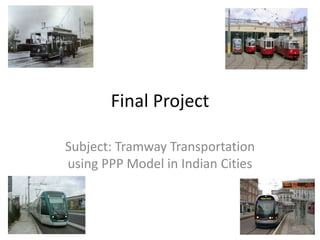
Final Project
Subject: Tramway Transportation
using PPP Model in Indian Cities
Present Scenario of Urban India
• From the year 1981 to 2001, the population increase in 6 major
metropolis is 1.9 times whereas motor vehicles increased by 7.75
times.
• Expected increase of vehicles population in this cities is 372 million
in 2035 from 49.1 in at present.
• Fuel consumption in 2035 will be over 6 times that of now.
• Energy demand in transport sector is projected to grow at 5-8% per
annum.
• Increase in Urban population from 30% at present to 40% by 2030
Infrastructure Need : Urban Mass Transportation System
The infrastructure need of the hour in Urban India is an efficient
and reliable inner-city transportation system. And this need arise
due to many factors.
• Increase in travel demand due to Economic prosperity both
personal and commercial.
• Increase in personalized mode and poor urban infrastructure
planning, leading to congestion, traffic and pollution.
• Demand for an efficient alternative public transport system.
• Poor quality of existing urban transport network.
• Economic loss due to non-availability of mass urban transport
systems.
Urban travel Demand Projection
759
1039
2511
0
500
1000
1500
2000
2500
3000
1994 2001 2021
Year
MillionPassenger-Kms
Infrastructure Problems Addressed by Tramway PPP Project
• Tramway Project if implemented will reduce congestion and Traffic.
• Reduction in air and noise pollution.
• More safe and efficient way to travel in a city.
• Will reduce travel time significantly.
• Reduce economic loss due to poor transportation systems.
• Using modern technology like ground level electric field to run the
system make it more easy to implement and operate.
• Efficient energy utilization and conservation.
• Most importantly, Tram Project, if implemented successfully will
provide affordable and quality service to the citizens.
• Also, the construction can be done adapting to the existing nature
of the infrastructure with few alterations unlike big projects like
metro rails.
• High transportation capacity and lower operating costs compared
to bus transport.
• Easy receptiveness and replacement of newer technology to the
transport system is more easy and faster.
Ideal PPP Model for TramRail in India
• The ideal PPP model to be used in this instance would be a Build
Operate & Transfer or BOT model.
• The contract period could any where between 15 to 25 years.
• Transparent bidding process should be put in place to attract
international companies with specific experience in the field of
Tram and railway operations.
• Also take into account existing Tram Projects or proposals in India.
Reasons Private Sector would want to involve
• First and foremost, Tram Transportation project is an good project.
There is an urgent need and demand for such a project.
• India is an untapped market with huge potential and internal
demand.
• Can easily achieve the scale and revenue targets due massive
population and huge reliance on public transport system.
• Massive challenges involved but can be very rewarding for the
private player, if it is able to successfully complete the project.
• Supportive Government policies conducive to infrastructure
projects and business development.
Risk Allocation Framework
Risk Type Sensitivity Primary Risk Bearer
Delays in Land
acquisition
High Government
Financing Risk Medium Private Sector
Planning Medium Private Sector
Regulatory & Approval
Delays
Low Private Sector
Pre-Operative Risks
Risk Type Sensitivity Primary Risk Bearer
Design Risk Medium Private Sector
Construction Risk Medium Private Sector
Change in Scope Risk Low Government
Construction Phase Risks
Risk Type Sensitivity Primary Risk Bearer
Technology Risk Low Private Sector
Operations &
maintenance Risk
Medium Private Sector
Market Risk High Private Sector
Performance Risk High Private Sector
Operational Phase Risk
Risk Type Sensitivity Primary Risk Bearer
Handover Risk Low Private Sector
Interface Risk Medium Private Sector
Force majeure Low Shared
Change in Law Low Private Sector
Other Risks
Conclusion
• Tram Rail Project will be a path breaking project in
modern India and will definitely boost the
development of public sector Transportation
infrastructure.
• This will ensure quality and affordable transportation
service to the citizens at the same time help in
effectively utilizing the urban space as well as
managing the energy utilization.

Ppp final project

  • 1.
    Final Project Subject: TramwayTransportation using PPP Model in Indian Cities
  • 2.
    Present Scenario ofUrban India • From the year 1981 to 2001, the population increase in 6 major metropolis is 1.9 times whereas motor vehicles increased by 7.75 times. • Expected increase of vehicles population in this cities is 372 million in 2035 from 49.1 in at present. • Fuel consumption in 2035 will be over 6 times that of now. • Energy demand in transport sector is projected to grow at 5-8% per annum. • Increase in Urban population from 30% at present to 40% by 2030
  • 5.
    Infrastructure Need :Urban Mass Transportation System The infrastructure need of the hour in Urban India is an efficient and reliable inner-city transportation system. And this need arise due to many factors. • Increase in travel demand due to Economic prosperity both personal and commercial. • Increase in personalized mode and poor urban infrastructure planning, leading to congestion, traffic and pollution. • Demand for an efficient alternative public transport system. • Poor quality of existing urban transport network. • Economic loss due to non-availability of mass urban transport systems.
  • 6.
    Urban travel DemandProjection 759 1039 2511 0 500 1000 1500 2000 2500 3000 1994 2001 2021 Year MillionPassenger-Kms
  • 7.
    Infrastructure Problems Addressedby Tramway PPP Project • Tramway Project if implemented will reduce congestion and Traffic. • Reduction in air and noise pollution. • More safe and efficient way to travel in a city. • Will reduce travel time significantly. • Reduce economic loss due to poor transportation systems. • Using modern technology like ground level electric field to run the system make it more easy to implement and operate.
  • 8.
    • Efficient energyutilization and conservation. • Most importantly, Tram Project, if implemented successfully will provide affordable and quality service to the citizens. • Also, the construction can be done adapting to the existing nature of the infrastructure with few alterations unlike big projects like metro rails. • High transportation capacity and lower operating costs compared to bus transport. • Easy receptiveness and replacement of newer technology to the transport system is more easy and faster.
  • 9.
    Ideal PPP Modelfor TramRail in India • The ideal PPP model to be used in this instance would be a Build Operate & Transfer or BOT model. • The contract period could any where between 15 to 25 years. • Transparent bidding process should be put in place to attract international companies with specific experience in the field of Tram and railway operations. • Also take into account existing Tram Projects or proposals in India.
  • 10.
    Reasons Private Sectorwould want to involve • First and foremost, Tram Transportation project is an good project. There is an urgent need and demand for such a project. • India is an untapped market with huge potential and internal demand. • Can easily achieve the scale and revenue targets due massive population and huge reliance on public transport system. • Massive challenges involved but can be very rewarding for the private player, if it is able to successfully complete the project. • Supportive Government policies conducive to infrastructure projects and business development.
  • 11.
    Risk Allocation Framework RiskType Sensitivity Primary Risk Bearer Delays in Land acquisition High Government Financing Risk Medium Private Sector Planning Medium Private Sector Regulatory & Approval Delays Low Private Sector Pre-Operative Risks
  • 12.
    Risk Type SensitivityPrimary Risk Bearer Design Risk Medium Private Sector Construction Risk Medium Private Sector Change in Scope Risk Low Government Construction Phase Risks
  • 13.
    Risk Type SensitivityPrimary Risk Bearer Technology Risk Low Private Sector Operations & maintenance Risk Medium Private Sector Market Risk High Private Sector Performance Risk High Private Sector Operational Phase Risk
  • 14.
    Risk Type SensitivityPrimary Risk Bearer Handover Risk Low Private Sector Interface Risk Medium Private Sector Force majeure Low Shared Change in Law Low Private Sector Other Risks
  • 15.
    Conclusion • Tram RailProject will be a path breaking project in modern India and will definitely boost the development of public sector Transportation infrastructure. • This will ensure quality and affordable transportation service to the citizens at the same time help in effectively utilizing the urban space as well as managing the energy utilization.