Methods and
Techniques of
Costing
By: -
Ms. Fathima Shirin Shaji
M.com, UGC-NET
Assistant Professor
Mangalam College of Engineering
Cost and Costing
A‘Cost’ canbe defined asthe monetary value
spent to acquire something; ‘Costing’ is defined
processof ascertaining cost and ‘CostAccounting’
is the processof accounting and recording ofcosts.
Costsare incurred by both manufacturingand
service organizations.
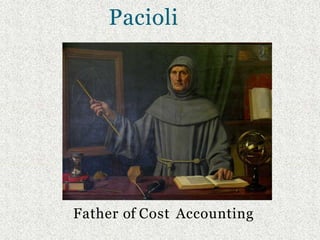
Pacioli
Father of Cost Accounting
Earlier:
The Institute of Chartered
Accountants of India
At present:
The Institute of Cost Accountants
of India
Methods of
Costing
Specific Order Costing
Job
Contract
Batch
Target
Continuous Operational
Costing
Process
Single/Output
Operating/Service
Composite/Multiple
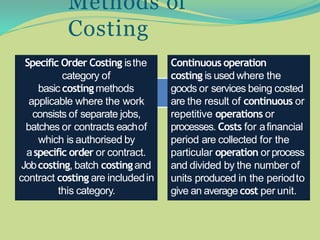
Specific Order Costing isthe
category of
basic costingmethods
applicable where the work
consists of separate jobs,
batches or contracts eachof
which is authorised by
aspecific order or contract.
Jobcosting, batch costingand
contract costing are includedin
this category.
Continuous operation
costing is used where the
goods or services being costed
are the result of continuous or
repetitive operations or
processes. Costs for afinancial
period are collected for the
particular operation orprocess
and divided by the number of
units produced in the periodto
give an average cost per unit.
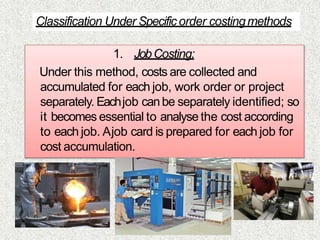
1. JobCosting:
Under this method, costs are collected and
accumulated for each job, work order or project
separately. Eachjob canbe separately identified; so
it becomes essential to analyse the cost according
to each job. Ajob card is prepared for each job for
cost accumulation.
Classification Under Specific order costingmethods
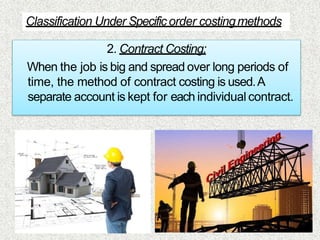
2. Contract Costing:
When the job is big and spread over long periods of
time, the method of contract costing is used.A
separate account is kept for each individual contract.
Classification Under Specific order costingmethods
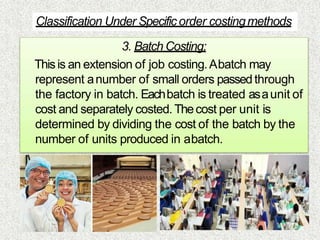
3. Batch Costing:
Thisis an extension of job costing.Abatch may
represent anumber of small orders passedthrough
the factory in batch. Eachbatch is treated asaunit of
cost and separately costed.Thecost per unit is
determined by dividing the cost of the batch by the
number of units produced in abatch.
Classification Under Specific order costingmethods
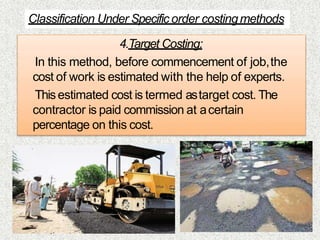
4.Target Costing:
In this method, before commencement of job,the
cost of work is estimated with the help of experts.
Thisestimated cost is termed astarget cost. The
contractor is paid commission at acertain
percentage on this cost.
Classification Under Specific order costingmethods
Classification under Continuous Operation Costing
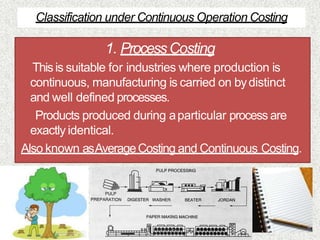
1. ProcessCosting
Thisis suitable for industries where production is
continuous, manufacturing is carried on bydistinct
and well defined processes.
Products produced during aparticular process are
exactly identical.
Also known asAverageCosting and Continuous Costing.
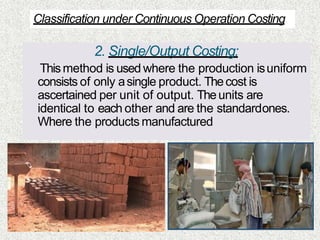
2. Single/Output Costing:
Thismethod is used where the production isuniform
consists of only asingle product. Thecost is
ascertained per unit of output. Theunits are
identical to each other and are the standardones.
Where the products manufactured
Classification under Continuous Operation Costing
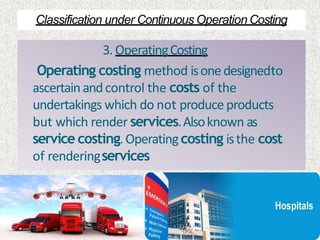
3. OperatingCosting
Operating costing method isonedesignedto
ascertain andcontrol the costs of the
undertakings which do not produce products
but which render services.Alsoknown as
service costing.Operatingcosting isthe cost
of renderingservices
Classification under Continuous Operation Costing
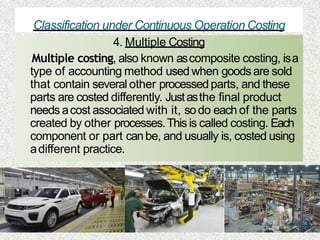
4. Multiple Costing
Multiple costing, also known ascomposite costing, isa
type of accounting method used when goodsare sold
that contain several other processedparts, and these
parts are costed differently. Justasthe final product
needs acost associated with it, sodo each of the parts
created by other processes.Thisis called costing. Each
component or part canbe, and usually is, costed using
adifferent practice.
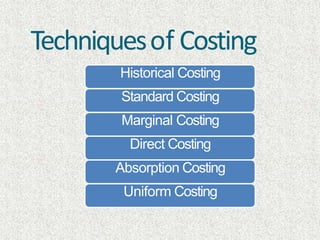
Techniquesof Costing
Historical Costing
Standard Costing
Marginal Costing
Direct Costing
Absorption Costing
Uniform Costing
Historical Costing
Costingsystemswherecostsandrevenues are
calculatedafter the endofthe accounting period
in which theyareincurred.
Historical costingpermits the accurate
calculationof costsafterwards but isoflittle
usefor forward planningpurposes.
Standard Costing
Astandard cost hasbeen described asapredetermined
cost, an estimated future cost and comparing them
with recorded actual costs. Standard costs are often a
part of amanufacturer's annual profit plan and
operating budgets.
Suitable where manufacturing is of standardisedgoods
or repetitive in nature.
Marginal Costing
Themarginal cost is calculated asthe differentiating
between fixed costsand variable costs. It is used to
ascertain the effect of changesin volume or type of
output on profit.
DirectCosting
Thepracticeof chargingall direct coststo operations,
processesor productsleavingall other coststo bewrittenoff
againstprofits inwhichthey ariseisknownasDirect Costing.
Absorption Costing
The practice of charging all costs, both variable and
fixed, to operation, processes, and product is known
asAbsorption Costing.
Uniform Costing
It canbe defined asthe useof samecosting
principles and/or practices by several organisations in
an industry for common control or comparison of
costs.
AnyQuestions..??

Costing techniques and methods

  • 1.
    Methods and Techniques of Costing By:- Ms. Fathima Shirin Shaji M.com, UGC-NET Assistant Professor Mangalam College of Engineering
  • 2.
    Cost and Costing A‘Cost’canbe defined asthe monetary value spent to acquire something; ‘Costing’ is defined processof ascertaining cost and ‘CostAccounting’ is the processof accounting and recording ofcosts. Costsare incurred by both manufacturingand service organizations.
  • 3.
  • 4.
    Earlier: The Institute ofChartered Accountants of India At present: The Institute of Cost Accountants of India
  • 5.
    Methods of Costing Specific OrderCosting Job Contract Batch Target Continuous Operational Costing Process Single/Output Operating/Service Composite/Multiple Specific Order Costing isthe category of basic costingmethods applicable where the work consists of separate jobs, batches or contracts eachof which is authorised by aspecific order or contract. Jobcosting, batch costingand contract costing are includedin this category. Continuous operation costing is used where the goods or services being costed are the result of continuous or repetitive operations or processes. Costs for afinancial period are collected for the particular operation orprocess and divided by the number of units produced in the periodto give an average cost per unit.
  • 6.
    1. JobCosting: Under thismethod, costs are collected and accumulated for each job, work order or project separately. Eachjob canbe separately identified; so it becomes essential to analyse the cost according to each job. Ajob card is prepared for each job for cost accumulation. Classification Under Specific order costingmethods
  • 7.
    2. Contract Costing: Whenthe job is big and spread over long periods of time, the method of contract costing is used.A separate account is kept for each individual contract. Classification Under Specific order costingmethods
  • 8.
    3. Batch Costing: Thisisan extension of job costing.Abatch may represent anumber of small orders passedthrough the factory in batch. Eachbatch is treated asaunit of cost and separately costed.Thecost per unit is determined by dividing the cost of the batch by the number of units produced in abatch. Classification Under Specific order costingmethods
  • 9.
    4.Target Costing: In thismethod, before commencement of job,the cost of work is estimated with the help of experts. Thisestimated cost is termed astarget cost. The contractor is paid commission at acertain percentage on this cost. Classification Under Specific order costingmethods
  • 10.
    Classification under ContinuousOperation Costing 1. ProcessCosting Thisis suitable for industries where production is continuous, manufacturing is carried on bydistinct and well defined processes. Products produced during aparticular process are exactly identical. Also known asAverageCosting and Continuous Costing.
  • 11.
    2. Single/Output Costing: Thismethodis used where the production isuniform consists of only asingle product. Thecost is ascertained per unit of output. Theunits are identical to each other and are the standardones. Where the products manufactured Classification under Continuous Operation Costing
  • 12.
    Classification under ContinuousOperation Costing 3. OperatingCosting Operating costing method isonedesignedto ascertain andcontrol the costs of the undertakings which do not produce products but which render services.Alsoknown as service costing.Operatingcosting isthe cost of renderingservices
  • 13.
    Classification under ContinuousOperation Costing 4. Multiple Costing Multiple costing, also known ascomposite costing, isa type of accounting method used when goodsare sold that contain several other processedparts, and these parts are costed differently. Justasthe final product needs acost associated with it, sodo each of the parts created by other processes.Thisis called costing. Each component or part canbe, and usually is, costed using adifferent practice.
  • 14.
    Techniquesof Costing Historical Costing StandardCosting Marginal Costing Direct Costing Absorption Costing Uniform Costing
  • 15.
    Historical Costing Costingsystemswherecostsandrevenues are calculatedafterthe endofthe accounting period in which theyareincurred. Historical costingpermits the accurate calculationof costsafterwards but isoflittle usefor forward planningpurposes.
  • 16.
    Standard Costing Astandard costhasbeen described asapredetermined cost, an estimated future cost and comparing them with recorded actual costs. Standard costs are often a part of amanufacturer's annual profit plan and operating budgets. Suitable where manufacturing is of standardisedgoods or repetitive in nature.
  • 17.
    Marginal Costing Themarginal costis calculated asthe differentiating between fixed costsand variable costs. It is used to ascertain the effect of changesin volume or type of output on profit.
  • 18.
    DirectCosting Thepracticeof chargingall directcoststo operations, processesor productsleavingall other coststo bewrittenoff againstprofits inwhichthey ariseisknownasDirect Costing.
  • 19.
    Absorption Costing The practiceof charging all costs, both variable and fixed, to operation, processes, and product is known asAbsorption Costing.
  • 20.
    Uniform Costing It canbedefined asthe useof samecosting principles and/or practices by several organisations in an industry for common control or comparison of costs.
  • 22.