

An intent is an abstract description of an operation to be
performed.



It can be used with startActivity to launch an Activity.
An Intent provides a facility for performing late runtime
binding between the code in different applications.





Its most significant use is in the launching of activities,
where it can be thought of as the glue between
activities.



It is basically a passive data structure holding an abstract
description of an action to be performed.


The primary pieces of information in an intent are:
◦ action -- The general action to be performed, such
as ACTION_VIEW, ACTION_EDIT, ACTION_MAIN, etc.

◦ data -- The data to operate on, such as a person record in
the contacts database, expressed as a Uri.


There are two primary forms of intents you will use.



Explicit Intents have specified a component
(via setComponent(ComponentName) or setClass(Con
text, Class)).



Which provides the exact class to be run.



Often these will not include any other information,
simply being a way for an application to launch various
internal activities it has as the user interacts with the
application.


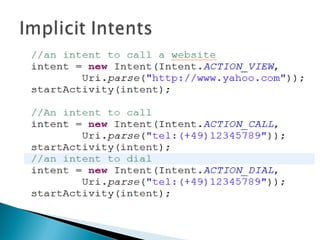
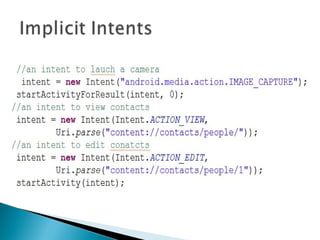
Implicit Intents have not specified a component;



Instead, they must include enough information for
the system to determine which of the available
components is best to run for that intent.


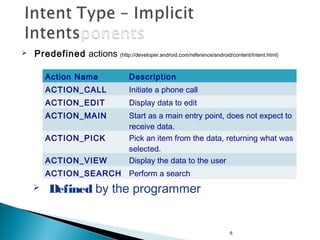
Predefined actions (http://developer.android.com/reference/android/content/Intent.html)
Action Name

Description

ACTION_CALL

Initiate a phone call

ACTION_EDIT

Display data to edit

ACTION_MAIN

ACTION_VIEW

Start as a main entry point, does not expect to
receive data.
Pick an item from the data, returning what was
selected.
Display the data to the user

ACTION_SEARCH

Perform a search

ACTION_PICK



Defined by the programmer

6
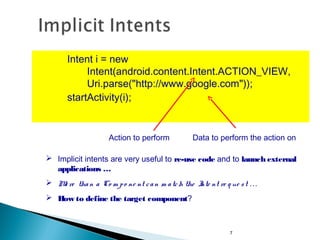
Intent i = new
Intent(android.content.Intent.ACTION_VIEW,
Uri.parse("http://www.google.com"));
startActivity(i);

Action to perform

Data to perform the action on

 Implicit intents are very useful to re-use code and to launch external
applications …
 M re tha n a Co m p o ne nt c a n m a tc h the I nt re q ue s t …
o
nte
 How to define the target component?

7


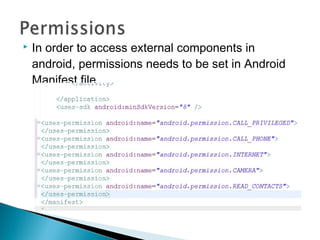
In order to access external components in
android, permissions needs to be set in Android
Manifest file.


Example on Explicit Intents
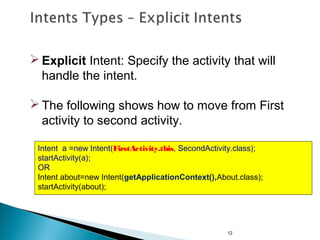
 Explicit Intent: Specify the activity that will
handle the intent.
 The following shows how to move from First
activity to second activity.
Intent a =new Intent(FirstActivity.this, SecondActivity.class);
startActivity(a);
OR
Intent about=new Intent(getApplicationContext(),About.class);
startActivity(about);

12


Developers mostly create applications using
different activities.



These activities needs to communicate and pass
data from one part to the other.



For this case, Explicit Intents should be used.


For activities to be able to communicate to one
another.



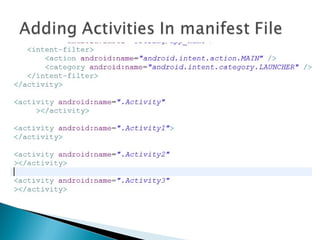
They must be registered in the manifest file.



This is done by adding all your activities in the
manifest file.



This is done inside the <application> tag of the
manifest


Labs – Joining Activities
Creating an Options Menu
 The options menu is where you should include
actions and other options that are relevant to the
current activity context.


◦ Such as "Search“,”Save” "Compose email," and
"Settings.“
◦ Ref:


http://www.droidnova.com/how-to-create-an-option-menu,427.html


First we have to make a new folder in our
res/layout directory .



In this new directory we will create a new xml file
named menu.xml.



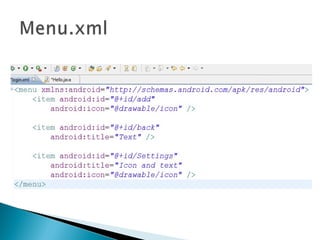
Put the following code.


The content of the xml file should be very self
explaining.



We have an id for each item, so we have a
reference for it.



The title attribute, if defined, is nothing more than
the text you see in the option menu.


The same with the icon attribute which references
to an icon, in our case the default icon.



Now we have to modify our Activity class.



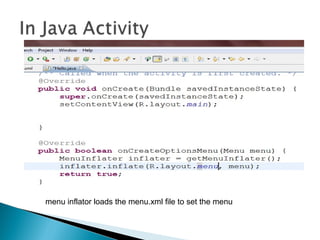
First we have to override the method
onCreateOptionsMenu()
 menu inflator loads the menu.xml file to set the menu


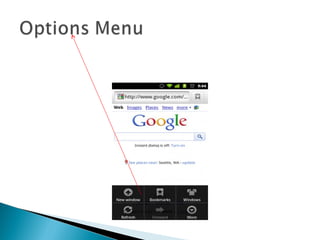
Right now we can start our application and we will
see our 3 option items in our menu when we press
the menu button.



As long as nothing happens when we press one
item, the menu is senseless.



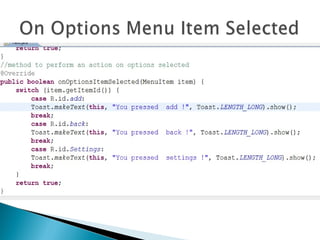
To implement a reaction of our menu, we should
override another method named
onOptionsItemSelected().
Android Bootcamp Tanzania:intents

Android Bootcamp Tanzania:intents

  • 2.
     An intent isan abstract description of an operation to be performed.  It can be used with startActivity to launch an Activity. An Intent provides a facility for performing late runtime binding between the code in different applications.   Its most significant use is in the launching of activities, where it can be thought of as the glue between activities.  It is basically a passive data structure holding an abstract description of an action to be performed.
  • 3.
     The primary piecesof information in an intent are: ◦ action -- The general action to be performed, such as ACTION_VIEW, ACTION_EDIT, ACTION_MAIN, etc. ◦ data -- The data to operate on, such as a person record in the contacts database, expressed as a Uri.
  • 4.
     There are twoprimary forms of intents you will use.  Explicit Intents have specified a component (via setComponent(ComponentName) or setClass(Con text, Class)).  Which provides the exact class to be run.  Often these will not include any other information, simply being a way for an application to launch various internal activities it has as the user interacts with the application.
  • 5.
     Implicit Intents have notspecified a component;  Instead, they must include enough information for the system to determine which of the available components is best to run for that intent.
  • 6.
     Predefined actions (http://developer.android.com/reference/android/content/Intent.html) ActionName Description ACTION_CALL Initiate a phone call ACTION_EDIT Display data to edit ACTION_MAIN ACTION_VIEW Start as a main entry point, does not expect to receive data. Pick an item from the data, returning what was selected. Display the data to the user ACTION_SEARCH Perform a search ACTION_PICK  Defined by the programmer 6
  • 7.
    Intent i =new Intent(android.content.Intent.ACTION_VIEW, Uri.parse("http://www.google.com")); startActivity(i); Action to perform Data to perform the action on  Implicit intents are very useful to re-use code and to launch external applications …  M re tha n a Co m p o ne nt c a n m a tc h the I nt re q ue s t … o nte  How to define the target component? 7
  • 10.
     In order toaccess external components in android, permissions needs to be set in Android Manifest file.
  • 11.
  • 12.
     Explicit Intent:Specify the activity that will handle the intent.  The following shows how to move from First activity to second activity. Intent a =new Intent(FirstActivity.this, SecondActivity.class); startActivity(a); OR Intent about=new Intent(getApplicationContext(),About.class); startActivity(about); 12
  • 13.
     Developers mostly createapplications using different activities.  These activities needs to communicate and pass data from one part to the other.  For this case, Explicit Intents should be used.
  • 14.
     For activities tobe able to communicate to one another.  They must be registered in the manifest file.  This is done by adding all your activities in the manifest file.  This is done inside the <application> tag of the manifest
  • 16.
  • 17.
    Creating an OptionsMenu  The options menu is where you should include actions and other options that are relevant to the current activity context.  ◦ Such as "Search“,”Save” "Compose email," and "Settings.“ ◦ Ref:  http://www.droidnova.com/how-to-create-an-option-menu,427.html
  • 19.
     First we haveto make a new folder in our res/layout directory .  In this new directory we will create a new xml file named menu.xml.  Put the following code.
  • 21.
     The content ofthe xml file should be very self explaining.  We have an id for each item, so we have a reference for it.  The title attribute, if defined, is nothing more than the text you see in the option menu.
  • 22.
     The same withthe icon attribute which references to an icon, in our case the default icon.  Now we have to modify our Activity class.  First we have to override the method onCreateOptionsMenu()
  • 23.
  • 24.
     Right now wecan start our application and we will see our 3 option items in our menu when we press the menu button.  As long as nothing happens when we press one item, the menu is senseless.  To implement a reaction of our menu, we should override another method named onOptionsItemSelected().