 Galileo 3.5
 Helios 3.6
 Indigo 3.7
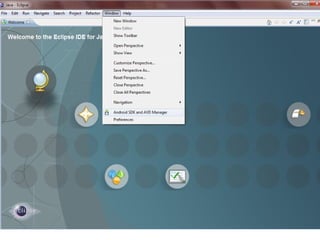
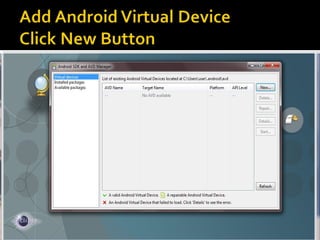
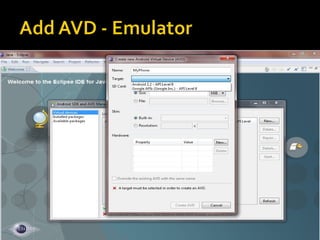
 Before using eclipse and android SDK, you

need to check that the Android Developer
Tools are set and corresponds to android
SDK is set directory correctly.
 See next slide
 Android Virtual Device is now set
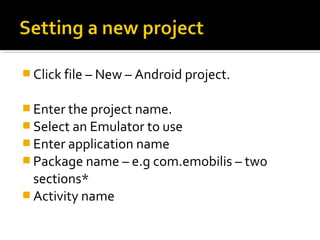
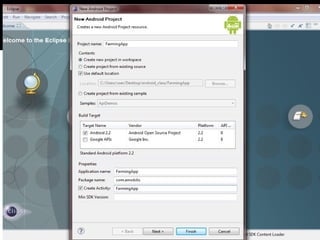
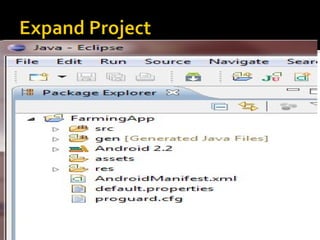
 Click file – New – Android project.
 Enter the project name.
 Select an Emulator to use
 Enter application name
 Package name – e.g com.emobilis – two

sections*
 Activity name
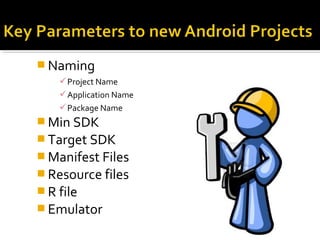
 Naming
 Project Name
 Application Name
 Package Name

 Min SDK
 Target SDK
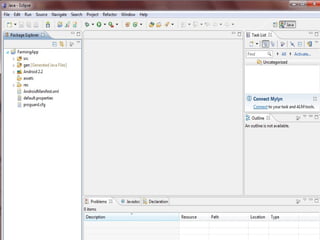
 Manifest Files
 Resource files
 R file
 Emulator


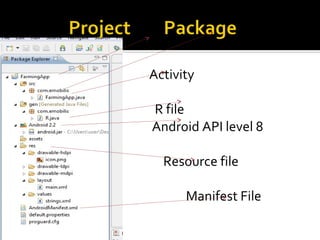
Activity







R file
Android API level 8
Resource file
Manifest File
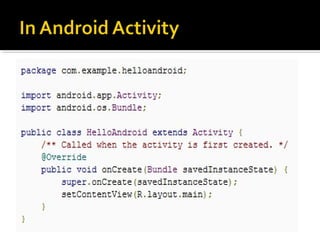
 An Activity is an application component that

provides a screen with which users can
interact in order to do something.
 Such as dial the phone, take a photo, send an

email, or view a map.
 Each activity is given a window in which to

draw its user interface.
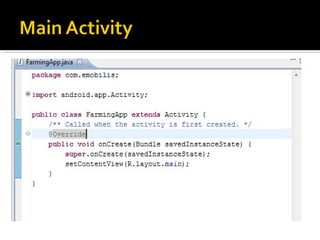
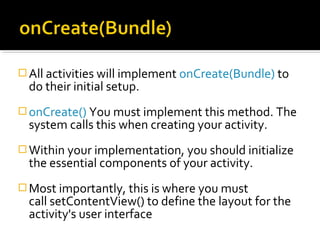
 All activities will implement onCreate(Bundle) to

do their initial setup.

 onCreate() You must implement this method. The

system calls this when creating your activity.

 Within your implementation, you should initialize

the essential components of your activity.

 Most importantly, this is where you must

call setContentView() to define the layout for the
activity's user interface



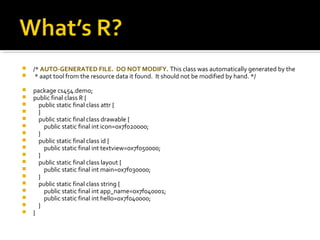
/* AUTO-GENERATED FILE. DO NOT MODIFY. This class was automatically generated by the
* aapt tool from the resource data it found. It should not be modified by hand. */




















package cs454.demo;
public final class R {
public static final class attr {
}
public static final class drawable {
public static final int icon=0x7f020000;
}
public static final class id {
public static final int textview=0x7f050000;
}
public static final class layout {
public static final int main=0x7f030000;
}
public static final class string {
public static final int app_name=0x7f040001;
public static final int hello=0x7f040000;
}
}
 What is a Resource File?
 A resource file may contain a collection of

icons, xml files for UI design, strings files etc.
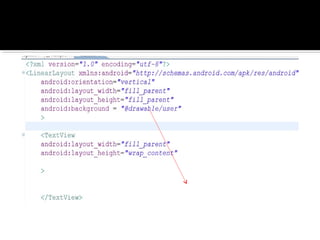
 In android, UI design is constructed in xml

files located in res – layout.
 Include drawable – use it for images, icons
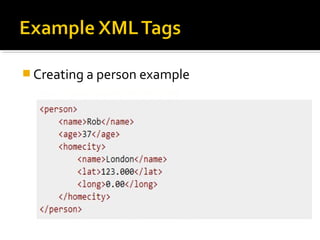
 Creating a person example
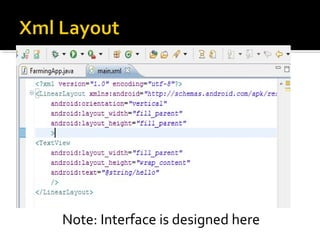
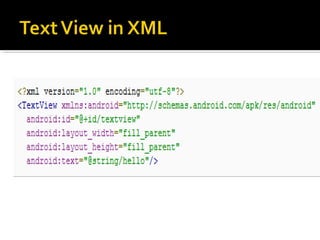
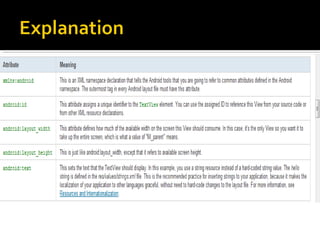
 The next xml Files shows a TextView with a

linear layout.
 Linear layout allows a developers to arrange

UI components in a vertical or horizontal
manner.
 A TextView shows text that can be edited –

it’s a label.
Note: Interface is designed here
 Android Provides several UI components including
 TextViews
 EditText
 TextArea
 RadioButton
 CheckBox
 List
 Buttons
 Tabs
 Menus
 Etc

We look on each UI component individually
 Displays text to the user and optionally

allows them to edit it.
 A TextView is a complete text editor,

however the basic component is configured
to not allow editing.
 In order to edit EditText for a subclass that

configures the text view for editing.
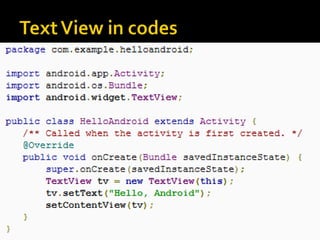
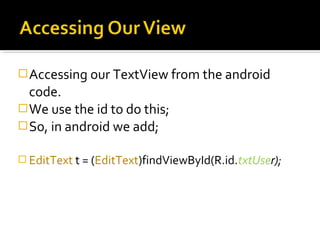
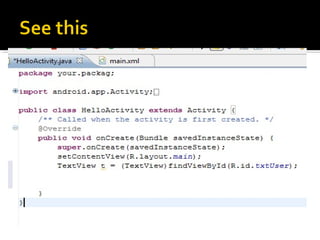
 Accessing our TextView from the android

code.
 We use the id to do this;
 So, in android we add;
 EditText t = (EditText)findViewById(R.id.txtUser);
 Allows you to separate your UI with the code

that is controlling.
 Allows developers arrange the java codes

easily
 Easy understanding of the Java programming

in android
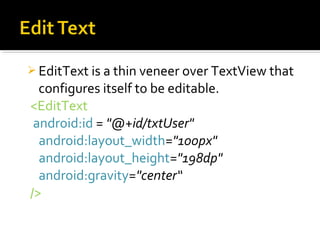
 EditText is a thin veneer over TextView that

configures itself to be editable.
<EditText
android:id = "@+id/txtUser"
android:layout_width="100px"
android:layout_height="198dp"
android:gravity="center“
/>
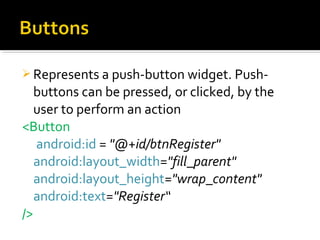
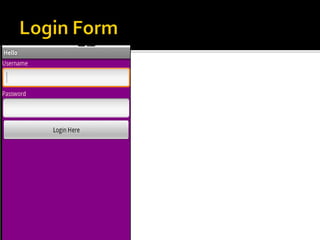
 Represents a push-button widget. Push-

buttons can be pressed, or clicked, by the
user to perform an action
<Button
android:id = "@+id/btnRegister"
android:layout_width="fill_parent"
android:layout_height="wrap_content"
android:text="Register“
/>
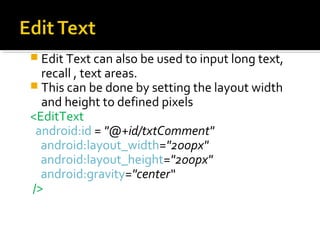
 Edit Text can also be used to input long text,

recall , text areas.
 This can be done by setting the layout width
and height to defined pixels
<EditText
android:id = "@+id/txtComment"
android:layout_width="200px"
android:layout_height="200px"
android:gravity="center“
/>
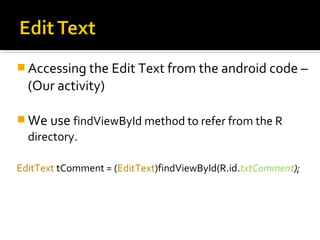
 Accessing the Edit Text from the android code –

(Our activity)
 We use findViewById method to refer from the R

directory.
EditText tComment = (EditText)findViewById(R.id.txtComment);
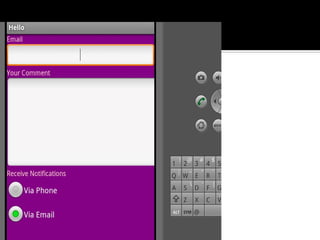
 A radio button is a two-states button that can

be either checked or unchecked.
 When the radio button is unchecked, the user

can press or click it to check it.
 However, contrary to aCheckBox, a radio

button cannot be unchecked by the user once
checked.
 Radio buttons are normally used together in

a RadioGroup.
 When several radio buttons live inside a radio

group, checking one radio button unchecks
all the others.
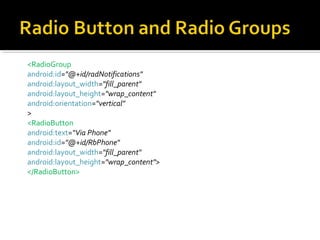
<RadioGroup
android:id="@+id/radNotifications"
android:layout_width="fill_parent"
android:layout_height="wrap_content"
android:orientation="vertical"
>
<RadioButton
android:text=“Via Phone"
android:id="@+id/RbPhone"
android:layout_width="fill_parent"
android:layout_height="wrap_content">
</RadioButton>
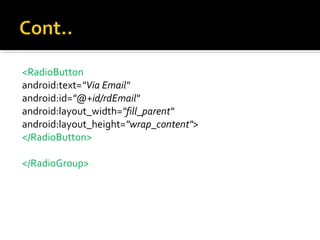
<RadioButton
android:text=“Via Email"
android:id="@+id/rdEmail"
android:layout_width="fill_parent"
android:layout_height="wrap_content">
</RadioButton>
</RadioGroup>
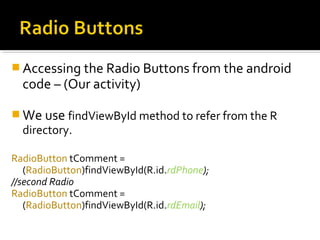
 Accessing the Radio Buttons from the android

code – (Our activity)

 We use findViewById method to refer from the R

directory.

RadioButton tComment =
(RadioButton)findViewById(R.id.rdPhone);
//second Radio
RadioButton tComment =
(RadioButton)findViewById(R.id.rdEmail);
 Quickview
 A toast is a message that appears on the

surface of the screen for a moment, but it
does not take focus (or pause the current
activity).
 so it cannot accept user input
 You can customize the toast layout to include

images
 A toast notification is a message that pops up

on the surface of the window.
 It only fills the amount of space required for
the message and the user's current activity
remains visible and interactive.
 The notification automatically fades in and
out, and does not accept interaction events.
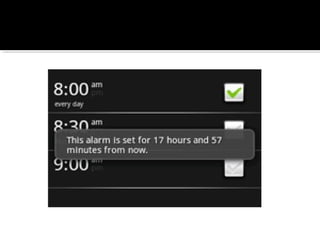
 The screenshot below shows an example

toast notification from the Alarm application.
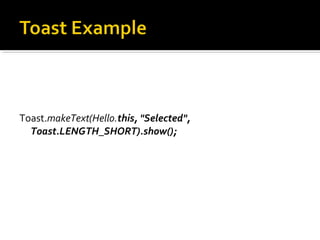
Toast.makeText(Hello.this, "Selected",
Toast.LENGTH_SHORT).show();
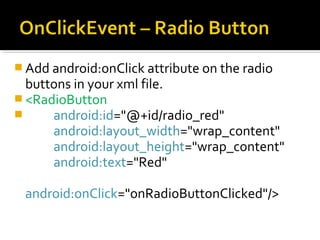
 Add android:onClick attribute on the radio

buttons in your xml file.
 <RadioButton

android:id="@+id/radio_red"
android:layout_width="wrap_content"
android:layout_height="wrap_content"
android:text="Red"
android:onClick="onRadioButtonClicked"/>
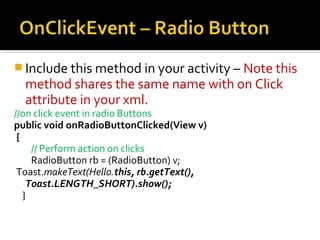
 Include this method in your activity – Note this

method shares the same name with on Click
attribute in your xml.

//on click event in radio Buttons
public void onRadioButtonClicked(View v)
{
// Perform action on clicks
RadioButton rb = (RadioButton) v;
Toast.makeText(Hello.this, rb.getText(),
Toast.LENGTH_SHORT).show();
}
 A checkbox is a specific type of two-states

button that can be either checked or
unchecked.
 A example usage of a checkbox inside your

xml would be the following.
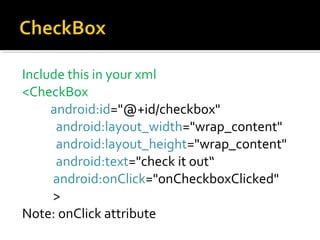
Include this in your xml
<CheckBox
android:id="@+id/checkbox"
android:layout_width="wrap_content"
android:layout_height="wrap_content"
android:text="check it out“
android:onClick="onCheckboxClicked"
>
Note: onClick attribute
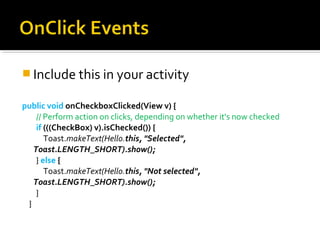
 Include this in your activity
public void onCheckboxClicked(View v) {
// Perform action on clicks, depending on whether it's now checked
if (((CheckBox) v).isChecked()) {
Toast.makeText(Hello.this, "Selected",
Toast.LENGTH_SHORT).show();
} else {
Toast.makeText(Hello.this, "Not selected",
Toast.LENGTH_SHORT).show();
}
}
 ListView is a ViewGroup that creates a list of 

scrollable items. 

 The list items are automatically inserted to 

the list using a ListAdapter.
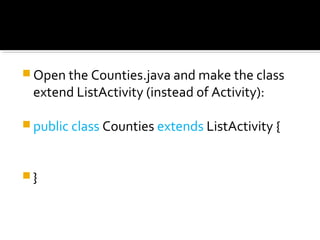
 Open the Counties.java and make the class 

extend ListActivity (instead of Activity):

 public class Counties extends ListActivity {

}
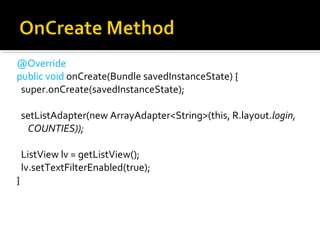
@Override
public void onCreate(Bundle savedInstanceState) {
  super.onCreate(savedInstanceState);
  setListAdapter(new ArrayAdapter<String>(this, R.layout.login,
COUNTIES));
  ListView lv = getListView();
  lv.setTextFilterEnabled(true);
}
//Include this string array after the onCreate 
method
static final String[] COUNTIES = new String[]
{
  “Nairobi", “Kakamega", “Kisii", “Nakuru", 
“Laikipia",“Bungoma", “Eldoret", “Kwale“
};
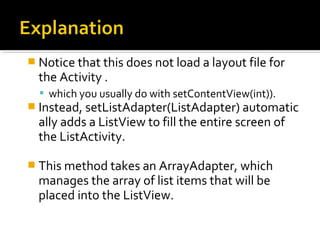
 Notice that this does not load a layout file for 

the Activity .

 which you usually do with setContentView(int)). 

 Instead, setListAdapter(ListAdapter) automatic

ally adds a ListView to fill the entire screen of 
the ListActivity. 

 This method takes an ArrayAdapter, which 

manages the array of list items that will be 
placed into the ListView. 
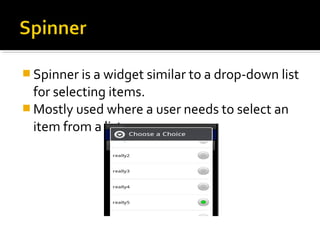
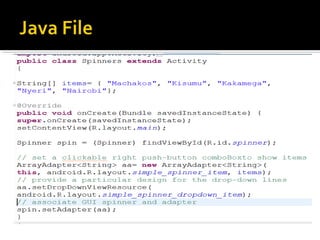
 Spinner is a widget similar to a drop-down list 

for selecting items. 
 Mostly used where a user needs to select an 
item from a list.
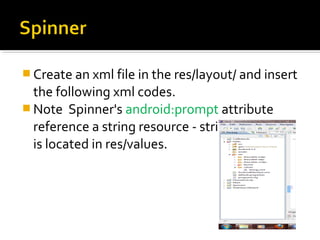
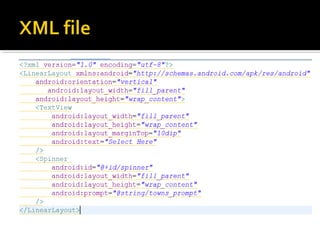
 Create an xml file in the res/layout/ and insert 

the following xml codes.
 Note  Spinner's android:prompt attribute 
reference a string resource - string resource  
is located in res/values.
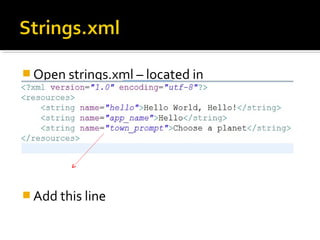
 Open strings.xml – located in 

res/values/strinng.xml

 Add this line 


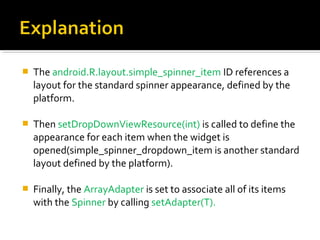
The android.R.layout.simple_spinner_item ID references a 
layout for the standard spinner appearance, defined by the 
platform. 



Then setDropDownViewResource(int) is called to define the 
appearance for each item when the widget is 
opened(simple_spinner_dropdown_item is another standard 
layout defined by the platform). 



Finally, the ArrayAdapter is set to associate all of its items 
with the Spinner by calling setAdapter(T).
 Android offers a custom 2D graphics library 

for drawing shapes and images. 
 The android.graphics.drawable package is 

where you'll find the common classes used 
for drawing in two-dimensions.
 A Drawable is a general abstraction for 

"something that can be drawn.
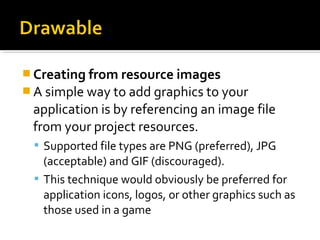
 Creating from resource images
 A simple way to add graphics to your 

application is by referencing an image file 
from your project resources. 
 Supported file types are PNG (preferred), JPG 

(acceptable) and GIF (discouraged). 
 This technique would obviously be preferred for 
application icons, logos, or other graphics such as 
those used in a game
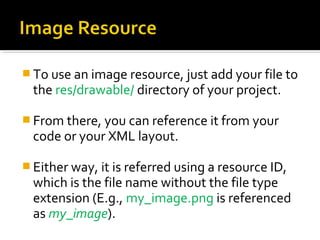
 To use an image resource, just add your file to 

the res/drawable/ directory of your project.

 From there, you can reference it from your 

code or your XML layout. 

 Either way, it is referred using a resource ID, 

which is the file name without the file type 
extension (E.g., my_image.png is referenced 
as my_image).
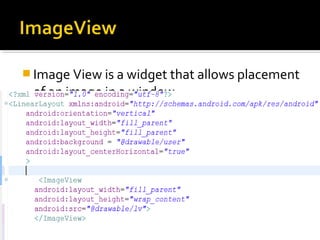
 Image View is a widget that allows placement 

of an image in a window
Android Bootcamp Tanzania:understanding ui in_android

Android Bootcamp Tanzania:understanding ui in_android

Editor's Notes

  • #11 Dimensions in,mm,pt(1/72in) dp (device independet pixel) sp(scale independet pixel) Resource color,dimen,string,string-array