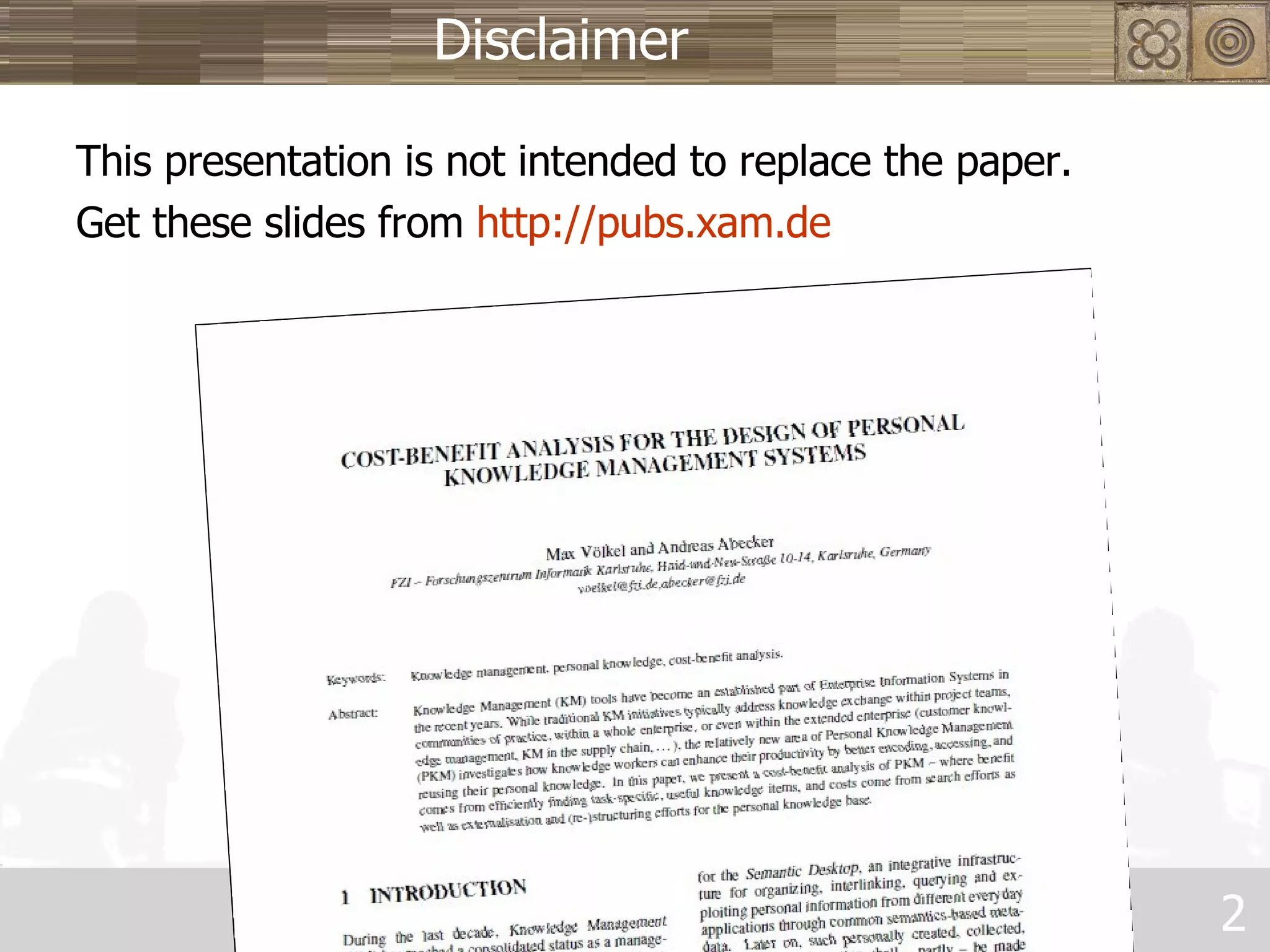
Cost-Benefit Analysis  for the Design of Personal  Knowledge Management Systems [email_address] , abecker@fzi.de and Andreas Abecker 16.06.2008 / ICEIS 2008 @ Barcelona, Spain.
Disclaimer This presentation is not intended to replace the paper. Get these slides from  http://pubs.xam.de
Outline Introduction to  Personal Knowledge Management (PKM) Comparision to Organisatinal KM (OKM) Processes in PKM Challenges for Re-Using Personal Knowledge Quantification of Costs and Benefit Conclusions
The most important contribution of management in the 20th century was to increase manual worker productivity fifty-fold.  The most important contribution of management in the 21st century will be to increase  knowledge worker  productivity – hopefully by the same percentage. […]  The methods, however, are totally different from those that increased the productivity of manual workers. Peter F. Drucker, 1958
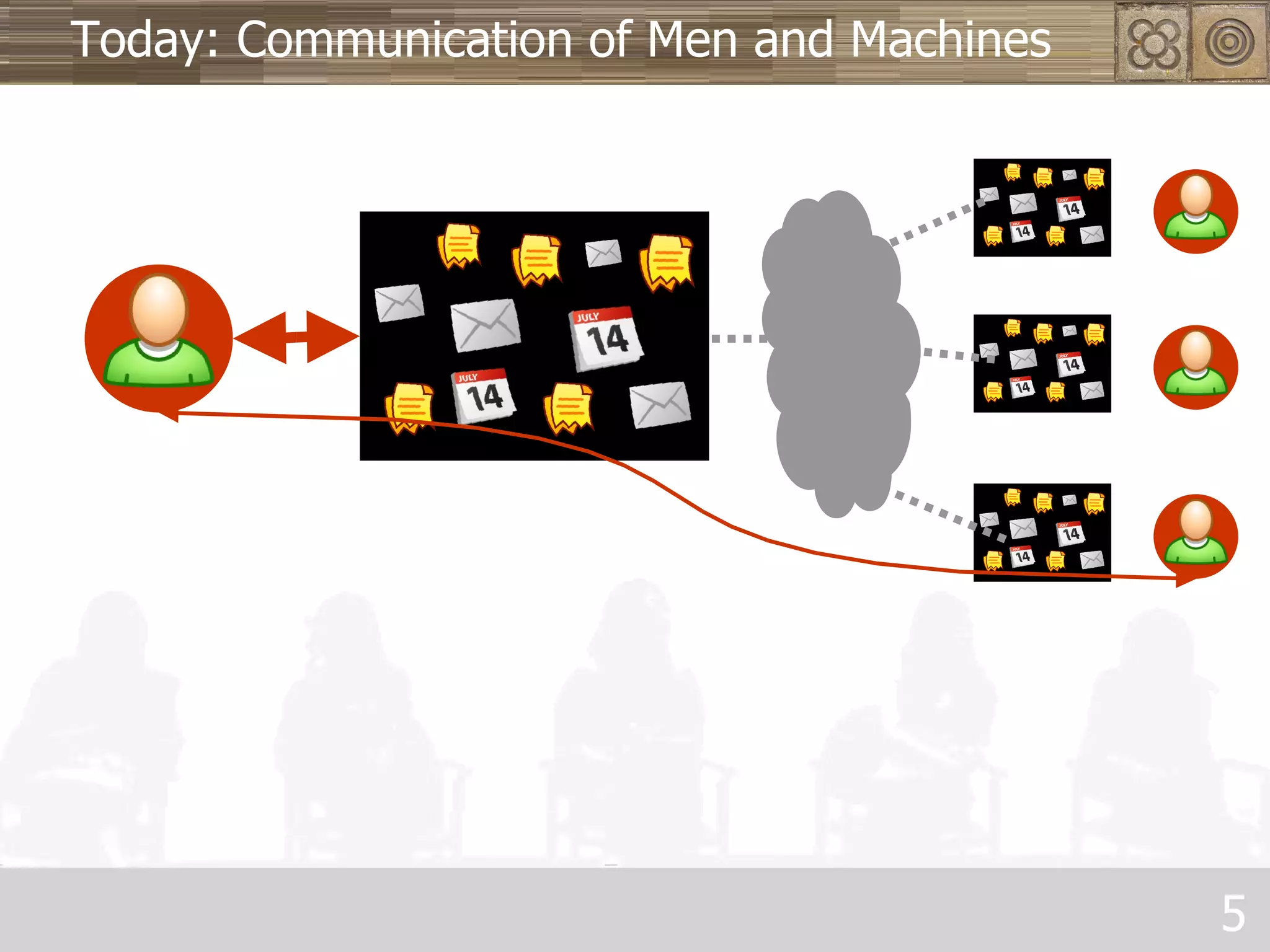
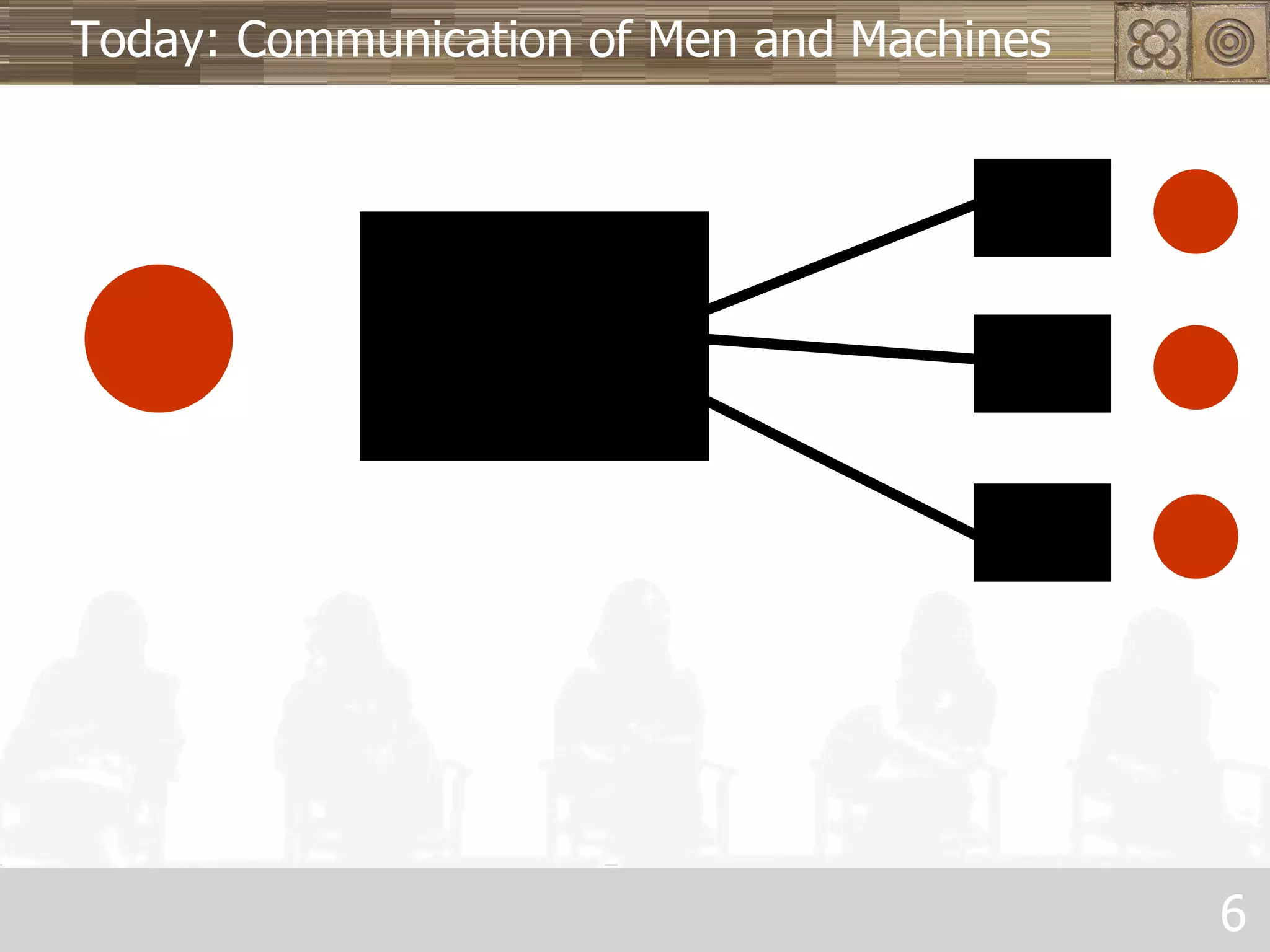
Today: Communication of Men and Machines
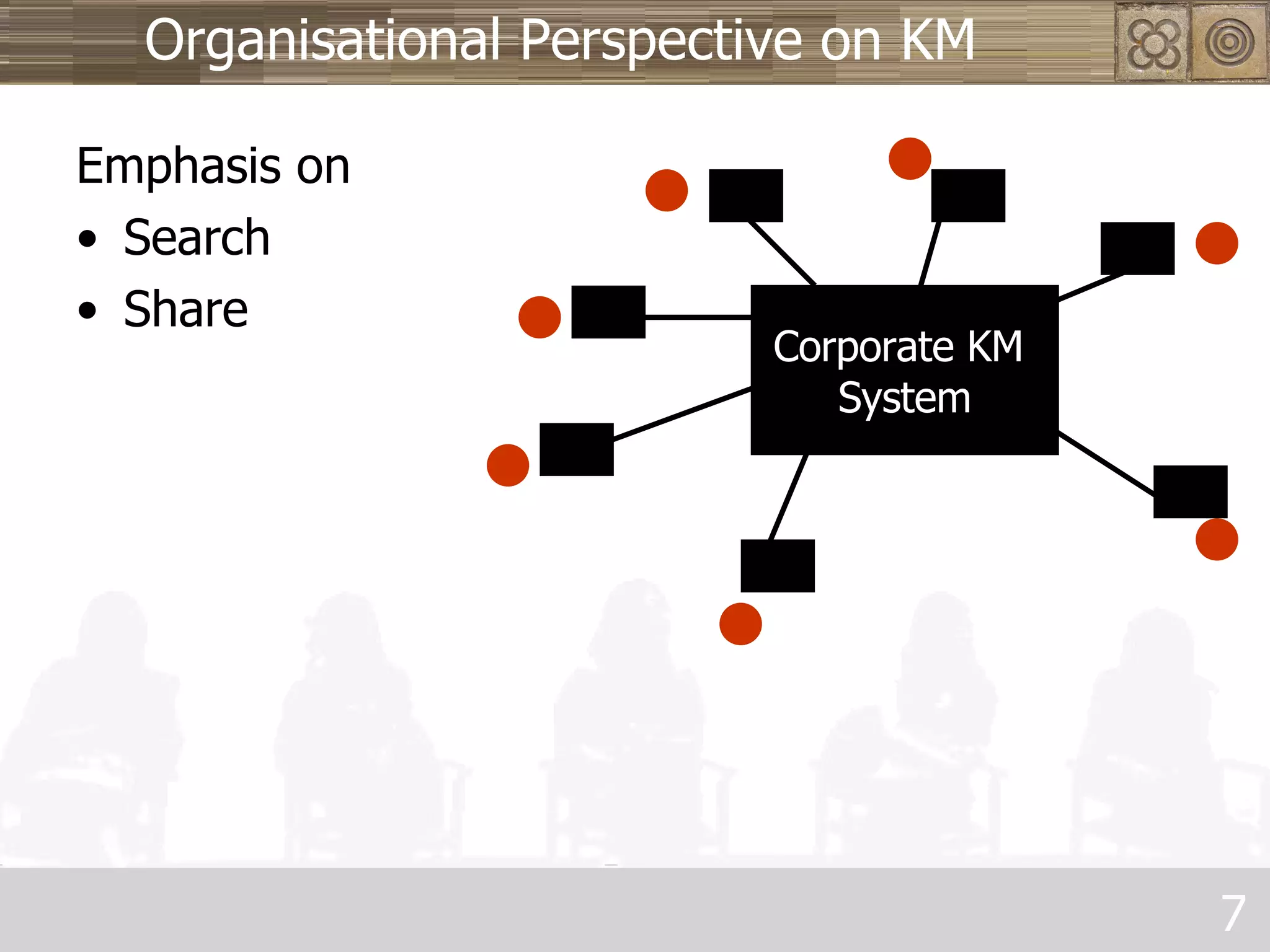
Organisational Perspective on KM Emphasis on Search Share Corporate KM  System
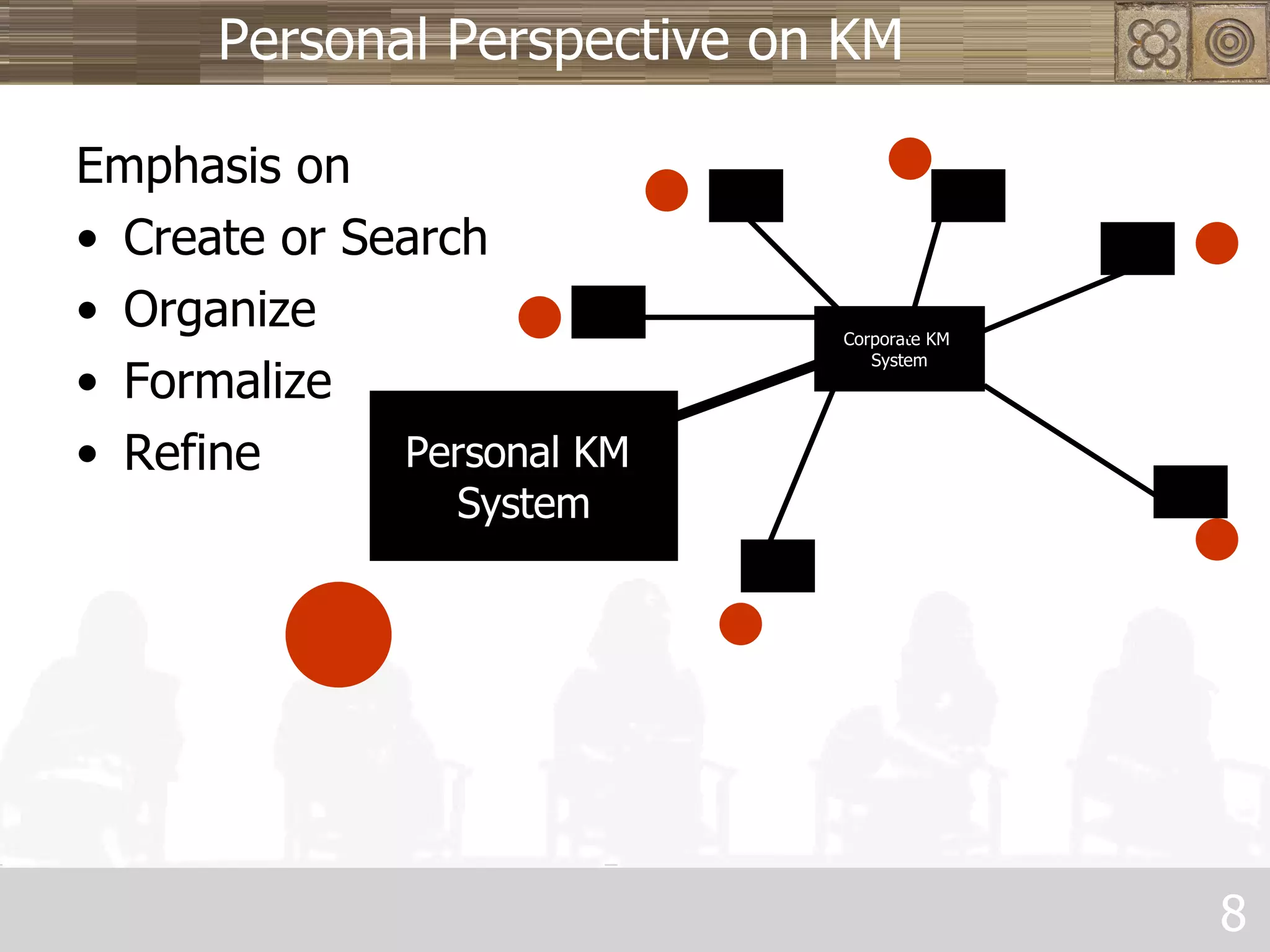
Personal Perspective on KM Emphasis on Create or Search Organize Formalize Refine Corporate KM  System Personal KM  System
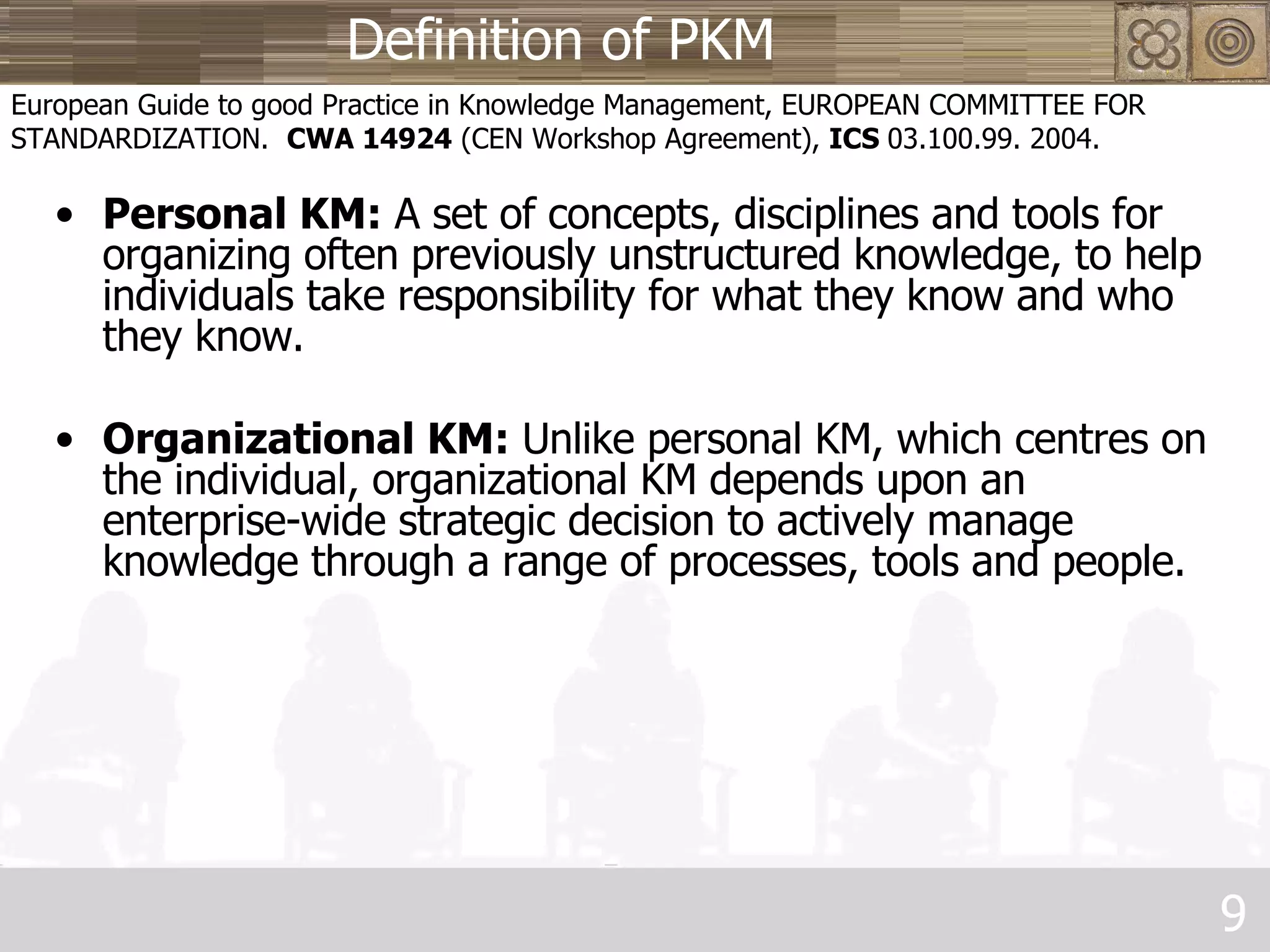
Definition of PKM Personal KM:  A set of concepts, disciplines and tools for organizing often previously unstructured knowledge, to help individuals take responsibility for what they know and who they know. Organizational KM:  Unlike personal KM, which centres on the individual, organizational KM depends upon an enterprise-wide strategic decision to actively manage knowledge through a range of processes, tools and people. European Guide to good Practice in Knowledge Management, EUROPEAN COMMITTEE FOR STANDARDIZATION.  CWA 14924  (CEN Workshop Agreement),  ICS  03.100.99. 2004.
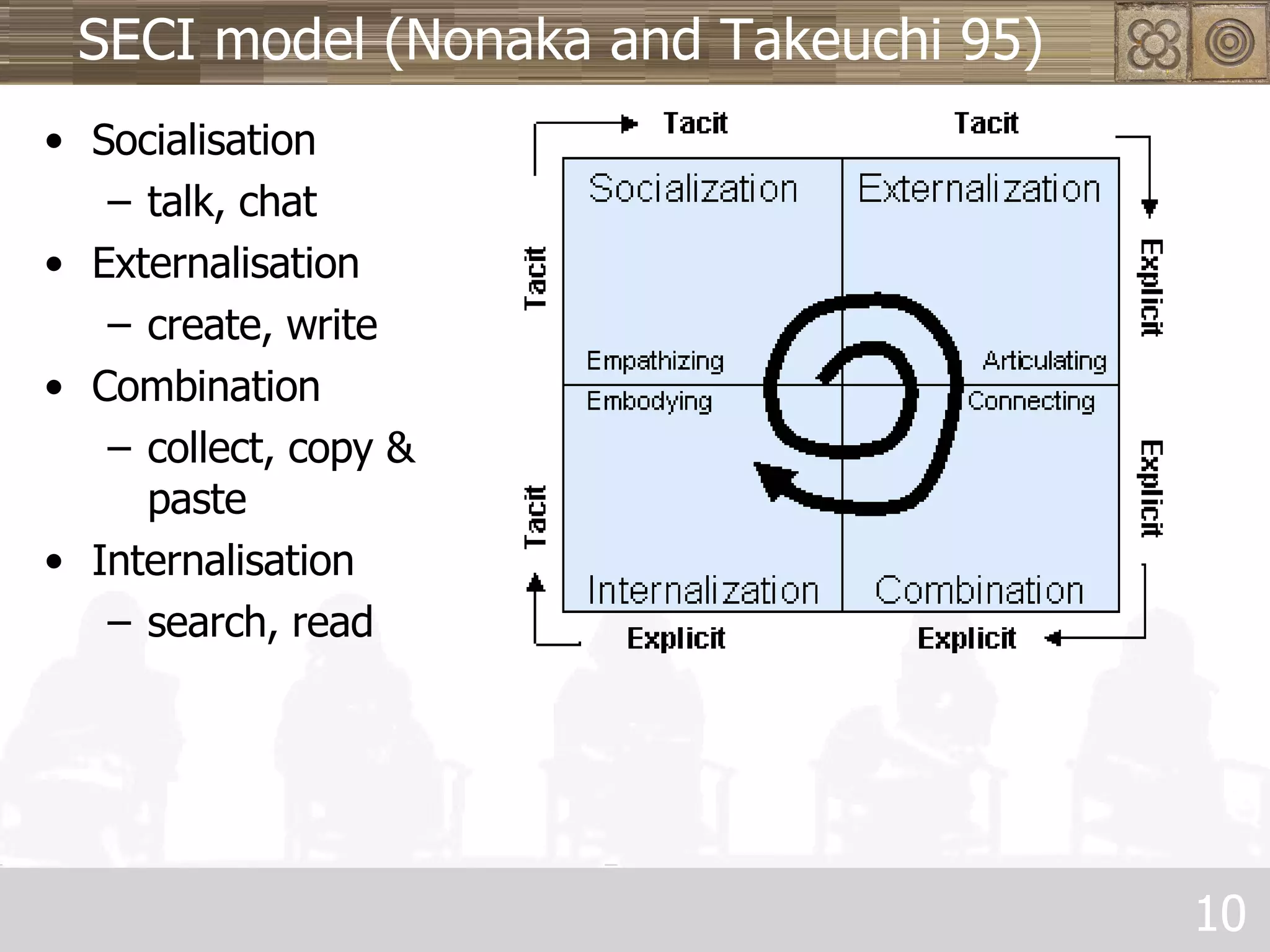
SECI model (Nonaka and Takeuchi 95) Socialisation talk, chat Externalisation create, write Combination collect, copy & paste Internalisation search, read
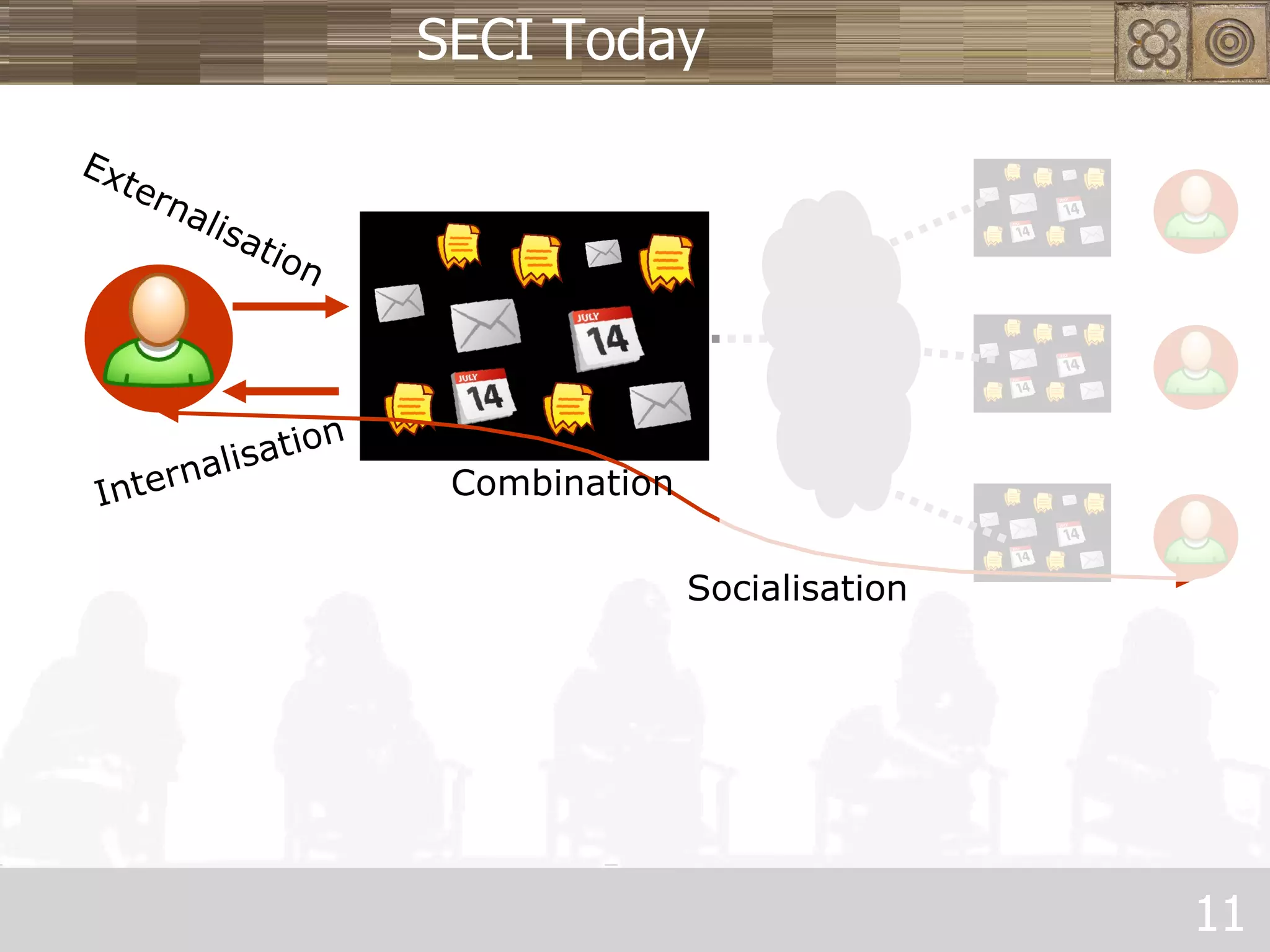
SECI Today Internalisation Externalisation Combination Socialisation
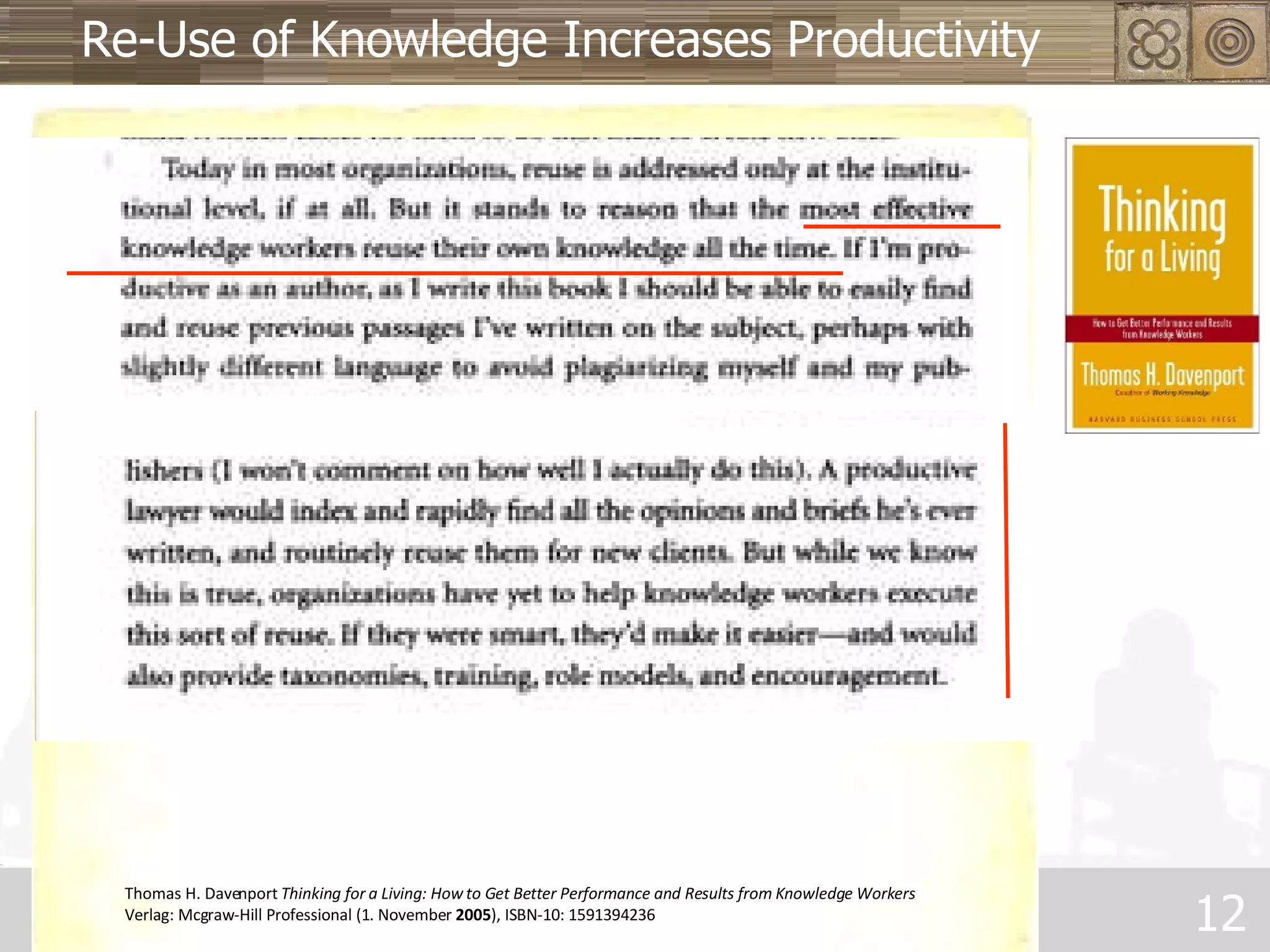
Re-Use of Knowledge Increases Productivity Thomas H. Davenport  Thinking for a Living: How to Get Better Performance and Results from Knowledge Workers Verlag: Mcgraw-Hill Professional (1. November  2005 ), ISBN-10: 1591394236
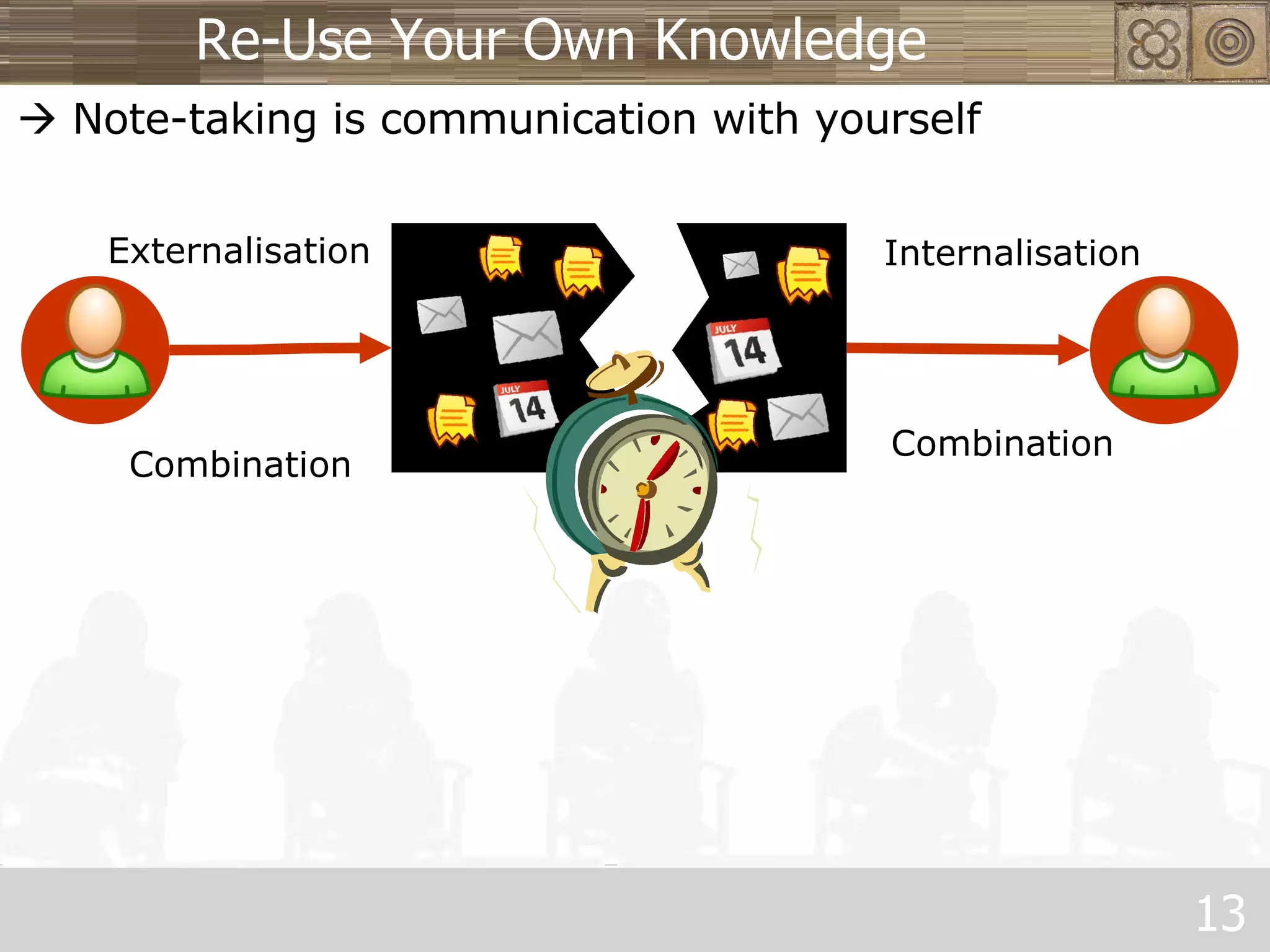
Re-Use Your Own Knowledge Internalisation Externalisation Combination Combination    Note-taking is communication with yourself
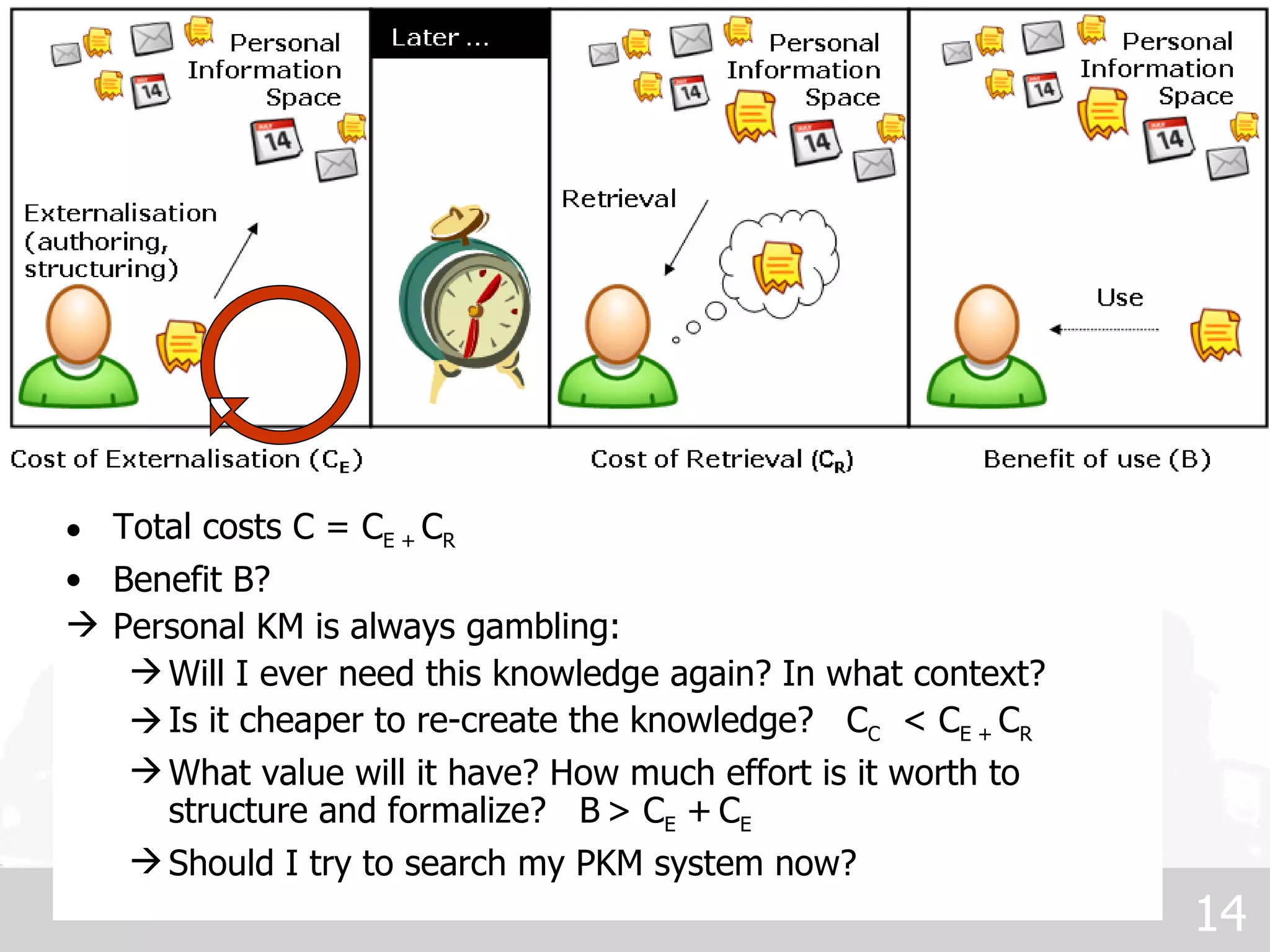
My Work Total costs C = C E +  C R Benefit B? Personal KM is always gambling:  Will I ever need this knowledge again? In what context?  Is it cheaper to re-create the knowledge?  C C   < C E +  C R What value will it have? How much effort is it worth to structure and formalize?  B   > C E  +   C E Should I try to search my PKM system now?
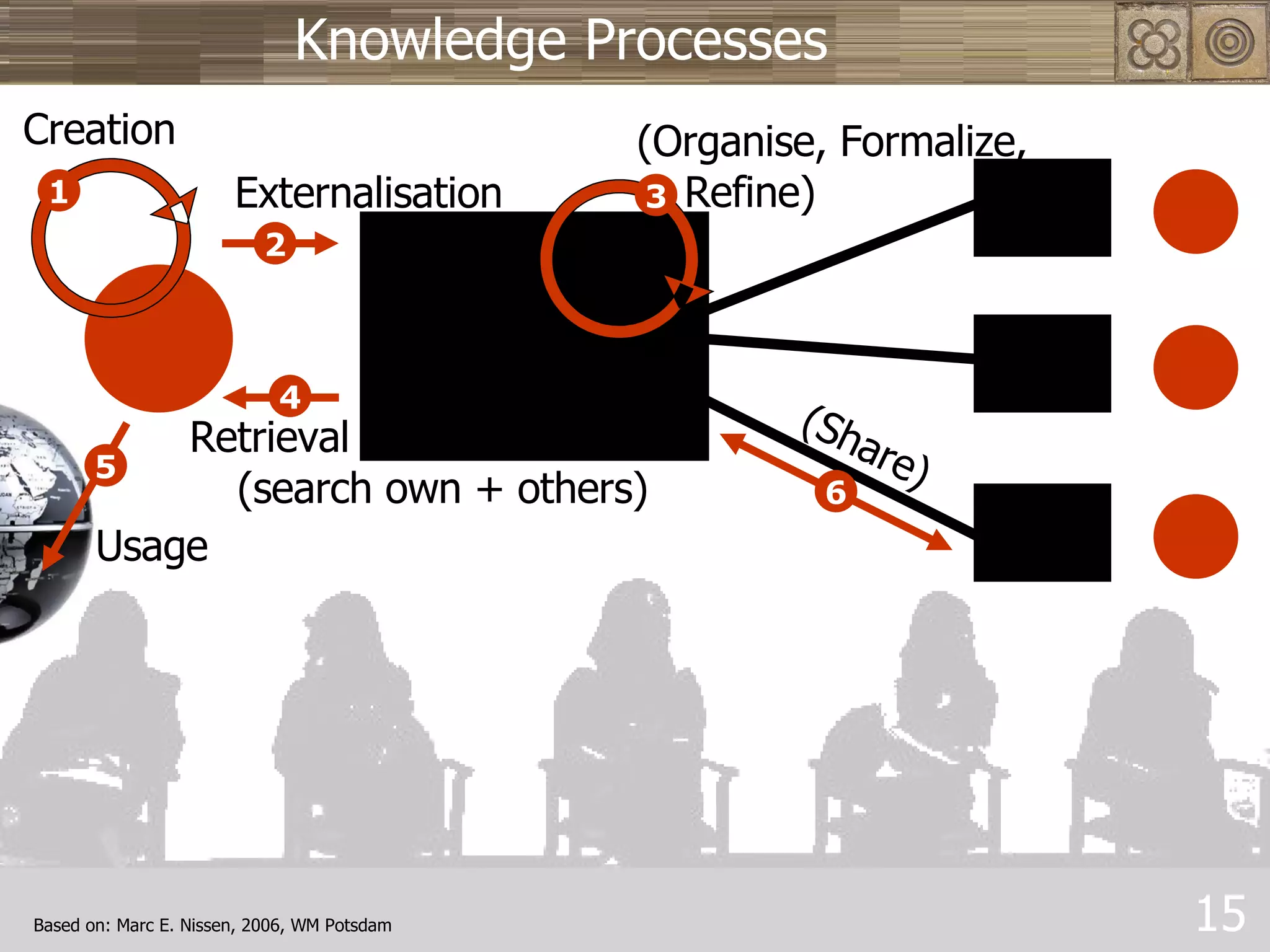
Knowledge Processes Creation Based on: Marc E. Nissen, 2006, WM Potsdam (Organise, Formalize,  Refine) Externalisation Retrieval  (search own + others) Usage (Share) 1 2 4 5 3 6
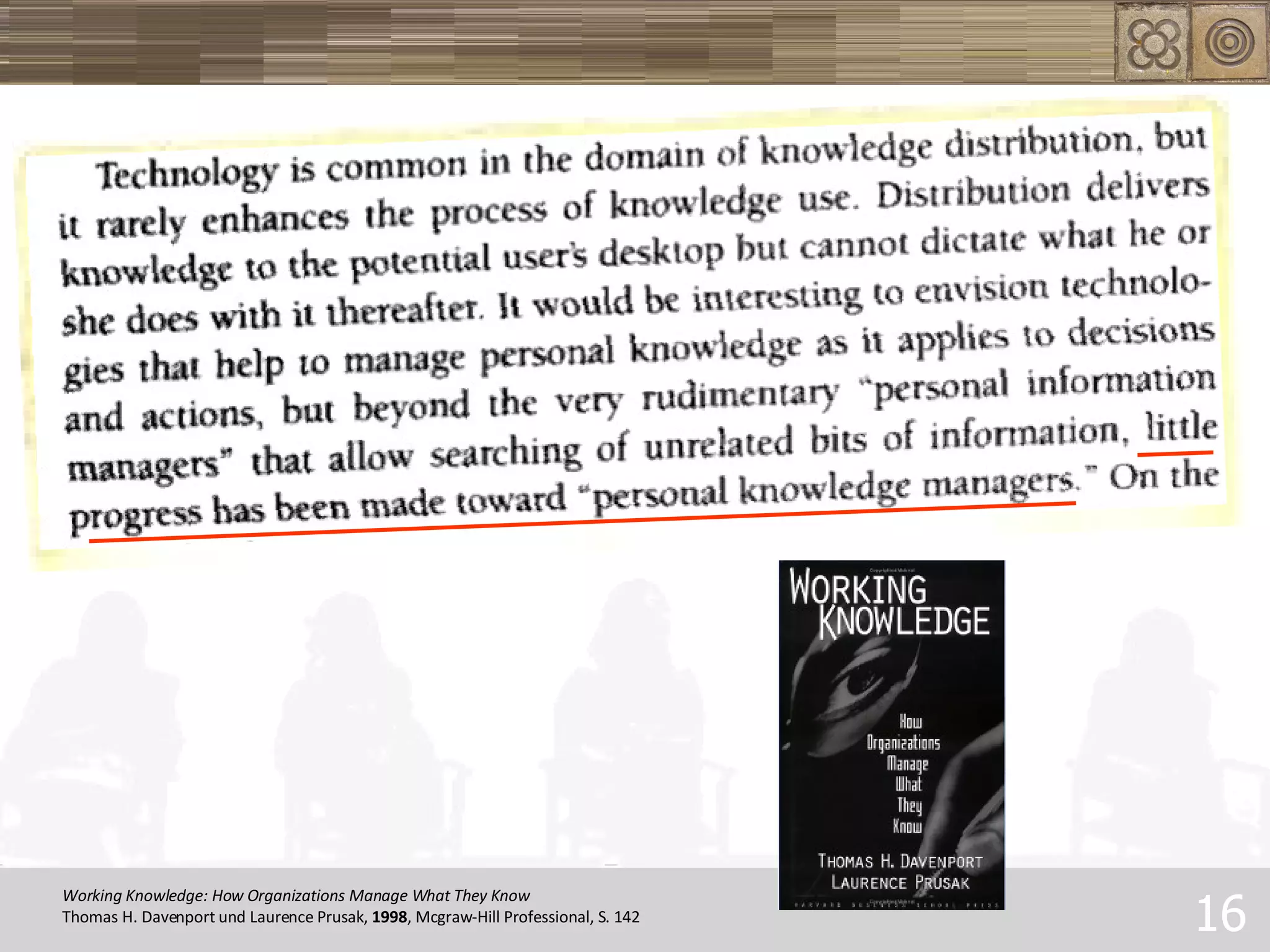
Working Knowledge: How Organizations Manage What They Know Thomas H. Davenport und Laurence Prusak,  1998 ,  Mcgraw-Hill Professional, S. 142
Challenges for Re-Using Personal Knowledge
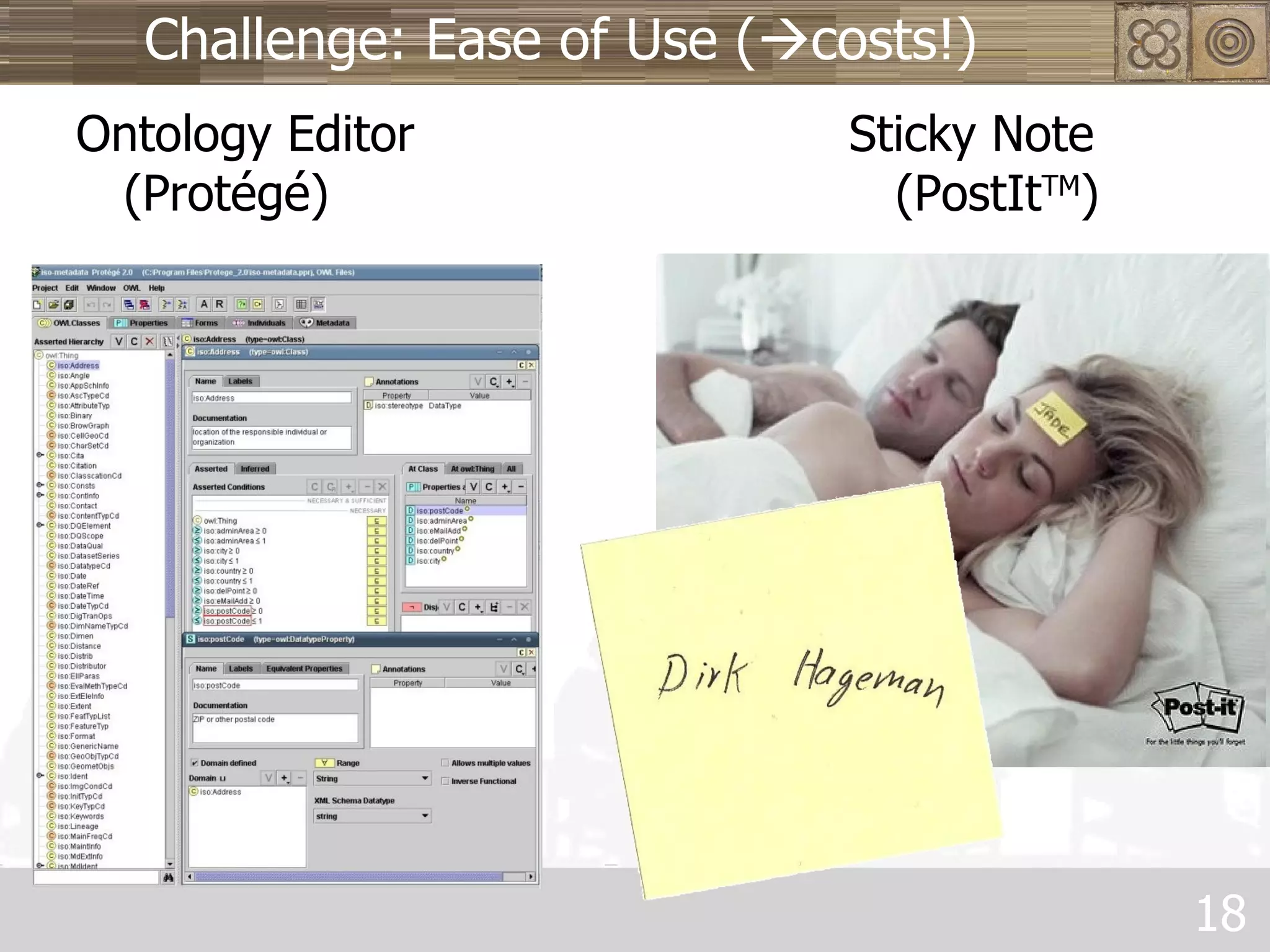
Challenge: Ease of Use (  costs!) Ontology Editor Sticky Note (Protégé)   (PostIt TM )
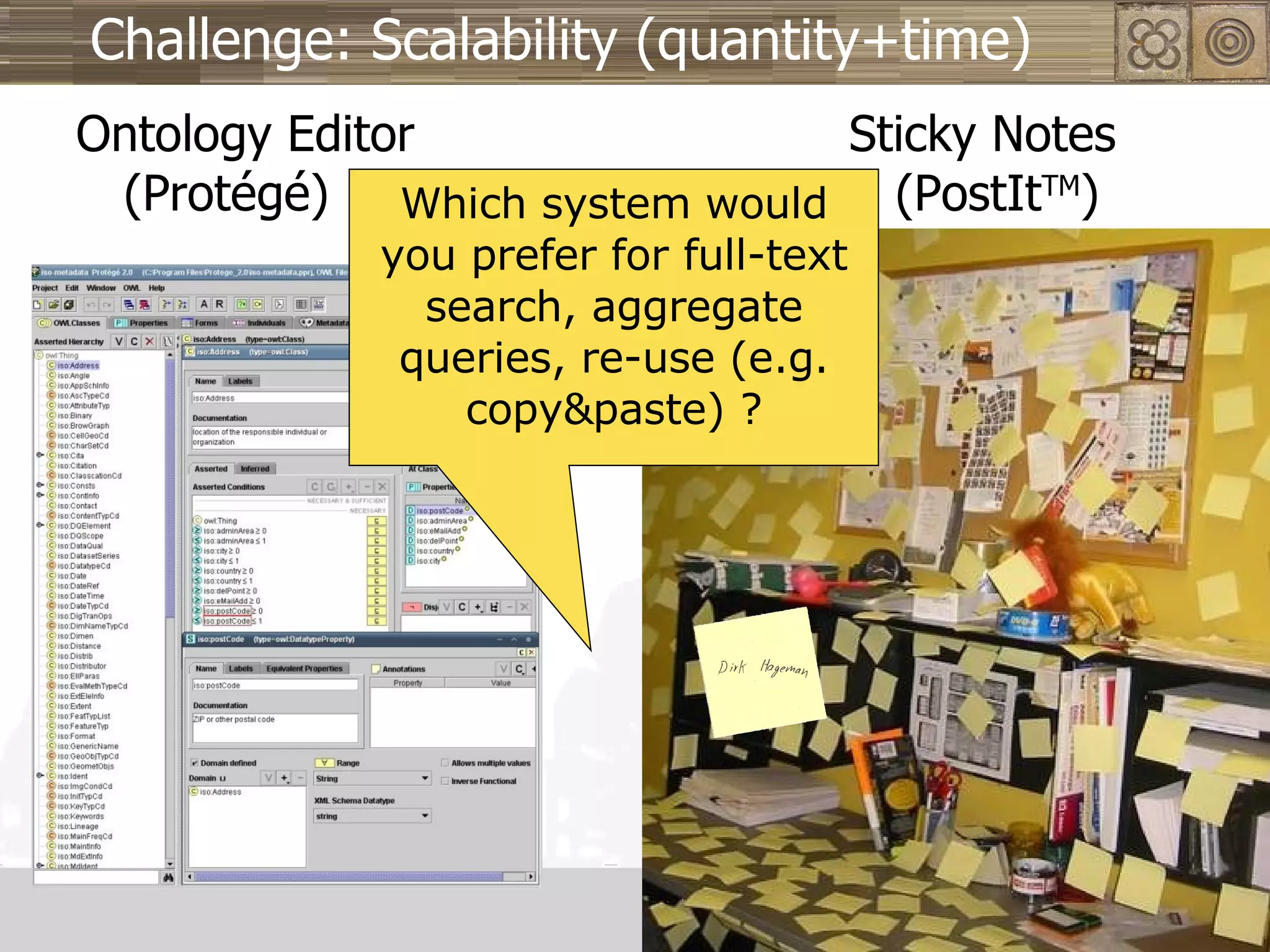
Challenge: Scalability (quantity+time) Ontology Editor Sticky Notes (Protégé)   (PostIt TM ) Which system would you prefer for full-text search, aggregate queries, re-use (e.g. copy&paste) ?
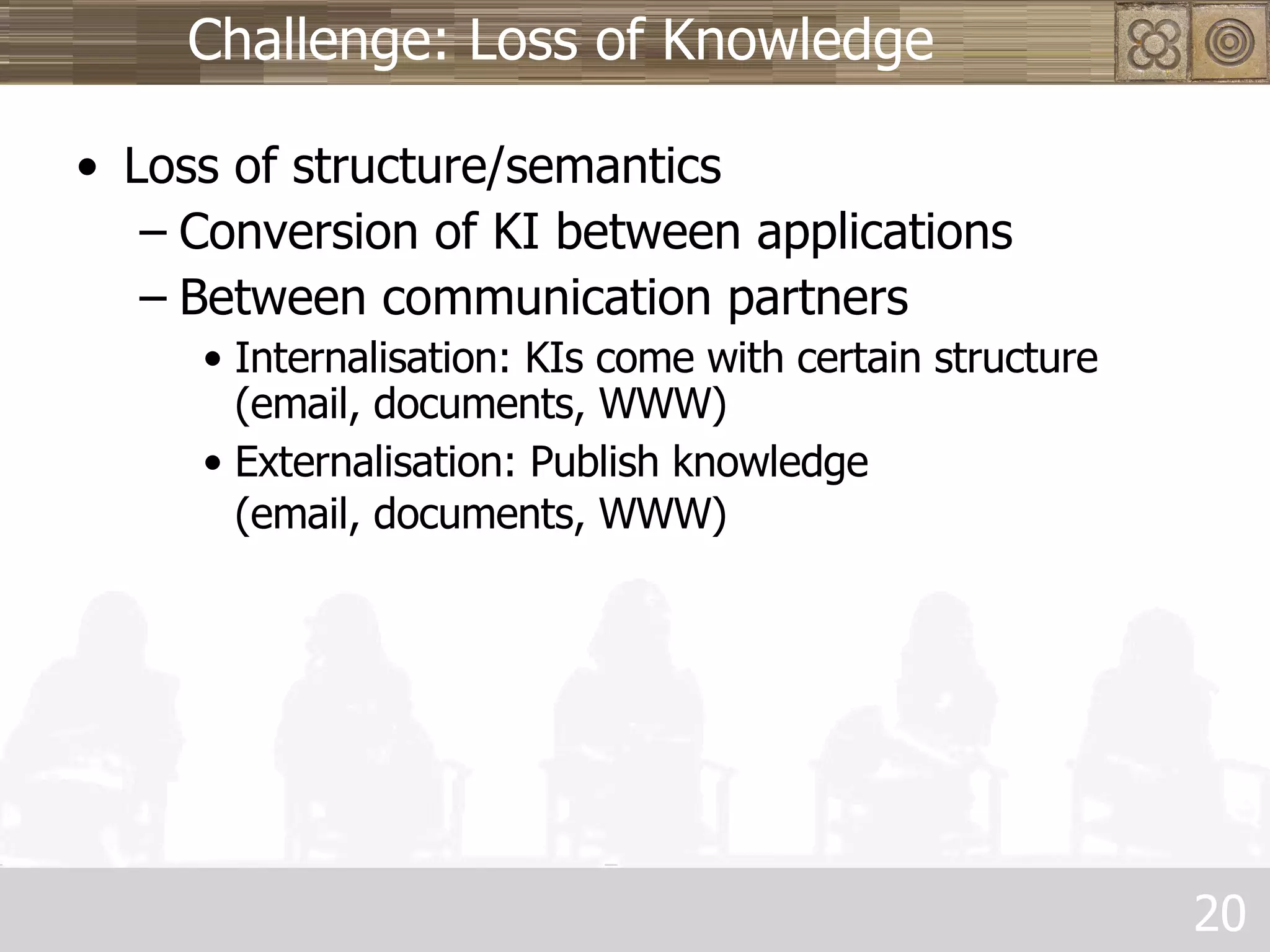
Challenge: Loss of Knowledge Loss of structure/semantics  Conversion of KI between applications Between communication partners Internalisation: KIs come with certain structure  (email, documents, WWW) Externalisation: Publish knowledge  (email, documents, WWW)
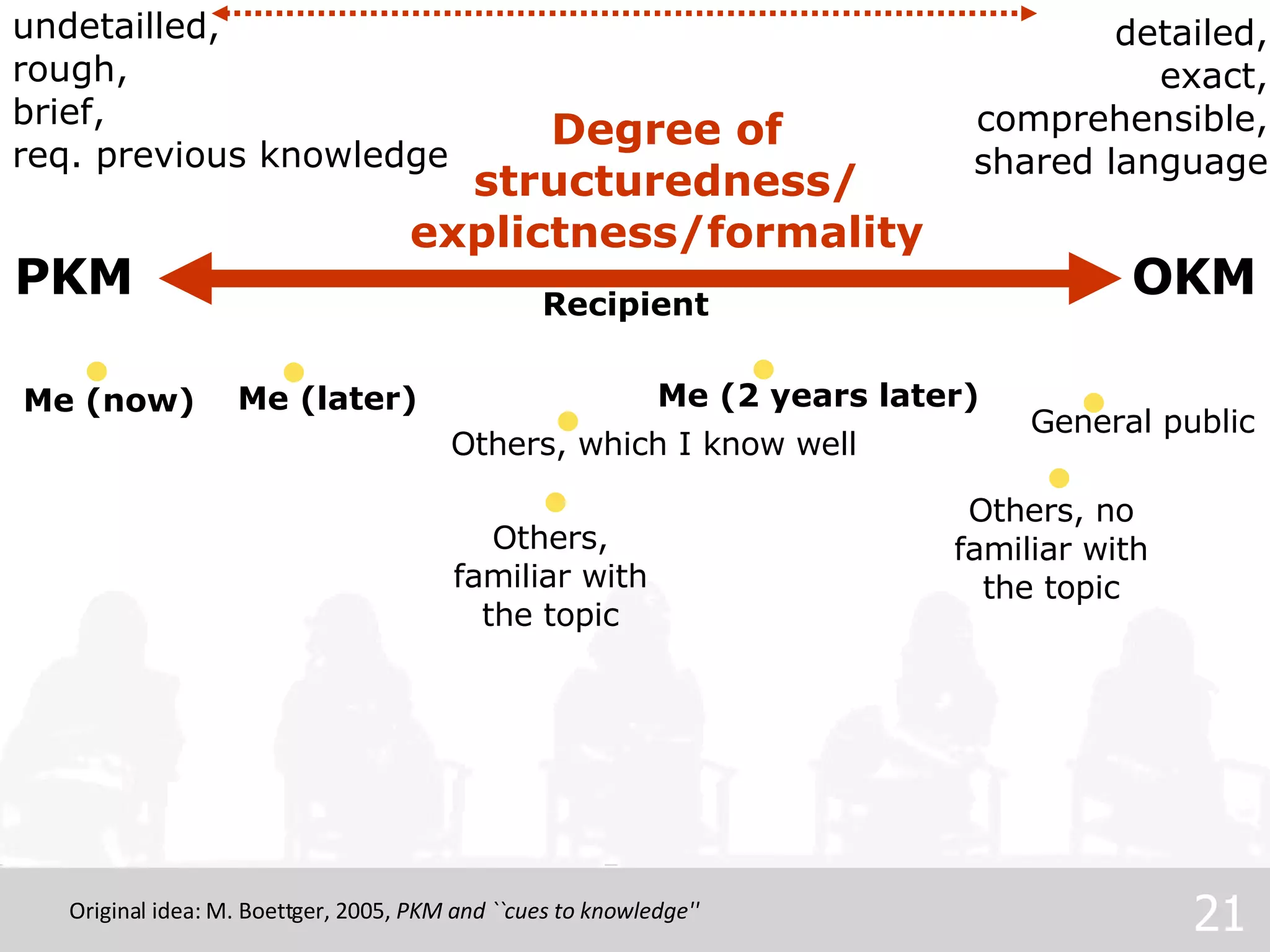
PKM OKM Degree of structuredness/ explictness/formality undetailled,  rough, brief, req. previous knowledge detailed, exact, comprehensible, shared language Recipient Me (now) Others, which I know well General public Others, no familiar with the topic Original idea: M. Boettger, 2005,  PKM and ``cues to knowledge'' Me (later) Me (2 years later) Others, familiar with the topic
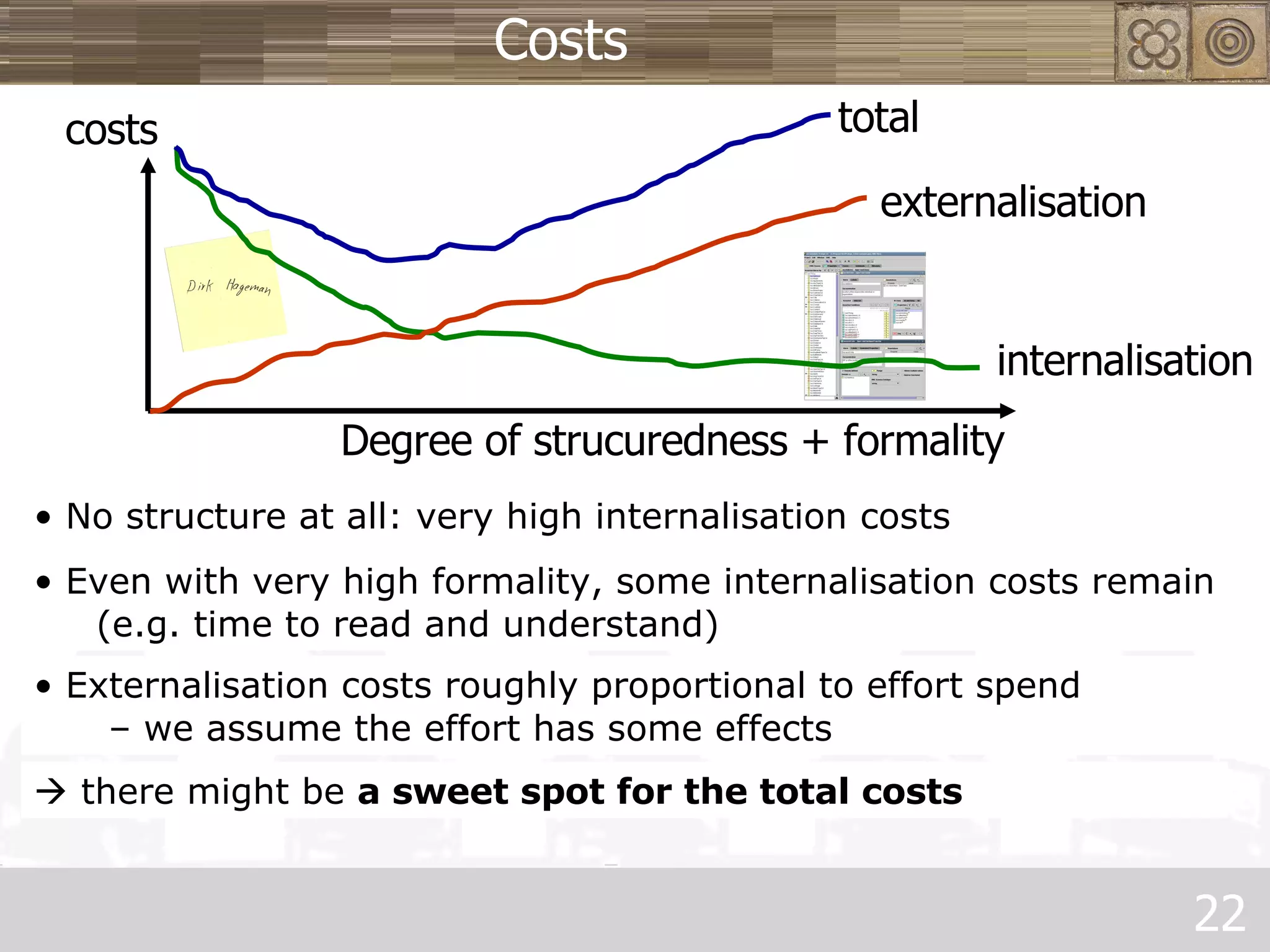
Costs costs Degree of strucuredness + formality internalisation No structure at all: very high internalisation costs Even with very high formality, some internalisation costs remain   (e.g. time to read and understand) total    there might be  a sweet spot for the total costs externalisation Externalisation costs roughly proportional to effort spend    – we assume the effort has some effects
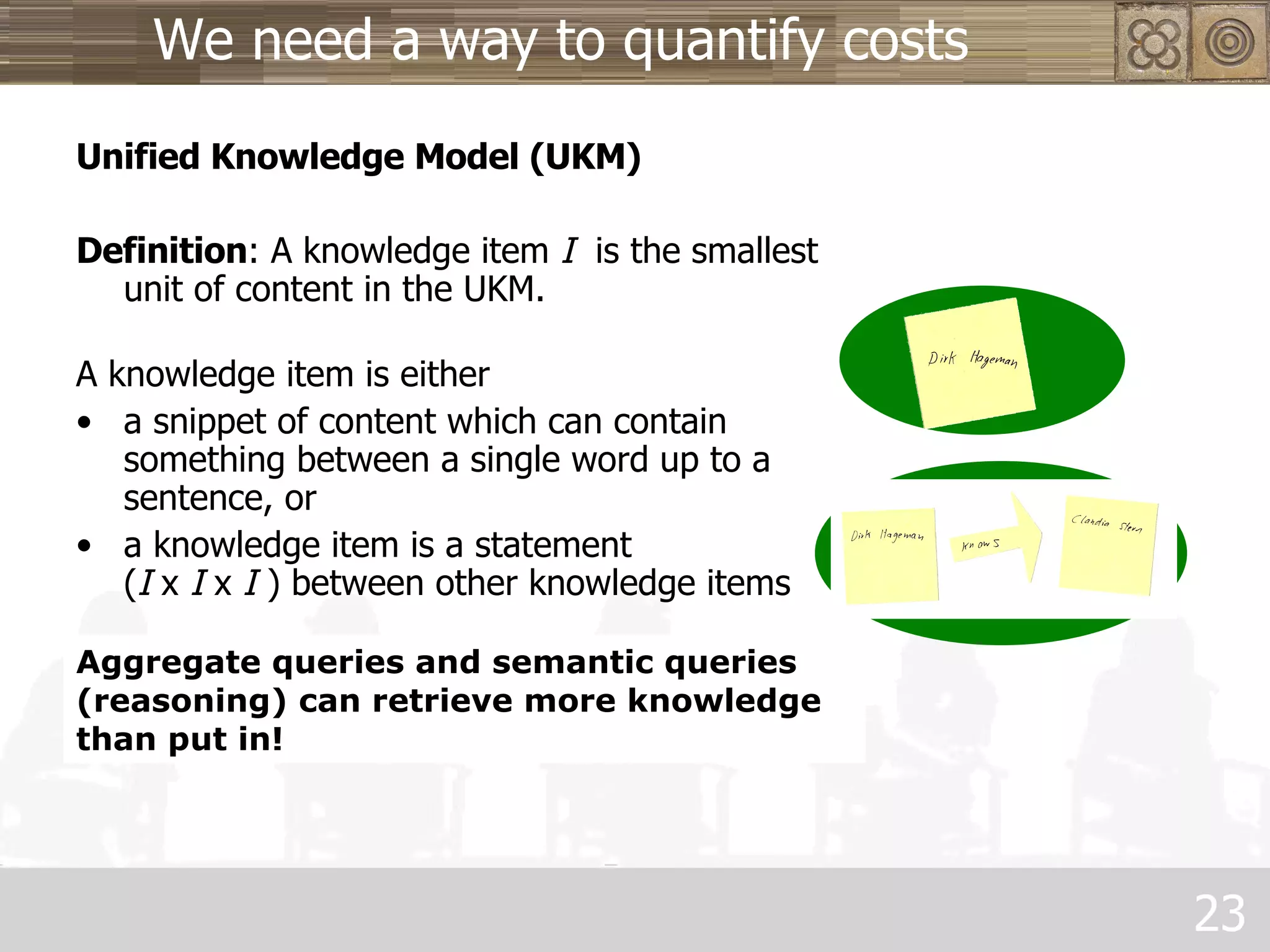
We need a way to quantify costs Unified Knowledge Model (UKM) Definition : A knowledge item  I   is the smallest unit of content in the UKM.  A knowledge item is either a snippet of content which can contain something between a single word up to a sentence, or a knowledge item is a statement  ( I  x  I  x  I  ) between other knowledge items Aggregate queries and semantic queries (reasoning) can retrieve more knowledge than put in!
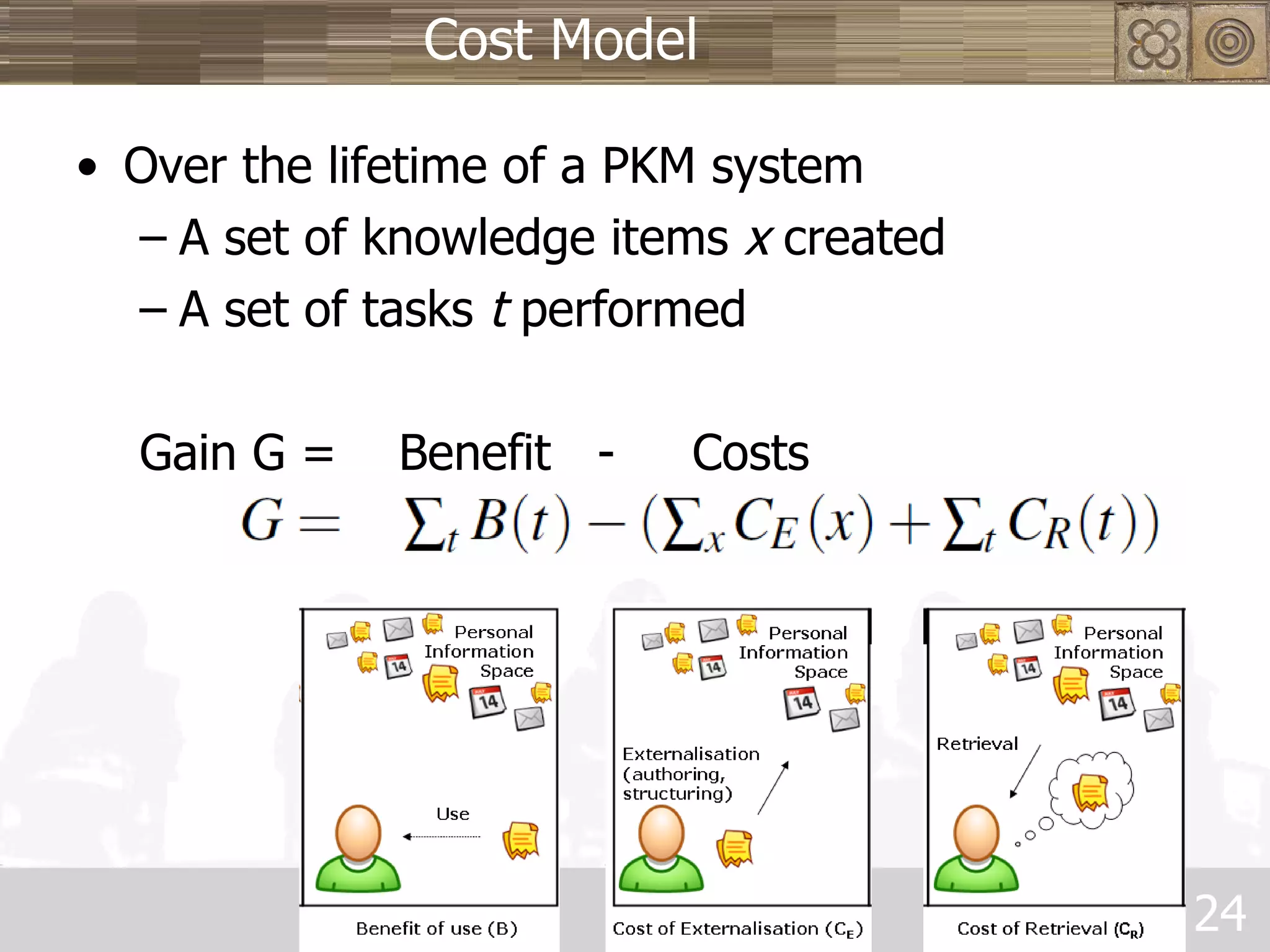
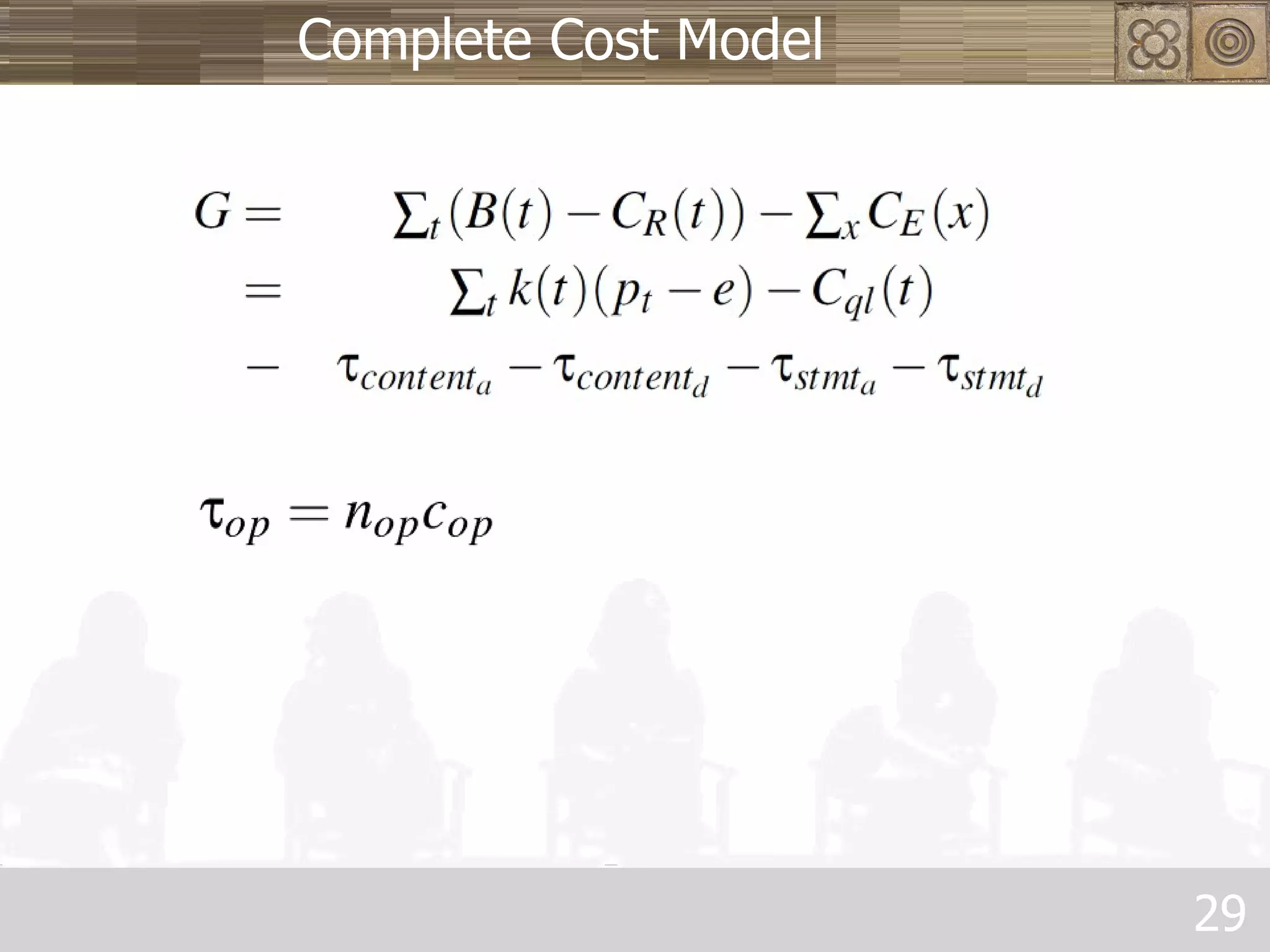
Cost Model Over the lifetime of a PKM system  A set of knowledge items  x  created A set of tasks  t  performed Gain G =  Benefit  -  Costs
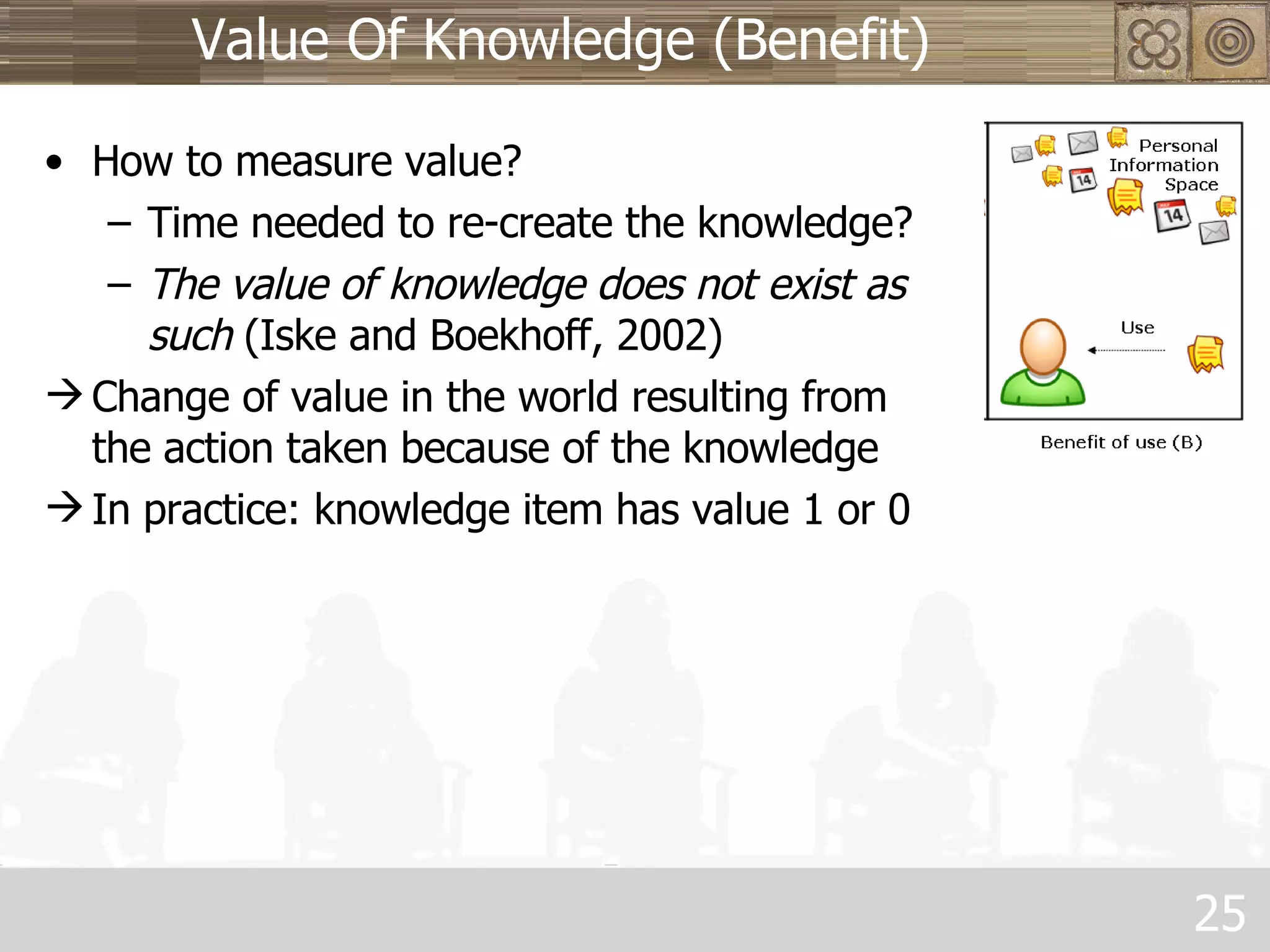
Value Of Knowledge (Benefit) How to measure value?  Time needed to re-create the knowledge?  The value of knowledge does not exist as such  (Iske and Boekhoff, 2002) Change of value in the world resulting from the action taken because of the knowledge In practice: knowledge item has value 1 or 0
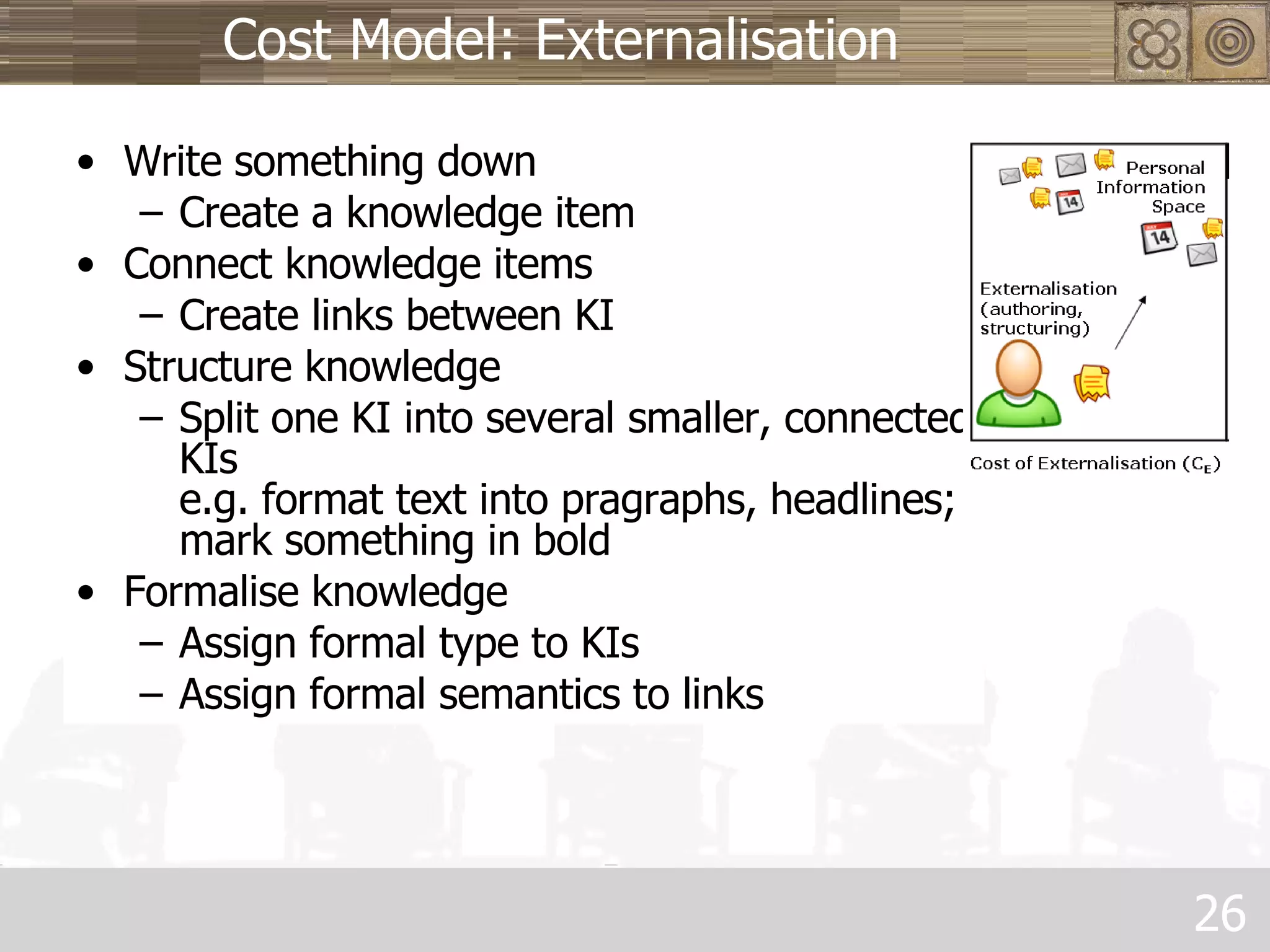
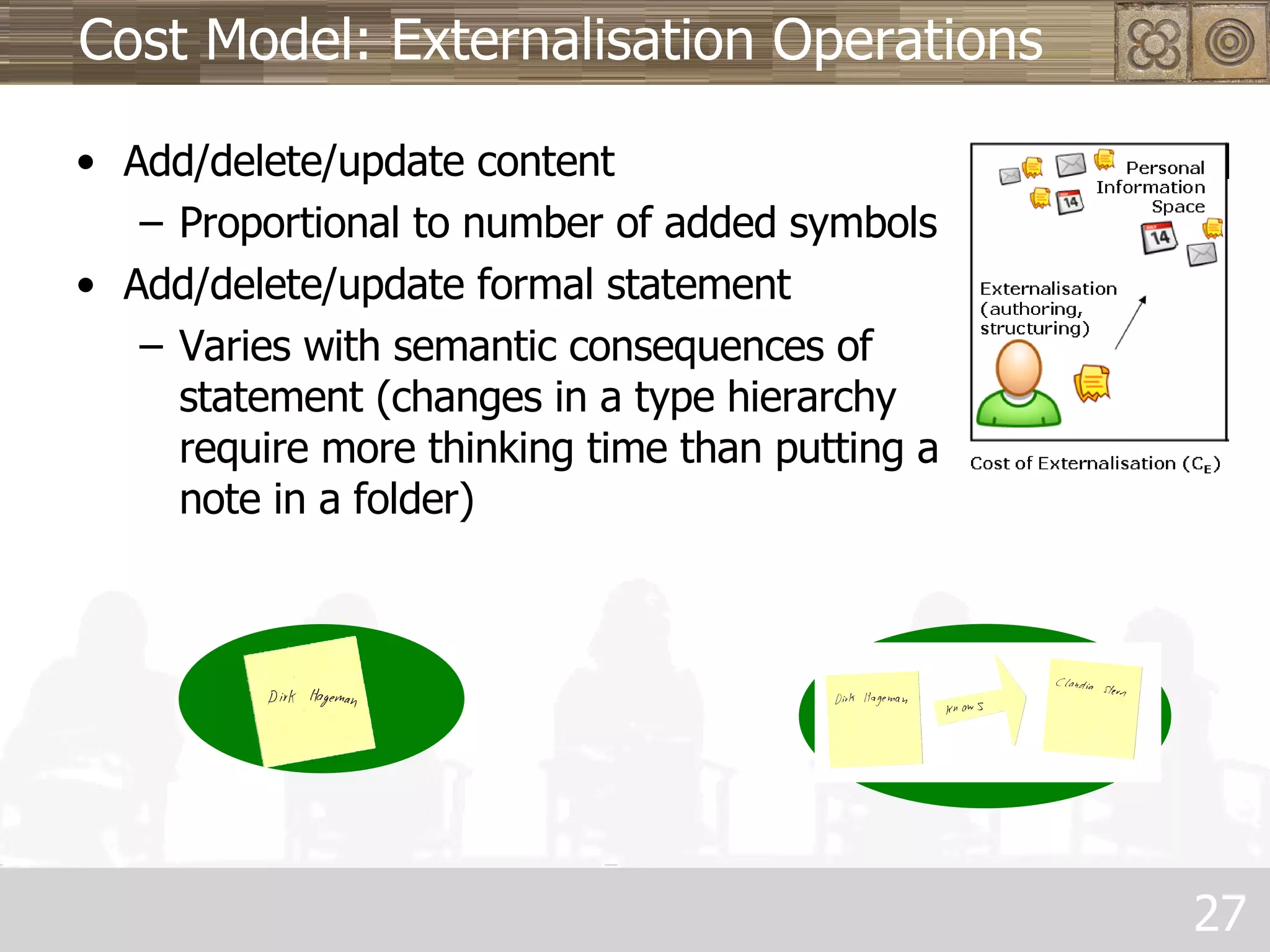
Cost Model: Externalisation Write something down Create a knowledge item Connect knowledge items Create links between KI Structure knowledge Split one KI into several smaller, connected KIs e.g. format text into pragraphs, headlines; mark something in bold Formalise knowledge Assign formal type to KIs  Assign formal semantics to links
Cost Model: Externalisation Operations Add/delete/update content Proportional to number of added symbols Add/delete/update formal statement Varies with semantic consequences of statement (changes in a type hierarchy require more thinking time than putting a note in a folder)
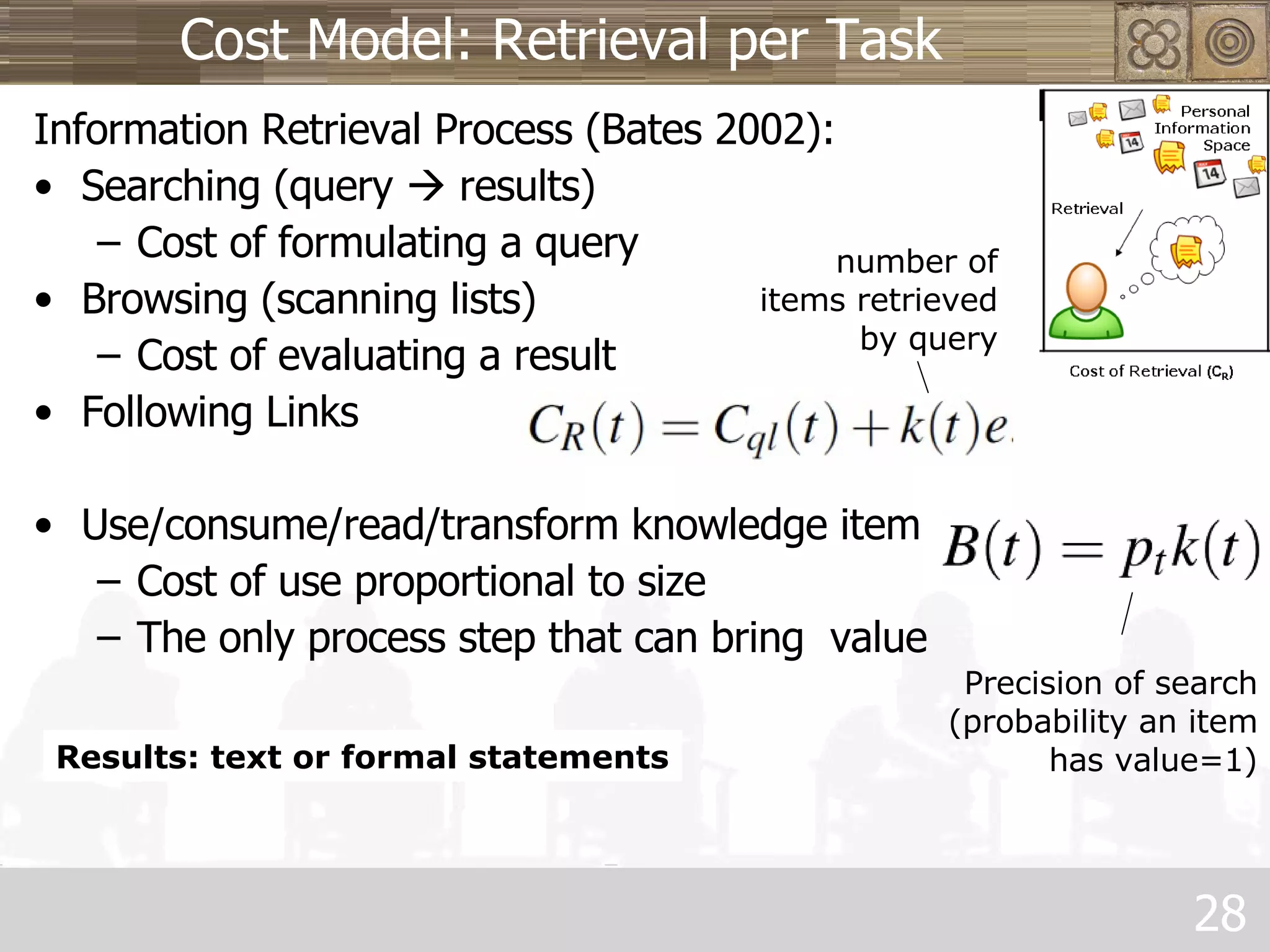
Cost Model: Retrieval per Task Information Retrieval Process (Bates 2002): Searching (query    results) Cost of formulating a query Browsing (scanning lists) Cost of evaluating a result  Following Links Use/consume/read/transform knowledge item Cost of use proportional to size The only process step that can bring  value number of items retrieved by query Precision of search (probability an item has value=1) Results: text or formal statements
Complete Cost Model
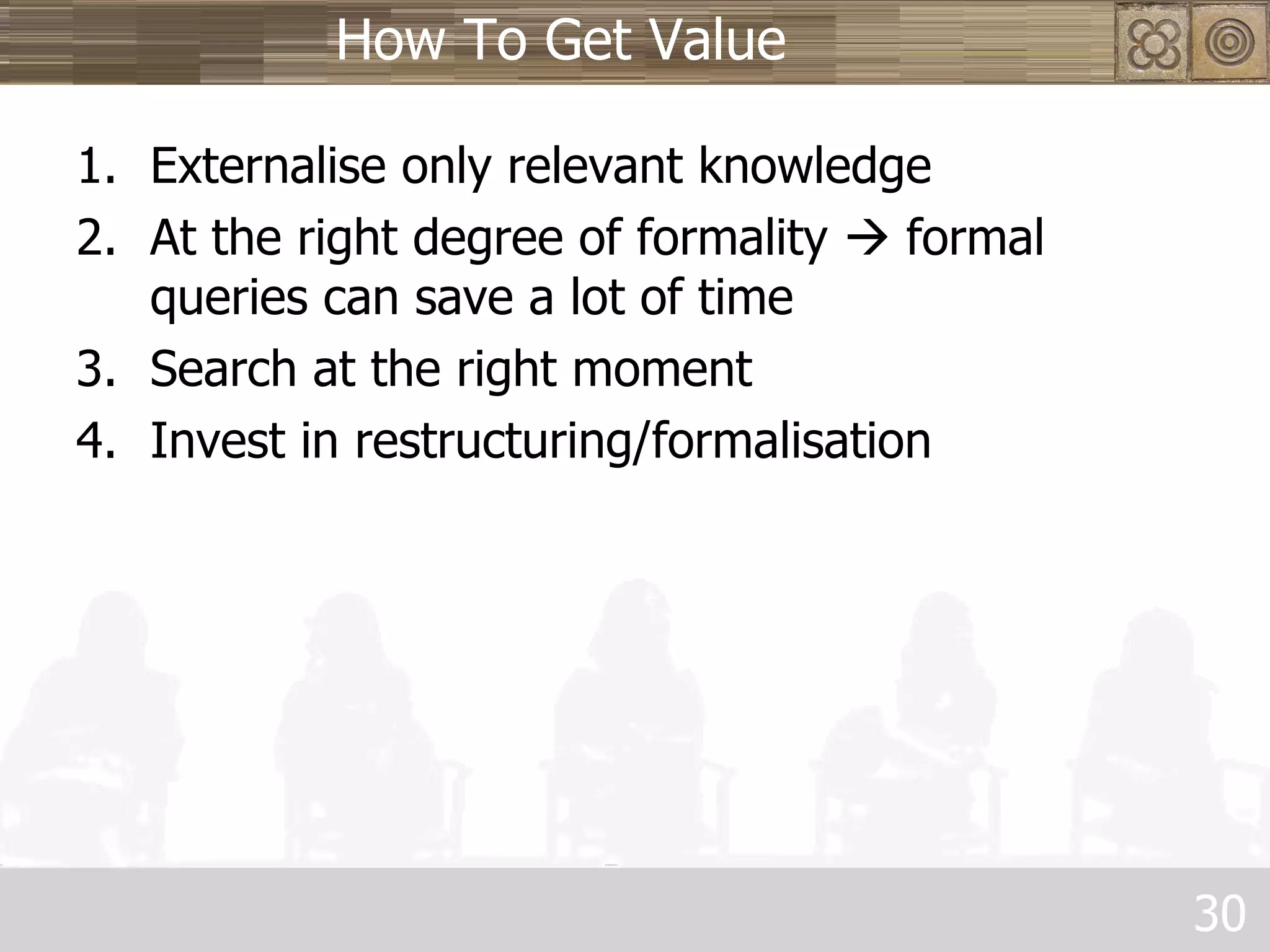
How To Get Value Externalise only relevant knowledge At the right degree of formality    formal queries can save a lot of time Search at the right moment Invest in restructuring/formalisation
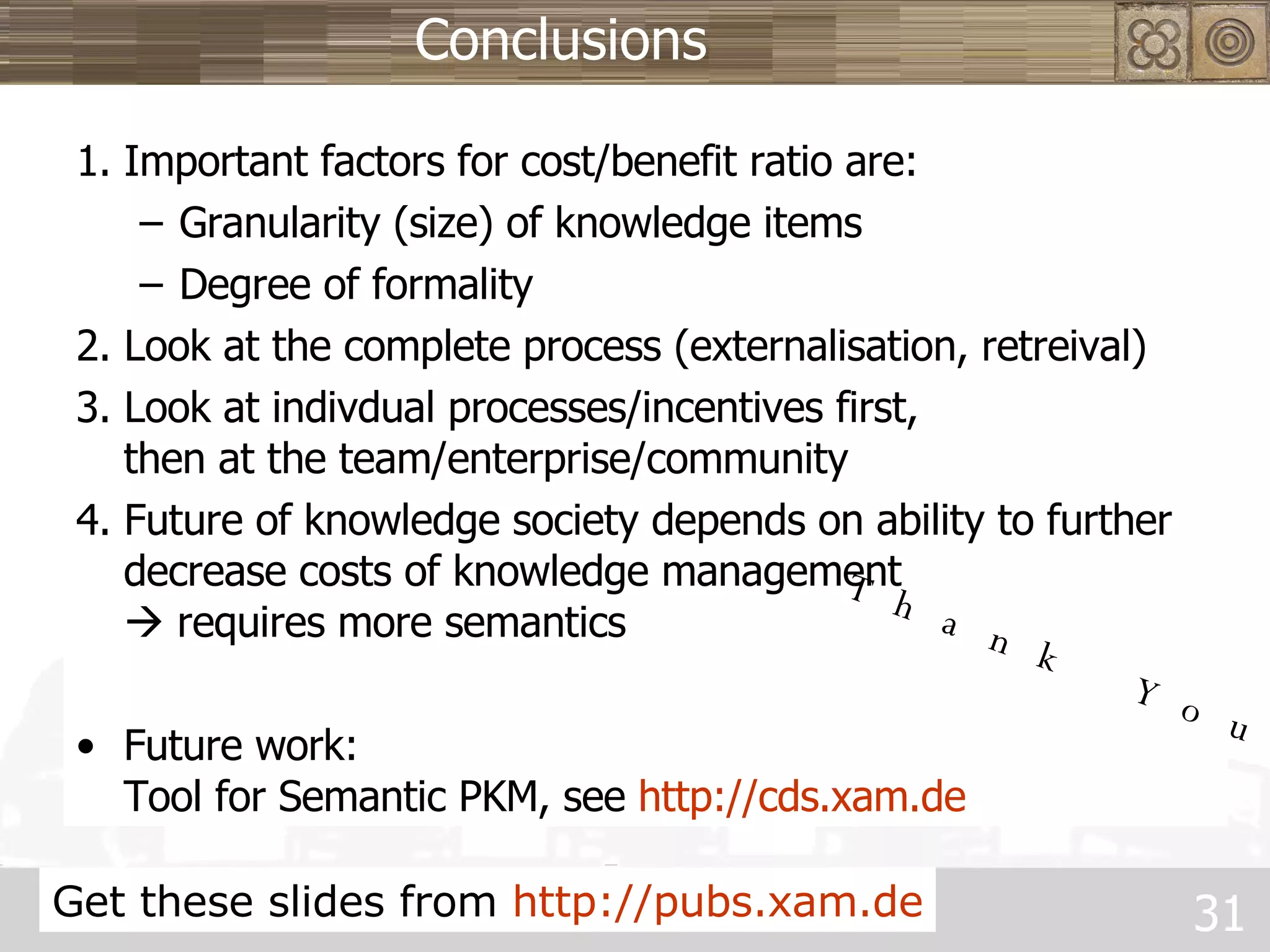
Conclusions 1. Important factors for cost/benefit ratio are: Granularity (size) of knowledge items Degree of formality 2. Look at the complete process (externalisation, retreival) 3. Look at indivdual processes/incentives first,  then at the team/enterprise/community 4. Future of knowledge society depends on ability to further decrease costs of knowledge management    requires more semantics Future work:  Tool for Semantic PKM, see  http ://cds.xam.de Get these slides from  http ://pubs.xam.de Thank You.
BACKUP
Prototype for Semantic PKM http://cds.xam.de Looking for private beta users, send me an email
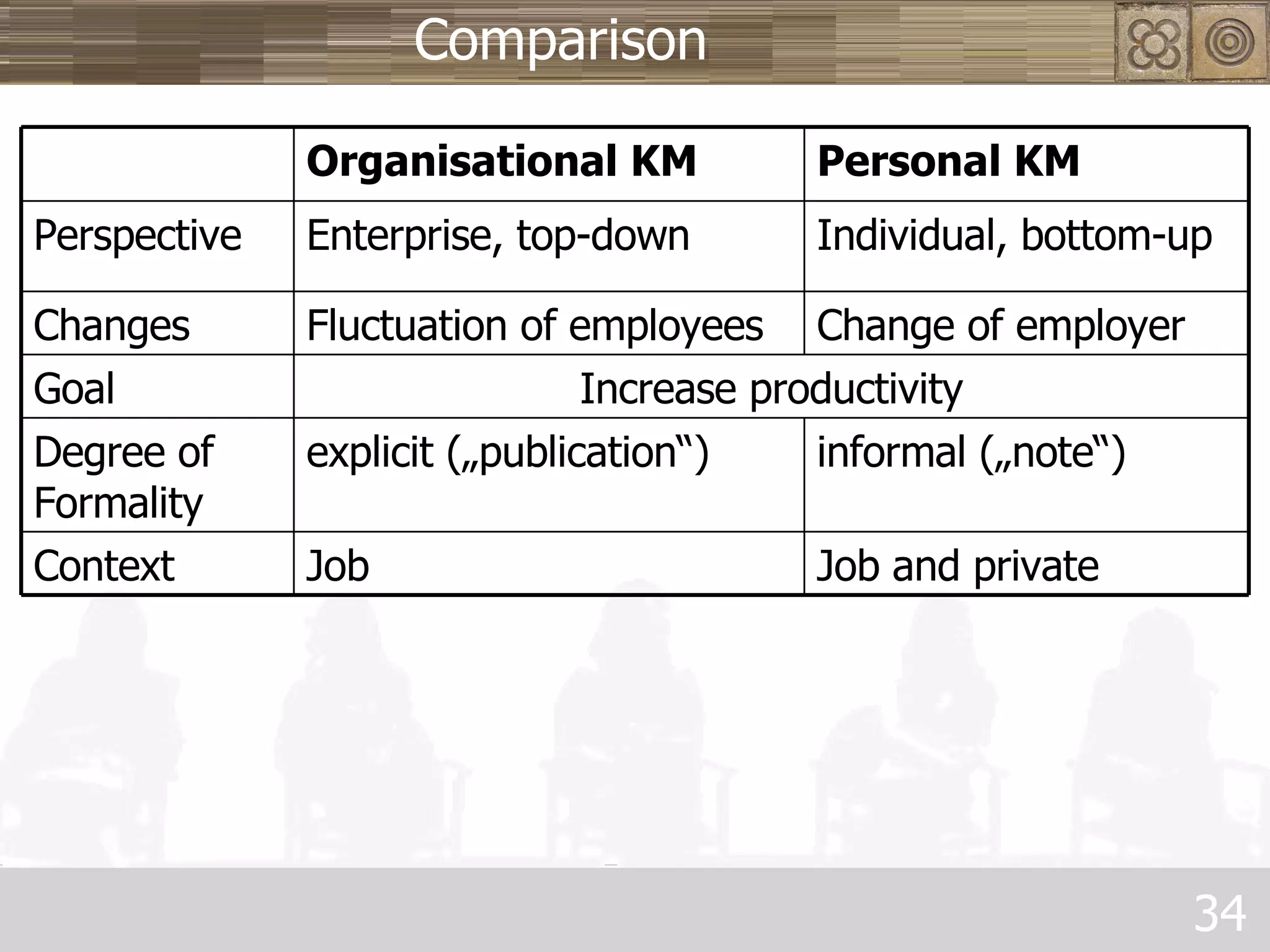
Comparison informal („note“) explicit („publication“) Degree of Formality Job and private Job Context Increase productivity Goal Change of employer Fluctuation of employees Changes Individual, bottom-up Enterprise, top-down Perspective Personal KM Organisational KM

Cost-Benefit Analysis for the Design of Personal Knowledge Management Systems

  • 1.
    Cost-Benefit Analysis for the Design of Personal Knowledge Management Systems [email_address] , abecker@fzi.de and Andreas Abecker 16.06.2008 / ICEIS 2008 @ Barcelona, Spain.
  • 2.
    Disclaimer This presentationis not intended to replace the paper. Get these slides from http://pubs.xam.de
  • 3.
    Outline Introduction to Personal Knowledge Management (PKM) Comparision to Organisatinal KM (OKM) Processes in PKM Challenges for Re-Using Personal Knowledge Quantification of Costs and Benefit Conclusions
  • 4.
    The most importantcontribution of management in the 20th century was to increase manual worker productivity fifty-fold. The most important contribution of management in the 21st century will be to increase knowledge worker productivity – hopefully by the same percentage. […] The methods, however, are totally different from those that increased the productivity of manual workers. Peter F. Drucker, 1958
  • 5.
    Today: Communication ofMen and Machines
  • 6.
    Today: Communication ofMen and Machines
  • 7.
    Organisational Perspective onKM Emphasis on Search Share Corporate KM System
  • 8.
    Personal Perspective onKM Emphasis on Create or Search Organize Formalize Refine Corporate KM System Personal KM System
  • 9.
    Definition of PKMPersonal KM: A set of concepts, disciplines and tools for organizing often previously unstructured knowledge, to help individuals take responsibility for what they know and who they know. Organizational KM: Unlike personal KM, which centres on the individual, organizational KM depends upon an enterprise-wide strategic decision to actively manage knowledge through a range of processes, tools and people. European Guide to good Practice in Knowledge Management, EUROPEAN COMMITTEE FOR STANDARDIZATION. CWA 14924 (CEN Workshop Agreement), ICS 03.100.99. 2004.
  • 10.
    SECI model (Nonakaand Takeuchi 95) Socialisation talk, chat Externalisation create, write Combination collect, copy & paste Internalisation search, read
  • 11.
    SECI Today InternalisationExternalisation Combination Socialisation
  • 12.
    Re-Use of KnowledgeIncreases Productivity Thomas H. Davenport Thinking for a Living: How to Get Better Performance and Results from Knowledge Workers Verlag: Mcgraw-Hill Professional (1. November 2005 ), ISBN-10: 1591394236
  • 13.
    Re-Use Your OwnKnowledge Internalisation Externalisation Combination Combination  Note-taking is communication with yourself
  • 14.
    My Work Totalcosts C = C E + C R Benefit B? Personal KM is always gambling: Will I ever need this knowledge again? In what context? Is it cheaper to re-create the knowledge? C C < C E + C R What value will it have? How much effort is it worth to structure and formalize? B > C E + C E Should I try to search my PKM system now?
  • 15.
    Knowledge Processes CreationBased on: Marc E. Nissen, 2006, WM Potsdam (Organise, Formalize, Refine) Externalisation Retrieval (search own + others) Usage (Share) 1 2 4 5 3 6
  • 16.
    Working Knowledge: HowOrganizations Manage What They Know Thomas H. Davenport und Laurence Prusak, 1998 , Mcgraw-Hill Professional, S. 142
  • 17.
    Challenges for Re-UsingPersonal Knowledge
  • 18.
    Challenge: Ease ofUse (  costs!) Ontology Editor Sticky Note (Protégé) (PostIt TM )
  • 19.
    Challenge: Scalability (quantity+time)Ontology Editor Sticky Notes (Protégé) (PostIt TM ) Which system would you prefer for full-text search, aggregate queries, re-use (e.g. copy&paste) ?
  • 20.
    Challenge: Loss ofKnowledge Loss of structure/semantics Conversion of KI between applications Between communication partners Internalisation: KIs come with certain structure (email, documents, WWW) Externalisation: Publish knowledge (email, documents, WWW)
  • 21.
    PKM OKM Degreeof structuredness/ explictness/formality undetailled, rough, brief, req. previous knowledge detailed, exact, comprehensible, shared language Recipient Me (now) Others, which I know well General public Others, no familiar with the topic Original idea: M. Boettger, 2005, PKM and ``cues to knowledge'' Me (later) Me (2 years later) Others, familiar with the topic
  • 22.
    Costs costs Degreeof strucuredness + formality internalisation No structure at all: very high internalisation costs Even with very high formality, some internalisation costs remain (e.g. time to read and understand) total  there might be a sweet spot for the total costs externalisation Externalisation costs roughly proportional to effort spend – we assume the effort has some effects
  • 23.
    We need away to quantify costs Unified Knowledge Model (UKM) Definition : A knowledge item I is the smallest unit of content in the UKM. A knowledge item is either a snippet of content which can contain something between a single word up to a sentence, or a knowledge item is a statement ( I x I x I ) between other knowledge items Aggregate queries and semantic queries (reasoning) can retrieve more knowledge than put in!
  • 24.
    Cost Model Overthe lifetime of a PKM system A set of knowledge items x created A set of tasks t performed Gain G = Benefit - Costs
  • 25.
    Value Of Knowledge(Benefit) How to measure value? Time needed to re-create the knowledge? The value of knowledge does not exist as such (Iske and Boekhoff, 2002) Change of value in the world resulting from the action taken because of the knowledge In practice: knowledge item has value 1 or 0
  • 26.
    Cost Model: ExternalisationWrite something down Create a knowledge item Connect knowledge items Create links between KI Structure knowledge Split one KI into several smaller, connected KIs e.g. format text into pragraphs, headlines; mark something in bold Formalise knowledge Assign formal type to KIs Assign formal semantics to links
  • 27.
    Cost Model: ExternalisationOperations Add/delete/update content Proportional to number of added symbols Add/delete/update formal statement Varies with semantic consequences of statement (changes in a type hierarchy require more thinking time than putting a note in a folder)
  • 28.
    Cost Model: Retrievalper Task Information Retrieval Process (Bates 2002): Searching (query  results) Cost of formulating a query Browsing (scanning lists) Cost of evaluating a result Following Links Use/consume/read/transform knowledge item Cost of use proportional to size The only process step that can bring value number of items retrieved by query Precision of search (probability an item has value=1) Results: text or formal statements
  • 29.
  • 30.
    How To GetValue Externalise only relevant knowledge At the right degree of formality  formal queries can save a lot of time Search at the right moment Invest in restructuring/formalisation
  • 31.
    Conclusions 1. Importantfactors for cost/benefit ratio are: Granularity (size) of knowledge items Degree of formality 2. Look at the complete process (externalisation, retreival) 3. Look at indivdual processes/incentives first, then at the team/enterprise/community 4. Future of knowledge society depends on ability to further decrease costs of knowledge management  requires more semantics Future work: Tool for Semantic PKM, see http ://cds.xam.de Get these slides from http ://pubs.xam.de Thank You.
  • 32.
  • 33.
    Prototype for SemanticPKM http://cds.xam.de Looking for private beta users, send me an email
  • 34.
    Comparison informal („note“)explicit („publication“) Degree of Formality Job and private Job Context Increase productivity Goal Change of employer Fluctuation of employees Changes Individual, bottom-up Enterprise, top-down Perspective Personal KM Organisational KM

Editor's Notes

  • #2 COST-BENEFIT ANALYSIS FOR THE DESIGN OF PERSONAL KNOWLEDGE MANAGEMENT SYSTEMS Max Völkel and Andreas Abecker FZI – Forschungszentrum Informatik Karlsruhe, Haid-und-Neu-Straße 10-14, Karlsruhe, Germany voelkel@fzi.de,abecker@fzi.de