Semantic Wiki Mini-Series 1st session:  A Survey of the Landscape and State-of-Art in Semantic Wiki Co-chairs:  Sebastian Schaffert (Salzburg Research, Austria), Max Völkel (FZI Karlsruhe)  2008-10-23 Semantic Wikis: The Wiki Way to the Semantic Web?
Agenda History State of the Art Trends Introduction
Introduction Introduction
Introduction: Semantic Wikis wiki principles metaweb two perspectives on Semantic Wikis characteristics of Semantic Wikis example Introduction
Wiki Principles wikis allow anyone to edit wikis are easy to use and do not require additional software wiki content is easy to link wikis support versioning of all changes wikis support all media Introduction
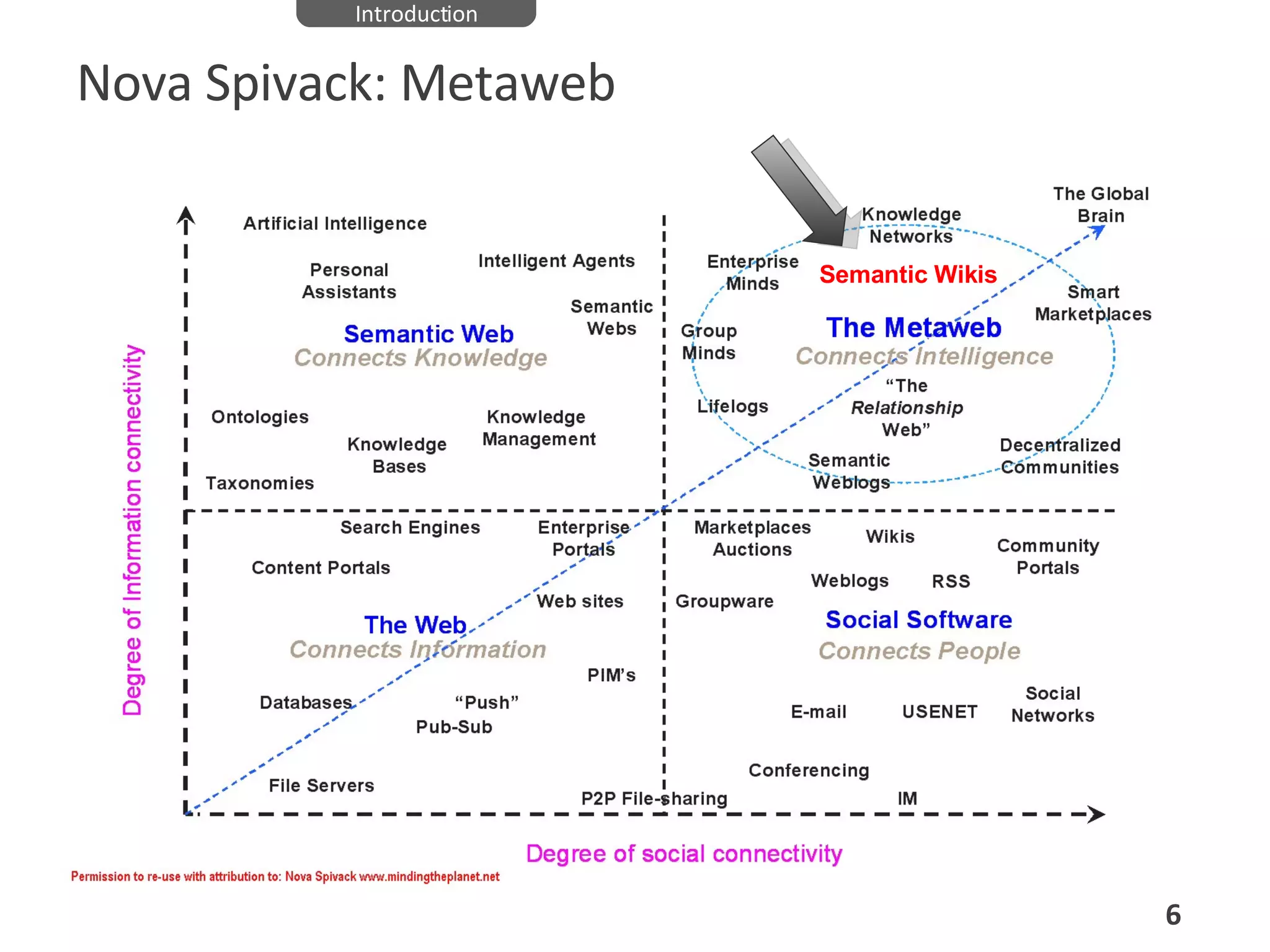
Nova Spivack: Metaweb Semantic Wikis Introduction
Two Perspectives on Semantic Wikis Wikis for Metadata Metadata for Wikis no clear separation, but tendencies! Introduction
Wikis for Metadata creating metadata on the Semantic Web is difficult!  requires domain knowledge requires knowledge engineering skills complicated, insufficient tools Wikis for metadata: simplified technological access to the creation of metadata collaboration of domain experts and knowledge engineers dynamically evolving knowledge networks and knowledge models Introduction
Metadata for Wikis Wikis huge amounts of digital content (e.g. Wikipedia) strong connection of content via hyperlinks problem: structure exists, but is only used for presentation and not accessible by computers finding relevant content is increasingly difficult integration and exchange between different systems is difficult Introduction
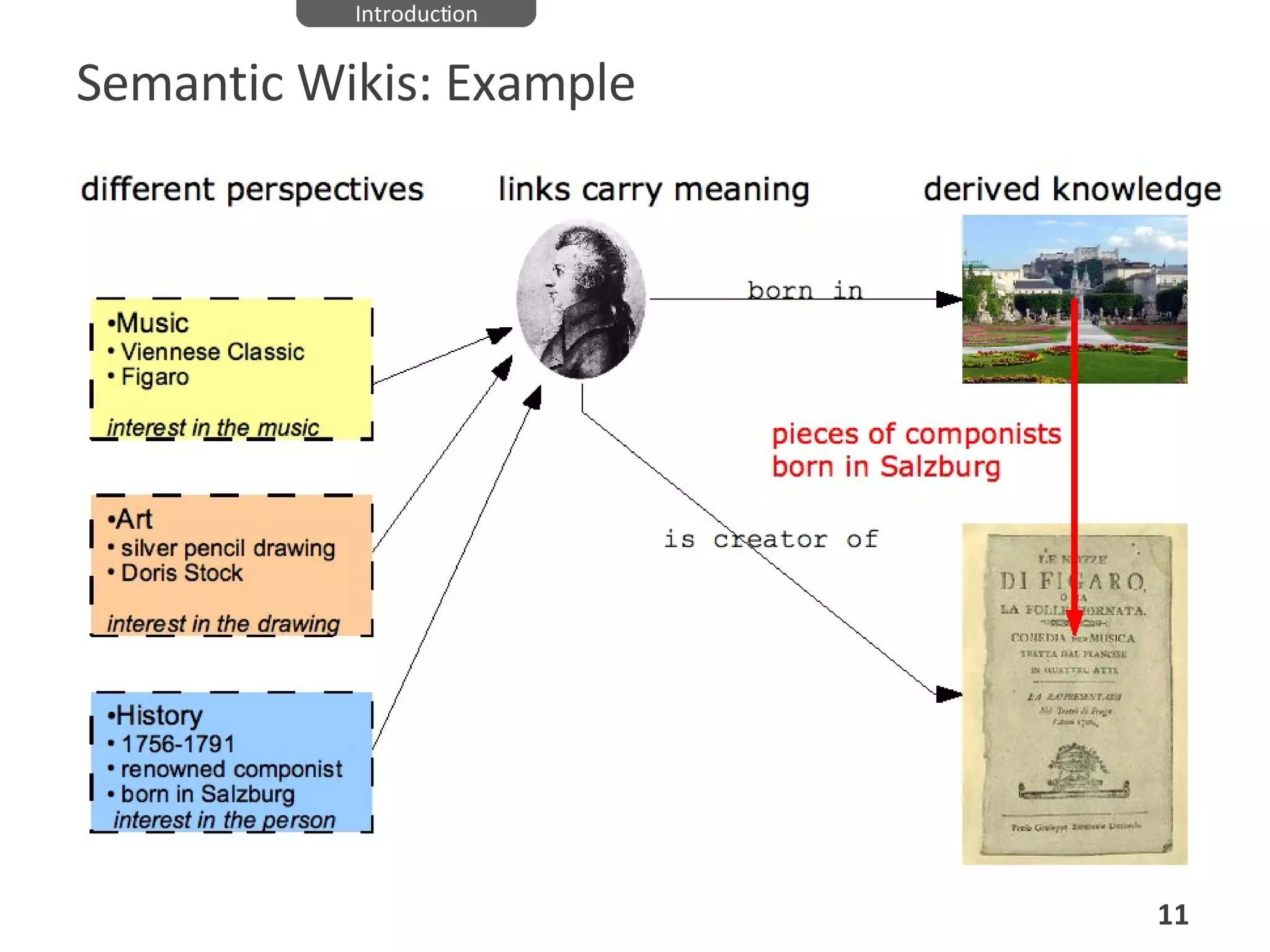
Semantic Wikis annotation of existing structures with machine readable metadata links carry meaning, typing of links, typing of pages context dependent adaptation and presentation different domains have different ways of presenting content, personal preferences, etc. improved, „intelligent“, search and navigation queries to the structure, visualisation of structure, derived information improved interoperability between systems exchange of content, integration of different systems, agents, etc Introduction
Semantic Wikis: Example Introduction
History History
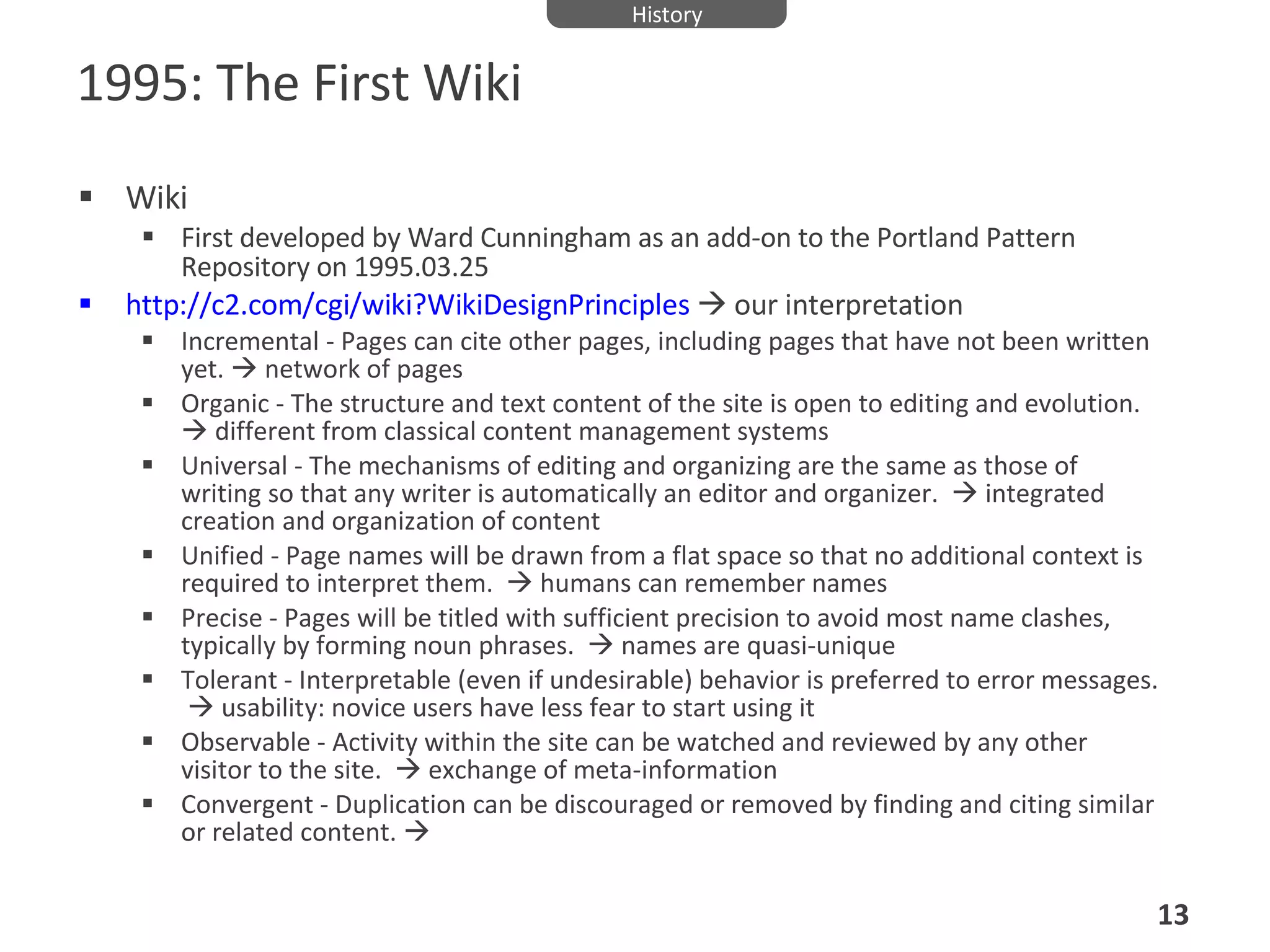
1995: The First Wiki Wiki First developed by Ward Cunningham as an add-on to the Portland Pattern Repository on 1995.03.25  http://c2.com/cgi/wiki?WikiDesignPrinciples     our interpretation Incremental - Pages can cite other pages, including pages that have not been written yet.    network of pages Organic - The structure and text content of the site is open to editing and evolution.    different from classical content management systems Universal - The mechanisms of editing and organizing are the same as those of writing so that any writer is automatically an editor and organizer.    integrated creation and organization of content Unified - Page names will be drawn from a flat space so that no additional context is required to interpret them.    humans can remember names Precise - Pages will be titled with sufficient precision to avoid most name clashes, typically by forming noun phrases.    names are quasi-unique Tolerant - Interpretable (even if undesirable) behavior is preferred to error messages.    usability: novice users have less fear to start using it Observable - Activity within the site can be watched and reviewed by any other visitor to the site.    exchange of meta-information Convergent - Duplication can be discouraged or removed by finding and citing similar or related content.     History
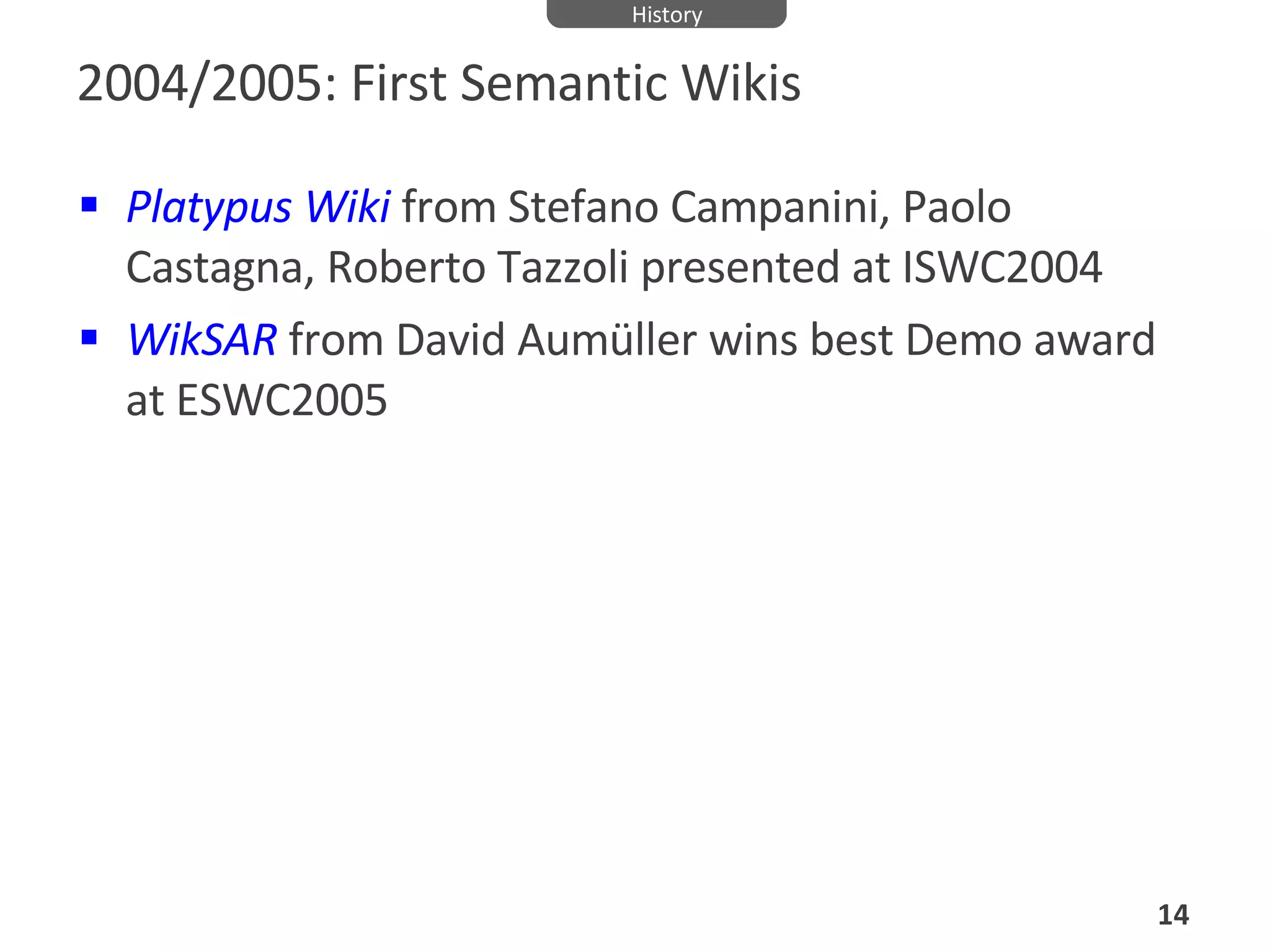
2004/2005: First Semantic Wikis Platypus Wiki   from  Stefano Campanini, Paolo Castagna, Roberto Tazzoli  presented at ISWC2004 WikSAR   from David Aumüller wins best Demo award at ESWC2005 History
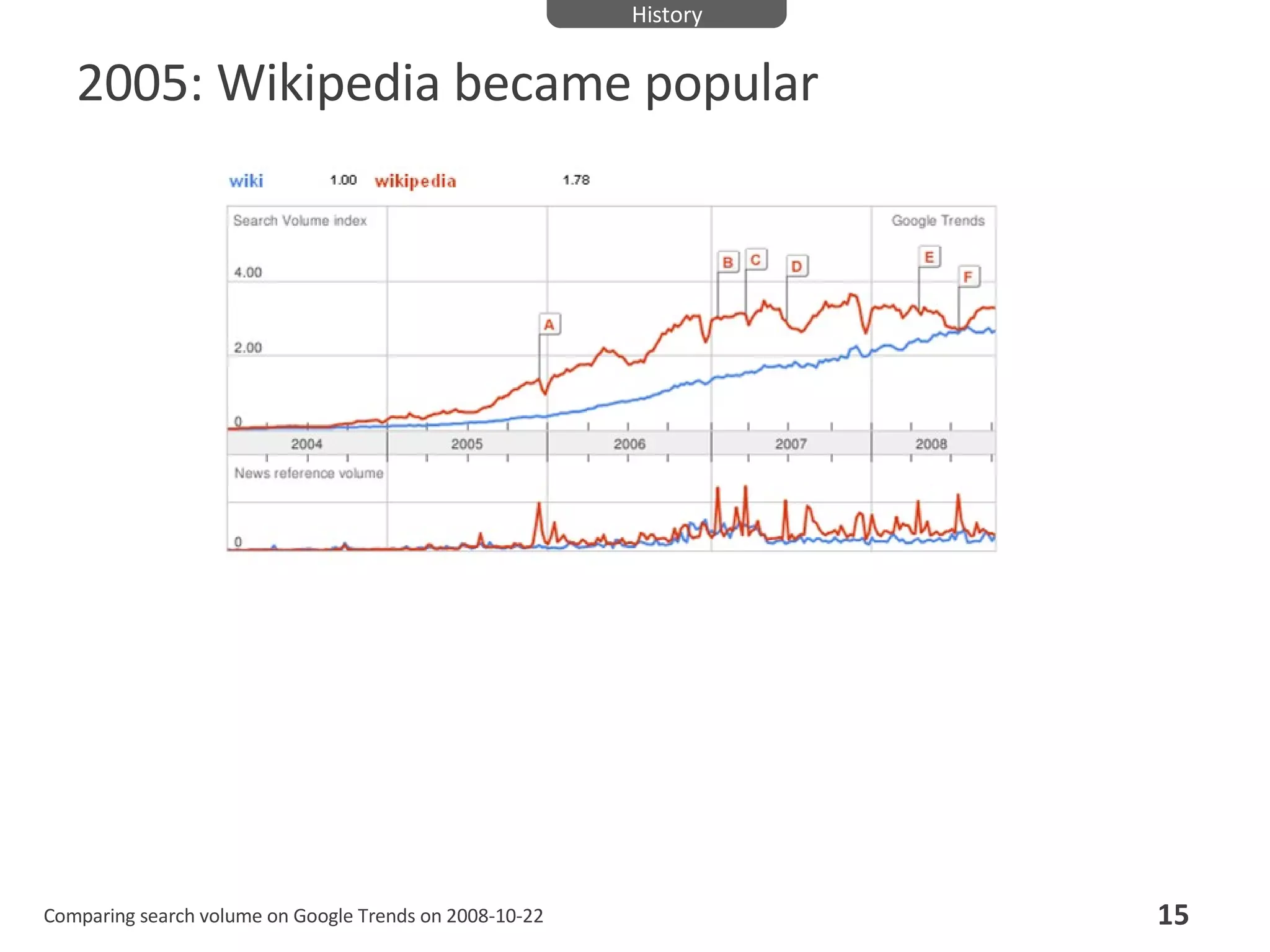
2005: Wikipedia became popular Comparing search volume on Google Trends on 2008-10-22 History
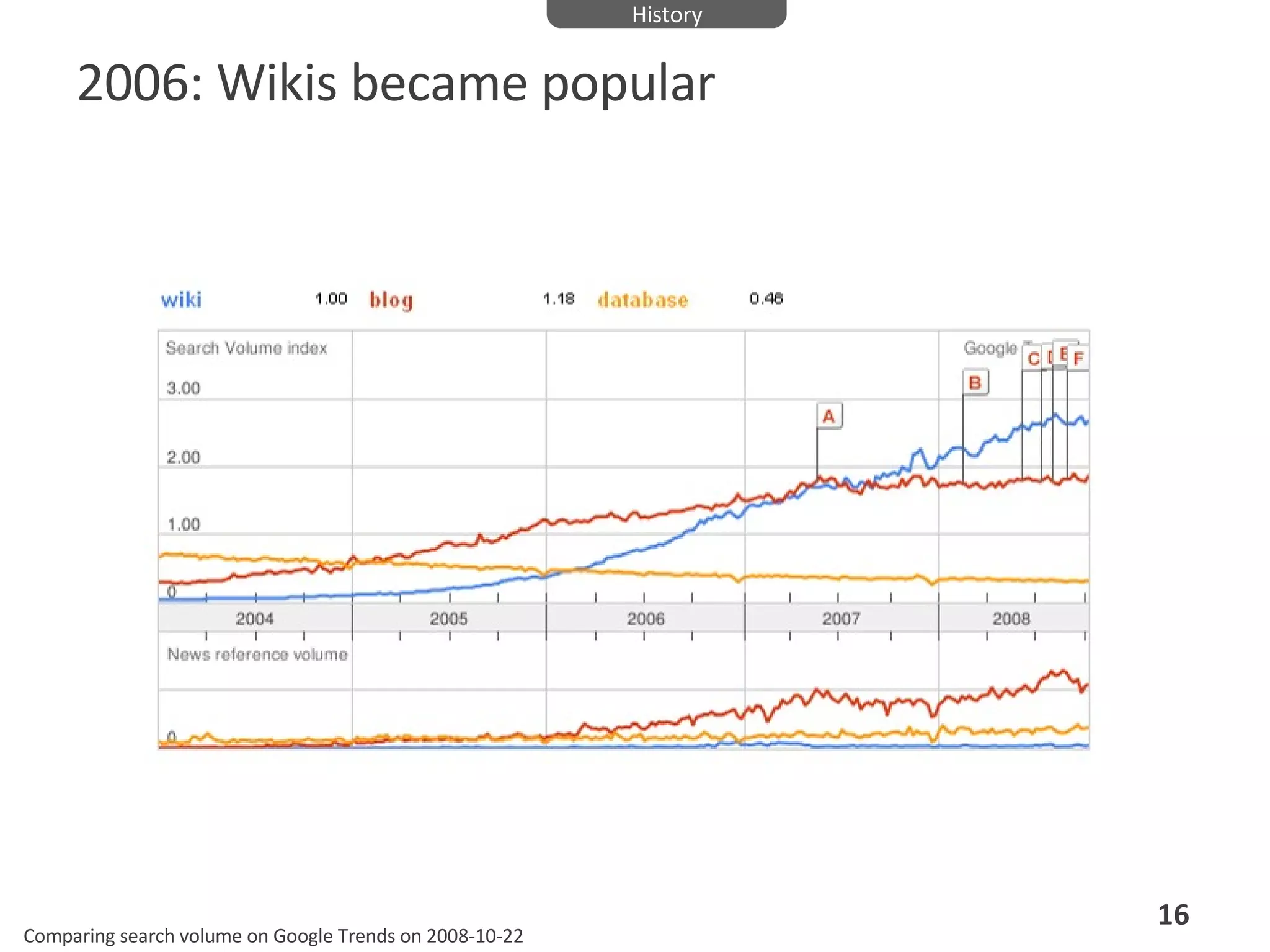
2006: Wikis became popular Comparing search volume on Google Trends on 2008-10-22 History
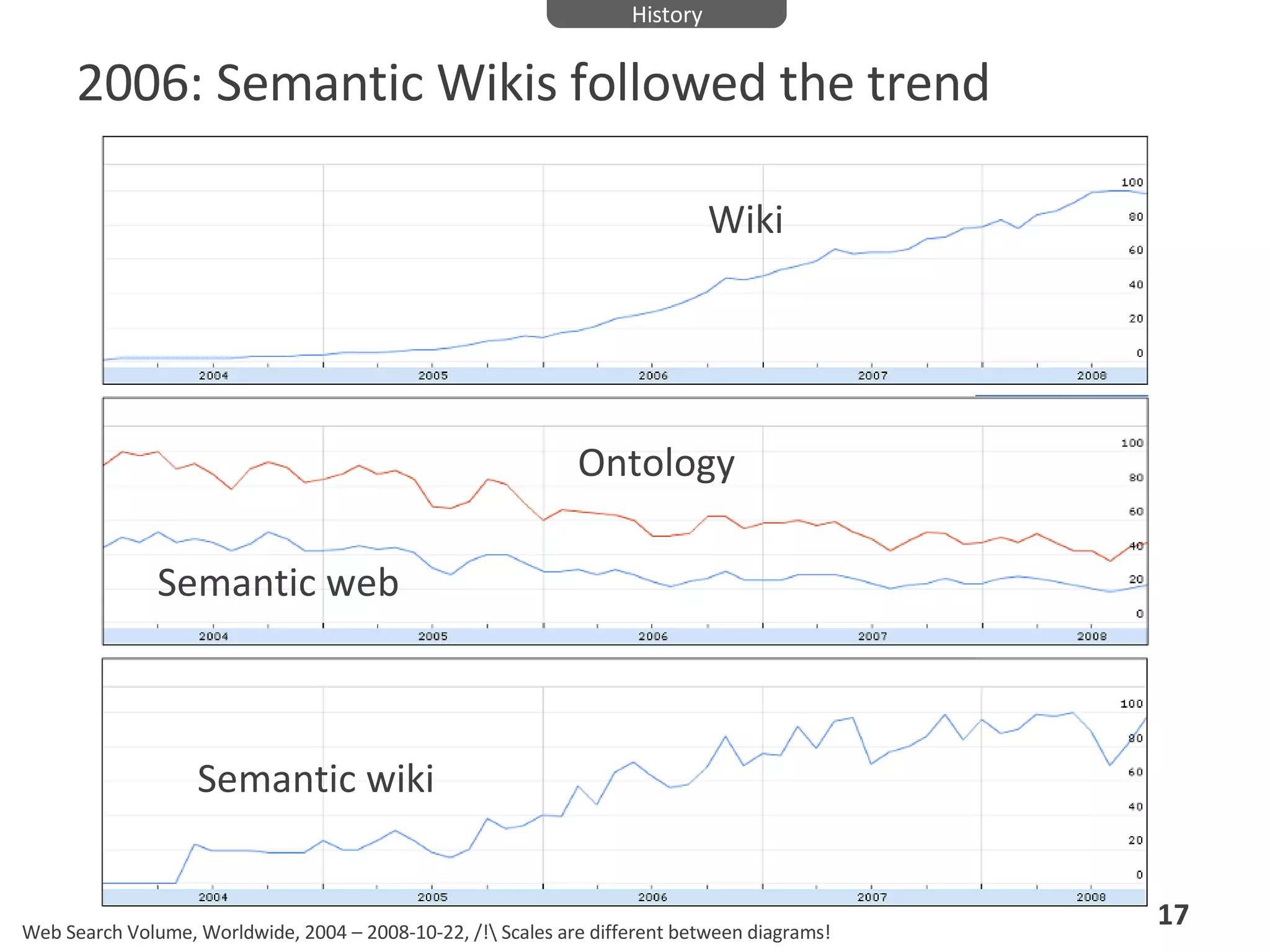
2006: Semantic Wikis followed the trend Web Search Volume, Worldwide, 2004 – 2008-10-22, /!\ Scales are different between diagrams!  Wiki Ontology Semantic web Semantic wiki History
2006: Semantic Wiki as a research topic 2005: [swikig] mailing list launched 2006: First Workshop on Semantic Wikis: From Wiki to Semantics [SemWiki2006] at ESWC2006, Budva, Montenrego  2006: Second Workshop on Semantic Wikis: Wiki-based Knowledge-Engineering [WibKe2006] at WikiSym 2006 in Odense, Denmark 2008: Third Workshop on Semantic Wikis: The Wiki Way of Semantics [SemWiki2008] at ESWC2008, Tenerife http://semwiki.org History
State of the Art State of the Art
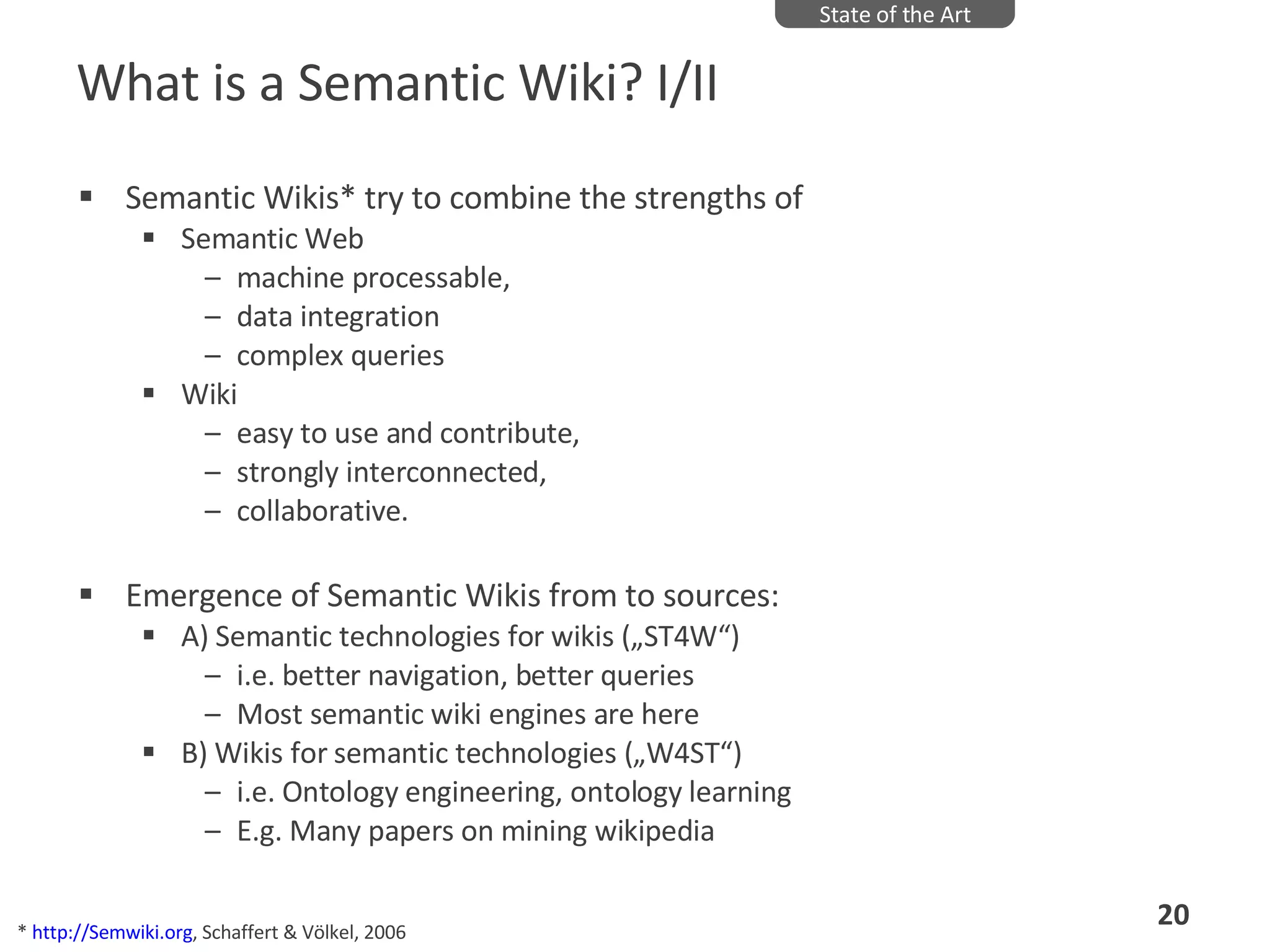
What is a Semantic Wiki? I/II Semantic Wikis* try to combine the strengths of  Semantic Web  machine processable,  data integration complex queries  Wiki easy to use and contribute,  strongly interconnected,  collaborative.  Emergence of Semantic Wikis from to sources:  A) Semantic technologies for wikis („ST4W“) i.e. better navigation, better queries Most semantic wiki engines are here B) Wikis for semantic technologies („W4ST“) i.e. Ontology engineering, ontology learning E.g. Many papers on mining wikipedia State of the Art *  http://Semwiki.org , Schaffert & Völkel, 2006
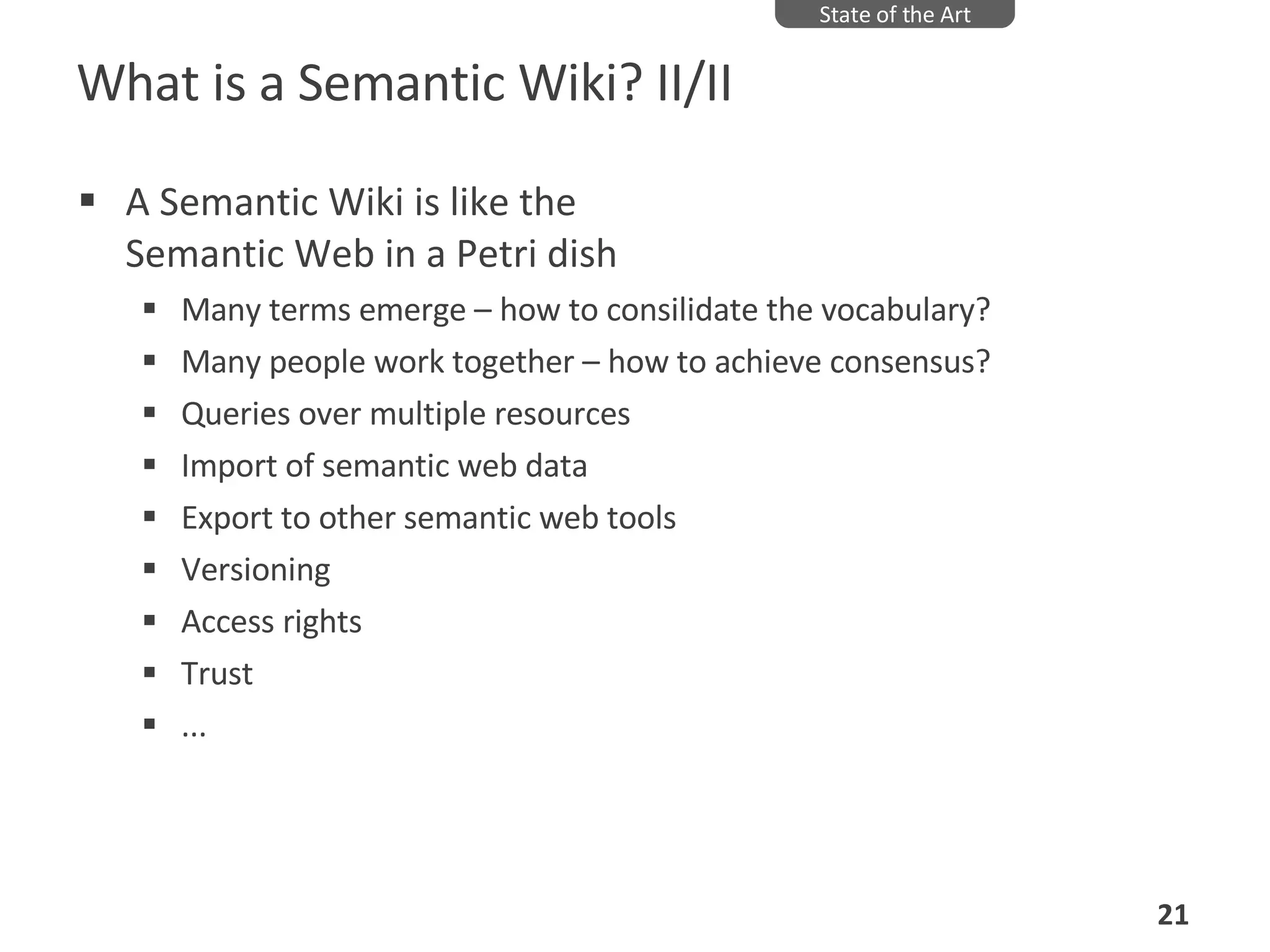
What is a Semantic Wiki? II/II A Semantic Wiki is like the  Semantic Web in a Petri dish Many terms emerge – how to consilidate the vocabulary? Many people work together – how to achieve consensus? Queries over multiple resources Import of semantic web data Export to other semantic web tools Versioning Access rights Trust ... State of the Art
Semantic Wiki Engines AceWiki – controlled english  Artificial Memory – personal knowledge management BOWiki – biomedical domain Confluence Plugins ( Metadata ,  Scaffolding ) - commercial Hypertext Knowledge Workbench – personal knowledge management IkeWiki  SWiM - offshoot of IkeWiki KiWI – successor in scope of KiWi project OntoWiki – free-form database OpenRecord – free-form database SweetWiki – semantic tagging  Semantic MediaWiki (MediaWiki extension) – Semantic Wikipedia HaloExtension – extension of Semantic MediaWiki, browsing & refactoring Semantic Forms – free-form database ... Many more Semantic MediaWiki extensions SWOOKI – a peer-to-peer based SemWiki State of the Art http://semanticweb.org/wiki/Semantic_Wiki_State_Of_The_Art
SemWiki2006 Results How is metadata created? Incentives for creating formal data Low in semantic web, higher in semantic wikis with direct benefit Page vs. Concept How is metadata used?  Trust - Can trustworthiness of article content be determined from the article metadata?  Navigation - alternative views on the data Search … Automated content generation including reasoning Ontology engineering Why/for what are Semantic Wikis used?  Like normal wikis, but more sophisticated, doing everything better Integration  Integartion of structured text and RDF world still unsolved No common wiki metadata ontology State of the Art
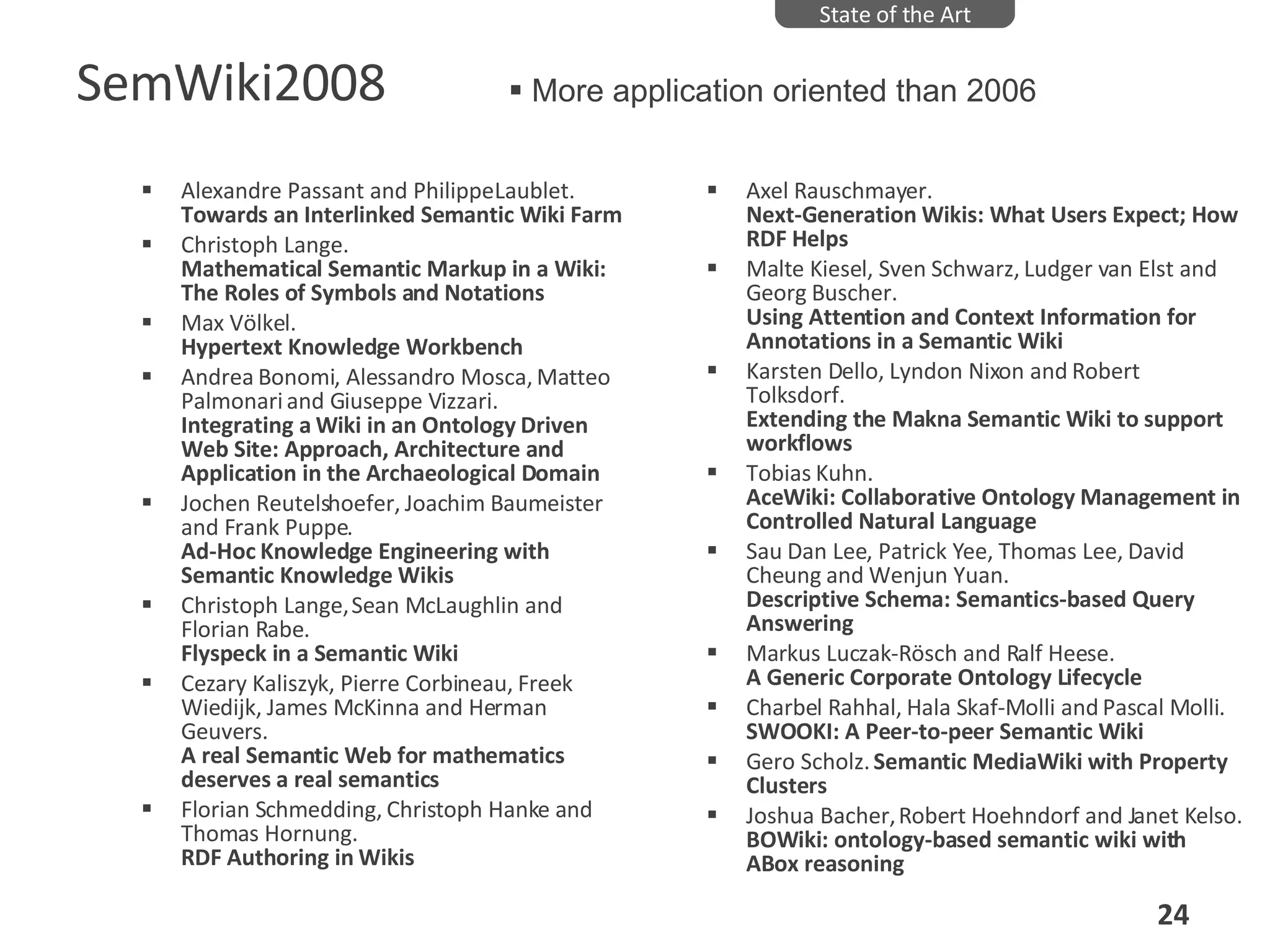
SemWiki2008 Alexandre Passant and Philippe Laublet.  Towards an Interlinked Semantic Wiki Farm   Christoph Lange.  Mathematical Semantic Markup in a Wiki: The Roles of Symbols and Notations   Max Völkel.  Hypertext Knowledge Workbench   Andrea Bonomi, Alessandro Mosca, Matteo Palmonari and Giuseppe Vizzari.  Integrating a Wiki in an Ontology Driven Web Site: Approach, Architecture and Application in the Archaeological Domain   Jochen Reutelshoefer, Joachim Baumeister and Frank Puppe.  Ad-Hoc Knowledge Engineering with Semantic Knowledge Wikis  Christoph Lange, Sean McLaughlin and Florian Rabe.  Flyspeck in a Semantic Wiki   Cezary Kaliszyk, Pierre Corbineau, Freek Wiedijk, James McKinna and Herman Geuvers.  A real Semantic Web for mathematics deserves a real semantics   Florian Schmedding, Christoph Hanke and Thomas Hornung.  RDF Authoring in Wikis Axel Rauschmayer.  Next-Generation Wikis: What Users Expect; How RDF Helps   Malte Kiesel, Sven Schwarz, Ludger van Elst and Georg Buscher.  Using Attention and Context Information for Annotations in a Semantic Wiki   Karsten Dello, Lyndon Nixon and Robert Tolksdorf.  Extending the Makna Semantic Wiki to support workflows   Tobias Kuhn.  AceWiki: Collaborative Ontology Management in Controlled Natural Language   Sau Dan Lee, Patrick Yee, Thomas Lee, David Cheung and Wenjun Yuan.  Descriptive Schema: Semantics-based Query Answering   Markus Luczak-Rösch and Ralf Heese.  A Generic Corporate Ontology Lifecycle   Charbel Rahhal, Hala Skaf-Molli and Pascal Molli.  SWOOKI: A Peer-to-peer Semantic Wiki   Gero Scholz.  Semantic MediaWiki with Property Clusters   Joshua Bacher, Robert Hoehndorf and Janet Kelso.  BOWiki: ontology-based semantic wiki with ABox reasoning   State of the Art More application oriented than 2006
Semantic Wikis: Trends Trends
Semantic Wikis: Trends Application Areas what kinds of application areas can be addressed by Semantic Wikis? Platform what kinds of software will Semantic Wikis develop into? Technology what kinds of technological development/improvements will Semantic Wikis see? Trends
Application Areas Trends
Application Areas Knowledge Management Semantic Wikipedia / Semantic Encyclopaedia eLearning Ontology Engineering Trends
Knowledge Management for me: primary application area from “knowledge is power” to “sharing is power” supporting the user by semantic technologies Trends
Knowledge Management: Examples connect software documentation (design documents, code documentation) about components with relevant bug reports and present developer a summary view of his tasks allow project managers in consultancies to share project knowledge, e.g. “look for projects that are similar to mine” or “generate instances of all relevant QM process definitions for my project setup” Trends
Knowledge Management: Examples allow project managers to modify project workplan in different ways, e.g. as a table, as a Gantt diagram, … with direct connection to ERP system allow head of department to get a summary view over all projects Trends
Knowledge Management: Challenges different perspectives on same content integration with existing tools (and here the Semantic Web can help) requires heavy support for the user, e.g. extensive reasoning, calculation,  … often very formal environments (contradiction with Wiki Philosophy) Trends
Semantic Wikipedia making the “wisdom of the crowds” in Wikipedia (and similar applications) accessible not restricted to Wikipedia, not even to Wikis as technology (see “platform” later) Trends
Semantic Wikipedia: Challenges requires high performance and scalability (i.e. little reasoning) community needs to be convinced to make use of semantic features (only if immediate benefit) Trends
Learning ePortfolio systems: collection of learning artefacts, reflection on learning collaborative story telling personal development planning and alignment with actual achievements Trends
Learning: Challenges requires functionalities current Wikis cannot provide, e.g. collaborative text writing require lots of metadata for planning Trends
Ontology Engineering make ontology development simpler allow knowledge workers and ontology engineers to collaborate in one system Trends
Ontology Engineering: Challenges allow different perspectives on same content (ontology engineer: ontology view, knowledge worker: domain specific view or wiki view) full support for ontologies and reasoning Trends
Platform Trends
Semantic Wiki Platform wiki as philosophy rather than technology: same principle holds for most other Web 2.0/Social Web applications breaking information and system boundaries: integrating information and giving different perspectives on the same information Semantic Wikis as generic platform for developing many different kinds of Social Web applications Trends
Wiki as Philosophy wikis allow anyone to edit wikis are easy to use and do not require additional software wiki content is easy to link wikis support versioning of all changes wikis support all media same holds for other social software applications! Trends
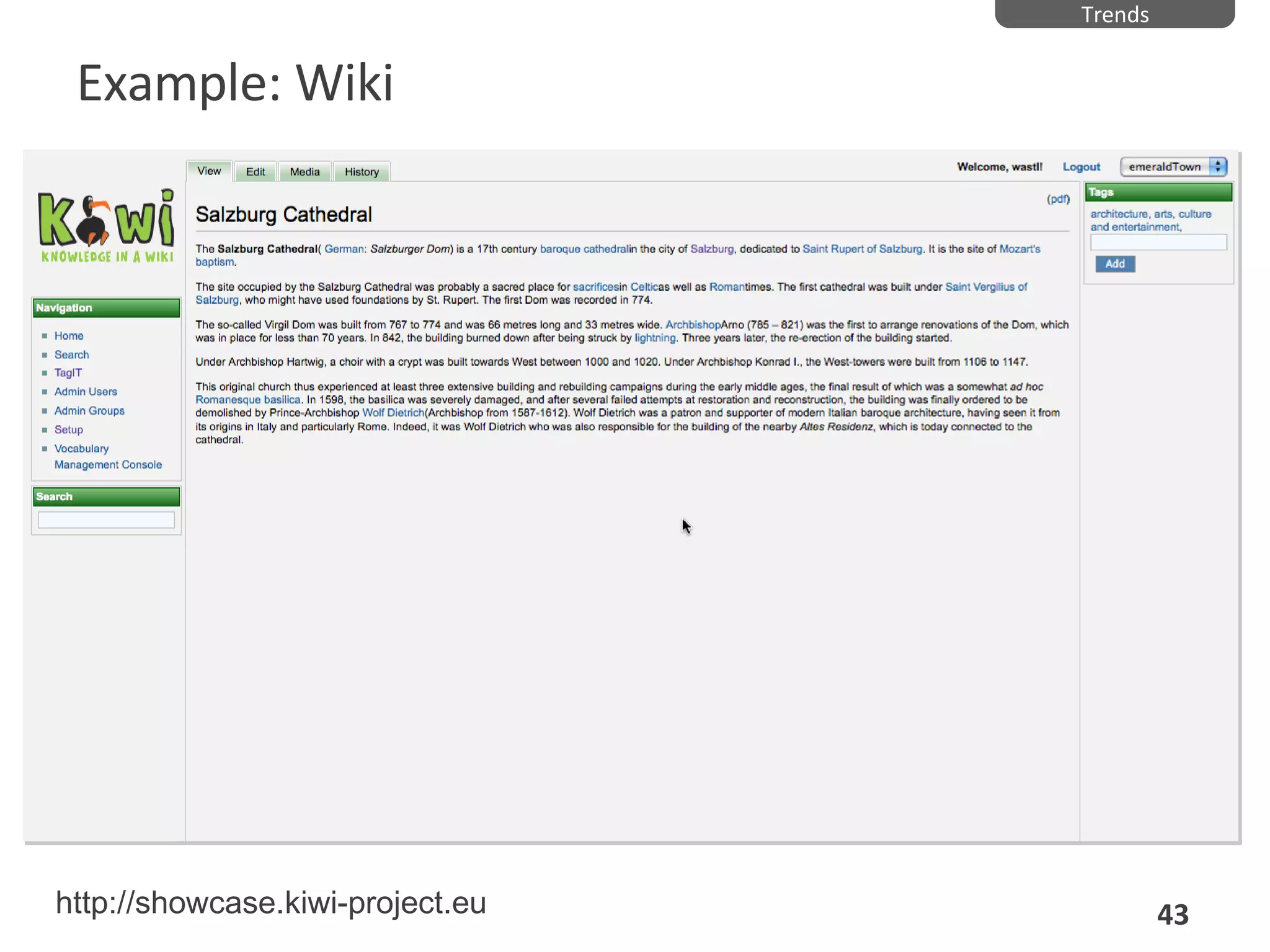
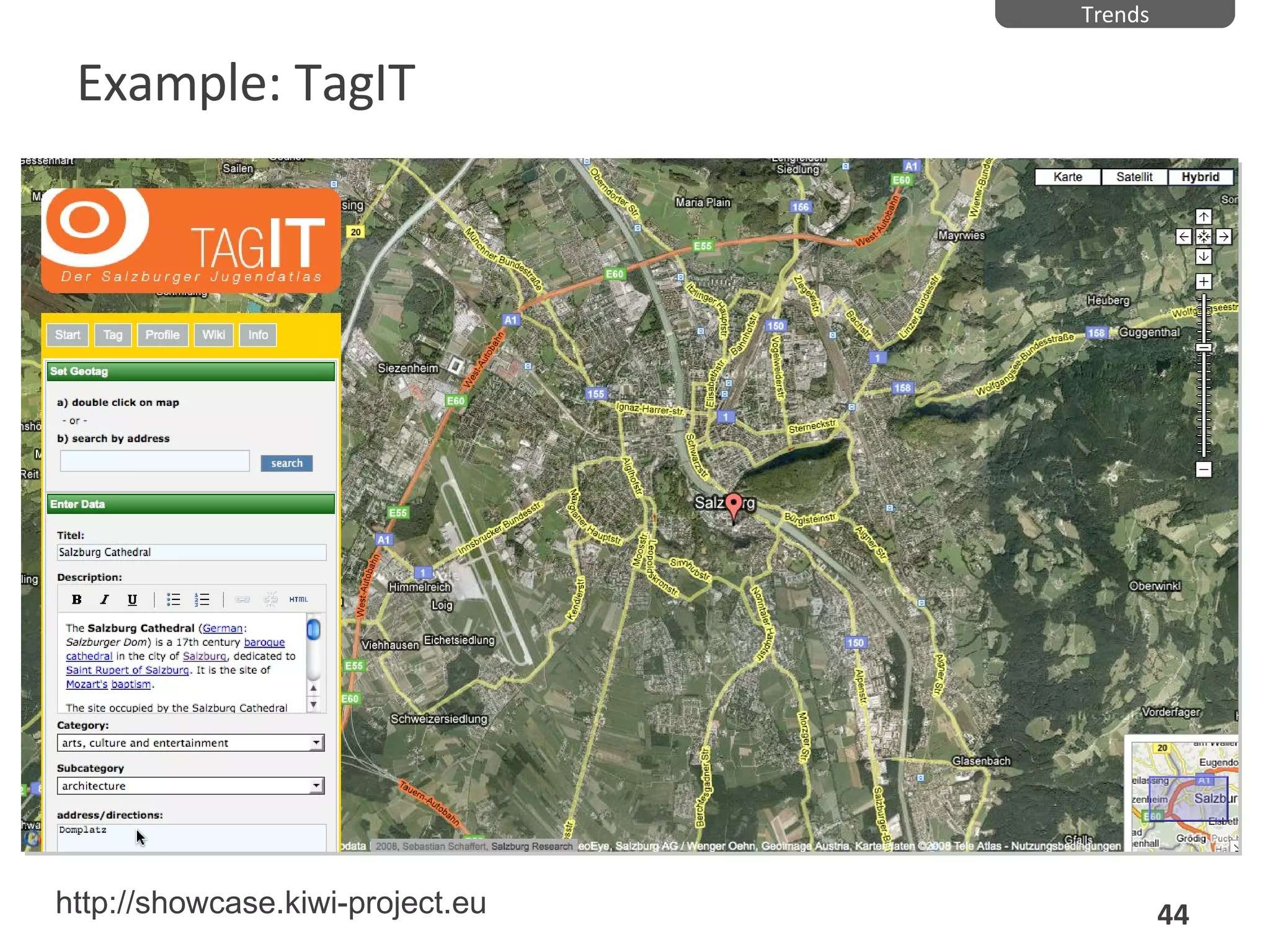
Breaking Information and System Boundaries integration of different kinds of content in one system (wiki text, photos, code,  …) different perspectives on the same content (wiki, blog, social network, tagit,  …) users edit the system behaviour, not only the content (e.g. widgets - zembly, custom layouts, declarative rules) Trends
Example: Wiki Trends http://showcase.kiwi-project.eu
Example: TagIT Trends http://showcase.kiwi-project.eu
Example: Blog no image (yet) but entries to wiki/tagit could also be displayed in blog style (ordered by creation time)! Trends
Example: Social Networking user information in the wiki could be used as basis for social networks (e.g. based on tags) information represented as foaf data (RDF) just another perspective on the same data! Trends
Example: Community Equity Community Equity: valuation system for community content developed by Sun content can be rated by users -> information equity tags inherit information equity -> tag equity users inherit information equity for their content -> contribution equity users inherit tag equity for the tags of their content -> skills equity Trends
Technology Trends
Semantic Wikis as Testbed for the Semantic Web Semantic Wikis connect the real world with the Semantic Web Semantic Wikis are the “Semantic Web in Small”, because a Wiki is “Web in Small” Semantic Wikis share many common properties with the Semantic Web most technologies developed on the Semantic Web can be used and evaluated in Semantic Wikis  (my challenge: if it is not useful in Semantic Wikis, it is not useful at all!) Trends
Challenge 1: Proof Benefit the Semantic Web and Semantic Wikis must show how they are beneficial to ordinary users Trends
Challenge 2: User Interfaces all users like simple interfaces; tools like Protégé are way too complicated how to do as much semantics as possible with as little user exposure as possible Trends
Challenge 3: Personalisation semantic data offers the possibility for personalising content presentation e.g. preferences, observed behaviour, context Trends
Challenge 4: Tagging users like tagging (various reasons: simplicity, low cognitive barrier,  …) how to „lift“ non-semantic tags to the Semantic Web? Trends
Challenge 5: Revisions & Versioning essential aspect of the wiki philosophy much harder with meta-data than only with textual content Trends
Challenge 6: Reasoning how can reasoning support users? what kinds of reasoning are useful in Semantic Wikis (guess: rule-based)? how to deal with performance issues (needs to be close to real-time)? Trends
Challenge 7: Reason Maintenance what rules are the justification for a triple? how can results of reasoning be explained to users? example: background turns purple because a rule says that all pages concerning “foo” should be rendered as purple; user needs to be able to get an explanation example:  Amazon “why was this recommended to me” Trends
Challenge 8: Permissions, Trust, Provenance big outstanding issue of the Semantic Web reputation systems can help (e.g. Community Equity by Sun) is metadata about metadata Trends
KiWi  –  Knowledge in a Wiki Applications Software Knowledge Management: Supporting Software Engineers in sharing knowledge (Sun Microsystems) Project Knowledge Management: Supporting Project Managers in documenting project knowledge (Logica) KiWi Showcase: “KiWi PhotoStories”, a social networking and story and image sharing platform Trends
KiWi  –  Knowledge in a Wiki Technology KiWi addresses personalisation KiWi allows arbitrary resources to tag other resources KiWi partly addresses reason maintenance  KiWi addresses rule-based reasoning in Semantic Wikis KiWi has a proposal for versioning and transactions (implemented but undocumented) Trends
KiWi  –  Knowledge in a Wiki website:  http://www.kiwi-project.eu contact:  Coordinator: Sebastian Schaffert ( [email_address] ) Dissemination: Julia Eder (julia.eder@salzburgresearch.at) Trends
Semantic Wikis:  The Wiki Way to the Semantic Web? Semantic Wiki Mini-Series 1st session:  A Survey of the Landscape and State-of-Art in Semantic Wiki   Co-chairs:  Sebastian Schaffert (Salzburg Research, Austria) Max Völkel (AIFB-Karlsruhe)  Thanks for listening!
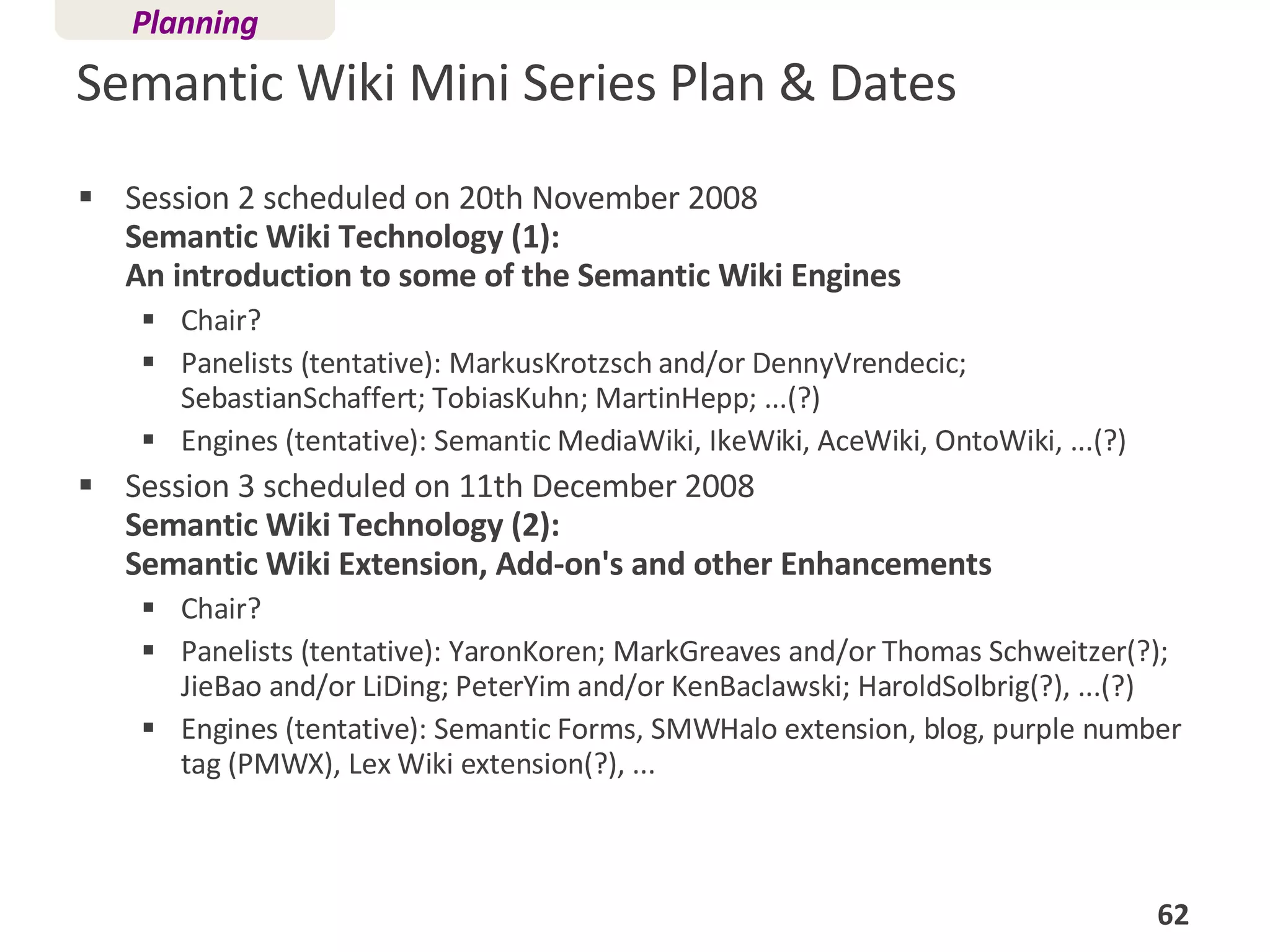
Semantic Wiki Mini Series Plan & Dates Session 2 scheduled on 20th November 2008  Semantic Wiki Technology (1):  An introduction to some of the Semantic Wiki Engines Chair? Panelists (tentative): MarkusKrotzsch and/or DennyVrendecic; SebastianSchaffert; TobiasKuhn; MartinHepp; ...(?)  Engines (tentative): Semantic MediaWiki, IkeWiki, AceWiki, OntoWiki, ...(?)  Session 3 scheduled on 11th December 2008 Semantic Wiki Technology (2):  Semantic Wiki Extension, Add-on's and other Enhancements Chair? Panelists (tentative): YaronKoren; MarkGreaves and/or Thomas Schweitzer(?); JieBao and/or LiDing; PeterYim and/or KenBaclawski; HaroldSolbrig(?), ...(?)  Engines (tentative): Semantic Forms, SMWHalo extension, blog, purple number tag (PMWX), Lex Wiki extension(?), ...  Planning
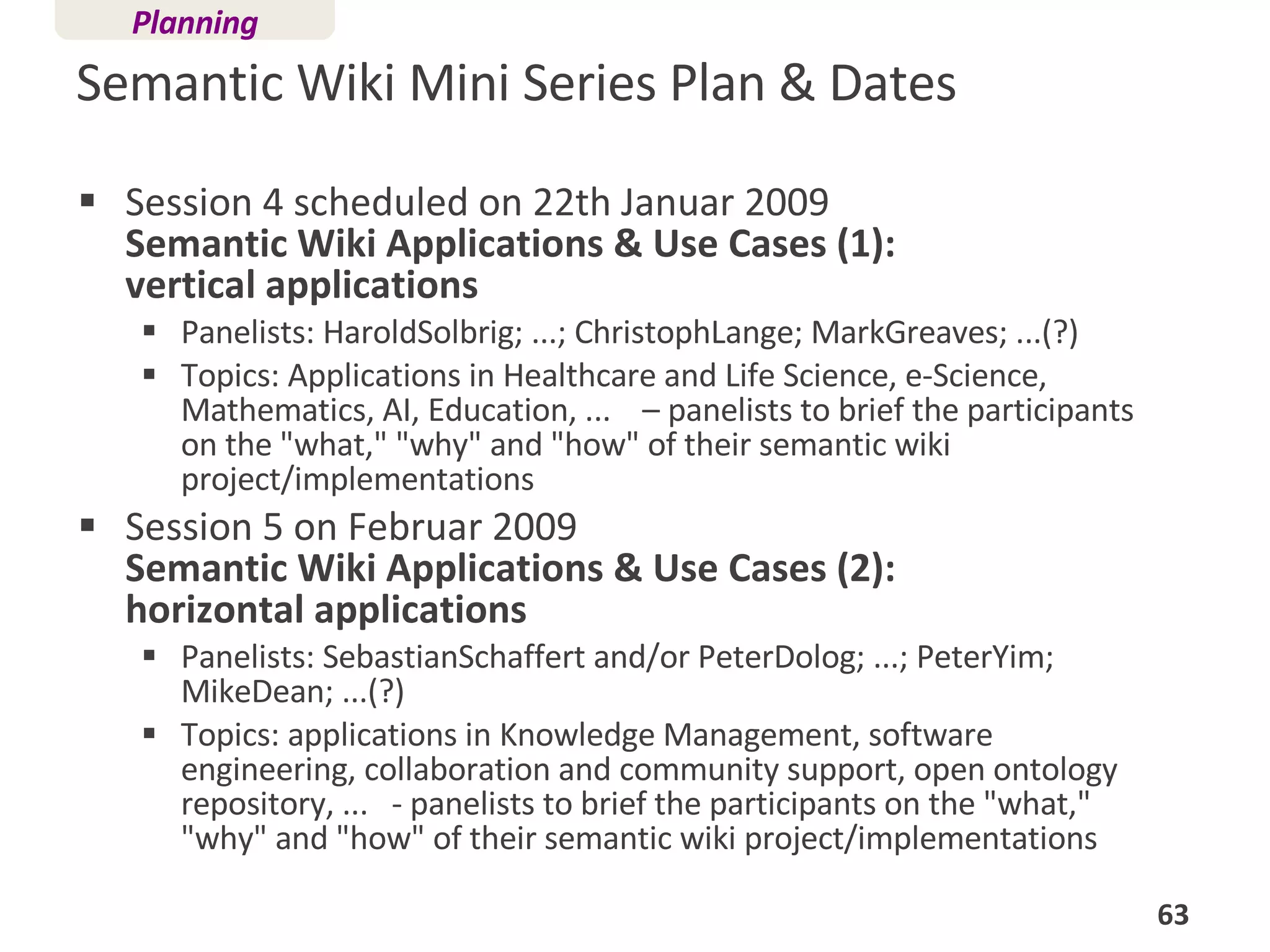
Semantic Wiki Mini Series Plan & Dates Session 4 scheduled on 22th Januar 2009  Semantic Wiki Applications & Use Cases (1):  vertical applications Panelists: HaroldSolbrig; ...; ChristophLange; MarkGreaves; ...(?)  Topics: Applications in Healthcare and Life Science, e-Science, Mathematics, AI, Education, ...  – panelists to brief the participants on the "what," "why" and "how" of their semantic wiki project/implementations Session 5 on Februar 2009 Semantic Wiki Applications & Use Cases (2):  horizontal applications Panelists: SebastianSchaffert and/or PeterDolog; ...; PeterYim; MikeDean; ...(?)  Topics: applications in Knowledge Management, software engineering, collaboration and community support, open ontology repository, ...  - panelists to brief the participants on the "what," "why" and "how" of their semantic wiki project/implementations Planning
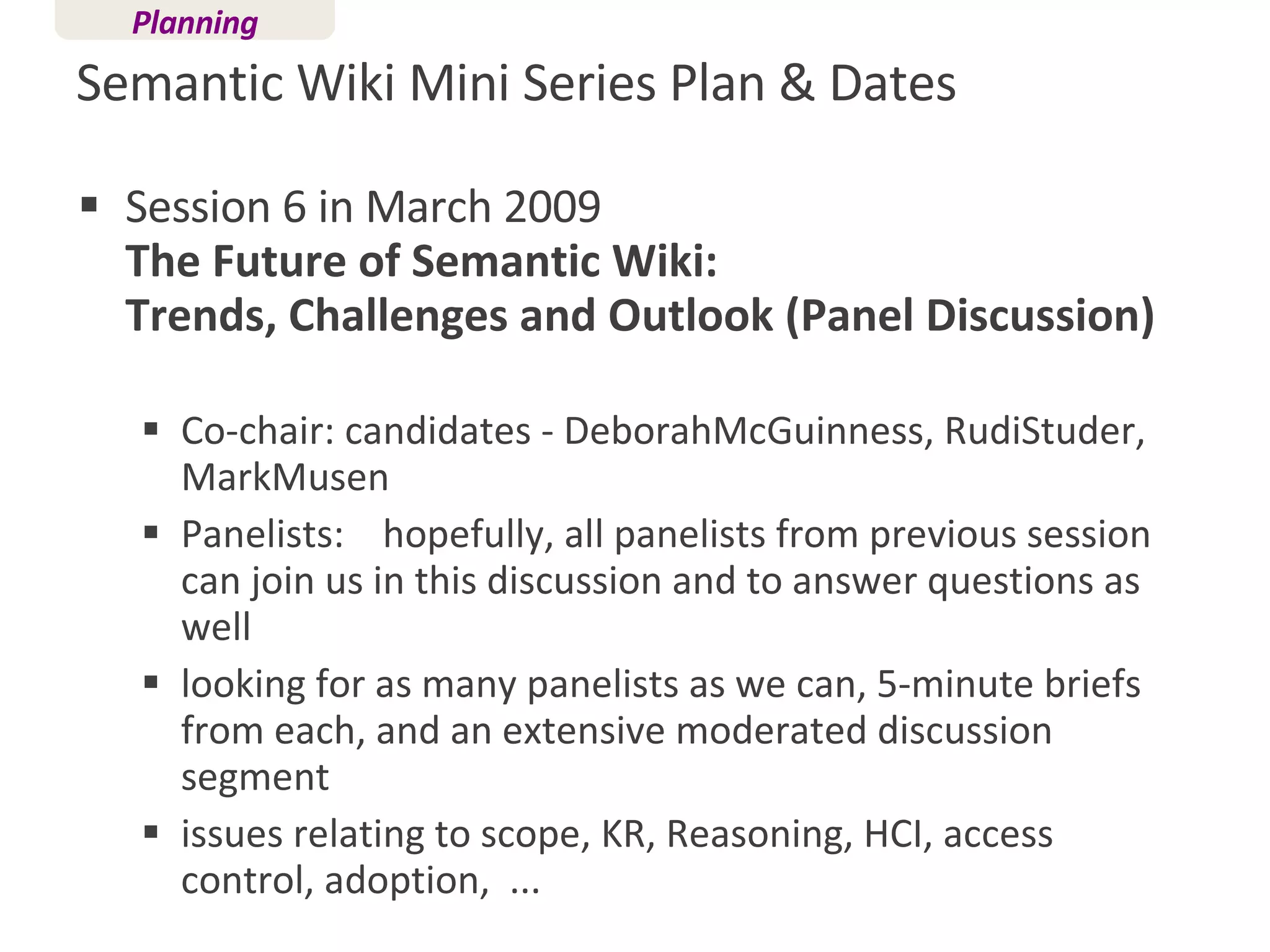
Semantic Wiki Mini Series Plan & Dates Session 6 in March 2009 The Future of Semantic Wiki:  Trends, Challenges and Outlook (Panel Discussion)  Co-chair: candidates - DeborahMcGuinness, RudiStuder, MarkMusen  Panelists:  hopefully, all panelists from previous session can join us in this discussion and to answer questions as well  looking for as many panelists as we can, 5-minute briefs from each, and an extensive moderated discussion segment  issues relating to scope, KR, Reasoning, HCI, access control, adoption,  ... Planning

A Survey of the Landscape and State-of-Art in Semantic Wiki

  • 1.
    Semantic Wiki Mini-Series1st session: A Survey of the Landscape and State-of-Art in Semantic Wiki Co-chairs: Sebastian Schaffert (Salzburg Research, Austria), Max Völkel (FZI Karlsruhe) 2008-10-23 Semantic Wikis: The Wiki Way to the Semantic Web?
  • 2.
    Agenda History Stateof the Art Trends Introduction
  • 3.
  • 4.
    Introduction: Semantic Wikiswiki principles metaweb two perspectives on Semantic Wikis characteristics of Semantic Wikis example Introduction
  • 5.
    Wiki Principles wikisallow anyone to edit wikis are easy to use and do not require additional software wiki content is easy to link wikis support versioning of all changes wikis support all media Introduction
  • 6.
    Nova Spivack: MetawebSemantic Wikis Introduction
  • 7.
    Two Perspectives onSemantic Wikis Wikis for Metadata Metadata for Wikis no clear separation, but tendencies! Introduction
  • 8.
    Wikis for Metadatacreating metadata on the Semantic Web is difficult! requires domain knowledge requires knowledge engineering skills complicated, insufficient tools Wikis for metadata: simplified technological access to the creation of metadata collaboration of domain experts and knowledge engineers dynamically evolving knowledge networks and knowledge models Introduction
  • 9.
    Metadata for WikisWikis huge amounts of digital content (e.g. Wikipedia) strong connection of content via hyperlinks problem: structure exists, but is only used for presentation and not accessible by computers finding relevant content is increasingly difficult integration and exchange between different systems is difficult Introduction
  • 10.
    Semantic Wikis annotationof existing structures with machine readable metadata links carry meaning, typing of links, typing of pages context dependent adaptation and presentation different domains have different ways of presenting content, personal preferences, etc. improved, „intelligent“, search and navigation queries to the structure, visualisation of structure, derived information improved interoperability between systems exchange of content, integration of different systems, agents, etc Introduction
  • 11.
  • 12.
  • 13.
    1995: The FirstWiki Wiki First developed by Ward Cunningham as an add-on to the Portland Pattern Repository on 1995.03.25 http://c2.com/cgi/wiki?WikiDesignPrinciples  our interpretation Incremental - Pages can cite other pages, including pages that have not been written yet.  network of pages Organic - The structure and text content of the site is open to editing and evolution.  different from classical content management systems Universal - The mechanisms of editing and organizing are the same as those of writing so that any writer is automatically an editor and organizer.  integrated creation and organization of content Unified - Page names will be drawn from a flat space so that no additional context is required to interpret them.  humans can remember names Precise - Pages will be titled with sufficient precision to avoid most name clashes, typically by forming noun phrases.  names are quasi-unique Tolerant - Interpretable (even if undesirable) behavior is preferred to error messages.  usability: novice users have less fear to start using it Observable - Activity within the site can be watched and reviewed by any other visitor to the site.  exchange of meta-information Convergent - Duplication can be discouraged or removed by finding and citing similar or related content.  History
  • 14.
    2004/2005: First SemanticWikis Platypus Wiki from Stefano Campanini, Paolo Castagna, Roberto Tazzoli presented at ISWC2004 WikSAR from David Aumüller wins best Demo award at ESWC2005 History
  • 15.
    2005: Wikipedia becamepopular Comparing search volume on Google Trends on 2008-10-22 History
  • 16.
    2006: Wikis becamepopular Comparing search volume on Google Trends on 2008-10-22 History
  • 17.
    2006: Semantic Wikisfollowed the trend Web Search Volume, Worldwide, 2004 – 2008-10-22, /!\ Scales are different between diagrams! Wiki Ontology Semantic web Semantic wiki History
  • 18.
    2006: Semantic Wikias a research topic 2005: [swikig] mailing list launched 2006: First Workshop on Semantic Wikis: From Wiki to Semantics [SemWiki2006] at ESWC2006, Budva, Montenrego 2006: Second Workshop on Semantic Wikis: Wiki-based Knowledge-Engineering [WibKe2006] at WikiSym 2006 in Odense, Denmark 2008: Third Workshop on Semantic Wikis: The Wiki Way of Semantics [SemWiki2008] at ESWC2008, Tenerife http://semwiki.org History
  • 19.
    State of theArt State of the Art
  • 20.
    What is aSemantic Wiki? I/II Semantic Wikis* try to combine the strengths of Semantic Web machine processable, data integration complex queries Wiki easy to use and contribute, strongly interconnected, collaborative. Emergence of Semantic Wikis from to sources: A) Semantic technologies for wikis („ST4W“) i.e. better navigation, better queries Most semantic wiki engines are here B) Wikis for semantic technologies („W4ST“) i.e. Ontology engineering, ontology learning E.g. Many papers on mining wikipedia State of the Art * http://Semwiki.org , Schaffert & Völkel, 2006
  • 21.
    What is aSemantic Wiki? II/II A Semantic Wiki is like the Semantic Web in a Petri dish Many terms emerge – how to consilidate the vocabulary? Many people work together – how to achieve consensus? Queries over multiple resources Import of semantic web data Export to other semantic web tools Versioning Access rights Trust ... State of the Art
  • 22.
    Semantic Wiki EnginesAceWiki – controlled english Artificial Memory – personal knowledge management BOWiki – biomedical domain Confluence Plugins ( Metadata , Scaffolding ) - commercial Hypertext Knowledge Workbench – personal knowledge management IkeWiki SWiM - offshoot of IkeWiki KiWI – successor in scope of KiWi project OntoWiki – free-form database OpenRecord – free-form database SweetWiki – semantic tagging Semantic MediaWiki (MediaWiki extension) – Semantic Wikipedia HaloExtension – extension of Semantic MediaWiki, browsing & refactoring Semantic Forms – free-form database ... Many more Semantic MediaWiki extensions SWOOKI – a peer-to-peer based SemWiki State of the Art http://semanticweb.org/wiki/Semantic_Wiki_State_Of_The_Art
  • 23.
    SemWiki2006 Results Howis metadata created? Incentives for creating formal data Low in semantic web, higher in semantic wikis with direct benefit Page vs. Concept How is metadata used? Trust - Can trustworthiness of article content be determined from the article metadata? Navigation - alternative views on the data Search … Automated content generation including reasoning Ontology engineering Why/for what are Semantic Wikis used? Like normal wikis, but more sophisticated, doing everything better Integration Integartion of structured text and RDF world still unsolved No common wiki metadata ontology State of the Art
  • 24.
    SemWiki2008 Alexandre Passantand Philippe Laublet. Towards an Interlinked Semantic Wiki Farm Christoph Lange. Mathematical Semantic Markup in a Wiki: The Roles of Symbols and Notations Max Völkel. Hypertext Knowledge Workbench Andrea Bonomi, Alessandro Mosca, Matteo Palmonari and Giuseppe Vizzari. Integrating a Wiki in an Ontology Driven Web Site: Approach, Architecture and Application in the Archaeological Domain Jochen Reutelshoefer, Joachim Baumeister and Frank Puppe. Ad-Hoc Knowledge Engineering with Semantic Knowledge Wikis Christoph Lange, Sean McLaughlin and Florian Rabe. Flyspeck in a Semantic Wiki Cezary Kaliszyk, Pierre Corbineau, Freek Wiedijk, James McKinna and Herman Geuvers. A real Semantic Web for mathematics deserves a real semantics Florian Schmedding, Christoph Hanke and Thomas Hornung. RDF Authoring in Wikis Axel Rauschmayer. Next-Generation Wikis: What Users Expect; How RDF Helps Malte Kiesel, Sven Schwarz, Ludger van Elst and Georg Buscher. Using Attention and Context Information for Annotations in a Semantic Wiki Karsten Dello, Lyndon Nixon and Robert Tolksdorf. Extending the Makna Semantic Wiki to support workflows Tobias Kuhn. AceWiki: Collaborative Ontology Management in Controlled Natural Language Sau Dan Lee, Patrick Yee, Thomas Lee, David Cheung and Wenjun Yuan. Descriptive Schema: Semantics-based Query Answering Markus Luczak-Rösch and Ralf Heese. A Generic Corporate Ontology Lifecycle Charbel Rahhal, Hala Skaf-Molli and Pascal Molli. SWOOKI: A Peer-to-peer Semantic Wiki Gero Scholz. Semantic MediaWiki with Property Clusters Joshua Bacher, Robert Hoehndorf and Janet Kelso. BOWiki: ontology-based semantic wiki with ABox reasoning State of the Art More application oriented than 2006
  • 25.
  • 26.
    Semantic Wikis: TrendsApplication Areas what kinds of application areas can be addressed by Semantic Wikis? Platform what kinds of software will Semantic Wikis develop into? Technology what kinds of technological development/improvements will Semantic Wikis see? Trends
  • 27.
  • 28.
    Application Areas KnowledgeManagement Semantic Wikipedia / Semantic Encyclopaedia eLearning Ontology Engineering Trends
  • 29.
    Knowledge Management forme: primary application area from “knowledge is power” to “sharing is power” supporting the user by semantic technologies Trends
  • 30.
    Knowledge Management: Examplesconnect software documentation (design documents, code documentation) about components with relevant bug reports and present developer a summary view of his tasks allow project managers in consultancies to share project knowledge, e.g. “look for projects that are similar to mine” or “generate instances of all relevant QM process definitions for my project setup” Trends
  • 31.
    Knowledge Management: Examplesallow project managers to modify project workplan in different ways, e.g. as a table, as a Gantt diagram, … with direct connection to ERP system allow head of department to get a summary view over all projects Trends
  • 32.
    Knowledge Management: Challengesdifferent perspectives on same content integration with existing tools (and here the Semantic Web can help) requires heavy support for the user, e.g. extensive reasoning, calculation, … often very formal environments (contradiction with Wiki Philosophy) Trends
  • 33.
    Semantic Wikipedia makingthe “wisdom of the crowds” in Wikipedia (and similar applications) accessible not restricted to Wikipedia, not even to Wikis as technology (see “platform” later) Trends
  • 34.
    Semantic Wikipedia: Challengesrequires high performance and scalability (i.e. little reasoning) community needs to be convinced to make use of semantic features (only if immediate benefit) Trends
  • 35.
    Learning ePortfolio systems:collection of learning artefacts, reflection on learning collaborative story telling personal development planning and alignment with actual achievements Trends
  • 36.
    Learning: Challenges requiresfunctionalities current Wikis cannot provide, e.g. collaborative text writing require lots of metadata for planning Trends
  • 37.
    Ontology Engineering makeontology development simpler allow knowledge workers and ontology engineers to collaborate in one system Trends
  • 38.
    Ontology Engineering: Challengesallow different perspectives on same content (ontology engineer: ontology view, knowledge worker: domain specific view or wiki view) full support for ontologies and reasoning Trends
  • 39.
  • 40.
    Semantic Wiki Platformwiki as philosophy rather than technology: same principle holds for most other Web 2.0/Social Web applications breaking information and system boundaries: integrating information and giving different perspectives on the same information Semantic Wikis as generic platform for developing many different kinds of Social Web applications Trends
  • 41.
    Wiki as Philosophywikis allow anyone to edit wikis are easy to use and do not require additional software wiki content is easy to link wikis support versioning of all changes wikis support all media same holds for other social software applications! Trends
  • 42.
    Breaking Information andSystem Boundaries integration of different kinds of content in one system (wiki text, photos, code, …) different perspectives on the same content (wiki, blog, social network, tagit, …) users edit the system behaviour, not only the content (e.g. widgets - zembly, custom layouts, declarative rules) Trends
  • 43.
    Example: Wiki Trendshttp://showcase.kiwi-project.eu
  • 44.
    Example: TagIT Trendshttp://showcase.kiwi-project.eu
  • 45.
    Example: Blog noimage (yet) but entries to wiki/tagit could also be displayed in blog style (ordered by creation time)! Trends
  • 46.
    Example: Social Networkinguser information in the wiki could be used as basis for social networks (e.g. based on tags) information represented as foaf data (RDF) just another perspective on the same data! Trends
  • 47.
    Example: Community EquityCommunity Equity: valuation system for community content developed by Sun content can be rated by users -> information equity tags inherit information equity -> tag equity users inherit information equity for their content -> contribution equity users inherit tag equity for the tags of their content -> skills equity Trends
  • 48.
  • 49.
    Semantic Wikis asTestbed for the Semantic Web Semantic Wikis connect the real world with the Semantic Web Semantic Wikis are the “Semantic Web in Small”, because a Wiki is “Web in Small” Semantic Wikis share many common properties with the Semantic Web most technologies developed on the Semantic Web can be used and evaluated in Semantic Wikis (my challenge: if it is not useful in Semantic Wikis, it is not useful at all!) Trends
  • 50.
    Challenge 1: ProofBenefit the Semantic Web and Semantic Wikis must show how they are beneficial to ordinary users Trends
  • 51.
    Challenge 2: UserInterfaces all users like simple interfaces; tools like Protégé are way too complicated how to do as much semantics as possible with as little user exposure as possible Trends
  • 52.
    Challenge 3: Personalisationsemantic data offers the possibility for personalising content presentation e.g. preferences, observed behaviour, context Trends
  • 53.
    Challenge 4: Taggingusers like tagging (various reasons: simplicity, low cognitive barrier, …) how to „lift“ non-semantic tags to the Semantic Web? Trends
  • 54.
    Challenge 5: Revisions& Versioning essential aspect of the wiki philosophy much harder with meta-data than only with textual content Trends
  • 55.
    Challenge 6: Reasoninghow can reasoning support users? what kinds of reasoning are useful in Semantic Wikis (guess: rule-based)? how to deal with performance issues (needs to be close to real-time)? Trends
  • 56.
    Challenge 7: ReasonMaintenance what rules are the justification for a triple? how can results of reasoning be explained to users? example: background turns purple because a rule says that all pages concerning “foo” should be rendered as purple; user needs to be able to get an explanation example: Amazon “why was this recommended to me” Trends
  • 57.
    Challenge 8: Permissions,Trust, Provenance big outstanding issue of the Semantic Web reputation systems can help (e.g. Community Equity by Sun) is metadata about metadata Trends
  • 58.
    KiWi – Knowledge in a Wiki Applications Software Knowledge Management: Supporting Software Engineers in sharing knowledge (Sun Microsystems) Project Knowledge Management: Supporting Project Managers in documenting project knowledge (Logica) KiWi Showcase: “KiWi PhotoStories”, a social networking and story and image sharing platform Trends
  • 59.
    KiWi – Knowledge in a Wiki Technology KiWi addresses personalisation KiWi allows arbitrary resources to tag other resources KiWi partly addresses reason maintenance KiWi addresses rule-based reasoning in Semantic Wikis KiWi has a proposal for versioning and transactions (implemented but undocumented) Trends
  • 60.
    KiWi – Knowledge in a Wiki website: http://www.kiwi-project.eu contact: Coordinator: Sebastian Schaffert ( [email_address] ) Dissemination: Julia Eder (julia.eder@salzburgresearch.at) Trends
  • 61.
    Semantic Wikis: The Wiki Way to the Semantic Web? Semantic Wiki Mini-Series 1st session: A Survey of the Landscape and State-of-Art in Semantic Wiki Co-chairs: Sebastian Schaffert (Salzburg Research, Austria) Max Völkel (AIFB-Karlsruhe) Thanks for listening!
  • 62.
    Semantic Wiki MiniSeries Plan & Dates Session 2 scheduled on 20th November 2008 Semantic Wiki Technology (1): An introduction to some of the Semantic Wiki Engines Chair? Panelists (tentative): MarkusKrotzsch and/or DennyVrendecic; SebastianSchaffert; TobiasKuhn; MartinHepp; ...(?) Engines (tentative): Semantic MediaWiki, IkeWiki, AceWiki, OntoWiki, ...(?) Session 3 scheduled on 11th December 2008 Semantic Wiki Technology (2): Semantic Wiki Extension, Add-on's and other Enhancements Chair? Panelists (tentative): YaronKoren; MarkGreaves and/or Thomas Schweitzer(?); JieBao and/or LiDing; PeterYim and/or KenBaclawski; HaroldSolbrig(?), ...(?) Engines (tentative): Semantic Forms, SMWHalo extension, blog, purple number tag (PMWX), Lex Wiki extension(?), ... Planning
  • 63.
    Semantic Wiki MiniSeries Plan & Dates Session 4 scheduled on 22th Januar 2009 Semantic Wiki Applications & Use Cases (1): vertical applications Panelists: HaroldSolbrig; ...; ChristophLange; MarkGreaves; ...(?) Topics: Applications in Healthcare and Life Science, e-Science, Mathematics, AI, Education, ... – panelists to brief the participants on the "what," "why" and "how" of their semantic wiki project/implementations Session 5 on Februar 2009 Semantic Wiki Applications & Use Cases (2): horizontal applications Panelists: SebastianSchaffert and/or PeterDolog; ...; PeterYim; MikeDean; ...(?) Topics: applications in Knowledge Management, software engineering, collaboration and community support, open ontology repository, ... - panelists to brief the participants on the "what," "why" and "how" of their semantic wiki project/implementations Planning
  • 64.
    Semantic Wiki MiniSeries Plan & Dates Session 6 in March 2009 The Future of Semantic Wiki: Trends, Challenges and Outlook (Panel Discussion) Co-chair: candidates - DeborahMcGuinness, RudiStuder, MarkMusen Panelists: hopefully, all panelists from previous session can join us in this discussion and to answer questions as well looking for as many panelists as we can, 5-minute briefs from each, and an extensive moderated discussion segment issues relating to scope, KR, Reasoning, HCI, access control, adoption, ... Planning