Presented by:- Akanksha Ashtankar
B. Pharm II nd Year
Nagpur college of Pharmacy, Wanadongari
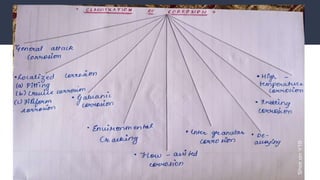
CORROSION:-
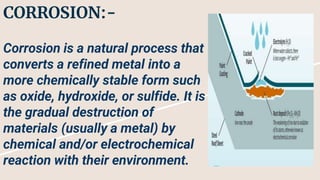
Corrosion is a natural process that
converts a refined metal into a
more chemically stable form such
as oxide, hydroxide, or sulfide. It is
the gradual destruction of
materials (usually a metal) by
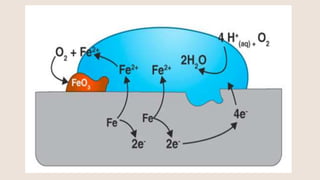
chemical and/or electrochemical
reaction with their environment.
Corrosion
Engineering:-
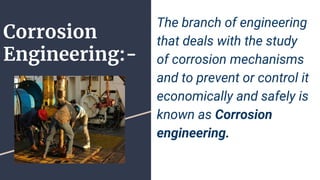
The branch of engineering
that deals with the study
of corrosion mechanisms
and to prevent or control it
economically and safely is
known as Corrosion
engineering.
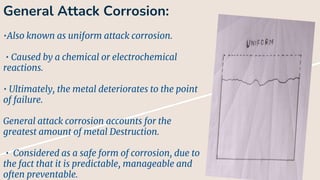
General Attack Corrosion:
•Also known as uniform attack corrosion.
• Caused by a chemical or electrochemical
reactions.
• Ultimately, the metal deteriorates to the point
of failure.
General attack corrosion accounts for the
greatest amount of metal Destruction.
• Considered as a safe form of corrosion, due to
the fact that it is predictable, manageable and
often preventable.
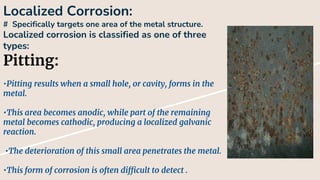
Localized Corrosion:
# Specifically targets one area of the metal structure.
Localized corrosion is classified as one of three
types:
Pitting:
•Pitting results when a small hole, or cavity, forms in the
metal.
•This area becomes anodic, while part of the remaining
metal becomes cathodic, producing a localized galvanic
reaction.
•The deterioration of this small area penetrates the metal.
•This form of corrosion is often difficult to detect .
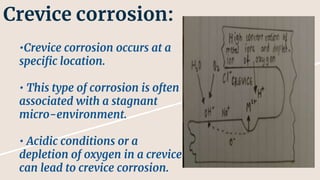
Crevice corrosion:
•Crevice corrosion occurs at a
specific location.
• This type of corrosion is often
associated with a stagnant
micro-environment.
• Acidic conditions or a
depletion of oxygen in a crevice
can lead to crevice corrosion.
Filiform corrosion:
•Occurring under painted or
plated surfaces.
•Filiform corrosion begins at small
defects in the coating and spreads
to cause structural weakness.
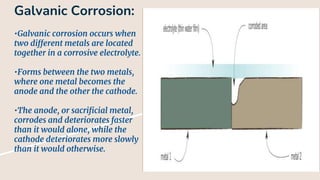
Galvanic Corrosion:
•Galvanic corrosion occurs when
two different metals are located
together in a corrosive electrolyte.
•Forms between the two metals,
where one metal becomes the
anode and the other the cathode.
•The anode, or sacrificial metal,
corrodes and deteriorates faster
than it would alone, while the
cathode deteriorates more slowly
than it would otherwise.
Three conditions must exist for
galvanic corrosion to occur:
•Electrochemically dissimilar metals
must be present
•The metals must be in electrical
contact
•The metals must be exposed to an
electrolyte
Environmental Cracking:
● It result from a combination of environmental
conditions affecting the metal.
● Chemical, temperature and stress-related conditions
can result in metal corrosion.
The following types of environmental corrosion:
#Stress Corrosion Cracking (SCC)
#Corrosion fatigue
#Hydrogen-induced cracking
#Liquid metal embrittlement
Flow-Assisted Corrosion (FAC):
•Results when a protective layer of oxide on a metal
surface is dissolved.
•Therefore exposing the underlying metal to
further corroding.
•Erosion-assisted corrosion
•Impingement
•Cavitation
Intergranular corrosion:-
•It is a chemical or electrochemical attack on the grain
boundaries of a metal.
• Occurs due to impurities in the metal, commonly near
boundaries .
• These boundaries can be more vulnerable to corrosion
than the bulk of the metal.
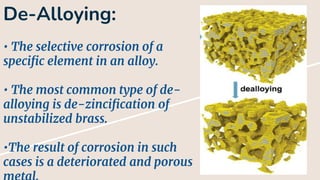
De-Alloying:
• The selective corrosion of a
specific element in an alloy.
• The most common type of de-
alloying is de-zincification of
unstabilized brass.
•The result of corrosion in such
cases is a deteriorated and porous
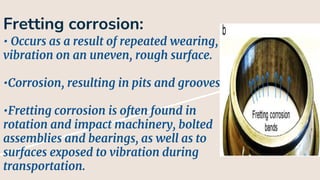
Fretting corrosion:
• Occurs as a result of repeated wearing,
vibration on an uneven, rough surface.
•Corrosion, resulting in pits and grooves.
•Fretting corrosion is often found in
rotation and impact machinery, bolted
assemblies and bearings, as well as to
surfaces exposed to vibration during
transportation.
High temperature corrosion:-
• It is the attack from solid or molten salts or
gases at temperature above 400°C (750°F) .
• Mainly occurs in gas turbines, diesel engine
or other machineries coming in contact with
hot gases.
• Oxidation is the most common result of this
type of corrosion.
Ex.:- some fuels contains vanadium or
sulphate compunds are strongly corrosive for
stainless steel.
Various types of high temperature
corrosion include:-
● Carburization
● Chlorination
● Fuel gas and deposit corrosion
● Nitridation
● Oxidation
● Sulphidation
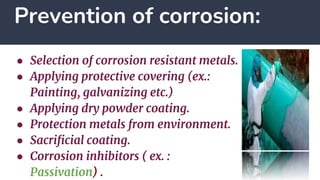
Prevention of corrosion:
● Selection of corrosion resistant metals.
● Applying protective covering (ex.:
Painting, galvanizing etc.)
● Applying dry powder coating.
● Protection metals from environment.
● Sacrificial coating.
● Corrosion inhibitors ( ex. :
Passivation) .
Factors
affecting during
materials
selected for
pharmaceutical
plant
construction:-
Properties:
● INTEGRITY
● ECONOMIC COST
Major materials used:
● Stainless steel
● Glass
● Iron
● Tin etc.
Factors:
1.Chemical factors:-
● Contamination of products
● Corrosion of materials of
construction
2.Physical factors:-
● Strength. • Sterilization
● Mass • Transparency
● Wear properties
● Thermal conductivity
● Thermal expansion
● Ease of fabrication
● Cleaning
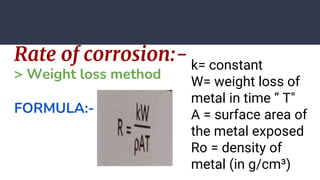
Rate of corrosion:-
> Weight loss method
FORMULA:-
k= constant
W= weight loss of
metal in time “ T"
A = surface area of
the metal exposed
Ro = density of
metal (in g/cm³)
CORROSION.pptx

CORROSION.pptx

  • 1.
    Presented by:- AkankshaAshtankar B. Pharm II nd Year Nagpur college of Pharmacy, Wanadongari
  • 2.
    CORROSION:- Corrosion is anatural process that converts a refined metal into a more chemically stable form such as oxide, hydroxide, or sulfide. It is the gradual destruction of materials (usually a metal) by chemical and/or electrochemical reaction with their environment.
  • 4.
    Corrosion Engineering:- The branch ofengineering that deals with the study of corrosion mechanisms and to prevent or control it economically and safely is known as Corrosion engineering.
  • 6.
    General Attack Corrosion: •Alsoknown as uniform attack corrosion. • Caused by a chemical or electrochemical reactions. • Ultimately, the metal deteriorates to the point of failure. General attack corrosion accounts for the greatest amount of metal Destruction. • Considered as a safe form of corrosion, due to the fact that it is predictable, manageable and often preventable.
  • 7.
    Localized Corrosion: # Specificallytargets one area of the metal structure. Localized corrosion is classified as one of three types: Pitting: •Pitting results when a small hole, or cavity, forms in the metal. •This area becomes anodic, while part of the remaining metal becomes cathodic, producing a localized galvanic reaction. •The deterioration of this small area penetrates the metal. •This form of corrosion is often difficult to detect .
  • 8.
    Crevice corrosion: •Crevice corrosionoccurs at a specific location. • This type of corrosion is often associated with a stagnant micro-environment. • Acidic conditions or a depletion of oxygen in a crevice can lead to crevice corrosion.
  • 9.
    Filiform corrosion: •Occurring underpainted or plated surfaces. •Filiform corrosion begins at small defects in the coating and spreads to cause structural weakness.
  • 10.
    Galvanic Corrosion: •Galvanic corrosionoccurs when two different metals are located together in a corrosive electrolyte. •Forms between the two metals, where one metal becomes the anode and the other the cathode. •The anode, or sacrificial metal, corrodes and deteriorates faster than it would alone, while the cathode deteriorates more slowly than it would otherwise.
  • 11.
    Three conditions mustexist for galvanic corrosion to occur: •Electrochemically dissimilar metals must be present •The metals must be in electrical contact •The metals must be exposed to an electrolyte
  • 12.
    Environmental Cracking: ● Itresult from a combination of environmental conditions affecting the metal. ● Chemical, temperature and stress-related conditions can result in metal corrosion. The following types of environmental corrosion: #Stress Corrosion Cracking (SCC) #Corrosion fatigue #Hydrogen-induced cracking #Liquid metal embrittlement
  • 13.
    Flow-Assisted Corrosion (FAC): •Resultswhen a protective layer of oxide on a metal surface is dissolved. •Therefore exposing the underlying metal to further corroding. •Erosion-assisted corrosion •Impingement •Cavitation
  • 14.
    Intergranular corrosion:- •It isa chemical or electrochemical attack on the grain boundaries of a metal. • Occurs due to impurities in the metal, commonly near boundaries . • These boundaries can be more vulnerable to corrosion than the bulk of the metal.
  • 15.
    De-Alloying: • The selectivecorrosion of a specific element in an alloy. • The most common type of de- alloying is de-zincification of unstabilized brass. •The result of corrosion in such cases is a deteriorated and porous
  • 16.
    Fretting corrosion: • Occursas a result of repeated wearing, vibration on an uneven, rough surface. •Corrosion, resulting in pits and grooves. •Fretting corrosion is often found in rotation and impact machinery, bolted assemblies and bearings, as well as to surfaces exposed to vibration during transportation.
  • 17.
    High temperature corrosion:- •It is the attack from solid or molten salts or gases at temperature above 400°C (750°F) . • Mainly occurs in gas turbines, diesel engine or other machineries coming in contact with hot gases. • Oxidation is the most common result of this type of corrosion. Ex.:- some fuels contains vanadium or sulphate compunds are strongly corrosive for stainless steel.
  • 18.
    Various types ofhigh temperature corrosion include:- ● Carburization ● Chlorination ● Fuel gas and deposit corrosion ● Nitridation ● Oxidation ● Sulphidation
  • 19.
    Prevention of corrosion: ●Selection of corrosion resistant metals. ● Applying protective covering (ex.: Painting, galvanizing etc.) ● Applying dry powder coating. ● Protection metals from environment. ● Sacrificial coating. ● Corrosion inhibitors ( ex. : Passivation) .
  • 20.
    Factors affecting during materials selected for pharmaceutical plant construction:- Properties: ●INTEGRITY ● ECONOMIC COST Major materials used: ● Stainless steel ● Glass ● Iron ● Tin etc.
  • 21.
    Factors: 1.Chemical factors:- ● Contaminationof products ● Corrosion of materials of construction
  • 22.
    2.Physical factors:- ● Strength.• Sterilization ● Mass • Transparency ● Wear properties ● Thermal conductivity ● Thermal expansion ● Ease of fabrication ● Cleaning
  • 23.
    Rate of corrosion:- >Weight loss method FORMULA:- k= constant W= weight loss of metal in time “ T" A = surface area of the metal exposed Ro = density of metal (in g/cm³)