Download to read offline
![International Journal of Software Engineering & Applications (IJSEA), Vol.6, No.6, November 2015
DOI : 10.5121/ijsea.2015.6602 13
CORRELATING FEATURES AND CODE BY
DYNAMIC AND SEMANTIC ANALYSIS
Ren Wu
Shanghai Lixin University of Commerce, Shanghai 201620, China
ABSTRACT
One major problem in maintaining a software system is to understand how many functional features in the
system and how these features are implemented. In this paper a novel approach for locating features in
code by semantic and dynamic analysis is proposed. The method process consists of three steps: The first
uses the execution traces as text corpus and the method calls involved in the traces as terms of document.
The second ranks the method calls in order to filter out omnipresent methods by setting a threshold. And
the third step treats feature-traces as first class entities and extracts identifiers from the rest method source
code and a trace-by-identifier matrix is generated. Then a semantic analysis model-LDA is applied on the
matrix to extract topics, which act as functional features. Through building several corresponding
matrices, the relations between features and code can be obtained for comprehending the system functional
intents. A case study is presented and the execution results of this approach can be used to guide future
research.
KEYWORDS
reverse engineering; dynamic analysis; semantic analysis; features; feature-traces; Latent Dirichlet
Allocation (LDA); scenarios; feature locations.
1. INTRODUCTION
Software maintenance often involves time-consuming and tedious activities. Maintainers spend
50% up to almost 90% of their time trying to understand the program so as to make changes
correctly [1]. To understand the underlying intents of an unfamiliar system, maintainers look for
clues in the code and documentation. These clues include program semantic information e.g.
identifiers and comments, program structural information such as programming patterns and
idioms, program dependencies and so on.
Feature location is to determine the relationships between domain concepts and other software
artefact [2], e.g., set of execution methods and the related method declarations in source code. We
refer to a feature is a unit of user-observable behaviour of a system. There are various techniques
for feature location such as static analysis, dynamic analysis, formal concept analysis etc. In this
paper we introduce an approach to analyse dynamic information combining with semantic
information. The main reasons for this combination are as follows:
Dynamic analysis: In reverse engineering approaches, it is common to focus on analysing static
source code entities of a system. But it is difficult for us to determine what roles for software](https://image.slidesharecdn.com/6615ijsea02-151216092919/85/CORRELATING-FEATURES-AND-CODE-BY-DYNAMIC-AND-SEMANTIC-ANALYSIS-1-320.jpg)
![International Journal of Software Engineering & Applications (IJSEA), Vol.6, No.6, November 2015
DOI : 10.5121/ijsea.2015.6602 13
CORRELATING FEATURES AND CODE BY
DYNAMIC AND SEMANTIC ANALYSIS
Ren Wu
Shanghai Lixin University of Commerce, Shanghai 201620, China
ABSTRACT
One major problem in maintaining a software system is to understand how many functional features in the
system and how these features are implemented. In this paper a novel approach for locating features in
code by semantic and dynamic analysis is proposed. The method process consists of three steps: The first
uses the execution traces as text corpus and the method calls involved in the traces as terms of document.
The second ranks the method calls in order to filter out omnipresent methods by setting a threshold. And
the third step treats feature-traces as first class entities and extracts identifiers from the rest method source
code and a trace-by-identifier matrix is generated. Then a semantic analysis model-LDA is applied on the
matrix to extract topics, which act as functional features. Through building several corresponding
matrices, the relations between features and code can be obtained for comprehending the system functional
intents. A case study is presented and the execution results of this approach can be used to guide future
research.
KEYWORDS
reverse engineering; dynamic analysis; semantic analysis; features; feature-traces; Latent Dirichlet
Allocation (LDA); scenarios; feature locations.
1. INTRODUCTION
Software maintenance often involves time-consuming and tedious activities. Maintainers spend
50% up to almost 90% of their time trying to understand the program so as to make changes
correctly [1]. To understand the underlying intents of an unfamiliar system, maintainers look for
clues in the code and documentation. These clues include program semantic information e.g.
identifiers and comments, program structural information such as programming patterns and
idioms, program dependencies and so on.
Feature location is to determine the relationships between domain concepts and other software
artefact [2], e.g., set of execution methods and the related method declarations in source code. We
refer to a feature is a unit of user-observable behaviour of a system. There are various techniques
for feature location such as static analysis, dynamic analysis, formal concept analysis etc. In this
paper we introduce an approach to analyse dynamic information combining with semantic
information. The main reasons for this combination are as follows:
Dynamic analysis: In reverse engineering approaches, it is common to focus on analysing static
source code entities of a system. But it is difficult for us to determine what roles for software](https://image.slidesharecdn.com/6615ijsea02-151216092919/75/CORRELATING-FEATURES-AND-CODE-BY-DYNAMIC-AND-SEMANTIC-ANALYSIS-1-2048.jpg)
![International Journal of Software Engineering & Applications (IJSEA), Vol.6, No.6, November 2015
14
entities playing in a software system and how these functions interact [3]. A set of trace events
generated by exercising desired use cases can be analysed to correlate features and software
entities e.g. methods and classes. As execution traces show system’s runtime behaviour, so it is
helpful for us to understand how the system’s functions are implemented by dynamic analysis.
Semantic analysis: Only analysing the structure of a software system to understand program is
not enough, since the structure tells us only how the system is working but not what the system is
about [4]. The names of identifiers and comments of source code can help understand what the
system is about by semantic analysis. A programmer’s code and comment often hint the content
of design documents and requirement documents, so it is possible to extract semantic information
associated with high-level business functions from the comments and identifier names of the
source code using information retrieval technology.
We focus on the correlation between features and code using dynamic and textual analysis
technology. The assumption is that the maintainer has limited prior familiarity with the target
system and wants to know how many features in the system and where they are implemented. A
simple solution is to exercise use cases as many as possible. By doing so, on one hand, to help the
maintainer know some functions of the target system, on the other hand, to locate features by
analysing generated trace events. Rather than assuming a one-to-one correspondence between
features and scenarios, we consider a scenario might tangle many features, and a feature scatter in
many execution traces. In other words, our approach is not restricted only to start from a single
feature and find its corresponding code, but on the assumption that maintainer start from a set of
use case scenarios, and then get relevant features, that is, the method is able to extract more
features and correlate features and code with a probability distribution.
The paper presents an implementation approach for finding features and locating features in code.
To this end, we first start by generating dynamic traces executing usage scenarios. The execution
result is the methods execution calls within trace then becomes the document corpus under
analysis. Meanwhile, method identifiers are parsed and extracted to establish the corpus of terms
and documents for LDA analysis, and the utility functions (i.e. methods with very high frequency
counts) are removed from the document corpus. And then LDA is used on the set of topics-to-
terms associations. Finally, a series of matrix comparisons are generated (e.g. trace-to-topic,
topic-to-identifier, class-by-topic) to calculate semantic similarities. The Luncene tool is used to
rank the list of relevant source code fragments, and visualization techniques depicting relevance
are also demonstrated using cluster maps.
2. BACKGROUND
In this section we will recall necessary basic notions and tools used in our paper for semantic and
dynamic analysis proceedings.
2.1. Execution Traces
Dynamic information is gathered based on a set of scenarios invoking the related features. A
scenario is a sequence of user inputs to a system [5]. As scenarios are being run, trace events are
collected. An execution event corresponds to a class or a method to accommodate different levels
of granularity.
Figure 1 shows the relations between the execution traces and method entities extracted from the
source code. Rather than assuming a one-to-one correspondence between features and scenarios,](https://image.slidesharecdn.com/6615ijsea02-151216092919/85/CORRELATING-FEATURES-AND-CODE-BY-DYNAMIC-AND-SEMANTIC-ANALYSIS-2-320.jpg)
![International Journal of Software Engineering & Applications (IJSEA), Vol.6, No.6, November 2015
15
we assume that a scenario invokes many features. Meanwhile, the features and code units are also
many-to-many mappings. We finally obtain a probability distribution between feature and code
by LDA extraction, which is more consistent with the actual situation.
Fig. 1. Feature-Model in UML
In this paper we focus only on method invocation events, but we can also apply to other different
levels of abstraction (e.g. classes, packages). We use a profiling tool, namely Java Platform
Debugger Architecture (JPDA) [6]. The JPDA-based tracer has the characteristics of flexibility,
and allows collect marked-traces during a system’s execution so that users can start and stop
tracing at will.
We establish the relationships between features and software entities by usage scenarios and
capture traces. Based the generation matrix, we cluster and analyse data according to feature
criterion. We use a trace-identifier matrix as input for the clustering algorithm. The column
represents identifiers extracted from source code and the row is the execution trace. Although a
trace might contain many features, however, they are similar on function, so we can apply
semantic analysis technology to cluster functional topics on the matrix.
2.2. Ranking Execution Traces
A set of traces can be obtained for generating a corresponding matrix: each row represents each
trace, and each column represents each method involved in the trace. We use a formula similar to
Term-Frequency/Inverse-Document-Frequency to distinguish elements that are specific to a
particular trace from those shared by traces. We modify the formula which introduced in [2] to
the following scoring formula:
log ( )
( )
i
iji
jsocre m
×
=
∑
# of i nvoked met hods by t r ace # t r aces t hat i nvoke met hod
# of t ot al i nvoked met hods # t r aces t hat i nvoke met hod
In the equation, “terms” are methods execution calls within trace, “term frequencies” are number
of method calls, and “documents” are executive traces. The algorithm is described in pseudo code
in Figure 2.
input: method name in each trace; Threshold of score](https://image.slidesharecdn.com/6615ijsea02-151216092919/85/CORRELATING-FEATURES-AND-CODE-BY-DYNAMIC-AND-SEMANTIC-ANALYSIS-3-320.jpg)
![International Journal of Software Engineering & Applications (IJSEA), Vol.6, No.6, November 2015
16
output: list of score rank
HashMap<String, Float> tf (String[] method) {
for each method[i] in a trace
int methodCount = 0;
for each method[j] in a trace
if (i != j) {
if (method[i].equals(method[j])) {
method[j] = " ";
methodCount++;
}
if (method[i] != " ")
{
tf.put(method[i](new
Float(++methodCount))/methodNum);
method[i] = " ";
}
}
return tf;
}
HashMap<String, Float> idf () {
……
Calculate the number of traces D
Calculate the number of traces that active the
current Method Dc
idf.put(method, Log.log(D / Dc, 2)); }
return idf;
}
……
Score(mj) = Sum(tf * idf) of each method
Mt={mj | score (mj) >= Threshold}
Fig. 2. The algorithm of traces score
2.3. Extracting semantic information
The process steps for extracting semantic information from the source code have also been
previously introduced in [7]. The steps work as follows: Extracting semantic information such as
comments and identifiers, from each source code element at a desired level of granularity (e.g.,
package, class, method). Pre-processing the textual information, e.g., perform stemming and
remove stop words. Storing the pre-processed data extracted from each code element as a
separate document in the document collection.
In this paper we extract the relevant information (e.g., name, parameters, relationships, etc.) from
source code by fact extraction and store these data in a relational database. The structure of
methods and classes is shown in Table 1.
Table 1. Relevant table structure
Level of Granularity Attribute
class ClassName](https://image.slidesharecdn.com/6615ijsea02-151216092919/85/CORRELATING-FEATURES-AND-CODE-BY-DYNAMIC-AND-SEMANTIC-ANALYSIS-4-320.jpg)
![International Journal of Software Engineering & Applications (IJSEA), Vol.6, No.6, November 2015
17
InheritsFrom
ImplemetsTo
Variables
method MethodName
Arguments
ReturnType
ReturnValue
Terms in comments
We collect a set of traces in a corpus, For example, each document in a corpus. The first line is
the number of traces, and each successive line is a single trace in the collection with a set of terms
or identifiers. In the paper, the list of identifiers from the above database corresponding to a
single method name or class name. Because we have stored these identifiers in a database, so we
just need to sort related method name and fetch the corresponding data, then write the
information to the document. This format is consistent with the input format required by the LDA
tool used in textual analysis.
2.4. LDA Model
Latent Dirichlet Allocation (LDA) is a document model which explicitly models topic
multiplicity of each document. It is a generative probabilistic model of a corpus. The basic idea is
that documents are represented as random mixtures over latent topics, where each topic is
characterized by a distribution over words [8]. In LDA, documents are represented as mixtures
over latent topics, and each topic is characterized by a distribution over words.
The LDA-based model assumes a prior Dirichlet distribution on θ, thus allowing the estimation
of φ without requiring the estimation of θ. LDA assumes the following generative process for
each document w in a corpus D:
1. Choose N ~ Poisson(ξ).
2. Choose q ~ Dir(α).
3. For each of the N words wi:
(a) Select a topic tk ~ Multinomial (θ).
(b) Select a word wi from p(wi|zw,β), a multinomial probability conditioned on topic tk.
There are more details pertaining to LDA in [8].
2.5. Semantic Clustering
To get a semantic model of the software system, we implement these steps as follows:](https://image.slidesharecdn.com/6615ijsea02-151216092919/85/CORRELATING-FEATURES-AND-CODE-BY-DYNAMIC-AND-SEMANTIC-ANALYSIS-5-320.jpg)
![International Journal of Software Engineering & Applications (IJSEA), Vol.6, No.6, November 2015
18
First, we split the software system into text documents and use the textual representation of traces
as a document. Second, we sort methods on the database for obtaining the related attribute values,
then we replace terms with identifiers by pair-wise matrix multiplication. An identifier is any
word found in the source code or comments, except keywords of the programming language.
Identifiers are separated based on standard naming conventions. Considering traces as a
document and an identifier as a term,we create a trace-by identifier matrix, similar to the
common document-term matrix.
2.6. Applying LDA
Since LDA is basically a topic modelling technique, it not only discovers similarity between
identifiers, it also creates a cluster of similar identifiers to form a topic. In this paper we use LDA
to cluster identifiers according to feature criterion.
Generating probability distributions: Topic-identifier and trace-topic matrices are obtained after
applying LDA, in the matrices each trace is probabilistically associated with a set of topics and
each topic is probabilistically associated with a set of identifiers.
Grouping similar topics: The process is to calculate cosine similarity among topics to group
similar topics for further analysis. Two topics will be clustered into the same category if a cosine
similarity between them is greater than a certain threshold [9]. A topic can belong to several
different categories, and the result is a list of categories and some rest topics.
3. OUR APPROACH
We outline how we apply our technique to incorporate feature-traces model of source code and
how to extract topics from the trace model. The approach is a combination coming from two
different sources: the execution traces of scenarios, and the comments and identifiers extracted
from the class calls or method calls source code. The whole execution process is illustrated in
Figure 3.
Fig. 3. Overview of our approach
3.1. Traces as text corpus](https://image.slidesharecdn.com/6615ijsea02-151216092919/85/CORRELATING-FEATURES-AND-CODE-BY-DYNAMIC-AND-SEMANTIC-ANALYSIS-6-320.jpg)
![International Journal of Software Engineering & Applications (IJSEA), Vol.6, No.6, November 2015
19
We assume one has limited prior familiarity with the target system, so he or she exercise some
scenarios for understanding system’s functions by clicking the button or menu on GUI to obtain
traces events. JPDA profiling tool is used to extract execution traces and model as a list of
methods within traces. The tool can collect marked traces to reduce the size of the traces or
collect complete traces without mark at will [10], and the outputs of the tool are a set of events in
each thread.
Fig. 4. The generation of a document and terms
We rank the methods of the collection by calculating rank score according to the algorithm in
Section 2, and set a threshold to filter out some methods with very high frequency counts, which
are useless to special-function. We use a similar example with [11] to show how Traces form a
document and the methods form the terms.
Table 2. The score of each method
tf-idf m1 m2 m3 m4
Trace1 0.044022813 0.044022813 0.044022813 0
Trace2 0.08804563 0.044022813 0 0
Trace3 0 0 0.08804563 0
Score(m) 0.132068443 0.088045626 0.132068443 0
The score of each method is calculated and show the result is shown in Table 2. Some methods
with lower score will be removed. For instance, m4 () is considered as a utility method and is
filtered out.
In analysis we consider only the relationships between traces and software entities e.g., classes or
methods. For mapping each cell to concept, we keep one occurrence of any repetition only if a
concept is repeated many times in a trace. Because a repetition does not introduce a new concept,
thus we compress traces to remove repetitions. Therefore, in Figure 4 we change the cell value of
m1 () in trace 2 from 2 to 1.
3.2. Building the Trace-Identifier Matrix](https://image.slidesharecdn.com/6615ijsea02-151216092919/85/CORRELATING-FEATURES-AND-CODE-BY-DYNAMIC-AND-SEMANTIC-ANALYSIS-7-320.jpg)
![International Journal of Software Engineering & Applications (IJSEA), Vol.6, No.6, November 2015
20
We treat traces as text corpus and analyse the entities and related static structural model of source
code. In this way, the relationships between the method calls in traces and the static model
method entities are established and a matrix is generated with each column represents an
identifier of source code and each row is a trace. The value of each cell in the matrix is either 0 or
1, indicating the absence or presence of a method or a class in the trace. The generation process
of the trace-identifier matrix is shown in Figure 5.
Fig. 5. The generation of trace-identifier matrix
Our semantic analysis tool is applied on the traces. To use the traces as text corpus, we correlate
the method names found in the traces and the database tables for obtaining related information,
and then replace terms with identifiers by pair-wise matrix multiplication. Figure 5 shows the
generation process of matrix.
3.3. Performing the LDA Analysis
We use an open-source software tool for LDA analysis called GibbsLDA++ [12]. GibbsLDA++
uses Gibbs sampling to estimate topics from the document collection as well as estimate the
word-topic and the topic-document probability distributions. The tool also outputs a list of topics
with the top n words in the topic, i.e., the n words that have the highest probability of belonging
to that topic, where n is a parameter set for each analysis [18].
Besides, after applying LDA to the matrix of trace-identifier, two relevant probability
distributions, i.e., trace-topic and topic-identifier matrices are generated. From the results
returned by LDA, the most likely terms in each topic, i.e. the topics with the highest probability,
can be examined to determine the likely meaning of the topic.
Fig. 6. Clustering by semantic similarity
The trace-topic matrix and the topic-identifier matrix are generated using LDA. Figure 6 shows a
partial clustering process. Identifiers can be further clustered into different categories using a](https://image.slidesharecdn.com/6615ijsea02-151216092919/85/CORRELATING-FEATURES-AND-CODE-BY-DYNAMIC-AND-SEMANTIC-ANALYSIS-8-320.jpg)
![International Journal of Software Engineering & Applications (IJSEA), Vol.6, No.6, November 2015
21
certain cosine value based on the corresponding relationships. The semantic similarity shows how
two topics are related to each other.
CASE STUDY
In this section we present the results of applying our approach to the JHotDraw [13] case study.
JHotDraw is an open source tool written in java which provides a graphical user interface. The
6.0 version of the software consists of 486 files representing 650 classes, 4,710 methods, and 845
fields across 28,337 lines of code.
Use cases selection: On the assumption that the requirements information is out-of-date or
incomplete, so we exercise execution scenarios as many as possible. The process is to click
buttons or menu on the GUI of the system, and our tool collects all trace events to analyse. Table
3 shows a part selected ten use cases [14] in JHotDraw system.
Table 3. Selected use cases in jhotdraw
U1. Use the Rectangle button to draw a new Rectangle figure
U2. Use the Round Rectangle button to draw a new figure
U3. Use the ellipse button to draw a new ellipse figure
U4. Use the polygon button to draw a new polygon figure
U5. Use the line button to draw a new line figure
U6. For each graphical element in the load file: turn tracing off; select it; turn
tracing on; move it
U7. For each graphical element in the load file: turn tracing off; select it; turn
tracing on; delete it
U8. For each graphical element in the load file: select it; use bring-to-front
command from the zoom figure.
U9. Use the URL button to attach an URL to each graphical element; to
modify the URL on each graphical
U10. Create a new text field using the text button; modify the existing text
field using the text button
Table 4 depicts the experimental results of execution traces extraction. The second column shows
the number of scenarios in terms of various use cases, the next is the count of execution events in
traces. The rest number of methods after filtering is listed in the last column.
Filtering out Omnipresent methods: Software system contains some components that act as mere
utilities. Some method invocations related to system events, are not feature-specific and can
appear almost anywhere in a trace. Therefore, we decide to remove the omnipresent components
in the system. The detection approach has been discussed in Section 2.2. We calculate the trace
score and set a certain threshold to filter out utilities. Figure 7 shows the dual axis chat views of
the data in Table 4.
Table 4. Results of execution trace extraction](https://image.slidesharecdn.com/6615ijsea02-151216092919/85/CORRELATING-FEATURES-AND-CODE-BY-DYNAMIC-AND-SEMANTIC-ANALYSIS-9-320.jpg)
![International Journal of Software Engineering & Applications (IJSEA), Vol.6, No.6, November 2015
22
Use case Number of
scenarios
Number of methods Number of methods
after filtering
U1 4 7889 6657
U2 4 5040 4980
U3 5 8493 7320
U4 7 10769 8960
U5 4 4253 4190
U6 4 4930 4790
U7 4 5739 5432
U8 6 11078 9590
U9 5 10356 10132
U10 4 6074 5879
Fig. 7. Dual axis chat views of data in Table III
Applying LDA: The LDA-based approach can capture more subtle statistical relationships among
topics, words, entities and traces [15]. We extract 30 topics from the trace-identifier matrix, and
list a partial topics and labels in Table 5.
Table 5. A partial extracted topics from jhotdrawtem
Topic label(feature) Word list (topic)
ITERATION “list has iterator next add”
UNDO “undo change figure activity affect”
DRAW FIGURE “figure change listener event remove”
EVENTS, TOOL “mouse event tool add down”
FIGURE ATTRIBUTES “attribute figure object constant draw”
MAP “all map contain object vector”
DRAW,COLOR “colour draw print map name”
DRAW SHAPE “point line box draw bound”
CONTENT “content class string producer frame”
DRAW,FIGURES “figure add draw decorated find”
DRAW RECTANGLE “shape rectangle draw rectangular figure”
CONNECT “connection connector figure start end”
ROTATION “radius angle reset rotation view”
EVENT, OBSERVER “desktop component container event listener”
RENDERING “graphic draw image rectangle fill”
EDITOR,ANIMAT ION “editor draw create animation tool”
PERSISTENCE “store read write input output”
MOVE “drag drop source listener target”
To perform a comparison, we inspect the trace-topic matrix with the probability distribution of
topics over traces. For each latent topic identified by a set of 5 words, we assign a meaningful](https://image.slidesharecdn.com/6615ijsea02-151216092919/85/CORRELATING-FEATURES-AND-CODE-BY-DYNAMIC-AND-SEMANTIC-ANALYSIS-10-320.jpg)
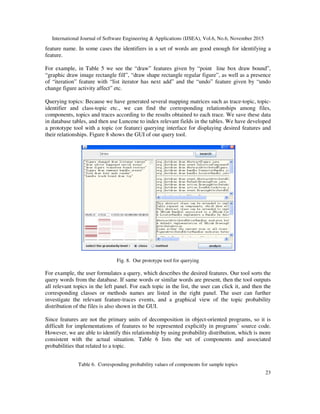
![International Journal of Software Engineering & Applications (IJSEA), Vol.6, No.6, November 2015
24
topic class Probability
“draw, editor,
happen, serial,
mouse”
AbstractAttributeEditorHandler.java 0.177966
DefaultDrawingView.java 0.127586
DrawingAttributeAction.java 0.122642
ZoomEditorAction.java 0.119565
DrawingAttributeEditorHandler.java 0.101153
“draw, figure,
transform,
bound, restore”
EllipseFigure.java 0.383333
RectangleFigure.java 0.382609
ImageFigure.java 0.378571
AbstractAttributedDecoratedFigure.java 0.373134
TextAreaFigure.java 0.368421
topic method Probability
“draw, stroke, fill,
view, decorate”
DrawingEditor.createInputMap() 0.270270
BezierControlPointHandle.draw(Graphics2D) 0.153846
BoundsOutlineHandle.draw(Graphics2D) 0.152941
drawFigure(Graphics2D) 0.152778
ConvexHullOutlineHandle.draw(Graphics2D) 0.146067
“draw, composite,
scale, image,
hint”
ODGGroupFigure.draw(Graphics2D) 0.379310
SVGPathFigure.draw(Graphics2D) 0.337079
ODGPathFigure.draw(Graphics2D) 0.314607
SVGAttributedFigure.draw(Graphics2D) 0.314376
SVGGroupFigure.draw(Graphics2D) 0.310345
Generating categories: To group similar topics on topic-identifier matrix, we compute cosine
similarity between each pair of topics. If a cosine similarity between two topics is greater than a
certain threshold, we cluster them into the same category [9]. Some similar features are clustered
together in terms of similarity comparison. For example, we set the threshold is 0.6, the similarity
of “tool enabled object usable palette” and “editor drawing create animation tool” is above 0.6,
which means the draw tool for use; “drag drop target source listener” and “event listener object
fire iterator” show listener event happening; “invoke handle owner step undo” and “undo figure
figures activity affected” show undo design model etc. By grouping relevant files into categories,
we further comprehend the system functional intents.
Forming class-topic matrix: We can also examine the relationships between topics and files by
the class-topic matrix. Table 7 shows a partial probability distribution data selected from the
JHotDraw experiment results.
Table 7. A partial of probability distribution in JHotDraw
Class Topic1 Topic2 Topic3 Topic4
“mouse event
down tool
added”
“list next
has
iterator
event”
“mouse
event
down
tool
added”
“graphics draw
image rectangle
fill”
AddTool 0.352631 0.243412 0.237861 0.012321
PolyLineFigure 0.123021 0.534300 0.030045 0.320000
PolyLineConnector 0.000120 0.650132 0.120000 0.400521
PolygonTool 0.000521 0.670120 0.064521 0.414211
PaletteButton 0.214211 0.124832 0.214211 0.300000](https://image.slidesharecdn.com/6615ijsea02-151216092919/85/CORRELATING-FEATURES-AND-CODE-BY-DYNAMIC-AND-SEMANTIC-ANALYSIS-12-320.jpg)
![International Journal of Software Engineering & Applications (IJSEA), Vol.6, No.6, November 2015
25
TextAreaFigure 0.400000 0.517232 0.490000 0.135432
DragTracker 0.135462 0.111213 0.567262 0.520000
NestedCreationTool 0.342401 0.000000 0.220000 0.124221
TriangleFigure 0.526342 0.131212 0.652123 0.004211
FigureChange 0.621001 0.106423 0.323232 0.000000
FigureChangeAdapter 0.600000 0.006423 0.124242 0.122462
The above data can be graphically displayed using a cluster map view of topic-class, which
shows the topic assignment across each component. Figure 9 shows the view, where a class with
a higher topic assignment is indicated with a darker colour and vice versa. In this paper, the heat-
map technique [16] for graphical representation of data depicting relevance is used, and the
clustering visualization is also demonstrated to quickly contrast and compare the distribution in
the various topics.
Fig. 9. Graphical display the relationships of class-topic
We can further cluster these classes by their similarity according to the data in Table 7.
Fig. 10. Graphical display the similarity of classes
We process the data in Table VII to generate an equivalent matrix. The matrix is graphically
displayed in Figure 10 (1). Then we cluster these classes by their similarity by selecting λ =0.912
as cut value which determines the following four clusters, and the clusters are displayed in Figure
10 (2).
Cluster 1: class 1, class 6, class 8, class 10, class 11
Cluster 2: class 2, class 3, class 4](https://image.slidesharecdn.com/6615ijsea02-151216092919/85/CORRELATING-FEATURES-AND-CODE-BY-DYNAMIC-AND-SEMANTIC-ANALYSIS-13-320.jpg)
![International Journal of Software Engineering & Applications (IJSEA), Vol.6, No.6, November 2015
26
Cluster 3: class 9
Cluster 4: class 5, class 7
3. DISCUSSION
In this paper we first exercise the system to collect execution traces for some scenarios related to
various use cases, which containing sets of different features. Then we compress the traces to
remove utilities. Second, we treat traces as first class entities and extract identifiers from the
method source code and generate a trace-identifier matrix. Then we apply a semantic analysis
tool on the matrix for extracting topics, which as functional features. Our approach makes the
syntax and semantics have a good combination.
F-measure: We assume that the maintainer exercises features by clicking the button or menu of
the target system for obtaining trace events. Therefore, our feature model does not achieve 100%
coverage of the system. To locating more features, we need to increase the coverage the
application by exercising more scenarios. However, by extracting identifiers from components
source code, expanding the scope of application semantics, to some extent this way can increase
the recall. Meanwhile, owing to filter out some concepts useless to system special-functions, we
get relative precision for features extracted in the traces. The future work we will compute the F-
measure, the harmonic mean of precision and recall: f-measure = 2· (recall · precision) / (recall +
precision) by some detail experiment data, and select an acceptable trade-off.
Effectiveness Measure: We build text corpus from the names of the methods involved in the
traces, then we sort methods in the database to obtain their corresponding identifiers of source
code by our parser tool. We consider it is beneficial for enriching semantic information by add
identifiers into analysis instead of methods name only. However, if a great deal identifiers are
introduced into analysis models, it is possible to introduce some not feature-specific terms into
analysis. So we need to have a choice of variable identifiers.
Topic and Software Feature: Pierre Baldi et al. [15] propose to unify the concept of latent topic
with the concept of concern in the domain of software. They claim the distribution of a topic
across modules indicates whether the topic is more or less scattered. Their conclusion is a
concern is a latent topic. Based on this idea, we focus on features of concerns: our approach
obtains concerns from execution traces, filters out some common concepts, and complements
semantic concepts into analysis. So we think a feature is also a latent topic. This is a theory of our
approach.
4. RELATED WORK
Hybrid feature location leverages the benefits of static and dynamic analyses. T.Eisenbarth et al.
[5] develop a technique that applies formal concept analysis to traces to produce a mapping of
features to methods. A feature-driven approach is presented in [17] by extracting execution traces
to achieve an explicit features location. In contrast, our approach not only takes into account
mappings between features and software entities like methods or classes, but also extracts more
features to help program comprehension.
Marcus et al. [10] present an approach with a single execution trace combining with LSI to
extract code relevant to a feature. Adrian Kuhn et al. [11] propose to combine LSI-based analysis](https://image.slidesharecdn.com/6615ijsea02-151216092919/85/CORRELATING-FEATURES-AND-CODE-BY-DYNAMIC-AND-SEMANTIC-ANALYSIS-14-320.jpg)
![International Journal of Software Engineering & Applications (IJSEA), Vol.6, No.6, November 2015
27
and dynamic analysis to identify related features. In contrast, our approach is not restricted only
to start from a single feature and find its corresponding code, but on the assumption that
maintainer starts from a set of use case scenarios, then get relevant features. The tool for us to use
is LDA instead of LSA, because LDA is able to extract features and correlate features and code
with a probability distribution, which is more consistent with the actual situation. Besides, a
series of matrix comparisons are generated (e.g. trace-to-topic, topic-to-identifier etc.) by LDA
tool to calculate semantic similarities.
Several works [9, 18] have shown that the idea of applying LDA in source code for extracting
topics can be carried out. In contrast, our approach is not used directly to examine source code for
topics, but on the concepts after dynamic processing and filtering, so obtained topics via LDA
have functional intents. Besides, Abram et al. [19] treat CVS commits as documents, and
compare how extracted topics changed between time periods. LDA has been also used for
traceability link recovery [20] and compared to other similar Information Retrieval based
approaches, but in [20], topics extraction from requirement documents and design documents not
from source code as ours.
5. CONCLUSIONS AND FUTURE WORK
Reverse engineering approaches focus only on the implementation details and static structure
often ignores the semantics of the problem and solution domain. But semantic information is
essential in revealing full of the picture of software system. Our approach discusses a technique
for determining which components source code implement which features of software application
by incorporating dynamic traces and semantic analysis via a series of pair-wise comparison
matrices. We demonstrate the application of the proposed technique via a case study. The main
idea behind the technique is to use LDA to extract topics, i.e. functional intents, from methods
and identifiers involved in execution traces. The technique is used for feature location in source
code.
In the future, we will focus on the following issues: (1) extending the scope of our feature
approach to consider exercising more scenarios according to feedback information (2) combining
dynamic analysis with system’s structural model, e.g. program-element dependencies for
enriching the semantic information, (3) assigning automatically meaningful labels to traces to
help maintainers understand their meanings, and (4) conducting systematic empirical studies on
the choice of the appropriate parameters for the proposed approach and collecting more
empirical data to evaluate the effectiveness based on LDA for features location.
REFERENCES
[1] Antoniol, G.; Gueheneuc, Y.-G.: Feature Identification: An Epidemiological Metaphor, in Software
Engineering, IEEE Transactions on , vol.32, no.9, pp.627-641, Sept. 2006
[2] Eaddy, M.; Aho, A.V.; Antoniol, G.; Gueheneuc, Y.-G., CERBERUS: Tracing Requirements to
Source Code Using Information Retrieval, Dynamic Analysis, and Program Analysis, in Program
Comprehension, 2008. ICPC 2008. The 16th IEEE International Conference on, pp.53-62, 10-13 June
2008
[3] Greevy, O.; Lanza, M.; Wysseier, C., Visualizing Feature Interaction in 3-D, in Visualizing Software
for Understanding and Analysis, 2005. VISSOFT 2005. 3rd IEEE International Workshop, pp.1-6,
114-119 2005](https://image.slidesharecdn.com/6615ijsea02-151216092919/85/CORRELATING-FEATURES-AND-CODE-BY-DYNAMIC-AND-SEMANTIC-ANALYSIS-15-320.jpg)
![International Journal of Software Engineering & Applications (IJSEA), Vol.6, No.6, November 2015
28
[4] Kuhn, A.; Ducasse, S.; Girba, T., Enriching reverse engineering with semantic clustering, in Reverse
Engineering, 12th Working Conference, 7-11 Nov. 2005: 133-142.
[5] T.Eisenbarth, R.Koschke, and D.Simon. Locating Features in Source Code. IEEE Computer, 29(3):
210–224, Mar. (2003).
[6] Jpda. http:// java.sun.com/javase/technologies/core/toolsapis/jpda/.
[7] Lukins, S.K.; Kraft, N.A.; Etzkorn, L.H., Source Code Retrieval for Bug Localization Using Latent
Dirichlet Allocation, in Reverse Engineering, 2008. WCRE '08. 15th Working Conference on,
pp.155-164, 15-18 Oct. 2008
[8] D. Blei, A. Ng, and M. Jordan. Latent dirichlet allocation. Journal of Machine Learning Research,
2003, 3: 993–1022.
[9] Kai Tian,; Revelle, M.; Poshyvanyk, D., Using Latent Dirichlet Allocation for automatic
categorization of software, in Mining Software Repositories, 2009. MSR '09. 6th IEEE International
Working Conference, pp.163-166, 16-17 May 2009.
[10] Liu, D., Marcus, A., Poshyvanyk, D., and Rajlich, V.: Feature Location via Information Retrieval
based Filtering of a Single Scenario Execution Trace, in Proc. of ASE'07, November 5-9 2007. PP.
563-566.
[11] Kuhn A, Greevy O, Gîrba T. Applying semantic analysis to feature execution traces. Proceedings
IEEE Workshop on Program Comprehension through Dynamic Analysis IEEE Computer Society
Press: Los Alamitos CA, 2005: 48-53.
[12] GibbsLDA++. http://gibbslda.sourceforge.net/.
[13] JHotDraw. http://www.JHotDraw.org/.
[14] Dynamo. http://star.fbk.eu/dynamo/
[15] Pierre Baldi, Cristina Videira Lopes, Erik Linstead, Sushil Krishna Bajracharya: A theory of aspects
as latent topics. Proceedings of the 23rd Annual ACM SIGPLAN Conference on Object-Oriented
Programming, Systems, Languages, and Applications, 2008: 543-562.
[16] http://www.patrick-wied.at/static/heatmapjs/
[17] Greevy, O.; Ducasse, S., Correlating Features and Code Using a Compact Two-Sided Trace Analysis
Approach, in Software Maintenance and Reengineering, 2005. CSMR 2005. Ninth European
Conference on , vol., no., pp.314-323, 21-23 March 2005.
[18] Maskeri, G., Sarkar, S., and Heafield, K. Mining Business Topics in Source Code using Latent
Dirichlet Allocation, Proceeding of the 1st Annual India Software Engineering Conference, ISEC
2008, Hyderabad, India, February 19-22, 2008. PP. 113-120.
[19] Hindle, A.; Godfrey, M.W.; Holt, R.C., What's hot and what's not: Windowed developer topic
analysis, in Software Maintenance, 2009. ICSM 2009. IEEE International Conference on , vol., no.,
pp.339-348, 20-26 Sept. 2009.
[20] Asuncion, H.U.; Asuncion, A.U.; Taylor, R.N., Software traceability with topic modelling, in
Software Engineering, 2010 ACM/IEEE 32nd International Conference on , vol.1, no., pp.95-104, 2-8
May 2010.
AUTHORS
Ren Wu Received his PhD degree in computer science in 2014. His current research
interests include information retrieval, software engineering and software maintenance.](https://image.slidesharecdn.com/6615ijsea02-151216092919/85/CORRELATING-FEATURES-AND-CODE-BY-DYNAMIC-AND-SEMANTIC-ANALYSIS-16-320.jpg)

The document proposes a novel method for locating functional features in code through dynamic and semantic analysis, focusing on generating execution traces and correlating them with method calls. The approach involves ranking method calls, extracting identifiers, and applying latent Dirichlet allocation (LDA) to identify topics as functional features. A case study demonstrates the effectiveness of this method in understanding software systems and guiding future research in feature location.


![Getting Started with Apache Spark: Big Data Made Simple [Free Meetup]](https://cdn.slidesharecdn.com/ss_thumbnails/apachesparkgettingstarted-260203175547-8361bcc3-thumbnail.jpg?width=640&height=640&fit=bounds)


