This presentation has been given at TEFSE, the 8th of November 2005, Long Beach , USA.


              On Feature Traceability in
              Object-Oriented Programs

                               Giuliano Antoniol, Ettore Merlo,
                         Yann-Gaël Guéhéneuc, and Houari Sahraoui
                                                                TEFSE 2005
                                                            Long Beach, CA, USA

GEODES Group of Open, Distributed Systems,                                               SOCCER Laboratory
       Experimental Software Engineering                                                 Department of Informatics
       Department of Informatics and Operations Research                                 École Polytechnique de Montréal
       University of Montreal
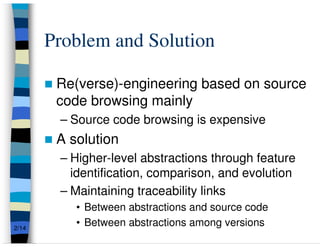
Problem and Solution

        Re(verse)-engineering based on source
        code browsing mainly
        – Source code browsing is expensive
        A solution
        – Higher-level abstractions through feature
          identification, comparison, and evolution
        – Maintaining traceability links
           • Between abstractions and source code
2/14
           • Between abstractions among versions
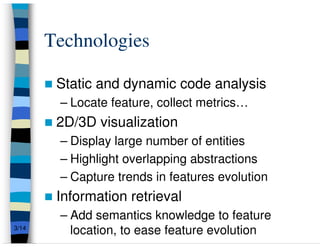
Technologies

        Static and dynamic code analysis
        – Locate feature, collect metrics…
        2D/3D visualization
        – Display large number of entities
        – Highlight overlapping abstractions
        – Capture trends in features evolution
        Information retrieval
        – Add semantics knowledge to feature
3/14
          location, to ease feature evolution
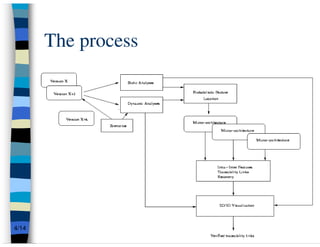
The process


4/14
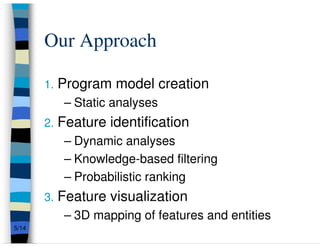
Our Approach

       1.   Program model creation
             – Static analyses
       2.   Feature identification
             – Dynamic analyses
             – Knowledge-based filtering
             – Probabilistic ranking
       3.   Feature visualization
             – 3D mapping of features and entities
5/14
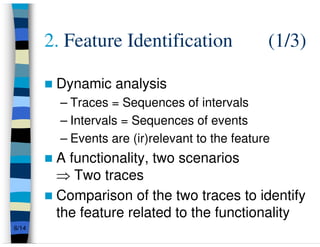
2. Feature Identification                (1/3)

        Dynamic analysis
         – Traces = Sequences of intervals
         – Intervals = Sequences of events
         – Events are (ir)relevant to the feature
        A functionality, two scenarios
        ⇒ Two traces
        Comparison of the two traces to identify
        the feature related to the functionality
6/14
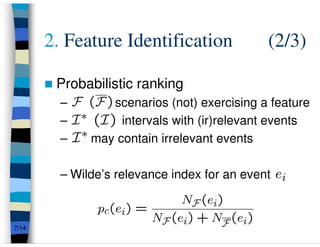
2. Feature Identification              (2/3)

        Probabilistic ranking
         –       scenarios (not) exercising a feature
         –         intervals with (ir)relevant events
         –    may contain irrelevant events

         – Wilde’s relevance index for an event


7/14
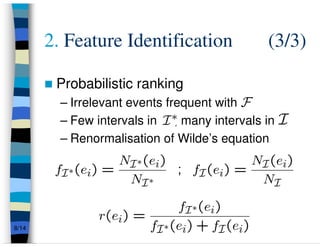
2. Feature Identification             (3/3)

        Probabilistic ranking
         – Irrelevant events frequent with
         – Few intervals in , many intervals in
         – Renormalisation of Wilde’s equation


8/14
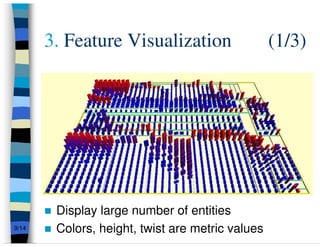
3. Feature Visualization                   (1/3)


        Display large number of entities
9/14    Colors, height, twist are metric values
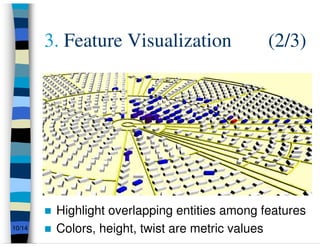
3. Feature Visualization               (2/3)


         Highlight overlapping entities among features
10/14    Colors, height, twist are metric values
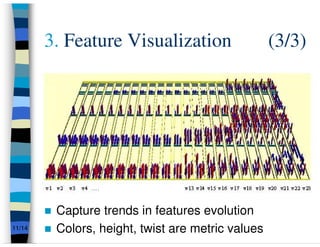
3. Feature Visualization                   (3/3)


         Capture trends in features evolution
11/14    Colors, height, twist are metric values
Questions on Feature Evolution

         Functionalities and micro-architectures
         common across release
         – Do they change?
         Newly added functionalities
         – How much do they reuse, integration?
         Disappearing functionalities
         – What happened to the micro-architectures?
         Micro-architectural change without
         feature change
12/14
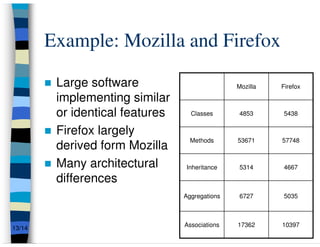
Example: Mozilla and Firefox

         Large software                         Mozilla   Firefox

         implementing similar
         or identical features     Classes       4853     5438


         Firefox largely
                                   Methods      53671     57748
         derived form Mozilla
         Many architectural      Inheritance     5314     4667

         differences
                                 Aggregations    6727     5035


                                 Associations   17362     10397
13/14
Conclusion

        (Not really a conclusion ☺)

         There is so much to be done
         Reliable multi-language parsers
         Scalable visualization tools
         Scalable IR tools
         Fast and accurate pattern matching
14/14

TEFSE05.ppt

  • 1.
    This presentation hasbeen given at TEFSE, the 8th of November 2005, Long Beach , USA. On Feature Traceability in Object-Oriented Programs Giuliano Antoniol, Ettore Merlo, Yann-Gaël Guéhéneuc, and Houari Sahraoui TEFSE 2005 Long Beach, CA, USA GEODES Group of Open, Distributed Systems, SOCCER Laboratory Experimental Software Engineering Department of Informatics Department of Informatics and Operations Research École Polytechnique de Montréal University of Montreal
  • 2.
    Problem and Solution Re(verse)-engineering based on source code browsing mainly – Source code browsing is expensive A solution – Higher-level abstractions through feature identification, comparison, and evolution – Maintaining traceability links • Between abstractions and source code 2/14 • Between abstractions among versions
  • 3.
    Technologies Static and dynamic code analysis – Locate feature, collect metrics… 2D/3D visualization – Display large number of entities – Highlight overlapping abstractions – Capture trends in features evolution Information retrieval – Add semantics knowledge to feature 3/14 location, to ease feature evolution
  • 4.
  • 5.
    Our Approach 1. Program model creation – Static analyses 2. Feature identification – Dynamic analyses – Knowledge-based filtering – Probabilistic ranking 3. Feature visualization – 3D mapping of features and entities 5/14
  • 6.
    2. Feature Identification (1/3) Dynamic analysis – Traces = Sequences of intervals – Intervals = Sequences of events – Events are (ir)relevant to the feature A functionality, two scenarios ⇒ Two traces Comparison of the two traces to identify the feature related to the functionality 6/14
  • 7.
    2. Feature Identification (2/3) Probabilistic ranking – scenarios (not) exercising a feature – intervals with (ir)relevant events – may contain irrelevant events – Wilde’s relevance index for an event 7/14
  • 8.
    2. Feature Identification (3/3) Probabilistic ranking – Irrelevant events frequent with – Few intervals in , many intervals in – Renormalisation of Wilde’s equation 8/14
  • 9.
    3. Feature Visualization (1/3) Display large number of entities 9/14 Colors, height, twist are metric values
  • 10.
    3. Feature Visualization (2/3) Highlight overlapping entities among features 10/14 Colors, height, twist are metric values
  • 11.
    3. Feature Visualization (3/3) Capture trends in features evolution 11/14 Colors, height, twist are metric values
  • 12.
    Questions on FeatureEvolution Functionalities and micro-architectures common across release – Do they change? Newly added functionalities – How much do they reuse, integration? Disappearing functionalities – What happened to the micro-architectures? Micro-architectural change without feature change 12/14
  • 13.
    Example: Mozilla andFirefox Large software Mozilla Firefox implementing similar or identical features Classes 4853 5438 Firefox largely Methods 53671 57748 derived form Mozilla Many architectural Inheritance 5314 4667 differences Aggregations 6727 5035 Associations 17362 10397 13/14
  • 14.
    Conclusion (Not really a conclusion ☺) There is so much to be done Reliable multi-language parsers Scalable visualization tools Scalable IR tools Fast and accurate pattern matching 14/14