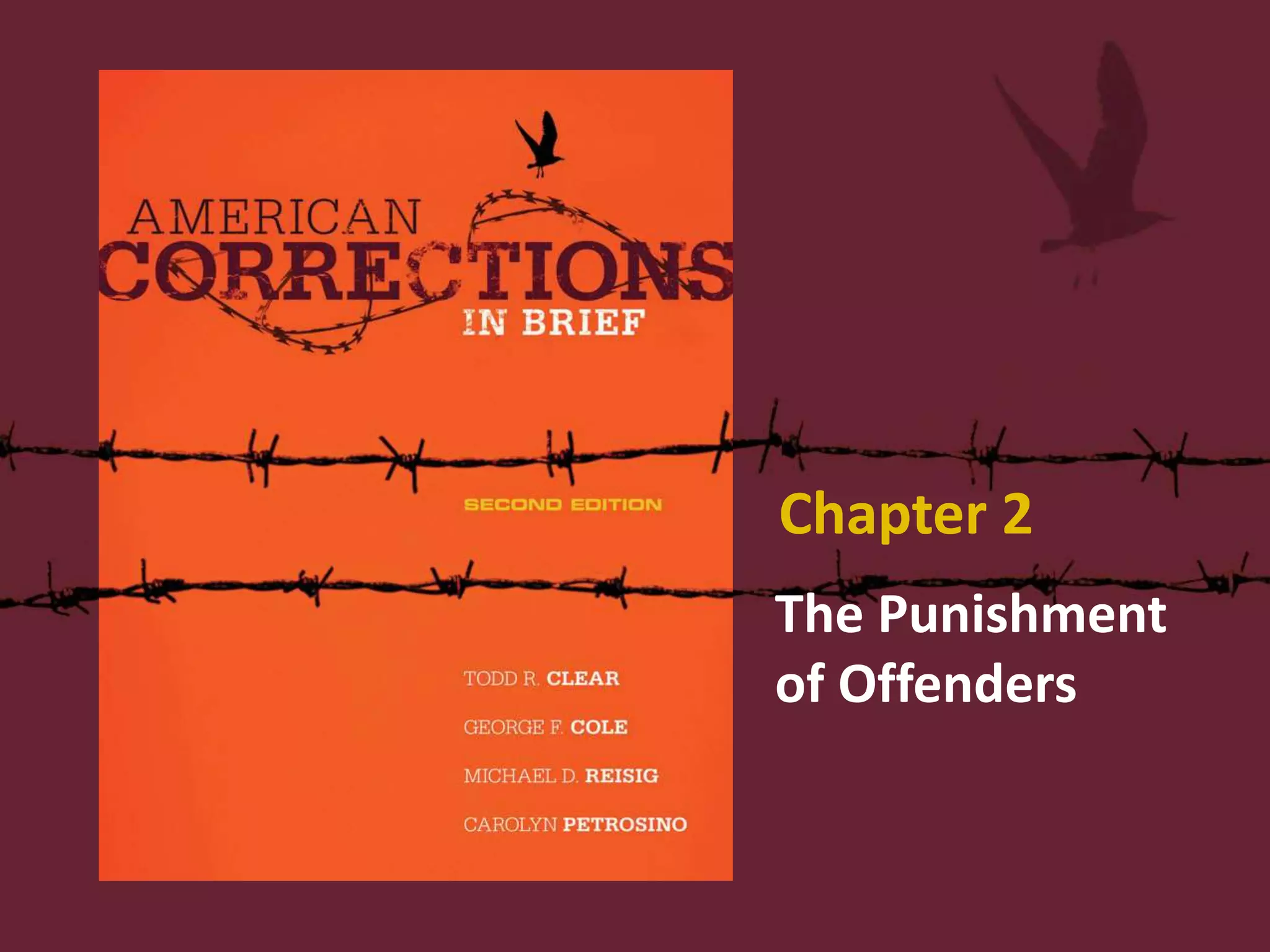
The Punishment
of Offenders
Chapter 2
Punishment from the Middles Ages to
the American Revolution
 Middle Ages to the American Revolution
 Sumerian Law of Mesopotamia
 Code of Hammurabi
 Draconian Code
 Law of the Twelve Tables
 Justinian Code
Lex talionis
Discussion Question
What if... the idea of Lex Talionis was the way of
the land? You kill my wife, I kill your wife!
Would crime decrease? What if every member
of society were given 5 murders, similar to a
frequent murder card…would this decrease
murders knowing that if I murder you, a family
member of yours could easily and legally
murder me?
Punishment from the Middles Ages to
the American Revolution
 The Age of Reason and Correctional Reform
 Enlightenment
 Liberalism, rationality, equality, individualism
dominated social and political thinking
 Punishment
 Correction
Punishment from the Middles Ages to
the American Revolution
 Cesare Beccaria and the Classical School
 Utility
 Rational link between crime and punishment
 Six principles created
Punishment from the Middles Ages
to the American Revolution
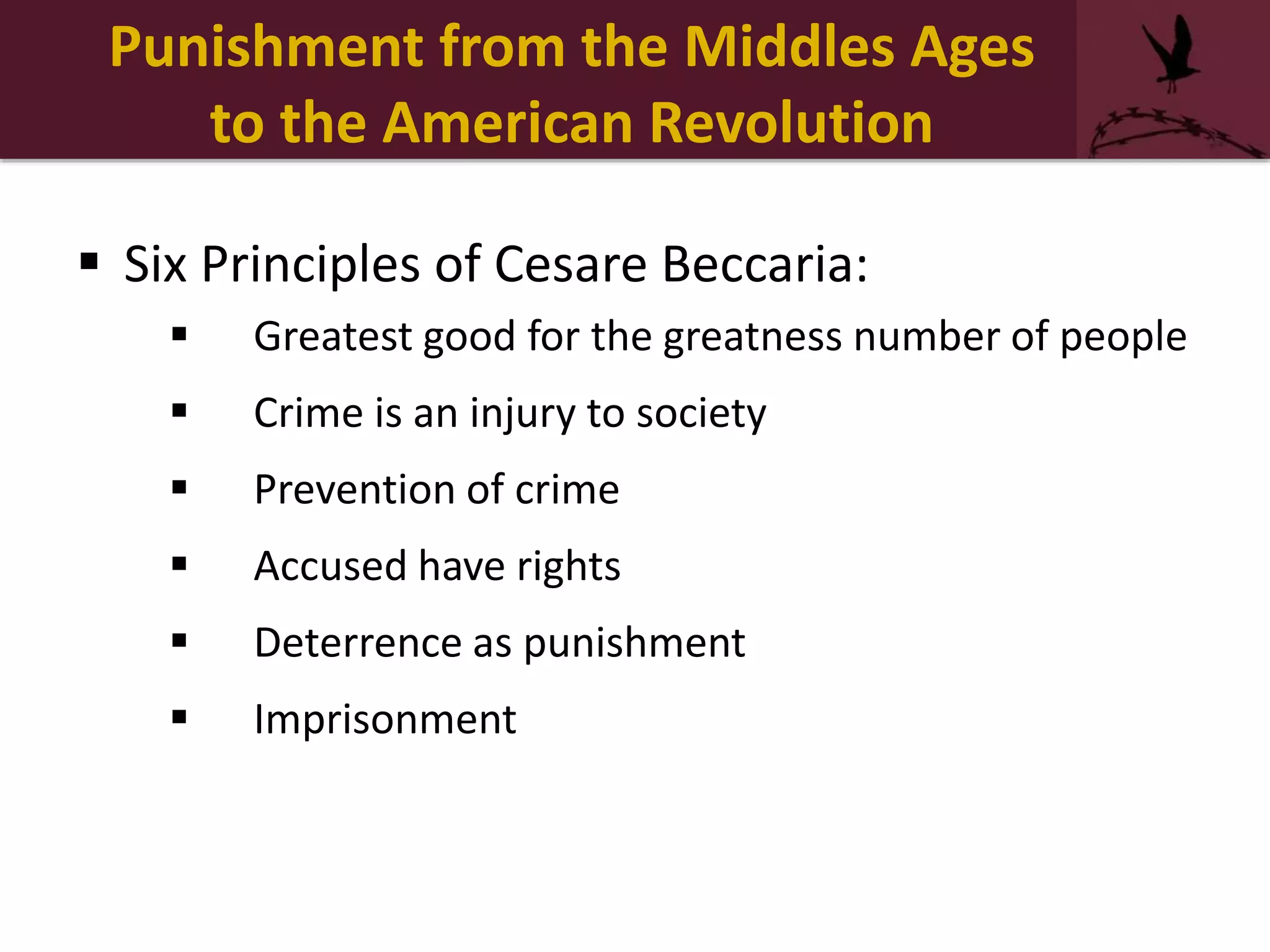
 Six Principles of Cesare Beccaria:
 Greatest good for the greatness number of people
 Crime is an injury to society
 Prevention of crime
 Accused have rights
 Deterrence as punishment
 Imprisonment
Punishment from the Middles Ages to
the American Revolution
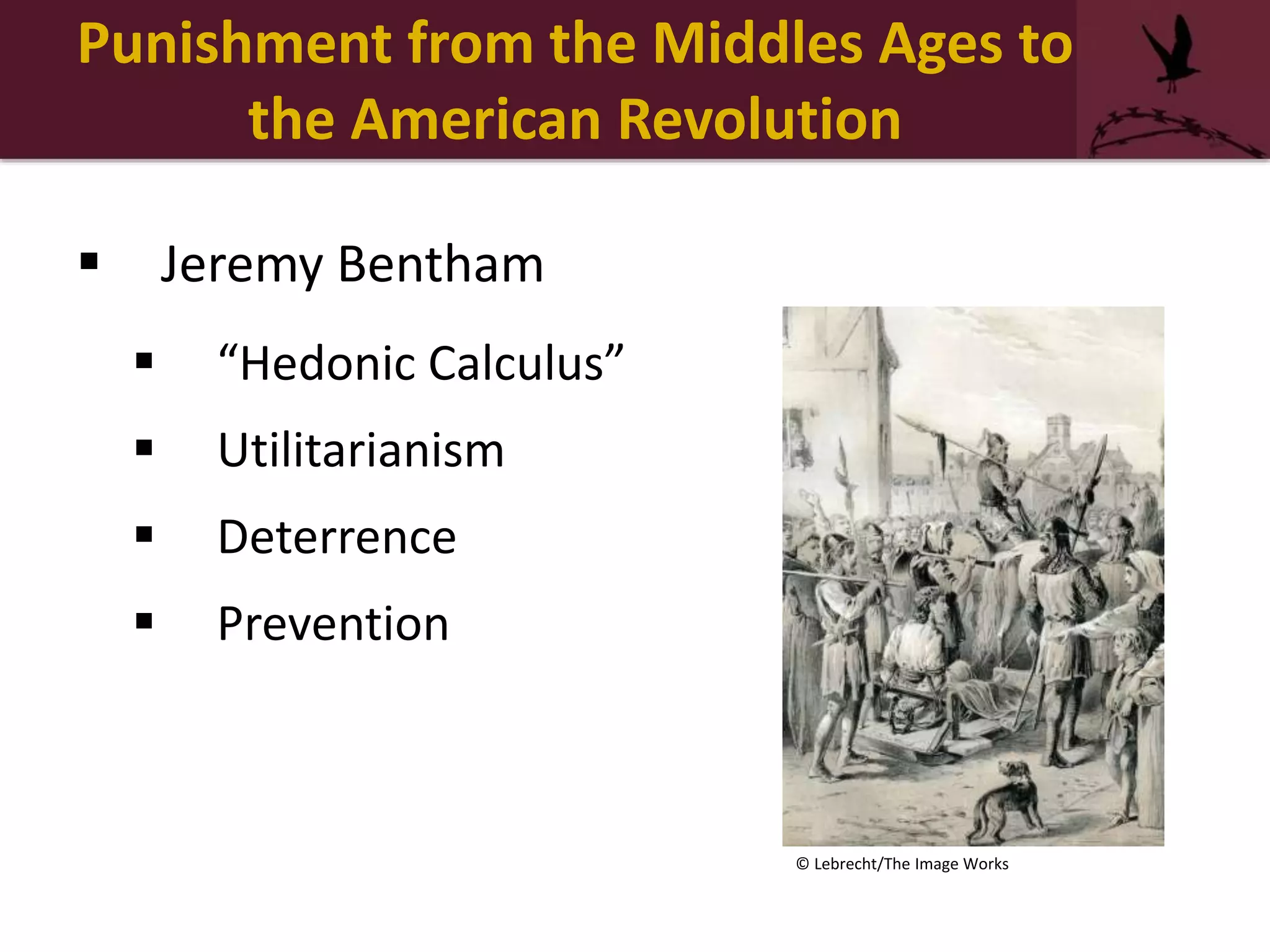
 Jeremy Bentham
 “Hedonic Calculus”
 Utilitarianism
 Deterrence
 Prevention
© Lebrecht/The Image Works
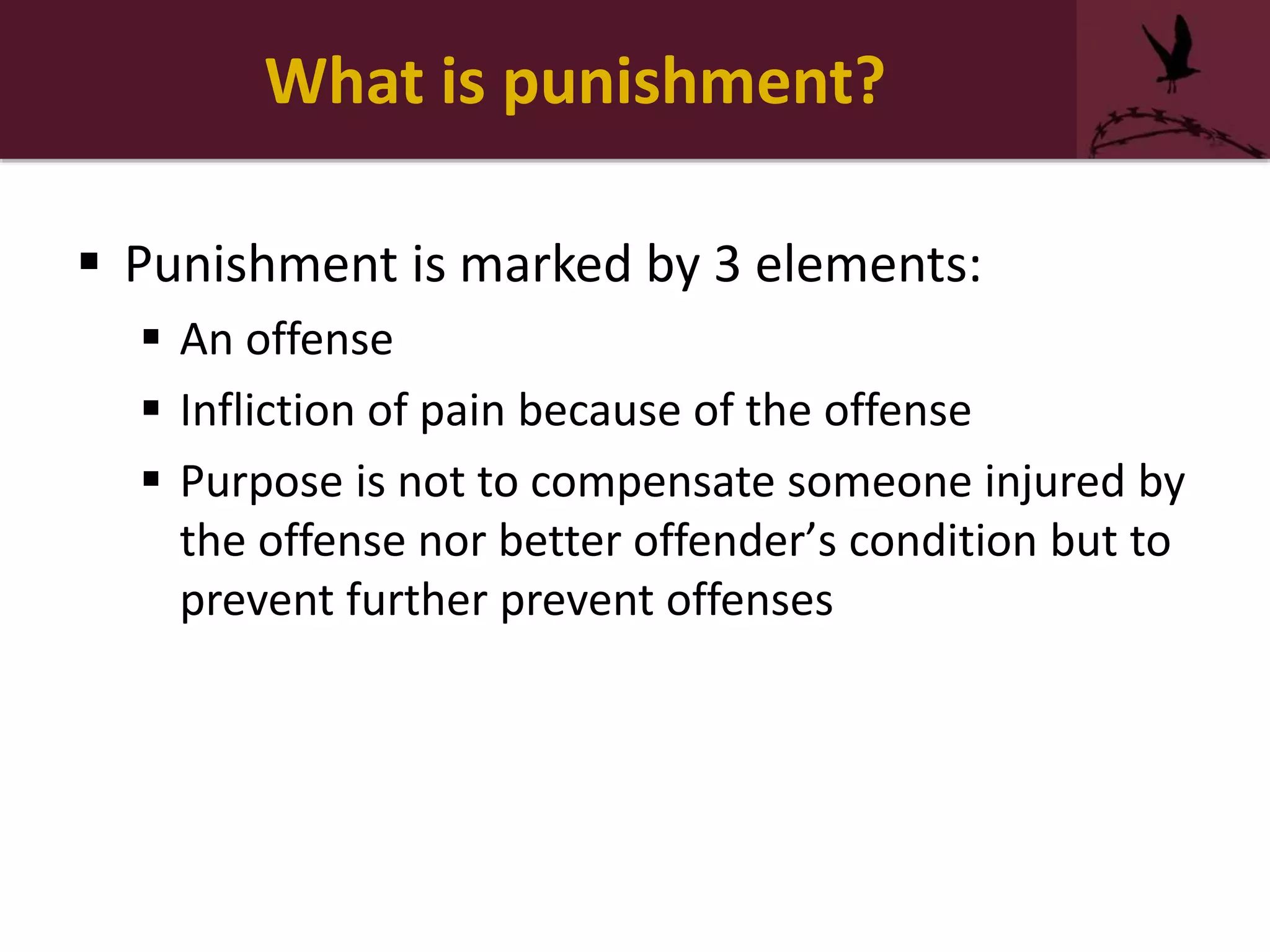
What is punishment?
 Punishment is marked by 3 elements:
 An offense
 Infliction of pain because of the offense
 Purpose is not to compensate someone injured by
the offense nor better offender’s condition but to
prevent further prevent offenses
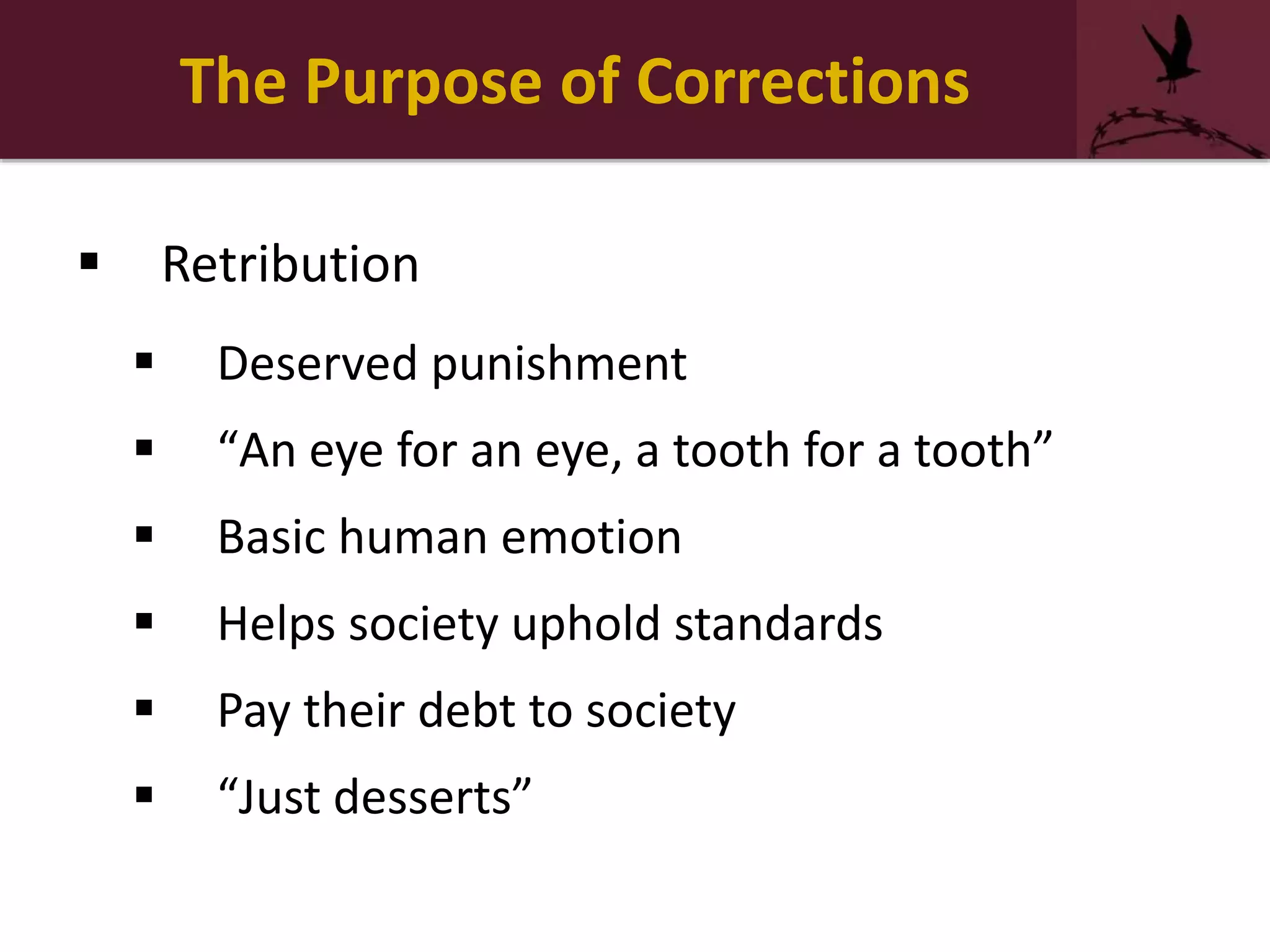
The Purpose of Corrections
 Retribution
 Deserved punishment
 “An eye for an eye, a tooth for a tooth”
 Basic human emotion
 Helps society uphold standards
 Pay their debt to society
 “Just desserts”
The Purpose of Corrections
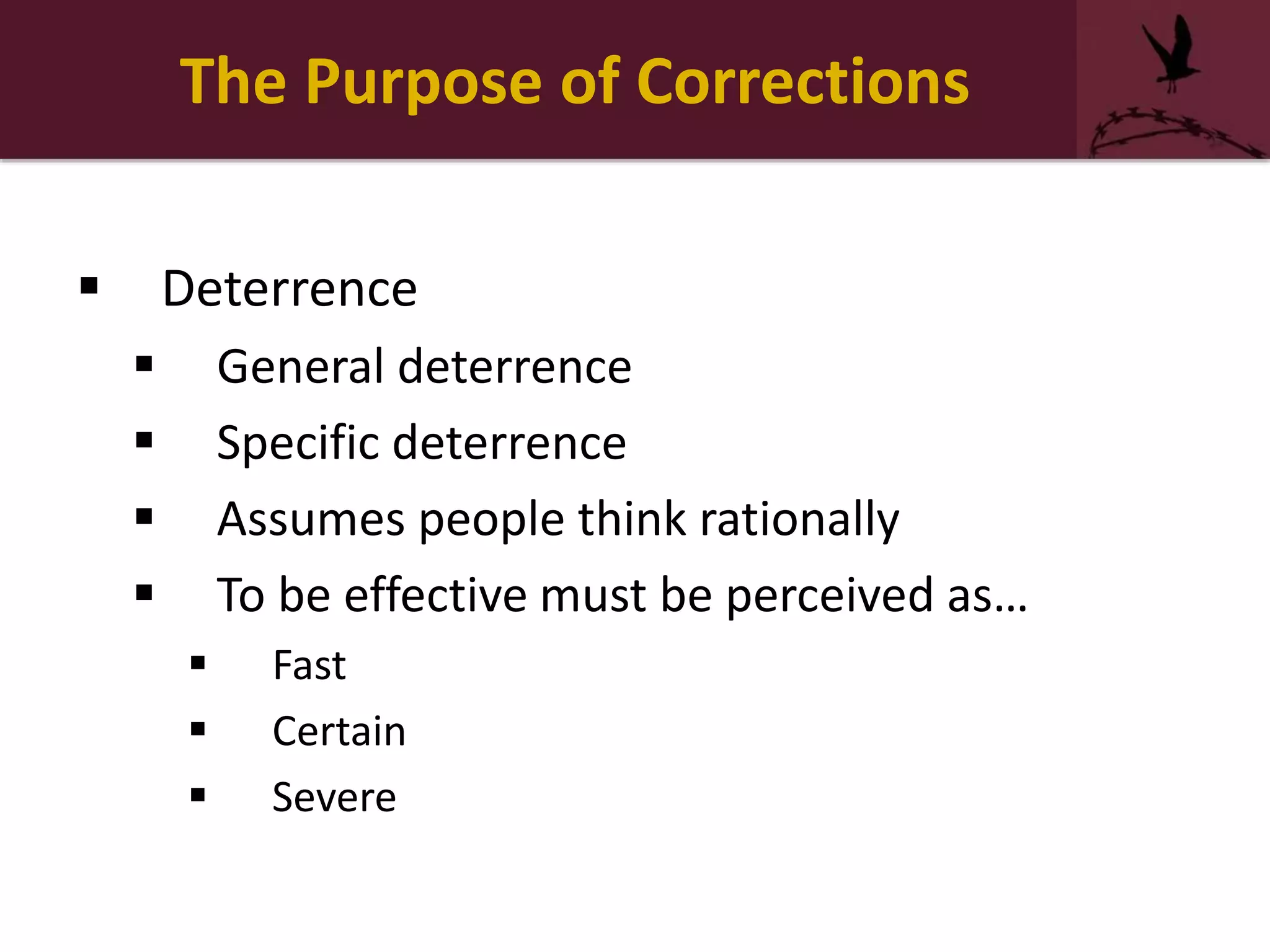
 Deterrence
 General deterrence
 Specific deterrence
 Assumes people think rationally
 To be effective must be perceived as…
 Fast
 Certain
 Severe
The Purpose of Corrections
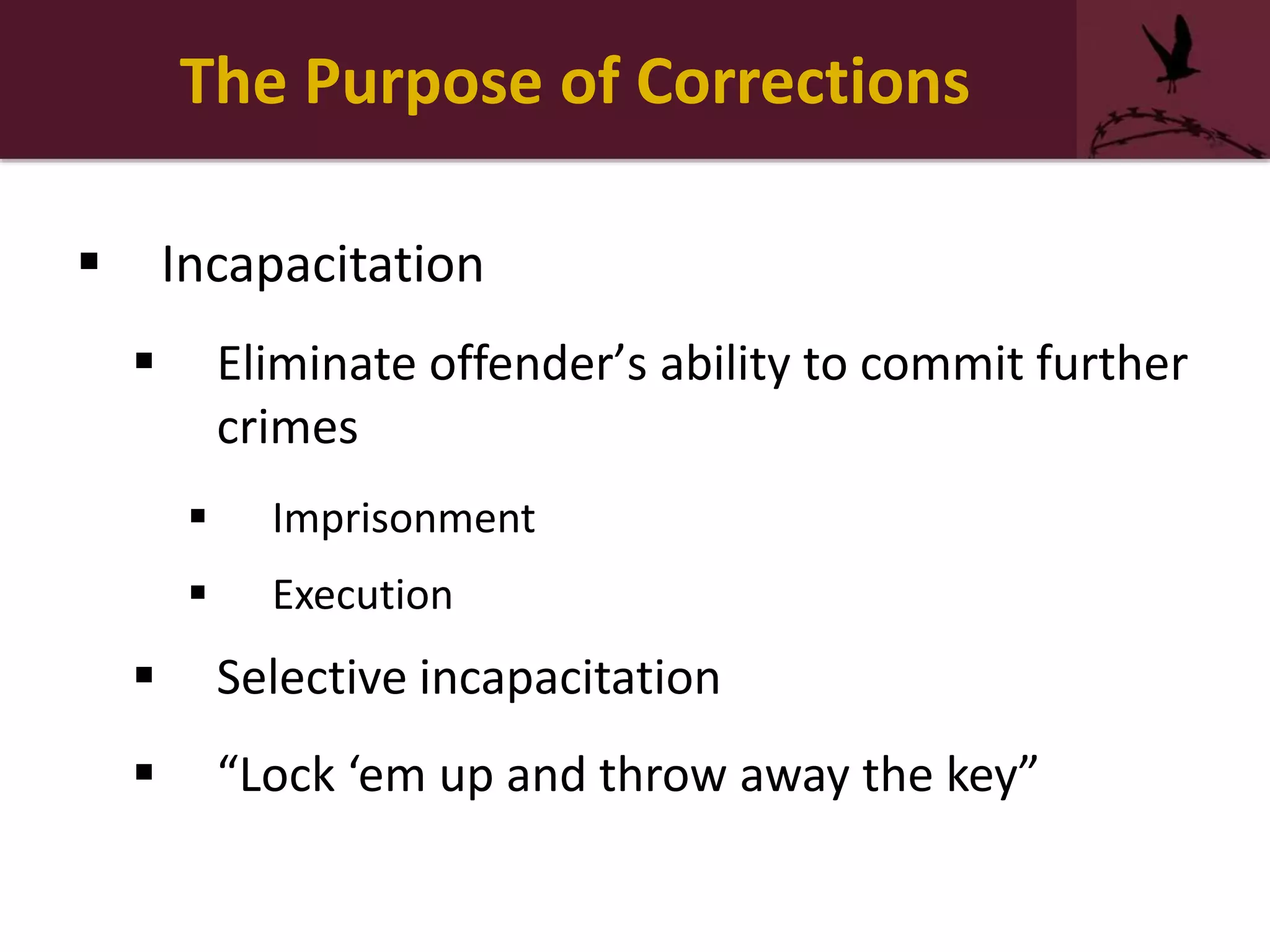
 Incapacitation
 Eliminate offender’s ability to commit further
crimes
 Imprisonment
 Execution
 Selective incapacitation
 “Lock ‘em up and throw away the key”
The Purpose of Corrections
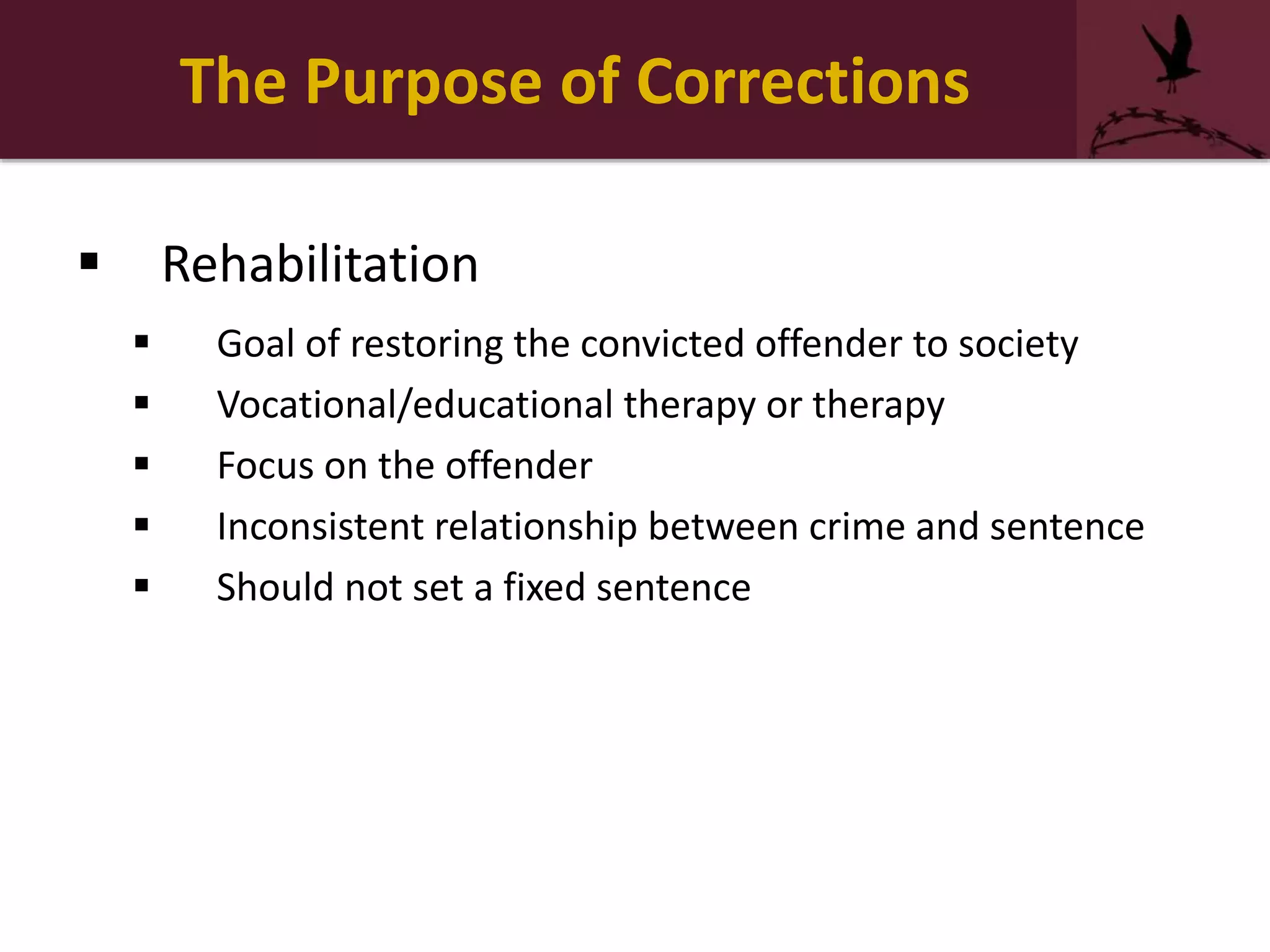
 Rehabilitation
 Goal of restoring the convicted offender to society
 Vocational/educational therapy or therapy
 Focus on the offender
 Inconsistent relationship between crime and sentence
 Should not set a fixed sentence
Discussion Question
Which goal of corrections is most effective?
Why?
The Purpose of Corrections
 New Approaches to Punishment
 Restorative justice
 Offender
 Victim
 Community
 Scientific evidence
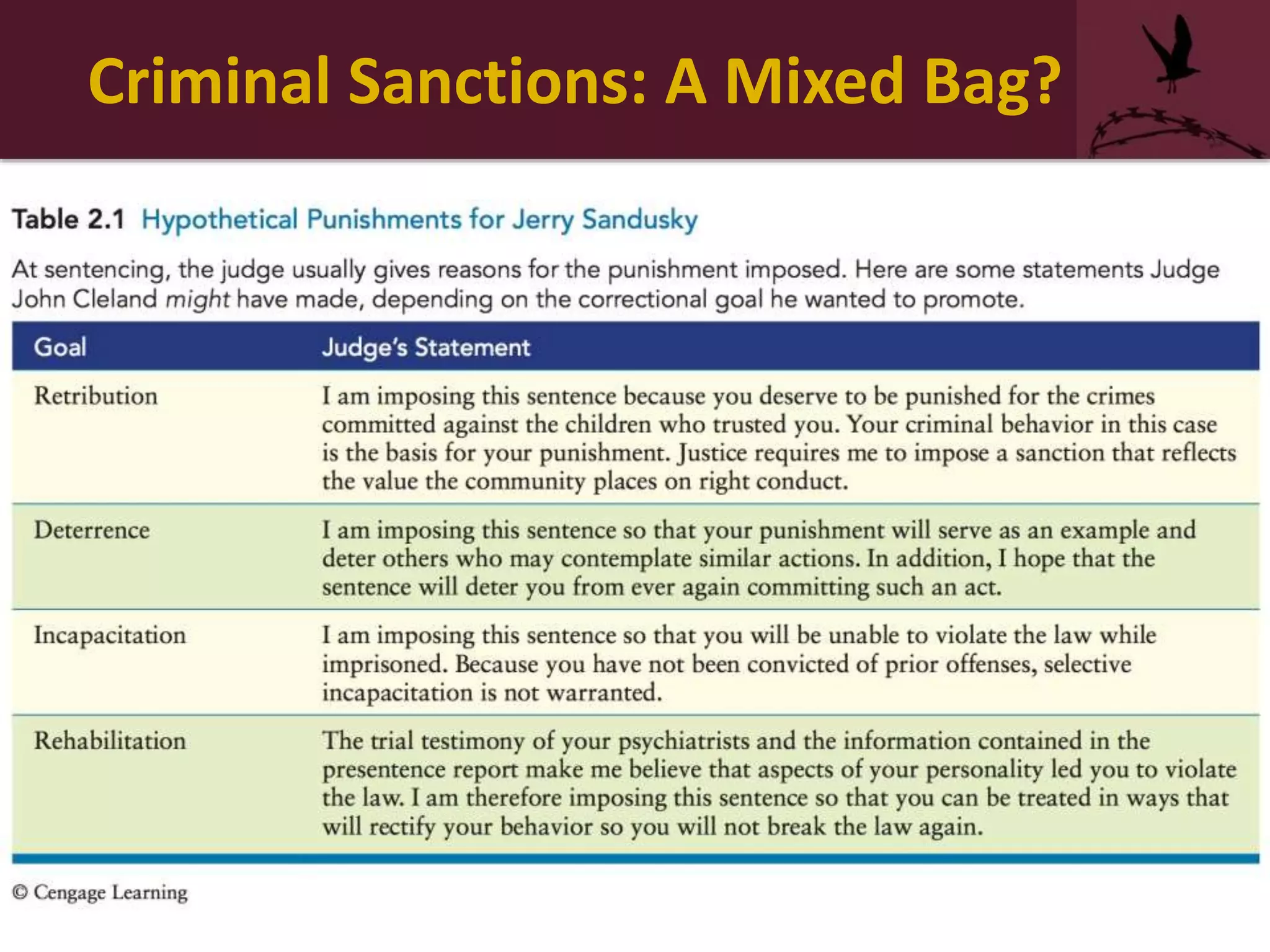
Criminal Sanctions: A Mixed Bag?
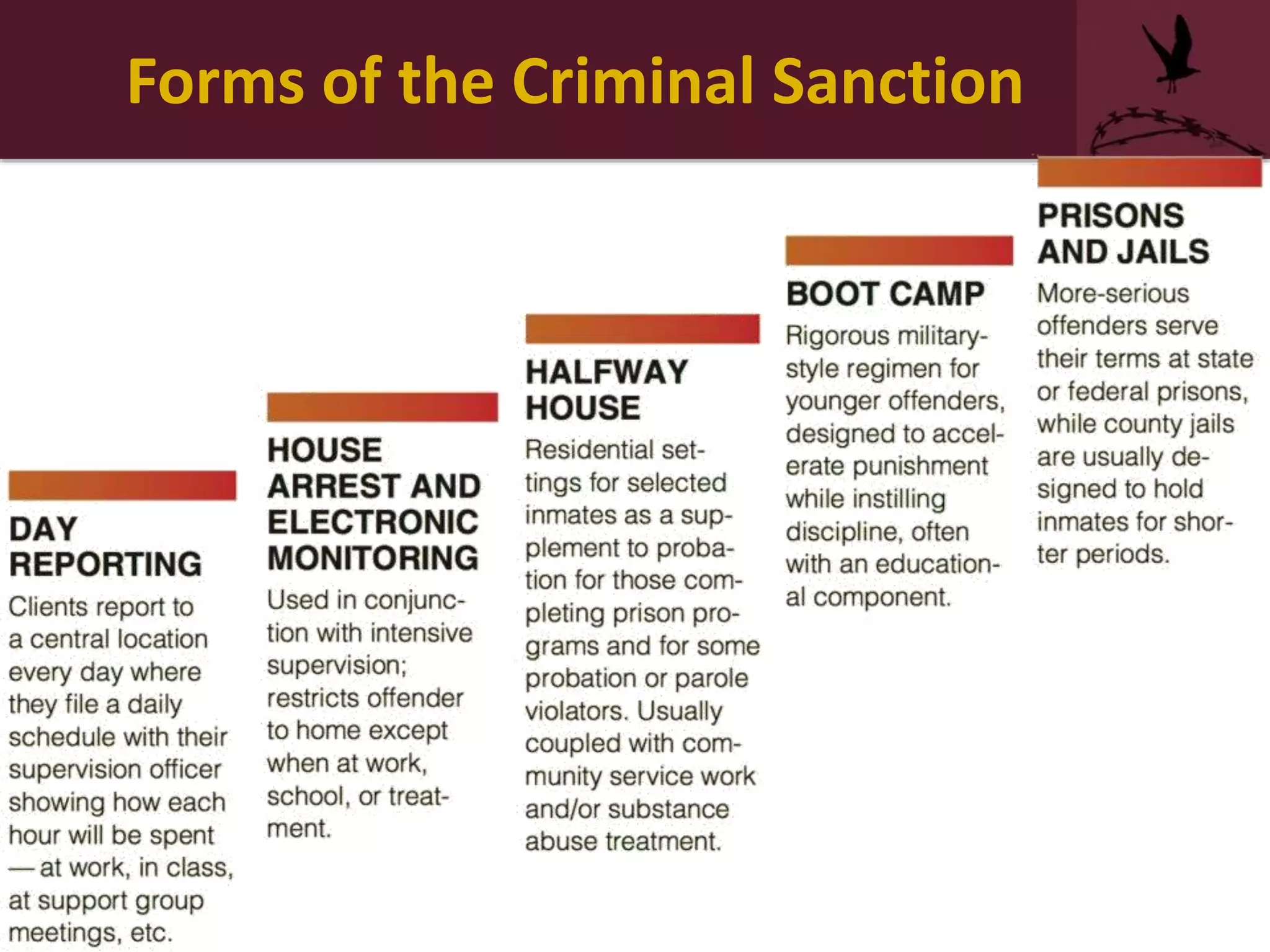
Forms of the Criminal Sanction
 Incarceration– nearly 7 million men and women
in the US currently under correctional supervision
 Indeterminate sentences
 Determinate sentences
 Presumptive sentences
 Mandatory sentences
Discussion Question
What should the sentencing method of choice
be for American corrections? Is one of the
three methods more effective than the
others? What appears to be the method of
choice currently in the United States?
Forms of the Criminal Sanction
 Intermediate Sanctions
 Monetary sanctions
 Fines
 Restitution
 Forfeiture
 Home confinement
 Intensive supervision probation
Forms of the Criminal Sanction
 Probation
 Most frequent criminal sanction in the
United States
 Community supervision
 Drug tests, curfews, job
 Shock probation
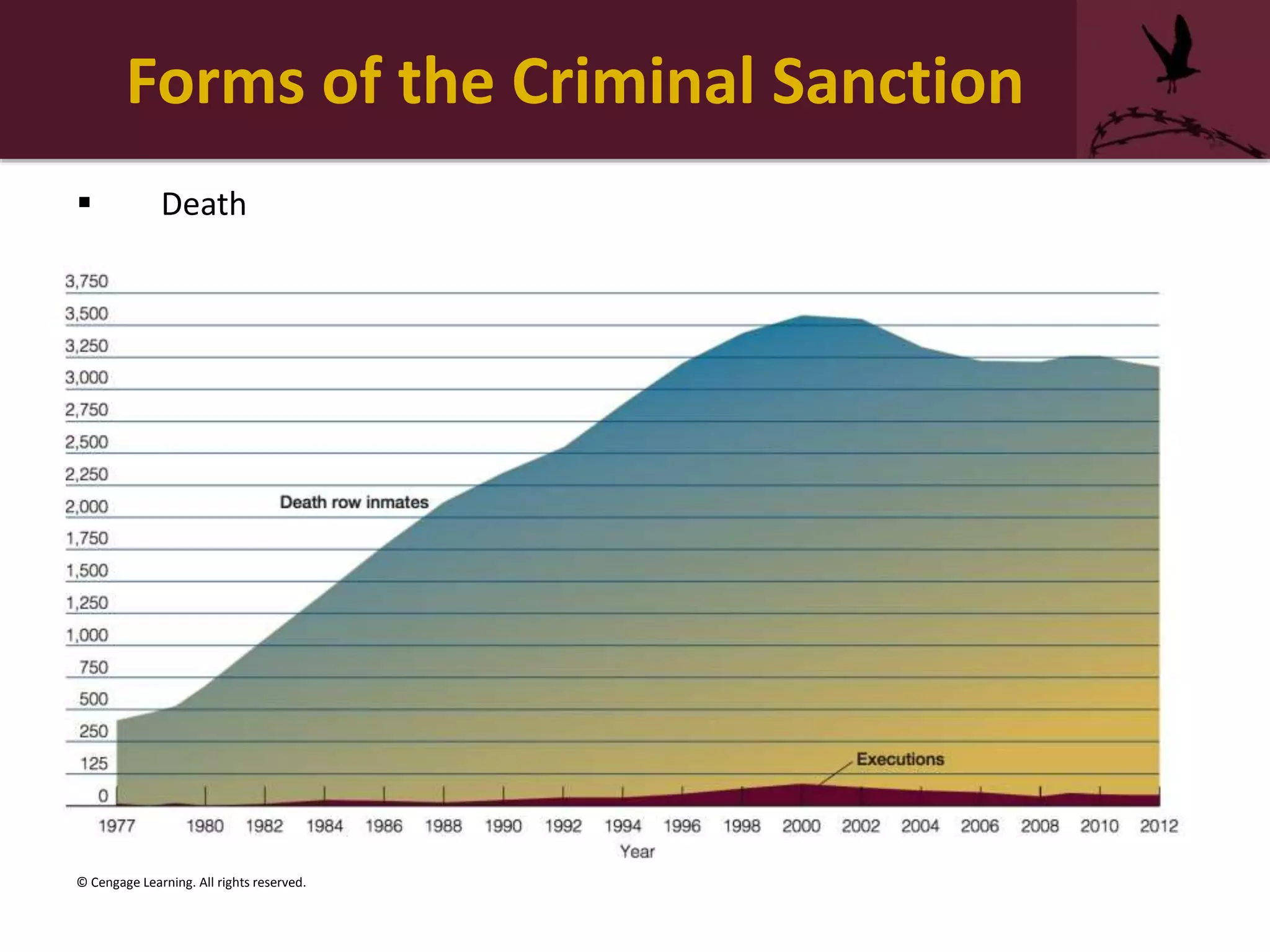
Forms of the Criminal Sanction
 Death
© Cengage Learning. All rights reserved.
Discussion Question
What if the death penalty was repealed and
become unconstitutional throughout the
United States? Do you believe that this would
lead to an increase in violent criminality? Why
or why not?
Forms of the Criminal Sanction
 Forms and Goals of Sanctions
 “Invisible punishments”
 Denying felons the right to vote
 Allowing termination of parental rights
 Establishing felony conviction as grounds for
divorce
 Restricting access to certain occupations
 Barring felons from public welfare programs and
benefits
The Sentencing Process
 Factors influencing Judicial Discretion
 The Attitudes of the Judge
 Blameworthiness, protecting the community,
practical implications of sentence
 Administrative context
 Misdemeanor, felonies
Discussion Question
Discuss the pressures judges face when
sentencing criminals. Do any of these appear
unethical?
The Sentencing Process
 The Presentence Report
 Background
 Criminal record
 Job status
 Mental health
The Sentencing Process
 Sentencing Guidelines
 Federal and state
 Goals
 Reduce disparity in sentencing
 Increase/decrease punishment for certain
offenses/offenders
 Reduce prison overcrowding
 Truth-in-sentencing
 Sentencing process more rational
Unjust Punishment
 Sentencing Disparity
 Different punishments for similar crimes
 Race
 Ethnicity
 Class
 Gender
Unjust Punishment
 Wrongful Conviction
 DNA technology
 Eyewitness testimony
 Unethical conduct
 Community pressure
 False accusations
 Inadequate counsel
 Plea-bargaining pressures

Chapter2

  • 1.
  • 2.
    Punishment from theMiddles Ages to the American Revolution  Middle Ages to the American Revolution  Sumerian Law of Mesopotamia  Code of Hammurabi  Draconian Code  Law of the Twelve Tables  Justinian Code Lex talionis
  • 3.
    Discussion Question What if...the idea of Lex Talionis was the way of the land? You kill my wife, I kill your wife! Would crime decrease? What if every member of society were given 5 murders, similar to a frequent murder card…would this decrease murders knowing that if I murder you, a family member of yours could easily and legally murder me?
  • 4.
    Punishment from theMiddles Ages to the American Revolution  The Age of Reason and Correctional Reform  Enlightenment  Liberalism, rationality, equality, individualism dominated social and political thinking  Punishment  Correction
  • 5.
    Punishment from theMiddles Ages to the American Revolution  Cesare Beccaria and the Classical School  Utility  Rational link between crime and punishment  Six principles created
  • 6.
    Punishment from theMiddles Ages to the American Revolution  Six Principles of Cesare Beccaria:  Greatest good for the greatness number of people  Crime is an injury to society  Prevention of crime  Accused have rights  Deterrence as punishment  Imprisonment
  • 7.
    Punishment from theMiddles Ages to the American Revolution  Jeremy Bentham  “Hedonic Calculus”  Utilitarianism  Deterrence  Prevention © Lebrecht/The Image Works
  • 8.
    What is punishment? Punishment is marked by 3 elements:  An offense  Infliction of pain because of the offense  Purpose is not to compensate someone injured by the offense nor better offender’s condition but to prevent further prevent offenses
  • 9.
    The Purpose ofCorrections  Retribution  Deserved punishment  “An eye for an eye, a tooth for a tooth”  Basic human emotion  Helps society uphold standards  Pay their debt to society  “Just desserts”
  • 10.
    The Purpose ofCorrections  Deterrence  General deterrence  Specific deterrence  Assumes people think rationally  To be effective must be perceived as…  Fast  Certain  Severe
  • 11.
    The Purpose ofCorrections  Incapacitation  Eliminate offender’s ability to commit further crimes  Imprisonment  Execution  Selective incapacitation  “Lock ‘em up and throw away the key”
  • 12.
    The Purpose ofCorrections  Rehabilitation  Goal of restoring the convicted offender to society  Vocational/educational therapy or therapy  Focus on the offender  Inconsistent relationship between crime and sentence  Should not set a fixed sentence
  • 13.
    Discussion Question Which goalof corrections is most effective? Why?
  • 14.
    The Purpose ofCorrections  New Approaches to Punishment  Restorative justice  Offender  Victim  Community  Scientific evidence
  • 15.
  • 16.
    Forms of theCriminal Sanction
  • 17.
    Forms of theCriminal Sanction
  • 18.
    Forms of theCriminal Sanction  Incarceration– nearly 7 million men and women in the US currently under correctional supervision  Indeterminate sentences  Determinate sentences  Presumptive sentences  Mandatory sentences
  • 19.
    Discussion Question What shouldthe sentencing method of choice be for American corrections? Is one of the three methods more effective than the others? What appears to be the method of choice currently in the United States?
  • 20.
    Forms of theCriminal Sanction  Intermediate Sanctions  Monetary sanctions  Fines  Restitution  Forfeiture  Home confinement  Intensive supervision probation
  • 21.
    Forms of theCriminal Sanction  Probation  Most frequent criminal sanction in the United States  Community supervision  Drug tests, curfews, job  Shock probation
  • 22.
    Forms of theCriminal Sanction  Death © Cengage Learning. All rights reserved.
  • 23.
    Discussion Question What ifthe death penalty was repealed and become unconstitutional throughout the United States? Do you believe that this would lead to an increase in violent criminality? Why or why not?
  • 24.
    Forms of theCriminal Sanction  Forms and Goals of Sanctions  “Invisible punishments”  Denying felons the right to vote  Allowing termination of parental rights  Establishing felony conviction as grounds for divorce  Restricting access to certain occupations  Barring felons from public welfare programs and benefits
  • 25.
    The Sentencing Process Factors influencing Judicial Discretion  The Attitudes of the Judge  Blameworthiness, protecting the community, practical implications of sentence  Administrative context  Misdemeanor, felonies
  • 26.
    Discussion Question Discuss thepressures judges face when sentencing criminals. Do any of these appear unethical?
  • 27.
    The Sentencing Process The Presentence Report  Background  Criminal record  Job status  Mental health
  • 28.
    The Sentencing Process Sentencing Guidelines  Federal and state  Goals  Reduce disparity in sentencing  Increase/decrease punishment for certain offenses/offenders  Reduce prison overcrowding  Truth-in-sentencing  Sentencing process more rational
  • 29.
    Unjust Punishment  SentencingDisparity  Different punishments for similar crimes  Race  Ethnicity  Class  Gender
  • 30.
    Unjust Punishment  WrongfulConviction  DNA technology  Eyewitness testimony  Unethical conduct  Community pressure  False accusations  Inadequate counsel  Plea-bargaining pressures

Editor's Notes

  • #17 Source: Seeking Justice: Crime and Punishment in America (New York: Edna McConnell Clark Foundation, 1997), 32–33.
  • #18 Source: Seeking Justice: Crime and Punishment in America (New York: Edna McConnell Clark Foundation, 1997), 32–33.
  • #23 Source: Death Penalty Information Center, www.deathpenaltyinfo.org, January 13, 2013.