

BASIC
Forms Of
BusinessVICTORIACABALLERO
MBA630MANAGERIALECONOMICS
MASTERSINBUSINESSADMINISTRATION
TYPES OF BUSINESS
OWNERSHIP
Sole Proprietorships
Partnerships
Corporations
Entrepreneurs need to understand
the advantages and disadvantages
of various forms of business
ownership so they can choose the
most appropriate form for their
business.
SOLE PROPRIETORSHIP
The easiest and most popular
form of business ownership is
the sole proprietorship.
SOLE PROPRIETORSHIP
A business that is owned and
operated by one person
SOLE PROPRIETORSHIP
The owner of a sole proprietorship:
Receives the profits
Incurs any losses
Is liable for the debts of the
business
SOLE PROPRIETORSHIP
In a sole proprietorship the owner
must decide how much liability
protection he or she needs.
LIABILITY PROTECTION
Insurance against the debts and
actions of a business
SOLE PROPRIETORSHIP
Advantages
Sole proprietorship is easy and inexpensive to create.
The owner has complete authority over all business activities.
It is the least regulated form of business ownership.
The business pays no taxes; income is taxed at
personal rate of owner.
SOLE PROPRIETORSHIP
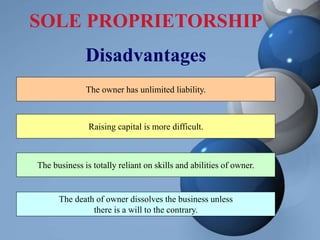
Disadvantages
The owner has unlimited liability.
Raising capital is more difficult.
The business is totally reliant on skills and abilities of owner.
The death of owner dissolves the business unless
there is a will to the contrary.
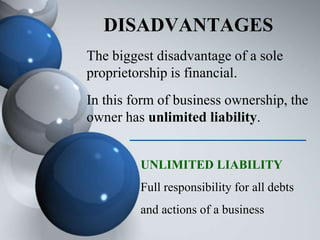
DISADVANTAGES
The biggest disadvantage of a sole
proprietorship is financial.
In this form of business ownership, the
owner has unlimited liability.
UNLIMITED LIABILITY
Full responsibility for all debts
and actions of a business
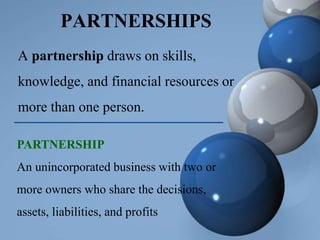
PARTNERSHIPS
A partnership draws on skills,
knowledge, and financial resources or
more than one person.
PARTNERSHIP
An unincorporated business with two or
more owners who share the decisions,
assets, liabilities, and profits
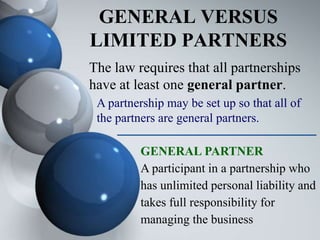
GENERAL VERSUS
LIMITED PARTNERS
The law requires that all partnerships
have at least one general partner.
GENERAL PARTNER
A participant in a partnership who
has unlimited personal liability and
takes full responsibility for
managing the business
A partnership may be set up so that all of
the partners are general partners.
GENERAL VERSUS
LIMITED PARTNERS
Some partnerships include a limited
partner.
LIMITED PARTNER
A partner in a business whose liability is limited
to his or her investment; a limited partner cannot
be actively involved in managing the business.
PARTNERSHIPS
Advantages
Partnerships are inexpensive to create.
General partners have complete control.
Partners can share ideas.
Partners can share ideas and secure investment capital more
easily and in greater amounts.
PARTNERSHIPS
Disadvantages
It is difficult to dissolve one partner’s interest without
dissolving the partnership.
There may be personality conflicts.
Partners can be held liable for each others’ actions.
Sole proprietorship is the easiest and most popular form of
business to create. The owner receives the profits, incurs any
losses, and is liable for the debts of the business.
A partnership is an unincorporated business with two or more
owners. The partners share the decisions, assets, liabilities,
and profits. The partnership can draw on the skills,
knowledge, and financial resources of more than one person,
which is an advantage when seeking loans.
In a corporation, the owners of the
business are protected from liability
for the actions of the company.
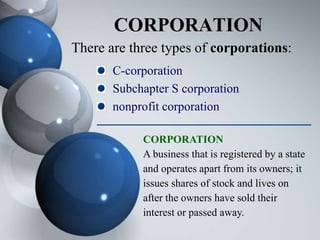
CORPORATION
There are three types of corporations:
CORPORATION
A business that is registered by a state
and operates apart from its owners; it
issues shares of stock and lives on
after the owners have sold their
interest or passed away.
C-corporation
Subchapter S corporation
nonprofit corporation
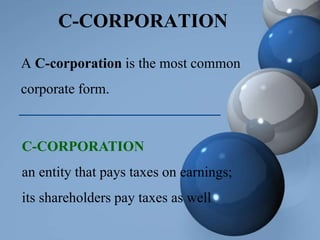
C-CORPORATION
A C-corporation is the most common
corporate form.
C-CORPORATION
an entity that pays taxes on earnings;
its shareholders pay taxes as well
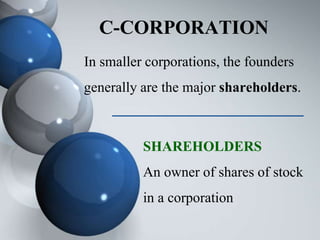
C-CORPORATION
In smaller corporations, the founders
generally are the major shareholders.
SHAREHOLDERS
An owner of shares of stock
in a corporation
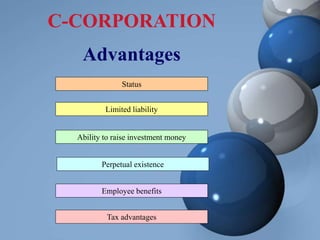
C-CORPORATION
Advantages
Status
Limited liability
Ability to raise investment money
Perpetual existence
Employee benefits
Tax advantages
ADVANTAGES
Corporate shareholders have limited
liability, but some banks require
officers to personally guarantee the
debts of the company.
LIMITED LIABILITY
Partial responsibility of a
corporate shareholder; he or she
is responsible only up to the
amount of the individual
investment.
C-CORPORATION
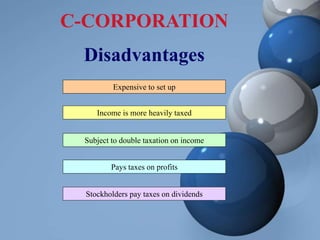
Disadvantages
Expensive to set up
Income is more heavily taxed
Subject to double taxation on income
Pays taxes on profits
Stockholders pay taxes on dividends
SUBCHAPTER S
CORPORATION
An entrepreneur can avoid the double
taxation of a C-corporation by setting
up a Subchapter S corporation.
SUBCHAPTER S
CORPORATION
A corporation that is taxed like a
partnership; profits are taxed
only once at the shareholder’s
personal tax rate.
NONPROFIT CORPORATION
A nonprofit corporation must fall within
one of four categories:
NONPROFIT CORPORATION
A legal entity that makes money for reasons other
than the owner’s profit; it can make a profit, but
the profit must remain within the company
religion
charity
public benefit
mutual benefit
MAKING THE DECISION
Before deciding on a legal form, ask
yourself key questions about:
Your skills
Capital
Expenses
Willingness to assume liability
Level of control wanted
Length of time you expect to
own the business
A corporation offers limited liability. In other words,
shareholders are liable only up to the amount of their
individual investments.
ADVANTAGES:
A corporation has a more professional appearance, its shareholders are liable
only up to the amount of their individual investment, it can raise money by
issuing shares of stock, it has perpetual existence, it is structured to
accommodate employee benefits, and it has tax advantages.
DISADVANTAGES:
A corporation is expensive to set up and its income is more heavily taxed.
The Subchapter S corporation is taxed like a
partnership; profits are taxed only once at the
shareholder’s personal tax rate. Therefore, the
Subchapter S corporation is not a tax-paying entity.
Nonprofit corporations can make a profit, but the profit must
remain within the companies and not be distributed to
shareholders. Any type of business can be a corporation, but a
nonprofit must be formed for religious or for charitable
purposes, public benefit, or religious purposes. C-corporations
are created to make a profit for its owners, or shareholders.
The limited liability company protects owners with the limited
liability of a corporation. That is, the company’s owners are
not liable for its debts. It also provides pass-through tax
advantages; shareholders are taxed only once. There are no
limitations on the number of members or on their status.
You should consider your skills, capital, living expenses,
willingness to assume personal liability for any claims against
the business, control desired. Also, ask yourself: do you expect
to have initial losses, or will the business be profitable from the
beginning? Do you expect to sell the business some day?
THANK YOU

Basic Forms of Business_Managerial Economics

  • 1.
  • 2.
    TYPES OF BUSINESS OWNERSHIP SoleProprietorships Partnerships Corporations
  • 3.
    Entrepreneurs need tounderstand the advantages and disadvantages of various forms of business ownership so they can choose the most appropriate form for their business.
  • 4.
    SOLE PROPRIETORSHIP The easiestand most popular form of business ownership is the sole proprietorship. SOLE PROPRIETORSHIP A business that is owned and operated by one person
  • 5.
    SOLE PROPRIETORSHIP The ownerof a sole proprietorship: Receives the profits Incurs any losses Is liable for the debts of the business
  • 6.
    SOLE PROPRIETORSHIP In asole proprietorship the owner must decide how much liability protection he or she needs. LIABILITY PROTECTION Insurance against the debts and actions of a business
  • 7.
    SOLE PROPRIETORSHIP Advantages Sole proprietorshipis easy and inexpensive to create. The owner has complete authority over all business activities. It is the least regulated form of business ownership. The business pays no taxes; income is taxed at personal rate of owner.
  • 8.
    SOLE PROPRIETORSHIP Disadvantages The ownerhas unlimited liability. Raising capital is more difficult. The business is totally reliant on skills and abilities of owner. The death of owner dissolves the business unless there is a will to the contrary.
  • 9.
    DISADVANTAGES The biggest disadvantageof a sole proprietorship is financial. In this form of business ownership, the owner has unlimited liability. UNLIMITED LIABILITY Full responsibility for all debts and actions of a business
  • 10.
    PARTNERSHIPS A partnership drawson skills, knowledge, and financial resources or more than one person. PARTNERSHIP An unincorporated business with two or more owners who share the decisions, assets, liabilities, and profits
  • 11.
    GENERAL VERSUS LIMITED PARTNERS Thelaw requires that all partnerships have at least one general partner. GENERAL PARTNER A participant in a partnership who has unlimited personal liability and takes full responsibility for managing the business A partnership may be set up so that all of the partners are general partners.
  • 12.
    GENERAL VERSUS LIMITED PARTNERS Somepartnerships include a limited partner. LIMITED PARTNER A partner in a business whose liability is limited to his or her investment; a limited partner cannot be actively involved in managing the business.
  • 13.
    PARTNERSHIPS Advantages Partnerships are inexpensiveto create. General partners have complete control. Partners can share ideas. Partners can share ideas and secure investment capital more easily and in greater amounts.
  • 14.
    PARTNERSHIPS Disadvantages It is difficultto dissolve one partner’s interest without dissolving the partnership. There may be personality conflicts. Partners can be held liable for each others’ actions.
  • 15.
    Sole proprietorship isthe easiest and most popular form of business to create. The owner receives the profits, incurs any losses, and is liable for the debts of the business. A partnership is an unincorporated business with two or more owners. The partners share the decisions, assets, liabilities, and profits. The partnership can draw on the skills, knowledge, and financial resources of more than one person, which is an advantage when seeking loans.
  • 16.
    In a corporation,the owners of the business are protected from liability for the actions of the company.
  • 17.
    CORPORATION There are threetypes of corporations: CORPORATION A business that is registered by a state and operates apart from its owners; it issues shares of stock and lives on after the owners have sold their interest or passed away. C-corporation Subchapter S corporation nonprofit corporation
  • 18.
    C-CORPORATION A C-corporation isthe most common corporate form. C-CORPORATION an entity that pays taxes on earnings; its shareholders pay taxes as well
  • 19.
    C-CORPORATION In smaller corporations,the founders generally are the major shareholders. SHAREHOLDERS An owner of shares of stock in a corporation
  • 20.
    C-CORPORATION Advantages Status Limited liability Ability toraise investment money Perpetual existence Employee benefits Tax advantages
  • 21.
    ADVANTAGES Corporate shareholders havelimited liability, but some banks require officers to personally guarantee the debts of the company. LIMITED LIABILITY Partial responsibility of a corporate shareholder; he or she is responsible only up to the amount of the individual investment.
  • 22.
    C-CORPORATION Disadvantages Expensive to setup Income is more heavily taxed Subject to double taxation on income Pays taxes on profits Stockholders pay taxes on dividends
  • 23.
    SUBCHAPTER S CORPORATION An entrepreneurcan avoid the double taxation of a C-corporation by setting up a Subchapter S corporation. SUBCHAPTER S CORPORATION A corporation that is taxed like a partnership; profits are taxed only once at the shareholder’s personal tax rate.
  • 24.
    NONPROFIT CORPORATION A nonprofitcorporation must fall within one of four categories: NONPROFIT CORPORATION A legal entity that makes money for reasons other than the owner’s profit; it can make a profit, but the profit must remain within the company religion charity public benefit mutual benefit
  • 25.
    MAKING THE DECISION Beforedeciding on a legal form, ask yourself key questions about: Your skills Capital Expenses Willingness to assume liability Level of control wanted Length of time you expect to own the business
  • 26.
    A corporation offerslimited liability. In other words, shareholders are liable only up to the amount of their individual investments. ADVANTAGES: A corporation has a more professional appearance, its shareholders are liable only up to the amount of their individual investment, it can raise money by issuing shares of stock, it has perpetual existence, it is structured to accommodate employee benefits, and it has tax advantages. DISADVANTAGES: A corporation is expensive to set up and its income is more heavily taxed.
  • 27.
    The Subchapter Scorporation is taxed like a partnership; profits are taxed only once at the shareholder’s personal tax rate. Therefore, the Subchapter S corporation is not a tax-paying entity. Nonprofit corporations can make a profit, but the profit must remain within the companies and not be distributed to shareholders. Any type of business can be a corporation, but a nonprofit must be formed for religious or for charitable purposes, public benefit, or religious purposes. C-corporations are created to make a profit for its owners, or shareholders.
  • 28.
    The limited liabilitycompany protects owners with the limited liability of a corporation. That is, the company’s owners are not liable for its debts. It also provides pass-through tax advantages; shareholders are taxed only once. There are no limitations on the number of members or on their status. You should consider your skills, capital, living expenses, willingness to assume personal liability for any claims against the business, control desired. Also, ask yourself: do you expect to have initial losses, or will the business be profitable from the beginning? Do you expect to sell the business some day?
  • 29.