Corporate Social Responsibility A Plus Point To Prosper Presented By: Tagya Sharma K38B1 B35
INTRODUCTION “ CSR is about how companies manage the business processes to produce an overall positive impact on society.” "Corporate Social Responsibility is the continuing commitment by business to behave ethically and contribute to economic development while improving the quality of life of the workforce and their families as well as of the local community and society at large"
Corporate social responsibility (CSR): An obligation, beyond that required by the law and economics, for a firm to pursue long term goals that are good for society . The continuing commitment by business to behave ethically and contribute to economic development while improving the quality of life of the workforce and their families as well as that of the local community and society at large. About how a company manages its business process to produce an overall positive impact on society.
Meaning of CSR Conducting business in an ethical way and in the interests of the wider community Responding positively to emerging societal priorities and expectations A willingness to act ahead of regulatory confrontation Balancing shareholder interests against the interests of the wider community Being a good citizen in the community
Contd… Millen Baker: “ A  way  companies manage the business processes to produce  an overall positive impact on society.” World Business Council for Sustainable Development:   “ Corporate Social Responsibility is the continuing commitment by business to behave ethically and contribute to economic development while improving the quality of life of the workforce and their families as well as of the local community and society at large”.
Concept of CSR CSR(corporate social responsibility) is a concept in which organizations consider the interests of society by taking responsibility for the impact of their activities on customers, suppliers, employees, shareholders, communities other stakeholders, future generation and on environment. The organizations voluntarily taking advance steps to improve the quality of life for employees and their families as well as for the local community and society.
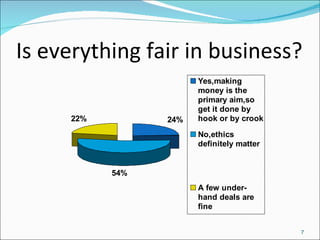
Is everything fair in business?
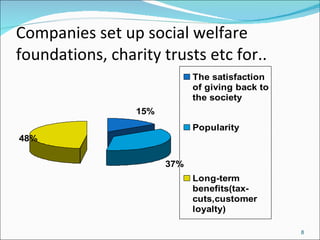
Companies set up social welfare foundations, charity trusts etc for..
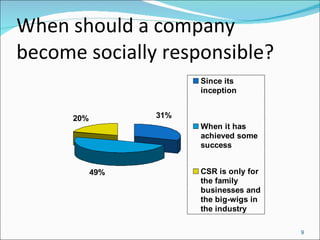
When should a company become socially responsible?
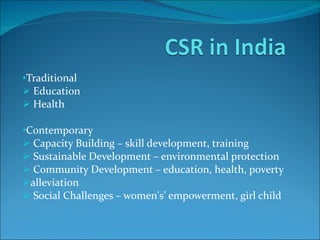
Traditional Education Health Contemporary Capacity Building – skill development, training Sustainable Development – environmental protection Community Development – education, health, poverty alleviation Social Challenges – women's’ empowerment, girl child
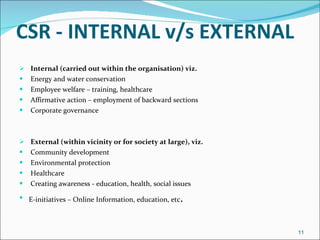
CSR - INTERNAL v/s EXTERNAL Internal (carried out within the organisation) viz. Energy and water conservation Employee welfare – training, healthcare Affirmative action – employment of backward sections Corporate governance External (within vicinity or for society at large), viz. Community development Environmental protection Healthcare Creating awareness - education, health, social issues E-initiatives – Online Information, education, etc .
For example, after 1945, TATA implemented social welfare provisions for its employees that have since become the legislative norm. From the perspectives of customers, CRS activities may include commitment to product quality, fair pricing policies, and so. TVS Electronics was involved in CSR during the Tsunami to provide relief measures to the victims. They have also participated with the government to improve sanitation in a village called Tiruvidenthai. Such initiatives will help in improving the conditions of rural people.
The Dell story… For years, the dirty little secret of the computer industry—left unaddressed even by the most environmentally advanced companies—has been the lack of accountability for the safe recycling of computer equipment. The issue is a significant one. Personal computers contain lead, mercury, cadmium, and bromine that should not end up in landfills or incinerators, and that can threaten the health of recycling workers if handled improperly.
Dell contd.. Dell has launched recently—including a low-cost consumer home pickup and recycling service, a computer recycling grant program to local communities, and a computer collection pilot program in its hometown of Austin, Tex. For 2005, Dell has announced an aggressive aim of a 50 percent increase in global product recovery, making it the first company to publicly release a computer recycling goal.
ITC  The company places computers with Internet access in rural farming villages; the e-Choupals serve as both a social gathering place for exchange of information  and an e-commerce hub.  ITC's businesses generate livelihoods for over 5 million people.     ITC's globally recognised e-Choupal initiative is  the world's largest rural digital infrastructure benefiting over 4 million farming families.     ITC's Social and Farm Forestry initiative has greened over 80,000 hectares creating an estimated 35 million person days of employment among the disadvantaged.    ITC's Watershed Development  Initiative brings precious water to nearly 35,000 hectares of drylands and moisture-stressed areas.    ITC's Sustainable Community Development initiatives include women empowerment, supplementary education, integrated animal husbandry programmes.
  CSR: In a developed country   • Governance • Business ethics • Human rights and •  Environment
  CSR in a Developing Country( India):  Fields where CSR is working Focus on nation building Socio-economic development Rural development Employment Education Community support
The purpose of CSR The purpose of Corporate Social Responsibility (CSR) is to make corporate business activity and corporate culture become sustainable in its three dimensions: economic, social and environmental.
Benefits  CSR behaviour can benefit the firm in several Ways: It aids the attraction and retention of staff It attracts green and ethical investment It attracts ethically conscious customers It can lead to a reduction in costs through re-cycling It differentiates the firm from its competitor and can be a source of competitive advantage It can lead to increased profitability in the long run
Thank you Any Queries ???

Corporate social responsibility

  • 1.
    Corporate Social ResponsibilityA Plus Point To Prosper Presented By: Tagya Sharma K38B1 B35
  • 2.
    INTRODUCTION “ CSRis about how companies manage the business processes to produce an overall positive impact on society.” "Corporate Social Responsibility is the continuing commitment by business to behave ethically and contribute to economic development while improving the quality of life of the workforce and their families as well as of the local community and society at large"
  • 3.
    Corporate social responsibility(CSR): An obligation, beyond that required by the law and economics, for a firm to pursue long term goals that are good for society . The continuing commitment by business to behave ethically and contribute to economic development while improving the quality of life of the workforce and their families as well as that of the local community and society at large. About how a company manages its business process to produce an overall positive impact on society.
  • 4.
    Meaning of CSRConducting business in an ethical way and in the interests of the wider community Responding positively to emerging societal priorities and expectations A willingness to act ahead of regulatory confrontation Balancing shareholder interests against the interests of the wider community Being a good citizen in the community
  • 5.
    Contd… Millen Baker:“ A way companies manage the business processes to produce an overall positive impact on society.” World Business Council for Sustainable Development: “ Corporate Social Responsibility is the continuing commitment by business to behave ethically and contribute to economic development while improving the quality of life of the workforce and their families as well as of the local community and society at large”.
  • 6.
    Concept of CSRCSR(corporate social responsibility) is a concept in which organizations consider the interests of society by taking responsibility for the impact of their activities on customers, suppliers, employees, shareholders, communities other stakeholders, future generation and on environment. The organizations voluntarily taking advance steps to improve the quality of life for employees and their families as well as for the local community and society.
  • 7.
    Is everything fairin business?
  • 8.
    Companies set upsocial welfare foundations, charity trusts etc for..
  • 9.
    When should acompany become socially responsible?
  • 10.
    Traditional Education HealthContemporary Capacity Building – skill development, training Sustainable Development – environmental protection Community Development – education, health, poverty alleviation Social Challenges – women's’ empowerment, girl child
  • 11.
    CSR - INTERNALv/s EXTERNAL Internal (carried out within the organisation) viz. Energy and water conservation Employee welfare – training, healthcare Affirmative action – employment of backward sections Corporate governance External (within vicinity or for society at large), viz. Community development Environmental protection Healthcare Creating awareness - education, health, social issues E-initiatives – Online Information, education, etc .
  • 12.
    For example, after1945, TATA implemented social welfare provisions for its employees that have since become the legislative norm. From the perspectives of customers, CRS activities may include commitment to product quality, fair pricing policies, and so. TVS Electronics was involved in CSR during the Tsunami to provide relief measures to the victims. They have also participated with the government to improve sanitation in a village called Tiruvidenthai. Such initiatives will help in improving the conditions of rural people.
  • 13.
    The Dell story…For years, the dirty little secret of the computer industry—left unaddressed even by the most environmentally advanced companies—has been the lack of accountability for the safe recycling of computer equipment. The issue is a significant one. Personal computers contain lead, mercury, cadmium, and bromine that should not end up in landfills or incinerators, and that can threaten the health of recycling workers if handled improperly.
  • 14.
    Dell contd.. Dellhas launched recently—including a low-cost consumer home pickup and recycling service, a computer recycling grant program to local communities, and a computer collection pilot program in its hometown of Austin, Tex. For 2005, Dell has announced an aggressive aim of a 50 percent increase in global product recovery, making it the first company to publicly release a computer recycling goal.
  • 15.
    ITC Thecompany places computers with Internet access in rural farming villages; the e-Choupals serve as both a social gathering place for exchange of information and an e-commerce hub. ITC's businesses generate livelihoods for over 5 million people.   ITC's globally recognised e-Choupal initiative is  the world's largest rural digital infrastructure benefiting over 4 million farming families.   ITC's Social and Farm Forestry initiative has greened over 80,000 hectares creating an estimated 35 million person days of employment among the disadvantaged.   ITC's Watershed Development  Initiative brings precious water to nearly 35,000 hectares of drylands and moisture-stressed areas.   ITC's Sustainable Community Development initiatives include women empowerment, supplementary education, integrated animal husbandry programmes.
  • 16.
    CSR:In a developed country • Governance • Business ethics • Human rights and • Environment
  • 17.
    CSRin a Developing Country( India): Fields where CSR is working Focus on nation building Socio-economic development Rural development Employment Education Community support
  • 18.
    The purpose ofCSR The purpose of Corporate Social Responsibility (CSR) is to make corporate business activity and corporate culture become sustainable in its three dimensions: economic, social and environmental.
  • 19.
    Benefits CSRbehaviour can benefit the firm in several Ways: It aids the attraction and retention of staff It attracts green and ethical investment It attracts ethically conscious customers It can lead to a reduction in costs through re-cycling It differentiates the firm from its competitor and can be a source of competitive advantage It can lead to increased profitability in the long run
  • 20.
    Thank you AnyQueries ???