A presentation on
Corporate Social Responsibility

School of Management Studies
Presented By:
Amit Kumar
Durgesh Kumar
Anil Kumar
Ujjwal Mishra

[2012MB72]
[2012MB88]
[2012MB06]
[2012MB01]
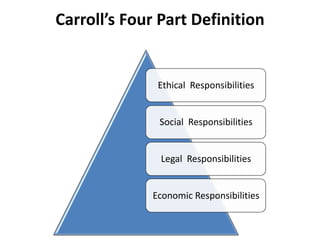
Carroll’s Four Part Definition

Ethical Responsibilities

Social Responsibilities

Legal Responsibilities

Economic Responsibilities
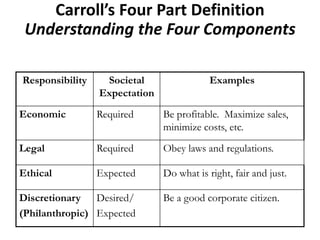
Carroll’s Four Part Definition
Understanding the Four Components
Responsibility

Societal
Expectation

Examples

Economic

Required

Be profitable. Maximize sales,
minimize costs, etc.

Legal

Required

Obey laws and regulations.

Ethical

Expected

Do what is right, fair and just.

Discretionary Desired/
(Philanthropic) Expected

Be a good corporate citizen.
Draft Rules under the Companies
Act; CSR








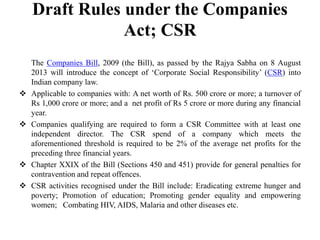
The Companies Bill, 2009 (the Bill), as passed by the Rajya Sabha on 8 August
2013 will introduce the concept of „Corporate Social Responsibility‟ (CSR) into
Indian company law.
Applicable to companies with: A net worth of Rs. 500 crore or more; a turnover of
Rs 1,000 crore or more; and a net profit of Rs 5 crore or more during any financial
year.
Companies qualifying are required to form a CSR Committee with at least one
independent director. The CSR spend of a company which meets the
aforementioned threshold is required to be 2% of the average net profits for the
preceding three financial years.
Chapter XXIX of the Bill (Sections 450 and 451) provide for general penalties for
contravention and repeat offences.
CSR activities recognised under the Bill include: Eradicating extreme hunger and
poverty; Promotion of education; Promoting gender equality and empowering
women; Combating HIV, AIDS, Malaria and other diseases etc.
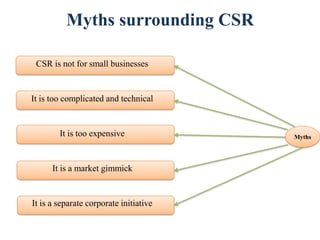
Myths surrounding CSR
CSR is not for small businesses

It is too complicated and technical

It is too expensive

It is a market gimmick

It is a separate corporate initiative

Myths
The Benefits of Corporate Social
Responsibility
“88% of consumers said they were more likely to
buy from a company that supports and engages
in activities to improve society.”
`
- Better Business Journey, UK
Small Business Consortium
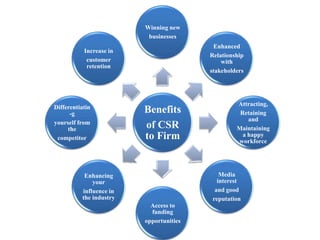
Winning new
businesses

Enhanced
Relationship
with
stakeholders

Increase in
customer
retention

Differentiatin
-g
yourself from
the
competitor

Benefits
of CSR
to Firm

Attracting,
Retaining
and
Maintaining
a happy
workforce

Media
interest
and good
reputation

Enhancing
your
influence in
the industry
Access to
funding
opportunities
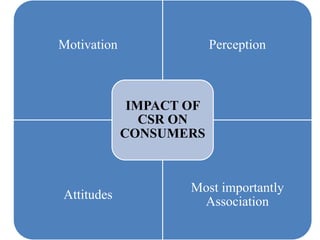
Motivation

Perception

IMPACT OF
CSR ON
CONSUMERS

Attitudes

Most importantly
Association
CSR in India
• The pressure on Indian industrialists to demonstrate their
commitment to social development increased during the
independence movement, when Mahatma Gandhi developed the
notion of „trusteeship‟, whereby the owners of property would
voluntarily manage their wealth on behalf of the people.
• TATA was one of the first corporate houses to initiate.
•

A review of contemporary CSR trends in India concluded that
although the corporate sector in India benefited immensely from
liberalization and privatization processes, its transition from
philanthropic mindsets to CSR has been lagging behind its
impressive financial growth
Examples
•

Hindustan Unilever‟s, Lifebuoy SWASTHYA CHETNA – health and hygiene
education program. Educate people about health related precautions to 200 million
in rural and urban areas.

•

Tata Tea‟s communication and positioning itself as a catalyst for social awakening
through JAAGO RE campaign.

•

Colgate Palmolive – SPREADING SMILES AT PRATHAM(NGO) , In association
with IDA organize free dental checkup camps , Supported free surgery of children
and young adults suffering from cleft lips.
Cont...
•

Marico Industries brand Saffola positioned itself as an edible oil brand that cares for
heart. On World Heart Day they ORGANISE FREE HEART CARE CAMPS.

•

ITC – every 4 notebook that is bought, rs 1 goes for EDUCATION OF UNDER
PRIVILEDGED CHILDREN Concept of E- Choupal .

•

Idea Cellular Ltd. – Had done a campaign on the eve of one year of 26/11 terror
attacks in Mumbai , talk between 20:26 – 21:26hrs and monies earned , a part of it
will go to the INFRASTRUCTURE DEVELOPMENT OF MUMBAI POLICE.
Similarly had done undertaken education of underprivileged children

•

Canon India launched I-CARE in 2008 with Venu Eye Institute and Research centre
to provide eye care and rehabilitation of visually challenged.

•

Proctor & Gamble initiated SHIKSHA for underprivileged children with the motto“Padhega India Badhega India , Mile sabko Shiksha ka Haq” A campaign had run
in April-June09 that r.s 1 from every product that is being bought will go for
education of downtrodden.
Environmental Benefits
• Greater material recyclability
• Better product durability and functionality
• Greater use of renewable resources
• Integration of environmental management tools into business
plans,
including
life-cycle
assessment
and
costing, environmental management standards, and ecolabeling.
Benefits to the Community and
the General Public
• Charitable contributions
•

Employee volunteer programs

• Corporate involvement in community education, employment
and homelessness programs
• Product safety and quality
Challenges
• Non-availability of Clear CSR Guidelines
• Lack of Consensus on Implementing CSR Issues
• Visibility Factor
• Narrow Perception towards CSR Initiatives
References
• (Source: A review of Corporate Social Responsibility in India Bimal
Arora , Ravi Puarnik.1999)
• (Source:Economic times, 14/12/2007)
• www.csr-asia.com/upload/hkpresentation
• vi.unctad.org/russiast09/docs/millercsr
• www.trikal.org/ictbm11/pdf/csr/d1142-done.pdf

Corporate social responsibility

  • 1.
    A presentation on CorporateSocial Responsibility School of Management Studies Presented By: Amit Kumar Durgesh Kumar Anil Kumar Ujjwal Mishra [2012MB72] [2012MB88] [2012MB06] [2012MB01]
  • 2.
    Carroll’s Four PartDefinition Ethical Responsibilities Social Responsibilities Legal Responsibilities Economic Responsibilities
  • 3.
    Carroll’s Four PartDefinition Understanding the Four Components Responsibility Societal Expectation Examples Economic Required Be profitable. Maximize sales, minimize costs, etc. Legal Required Obey laws and regulations. Ethical Expected Do what is right, fair and just. Discretionary Desired/ (Philanthropic) Expected Be a good corporate citizen.
  • 4.
    Draft Rules underthe Companies Act; CSR     The Companies Bill, 2009 (the Bill), as passed by the Rajya Sabha on 8 August 2013 will introduce the concept of „Corporate Social Responsibility‟ (CSR) into Indian company law. Applicable to companies with: A net worth of Rs. 500 crore or more; a turnover of Rs 1,000 crore or more; and a net profit of Rs 5 crore or more during any financial year. Companies qualifying are required to form a CSR Committee with at least one independent director. The CSR spend of a company which meets the aforementioned threshold is required to be 2% of the average net profits for the preceding three financial years. Chapter XXIX of the Bill (Sections 450 and 451) provide for general penalties for contravention and repeat offences. CSR activities recognised under the Bill include: Eradicating extreme hunger and poverty; Promotion of education; Promoting gender equality and empowering women; Combating HIV, AIDS, Malaria and other diseases etc.
  • 5.
    Myths surrounding CSR CSRis not for small businesses It is too complicated and technical It is too expensive It is a market gimmick It is a separate corporate initiative Myths
  • 6.
    The Benefits ofCorporate Social Responsibility “88% of consumers said they were more likely to buy from a company that supports and engages in activities to improve society.” ` - Better Business Journey, UK Small Business Consortium
  • 7.
    Winning new businesses Enhanced Relationship with stakeholders Increase in customer retention Differentiatin -g yourselffrom the competitor Benefits of CSR to Firm Attracting, Retaining and Maintaining a happy workforce Media interest and good reputation Enhancing your influence in the industry Access to funding opportunities
  • 8.
  • 9.
    CSR in India •The pressure on Indian industrialists to demonstrate their commitment to social development increased during the independence movement, when Mahatma Gandhi developed the notion of „trusteeship‟, whereby the owners of property would voluntarily manage their wealth on behalf of the people. • TATA was one of the first corporate houses to initiate. • A review of contemporary CSR trends in India concluded that although the corporate sector in India benefited immensely from liberalization and privatization processes, its transition from philanthropic mindsets to CSR has been lagging behind its impressive financial growth
  • 10.
    Examples • Hindustan Unilever‟s, LifebuoySWASTHYA CHETNA – health and hygiene education program. Educate people about health related precautions to 200 million in rural and urban areas. • Tata Tea‟s communication and positioning itself as a catalyst for social awakening through JAAGO RE campaign. • Colgate Palmolive – SPREADING SMILES AT PRATHAM(NGO) , In association with IDA organize free dental checkup camps , Supported free surgery of children and young adults suffering from cleft lips.
  • 11.
    Cont... • Marico Industries brandSaffola positioned itself as an edible oil brand that cares for heart. On World Heart Day they ORGANISE FREE HEART CARE CAMPS. • ITC – every 4 notebook that is bought, rs 1 goes for EDUCATION OF UNDER PRIVILEDGED CHILDREN Concept of E- Choupal . • Idea Cellular Ltd. – Had done a campaign on the eve of one year of 26/11 terror attacks in Mumbai , talk between 20:26 – 21:26hrs and monies earned , a part of it will go to the INFRASTRUCTURE DEVELOPMENT OF MUMBAI POLICE. Similarly had done undertaken education of underprivileged children • Canon India launched I-CARE in 2008 with Venu Eye Institute and Research centre to provide eye care and rehabilitation of visually challenged. • Proctor & Gamble initiated SHIKSHA for underprivileged children with the motto“Padhega India Badhega India , Mile sabko Shiksha ka Haq” A campaign had run in April-June09 that r.s 1 from every product that is being bought will go for education of downtrodden.
  • 12.
    Environmental Benefits • Greatermaterial recyclability • Better product durability and functionality • Greater use of renewable resources • Integration of environmental management tools into business plans, including life-cycle assessment and costing, environmental management standards, and ecolabeling.
  • 13.
    Benefits to theCommunity and the General Public • Charitable contributions • Employee volunteer programs • Corporate involvement in community education, employment and homelessness programs • Product safety and quality
  • 14.
    Challenges • Non-availability ofClear CSR Guidelines • Lack of Consensus on Implementing CSR Issues • Visibility Factor • Narrow Perception towards CSR Initiatives
  • 15.
    References • (Source: Areview of Corporate Social Responsibility in India Bimal Arora , Ravi Puarnik.1999) • (Source:Economic times, 14/12/2007) • www.csr-asia.com/upload/hkpresentation • vi.unctad.org/russiast09/docs/millercsr • www.trikal.org/ictbm11/pdf/csr/d1142-done.pdf