
6

Corporate-Level Strategy:
Creating Value through Diversification

 McGraw-Hill/Irwin
 Strategic Management: Text and Cases, 4e   Copyright © 2008 The McGraw-Hill Companies, Inc. All rights reserved.
Making Diversification Work


   What businesses should a
   corporation compete in?

   How should these businesses be
   managed to jointly create more value
   than if they were freestanding units?
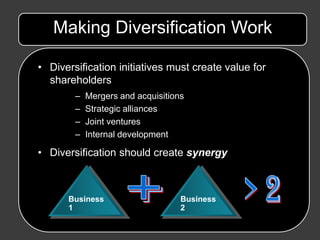
Making Diversification Work

• Diversification initiatives must create value for
  shareholders
        –   Mergers and acquisitions
        –   Strategic alliances
        –   Joint ventures
        –   Internal development

• Diversification should create synergy


      Business                     Business
      1                            2
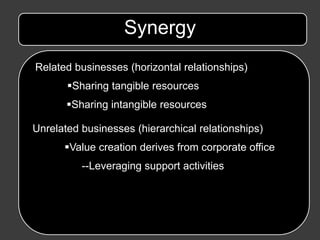
Synergy
Related businesses (horizontal relationships)
       Sharing tangible resources
       Sharing intangible resources

Unrelated businesses (hierarchical relationships)
      Value creation derives from corporate office
          --Leveraging support activities
Creating Value

Related Diversification: Economies of Scope
   Leveraging core competencies
   Sharing activities

Related Diversification: Market Power
    Pooled negotiating power
    Vertical integration
Creating Value

Unrelated Diversification
     Corporate Parenting
     Corporate Restructuring
     Portfolio Management
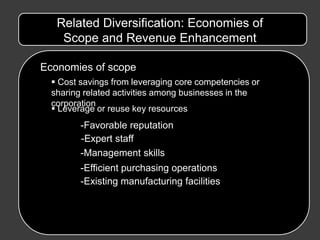
Related Diversification: Economies of
    Scope and Revenue Enhancement

Economies of scope
   Cost savings from leveraging core competencies or
  sharing related activities among businesses in the
  corporation
   Leverage or reuse key resources
         -Favorable reputation
         -Expert staff
         -Management skills
         -Efficient purchasing operations
         -Existing manufacturing facilities
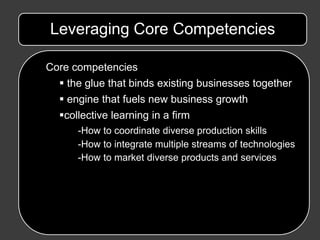
Leveraging Core Competencies

Core competencies
   the glue that binds existing businesses together
   engine that fuels new business growth
  collective learning in a firm
      -How to coordinate diverse production skills
      -How to integrate multiple streams of technologies
      -How to market diverse products and services
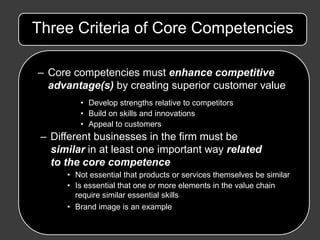
Three Criteria of Core Competencies

– Core competencies must enhance competitive
  advantage(s) by creating superior customer value
         • Develop strengths relative to competitors
         • Build on skills and innovations
         • Appeal to customers
 – Different businesses in the firm must be
   similar in at least one important way related
   to the core competence
      • Not essential that products or services themselves be similar
      • Is essential that one or more elements in the value chain
        require similar essential skills
      • Brand image is an example
Three Criteria of Core Competencies

  – Core competencies must be difficult for
    competitors to imitate or find substitutes
    for• Easily imitated or replicated core competencies are not a
          sound basis for sustainable advantages
       • Specialized technical skills acquired only in company
         work experience are an example
Question

 The concept of core competencies can be illustrated
by the imagery of the diversified corporation as a
tree. Describe what the different parts of a tree
would represent in a corporation.
Sharing Activities

• Corporations can also achieve synergy by sharing
  tangible and value-creating activities across their
  business units
     – Common manufacturing facilities
     – Distribution channels
      – Sales forces
• Sharing activities provide two payoffs
      – Cost savings
      – Revenue enhancements
Related Diversification: Market Power


Pooled negotiating power
  Similar businesses working together can have
   stronger bargaining position relative to
           – Suppliers
           – Customers
           – Competitors

 Abuse of bargaining power may affect relationships
  with customers, suppliers and competitors
Related Diversification: Market Power

Vertical integration
 Occurs when a firm becomes its own supplier or
  distributor


   Backward integration—a firm produces its own
   inputs.
   Forward integration—a firm operates its own
   distribution system for delivering its outputs.
Corporate Parenting & Restructuring

 Corporate Parenting
    – Parenting —creating value within business units
        • Experience of the corporate office
        • Support of the corporate office

 Corporate Restructuring
   – Find poorly performing firms
        • With unrealized potential
        • On threshold of significant positive change
Corporate Restructuring (Cont.)

Corporate management must
     – Have insight to detect undervalued companies or
       businesses with high potential for transformation
     – Have requisite skills and resources to turn the
       businesses around
Restructuring can involve changes in
      – Assets
      – Capital structure
      – Management
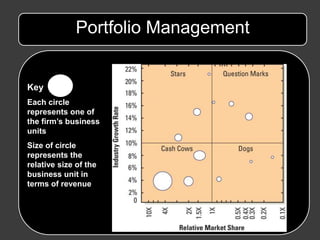
Portfolio Management


Key
Each circle
represents one of
the firm’s business
units
Size of circle
represents the
relative size of the
business unit in
terms of revenue
Portfolio Management

• Creation of synergies and shareholder value by
  portfolio management and the corporate office
    – Allocate resources (cash cows to stars and some
       question marks)
     – Expertise of corporate office in locating attractive
       firms to acquire
     – Provide financial resources to business units on
       favorable terms reflecting the corporation’s overall
       ability to raise funds
     – Provide high quality review and coaching for units
     – Provide a basis for developing strategic goals
       and reward/evaluation systems
Portfolio Management Downsides

• They are overly simplistic
• They view each business as separate

• The process may become overly largely mechanical

• The reliance on rules for resource allocation can be
  detrimental to a firm’s long-term viability

• The imagery while colorful may lead to troublesome
  and overly simplistic prescriptions
Means to Achieve Diversification

      Acquisitions or mergers
      Joint venture
      Strategic alliance
      Internal development
              – New products
              – New markets
              – New technology
Mergers and Acquisitions

• Acquisitions
  -- one firm buys another either through a stock
     purchase, cash, or the issuance of debt

• Mergers
 -- entail a combination or consolidation of two firms
    to form a new legal entity
Mergers and Acquisitions Downsides

• The takeover premium that is paid for an
  acquisition is very high
• Competing firms often can imitate any advantage
  realized or copied synergies
• Managers credibility and ego can sometimes get
  in the way of sound business decisions.
• There can be many cultural issues that may
  doom the intended benefits from M&A endeavors
Strategic Alliances and Joint Ventures

• Introduce successful product or service into a
  new market
• Join other firms to reduce manufacturing (or
  other) costs in the value chain
•   Develop or diffuse new technologies
Unmet Expectations: Strategic
      Alliances and Joint Ventures


• Improper partner
• Partners must be compatible
• Partners must trust one another
Managerial Motives Can
         Erode Value Creation

• Growth for growth’s sake
• Egotism
• Antitakeover tactics
        – Greenmail
        – Golden parachute
        – Poison pills

Corporate level strategy

  • 1.
    6 Corporate-Level Strategy: Creating Valuethrough Diversification McGraw-Hill/Irwin Strategic Management: Text and Cases, 4e Copyright © 2008 The McGraw-Hill Companies, Inc. All rights reserved.
  • 2.
    Making Diversification Work What businesses should a corporation compete in? How should these businesses be managed to jointly create more value than if they were freestanding units?
  • 3.
    Making Diversification Work •Diversification initiatives must create value for shareholders – Mergers and acquisitions – Strategic alliances – Joint ventures – Internal development • Diversification should create synergy Business Business 1 2
  • 4.
    Synergy Related businesses (horizontalrelationships) Sharing tangible resources Sharing intangible resources Unrelated businesses (hierarchical relationships) Value creation derives from corporate office --Leveraging support activities
  • 5.
    Creating Value Related Diversification:Economies of Scope Leveraging core competencies Sharing activities Related Diversification: Market Power  Pooled negotiating power  Vertical integration
  • 6.
    Creating Value Unrelated Diversification Corporate Parenting Corporate Restructuring Portfolio Management
  • 7.
    Related Diversification: Economiesof Scope and Revenue Enhancement Economies of scope  Cost savings from leveraging core competencies or sharing related activities among businesses in the corporation  Leverage or reuse key resources -Favorable reputation -Expert staff -Management skills -Efficient purchasing operations -Existing manufacturing facilities
  • 8.
    Leveraging Core Competencies Corecompetencies  the glue that binds existing businesses together  engine that fuels new business growth collective learning in a firm -How to coordinate diverse production skills -How to integrate multiple streams of technologies -How to market diverse products and services
  • 9.
    Three Criteria ofCore Competencies – Core competencies must enhance competitive advantage(s) by creating superior customer value • Develop strengths relative to competitors • Build on skills and innovations • Appeal to customers – Different businesses in the firm must be similar in at least one important way related to the core competence • Not essential that products or services themselves be similar • Is essential that one or more elements in the value chain require similar essential skills • Brand image is an example
  • 10.
    Three Criteria ofCore Competencies – Core competencies must be difficult for competitors to imitate or find substitutes for• Easily imitated or replicated core competencies are not a sound basis for sustainable advantages • Specialized technical skills acquired only in company work experience are an example
  • 11.
    Question The conceptof core competencies can be illustrated by the imagery of the diversified corporation as a tree. Describe what the different parts of a tree would represent in a corporation.
  • 12.
    Sharing Activities • Corporationscan also achieve synergy by sharing tangible and value-creating activities across their business units – Common manufacturing facilities – Distribution channels – Sales forces • Sharing activities provide two payoffs – Cost savings – Revenue enhancements
  • 13.
    Related Diversification: MarketPower Pooled negotiating power  Similar businesses working together can have stronger bargaining position relative to – Suppliers – Customers – Competitors  Abuse of bargaining power may affect relationships with customers, suppliers and competitors
  • 14.
    Related Diversification: MarketPower Vertical integration  Occurs when a firm becomes its own supplier or distributor Backward integration—a firm produces its own inputs. Forward integration—a firm operates its own distribution system for delivering its outputs.
  • 15.
    Corporate Parenting &Restructuring  Corporate Parenting – Parenting —creating value within business units • Experience of the corporate office • Support of the corporate office  Corporate Restructuring – Find poorly performing firms • With unrealized potential • On threshold of significant positive change
  • 16.
    Corporate Restructuring (Cont.) Corporatemanagement must – Have insight to detect undervalued companies or businesses with high potential for transformation – Have requisite skills and resources to turn the businesses around Restructuring can involve changes in – Assets – Capital structure – Management
  • 17.
    Portfolio Management Key Each circle representsone of the firm’s business units Size of circle represents the relative size of the business unit in terms of revenue
  • 18.
    Portfolio Management • Creationof synergies and shareholder value by portfolio management and the corporate office – Allocate resources (cash cows to stars and some question marks) – Expertise of corporate office in locating attractive firms to acquire – Provide financial resources to business units on favorable terms reflecting the corporation’s overall ability to raise funds – Provide high quality review and coaching for units – Provide a basis for developing strategic goals and reward/evaluation systems
  • 19.
    Portfolio Management Downsides •They are overly simplistic • They view each business as separate • The process may become overly largely mechanical • The reliance on rules for resource allocation can be detrimental to a firm’s long-term viability • The imagery while colorful may lead to troublesome and overly simplistic prescriptions
  • 20.
    Means to AchieveDiversification  Acquisitions or mergers  Joint venture  Strategic alliance  Internal development – New products – New markets – New technology
  • 21.
    Mergers and Acquisitions •Acquisitions -- one firm buys another either through a stock purchase, cash, or the issuance of debt • Mergers -- entail a combination or consolidation of two firms to form a new legal entity
  • 22.
    Mergers and AcquisitionsDownsides • The takeover premium that is paid for an acquisition is very high • Competing firms often can imitate any advantage realized or copied synergies • Managers credibility and ego can sometimes get in the way of sound business decisions. • There can be many cultural issues that may doom the intended benefits from M&A endeavors
  • 23.
    Strategic Alliances andJoint Ventures • Introduce successful product or service into a new market • Join other firms to reduce manufacturing (or other) costs in the value chain • Develop or diffuse new technologies
  • 24.
    Unmet Expectations: Strategic Alliances and Joint Ventures • Improper partner • Partners must be compatible • Partners must trust one another
  • 25.
    Managerial Motives Can Erode Value Creation • Growth for growth’s sake • Egotism • Antitakeover tactics – Greenmail – Golden parachute – Poison pills