Diversification, Mergers &
Acquisitions
Corporate-Level
Strategy
2
Knowledge Objectives
• This conversation should provide you with the
strategic management knowledge needed to:
 Define corporate-level strategy and discuss its importance
to the diversified firm.
 Explain the primary reasons why firms move from single-
business strategies to more diversified strategies.
 Describe how related diversified firms create value by
sharing or transferring core competencies.
 Explain the two ways value can be created with an
unrelated diversification strategy.
 Describe motives that can encourage managers to over-
diversify a firm.
 Describe reasons firms use acquisitions to achieve
strategic competitiveness, and problems that arise.
3
The Role of Diversification
• Diversification strategies play a major role
in the behavior of large firms
• Product diversification concerns:
The scope of the industries and markets in
which the firm competes
How managers buy, create and sell different
businesses to match skills and strengths with
opportunities presented to the firm
4
Two Strategy Levels
• Business-level Strategy (Competitive)
Each business unit in a diversified firm chooses
a business-level strategy as its means of
competing in individual product markets
• Corporate-level Strategy (Companywide)
Specifies actions taken by the firm to gain a
competitive advantage by selecting and
managing a group of different businesses
competing in several industries and product
markets
5
Corporate-Level Strategy: Key Questions
• Corporate-level Strategy’s Value
The degree to which the businesses in the
portfolio are worth more under the management
of the company than they would be under other
ownership
What businesses should
the firm be in?
How should the corporate
office manage the
group of businesses?
Business Units
6
Levels and Types of Diversification
SOURCE: Adapted from R. P. Rumelt, 1974, Strategy, Structure and Economic Performance, Boston: Harvard Business School.
Figure 6.1
7
Reasons for Diversification
Adapt to Tax Laws & Antitrust Regulations
Remedy Poor Performance
Hedge against future market & cash flow
uncertainties (risk reduction for firm)
More Fully Leverage Tangible/Intangible
Resources
Reduce Executives’ Employment Risk and
Increase Their Compensation
8
Strategic Motives for Diversification
To Enhance Strategic Competitiveness via:
• Economies of scope (related diversification)
--Sharing activities
--Transferring core competencies
• Market power (related diversification)
--Blocking competitors through multipoint competition
--Vertical integration
• Financial economies (unrelated diversification)
--Efficient internal capital allocation
--Business restructuring
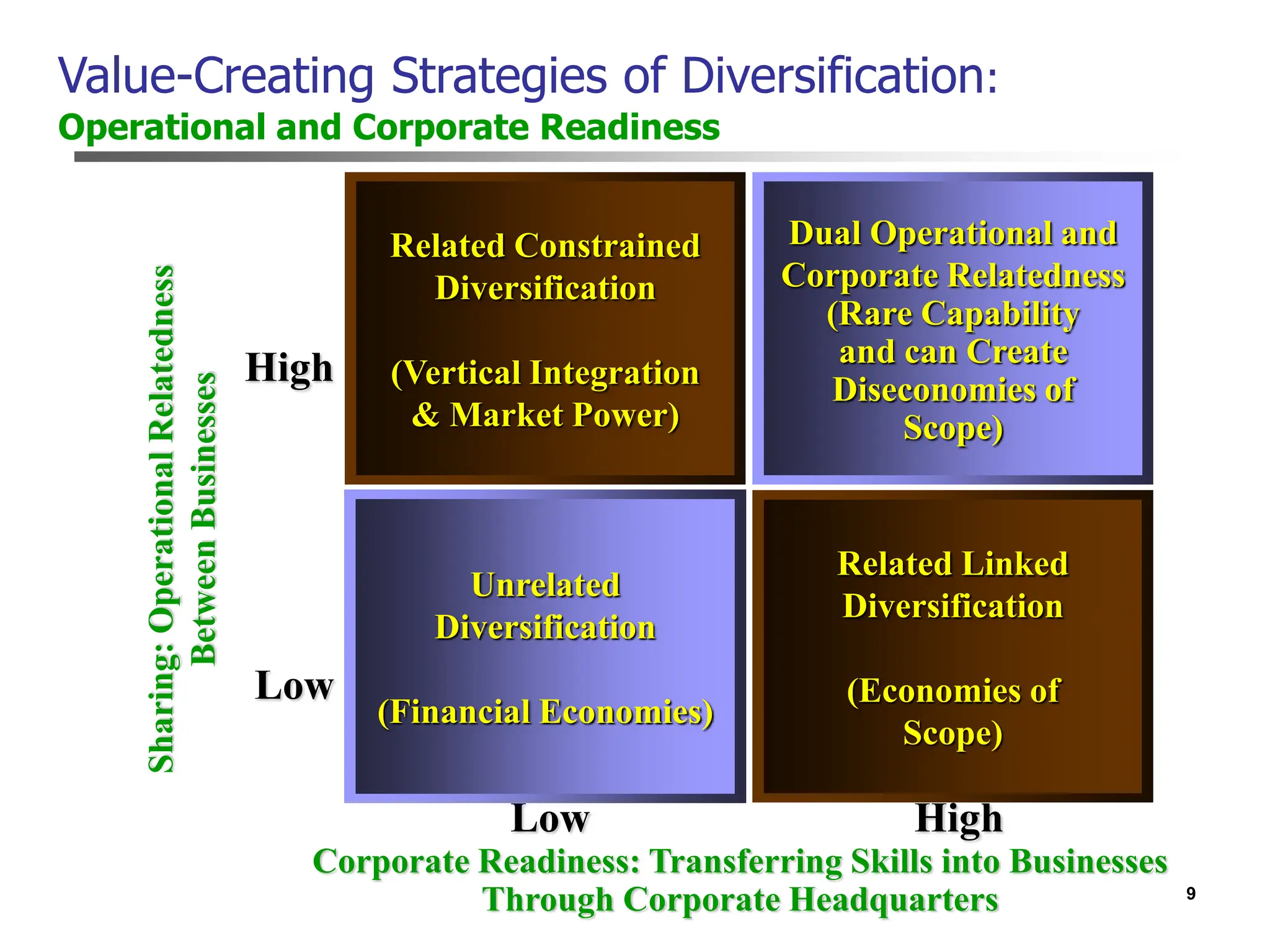
9
Value-Creating Strategies of Diversification:
Operational and Corporate Readiness
Related Constrained
Diversification
(Vertical Integration
& Market Power)
Unrelated
Diversification
(Financial Economies)
Dual Operational and
Corporate Relatedness
(Rare Capability
and can Create
Diseconomies of
Scope)
Related Linked
Diversification
(Economies of
Scope)
Corporate Readiness: Transferring Skills into Businesses
Through Corporate Headquarters
Low High
Sharing:
Operational
Relatedness
Between
Businesses
Low
High
10
Related Diversification: Economies of Scope
• Value is created from economies of scope
through:
Operational relatedness in sharing
activities
Corporate relatedness in transferring
skills or corporate core competencies
among units
• The difference between sharing activities and
transferring competencies is based on how the
resources are jointly used to create economies of
scope
11
Sharing Activities
• Operational Relatedness
 Created by sharing either primary activities such as
production and distribution systems, or support activities
such as purchasing, IT and HR
• Sharing activities often lowers costs or raises differentiation
 Sharing activities can lower costs if it:
 achieves economies of scale
 boosts efficiency of utilization
 helps move more rapidly down the Learning Curve
 Sharing activities can enhance potential for or reduce the cost of
differentiation
• Activity sharing requires sharing strategic control over
business units
• Activity sharing may create risk because business-unit ties
create links between outcomes (i.e., constraints)
12
Sharing Activities: Assumptions
• Strong sense of corporate identity
• Clear corporate mission that emphasizes
the importance of integrating business
units
• Incentive system that rewards more than
just business unit performance
13
Transferring Corporate Competencies
• Corporate Relatedness
 identify & exploit ability to transfer skills or expertise
among similar value chains
 Using complex sets of resources and capabilities to link
different businesses through managerial and technological
knowledge, experience, and expertise
• Creates value in two ways:
 Eliminates resource duplication in the need to allocate resources
for a second unit to develop a competence that already exists in
another unit
 Provides intangible resources that are difficult for competitors to
understand and imitate
 A transferred intangible resource gives unit receiving it
an immediate competitive advantage over its rivals
14
Transferring Core Competencies: Assumptions
• Transferring core competencies leads to
competitive advantage only if the similarities among
business units meet the following conditions:
 activities involved in the businesses are similar enough
that sharing expertise is meaningful
 transfer of skills involves activities which are important to
competitive advantage
 the skills transferred represent significant sources of
competitive advantage for the receiving unit
• The often substantial organizational costs of
fostering/enabling transfer do not exceed the
benefits
15
Related Diversification: Market Power
• Market power exists when a firm can:
 Sell its products above the existing competitive level
and/or
 Reduce the costs of its primary and support activities
below the competitive level
• Multipoint Competition
 Two or more diversified firms simultaneously compete in
the same product areas or geographic markets
• Vertical Integration
 Backward integration—a firm produces its own inputs
 Forward integration—a firm operates its own distribution
system for delivering its outputs
16
DUAL Related Diversification: Complexity
• Simultaneous Operational Relatedness and
Corporate Relatedness
Involves managing two sources of knowledge
simultaneously:
Operational (activity-sharing) forms of
economies of scope
Corporate (learning-transfer) forms of
economies of scope
Many such efforts often fail because of
implementation difficulties caused by complexity
17
Diversification & Multidivisional Structure
• Three major benefits
 more accurate monitoring performance of each business,
simplifying problems of control
 facilitate comparisons between divisions, improving
resource allocation process
 stimulate managers of poorly performing divisions to look
for ways of improving performance
• Managers try to strike a balance between:
 competing among divisions for scarce capital resources
 creating opportunities for cooperation to develop
synergies
• The goal is to maximize overall firm performance
18
Three Variations of the Multidivisional Structure
Multidivisional
Structure
(M-form)
Strategic Business-Unit
(SBU) Form
Cooperative
Form
Competitive
Form
19
Cooperative Form of Multidivisional Structure:
Related-Constrained Diversification Strategy
Government
Affairs
Legal
Affairs
Corporate
R&D Lab
Strategic
Planning
Corporate
Human
Resources
Corporate
Marketing
Corporate
Finance
Product
Division
Product
Division
Product
Division
Product
Division
Product
Division
President
Headquarters Office
20
Cooperative Form of Multidivisional Structure:
• Structural integration devices create tight links
among all divisions
• Corporate office emphasizes centralized strategic
planning, human resources, and marketing to foster
cooperation between divisions
• R&D is likely to be centralized
• Rewards are subjective (strategic) and tend to
emphasize overall corporate performance, in
addition to divisional performance
• Culture emphasizes cooperative sharing
Related-Constrained Diversification Strategy
21
SBU Form of Multidivisional Structure:
Related-Linked Diversification Strategy
President
Corporate
R&D Lab
Strategic
Planning
Corporate
HRM
Corporate
Marketing
Corporate
Finance
Headquarters Office
Division
Division
Division
SBU SBU SBU
Division
Division
Division
Division
Division
Division
22
SBU Form of Multidivisional Structure:
• Structural integration devices create tight links
among all divisions within SBUs, but only weak-
moderate links between SBUs
• Corporate office uses somewhat centralized
strategic planning, human resources, and marketing
to foster cooperation between SBUs
• R&D is likely to be mostly centralized
• Rewards tend to emphasize overall corporate
performance, in addition to SBU & divisional
performance, and are both subjective/strategic and
objective/financial (SBU profit centers)
• Culture emphasizes cooperative sharing
Related-Linked Diversification Strategy
23
Unrelated Diversification
• Financial Economies
Are cost savings realized through improved
allocations of financial resources
Based on investments inside or outside the
firm
Create value through two types of financial
economies:
Efficient internal capital allocations
Purchasing other corporations and
restructuring their assets
24
Competitive Form of Multidivisional Structure:
Unrelated Diversification Strategy
President
Legal
Affairs
Finance Auditing
Headquarters Office
Division Division Division Division Division Division
25
Competitive Form of Multidivisional Structure:
• Corporate headquarters has a small staff
• Finance and auditing are the most prominent functions
in the headquarters to manage cash flow and ensure the
accuracy of performance data coming from divisions
• The legal affairs function becomes important when the
firm acquires or divests assets
• Divisions are independent and separate for financial
evaluation purposes
• Divisions retain strategic control, but cash is managed
by the corporate office
• Divisions compete for corporate resources
Unrelated Diversification Strategy
26
Unrelated Diversification (cont’d)
• Efficient Internal Capital Market Allocation
Corporate office distributes capital to business
divisions to create value for overall company
Corporate office gains access to information
about those businesses’ actual and
prospective performance
Conglomerates have a fairly short life cycle of
competitive advantage because financial
economies are more easily duplicated by
competitors than are gains from operational and
corporate relatedness
27
Unrelated Diversification: Restructuring
• Restructuring creates financial economies
A firm creates value by buying and selling other
firms’ assets in the external market
• Resource allocation decisions may become
complex, so success often requires:
Focus on mature, low-technology businesses
Focus on businesses not reliant on a client
orientation
28
Characteristics of Various Structural Forms
Structural
Characteristics
Cooperative
M-Form
SBU
M-Form
Competitive
M-Form
Degree of
Centralization
Centralized at
Corporate
Office
Partially
Centralized
in SBUs
Decentralized
to Divisions
Use of
Integrating
Mechanisms
Extensive Moderate Nonexistent
Type of
Corporate
Strategy
Related-
Constrained
Related-
Linked
Unrelated
Diversification
29
Characteristics of Various Structural Forms
Divisional
Incentive
Compensation
Linked to
Corporate
Performance
Linked to
Corporate
SBU & Division
Performance
Linked to
Divisional
Performance
Divisional
Performance
Appraisal
Subjective
Strategic
Criteria
Strategic &
Financial
Criteria
Objective
Financial
Criteria
Structural
Characteristics
Cooperative
M-Form
SBU
M-Form
Competitive
M-Form
30
The Curvilinear Relationship between
Diversification and Performance
31
Mergers, Acquisitions, and Takeovers:
What are the Differences?
• Merger
 A strategy through which two firms agree to integrate their
operations on a relatively co-equal basis
• Acquisition
 A strategy through which one firm buys a controlling, or
100% interest in another firm with the intent of making the
acquired firm a subsidiary business within its portfolio
• Takeover
 A special type of acquisition when the target firm did not
solicit the acquiring firm’s bid for outright ownership
32
Acquisitions
Cost new product
development/increased
speed to market
Increased
diversification
Increased
market power
Avoiding excessive
competition
Overcoming
entry barriers
Learning and
developing new
capabilities
Lower risk
compared to
developing new
products
Reasons for
Acquisitions
and
Problems in
Achieving
Success
33
Acquisitions: Increased Market Power
• Factors increasing market power
 When there is the ability to sell goods or services above
competitive levels
 When costs of primary or support activities are below those of
competitors
 Usually is derived from the size of the firm and its resources and
capabilities to compete
• Market power is increased by
 horizontal acquisitions –cost & revenue synergy in same industry
 vertical acquisitions –controlling more parts of value chain
 related acquisitions –synergy in highly related industry (elusive)
• Acquisitions intended to increase market power are subject to:
 Regulatory review
 Analysis by financial markets
34
Acquisitions: Overcoming Entry Barriers
• Factors associated with the market or with
the firms currently operating in it that
increase the expense and difficulty faced by
new ventures trying to enter that market
Economies of scale
Differentiated products
• Cross-Border Acquisitions
Social, political, governmental barriers
35
Acquisitions: Cost of New-Product
Development and Increased Speed to
Market
• Internal development of new products is
often perceived as high-risk activity
Acquisitions allow a firm to gain access to new
and current products that are new to the firm
Returns are more predictable because of the
acquired firms’ experience with the products
36
Acquisitions: Lower Risk Compared to
Developing New Products
• An acquisition’s outcomes can be estimated
more easily and accurately than the
outcomes of an internal product
development process
• Managers may view acquisitions as lowering
risk
37
Acquisitions: Increased Diversification
• Using acquisitions to diversify a firm is the
quickest and easiest way to change its
portfolio of businesses
• Both related diversification and unrelated
diversification strategies can be
implemented through acquisitions
• The more related the acquired firm is to the
acquiring firm, the greater is the probability
that the acquisition will be successful
38
Acquisitions: Reshaping the Firm’s
Competitive Scope
• An acquisition can:
Reduce the negative effect of an intense rivalry
on a firm’s financial performance
Reduce a firm’s dependence on one or more
products or markets
• Reducing a company’s dependence on
specific markets alters the firm’s
competitive scope
39
Acquisitions: Learning and Developing New
Capabilities
• An acquiring firm can gain capabilities that
the firm does not currently possess:
Special technological capability
Broaden a firm’s knowledge base
Reduce inertia
• Firms should acquire other firms with
different but related and complementary
capabilities in order to build their own
knowledge base
40
Acquisitions
Reasons for
Acquisitions
and
Problems in
Achieving
Success
Integration
difficulties
Inadequate
evaluation of target
Large or
extraordinary debt
Inability to
achieve synergy
Too much
diversification
Managers overly
focused on
acquisitions
Too large
41
Problems in Achieving Acquisition Success:
Integration Difficulties
• Integration challenges include:
Melding two disparate corporate cultures
Linking different financial and control systems
Building effective working relationships
(particularly when management styles differ)
Resolving problems regarding the status of the
newly acquired firm’s executives
Loss of key personnel weakens the acquired
firm’s capabilities and reduces its value
42
Problems in Achieving Acquisition Success:
Inadequate Evaluation of the Target
• Due Diligence
The process of evaluating a target firm for
acquisition
 Ineffective due diligence may result in paying an
excessive premium for the target company
• Evaluation requires examining:
Financing of the intended transaction
Differences in culture between the firms
Tax consequences of the transaction
Actions necessary to meld the two workforces
43
Problems in Achieving Acquisition Success:
Large or Extraordinary Debt
• High debt can:
Increase the likelihood of bankruptcy
Lead to a downgrade of the firm’s credit rating
Preclude investment in activities that contribute
to the firm’s long-term success such as:
Research and development
Human resource training
Marketing
44
Problems in Achieving Acquisition Success:
Inability to Achieve Synergy
• Synergy exists when assets are worth more
when used in conjunction with each other
than when they are used separately
Firms experience transaction costs when they
use acquisition strategies to create synergy
Firms tend to underestimate indirect costs when
evaluating a potential acquisition
45
Problems in Achieving Acquisition Success:
Too Much Diversification
• Diversified firms must process more
information of greater diversity
• Scope created by diversification may cause
managers to rely too much on financial
rather than strategic controls to evaluate
business units’ performances
• Acquisitions may become substitutes for
innovation
46
Problems With Acquisitions
• Managers in target firms may operate in a
state of virtual suspended animation during
an acquisition
• Executives may become hesitant to make
decisions with long-term consequences
until negotiations have been completed
• Acquisition process can create a short-term
perspective and a greater aversion to risk
among top-level executives in a target firm
Managers Overly Focused on Acquisitions
47
Problems in Achieving Acquisition Success:
Too Large
• Additional costs of controls may exceed the
benefits of the economies of scale and
additional market power
• Larger size may lead to more bureaucratic
controls
• Formalized controls often lead to relatively
rigid and standardized managerial behavior
• Firm may produce less innovation
48
Attributes of Effective Acquisitions
Attributes Results
Complementary
Assets or Resources
Buying firms with assets that meet current
needs to build competitiveness
Friendly
Acquisitions
Friendly deals make integration go more
smoothly
Careful Selection
Process (financial,
cultural, HR dimensions)
Deliberate evaluation and negotiations are
more likely to avoid overpayment and lead
to easy integration and building synergies
Maintain Financial
Slack
Provide enough additional financial
resources so that risk is lower
49
Attributes of Effective Acquisitions
Attributes Results
Low-to-Moderate
Debt
Merged firm maintains financial flexibility
and profitable projects are not foregone
Manage Change
Well and Be
Flexibility &
Adaptable
Faster and more effective implementation
facilitates achieving synergy
Sustain Emphasis
on Innovation
Continue to invest in R&D as part of the
firm’s overall strategy to maintain
competitive advantage
50
Restructuring Activities
• Downsizing
Wholesale reduction of employees
• Downscoping
Selectively divesting or closing non-core
businesses
Reducing scope of operations
Leads to greater focus
• Leveraged Buyout (LBO)
A party buys a firm’s entire assets in order to
take the firm private.
51
Restructuring and Outcomes

Corporate strategy in Strategic Management

  • 1.
  • 2.
    2 Knowledge Objectives • Thisconversation should provide you with the strategic management knowledge needed to:  Define corporate-level strategy and discuss its importance to the diversified firm.  Explain the primary reasons why firms move from single- business strategies to more diversified strategies.  Describe how related diversified firms create value by sharing or transferring core competencies.  Explain the two ways value can be created with an unrelated diversification strategy.  Describe motives that can encourage managers to over- diversify a firm.  Describe reasons firms use acquisitions to achieve strategic competitiveness, and problems that arise.
  • 3.
    3 The Role ofDiversification • Diversification strategies play a major role in the behavior of large firms • Product diversification concerns: The scope of the industries and markets in which the firm competes How managers buy, create and sell different businesses to match skills and strengths with opportunities presented to the firm
  • 4.
    4 Two Strategy Levels •Business-level Strategy (Competitive) Each business unit in a diversified firm chooses a business-level strategy as its means of competing in individual product markets • Corporate-level Strategy (Companywide) Specifies actions taken by the firm to gain a competitive advantage by selecting and managing a group of different businesses competing in several industries and product markets
  • 5.
    5 Corporate-Level Strategy: KeyQuestions • Corporate-level Strategy’s Value The degree to which the businesses in the portfolio are worth more under the management of the company than they would be under other ownership What businesses should the firm be in? How should the corporate office manage the group of businesses? Business Units
  • 6.
    6 Levels and Typesof Diversification SOURCE: Adapted from R. P. Rumelt, 1974, Strategy, Structure and Economic Performance, Boston: Harvard Business School. Figure 6.1
  • 7.
    7 Reasons for Diversification Adaptto Tax Laws & Antitrust Regulations Remedy Poor Performance Hedge against future market & cash flow uncertainties (risk reduction for firm) More Fully Leverage Tangible/Intangible Resources Reduce Executives’ Employment Risk and Increase Their Compensation
  • 8.
    8 Strategic Motives forDiversification To Enhance Strategic Competitiveness via: • Economies of scope (related diversification) --Sharing activities --Transferring core competencies • Market power (related diversification) --Blocking competitors through multipoint competition --Vertical integration • Financial economies (unrelated diversification) --Efficient internal capital allocation --Business restructuring
  • 9.
    9 Value-Creating Strategies ofDiversification: Operational and Corporate Readiness Related Constrained Diversification (Vertical Integration & Market Power) Unrelated Diversification (Financial Economies) Dual Operational and Corporate Relatedness (Rare Capability and can Create Diseconomies of Scope) Related Linked Diversification (Economies of Scope) Corporate Readiness: Transferring Skills into Businesses Through Corporate Headquarters Low High Sharing: Operational Relatedness Between Businesses Low High
  • 10.
    10 Related Diversification: Economiesof Scope • Value is created from economies of scope through: Operational relatedness in sharing activities Corporate relatedness in transferring skills or corporate core competencies among units • The difference between sharing activities and transferring competencies is based on how the resources are jointly used to create economies of scope
  • 11.
    11 Sharing Activities • OperationalRelatedness  Created by sharing either primary activities such as production and distribution systems, or support activities such as purchasing, IT and HR • Sharing activities often lowers costs or raises differentiation  Sharing activities can lower costs if it:  achieves economies of scale  boosts efficiency of utilization  helps move more rapidly down the Learning Curve  Sharing activities can enhance potential for or reduce the cost of differentiation • Activity sharing requires sharing strategic control over business units • Activity sharing may create risk because business-unit ties create links between outcomes (i.e., constraints)
  • 12.
    12 Sharing Activities: Assumptions •Strong sense of corporate identity • Clear corporate mission that emphasizes the importance of integrating business units • Incentive system that rewards more than just business unit performance
  • 13.
    13 Transferring Corporate Competencies •Corporate Relatedness  identify & exploit ability to transfer skills or expertise among similar value chains  Using complex sets of resources and capabilities to link different businesses through managerial and technological knowledge, experience, and expertise • Creates value in two ways:  Eliminates resource duplication in the need to allocate resources for a second unit to develop a competence that already exists in another unit  Provides intangible resources that are difficult for competitors to understand and imitate  A transferred intangible resource gives unit receiving it an immediate competitive advantage over its rivals
  • 14.
    14 Transferring Core Competencies:Assumptions • Transferring core competencies leads to competitive advantage only if the similarities among business units meet the following conditions:  activities involved in the businesses are similar enough that sharing expertise is meaningful  transfer of skills involves activities which are important to competitive advantage  the skills transferred represent significant sources of competitive advantage for the receiving unit • The often substantial organizational costs of fostering/enabling transfer do not exceed the benefits
  • 15.
    15 Related Diversification: MarketPower • Market power exists when a firm can:  Sell its products above the existing competitive level and/or  Reduce the costs of its primary and support activities below the competitive level • Multipoint Competition  Two or more diversified firms simultaneously compete in the same product areas or geographic markets • Vertical Integration  Backward integration—a firm produces its own inputs  Forward integration—a firm operates its own distribution system for delivering its outputs
  • 16.
    16 DUAL Related Diversification:Complexity • Simultaneous Operational Relatedness and Corporate Relatedness Involves managing two sources of knowledge simultaneously: Operational (activity-sharing) forms of economies of scope Corporate (learning-transfer) forms of economies of scope Many such efforts often fail because of implementation difficulties caused by complexity
  • 17.
    17 Diversification & MultidivisionalStructure • Three major benefits  more accurate monitoring performance of each business, simplifying problems of control  facilitate comparisons between divisions, improving resource allocation process  stimulate managers of poorly performing divisions to look for ways of improving performance • Managers try to strike a balance between:  competing among divisions for scarce capital resources  creating opportunities for cooperation to develop synergies • The goal is to maximize overall firm performance
  • 18.
    18 Three Variations ofthe Multidivisional Structure Multidivisional Structure (M-form) Strategic Business-Unit (SBU) Form Cooperative Form Competitive Form
  • 19.
    19 Cooperative Form ofMultidivisional Structure: Related-Constrained Diversification Strategy Government Affairs Legal Affairs Corporate R&D Lab Strategic Planning Corporate Human Resources Corporate Marketing Corporate Finance Product Division Product Division Product Division Product Division Product Division President Headquarters Office
  • 20.
    20 Cooperative Form ofMultidivisional Structure: • Structural integration devices create tight links among all divisions • Corporate office emphasizes centralized strategic planning, human resources, and marketing to foster cooperation between divisions • R&D is likely to be centralized • Rewards are subjective (strategic) and tend to emphasize overall corporate performance, in addition to divisional performance • Culture emphasizes cooperative sharing Related-Constrained Diversification Strategy
  • 21.
    21 SBU Form ofMultidivisional Structure: Related-Linked Diversification Strategy President Corporate R&D Lab Strategic Planning Corporate HRM Corporate Marketing Corporate Finance Headquarters Office Division Division Division SBU SBU SBU Division Division Division Division Division Division
  • 22.
    22 SBU Form ofMultidivisional Structure: • Structural integration devices create tight links among all divisions within SBUs, but only weak- moderate links between SBUs • Corporate office uses somewhat centralized strategic planning, human resources, and marketing to foster cooperation between SBUs • R&D is likely to be mostly centralized • Rewards tend to emphasize overall corporate performance, in addition to SBU & divisional performance, and are both subjective/strategic and objective/financial (SBU profit centers) • Culture emphasizes cooperative sharing Related-Linked Diversification Strategy
  • 23.
    23 Unrelated Diversification • FinancialEconomies Are cost savings realized through improved allocations of financial resources Based on investments inside or outside the firm Create value through two types of financial economies: Efficient internal capital allocations Purchasing other corporations and restructuring their assets
  • 24.
    24 Competitive Form ofMultidivisional Structure: Unrelated Diversification Strategy President Legal Affairs Finance Auditing Headquarters Office Division Division Division Division Division Division
  • 25.
    25 Competitive Form ofMultidivisional Structure: • Corporate headquarters has a small staff • Finance and auditing are the most prominent functions in the headquarters to manage cash flow and ensure the accuracy of performance data coming from divisions • The legal affairs function becomes important when the firm acquires or divests assets • Divisions are independent and separate for financial evaluation purposes • Divisions retain strategic control, but cash is managed by the corporate office • Divisions compete for corporate resources Unrelated Diversification Strategy
  • 26.
    26 Unrelated Diversification (cont’d) •Efficient Internal Capital Market Allocation Corporate office distributes capital to business divisions to create value for overall company Corporate office gains access to information about those businesses’ actual and prospective performance Conglomerates have a fairly short life cycle of competitive advantage because financial economies are more easily duplicated by competitors than are gains from operational and corporate relatedness
  • 27.
    27 Unrelated Diversification: Restructuring •Restructuring creates financial economies A firm creates value by buying and selling other firms’ assets in the external market • Resource allocation decisions may become complex, so success often requires: Focus on mature, low-technology businesses Focus on businesses not reliant on a client orientation
  • 28.
    28 Characteristics of VariousStructural Forms Structural Characteristics Cooperative M-Form SBU M-Form Competitive M-Form Degree of Centralization Centralized at Corporate Office Partially Centralized in SBUs Decentralized to Divisions Use of Integrating Mechanisms Extensive Moderate Nonexistent Type of Corporate Strategy Related- Constrained Related- Linked Unrelated Diversification
  • 29.
    29 Characteristics of VariousStructural Forms Divisional Incentive Compensation Linked to Corporate Performance Linked to Corporate SBU & Division Performance Linked to Divisional Performance Divisional Performance Appraisal Subjective Strategic Criteria Strategic & Financial Criteria Objective Financial Criteria Structural Characteristics Cooperative M-Form SBU M-Form Competitive M-Form
  • 30.
    30 The Curvilinear Relationshipbetween Diversification and Performance
  • 31.
    31 Mergers, Acquisitions, andTakeovers: What are the Differences? • Merger  A strategy through which two firms agree to integrate their operations on a relatively co-equal basis • Acquisition  A strategy through which one firm buys a controlling, or 100% interest in another firm with the intent of making the acquired firm a subsidiary business within its portfolio • Takeover  A special type of acquisition when the target firm did not solicit the acquiring firm’s bid for outright ownership
  • 32.
    32 Acquisitions Cost new product development/increased speedto market Increased diversification Increased market power Avoiding excessive competition Overcoming entry barriers Learning and developing new capabilities Lower risk compared to developing new products Reasons for Acquisitions and Problems in Achieving Success
  • 33.
    33 Acquisitions: Increased MarketPower • Factors increasing market power  When there is the ability to sell goods or services above competitive levels  When costs of primary or support activities are below those of competitors  Usually is derived from the size of the firm and its resources and capabilities to compete • Market power is increased by  horizontal acquisitions –cost & revenue synergy in same industry  vertical acquisitions –controlling more parts of value chain  related acquisitions –synergy in highly related industry (elusive) • Acquisitions intended to increase market power are subject to:  Regulatory review  Analysis by financial markets
  • 34.
    34 Acquisitions: Overcoming EntryBarriers • Factors associated with the market or with the firms currently operating in it that increase the expense and difficulty faced by new ventures trying to enter that market Economies of scale Differentiated products • Cross-Border Acquisitions Social, political, governmental barriers
  • 35.
    35 Acquisitions: Cost ofNew-Product Development and Increased Speed to Market • Internal development of new products is often perceived as high-risk activity Acquisitions allow a firm to gain access to new and current products that are new to the firm Returns are more predictable because of the acquired firms’ experience with the products
  • 36.
    36 Acquisitions: Lower RiskCompared to Developing New Products • An acquisition’s outcomes can be estimated more easily and accurately than the outcomes of an internal product development process • Managers may view acquisitions as lowering risk
  • 37.
    37 Acquisitions: Increased Diversification •Using acquisitions to diversify a firm is the quickest and easiest way to change its portfolio of businesses • Both related diversification and unrelated diversification strategies can be implemented through acquisitions • The more related the acquired firm is to the acquiring firm, the greater is the probability that the acquisition will be successful
  • 38.
    38 Acquisitions: Reshaping theFirm’s Competitive Scope • An acquisition can: Reduce the negative effect of an intense rivalry on a firm’s financial performance Reduce a firm’s dependence on one or more products or markets • Reducing a company’s dependence on specific markets alters the firm’s competitive scope
  • 39.
    39 Acquisitions: Learning andDeveloping New Capabilities • An acquiring firm can gain capabilities that the firm does not currently possess: Special technological capability Broaden a firm’s knowledge base Reduce inertia • Firms should acquire other firms with different but related and complementary capabilities in order to build their own knowledge base
  • 40.
    40 Acquisitions Reasons for Acquisitions and Problems in Achieving Success Integration difficulties Inadequate evaluationof target Large or extraordinary debt Inability to achieve synergy Too much diversification Managers overly focused on acquisitions Too large
  • 41.
    41 Problems in AchievingAcquisition Success: Integration Difficulties • Integration challenges include: Melding two disparate corporate cultures Linking different financial and control systems Building effective working relationships (particularly when management styles differ) Resolving problems regarding the status of the newly acquired firm’s executives Loss of key personnel weakens the acquired firm’s capabilities and reduces its value
  • 42.
    42 Problems in AchievingAcquisition Success: Inadequate Evaluation of the Target • Due Diligence The process of evaluating a target firm for acquisition  Ineffective due diligence may result in paying an excessive premium for the target company • Evaluation requires examining: Financing of the intended transaction Differences in culture between the firms Tax consequences of the transaction Actions necessary to meld the two workforces
  • 43.
    43 Problems in AchievingAcquisition Success: Large or Extraordinary Debt • High debt can: Increase the likelihood of bankruptcy Lead to a downgrade of the firm’s credit rating Preclude investment in activities that contribute to the firm’s long-term success such as: Research and development Human resource training Marketing
  • 44.
    44 Problems in AchievingAcquisition Success: Inability to Achieve Synergy • Synergy exists when assets are worth more when used in conjunction with each other than when they are used separately Firms experience transaction costs when they use acquisition strategies to create synergy Firms tend to underestimate indirect costs when evaluating a potential acquisition
  • 45.
    45 Problems in AchievingAcquisition Success: Too Much Diversification • Diversified firms must process more information of greater diversity • Scope created by diversification may cause managers to rely too much on financial rather than strategic controls to evaluate business units’ performances • Acquisitions may become substitutes for innovation
  • 46.
    46 Problems With Acquisitions •Managers in target firms may operate in a state of virtual suspended animation during an acquisition • Executives may become hesitant to make decisions with long-term consequences until negotiations have been completed • Acquisition process can create a short-term perspective and a greater aversion to risk among top-level executives in a target firm Managers Overly Focused on Acquisitions
  • 47.
    47 Problems in AchievingAcquisition Success: Too Large • Additional costs of controls may exceed the benefits of the economies of scale and additional market power • Larger size may lead to more bureaucratic controls • Formalized controls often lead to relatively rigid and standardized managerial behavior • Firm may produce less innovation
  • 48.
    48 Attributes of EffectiveAcquisitions Attributes Results Complementary Assets or Resources Buying firms with assets that meet current needs to build competitiveness Friendly Acquisitions Friendly deals make integration go more smoothly Careful Selection Process (financial, cultural, HR dimensions) Deliberate evaluation and negotiations are more likely to avoid overpayment and lead to easy integration and building synergies Maintain Financial Slack Provide enough additional financial resources so that risk is lower
  • 49.
    49 Attributes of EffectiveAcquisitions Attributes Results Low-to-Moderate Debt Merged firm maintains financial flexibility and profitable projects are not foregone Manage Change Well and Be Flexibility & Adaptable Faster and more effective implementation facilitates achieving synergy Sustain Emphasis on Innovation Continue to invest in R&D as part of the firm’s overall strategy to maintain competitive advantage
  • 50.
    50 Restructuring Activities • Downsizing Wholesalereduction of employees • Downscoping Selectively divesting or closing non-core businesses Reducing scope of operations Leads to greater focus • Leveraged Buyout (LBO) A party buys a firm’s entire assets in order to take the firm private.
  • 51.