Coronary circulation
DR IRANNA MD (CLINICAL NUTRITION 1ST PG)
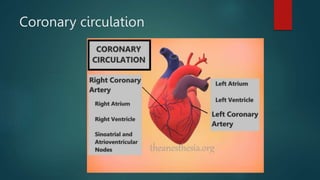
Caronary circulation
 Coronary circulation is the circulation of blood in the arteries and veins
that supply the heart muscle.
 Coronary arteries supply oxygenated blood to the heart muscle.
 Cardiac veins then drain away the blood after it has been deoxygenated
 the heart is required to function continuously
 Therefore its circulation is of major importance not only to its own tissues
but to the entire body and even the level of consciousness of the brain
from moment to moment
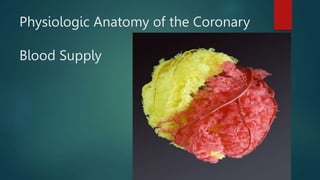
Physiologic Anatomy of the Coronary
Blood Supply
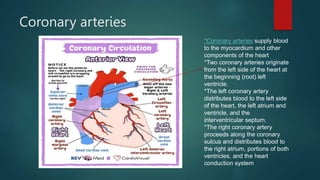
Coronary arteries
*Coronary arteries supply blood
to the myocardium and other
components of the heart
*Two coronary arteries originate
from the left side of the heart at
the beginning (root) left
ventricle.
*The left coronary artery
distributes blood to the left side
of the heart, the left atrium and
ventricle, and the
interventricular septum.
*The right coronary artery
proceeds along the coronary
sulcus and distributes blood to
the right atrium, portions of both
ventricles, and the heart
conduction system
Coronary circulation
Coronary Circulation
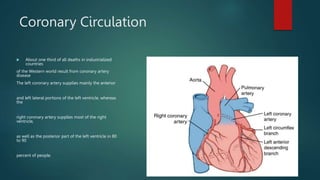
 About one third of all deaths in industrialized
countries
of the Western world result from coronary artery
disease
The left coronary artery supplies mainly the anterior
and left lateral portions of the left ventricle, whereas
the
right coronary artery supplies most of the right
ventricle,
as well as the posterior part of the left ventricle in 80
to 90
percent of people.
Most of the coronary venous blood flow from the
left ventricular muscle returns to the right atrium of
the heart by way of the coronary sinus
Normal Coronary Blood Flow—About
5 Percent
of Cardiac Output
 The resting coronary blood flow in the resting human
being averages 70ml/min/100 g heart weight, or about
225ml/min, which is about 4 to 5 percent of the total cardiac output
 During strenuous exercise, the heart in the young adult increases its
cardiac output fourfold to sevenfold, and it pumps this blood against a
higher than normal arterial pressure. Conseque
 At the same time, the coronary blood flow increases threefold to fourfold
to supply the extra nutrients needed by the heart.
Phasic Changes in Coronary Blood
Flow During Systole and Diastole—
Effect of Cardiac Muscle
Compression
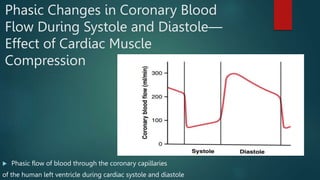
 Phasic flow of blood through the coronary capillaries
of the human left ventricle during cardiac systole and diastole
Phasic Changes
 Note from this diagram that the
coronary capillary blood flow in the left ventricle muscle
falls to a low value during systole, which is opposite to flow
in vascular beds elsewhere in the body. The reason for this
is strong compression of the left ventricular muscle around
the intramuscular vessels during systolic contraction
#During diastole, the cardiac muscle relaxes and no lon-
ger obstructs blood flow through the left ventricular mus-
clef capillaries, so blood flows rapidly during all of diastole.
Control of Coronary Blood Flow
 Oxygen Demand as a Major Factor in Local Coronary Blood Flow
Regulation.
 Nervous Control of Coronary Blood Flow
 Stimulation of the autonomic nerves to the heart can affect coronary
blood flow both directly and indirectly.
The direct effects result from action of the nervous transmitter substances
acetylcholine from the vagus nerves norepinephrine and epinephrine from
the sympa-thetic nerves on the coronary vessels themselves
CAD (Coronary artery disease)
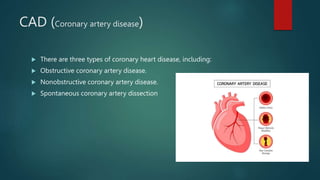
 There are three types of coronary heart disease, including:
 Obstructive coronary artery disease.
 Nonobstructive coronary artery disease.
 Spontaneous coronary artery dissection
Obstructive coronary artery disease
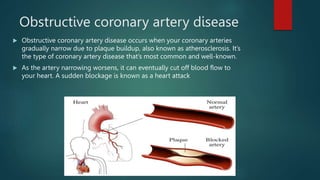
 Obstructive coronary artery disease occurs when your coronary arteries
gradually narrow due to plaque buildup, also known as atherosclerosis. It’s
the type of coronary artery disease that’s most common and well-known.
 As the artery narrowing worsens, it can eventually cut off blood flow to
your heart. A sudden blockage is known as a heart attack
Nonobstructive coronary artery
disease
 Nonobstructive coronary artery disease occurs because of other problems
with your coronary arteries. It’s not caused by plaque buildup. Instead,
your coronary arteries may have problems such as:
 Compression or squeezing from the heart muscle (myocardial bridging)
 Constrictions at improper times (coronary vasospasm)
 Damage to the artery lining (endothelial dysfunction)
 Malfunctions in smaller artery branches (microvascular dysfunction)
Spontaneous coronary artery
dissection
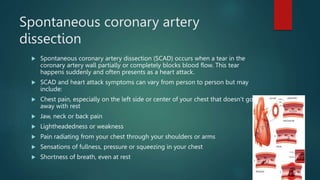
 Spontaneous coronary artery dissection (SCAD) occurs when a tear in the
coronary artery wall partially or completely blocks blood flow. This tear
happens suddenly and often presents as a heart attack.
 SCAD and heart attack symptoms can vary from person to person but may
include:
 Chest pain, especially on the left side or center of your chest that doesn’t go
away with rest
 Jaw, neck or back pain
 Lightheadedness or weakness
 Pain radiating from your chest through your shoulders or arms
 Sensations of fullness, pressure or squeezing in your chest
 Shortness of breath, even at rest
How is coronary artery disease
diagnosed?
 Physical exam
 Measure your blood pressure.
 Listen to your heart with a stethoscope.
 Ask what symptoms you’re experiencing and how long you’ve had them.
 Ask you about your medical history.
 Ask you about your lifestyle.
 Ask you about your family history.
Diagnosis and Tests
 Blood tests.
 Cardiac catheterization.
 Computed tomography (CT) coronary angiogram.
 Heart MRI (magnetic resonance imaging).
 Coronary calcium scan.
 Echocardiogram (echo).
 Electrocardiogram (EKG/ECG).
 Exercise stress test.
 Chest X-ray.
How is coronary artery disease
treated?
 Don’t smoke, vape or use any tobacco products.
 Eat heart-healthy foods low in sodium, saturated fat, trans fat and sugar.
The Mediterranean diet is a proven way to lower your risk of a heart attack
or stroke.
 Exercise: Aim for 30 minutes of walking (or other activities) five days a
week.
 Limit alcohol.
 Diabetes.
 High blood pressure.
 High cholesterol.
 High triglycerides (hypertriglyceridemia).
 Having a BMI higher than 25.
Medications
 Lower your blood pressure.
 Lower your cholesterol.
 Manage stable angina, like nitroglycerin and ranolazine.
 Reduce your risk of blood clots.
Procedures and surgeries
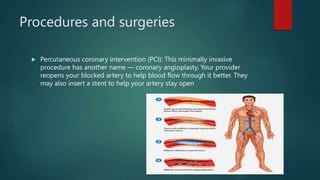
 Percutaneous coronary intervention (PCI): This minimally invasive
procedure has another name — coronary angioplasty. Your provider
reopens your blocked artery to help blood flow through it better. They
may also insert a stent to help your artery stay open
CABG
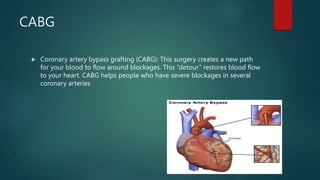
 Coronary artery bypass grafting (CABG): This surgery creates a new path
for your blood to flow around blockages. This “detour” restores blood flow
to your heart. CABG helps people who have severe blockages in several
coronary arteries
Coronary circulation and it's function  .

Coronary circulation and it's function .

  • 1.
    Coronary circulation DR IRANNAMD (CLINICAL NUTRITION 1ST PG)
  • 2.
    Caronary circulation  Coronarycirculation is the circulation of blood in the arteries and veins that supply the heart muscle.  Coronary arteries supply oxygenated blood to the heart muscle.  Cardiac veins then drain away the blood after it has been deoxygenated  the heart is required to function continuously  Therefore its circulation is of major importance not only to its own tissues but to the entire body and even the level of consciousness of the brain from moment to moment
  • 3.
    Physiologic Anatomy ofthe Coronary Blood Supply
  • 4.
    Coronary arteries *Coronary arteriessupply blood to the myocardium and other components of the heart *Two coronary arteries originate from the left side of the heart at the beginning (root) left ventricle. *The left coronary artery distributes blood to the left side of the heart, the left atrium and ventricle, and the interventricular septum. *The right coronary artery proceeds along the coronary sulcus and distributes blood to the right atrium, portions of both ventricles, and the heart conduction system
  • 5.
  • 6.
    Coronary Circulation  Aboutone third of all deaths in industrialized countries of the Western world result from coronary artery disease The left coronary artery supplies mainly the anterior and left lateral portions of the left ventricle, whereas the right coronary artery supplies most of the right ventricle, as well as the posterior part of the left ventricle in 80 to 90 percent of people.
  • 7.
    Most of thecoronary venous blood flow from the left ventricular muscle returns to the right atrium of the heart by way of the coronary sinus
  • 8.
    Normal Coronary BloodFlow—About 5 Percent of Cardiac Output  The resting coronary blood flow in the resting human being averages 70ml/min/100 g heart weight, or about 225ml/min, which is about 4 to 5 percent of the total cardiac output  During strenuous exercise, the heart in the young adult increases its cardiac output fourfold to sevenfold, and it pumps this blood against a higher than normal arterial pressure. Conseque  At the same time, the coronary blood flow increases threefold to fourfold to supply the extra nutrients needed by the heart.
  • 9.
    Phasic Changes inCoronary Blood Flow During Systole and Diastole— Effect of Cardiac Muscle Compression  Phasic flow of blood through the coronary capillaries of the human left ventricle during cardiac systole and diastole
  • 10.
    Phasic Changes  Notefrom this diagram that the coronary capillary blood flow in the left ventricle muscle falls to a low value during systole, which is opposite to flow in vascular beds elsewhere in the body. The reason for this is strong compression of the left ventricular muscle around the intramuscular vessels during systolic contraction #During diastole, the cardiac muscle relaxes and no lon- ger obstructs blood flow through the left ventricular mus- clef capillaries, so blood flows rapidly during all of diastole.
  • 11.
    Control of CoronaryBlood Flow  Oxygen Demand as a Major Factor in Local Coronary Blood Flow Regulation.  Nervous Control of Coronary Blood Flow  Stimulation of the autonomic nerves to the heart can affect coronary blood flow both directly and indirectly. The direct effects result from action of the nervous transmitter substances acetylcholine from the vagus nerves norepinephrine and epinephrine from the sympa-thetic nerves on the coronary vessels themselves
  • 12.
    CAD (Coronary arterydisease)  There are three types of coronary heart disease, including:  Obstructive coronary artery disease.  Nonobstructive coronary artery disease.  Spontaneous coronary artery dissection
  • 13.
    Obstructive coronary arterydisease  Obstructive coronary artery disease occurs when your coronary arteries gradually narrow due to plaque buildup, also known as atherosclerosis. It’s the type of coronary artery disease that’s most common and well-known.  As the artery narrowing worsens, it can eventually cut off blood flow to your heart. A sudden blockage is known as a heart attack
  • 14.
    Nonobstructive coronary artery disease Nonobstructive coronary artery disease occurs because of other problems with your coronary arteries. It’s not caused by plaque buildup. Instead, your coronary arteries may have problems such as:  Compression or squeezing from the heart muscle (myocardial bridging)  Constrictions at improper times (coronary vasospasm)  Damage to the artery lining (endothelial dysfunction)  Malfunctions in smaller artery branches (microvascular dysfunction)
  • 15.
    Spontaneous coronary artery dissection Spontaneous coronary artery dissection (SCAD) occurs when a tear in the coronary artery wall partially or completely blocks blood flow. This tear happens suddenly and often presents as a heart attack.  SCAD and heart attack symptoms can vary from person to person but may include:  Chest pain, especially on the left side or center of your chest that doesn’t go away with rest  Jaw, neck or back pain  Lightheadedness or weakness  Pain radiating from your chest through your shoulders or arms  Sensations of fullness, pressure or squeezing in your chest  Shortness of breath, even at rest
  • 16.
    How is coronaryartery disease diagnosed?  Physical exam  Measure your blood pressure.  Listen to your heart with a stethoscope.  Ask what symptoms you’re experiencing and how long you’ve had them.  Ask you about your medical history.  Ask you about your lifestyle.  Ask you about your family history.
  • 17.
    Diagnosis and Tests Blood tests.  Cardiac catheterization.  Computed tomography (CT) coronary angiogram.  Heart MRI (magnetic resonance imaging).  Coronary calcium scan.  Echocardiogram (echo).  Electrocardiogram (EKG/ECG).  Exercise stress test.  Chest X-ray.
  • 18.
    How is coronaryartery disease treated?  Don’t smoke, vape or use any tobacco products.  Eat heart-healthy foods low in sodium, saturated fat, trans fat and sugar. The Mediterranean diet is a proven way to lower your risk of a heart attack or stroke.  Exercise: Aim for 30 minutes of walking (or other activities) five days a week.  Limit alcohol.
  • 19.
     Diabetes.  Highblood pressure.  High cholesterol.  High triglycerides (hypertriglyceridemia).  Having a BMI higher than 25.
  • 20.
    Medications  Lower yourblood pressure.  Lower your cholesterol.  Manage stable angina, like nitroglycerin and ranolazine.  Reduce your risk of blood clots.
  • 21.
    Procedures and surgeries Percutaneous coronary intervention (PCI): This minimally invasive procedure has another name — coronary angioplasty. Your provider reopens your blocked artery to help blood flow through it better. They may also insert a stent to help your artery stay open
  • 22.
    CABG  Coronary arterybypass grafting (CABG): This surgery creates a new path for your blood to flow around blockages. This “detour” restores blood flow to your heart. CABG helps people who have severe blockages in several coronary arteries